seats CHEVROLET CORVETTE 2012 6.G Service Manual
[x] Cancel search | Manufacturer: CHEVROLET, Model Year: 2012, Model line: CORVETTE, Model: CHEVROLET CORVETTE 2012 6.GPages: 434, PDF Size: 6.96 MB
Page 99 of 434
Black plate (35,1)Chevrolet Corvette Owner Manual - 2012
Seats and Restraints 3-35
Lower Anchors and
Tethers for Children
(LATCH System)
(Coupe and Convertible
Models Only)
Some child restraints have a
LATCH system. As part of the
LATCH system, your child restraint
may have lower attachments and/or
a top tether. The LATCH system can
help hold the child restraint in place
during driving or in a crash. Some
vehicles have lower and/or top
tether anchors designed to secure
a child restraint with lower
attachments and/or a top tether.
Some child restraints with a top
tether are designed to be used
whether the top tether is anchored
or not. Other child restraints require
that the top tether be anchored.
A national or local law may require
that the top tether be anchored.In Canada, the law requires that
forward-facing child restraints
have a top tether, and that the
tether be attached.
Your vehicle does not have lower
anchors or top tether anchors to
secure a child restraint with the
LATCH system. If a national or local
law requires that your top tether
be anchored, do not use a child
restraint in this vehicle because a
top tether cannot be properly
anchored. You must use the safety
belts to secure your child restraint
in this vehicle, unless a national or
local law requires that the top tether
be anchored. Refer to the child
restraint instructions and
instructions in this manual for
securing a child restraint using the
vehicle's safety belts. See
Securing
Child Restraints on page 3‑39.
Lower Anchors and
Tethers for Children
(LATCH System) (Z06 and
ZR1 Models Only)
Some child restraints have a
LATCH system. As part of the
LATCH system, your child restraint
may have lower attachments and/or
a top tether. The LATCH system can
help hold the child restraint in place
during driving or in a crash. Some
vehicles have lower and/or top
tether anchors designed to secure
a child restraint with lower
attachments and/or a top tether.
Your vehicle does not have lower
anchors to accommodate lower
attachments. Your vehicle does
have a top tether anchor. If your
child restraint has a top tether, make
sure your child restraint is properly
installed using the top tether anchor
and the vehicle's safety belt. A child
restraint must never be installed
using only the top tether and
anchor.
Page 100 of 434
Black plate (36,1)Chevrolet Corvette Owner Manual - 2012
3-36 Seats and Restraints
Refer to your child restraint
instructions and seeSecuring Child
Restraints on page 3‑39 for
instructions on securing your
child restraint using the vehicle's
safety belts.
In order to use the top tether
anchors in your vehicle, you
need a child restraint equipped with
a top tether. The child restraint
manufacturer will provide you with
instructions on how to use the child
restraint and its top tether. The
following explains how to attach a
child restraint with the top tether in
your vehicle.
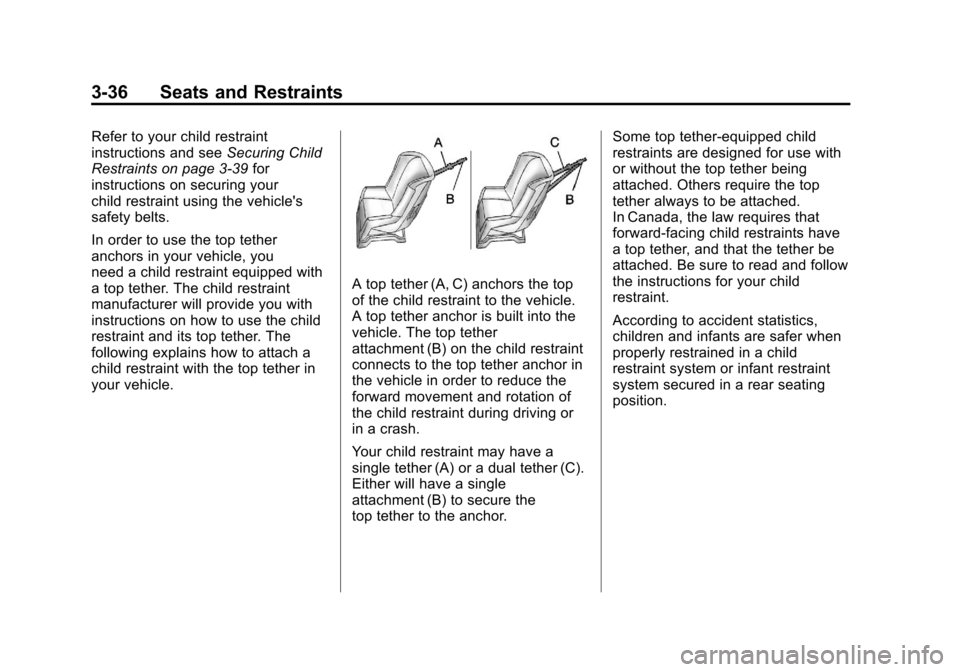
A top tether (A, C) anchors the top
of the child restraint to the vehicle.
A top tether anchor is built into the
vehicle. The top tether
attachment (B) on the child restraint
connects to the top tether anchor in
the vehicle in order to reduce the
forward movement and rotation of
the child restraint during driving or
in a crash.
Your child restraint may have a
single tether (A) or a dual tether (C).
Either will have a single
attachment (B) to secure the
top tether to the anchor. Some top tether-equipped child
restraints are designed for use with
or without the top tether being
attached. Others require the top
tether always to be attached.
In Canada, the law requires that
forward-facing child restraints have
a top tether, and that the tether be
attached. Be sure to read and follow
the instructions for your child
restraint.
According to accident statistics,
children and infants are safer when
properly restrained in a child
restraint system or infant restraint
system secured in a rear seating
position.
Page 101 of 434
Black plate (37,1)Chevrolet Corvette Owner Manual - 2012
Seats and Restraints 3-37
Top Tether Anchor Locations
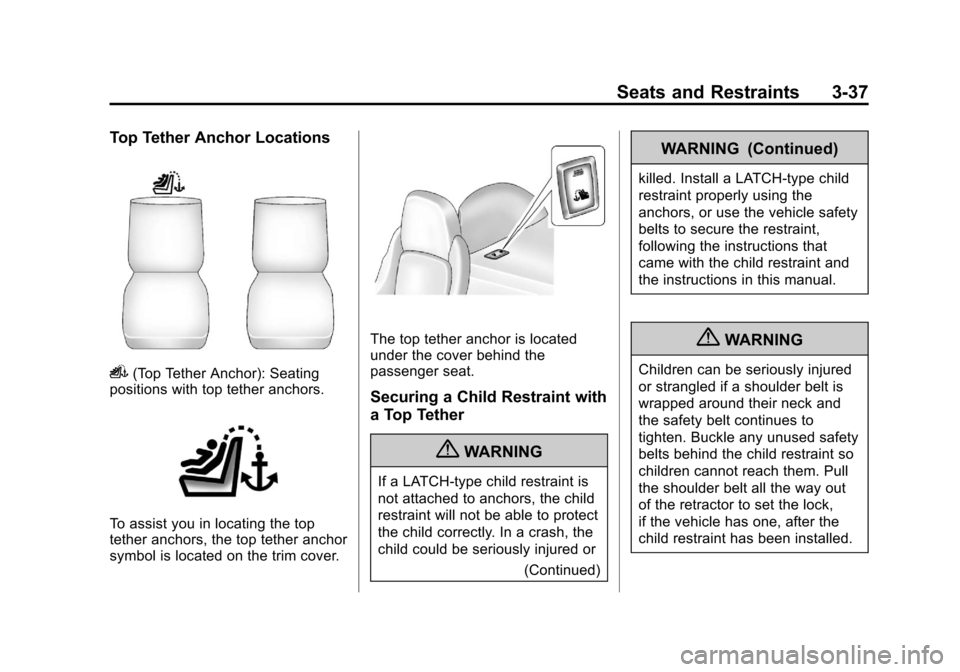
i(Top Tether Anchor): Seating
positions with top tether anchors.
To assist you in locating the top
tether anchors, the top tether anchor
symbol is located on the trim cover.
The top tether anchor is located
under the cover behind the
passenger seat.
Securing a Child Restraint with
a Top Tether
{WARNING
If a LATCH-type child restraint is
not attached to anchors, the child
restraint will not be able to protect
the child correctly. In a crash, the
child could be seriously injured or
(Continued)
WARNING (Continued)
killed. Install a LATCH-type child
restraint properly using the
anchors, or use the vehicle safety
belts to secure the restraint,
following the instructions that
came with the child restraint and
the instructions in this manual.
{WARNING
Children can be seriously injured
or strangled if a shoulder belt is
wrapped around their neck and
the safety belt continues to
tighten. Buckle any unused safety
belts behind the child restraint so
children cannot reach them. Pull
the shoulder belt all the way out
of the retractor to set the lock,
if the vehicle has one, after the
child restraint has been installed.
Page 102 of 434
Black plate (38,1)Chevrolet Corvette Owner Manual - 2012
3-38 Seats and Restraints
Notice:Do not let the LATCH
attachments rub against the
vehicle’ s safety belts. This may
damage these parts. If necessary,
move buckled safety belts to
avoid rubbing the LATCH
attachments.
Do not fold the empty rear seat
with a safety belt buckled. This
could damage the safety belt or
the seat. Unbuckle and return the
safety belt to its stowed position,
before folding the seat.
Do not secure a child restraint in a
position without a top tether anchor
if a national or local law requires
that the top tether be attached, or if
the instructions that come with the
child restraint say that the top tether
must be attached. 1. Secure the child restraint using
the vehicle's safety belt. See
Securing Child Restraints on
page 3‑39.
2. If the child restraint manufacturer recommends that the top tether
be attached, attach and tighten
the top tether to the top tether
anchor, if equipped. Refer to the
child restraint instructions and
the following steps:
2.1. Find the top tether anchor.
2.2. Press the ribbed area of the
trim cover to open the cover
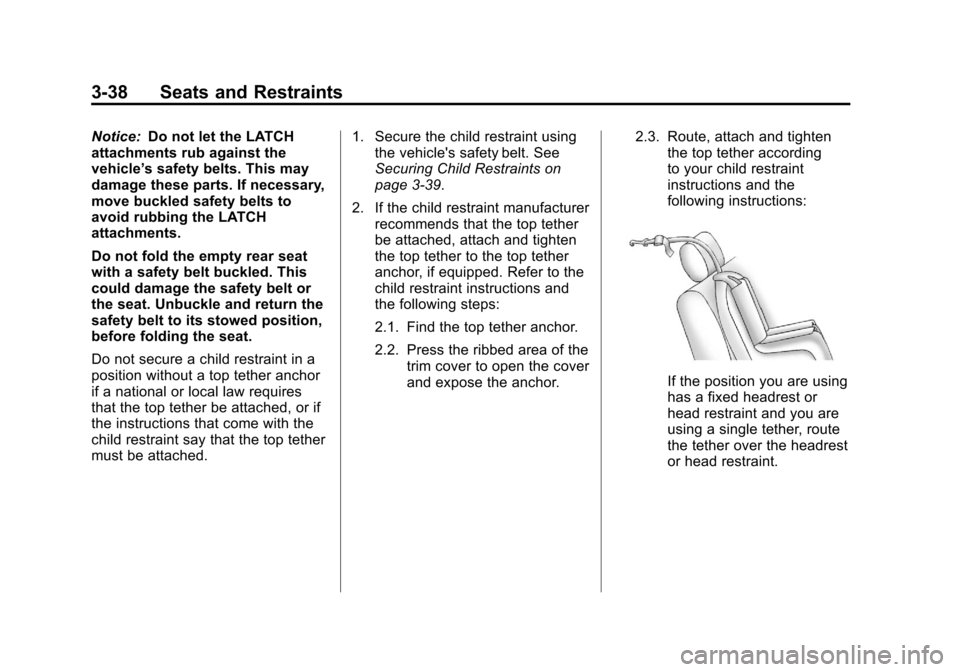
and expose the anchor. 2.3. Route, attach and tighten
the top tether according
to your child restraint
instructions and the
following instructions:
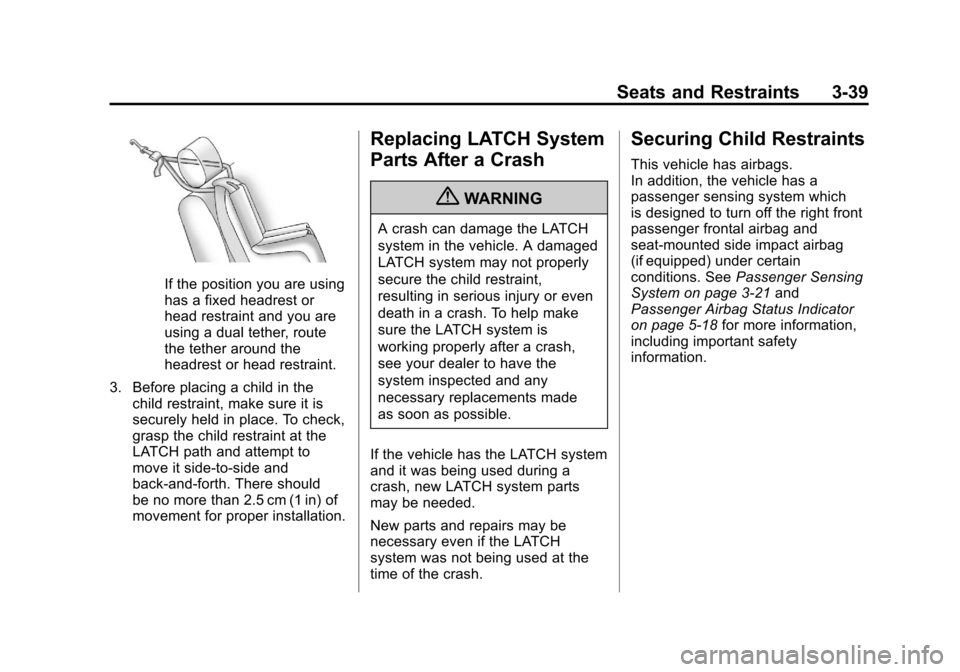
If the position you are using
has a fixed headrest or
head restraint and you are
using a single tether, route
the tether over the headrest
or head restraint.
Page 103 of 434
Black plate (39,1)Chevrolet Corvette Owner Manual - 2012
Seats and Restraints 3-39
If the position you are using
has a fixed headrest or
head restraint and you are
using a dual tether, route
the tether around the
headrest or head restraint.
3. Before placing a child in the child restraint, make sure it is
securely held in place. To check,
grasp the child restraint at the
LATCH path and attempt to
move it side‐to‐side and
back‐and‐forth. There should
be no more than 2.5 cm (1 in) of
movement for proper installation.
Replacing LATCH System
Parts After a Crash
{WARNING
A crash can damage the LATCH
system in the vehicle. A damaged
LATCH system may not properly
secure the child restraint,
resulting in serious injury or even
death in a crash. To help make
sure the LATCH system is
working properly after a crash,
see your dealer to have the
system inspected and any
necessary replacements made
as soon as possible.
If the vehicle has the LATCH system
and it was being used during a
crash, new LATCH system parts
may be needed.
New parts and repairs may be
necessary even if the LATCH
system was not being used at the
time of the crash.
Securing Child Restraints
This vehicle has airbags.
In addition, the vehicle has a
passenger sensing system which
is designed to turn off the right front
passenger frontal airbag and
seat-mounted side impact airbag
(if equipped) under certain
conditions. See Passenger Sensing
System on page 3‑21 and
Passenger Airbag Status Indicator
on page 5‑18 for more information,
including important safety
information.
Page 104 of 434
Black plate (40,1)Chevrolet Corvette Owner Manual - 2012
3-40 Seats and Restraints
A label on the sun visor says,
“Never put a rear-facing child seat in
the front.”This is because the risk to
the rear-facing child is so great,
if the airbag deploys.
{WARNING
A child in a rear-facing child
restraint can be seriously injured
or killed if the right front
passenger airbag inflates.
This is because the back of the
rear-facing child restraint would
be very close to the inflating
airbag. A child in a forward-facing
child restraint can be seriously
injured or killed if the right front
passenger airbag inflates and
the passenger seat is in a
forward position.
Even if the passenger sensing
system has turned off the right
front passenger frontal airbag, no
system is fail-safe. No one can
guarantee that an airbag will not
(Continued)
WARNING (Continued)
deploy under some unusual
circumstance, even though it is
turned off.
Secure rear-facing child
restraints in a rear seat, even if
the airbag is off. If you secure a
forward-facing child restraint in
the right front seat, always move
the front passenger seat as far
back as it will go. It is better to
secure the child restraint in a
rear seat.
SeePassenger Sensing System
on page 3‑21 for additional
information.
Rear-facing child restraints should
not be installed in the vehicle, even
if the airbag(s) are off.
If the child restraint has the LATCH
system, see Lower Anchors and
Tethers for Children (LATCH
System) (Coupe and Convertible Models Only) on page 3‑35
or
Lower Anchors and Tethers for
Children (LATCH System) (Z06 and
ZR1 Models Only) on page 3‑35 for
how and where to install the child
restraint using LATCH. If a child
restraint is secured using a safety
belt and it uses a top tether, see
Lower Anchors and Tethers for
Children (LATCH System) (Coupe
and Convertible Models Only) on
page 3‑35 orLower Anchors and
Tethers for Children (LATCH
System) (Z06 and ZR1 Models
Only) on page 3‑35 for top tether
anchor locations.
Do not secure a child seat in a
position without a top tether anchor
if a national or local law requires
that the top tether be anchored, or if
the instructions that come with the
child restraint say that the top strap
must be anchored.
In Canada, the law requires that
forward-facing child restraints have
a top tether, and that the tether
be attached.
Page 105 of 434
Black plate (41,1)Chevrolet Corvette Owner Manual - 2012
Seats and Restraints 3-41
You will be using the lap-shoulder
belt to secure the child restraint in
this position. Follow the instructions
that came with the child restraint.
1. Move the seat as far back as itwill go before securing the
forward-facing child restraint.
When the passenger sensing
system has turned off the right
front passenger frontal airbag
and seat-mounted side impact
airbag (if equipped), the off
indicator on the passenger
airbag status indicator should
light and stay lit when you start
the vehicle. See Passenger
Airbag Status Indicator on
page 5‑18.
2. Put the child restraint on the seat.
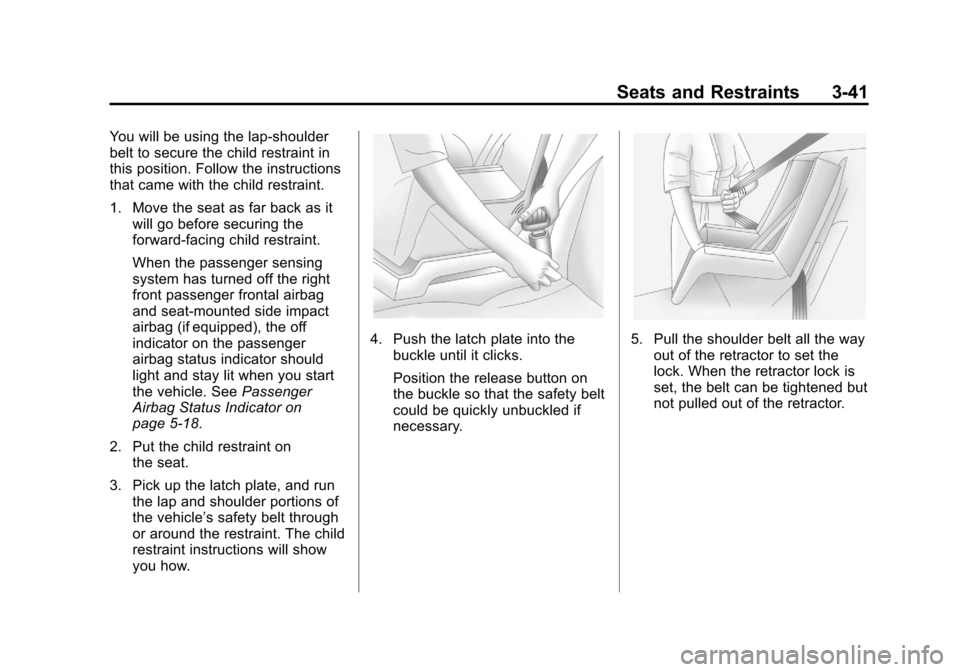
3. Pick up the latch plate, and run the lap and shoulder portions of
the vehicle’ s safety belt through
or around the restraint. The child
restraint instructions will show
you how.
4. Push the latch plate into the
buckle until it clicks.
Position the release button on
the buckle so that the safety belt
could be quickly unbuckled if
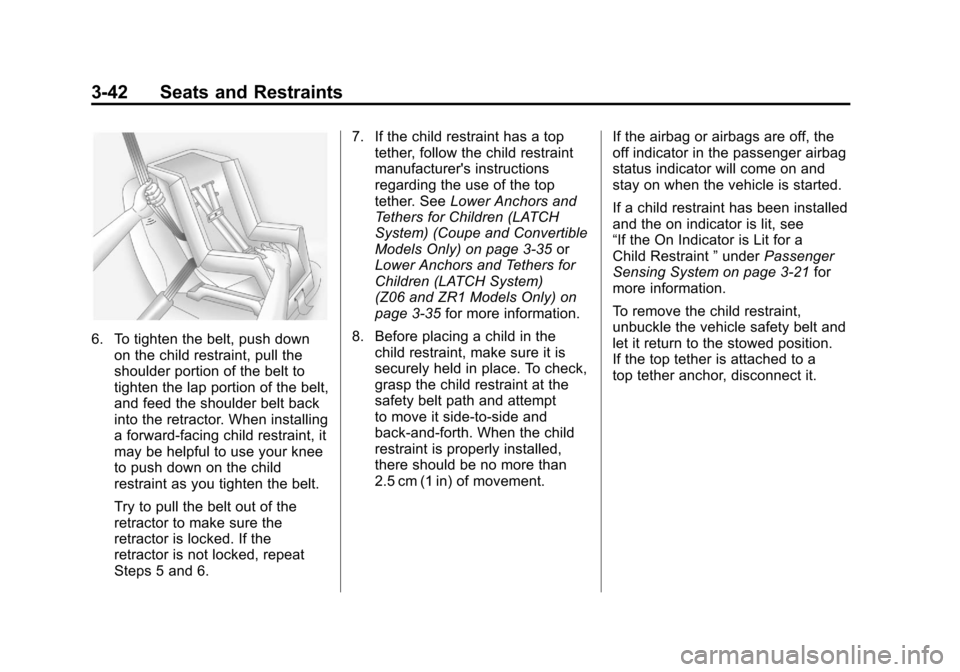
necessary.5. Pull the shoulder belt all the wayout of the retractor to set the
lock. When the retractor lock is
set, the belt can be tightened but
not pulled out of the retractor.
Page 106 of 434
Black plate (42,1)Chevrolet Corvette Owner Manual - 2012
3-42 Seats and Restraints
6. To tighten the belt, push downon the child restraint, pull the
shoulder portion of the belt to
tighten the lap portion of the belt,
and feed the shoulder belt back
into the retractor. When installing
a forward-facing child restraint, it
may be helpful to use your knee
to push down on the child
restraint as you tighten the belt.
Try to pull the belt out of the
retractor to make sure the
retractor is locked. If the
retractor is not locked, repeat
Steps 5 and 6. 7. If the child restraint has a top
tether, follow the child restraint
manufacturer's instructions
regarding the use of the top
tether. See Lower Anchors and
Tethers for Children (LATCH
System) (Coupe and Convertible
Models Only) on page 3‑35 or
Lower Anchors and Tethers for
Children (LATCH System)
(Z06 and ZR1 Models Only) on
page 3‑35 for more information.
8. Before placing a child in the child restraint, make sure it is
securely held in place. To check,
grasp the child restraint at the
safety belt path and attempt
to move it side‐to‐side and
back‐and‐forth. When the child
restraint is properly installed,
there should be no more than
2.5 cm (1 in) of movement. If the airbag or airbags are off, the
off indicator in the passenger airbag
status indicator will come on and
stay on when the vehicle is started.
If a child restraint has been installed
and the on indicator is lit, see
“If the On Indicator is Lit for a
Child Restraint
”under Passenger
Sensing System on page 3‑21 for
more information.
To remove the child restraint,
unbuckle the vehicle safety belt and
let it return to the stowed position.
If the top tether is attached to a
top tether anchor, disconnect it.
Page 138 of 434
Black plate (28,1)Chevrolet Corvette Owner Manual - 2012
5-28 Instruments and Controls
Information Displays
Driver Information
Center (DIC)
The Driver Information Center (DIC)
display is located on the instrument
panel cluster and shows driver
personalization features and
warning/status messages.
The DIC comes on when the ignition
is turned on. After displaying
CORVETTE BY CHEVROLET, the
DIC shows the information that was
last displayed before the engine
was turned off.
If a problem is detected, a warning
message appears on the DIC
display. SeeVehicle Messages on
page 5‑36 for more information.
DIC Operation and Displays
Depending on the features on the
vehicle, the drive gear may display
on the DIC. See “Manual Paddle
Shift” under Automatic Transmission on page 9‑27
andHead-Up Display
(HUD) on page 5‑32 for more
information.
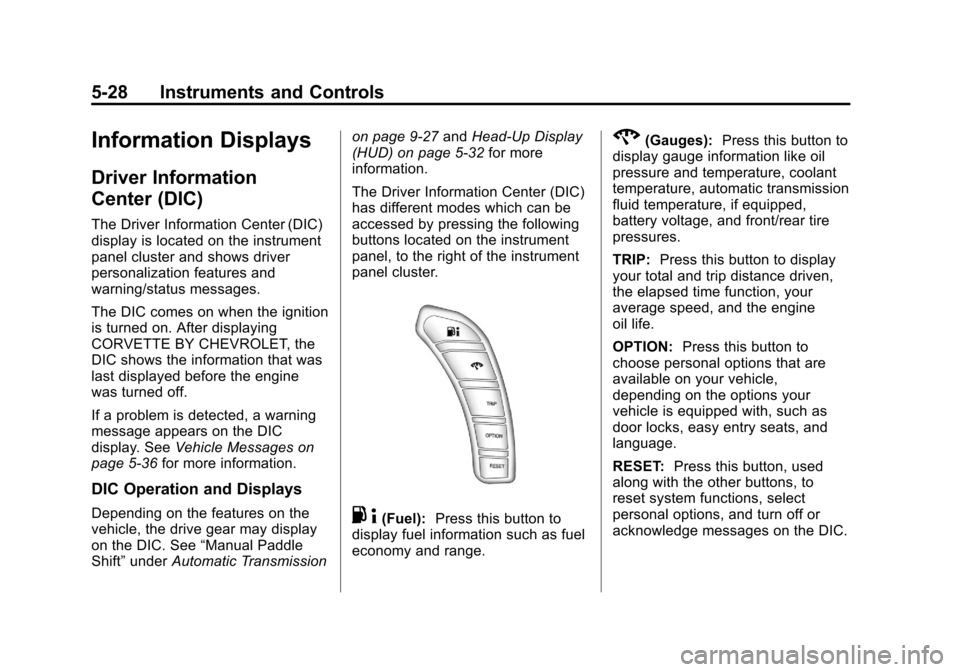
The Driver Information Center (DIC)
has different modes which can be
accessed by pressing the following
buttons located on the instrument
panel, to the right of the instrument
panel cluster.. 4(Fuel): Press this button to
display fuel information such as fuel
economy and range.
2(Gauges): Press this button to
display gauge information like oil
pressure and temperature, coolant
temperature, automatic transmission
fluid temperature, if equipped,
battery voltage, and front/rear tire
pressures.
TRIP: Press this button to display
your total and trip distance driven,
the elapsed time function, your
average speed, and the engine
oil life.
OPTION: Press this button to
choose personal options that are
available on your vehicle,
depending on the options your
vehicle is equipped with, such as
door locks, easy entry seats, and
language.
RESET: Press this button, used
along with the other buttons, to
reset system functions, select
personal options, and turn off or
acknowledge messages on the DIC.
Page 218 of 434
Black plate (6,1)Chevrolet Corvette Owner Manual - 2012
8-6 Climate Controls
Air Vents
Use the tab located on the air
outlets to change the direction of
the airflow.
Operation Tips
.Clear away any ice, snow,
or leaves from the air inlets at
the base of the windshield that
may block the flow of air into
your vehicle.
.Use of non-GM approved hood
deflectors may adversely affect
the performance of the system.
.Keep the area around the base
of the instrument panel console
and air path under the seats
clear of objects to help circulate
the air inside of your vehicle
more effectively.
Maintenance
Passenger Compartment
Air Filter
The passenger compartment air
filter removes certain particles from
the air including pollen and dust
particles. Reductions in airflow,
which may occur more often in
dusty areas, indicate that the
filter may need to be replaced.
SeeMaintenance Schedule on
page 11‑3. Notice:
Driving without a
passenger compartment air filter
in place can cause water and
small particles, like paper and
leaves, to be pulled into your
climate control system which may
cause damage to it. Make sure
you always replace the old filter
with a new one.
The passenger compartment air
filter is located on the passenger
side of the engine compartment
near the battery. See Engine
Compartment Overview on
page 10‑10.