cooling CHEVROLET CORVETTE 2013 6.G User Guide
[x] Cancel search | Manufacturer: CHEVROLET, Model Year: 2013, Model line: CORVETTE, Model: CHEVROLET CORVETTE 2013 6.GPages: 414, PDF Size: 6.97 MB
Page 289 of 414
Black plate (27,1)Chevrolet Corvette Owner Manual - 2013 - crc2 - 11/8/12
Vehicle Care 10-27
coolant for the cooling system.
SeeRecommended Fluids and
Lubricants on page 11‑12.
Never dispose of engine coolant by
putting it in the trash, pouring it on
the ground, or into sewers, streams,
or bodies of water. Have the coolant
changed by an authorized service
center, familiar with legal
requirements regarding used
coolant disposal. This will help
protect the environment and your
health.
Checking Coolant
The vehicle must be on a level
surface when checking the coolant
level.
Check to see if coolant is visible in
the coolant surge tank. If the coolant
inside the coolant surge tank is
boiling, do not do anything else until
it cools down. If coolant is visible
but the coolant level is not at or
above the FULL COLD mark, add a
50/50 mixture of clean, drinkable
water and DEX-COOL coolant at the
coolant recovery tank, but be sure the cooling system is cool before
this is done. See
Cooling System
(Engine) on page 10‑24 orCooling
System (Intercooler) on page 10‑25.
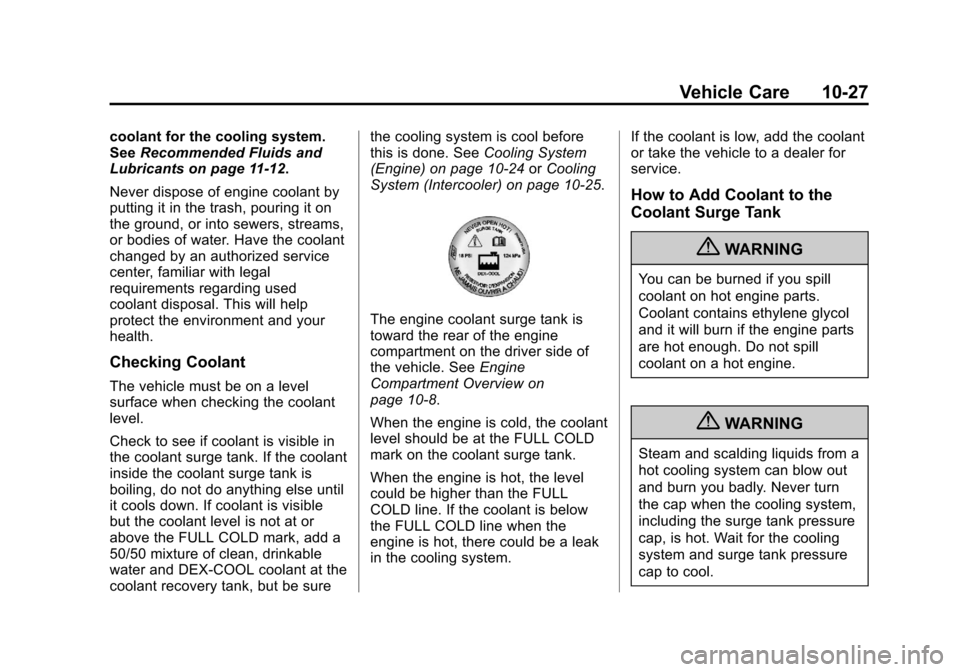
The engine coolant surge tank is
toward the rear of the engine
compartment on the driver side of
the vehicle. See Engine
Compartment Overview on
page 10‑8.
When the engine is cold, the coolant
level should be at the FULL COLD
mark on the coolant surge tank.
When the engine is hot, the level
could be higher than the FULL
COLD line. If the coolant is below
the FULL COLD line when the
engine is hot, there could be a leak
in the cooling system. If the coolant is low, add the coolant
or take the vehicle to a dealer for
service.
How to Add Coolant to the
Coolant Surge Tank
{WARNING
You can be burned if you spill
coolant on hot engine parts.
Coolant contains ethylene glycol
and it will burn if the engine parts
are hot enough. Do not spill
coolant on a hot engine.
{WARNING
Steam and scalding liquids from a
hot cooling system can blow out
and burn you badly. Never turn
the cap when the cooling system,
including the surge tank pressure
cap, is hot. Wait for the cooling
system and surge tank pressure
cap to cool.
Page 290 of 414
Black plate (28,1)Chevrolet Corvette Owner Manual - 2013 - crc2 - 11/8/12
10-28 Vehicle Care
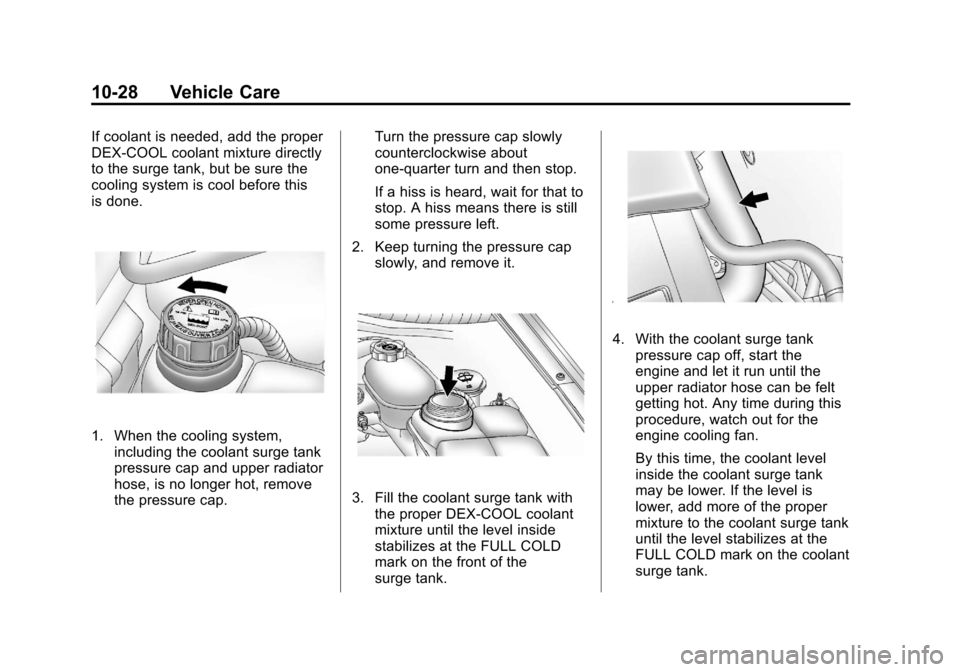
If coolant is needed, add the proper
DEX-COOL coolant mixture directly
to the surge tank, but be sure the
cooling system is cool before this
is done.
1. When the cooling system,including the coolant surge tank
pressure cap and upper radiator
hose, is no longer hot, remove
the pressure cap. Turn the pressure cap slowly
counterclockwise about
one-quarter turn and then stop.
If a hiss is heard, wait for that to
stop. A hiss means there is still
some pressure left.
2. Keep turning the pressure cap slowly, and remove it.
3. Fill the coolant surge tank withthe proper DEX-COOL coolant
mixture until the level inside
stabilizes at the FULL COLD
mark on the front of the
surge tank.
4. With the coolant surge tankpressure cap off, start the
engine and let it run until the
upper radiator hose can be felt
getting hot. Any time during this
procedure, watch out for the
engine cooling fan.
By this time, the coolant level
inside the coolant surge tank
may be lower. If the level is
lower, add more of the proper
mixture to the coolant surge tank
until the level stabilizes at the
FULL COLD mark on the coolant
surge tank.
Page 291 of 414
Black plate (29,1)Chevrolet Corvette Owner Manual - 2013 - crc2 - 11/8/12
Vehicle Care 10-29
5. Replace the pressure cap tightly.Check the level in the surge tank
when the system has cooled
down. If the coolant is not at the
proper level, repeat Steps 1−4,
then reinstall the pressure cap.
If the coolant is not at the proper
level when the system cools
down again, see the dealer.
Notice: If the pressure cap is not
tightly installed, coolant loss and
possible engine damage may
occur. Be sure the cap is properly
and tightly secured.
Engine Overheating
The vehicle has several indicators
to warn of engine overheating.
There is an engine coolant
temperature gauge on the
instrument panel cluster. See
Engine Coolant Temperature Gauge
on page 5‑15. The vehicle may also
display a COOLANT OVER
TEMPERATURE message on the Driver Information Center (DIC). See
Engine Cooling System Messages
on page 5‑38.
If the decision is made not to lift the
hood but to get service help right
away. See
Roadside Assistance
Program (Mexico) on page 13‑7 or
Roadside Assistance Program (U.S.
and Canada) on page 13‑10.
If the decision is made to lift the
hood, make sure the vehicle is
parked on a level surface.
Then check to see if the engine
cooling fan is running. If the engine
is overheating, the fan should be
running. If it is not, do not continue
to run the engine and have the
vehicle serviced.
Notice: Running the engine
without coolant may cause
damage or a fire. Vehicle damage
would not be covered by the
warranty. See Overheated Engine
Protection Operating Mode on
page 10‑30 for information on
driving to a safe place in an
emergency.
If Steam is Coming from the
Engine
{WARNING
Steam from an overheated engine
can burn you badly, even if you
just open the hood. Stay away
from the engine if you see or hear
steam coming from it. Turn it off
and get everyone away from the
vehicle until it cools down. Wait
until there is no sign of steam or
coolant before you open
the hood.
If you keep driving when the
vehicles engine is overheated,
the liquids in it can catch fire. You
or others could be badly burned.
Stop the engine if it overheats,
and get out of the vehicle until the
engine is cool.
(Continued)
Page 309 of 414
Black plate (47,1)Chevrolet Corvette Owner Manual - 2013 - crc2 - 11/8/12
Vehicle Care 10-47
FuseUsage
14 Canister Purge Solenoid, Mass Air
Flow Sensor
15 Air Conditioner Compressor
16 Even Numbered Fuel Injectors
17 Windshield Washer
18 Headlamp Washer
19 Passenger Side Low-Beam
Headlamp
20 Fuel Pump (except ZR1)
21 Driver Side Low-Beam
Headlamp
22 Front Fog Lamp
23 Passenger Side High-Beam
Headlamp Fuse
Usage
24 Driver Side High-Beam
Headlamp
56 Engine Control Module (ECM)/
Transmission
Control
Module (TCM)/
Easy Key Module
J-Style Fuses Usage
25 Cooling Fan
26 Battery Main 3
27 Antilock Brake System
28 Heating/Ventilation/ Air Conditioning
Blower
29 Battery Main 2
30 Starter
31 Audio Amplifier J-Style
Fuses Usage
32 Intercooler Pump
33 Battery Main 1
Micro-Relays Usage 34 Horn
35 Air Conditioning
Compressor
36 Windshield Washer
37 Parking Lamps, Fog
Lamps
38 Front Fog Lamp
39 High-Beam Headlamp
46 Headlamp Washer
55 Fuel Pump (except ZR1)
Page 335 of 414
Black plate (73,1)Chevrolet Corvette Owner Manual - 2013 - crc2 - 11/8/12
Vehicle Care 10-73
Notice:The wrong wheel can
also cause problems with bearing
life, brake cooling, speedometer
or odometer calibration,
headlamp aim, bumper height,
vehicle ground clearance, and tire
clearance to the body and
chassis.
{WARNING
Rust or dirt on a wheel, or on
the parts to which it is
fastened, can make wheel
nuts become loose after a
time. The wheel could come
off and cause a crash. When
changing a wheel, remove any
rust or dirt from places where
the wheel attaches to the
vehicle. In an emergency, a
cloth or a paper towel can be
used, however, use a scraper
or wire brush to remove all
rust or dirt.
Tightening Wheel Lug Nuts
{WARNING
Never use oil or grease on studs
or the threads of the wheel nuts.
The wheel nuts might come loose
and the wheel could fall off,
causing a crash.
{WARNING
Incorrect wheel nuts or improperly
tightened wheel nuts can cause
the wheel to become loose and
even come off. This could lead to
a crash. Be sure to use the
correct wheel nuts. If you have to
replace them, be sure to get new
GM original equipment
wheel nuts. Notice:
Improperly tightened
wheel nuts can lead to brake
pulsation and rotor damage. To
avoid expensive brake repairs,
evenly tighten the wheel nuts in
the proper sequence and to the
proper torque specification.
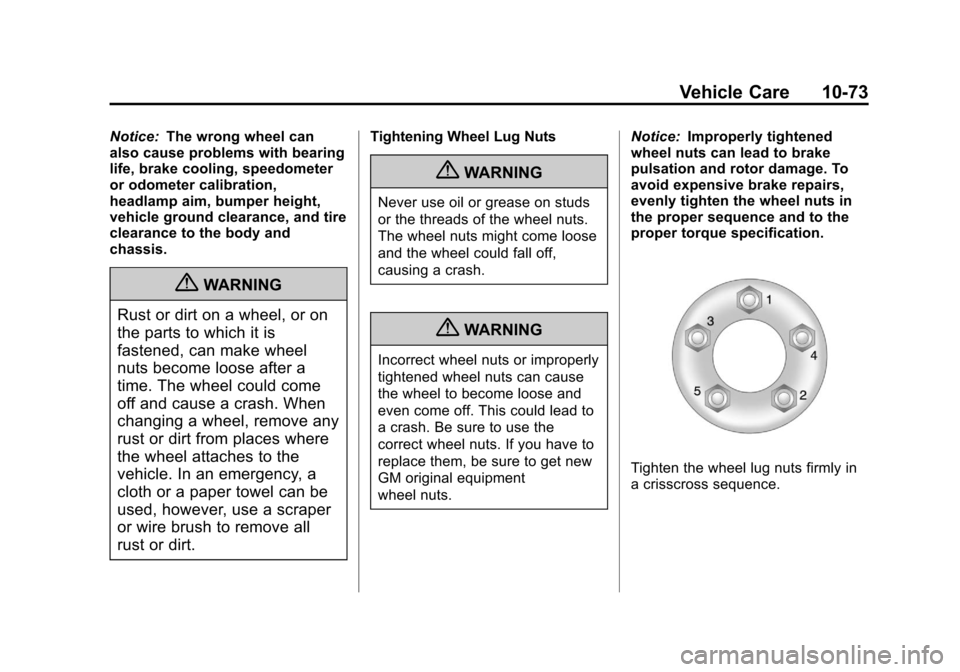
Tighten the wheel lug nuts firmly in
a crisscross sequence.
Page 356 of 414
Black plate (6,1)Chevrolet Corvette Owner Manual - 2013 - crc2 - 11/8/12
11-6 Service and Maintenance
Footnotes—Maintenance
Schedule Additional Required
Services —Normal
(1) Or every two years, whichever
comes first. More frequent
replacement may be needed if the
vehicle is driven in areas with heavy
traffic, areas with poor air quality,
or areas with high dust levels.
Replacement may also be needed if
there is a reduction in air flow,
excessive window fogging, or odors.
(2) Check all fuel and vapor lines
and hoses for proper hook-up,
routing, and condition. Check that
the purge valve, if the vehicle has
one, works properly. Replace as
needed.
(3) Or every four years, whichever
comes first. (4)
Or every five years, whichever
comes first. See Cooling System
(Engine) on page 10‑24 orCooling
System (Intercooler) on page 10‑25.
(5) Or every 10 years, whichever
comes first.
(6) Inspect for fraying, excessive
cracking, or damage; replace,
if needed.
(7) Or every two years, whichever
comes first.
Page 358 of 414
Black plate (8,1)Chevrolet Corvette Owner Manual - 2013 - crc2 - 11/8/12
11-8 Service and Maintenance
Footnotes—Maintenance
Schedule Additional Required
Services —Severe
(1) Or every two years, whichever
comes first. More frequent
replacement may be needed if the
vehicle is driven in areas with heavy
traffic, areas with poor air quality,
or areas with high dust levels.
Replacement may also be needed if
there is a reduction in air flow,
excessive window fogging, or odors.
(2) Check all fuel and vapor lines
and hoses for proper hook-up,
routing, and condition. Check that
the purge valve, if the vehicle has
one, works properly. Replace as
needed.
(3) Or every four years, whichever
comes first. (4)
Or every five years, whichever
comes first. See Cooling System
(Engine) on page 10‑24 orCooling
System (Intercooler) on page 10‑25.
(5) Or every 10 years, whichever
comes first.
(6) Inspect for fraying, excessive
cracking, or damage; replace,
if needed.
(7) Or every two years, whichever
comes first.Special Application
Services
.Severe Commercial Use
Vehicles Only: Lubricate chassis
components every 5 000 km/
3,000 mi.
.Have underbody flushing service
performed once a year.
Page 370 of 414
Black plate (2,1)Chevrolet Corvette Owner Manual - 2013 - crc2 - 11/8/12
12-2 Technical Data
Vehicle Data
Capacities and Specifications
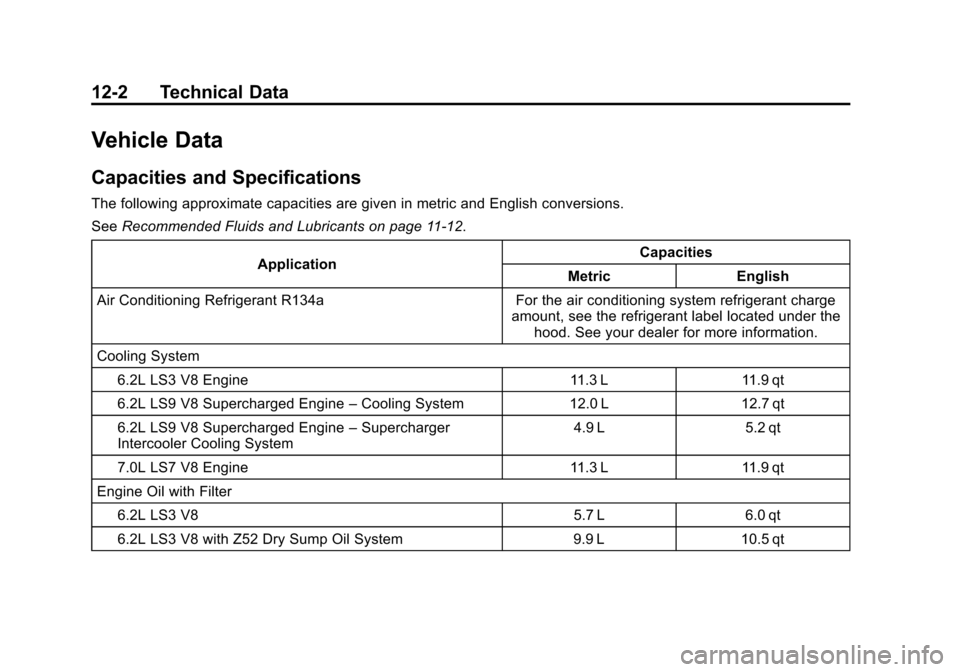
The following approximate capacities are given in metric and English conversions.
SeeRecommended Fluids and Lubricants on page 11‑12.
Application Capacities
Metric English
Air Conditioning Refrigerant R134a For the air conditioning system refrigerant charge amount, see the refrigerant label located under thehood. See your dealer for more information.
Cooling System 6.2L LS3 V8 Engine 11.3 L 11.9 qt
6.2L LS9 V8 Supercharged Engine –Cooling System 12.0 L 12.7 qt
6.2L LS9 V8 Supercharged Engine –Supercharger
Intercooler Cooling System 4.9 L 5.2 qt
7.0L LS7 V8 Engine 11.3 L 11.9 qt
Engine Oil with Filter 6.2L LS3 V8 5.7 L 6.0 qt
6.2L LS3 V8 with Z52 Dry Sump Oil System 9.9 L 10.5 qt
Page 405 of 414

Black plate (3,1)Chevrolet Corvette Owner Manual - 2013 - crc2 - 11/8/12
INDEX i-3
Clutch, Hydraulic . . . . . . . . . . . . . 10-21
Collision Damage Repair . . . . . 13-14
Compass . . . . . . . . . . . . . . . . . . . . . . . 5-5
Competitive Driving Mode . . . . . 9-36
Competitive Driving, Racingor Other . . . . . . . . . . . . . . . . . . . . . . . 9-6
Connections
OnStar
®. . . . . . . . . . . . . . . . . . . . . . 14-4
Control of a Vehicle . . . . . . . . . . . . . 9-3
Convenience Net . . . . . . . . . . . . . . . 4-3
Convertible Top . . . . . . . . . . . . . . . . 2-22 Messages . . . . . . . . . . . . . . . . . . . . 5-36
Convex Mirrors . . . . . . . . . . . . . . . . 2-15
Coolant Engine . . . . . . . . . . . . . . . . . . . . . . 10-26
Engine TemperatureGauge . . . . . . . . . . . . . . . . . . . . . . 5-15
Cooling System . . . . . . . .10-24, 10-25 Engine Messages . . . . . . . . . . . . 5-38
Courtesy Lamps . . . . . . . . . . . . . . . . 6-6
Courtesy Transportation Program . . . . . . . . . . . . . . . . . . . . . 13-12
Cover Cargo . . . . . . . . . . . . . . . . . . . . . . . . . . 4-2
Cruise Control . . . . . . . . . . . . . . . . . 9-42
Messages . . . . . . . . . . . . . . . . . . . . 5-37 Cupholders . . . . . . . . . . . . . . . . . . . . . 4-1
Customer Assistance . . . . . . . . . . 13-6
Offices . . . . . . . . . . . . . . . . . . . . . . . . 13-5
Text Telephone (TTY)Users . . . . . . . . . . . . . . . . . . . . . . . 13-6
Customer Information Service Publications
Ordering Information . . . . . . 13-16
Customer Satisfaction Procedure . . . . . . . . . . . . . . 13-2, 13-4
D
Damage Repair, Collision . . . . . 13-14
Danger, Warnings, andCautions . . . . . . . . . . . . . . . . . . . . . . . . iv
Daytime Running Lamps (DRL) . . . . . . . . . . . . . . . . . . 6-2
Defensive Driving . . . . . . . . . . . . . . . 9-3
Devices
Auxiliary . . . . . . . . . . . . . . . . . . . . . . 7-17
Diagnostics OnStar
®. . . . . . . . . . . . . . . . . . . . . . 14-5
Distracted Driving . . . . . . . . . . . . . . . 9-2 Door
Ajar Messages . . . . . . . . . . . . . . . 5-37
Locks . . . . . . . . . . . . . . . . . . . . . . . . . . 2-7
Power Locks . . . . . . . . . . . . . . . . . . . 2-8
Drive Belt Routing, Engine . . . . . 12-5
Driver Information Center (DIC) . . . . . . . . . . . . . . . . . 5-25
Driving Competitive . . . . . . . . . . . . . . . . . . . 9-36
Defensive . . . . . . . . . . . . . . . . . . . . . . 9-3
Drunk . . . . . . . . . . . . . . . . . . . . . . . . . . 9-3
For Better Fuel Economy . . . . . 1-22
Highway Hypnosis . . . . . . . . . . . . . 9-9
Hill and Mountain Roads . . . . . . . 9-9
If the Vehicle is Stuck . . . . . . . . . 9-12
Loss of Control . . . . . . . . . . . . . . . . 9-5
Off-Road Recovery . . . . . . . . . . . . 9-5
Vehicle Load Limits . . . . . . . . . . . 9-12
Wet Roads . . . . . . . . . . . . . . . . . . . . 9-8
Winter . . . . . . . . . . . . . . . . . . . . . . . . 9-10
Dual Automatic Climate
Control System . . . . . . . . . . . . . . . . 8-1
Page 406 of 414

Black plate (4,1)Chevrolet Corvette Owner Manual - 2013 - crc2 - 11/8/12
i-4 INDEX
E
Electrical Equipment,Add-On . . . . . . . . . . . . . . . . . . . . . . 9-50
Electrical System Engine CompartmentFuse Block . . . . . . . . . . . . . . . . 10-45
Fuses and Circuit
Breakers . . . . . . . . . . . . . . . . . . 10-45
Instrument Panel Fuse Block . . . . . . . . . . . . . . . . . . . . . . 10-48
Overload . . . . . . . . . . . . . . . . . . . 10-44
Emergency OnStar
®. . . . . . . . . . . . . . . . . . . . . . 14-2
Engine Air Cleaner/Filter . . . . . . . . . . . 10-21
Check and Service EngineSoon Light . . . . . . . . . . . . . . . . . . 5-18
Compartment Overview . . . . . . . 10-8
Coolant . . . . . . . . . . . . . . . . . . . . . 10-26
Coolant Temperature Gauge . . . . . . . . . . . . . . . . . . . . . . 5-15
Cooling System . . . . . . 10-24, 10-25
Cooling System Messages . . . 5-38
Drive Belt Routing . . . . . . . . . . . . 12-5
Exhaust . . . . . . . . . . . . . . . . . . . . . . 9-24
Oil Life System . . . . . . . . . . . . . 10-19 Engine (cont'd)
Oil Messages . . . . . . . . . . . . . . . . . 5-39
Oil Pressure Gauge . . . . . . . . . . 5-14
Overheated Protection
Operating Mode . . . . . . . . . . . 10-30
Overheating . . . . . . . . . . . . . . . . 10-29
Power Messages . . . . . . . . . . . . . 5-39
Running While Parked . . . . . . . . 9-24
Starting . . . . . . . . . . . . . . . . . . . . . . . 9-20
Entry/Exit Lighting . . . . . . . . . . . . . . 6-6
Extender, Safety Belt . . . . . . . . . . 3-13
Exterior Lamp Controls . . . . . . . . . 6-1
Exterior Lamps Off Reminder . . . 6-2
Exterior Lighting Battery Saver . . . . . . . . . . . . . . . . . . . . . . . . . 6-7
F
FeaturesMemory . . . . . . . . . . . . . . . . . . . . . . . . 1-9
Filter,
Engine Air Cleaner . . . . . . . . . 10-21
Flash-to-Pass . . . . . . . . . . . . . . . . . . . 6-2
Flashers, Hazard Warning . . . . . . 6-4
Flat Tire . . . . . . . . . . . . . . . . . . . . . . 10-74
Floor Mats . . . . . . . . . . . . . . . . . . . . 10-86 Fluid
Automatic Transmission . . . . 10-20
Brakes . . . . . . . . . . . . . . . . . . . . . . 10-36
Power Steering . . . . . . . . . . . . . 10-31
Washer . . . . . . . . . . . . . . . . . . . . . 10-32
Fog Lamps Bulb Replacement . . . . . . . . . . . . . 6-5
Folding Mirrors . . . . . . . . . . . . . . . . 2-15
Front Air Dam . . . . . . . . . . . . . . . . . 9-17
Front Fog Lamp Light . . . . . . . . . . . . . . . . . . . . . . . . . . 5-24
Front Seats Heated . . . . . . . . . . . . . . . . . . . . . . . . 3-7
Fuel . . . . . . . . . . . . . . . . . . . . . . . . . . . 9-45 Additives . . . . . . . . . . . . . . . . . . . . . 9-46
Economy Driving . . . . . . . . . . . . . 1-22
Filling a Portable FuelContainer . . . . . . . . . . . . . . . . . . . 9-49
Filling the Tank . . . . . . . . . . . . . . . 9-47
Foreign Countries . . . . . . . . . . . . 9-46
Gasoline Specifications . . . . . . . 9-46
Gauge . . . . . . . . . . . . . . . . . . . . . . . . 5-12
Recommended . . . . . . . . . . . . . . . 9-45
Requirements, California . . . . . 9-46
System Messages . . . . . . . . . . . . 5-40