tire size CHEVROLET CORVETTE 2024 User Guide
[x] Cancel search | Manufacturer: CHEVROLET, Model Year: 2024, Model line: CORVETTE, Model: CHEVROLET CORVETTE 2024Pages: 362, PDF Size: 6.62 MB
Page 289 of 362
Chevrolet Corvette Owner Manual (GMNA-Localizing-U.S./Canada/Mexico-
17272984) - 2024 - CRC - 2/20/23
288 Vehicle Care
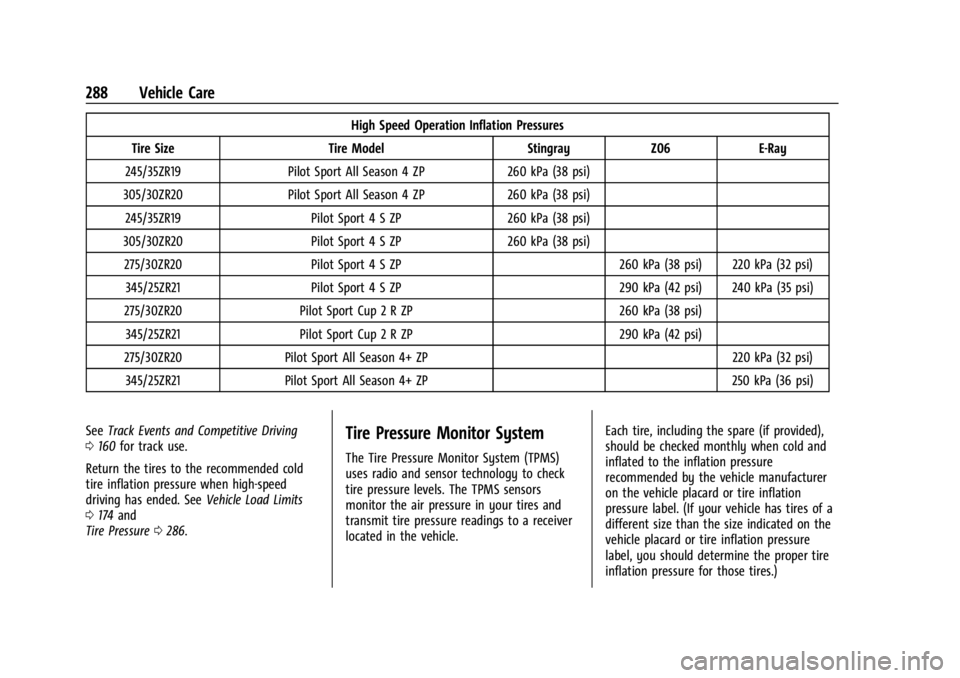
High Speed Operation Inflation Pressures
Tire Size Tire Model Stingray Z06 E-Ray
245/35ZR19 Pilot Sport All Season 4 ZP 260 kPa (38 psi)
305/30ZR20 Pilot Sport All Season 4 ZP 260 kPa (38 psi) 245/35ZR19 Pilot Sport 4 S ZP 260 kPa (38 psi)
305/30ZR20 Pilot Sport 4 S ZP 260 kPa (38 psi) 275/30ZR20 Pilot Sport 4 S ZP 260 kPa (38 psi) 220 kPa (32 psi) 345/25ZR21 Pilot Sport 4 S ZP 290 kPa (42 psi) 240 kPa (35 psi)
275/30ZR20 Pilot Sport Cup 2 R ZP 260 kPa (38 psi) 345/25ZR21 Pilot Sport Cup 2 R ZP 290 kPa (42 psi)
275/30ZR20 Pilot Sport All Season 4+ ZP 220 kPa (32 psi) 345/25ZR21 Pilot Sport All Season 4+ ZP 250 kPa (36 psi)
See Track Events and Competitive Driving
0 160 for track use.
Return the tires to the recommended cold
tire inflation pressure when high-speed
driving has ended. See Vehicle Load Limits
0 174 and
Tire Pressure 0286.
Tire Pressure Monitor System
The Tire Pressure Monitor System (TPMS)
uses radio and sensor technology to check
tire pressure levels. The TPMS sensors
monitor the air pressure in your tires and
transmit tire pressure readings to a receiver
located in the vehicle. Each tire, including the spare (if provided),
should be checked monthly when cold and
inflated to the inflation pressure
recommended by the vehicle manufacturer
on the vehicle placard or tire inflation
pressure label. (If your vehicle has tires of a
different size than the size indicated on the
vehicle placard or tire inflation pressure
label, you should determine the proper tire
inflation pressure for those tires.)
Page 291 of 362
Chevrolet Corvette Owner Manual (GMNA-Localizing-U.S./Canada/Mexico-
17272984) - 2024 - CRC - 2/20/23
290 Vehicle Care
The low tire pressure warning light may
come on in cool weather when the vehicle is
first started, and then turn off as the vehicle
is driven. This could be an early indicator
that the air pressure is getting low and
needs to be inflated to the proper pressure.
A Tire and Loading Information label shows
the size of the original equipment tires and
the correct inflation pressure for the tires
when they are cold. SeeVehicle Load Limits
0 174, for an example of the Tire and
Loading Information label and its location.
Also see Tire Pressure 0286.
The TPMS can warn about a low tire
pressure condition but it does not replace
normal tire maintenance. See Tire Inspection
0 291, Tire Rotation 0292, and Tires0279.
Caution
Tire sealant materials are not all the
same. A non-approved tire sealant could
damage the TPMS sensors. TPMS sensor
damage caused by using an incorrect tire
sealant is not covered by the vehicle
warranty. Always use only the GM
approved tire sealant available through
your dealer or included in the vehicle.
TPMS Malfunction Light and Message
The TPMS will not function properly if one
or more of the TPMS sensors are missing or
inoperable. When the system detects a
malfunction, the low tire pressure warning
light flashes for about one minute and then
stays on for the remainder of the ignition
cycle. A DIC warning message also displays.
The malfunction light and DIC warning
message come on at each ignition cycle
until the problem is corrected. Some of the
conditions that can cause these to come
on are:
.One of the road tires has been replaced
with the spare tire. The spare tire does
not have a TPMS sensor. The malfunction
light and the DIC message should go off
after the road tire is replaced and the
sensor matching process is performed
successfully. See "TPMS Sensor Matching
Process" later in this section.
.The TPMS sensor matching process was
not done or not completed successfully
after rotating the tires. The malfunction
light and the DIC message should go off
after successfully completing the sensor
matching process. See "TPMS Sensor
Matching Process" later in this section.
.One or more TPMS sensors are missing or
damaged. The malfunction light and the
DIC message should go off when the
TPMS sensors are installed and the sensor
matching process is performed
successfully. See your dealer for service.
.Replacement tires or wheels do not match
the original equipment tires or wheels.
Tires and wheels other than those
recommended could prevent the TPMS
from functioning properly. See Buying
New Tires 0294.
.Operating electronic devices or being near
facilities using radio wave frequencies
similar to the TPMS could cause the TPMS
sensors to malfunction.
If the TPMS is not functioning properly, it
cannot detect or signal a low tire pressure
condition. See your dealer for service if the
TPMS malfunction light and DIC message
come on and stay on.
Tire Fill Alert (If Equipped)
This feature provides visual and audible
alerts outside the vehicle to help when
inflating an underinflated tire to the
recommended cold tire pressure.
Page 293 of 362
Chevrolet Corvette Owner Manual (GMNA-Localizing-U.S./Canada/Mexico-
17272984) - 2024 - CRC - 2/20/23
292 Vehicle Care
Replace the tire if:
.The indicators at three or more
places around the tire can be seen.
.There is cord or fabric showing
through the tire's rubber.
.The tread or sidewall is cracked, cut,
or snagged deep enough to show
cord or fabric.
.The tire has a bump, bulge, or split.
.The tire has a puncture, cut, or other
damage that cannot be repaired well
because of the size or location of the
damage.
Tire Rotation
Tires should be rotated according to the
interval listed in the maintenance
schedule. SeeMaintenance Schedule
0 316.
Tires are rotated to achieve uniform
wear for all tires. The first rotation is
the most important.
Anytime unusual wear is noticed, rotate
the tires as soon as possible, check for
proper tire inflation pressure, and check for damaged tires or wheels. If the
unusual wear continues after the
rotation, check the wheel alignment.
See
When It Is Time for New Tires
0 293 and
Wheel Replacement 0297.
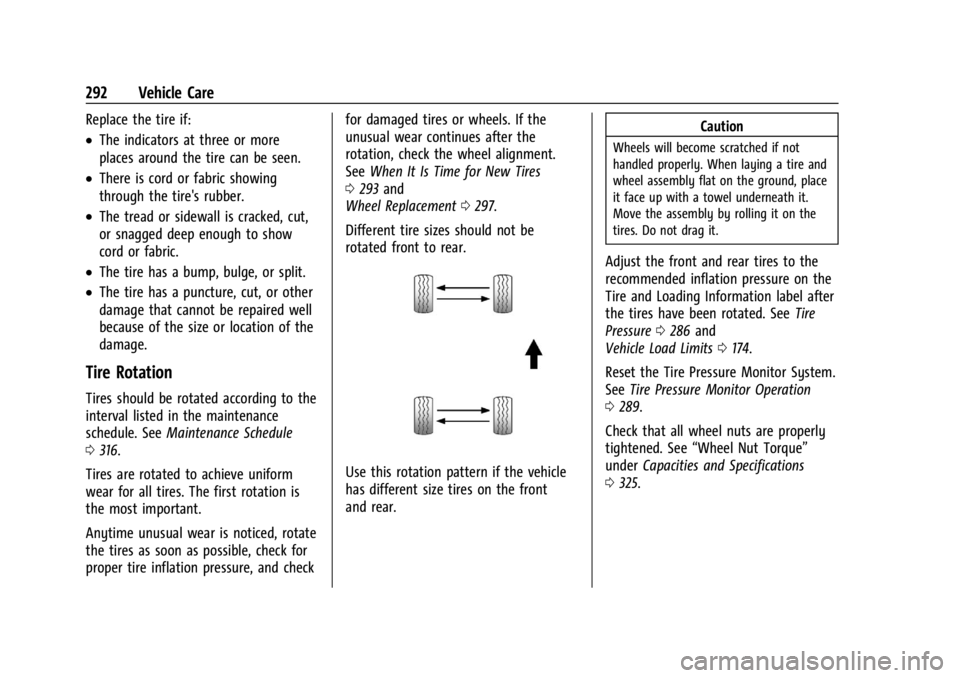
Different tire sizes should not be
rotated front to rear.
Use this rotation pattern if the vehicle
has different size tires on the front
and rear. Caution
Wheels will become scratched if not
handled properly. When laying a tire and
wheel assembly flat on the ground, place
it face up with a towel underneath it.
Move the assembly by rolling it on the
tires. Do not drag it.
Adjust the front and rear tires to the
recommended inflation pressure on the
Tire and Loading Information label after
the tires have been rotated. See
Tire
Pressure 0286 and
Vehicle Load Limits 0174.
Reset the Tire Pressure Monitor System.
See Tire Pressure Monitor Operation
0 289.
Check that all wheel nuts are properly
tightened. See “Wheel Nut Torque”
under Capacities and Specifications
0 325.
Page 295 of 362
Chevrolet Corvette Owner Manual (GMNA-Localizing-U.S./Canada/Mexico-
17272984) - 2024 - CRC - 2/20/23
294 Vehicle Care
Buying New Tires
GM has developed and matched specific
tires for the vehicle. The original
equipment tires installed were designed
to meet General Motors Tire
Performance Criteria Specification
(TPC Spec) system rating. When
replacement tires are needed, GM
strongly recommends buying tires with
the same TPC Spec rating.
GM's exclusive TPC Spec system
considers over a dozen critical
specifications that impact the overall
performance of the vehicle, including
brake system performance, ride and
handling, traction control, and tire
pressure monitoring performance. GM's
TPC Spec number is molded onto the
tire's sidewall near the tire size. If the
tires have an all-season tread design,
the TPC Spec number will be followed
by MS for mud and snow. SeeTire
Sidewall Labeling 0282 for additional
information. GM recommends replacing worn tires in
complete sets of four. Uniform tread
depth on all tires will help to maintain
the performance of the vehicle. Braking
and handling performance may be
adversely affected if all the tires are not
replaced at the same time. If proper
rotation and maintenance have been
done, all four tires should wear out at
about the same time. However, if it is
necessary to replace only one axle set
of worn tires, place the new tires on
the rear axle. See
Tire Rotation0292.
{Warning
Tires could explode during improper
service. Attempting to mount or
dismount a tire could cause injury or
death. Only your dealer or authorized
tire service center should mount or
dismount the tires.
{Warning
Mixing tires of different sizes (other
than those originally installed on the
vehicle), brands, tread patterns,
or types may cause loss of vehicle
control, resulting in a crash or other
vehicle damage. Use the correct size,
brand, and type of tire on all wheels.
{Warning
Using bias-ply tires on the vehicle
may cause the wheel rim flanges to
develop cracks after many miles of
driving. A tire and/or wheel could fail
suddenly and cause a crash. Use only
radial-ply tires with the wheels on
the vehicle.
Winter tires with the same speed rating
as the original equipment tires may not
be available for H, V, W, Y and ZR
speed rated tires. Never exceed the
winter tires’ maximum speed capability
when using winter tires with a lower
speed rating.
Page 296 of 362
Chevrolet Corvette Owner Manual (GMNA-Localizing-U.S./Canada/Mexico-
17272984) - 2024 - CRC - 2/20/23
Vehicle Care 295
If the vehicle tires must be replaced
with a tire that does not have a TPC
Spec number, make sure they are the
same size, load range, speed rating, and
construction (radial) as the original
tires.
The Tire and Loading Information label
indicates the original equipment tires
on the vehicle. SeeVehicle Load Limits
0 174.
Different Size Tires and Wheels
If wheels or tires are installed that are a
different size than the original equipment
wheels and tires, vehicle performance,
including its braking, ride and handling
characteristics, stability, and resistance to
rollover may be affected. If the vehicle has
electronic systems such as antilock brakes,
rollover airbags, traction control, electronic
stability control, or All-Wheel Drive, the
performance of these systems can also be
affected.
{Warning
If different sized wheels are used, there
may not be an acceptable level of
performance and safety if tires not
recommended for those wheels are
selected. This increases the chance of a
crash and serious injury. Only use GM
specific wheel and tire systems developed
for the vehicle, and have them properly
installed by a GM certified technician.
See Buying New Tires 0294 and
Accessories and Modifications 0232.
Uniform Tire Quality Grading
The following information relates to the
system developed by the United States
National Highway Traffic Safety
Administration (NHTSA), which grades
tires by treadwear, traction, and
temperature performance. This applies
only to vehicles sold in the United
States. The grades are molded on the
sidewalls of most passenger car tires.
The Uniform Tire Quality Grading
(UTQG) system does not apply to deep
tread, winter tires, compact spare tires, tires with nominal rim diameters of
10 to 12 inches (25 to 30 cm), or to some
limited-production tires.
While the tires available on General
Motors passenger cars and light trucks
may vary with respect to these grades,
they must also conform to federal
safety requirements and additional
General Motors Tire Performance
Criteria (TPC) standards.
Quality grades can be found where
applicable on the tire sidewall between
tread shoulder and maximum section
width. For example:Treadwear 200 Traction AA Temperature A
All Passenger Car Tires Must Conform to
Federal Safety Requirements In Addition
To These Grades.
Treadwear
The treadwear grade is a comparative
rating based on the wear rate of the
tire when tested under controlled
conditions on a specified government
test course. For example, a tire graded
150 would wear one and one-half (1½)
Page 299 of 362
Chevrolet Corvette Owner Manual (GMNA-Localizing-U.S./Canada/Mexico-
17272984) - 2024 - CRC - 2/20/23
298 Vehicle Care
Caution
The wrong wheel can also cause
problems with bearing life, brake cooling,
speedometer or odometer calibration,
headlamp aim, bumper height, vehicle
ground clearance, and tire or tire chain
clearance to the body and chassis.
Tire Chains
{Warning
Do not use tire chains. There is not
enough clearance. Tire chains used on a
vehicle without the proper amount of
clearance can cause damage to the
brakes, suspension, or other vehicle parts.
The area damaged by the tire chains
could cause loss of control and a crash.
Use another type of traction device only
if its manufacturer recommends it for the
vehicle's tire size combination and road
conditions. Follow that manufacturer's
instructions. To avoid vehicle damage,
drive slowly and readjust or remove the
traction device if it contacts the vehicle.(Continued)
Warning (Continued)
Do not spin the wheels. If traction
devices are used, install them on the tires
of the drive axle only.
If a Tire Goes Flat
It is unusual for a tire to blow out while
driving, especially if the tires are maintained
properly. SeeTires0279. If air goes out of
a tire, it is much more likely to leak out
slowly. But if there ever is a blowout, here
are a few tips about what to expect and
what to do:
If a front tire fails, the flat tire creates a
drag that pulls the vehicle toward that side.
Take your foot off the accelerator pedal and
grip the steering wheel firmly. Steer to
maintain lane position, and then gently
brake to a stop, well off the road,
if possible.
A rear blowout, particularly on a curve, acts
much like a skid and may require the same
correction as used in a skid. Stop pressing
the accelerator pedal and steer to straighten
the vehicle. It may be very bumpy and
noisy. Gently brake to a stop, well off the
road, if possible. The vehicle has no spare tire, no tire
changing equipment, and no place to store
a tire.
If the vehicle has run-flat tires, there is no
need to stop on the side of the road to
change a flat tire. See
Run-Flat Tires0280.{Warning
Driving on a flat tire will cause
permanent damage to the tire.
Re-inflating a tire after it has been driven
on while severely underinflated or flat
may cause a blowout and a serious crash.
Never attempt to re-inflate a tire that has
been driven on while severely
underinflated or flat. Have your dealer or
an authorized tire service center repair or
replace the flat tire as soon as possible.
{Warning
Special tools and procedures are required
to service a run-flat tire. If these special
tools and procedures are not used, injury
or vehicle damage may occur. Always be
sure the proper tools and procedures, as
described in the service manual, are used.
Page 359 of 362

Chevrolet Corvette Owner Manual (GMNA-Localizing-U.S./Canada/Mexico-
17272984) - 2024 - CRC - 2/20/23
358 Index
Security (cont'd)Vehicle . . . . . . . . . . . . . . . . . . . . . . . . . . . . . . . . . 22
Vehicle Alarm . . . . . . . . . . . . . . . . . . . . . . . . . . . 22
Service . . . . . . . . . . . . . . . . . . . . . . . . . . . . . . . . . . . .154 Accessories and Modifications . . . . . . . . . 232
Doing Your Own Work . . . . . . . . . . . . . . . . . 234
Electric Parking Brake Light . . . . . . . . . . . . . 92
Maintenance Records . . . . . . . . . . . . . . . . . . 323
Maintenance, General Information . . . . . 315
Parts Identification . . . . . . . . . . . . . . . . . . . . . 324
Scheduling Appointments . . . . . . . . . . . . . . 334
Services
Special Application . . . . . . . . . . . . . . . . . . . . . 319
Servicing the Airbag . . . . . . . . . . . . . . . . . . . . . . 60
Settings . . . . . . . . . . . . . . . . . . . . . . . . . . . . . . . . . . .142
Shifting Into Park . . . . . . . . . . . . . . . . . . . . . . . . . . . . . . . 181
Out of Park . . . . . . . . . . . . . . . . . . . . . . . . . . . . 182
Signals, Turn and Lane-Change . . . . . . . . . . . . 112
Software Updates . . . . . . . . . . . . . . . . . . . . . . . . . 122
Special Application Services . . . . . . . . . . . . . . 319
Specifications and Capacities . . . . . . . . . . . . . 325
Speedometer . . . . . . . . . . . . . . . . . . . . . . . . . . . . . 85
Start Assist, Hill . . . . . . . . . . . . . . . . . . . . . . . . . . 194
Start Vehicle, Remote . . . . . . . . . . . . . . . . . . . . . . 12
Starting the Engine . . . . . . . . . . . . . . . . . . . . . . 179
Stealth Drive Mode Capability Gauge . . . . . 86
Steering . . . . . . . . . . . . . . . . . . . . . . . . . . . . . . . . . .158 Steering (cont'd)
Heated Wheel . . . . . . . . . . . . . . . . . . . . . . . . . . 75
Wheel Adjustment . . . . . . . . . . . . . . . . . . . . . . 75
Wheel Controls . . . . . . . . . . . . . . . . . . . . . . . . . 119
Stop/Start System . . . . . . . . . . . . . . . . . . . . . . . 180
Storage Center Console . . . . . . . . . . . . . . . . . . . . . . . . . 73
Compartments . . . . . . . . . . . . . . . . . . . . . . . . . . . 71
Convenience Net . . . . . . . . . . . . . . . . . . . . . . . . 73
Cupholders . . . . . . . . . . . . . . . . . . . . . . . . . . . . . . 71
Glove Box . . . . . . . . . . . . . . . . . . . . . . . . . . . . . . . 71
Rear . . . . . . . . . . . . . . . . . . . . . . . . . . . . . . . . . . . . 72
Vehicle . . . . . . . . . . . . . . . . . . . . . . . . . . . . . . . . 234
Storage Areas Underhood . . . . . . . . . . . . . . . . . . . . . . . . . . . . . . 71
Struts
Gas . . . . . . . . . . . . . . . . . . . . . . . . . . . . . . . . . . . . 270
Stuck Vehicle . . . . . . . . . . . . . . . . . . . . . . . . . . . . . 173
Summer Tires . . . . . . . . . . . . . . . . . . . . . . . . . . . . 282
Sun Visors . . . . . . . . . . . . . . . . . . . . . . . . . . . . . . . . . 31
Symbols . . . . . . . . . . . . . . . . . . . . . . . . . . . . . . . . . . . .3 Navigation . . . . . . . . . . . . . . . . . . . . . . . . . . . . . 126
System Airbag . . . . . . . . . . . . . . . . . . . . . . . . . . . . . . . . . . 53
Brake Pad Life . . . . . . . . . . . . . . . . . . . . . . . . . 264
Engine Air Filter Life . . . . . . . . . . . . . . . . . . . 254
Front Lift . . . . . . . . . . . . . . . . . . . . . . . . . . . . . . 205
Global Positioning . . . . . . . . . . . . . . . . . . . . . 128 System (cont'd)
Infotainment . . . . . . . . . . . . . . . . . . . . . . . . . . . 340
T
Tachometer . . . . . . . . . . . . . . . . . . . . . . . . . . . . . . . 85
Teen Driver . . . . . . . . . . . . . . . . . . . . . . . . . . . . . . 144
Text Telephone (TTY) Users . . . . . . . . . . . . . . . 331
Theft-Deterrent Systems . . . . . . . . . . . . . . . . . . 24
Immobilizer . . . . . . . . . . . . . . . . . . . . . . . . . . . . . 23
Time . . . . . . . . . . . . . . . . . . . . . . . . . . . . . . . . . . . . . . 76
Tires . . . . . . . . . . . . . . . . . . . . . . . . . . . . . . . . . . . . . 279 All-Season . . . . . . . . . . . . . . . . . . . . . . . . . . . . . 280
Buying New Tires . . . . . . . . . . . . . . . . . . . . . . 294
Chains . . . . . . . . . . . . . . . . . . . . . . . . . . . . . . . . . 298
Competition Oriented . . . . . . . . . . . . . . . . . . 281
Designations . . . . . . . . . . . . . . . . . . . . . . . . . . . 283
Different Size . . . . . . . . . . . . . . . . . . . . . . . . . . 295
If a Tire Goes Flat . . . . . . . . . . . . . . . . . . . . . 298
Inspection . . . . . . . . . . . . . . . . . . . . . . . . . . . . . 291
Lifting the Vehicle . . . . . . . . . . . . . . . . . . . . . 232
Low-Profile . . . . . . . . . . . . . . . . . . . . . . . . . . . . . 281
Pressure . . . . . . . . . . . . . . . . . . . . . . . . . . 286, 287
Pressure Light . . . . . . . . . . . . . . . . . . . . . . . . . . 97
Pressure Monitor Operation . . . . . . . . . . . 289
Pressure Monitor System . . . . . . . . . . . . . . 288
Rotation . . . . . . . . . . . . . . . . . . . . . . . . . . . . . . . 292
Run-Flat . . . . . . . . . . . . . . . . . . . . . . . . . . . . . . . . 280
Sidewall Labeling . . . . . . . . . . . . . . . . . . . . . . 282
Page 360 of 362

Chevrolet Corvette Owner Manual (GMNA-Localizing-U.S./Canada/Mexico-
17272984) - 2024 - CRC - 2/20/23
Index 359
Tires (cont'd)Terminology and Definitions . . . . . . . . . . . 284
Uniform Tire Quality Grading . . . . . . . . . . 295
Wheel Alignment and Tire Balance . . . . 296
Wheel Replacement . . . . . . . . . . . . . . . . . . . . 297
When It Is Time for New Tires . . . . . . . . . 293
Winter . . . . . . . . . . . . . . . . . . . . . . . . . . . . . . . . . 280
Top Tier Fuel . . . . . . . . . . . . . . . . . . . . . . . . . . . . 227
Towing General Information . . . . . . . . . . . . . . . . . . . 230
Recreational Vehicle . . . . . . . . . . . . . . . . . . . 306
Track Events and Competitive Driving . . . . 160
Traction
Control System (TCS)/ElectronicStability Control Light . . . . . . . . . . . . . . . . . 95
Control/Electronic Stability Control . . . . 194
Limited-Slip Differential . . . . . . . . . . . . . . . . . 211
Off Light . . . . . . . . . . . . . . . . . . . . . . . . . . . . . . . . 95
Trademarks and License Agreements . . . . . .147
Traffic Sign Indicator . . . . . . . . . . . . . . . . . . . . . . . . . . . 98
Transmission Dual Clutch . . . . . . . . . . . . . . . . . . . . . . . . . . . . 184
Dual Clutch Fluid . . . . . . . . . . . . . . . . . . . . . . 253
Dual Clutch Fluid Life System . . . . . . . . . . 253
Performance, Active . . . . . . . . . . . . . . . . . . . . . 93
Temperature Gauge . . . . . . . . . . . . . . . . . . . . . 88
Transportation Program, Courtesy . . . . . . . 334 Transporting
a Disabled Vehicle . . . . . . . . . . . . . . . . . . . . . 303
Trip Odometer . . . . . . . . . . . . . . . . . . . . . . . . . . . . 85
TTY Users Customer Assistance . . . . . . . . . . . . . . . . . . . 331
Turn and Lane-Change Signals . . . . . . . . . . . . 112
U
Underhood Compartment Overview . . . . . . . . . . . . . . . . 235
Storage . . . . . . . . . . . . . . . . . . . . . . . . . . . . . . . . . . 71
Uniform Tire Quality Grading . . . . . . . . . . . . 295
Universal Remote System . . . . . . . . . . . . . . . . 106
Operation . . . . . . . . . . . . . . . . . . . . . . . . . . . . . . 108
Programming . . . . . . . . . . . . . . . . . . . . . . . . . . 106
Updates Software . . . . . . . . . . . . . . . . . . . . . . . . . . . . . . . 122
USB Port . . . . . . . . . . . . . . . . . . . . . . . . . . . . . . . . . .124
Using Infotainment System . . . . . . . . . . . . . . . . . . 120
Navigation System . . . . . . . . . . . . . . . . . . . . . 125
This Manual . . . . . . . . . . . . . . . . . . . . . . . . . . . . . 2
V
VehicleAhead Indicator . . . . . . . . . . . . . . . . . . . . . . . . . 94
Alarm System . . . . . . . . . . . . . . . . . . . . . . . . . . 22
Canadian Owners . . . . . . . . . . . . . . . . . . . . . . . . 2
Control . . . . . . . . . . . . . . . . . . . . . . . . . . . . . . . . . 157 Vehicle (cont'd)
Data Recording and Privacy . . . . . . . . . . . . 339
Identification Number (VIN) . . . . . . . . . . . . 324
Load Limits . . . . . . . . . . . . . . . . . . . . . . . . . . . . 174
Messages . . . . . . . . . . . . . . . . . . . . . . . . . . . . . . 105
Positioning . . . . . . . . . . . . . . . . . . . . . . . . . . . . 128
Remote Start . . . . . . . . . . . . . . . . . . . . . . . . . . . . 12
Security . . . . . . . . . . . . . . . . . . . . . . . . . . . . . . . . . 22
Speed Messages . . . . . . . . . . . . . . . . . . . . . . . 106
Storage . . . . . . . . . . . . . . . . . . . . . . . . . . . . . . . . 234
Symbols . . . . . . . . . . . . . . . . . . . . . . . . . . . . . . . . . 3
Vehicle Care
Tire Pressure . . . . . . . . . . . . . . . . . . . . . . . . . . . 286
Ventilation, Air . . . . . . . . . . . . . . . . . . . . . . . . . . . 153
Visors . . . . . . . . . . . . . . . . . . . . . . . . . . . . . . . . . . . . . . 31
Voice Recognition . . . . . . . . . . . . . . . . . . . . . . . . 129
W
Warning Brake System Light . . . . . . . . . . . . . . . . . . . . . 92
Caution and Danger . . . . . . . . . . . . . . . . . . . . . 2
Hazard Flashers . . . . . . . . . . . . . . . . . . . . . . . . . 112
Lights, Gauges, and Indicators . . . . . . . . . . 80
Washer Fluid . . . . . . . . . . . . . . . . . . . . . . . . . . . . 262
Wheels Alignment and Tire Balance . . . . . . . . . . . . 296
Different Size . . . . . . . . . . . . . . . . . . . . . . . . . . 295