brake fluid CHEVROLET CORVETTE C6 2012 User Guide
[x] Cancel search | Manufacturer: CHEVROLET, Model Year: 2012, Model line: CORVETTE C6, Model: CHEVROLET CORVETTE C6 2012Pages: 432, PDF Size: 5.73 MB
Page 279 of 432
Black plate (3,1)Chevrolet Corvette Owner Manual - 2012
Vehicle Care 10-3
California Proposition
65 Warning
Most motor vehicles, including this
one, contain and/or emit chemicals
known to the State of California to
cause cancer and birth defects or
other reproductive harm. Engine
exhaust, many parts and systems,
many fluids, and some component
wear by-products contain and/or
emit these chemicals.
California Perchlorate
Materials Requirements
Certain types of automotive
applications, such as airbag
initiators, safety belt pretensioners,
and lithium batteries contained in
Remote Keyless Entry transmitters,
may contain perchlorate materials.
Special handling may be necessary.
For additional information, see
www.dtsc.ca.gov/hazardouswaste/
perchlorate.
Accessories and
Modifications
Adding non‐dealer accessories or
making modifications to the vehicle
can affect vehicle performance and
safety, including such things as
airbags, braking, stability, ride and
handling, emissions systems,
aerodynamics, durability, and
electronic systems like antilock
brakes, traction control, and stability
control. These accessories or
modifications could even cause
malfunction or damage not covered
by the vehicle warranty.
Damage to vehicle components
resulting from modifications or the
installation or use of non‐GM
certified parts, including control
module or software modifications, is
not covered under the terms of the
vehicle warranty and may affect
remaining warranty coverage for
affected parts.GM Accessories are designed to
complement and function with
other systems on the vehicle.
See your dealer to accessorize
the vehicle using genuine GM
Accessories installed by a dealer
technician.
Also, see
Adding Equipment to the
Airbag-Equipped Vehicle on
page 3‑27.
Page 285 of 432
Black plate (9,1)Chevrolet Corvette Owner Manual - 2012
Vehicle Care 10-9
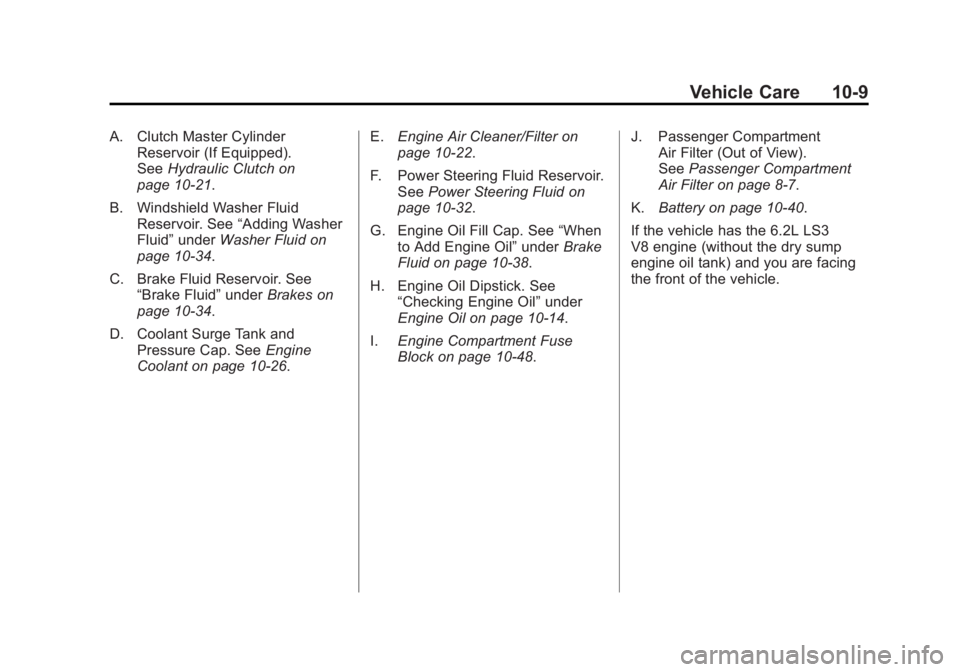
A. Clutch Master CylinderReservoir (If Equipped).
See Hydraulic Clutch on
page 10‑21.
B. Windshield Washer Fluid Reservoir. See “Adding Washer
Fluid” under Washer Fluid on
page 10‑34.
C. Brake Fluid Reservoir. See “Brake Fluid” underBrakes on
page 10‑34.
D. Coolant Surge Tank and Pressure Cap. See Engine
Coolant on page 10‑26. E.
Engine Air Cleaner/Filter on
page 10‑22.
F. Power Steering Fluid Reservoir. See Power Steering Fluid on
page 10‑32.
G. Engine Oil Fill Cap. See “When
to Add Engine Oil” underBrake
Fluid on page 10‑38.
H. Engine Oil Dipstick. See “Checking Engine Oil” under
Engine Oil on page 10‑14.
I. Engine Compartment Fuse
Block on page 10‑48. J. Passenger Compartment
Air Filter (Out of View).
See Passenger Compartment
Air Filter on page 8‑7.
K. Battery on page 10‑40.
If the vehicle has the 6.2L LS3
V8 engine (without the dry sump
engine oil tank) and you are facing
the front of the vehicle.
Page 287 of 432
Black plate (11,1)Chevrolet Corvette Owner Manual - 2012
Vehicle Care 10-11
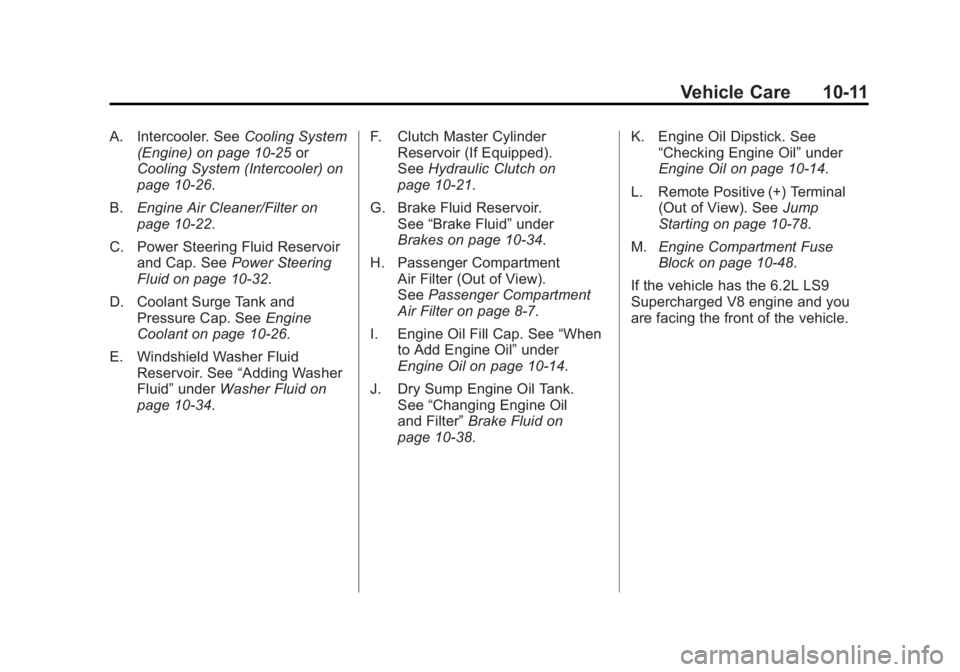
A. Intercooler. SeeCooling System
(Engine) on page 10‑25 or
Cooling System (Intercooler) on
page 10‑26.
B. Engine Air Cleaner/Filter on
page 10‑22.
C. Power Steering Fluid Reservoir and Cap. See Power Steering
Fluid on page 10‑32.
D. Coolant Surge Tank and Pressure Cap. See Engine
Coolant on page 10‑26.
E. Windshield Washer Fluid Reservoir. See “Adding Washer
Fluid” under Washer Fluid on
page 10‑34. F. Clutch Master Cylinder
Reservoir (If Equipped).
See Hydraulic Clutch on
page 10‑21.
G. Brake Fluid Reservoir. See “Brake Fluid” under
Brakes on page 10‑34.
H. Passenger Compartment Air Filter (Out of View).
See Passenger Compartment
Air Filter on page 8‑7.
I. Engine Oil Fill Cap. See “When
to Add Engine Oil” under
Engine Oil on page 10‑14.
J. Dry Sump Engine Oil Tank. See “Changing Engine Oil
and Filter” Brake Fluid on
page 10‑38. K. Engine Oil Dipstick. See
“Checking Engine Oil” under
Engine Oil on page 10‑14.
L. Remote Positive (+) Terminal (Out of View). See Jump
Starting on page 10‑78.
M. Engine Compartment Fuse
Block on page 10‑48.
If the vehicle has the 6.2L LS9
Supercharged V8 engine and you
are facing the front of the vehicle.
Page 289 of 432
Black plate (13,1)Chevrolet Corvette Owner Manual - 2012
Vehicle Care 10-13
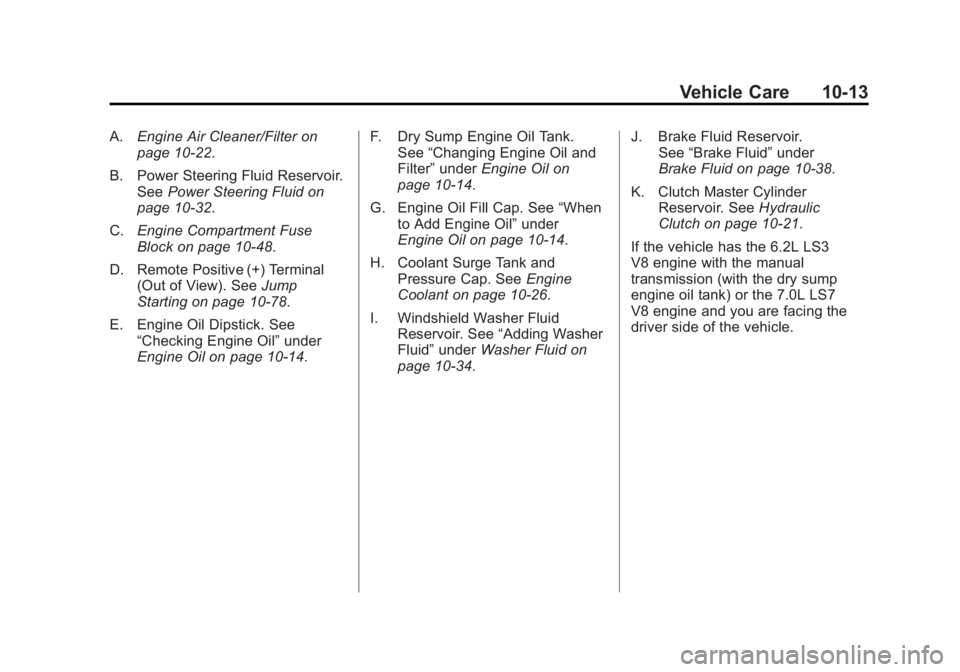
A.Engine Air Cleaner/Filter on
page 10‑22.
B. Power Steering Fluid Reservoir. See Power Steering Fluid on
page 10‑32.
C. Engine Compartment Fuse
Block on page 10‑48.
D. Remote Positive (+) Terminal (Out of View). See Jump
Starting on page 10‑78.
E. Engine Oil Dipstick. See “Checking Engine Oil” under
Engine Oil on page 10‑14. F. Dry Sump Engine Oil Tank.
See “Changing Engine Oil and
Filter” under Engine Oil on
page 10‑14.
G. Engine Oil Fill Cap. See “When
to Add Engine Oil” under
Engine Oil on page 10‑14.
H. Coolant Surge Tank and Pressure Cap. See Engine
Coolant on page 10‑26.
I. Windshield Washer Fluid Reservoir. See “Adding Washer
Fluid” under Washer Fluid on
page 10‑34. J. Brake Fluid Reservoir.
See “Brake Fluid” under
Brake Fluid on page 10‑38.
K. Clutch Master Cylinder Reservoir. See Hydraulic
Clutch on page 10‑21.
If the vehicle has the 6.2L LS3
V8 engine with the manual
transmission (with the dry sump
engine oil tank) or the 7.0L LS7
V8 engine and you are facing the
driver side of the vehicle.
Page 310 of 432
Black plate (34,1)Chevrolet Corvette Owner Manual - 2012
10-34 Vehicle Care
Washer Fluid
What to Use
When the vehicle needs windshield
washer fluid, be sure to read the
manufacturer's instructions before
use. If the vehicle will be operating
in an area where the temperature
may fall below freezing, use a fluid
that has sufficient protection against
freezing.
Adding Washer Fluid
Open the cap with the washer
symbol on it. Add washer fluid until
the tank is full. SeeEngine
Compartment Overview on
page 10‑8 for reservoir location. Notice
.When using concentrated
washer fluid, follow the
manufacturer's instructions
for adding water.
.Do not mix water with
ready-to-use washer fluid.
Water can cause the solution
to freeze and damage the
washer fluid tank and other
parts of the washer system.
Also, water does not clean as
well as washer fluid.
.Fill the washer fluid tank only
three-quarters full when it is
very cold. This allows for
fluid expansion if freezing
occurs, which could
damage the tank if it is
completely full.
.Do not use engine coolant
(antifreeze) in the windshield
washer. It can damage the
windshield washer system
and paint.
Brakes
Brake Wear (Except ZR1, Z06,
and Grand Sport)
This vehicle has disc brakes.
Disc brake pads have built-in wear
indicators that make a high-pitched
warning sound when the brake pads
are worn and new pads are needed.
The sound can come and go or be
heard all the time the vehicle is
moving, except when applying the
brake pedal firmly.
{WARNING
The brake wear warning sound
means that soon the brakes will
not work well. That could lead to
a crash. When the brake wear
warning sound is heard, have the
vehicle serviced.
Page 314 of 432
Black plate (38,1)Chevrolet Corvette Owner Manual - 2012
10-38 Vehicle Care
Brake Fluid
The brake master cylinder reservoir
is filled with DOT 3 brake fluid.
SeeEngine Compartment Overview
on page 10‑8 for the location of the
reservoir.
There are only two reasons why the
brake fluid level in the reservoir
might go down:
.The brake fluid level goes down
because of normal brake lining
wear. When new linings are
installed, the fluid level goes
back up.
.A fluid leak in the brake
hydraulic system can also cause
a low fluid level. Have the brake
hydraulic system fixed, since a
leak means that sooner or later
the brakes will not work well.
Do not top off the brake fluid.
Adding fluid does not correct a leak.
If fluid is added when the linings are
worn, there will be too much fluid
when new brake linings are
installed. Add or remove brake fluid,
as necessary, only when work is
done on the brake hydraulic system.
{WARNING
If too much brake fluid is added,
it can spill on the engine and
burn, if the engine is hot enough. (Continued)
WARNING (Continued)
You or others could be burned,
and the vehicle could be
damaged. Add brake fluid only
when work is done on the brake
hydraulic system. See “Checking
Brake Fluid” in this section.
Refer to the Maintenance Schedule
to determine when to check the
brake fluid. See Maintenance
Schedule on page 11‑3.
Page 315 of 432
Black plate (39,1)Chevrolet Corvette Owner Manual - 2012
Vehicle Care 10-39
Checking Brake Fluid
Check brake fluid by looking at the
brake fluid reservoir. SeeEngine
Compartment Overview on
page 10‑8.
The fluid level should be above the
MIN mark on the reservoir. If it is
not, have the brake hydraulic
system checked to see if there is
a leak.
After work is done on the brake
hydraulic system, make sure the
level is between the MIN and MAX
marks. What to Add
Use only new DOT 3 brake
fluid from a sealed container.
See
Recommended Fluids and
Lubricants on page 11‑12.
Always clean the brake fluid
reservoir cap and the area
around the cap before removing it.
This helps keep dirt from entering
the reservoir.
{WARNING
With the wrong kind of fluid in the
brake hydraulic system, the
brakes might not work well.
This could cause a crash.
Always use the proper brake fluid. Notice
.Using the wrong fluid
can badly damage brake
hydraulic system parts.
For example, just a few
drops of mineral-based oil,
such as engine oil, in the
brake hydraulic system can
damage brake hydraulic
system parts so badly that
they will have to be replaced.
Do not let someone put in
the wrong kind of fluid.
.If brake fluid is spilled on the
vehicle's painted surfaces,
the paint finish can be
damaged. Be careful not to
spill brake fluid on the
vehicle. If you do, wash it off
immediately.
Page 317 of 432

Black plate (41,1)Chevrolet Corvette Owner Manual - 2012
Vehicle Care 10-41
How to Check Lubricant
To get an accurate reading, the
vehicle should be on a level
surface.
If the level is below the bottom of
the fill plug hole, some lubricant will
need to be added. Add enough
lubricant to raise the level to the
bottom of the fill plug hole.
What to Use
To add lubricant when the level is
low or to completely refill after
draining, seeRecommended Fluids
and Lubricants on page 11‑12.
Then fill to the bottom of the fill plug
hole with the required lubricant.
Starter Switch Check
{WARNING
When you are doing this
inspection, the vehicle could
move suddenly. If the vehicle
moves, you or others could be
injured.
1. Before starting this check, be sure there is enough room
around the vehicle. 2. Firmly apply both the parking
brake and the regular brake.
See Parking Brake on
page 9‑36.
Do not use the accelerator
pedal, and be ready to turn off
the engine immediately if it
starts.
3. For automatic transmission vehicles, try to start the engine
in each gear. The vehicle should
start only in P (Park) or
N (Neutral). If the vehicle starts
in any other position, contact
your dealer for service.
For manual transmission
vehicles, put the shift lever in
Neutral, push the clutch pedal
down halfway, and try to start
the engine. The vehicle should
start only when the clutch pedal
is pushed down all the way to
the floor. If the vehicle starts
when the clutch pedal is not
pushed all the way down,
contact your dealer for service.
Page 367 of 432
Black plate (1,1)Chevrolet Corvette Owner Manual - 2012
Service and Maintenance 11-1
Service and
Maintenance
General Information
General Information . . . . . . . . . . 11-1
Maintenance Schedule
Maintenance Schedule . . . . . . . 11-3
Special Application Services
Special ApplicationServices . . . . . . . . . . . . . . . . . . . . 11-8
Additional Maintenance
and Care
Additional Maintenanceand Care . . . . . . . . . . . . . . . . . . . 11-8
Recommended Fluids,
Lubricants, and Parts
Recommended Fluids andLubricants . . . . . . . . . . . . . . . . . 11-12
Maintenance Replacement Parts . . . . . . . . . . . . . . . . . . . . . . 11-14
Maintenance Records
Maintenance Records . . . . . . 11-15
General Information
Your vehicle is an important
investment. This section describes
the required maintenance for the
vehicle. Follow this schedule to
help protect against major repair
expenses resulting from neglect or
inadequate maintenance. It may
also help to maintain the value of
the vehicle if it is sold. It is the
responsibility of the owner to have
all required maintenance performed.
Your dealer has trained technicians
who can perform required
maintenance using genuine
replacement parts. They have
up‐to‐date tools and equipment
for fast and accurate diagnostics.
Many dealers have extended
evening and Saturday hours,
courtesy transportation, and online
scheduling to assist with service
needs. Your dealer recognizes the
importance of providing
competitively priced maintenance
and repair services. With trained
technicians, the dealer is the place
for routine maintenance such as oil
changes and tire rotations and
additional maintenance items like
tires, brakes, batteries, and wiper
blades.
Notice:
Damage caused by
improper maintenance can lead to
costly repairs and may not be
covered by the vehicle warranty.
Maintenance intervals, checks,
inspections, recommended fluids,
and lubricants are important to
keep the vehicle in good working
condition.
The Required Services are the
responsibility of the vehicle owner.
It is recommended to have your
dealer perform these services
every 12 000 km/7,500 mi.
Page 370 of 432
Black plate (4,1)Chevrolet Corvette Owner Manual - 2012
11-4 Service and Maintenance
.Check tire inflation pressures.
SeeTire Pressure on
page 10‑62.
.Inspect tire wear. See Tire
Inspection on page 10‑68.
.Visually check for fluid leaks.
.Inspect engine air cleaner filter.
See Engine Air Cleaner/Filter on
page 10‑22.
.Inspect brake system.
.Visually inspect steering,
suspension, and chassis
components for damaged, loose,
or missing parts or signs of
wear. See Exterior Care on
page 10‑82.
.Check restraint system
components. See Safety
System Check on page 3‑14.
.Visually inspect fuel system for
damage or leaks.
.Visually inspect exhaust system
and nearby heat shields for
loose or damaged parts.
.Lubricate body components.
See Exterior Care on
page 10‑82.
.Check starter switch. See Starter
Switch Check on page 10‑41.
.Check automatic transmission
shift lock control function.
See Automatic Transmission
Shift Lock Control Function
Check on page 10‑42.
.Check parking brake and
automatic transmission park
mechanism. See Park Brake and
P (Park) Mechanism Check on
page 10‑42.
.Check accelerator pedal for
damage, high effort, or binding.
Replace if needed.
.Visually inspect gas strut for
signs of wear, cracks, or other
damage. Check the hold open
ability of the strut. See your
dealer if service is required.