power steering CHEVROLET CORVETTE C6 2012 User Guide
[x] Cancel search | Manufacturer: CHEVROLET, Model Year: 2012, Model line: CORVETTE C6, Model: CHEVROLET CORVETTE C6 2012Pages: 432, PDF Size: 5.73 MB
Page 183 of 432
Black plate (1,1)Chevrolet Corvette Owner Manual - 2012
Lighting 6-1
Lighting
Exterior Lighting
Exterior Lamp Controls . . . . . . . . 6-1
Exterior Lamps OffReminder . . . . . . . . . . . . . . . . . . . . 6-2
Headlamp High/Low-Beam Changer . . . . . . . . . . . . . . . . . . . . . 6-2
Flash-to-Pass . . . . . . . . . . . . . . . . . 6-2
Daytime Running Lamps (DRL) . . . . . . . . . . . . . . . . 6-2
Twilight Sentinel . . . . . . . . . . . . . . 6-3
Hazard Warning Flashers . . . . . 6-4
Turn and Lane-Change Signals . . . . . . . . . . . . . . . . . . . . . . 6-4
Fog Lamps . . . . . . . . . . . . . . . . . . . . 6-5
Interior Lighting
Instrument Panel Illumination Control . . . . . . . . . . . . . . . . . . . . . . 6-6
Courtesy Lamps . . . . . . . . . . . . . . 6-6
Reading Lamps . . . . . . . . . . . . . . . 6-6
Lighting Features
Entry/Exit Lighting . . . . . . . . . . . . . 6-6
Battery Power Protection . . . . . . 6-7
Exterior Lighting Battery Saver . . . . . . . . . . . . . . . . . . . . . . . . 6-7
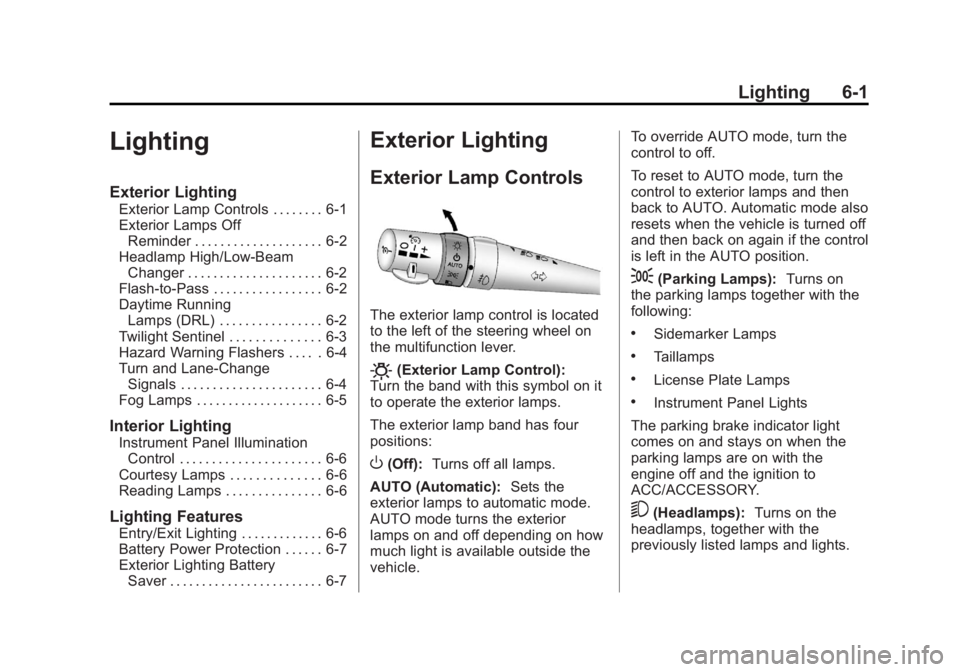
Exterior Lighting
Exterior Lamp Controls
The exterior lamp control is located
to the left of the steering wheel on
the multifunction lever.
O(Exterior Lamp Control):
Turn the band with this symbol on it
to operate the exterior lamps.
The exterior lamp band has four
positions:
O(Off): Turns off all lamps.
AUTO (Automatic): Sets the
exterior lamps to automatic mode.
AUTO mode turns the exterior
lamps on and off depending on how
much light is available outside the
vehicle. To override AUTO mode, turn the
control to off.
To reset to AUTO mode, turn the
control to exterior lamps and then
back to AUTO. Automatic mode also
resets when the vehicle is turned off
and then back on again if the control
is left in the AUTO position.
;(Parking Lamps):
Turns on
the parking lamps together with the
following:
.Sidemarker Lamps
.Taillamps
.License Plate Lamps
.Instrument Panel Lights
The parking brake indicator light
comes on and stays on when the
parking lamps are on with the
engine off and the ignition to
ACC/ACCESSORY.
5(Headlamps): Turns on the
headlamps, together with the
previously listed lamps and lights.
Page 223 of 432
Black plate (1,1)Chevrolet Corvette Owner Manual - 2012
Driving and Operating 9-1
Driving and
Operating
Driving Information
Distracted Driving . . . . . . . . . . . . . 9-2
Defensive Driving . . . . . . . . . . . . . 9-3
Drunk Driving . . . . . . . . . . . . . . . . . 9-3
Control of a Vehicle . . . . . . . . . . . 9-4
Braking . . . . . . . . . . . . . . . . . . . . . . . 9-4
Steering . . . . . . . . . . . . . . . . . . . . . . . 9-4
Off-Road Recovery . . . . . . . . . . . . 9-5
Loss of Control . . . . . . . . . . . . . . . . 9-5
Racing or Other CompetitiveDriving . . . . . . . . . . . . . . . . . . . . . . . 9-6
Driving on Wet Roads . . . . . . . . . 9-9
Highway Hypnosis . . . . . . . . . . . 9-10
Hill and Mountain Roads . . . . . 9-10
Winter Driving . . . . . . . . . . . . . . . . 9-11
If the Vehicle Is Stuck . . . . . . . . 9-13
Vehicle Load Limits . . . . . . . . . . 9-14
Starting and Operating
New Vehicle Break-In . . . . . . . . 9-18
Front Air Dam . . . . . . . . . . . . . . . 9-19
Ignition Positions . . . . . . . . . . . . 9-20
Starting the Engine . . . . . . . . . . 9-22
Retained Accessory Power (RAP) . . . . . . . . . . . . . . . 9-24
Shifting Into Park (Automatic
Transmission) . . . . . . . . . . . . . . 9-24
Shifting out of Park . . . . . . . . . . 9-25
Parking (Manual Transmission) . . . . . . . . . . . . . . 9-26
Parking over Things That Burn . . . . . . . . . . . . . . . . . . 9-26
Engine Exhaust
Engine Exhaust . . . . . . . . . . . . . . 9-26
Running the Vehicle WhileParked . . . . . . . . . . . . . . . . . . . . . 9-27
Automatic Transmission
Automatic Transmission . . . . . 9-27
Manual Mode . . . . . . . . . . . . . . . . 9-29
Manual Transmission
Manual Transmission . . . . . . . . 9-32
Brakes
Antilock BrakeSystem (ABS) . . . . . . . . . . . . . . 9-35
Parking Brake . . . . . . . . . . . . . . . 9-36
Brake Assist . . . . . . . . . . . . . . . . . 9-36
Ride Control Systems
Traction Control System (TCS) . . . . . . . . . . . . . . 9-36
Active Handling System . . . . . 9-38
Competitive Driving Mode . . . 9-39
Limited-Slip Rear Axle . . . . . . . 9-43
Selective Ride Control . . . . . . . 9-43
Cruise Control
Cruise Control . . . . . . . . . . . . . . . 9-45
Page 226 of 432
Black plate (4,1)Chevrolet Corvette Owner Manual - 2012
9-4 Driving and Operating
Control of a Vehicle
Braking, steering, and accelerating
are important factors in helping to
control a vehicle while driving.
Braking
Braking action involves perception
time and reaction time. Deciding to
push the brake pedal is perception
time. Actually doing it is
reaction time.
Average driver reaction time is
about three-quarters of a second.
In that time, a vehicle moving at
100 km/h (60 mph) travels 20 m
(66 ft), which could be a lot of
distance in an emergency.Helpful braking tips to keep in mind
include:
.Keep enough distance between
you and the vehicle in front
of you.
.Avoid needless heavy braking.
.Keep pace with traffic.
If the engine ever stops while the
vehicle is being driven, brake
normally but do not pump the
brakes. Doing so could make the
pedal harder to push down. If the
engine stops, there will be some
power brake assist but it will be
used when the brake is applied.
Once the power assist is used up,
it can take longer to stop and the
brake pedal will be harder to push.
Steering
Magnetic Effort Steering
This system continuously adjusts
the effort felt when steering at all
vehicle speeds. It provides ease
when parking, yet a firm, solid feel
at highway speeds.
Hydraulic Power Steering
Your vehicle has hydraulic
power steering. It may require
maintenance. See Power Steering
Fluid Power Steering Fluid on
page 10‑32.
If power steering assist is lost
because the engine stops or the
power steering system is not
functioning, the vehicle can be
steered but may required increased
effort. See your dealer if there is a
problem.
Page 242 of 432
Black plate (20,1)Chevrolet Corvette Owner Manual - 2012
9-20 Driving and Operating
Ignition Positions
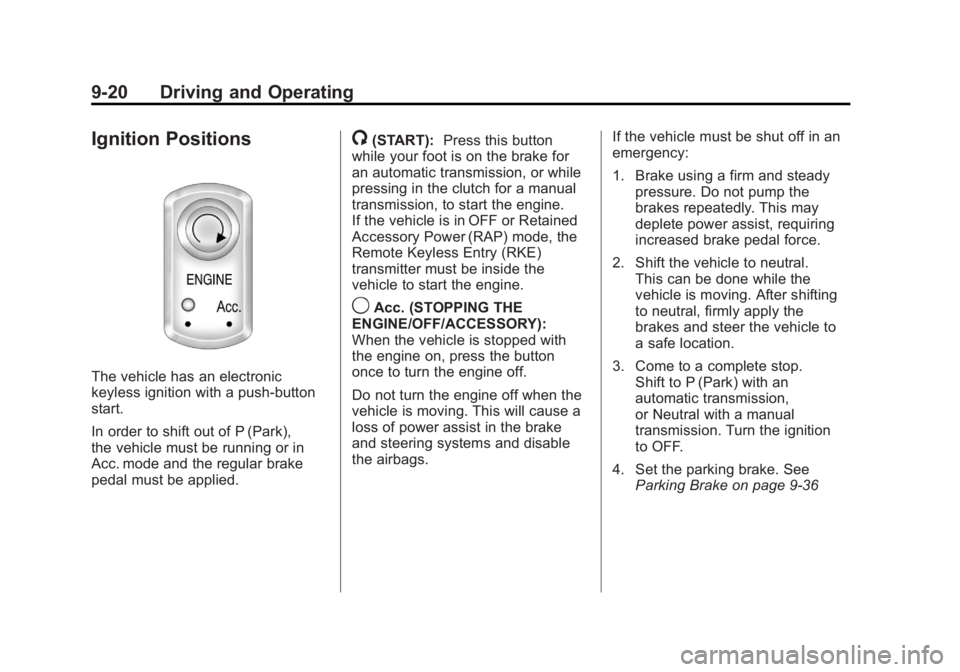
The vehicle has an electronic
keyless ignition with a push-button
start.
In order to shift out of P (Park),
the vehicle must be running or in
Acc. mode and the regular brake
pedal must be applied.
/(START):Press this button
while your foot is on the brake for
an automatic transmission, or while
pressing in the clutch for a manual
transmission, to start the engine.
If the vehicle is in OFF or Retained
Accessory Power (RAP) mode, the
Remote Keyless Entry (RKE)
transmitter must be inside the
vehicle to start the engine.
9Acc. (STOPPING THE
ENGINE/OFF/ACCESSORY):
When the vehicle is stopped with
the engine on, press the button
once to turn the engine off.
Do not turn the engine off when the
vehicle is moving. This will cause a
loss of power assist in the brake
and steering systems and disable
the airbags. If the vehicle must be shut off in an
emergency:
1. Brake using a firm and steady
pressure. Do not pump the
brakes repeatedly. This may
deplete power assist, requiring
increased brake pedal force.
2. Shift the vehicle to neutral. This can be done while the
vehicle is moving. After shifting
to neutral, firmly apply the
brakes and steer the vehicle to
a safe location.
3. Come to a complete stop. Shift to P (Park) with an
automatic transmission,
or Neutral with a manual
transmission. Turn the ignition
to OFF.
4. Set the parking brake. See Parking Brake on page 9‑36
Page 243 of 432
Black plate (21,1)Chevrolet Corvette Owner Manual - 2012
Driving and Operating 9-21
{WARNING
Turning off the vehicle while
moving may cause loss of power
assist in the brake and steering
systems and disable the airbags.
While driving, only shut the
vehicle off in an emergency.
If the vehicle cannot be pulled
over, and must be shut off while
driving, turn the ignition to
ACC/ACCESSORY.
When the engine is on or the
vehicle is in accessory power
mode, it is recommended that a
manual transmission be placed
in R (Reverse). An automatic
transmission must be placed in
P (Park). Then press the Acc. button
to turn the engine off and place the
vehicle in RAP. See Retained
Accessory Power (RAP) on
page 9‑24 for more information. If an automatic vehicle is not
correctly placed in P (Park) a SHIFT
TO PARK message will display on
the Driver Information Center (DIC).
For more information, see
Transmission Messages on
page 5‑52.
When the engine is off, press this
button to place the vehicle in
accessory mode. ACCESSORY
MODE ON will display on the Driver
Information Center (DIC). This mode
allows you to use things like the
radio and the power windows while
the engine is off. Use accessory
mode if you must have the vehicle
in motion while the engine is off, for
example, if the vehicle is being
pushed or towed.
After being in accessory mode for
about 10 minutes, the vehicle will
automatically enter RAP or OFF,
depending on if the doors are
opened or closed.
Service Only Mode
This power mode is available for
service and diagnostics, and to
verify the proper operation of the
malfunction indicator lamp as may
be required for emission inspection
purposes. With the vehicle off,
pressing and holding the bottom
of the button for more than
five seconds will place the vehicle in
Service Only Mode. The instruments
and audio systems will operate as
they do when the engine is running,
but the vehicle will not be able to be
driven. The engine will not start in
Service Only Mode. Push the button
again to turn the vehicle off.
Page 251 of 432
Black plate (29,1)Chevrolet Corvette Owner Manual - 2012
Driving and Operating 9-29
The repairs would not be
covered by the vehicle warranty.
Be sure the engine is not running
at high speed when shifting the
vehicle.
D (Drive):This position is for
normal driving. It provides the best
fuel economy. If you need more
power for passing, push the pedal
down to achieve the desired level of
acceleration.
Downshifting the transmission in
slippery road conditions could result
in skidding. See “Skidding”under
Loss of Control on page 9‑5.
S (Sport Mode): When in
S (Sport Mode), the transmission will
work as an automatic until you use
the Manual Paddle Shift Controls,
which activates driver manual gear
selection. See Manual Mode on
page 9‑29. While in S (Sport Mode),
the transmission will have more
noticeable upshifts for sportier
vehicle performance.Manual Mode
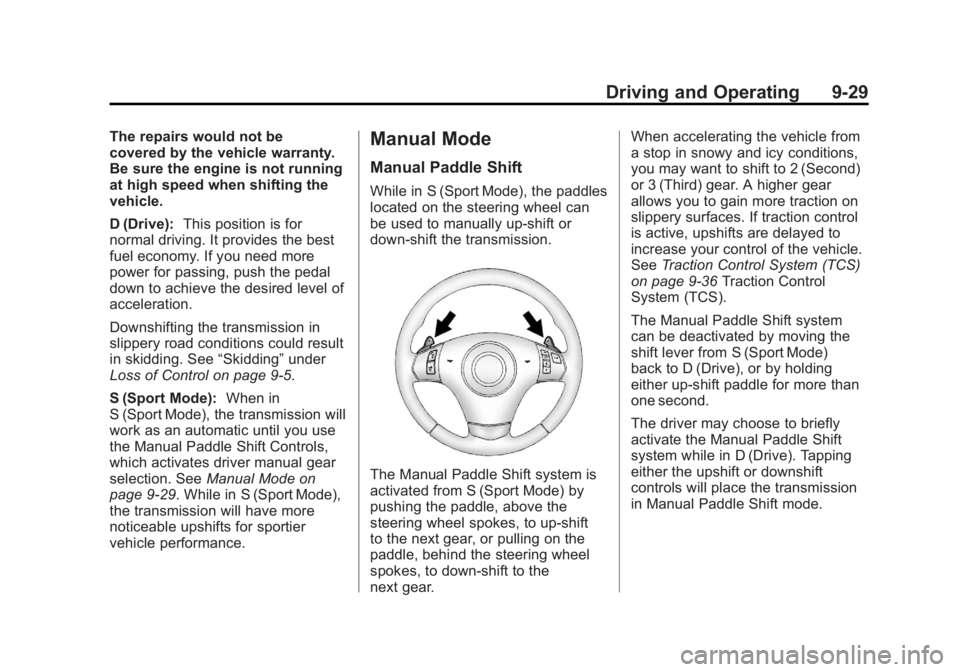
Manual Paddle Shift
While in S (Sport Mode), the paddles
located on the steering wheel can
be used to manually up-shift or
down-shift the transmission.
The Manual Paddle Shift system is
activated from S (Sport Mode) by
pushing the paddle, above the
steering wheel spokes, to up-shift
to the next gear, or pulling on the
paddle, behind the steering wheel
spokes, to down-shift to the
next gear. When accelerating the vehicle from
a stop in snowy and icy conditions,
you may want to shift to 2 (Second)
or 3 (Third) gear. A higher gear
allows you to gain more traction on
slippery surfaces. If traction control
is active, upshifts are delayed to
increase your control of the vehicle.
See
Traction Control System (TCS)
on page 9‑36 Traction Control
System (TCS).
The Manual Paddle Shift system
can be deactivated by moving the
shift lever from S (Sport Mode)
back to D (Drive), or by holding
either up‐shift paddle for more than
one second.
The driver may choose to briefly
activate the Manual Paddle Shift
system while in D (Drive). Tapping
either the upshift or downshift
controls will place the transmission
in Manual Paddle Shift mode.
Page 277 of 432
Black plate (1,1)Chevrolet Corvette Owner Manual - 2012
Vehicle Care 10-1
Vehicle Care
General Information
General Information . . . . . . . . . . 10-2
California Proposition65 Warning . . . . . . . . . . . . . . . . . 10-3
California Perchlorate Materials Requirements . . . . 10-3
Accessories and Modifications . . . . . . . . . . . . . . . 10-3
Lifting the Vehicle . . . . . . . . . . . . 10-4
Vehicle Checks
Doing Your Own Service Work . . . . . . . . . . . . . . . 10-7
Hood . . . . . . . . . . . . . . . . . . . . . . . . 10-7
Engine Compartment Overview . . . . . . . . . . . . . . . . . . . 10-8
Engine Oil . . . . . . . . . . . . . . . . . . 10-14
Engine Oil Life System . . . . . 10-19
Automatic Transmission Fluid . . . . . . . . . . . . . . . . . . . . . . 10-20
Manual Transmission Fluid . . . . . . . . . . . . . . . . . . . . . . 10-21
Hydraulic Clutch . . . . . . . . . . . . 10-21 Engine Air Cleaner/Filter . . . . 10-22
Cooling System (Engine) . . . 10-25
Cooling System
(Intercooler) . . . . . . . . . . . . . . . 10-26
Engine Coolant . . . . . . . . . . . . . 10-26
Engine Overheating . . . . . . . . 10-30
Overheated Engine
Protection
Operating Mode . . . . . . . . . . . 10-32
Power Steering Fluid . . . . . . . 10-32
Washer Fluid . . . . . . . . . . . . . . . 10-34
Brakes . . . . . . . . . . . . . . . . . . . . . 10-34
Brake Fluid . . . . . . . . . . . . . . . . . 10-38
Battery . . . . . . . . . . . . . . . . . . . . . 10-40
Rear Axle . . . . . . . . . . . . . . . . . . 10-40
Starter Switch Check . . . . . . . 10-41
Automatic Transmission Shift Lock Control
Function Check . . . . . . . . . . . 10-42
Park Brake and P (Park) Mechanism Check . . . . . . . . 10-42
Wiper Blade Replacement . . . . . . . . . . . . . . 10-43
Windshield Replacement . . . 10-43
Headlamp Aiming
Headlamp Aiming . . . . . . . . . . 10-44
Bulb Replacement
Bulb Replacement . . . . . . . . . . 10-44
Halogen Bulbs . . . . . . . . . . . . . . 10-44
High Intensity Discharge (HID) Lighting . . . . . . . . . . . . . 10-44
Headlamps, Front Turn
Signal and Parking
Lamps . . . . . . . . . . . . . . . . . . . . 10-45
Taillamps, Turn Signal, and Stoplamps . . . . . . . . . . . . . . . . 10-46
Replacement Bulbs . . . . . . . . . 10-46
Electrical System
Electrical System Overload . . . . . . . . . . . . . . . . . . 10-46
Fuses and Circuit Breakers . . . . . . . . . . . . . . . . . . 10-47
Engine Compartment
Fuse Block . . . . . . . . . . . . . . . . 10-48
Instrument Panel Fuse Block . . . . . . . . . . . . . . . . . . . . . 10-51
Wheels and Tires
Tires . . . . . . . . . . . . . . . . . . . . . . . . 10-54
Winter Tires . . . . . . . . . . . . . . . . 10-55
Run-Flat Tires . . . . . . . . . . . . . . 10-56
Low-Profile Tires . . . . . . . . . . . 10-57
Page 285 of 432
Black plate (9,1)Chevrolet Corvette Owner Manual - 2012
Vehicle Care 10-9
A. Clutch Master CylinderReservoir (If Equipped).
See Hydraulic Clutch on
page 10‑21.
B. Windshield Washer Fluid Reservoir. See “Adding Washer
Fluid” under Washer Fluid on
page 10‑34.
C. Brake Fluid Reservoir. See “Brake Fluid” underBrakes on
page 10‑34.
D. Coolant Surge Tank and Pressure Cap. See Engine
Coolant on page 10‑26. E.
Engine Air Cleaner/Filter on
page 10‑22.
F. Power Steering Fluid Reservoir. See Power Steering Fluid on
page 10‑32.
G. Engine Oil Fill Cap. See “When
to Add Engine Oil” underBrake
Fluid on page 10‑38.
H. Engine Oil Dipstick. See “Checking Engine Oil” under
Engine Oil on page 10‑14.
I. Engine Compartment Fuse
Block on page 10‑48. J. Passenger Compartment
Air Filter (Out of View).
See Passenger Compartment
Air Filter on page 8‑7.
K. Battery on page 10‑40.
If the vehicle has the 6.2L LS3
V8 engine (without the dry sump
engine oil tank) and you are facing
the front of the vehicle.
Page 287 of 432
Black plate (11,1)Chevrolet Corvette Owner Manual - 2012
Vehicle Care 10-11
A. Intercooler. SeeCooling System
(Engine) on page 10‑25 or
Cooling System (Intercooler) on
page 10‑26.
B. Engine Air Cleaner/Filter on
page 10‑22.
C. Power Steering Fluid Reservoir and Cap. See Power Steering
Fluid on page 10‑32.
D. Coolant Surge Tank and Pressure Cap. See Engine
Coolant on page 10‑26.
E. Windshield Washer Fluid Reservoir. See “Adding Washer
Fluid” under Washer Fluid on
page 10‑34. F. Clutch Master Cylinder
Reservoir (If Equipped).
See Hydraulic Clutch on
page 10‑21.
G. Brake Fluid Reservoir. See “Brake Fluid” under
Brakes on page 10‑34.
H. Passenger Compartment Air Filter (Out of View).
See Passenger Compartment
Air Filter on page 8‑7.
I. Engine Oil Fill Cap. See “When
to Add Engine Oil” under
Engine Oil on page 10‑14.
J. Dry Sump Engine Oil Tank. See “Changing Engine Oil
and Filter” Brake Fluid on
page 10‑38. K. Engine Oil Dipstick. See
“Checking Engine Oil” under
Engine Oil on page 10‑14.
L. Remote Positive (+) Terminal (Out of View). See Jump
Starting on page 10‑78.
M. Engine Compartment Fuse
Block on page 10‑48.
If the vehicle has the 6.2L LS9
Supercharged V8 engine and you
are facing the front of the vehicle.
Page 289 of 432
Black plate (13,1)Chevrolet Corvette Owner Manual - 2012
Vehicle Care 10-13
A.Engine Air Cleaner/Filter on
page 10‑22.
B. Power Steering Fluid Reservoir. See Power Steering Fluid on
page 10‑32.
C. Engine Compartment Fuse
Block on page 10‑48.
D. Remote Positive (+) Terminal (Out of View). See Jump
Starting on page 10‑78.
E. Engine Oil Dipstick. See “Checking Engine Oil” under
Engine Oil on page 10‑14. F. Dry Sump Engine Oil Tank.
See “Changing Engine Oil and
Filter” under Engine Oil on
page 10‑14.
G. Engine Oil Fill Cap. See “When
to Add Engine Oil” under
Engine Oil on page 10‑14.
H. Coolant Surge Tank and Pressure Cap. See Engine
Coolant on page 10‑26.
I. Windshield Washer Fluid Reservoir. See “Adding Washer
Fluid” under Washer Fluid on
page 10‑34. J. Brake Fluid Reservoir.
See “Brake Fluid” under
Brake Fluid on page 10‑38.
K. Clutch Master Cylinder Reservoir. See Hydraulic
Clutch on page 10‑21.
If the vehicle has the 6.2L LS3
V8 engine with the manual
transmission (with the dry sump
engine oil tank) or the 7.0L LS7
V8 engine and you are facing the
driver side of the vehicle.