instrument panel CHEVROLET CORVETTE C6 2012 Workshop Manual
[x] Cancel search | Manufacturer: CHEVROLET, Model Year: 2012, Model line: CORVETTE C6, Model: CHEVROLET CORVETTE C6 2012Pages: 432, PDF Size: 5.73 MB
Page 283 of 432
Black plate (7,1)Chevrolet Corvette Owner Manual - 2012
Vehicle Care 10-7
Vehicle Checks
Doing Your Own
Service Work
{WARNING
It can be dangerous to work on
your vehicle if you do not have
the proper knowledge, service
manual, tools, or parts. Always
follow owner manual procedures
and consult the service manual
for your vehicle before doing any
service work.
If doing some of your own service
work, use the proper service
manual. It tells you much more
about how to service the vehicle
than this manual can. To order the
proper service manual, see Service
Publications Ordering Information
on page 13‑18. This vehicle has an airbag system.
Before attempting to do your own
service work, see
Servicing the
Airbag-Equipped Vehicle on
page 3‑26.
Keep a record with all parts receipts
and list the mileage and the date
of any service work performed.
See Maintenance Records on
page 11‑15.
Hood
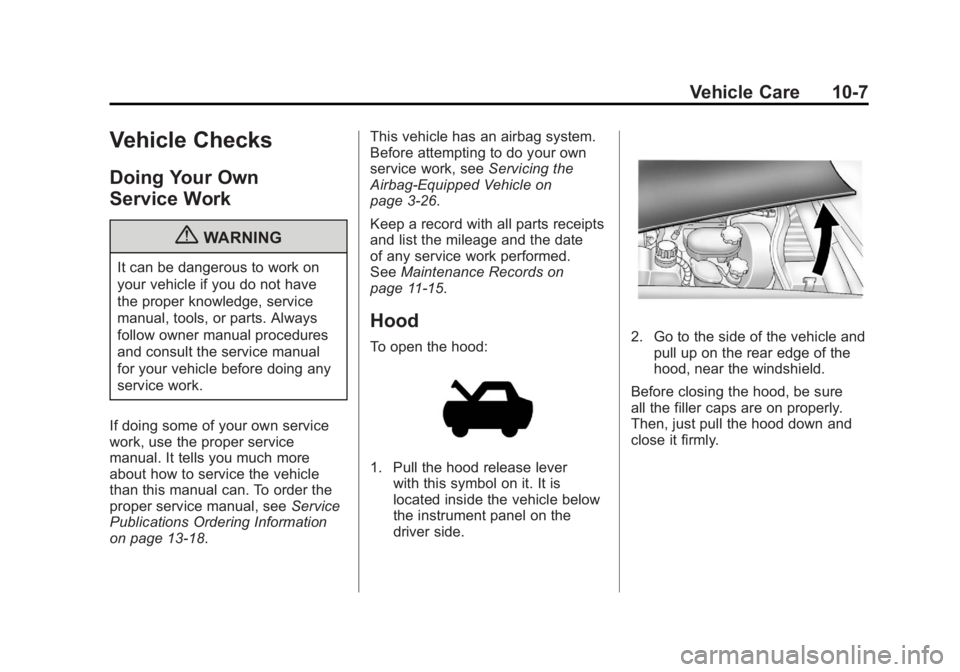
To open the hood:
1. Pull the hood release lever with this symbol on it. It is
located inside the vehicle below
the instrument panel on the
driver side.
2. Go to the side of the vehicle and
pull up on the rear edge of the
hood, near the windshield.
Before closing the hood, be sure
all the filler caps are on properly.
Then, just pull the hood down and
close it firmly.
Page 306 of 432
Black plate (30,1)Chevrolet Corvette Owner Manual - 2012
10-30 Vehicle Care
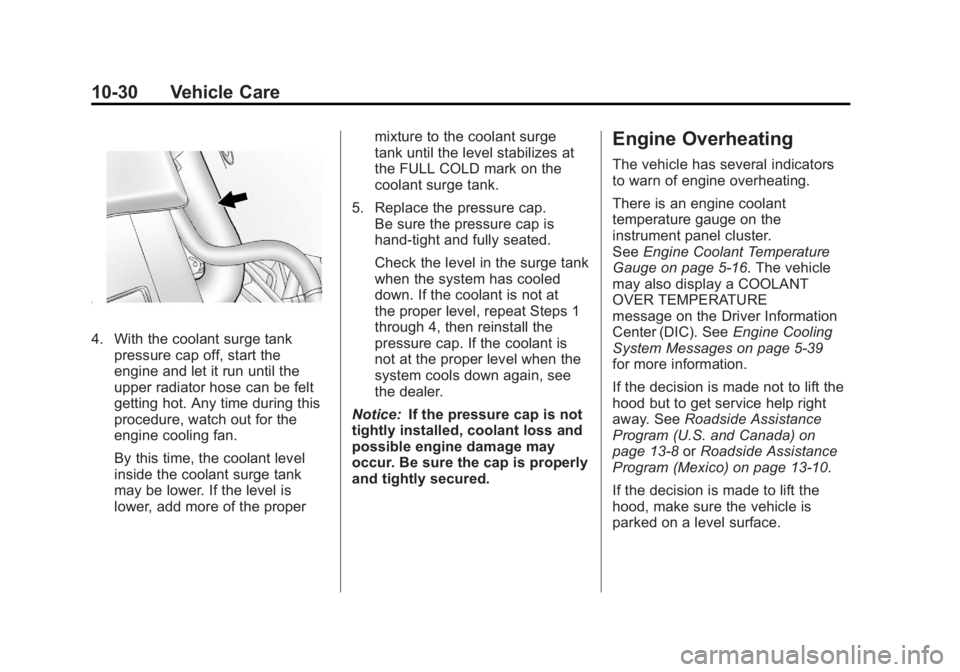
4. With the coolant surge tankpressure cap off, start the
engine and let it run until the
upper radiator hose can be felt
getting hot. Any time during this
procedure, watch out for the
engine cooling fan.
By this time, the coolant level
inside the coolant surge tank
may be lower. If the level is
lower, add more of the proper mixture to the coolant surge
tank until the level stabilizes at
the FULL COLD mark on the
coolant surge tank.
5. Replace the pressure cap. Be sure the pressure cap is
hand-tight and fully seated.
Check the level in the surge tank
when the system has cooled
down. If the coolant is not at
the proper level, repeat Steps 1
through 4, then reinstall the
pressure cap. If the coolant is
not at the proper level when the
system cools down again, see
the dealer.
Notice: If the pressure cap is not
tightly installed, coolant loss and
possible engine damage may
occur. Be sure the cap is properly
and tightly secured.
Engine Overheating
The vehicle has several indicators
to warn of engine overheating.
There is an engine coolant
temperature gauge on the
instrument panel cluster.
See Engine Coolant Temperature
Gauge on page 5‑16. The vehicle
may also display a COOLANT
OVER TEMPERATURE
message on the Driver Information
Center (DIC). See Engine Cooling
System Messages on page 5‑39
for more information.
If the decision is made not to lift the
hood but to get service help right
away. See Roadside Assistance
Program (U.S. and Canada) on
page 13‑8 orRoadside Assistance
Program (Mexico) on page 13‑10.
If the decision is made to lift the
hood, make sure the vehicle is
parked on a level surface.
Page 327 of 432
Black plate (51,1)Chevrolet Corvette Owner Manual - 2012
Vehicle Care 10-51
Instrument Panel Fuse
Block
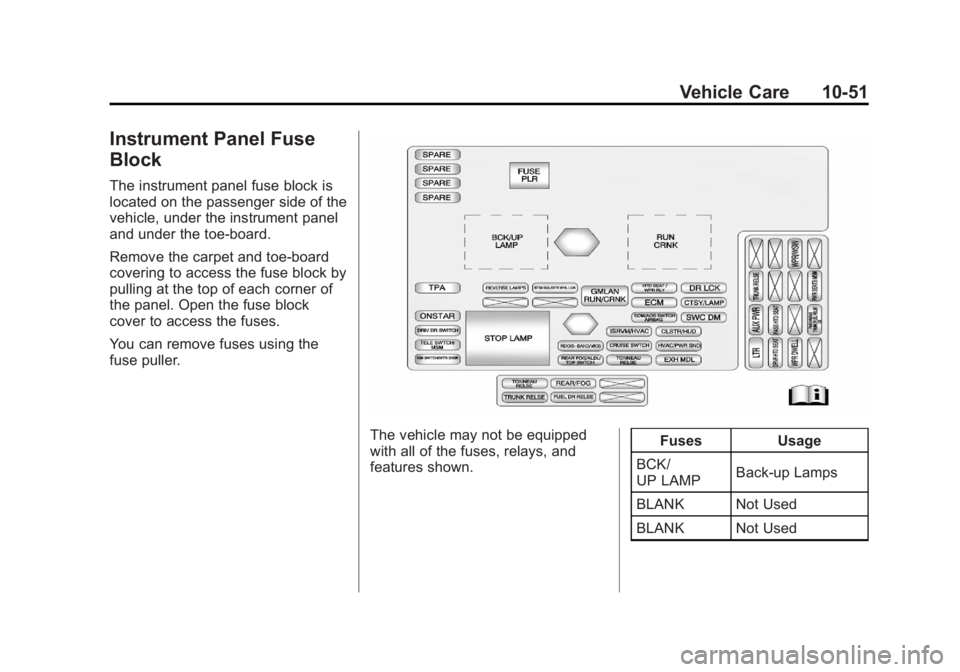
The instrument panel fuse block is
located on the passenger side of the
vehicle, under the instrument panel
and under the toe-board.
Remove the carpet and toe-board
covering to access the fuse block by
pulling at the top of each corner of
the panel. Open the fuse block
cover to access the fuses.
You can remove fuses using the
fuse puller.
The vehicle may not be equipped
with all of the fuses, relays, and
features shown.Fuses Usage
BCK/
UP LAMP Back-up Lamps
BLANK Not Used
BLANK Not Used
Page 332 of 432
Black plate (56,1)Chevrolet Corvette Owner Manual - 2012
10-56 Vehicle Care
Run-Flat Tires
This vehicle, when new, had run-flat
tires. There is no spare tire, no tire
changing equipment, and no place
to store a tire in the vehicle.
The vehicle also has a Tire
Pressure Monitor System (TPMS)
that indicates a loss of tire pressure
in any of the tires.
{WARNING
If the low tire warning light
displays on the instrument panel
cluster, the handling capabilities
will be reduced during severe
maneuvers. Driving too fast could
cause loss of control and you or
others could be injured. Do not
drive over 90 km/h (55 mph)
when the low tire warning light is
displayed. Drive cautiously and
check the tire pressures as soon
as possible.If a tire goes flat, there is no need to
stop on the side of the road to
change the tire. Continue driving,
however, do not drive too far or too
fast. Driving on the tire may not be
possible if there is permanent
damage. The tire can be driven with
no air pressure for up to 105 km
(65 miles) at speeds slower than
90 km/h (55 mph). The shorter the
distance and the slower the speed,
the greater the chance the tire will
not have to be replaced. As soon
as possible, contact the nearest
authorized GM or run-flat servicing
facility for inspection and repair or
replacement. When driving on a
deflated run-flat tire, avoid potholes
and other road hazards that could
damage the tire and/or wheel
beyond repair. When a tire has been
damaged, or if driven any distance
on a deflated run-flat tire, check with
an authorized run-flat tire service
center to determine whether the
tire can be repaired or should be
replaced. To maintain the run-flat
feature, all replacement tires must
be run-flat tires. To locate the nearest GM or run-flat
servicing facility, call Roadside
Assistance. See
Roadside
Assistance Program (U.S. and
Canada) on page 13‑8 orRoadside
Assistance Program (Mexico) on
page 13‑10 for details.
The valve stems on run-flat
tires have sensors that are part of
the TPMS. See Tire Pressure
Monitor System on page 10‑64.
These sensors contain batteries that
are designed to last for 10 years
under normal driving conditions.
See your dealer for wheel or sensor
replacement.
Notice: Using liquid sealants can
damage the tire valves and tire
pressure monitor sensors in the
run-flat tires. This damage is not
covered by the vehicle warranty.
Do not use liquid sealants in
run-flat tires.
Page 364 of 432
Black plate (88,1)Chevrolet Corvette Owner Manual - 2012
10-88 Vehicle Care
To clean:
1. Saturate a clean lint-freecolorfast cloth with water or club
soda. Microfiber cloth is
recommended to prevent lint
transfer to the fabric or carpet.
2. Remove excess moisture by gently wringing until water does
not drip from the cleaning cloth.
3. Start on the outside edge of the soil and gently rub toward the
center. Rotate the cleaning cloth
to a clean area frequently to
prevent forcing the soil in to the
fabric.
4. Continue gently rubbing the soiled area until there is no
longer any color transfer from
the soil to the cleaning cloth.
5. If the soil is not completely removed, use a mild soap
solution followed by only club
soda or plain water. If the soil is not completely
removed, it may be necessary
to use a commercial upholstery
cleaner or spot lifter. Test a small
hidden area for colorfastness
before using a commercial
upholstery cleaner or spot lifter.
If ring formation occurs, clean the
entire fabric or carpet.
Following the cleaning process, a
paper towel can be used to blot
excess moisture.
Instrument Panel, Leather,
Vinyl, & Other Plastic Surfaces
Use a soft microfiber cloth
dampened with water to remove
dust and loose dirt. For a more
thorough cleaning, use a soft
microfiber cloth dampened with a
mild soap solution.
Notice:
Soaking or saturating
leather, especially perforated
leather, as well as other interior
surfaces, may cause permanent
damage. Wipe excess moisture from these surfaces after
cleaning and allow them to dry
naturally. Never use heat, steam,
spot lifters or spot removers.
Do not use cleaners that contain
silicone or wax-based products.
Cleaners containing these
solvents can permanently
change the appearance and feel
of leather or soft trim and are not
recommended.
Do not use cleaners that increase
gloss, especially on the instrument
panel. Reflected glare can decrease
visibility through the windshield
under certain conditions.
Notice:
Use of air fresheners may
cause permanent damage to
plastics and painted surfaces.
If an air freshener comes in
contact with any plastic or
painted surface in the vehicle,
blot immediately and clean with a
soft cloth dampened with a mild
soap solution. Damage caused
by air fresheners would not be
covered by the vehicle warranty.
Page 385 of 432
Black plate (1,1)Chevrolet Corvette Owner Manual - 2012
Technical Data 12-1
Technical Data
Vehicle Identification
Vehicle IdentificationNumber (VIN) . . . . . . . . . . . . . . 12-1
Service Parts Identification Label . . . . . . . . . . . . . . . . . . . . . . . 12-1
Vehicle Data
Capacities andSpecifications . . . . . . . . . . . . . . 12-2
Engine Drive Belt Routing . . . 12-5
Vehicle Identification
Vehicle Identification
Number (VIN)
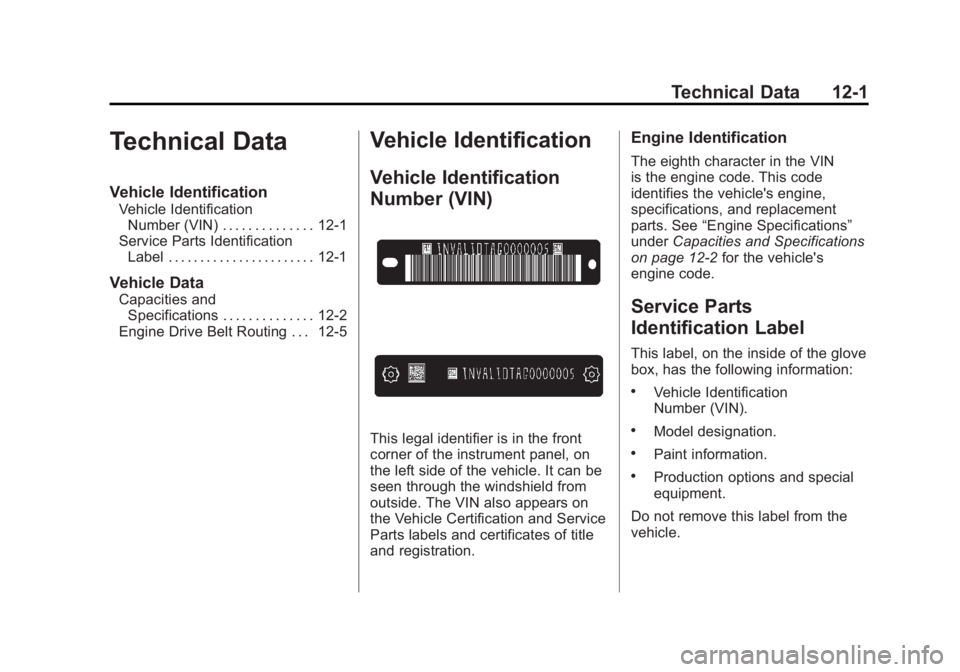
This legal identifier is in the front
corner of the instrument panel, on
the left side of the vehicle. It can be
seen through the windshield from
outside. The VIN also appears on
the Vehicle Certification and Service
Parts labels and certificates of title
and registration.
Engine Identification
The eighth character in the VIN
is the engine code. This code
identifies the vehicle's engine,
specifications, and replacement
parts. See “Engine Specifications”
under Capacities and Specifications
on page 12‑2 for the vehicle's
engine code.
Service Parts
Identification Label
This label, on the inside of the glove
box, has the following information:
.Vehicle Identification
Number (VIN).
.Model designation.
.Paint information.
.Production options and special
equipment.
Do not remove this label from the
vehicle.
Page 392 of 432
Black plate (2,1)Chevrolet Corvette Owner Manual - 2012
13-2 Customer Information
STEP TWO:If after contacting a
member of dealership management,
it appears your concern cannot be
resolved by your dealership without
further help, in the U.S., call the
Chevrolet Customer Assistance
Center at 1-800-222-1020.
In Canada, call General Motors
of Canada Customer Care Centre
at 1-800-263-3777 (English),
or 1-800-263-7854 (French).
We encourage you to call the
toll-free number in order to give
your inquiry prompt attention.
Have the following information
available to give the Customer
Assistance representative:
.Vehicle Identification
Number (VIN). This is available
from the vehicle registration or
title, or the plate at the top left of
the instrument panel and visible
through the windshield.
.Dealership name and location.
.Vehicle delivery date and
present mileage. When contacting Chevrolet,
remember that your concern will
likely be resolved at a dealer's
facility. That is why we suggest
following Step One first.
STEP THREE
—U.S. Owners:
Both General Motors and your
dealer are committed to making
sure you are completely satisfied
with your new vehicle. However,
if you continue to remain unsatisfied
after following the procedure
outlined in Steps One and Two, you
can file with the Better Business
Bureau (BBB) Auto Line
®Program
to enforce your rights.
The BBB Auto Line Program is an
out-of-court program administered
by the Council of Better Business
Bureaus to settle automotive
disputes regarding vehicle repairs or
the interpretation of the New Vehicle
Limited Warranty. Although you may
be required to resort to this informal
dispute resolution program prior to
filing a court action, use of the
program is free of charge and your case will generally be heard within
40 days. If you do not agree with the
decision given in your case, you
may reject it and proceed with any
other venue for relief available
to you.
You may contact the BBB Auto
Line Program using the toll-free
telephone number or write them at
the following address:
BBB Auto Line Program
Council of Better Business
Bureaus, Inc.
4200 Wilson Boulevard
Suite 800
Arlington, VA 22203-1838
Telephone: 1-800-955-5100
www.dr.bbb.org/goauto
This program is available in all
50 states and the District of
Columbia. Eligibility is limited by
vehicle age, mileage, and other
factors. General Motors reserves
the right to change eligibility
limitations and/or discontinue its
participation in this program.
Page 424 of 432
Black plate (4,1)Chevrolet Corvette Owner Manual - 2012
i-4 INDEX
E
Electrical Equipment,Add-On . . . . . . . . . . . . . . . . . . . . . . 9-54
Electrical System Engine CompartmentFuse Block . . . . . . . . . . . . . . . . 10-48
Fuses and Circuit
Breakers . . . . . . . . . . . . . . . . . . 10-47
Instrument Panel Fuse Block . . . . . . . . . . . . . . . . . . . . . . 10-51
Overload . . . . . . . . . . . . . . . . . . . 10-46
Emergency, OnStar
®. . . . . . . . . . 14-2
Engine Air Cleaner/Filter . . . . . . . . . . . 10-22
Check and Service EngineSoon Light . . . . . . . . . . . . . . . . . . 5-19
Compartment Overview . . . . . . . 10-8
Coolant . . . . . . . . . . . . . . . . . . . . . 10-26
Coolant Temperature Gauge . . . . . . . . . . . . . . . . . . . . . . 5-16
Cooling System . . . . . . 10-25, 10-26
Cooling System Messages . . . . . . . . . . . . . . . . . . . 5-39 Engine (cont'd)
Drive Belt Routing . . . . . . . . . . . . 12-5
Exhaust . . . . . . . . . . . . . . . . . . . . . . 9-26
Oil Life System . . . . . . . . . . . . . 10-19
Oil Messages . . . . . . . . . . . . . . . . . 5-40
Oil Pressure Gauge . . . . . . . . . . 5-14
Overheated Protection
Operating Mode . . . . . . . . . . . 10-32
Overheating . . . . . . . . . . . . . . . . 10-30
Power Messages . . . . . . . . . . . . . 5-41
Running While Parked . . . . . . . . 9-27
Starting . . . . . . . . . . . . . . . . . . . . . . . 9-22
Entry/Exit Lighting . . . . . . . . . . . . . . 6-6
Event Data Recorders . . . . . . . . 13-20
Extender, Safety Belt . . . . . . . . . . 3-13
Exterior Lamp Controls . . . . . . . . . 6-1
Exterior Lamps Off Reminder . . . . . . . . . . . . . . . . . . . . . 6-2
Exterior Lighting Battery Saver . . . . . . . . . . . . . . . . . . . . . . . . . 6-7
F
FeaturesMemory . . . . . . . . . . . . . . . . . . . . . . . . 1-9
Filter, Engine Air Cleaner . . . . . . . . . 10-22
Flash-to-Pass . . . . . . . . . . . . . . . . . . . 6-2
Flashers, Hazard Warning . . . . . . 6-4
Flat Tire . . . . . . . . . . . . . . . . . . . . . . 10-77
Floor Mats . . . . . . . . . . . . . . . . . . . . 10-89
Fluid Automatic Transmission . . . . 10-20
Brakes . . . . . . . . . . . . . . . . . . . . . . 10-38
Power Steering . . . . . . . . . . . . . 10-32
Washer . . . . . . . . . . . . . . . . . . . . . 10-34
Fog Lamps Bulb Replacement . . . . . . . . . . . . . 6-5
Folding Mirrors . . . . . . . . . . . . . . . . 2-17
Front Air Dam . . . . . . . . . . . . . . . . . 9-19
Front Fog Lamp Light . . . . . . . . . . . . . . . . . . . . . . . . . . 5-25
Front Seats Heated . . . . . . . . . . . . . . . . . . . . . . . . 3-8
Page 425 of 432
Black plate (5,1)Chevrolet Corvette Owner Manual - 2012
INDEX i-5
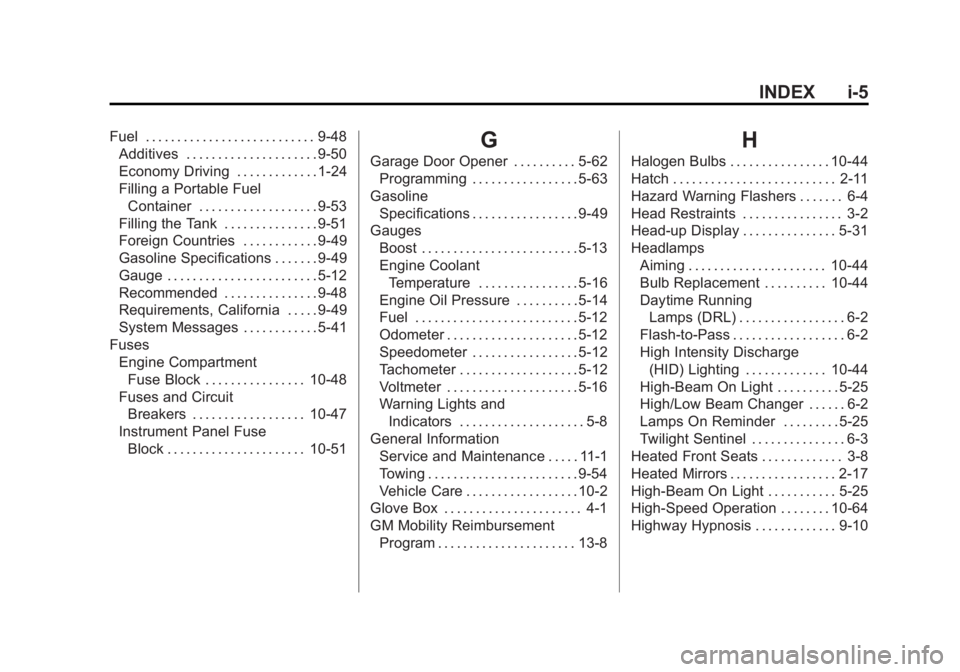
Fuel . . . . . . . . . . . . . . . . . . . . . . . . . . . 9-48Additives . . . . . . . . . . . . . . . . . . . . . 9-50
Economy Driving . . . . . . . . . . . . . 1-24
Filling a Portable Fuel
Container . . . . . . . . . . . . . . . . . . . 9-53
Filling the Tank . . . . . . . . . . . . . . . 9-51
Foreign Countries . . . . . . . . . . . . 9-49
Gasoline Specifications . . . . . . . 9-49
Gauge . . . . . . . . . . . . . . . . . . . . . . . . 5-12
Recommended . . . . . . . . . . . . . . . 9-48
Requirements, California . . . . . 9-49
System Messages . . . . . . . . . . . . 5-41
Fuses Engine CompartmentFuse Block . . . . . . . . . . . . . . . . 10-48
Fuses and Circuit
Breakers . . . . . . . . . . . . . . . . . . 10-47
Instrument Panel Fuse Block . . . . . . . . . . . . . . . . . . . . . . 10-51G
Garage Door Opener . . . . . . . . . . 5-62Programming . . . . . . . . . . . . . . . . . 5-63
Gasoline Specifications . . . . . . . . . . . . . . . . . 9-49
Gauges Boost . . . . . . . . . . . . . . . . . . . . . . . . . 5-13
Engine Coolant
Temperature . . . . . . . . . . . . . . . . 5-16
Engine Oil Pressure . . . . . . . . . . 5-14
Fuel . . . . . . . . . . . . . . . . . . . . . . . . . . 5-12
Odometer . . . . . . . . . . . . . . . . . . . . . 5-12
Speedometer . . . . . . . . . . . . . . . . . 5-12
Tachometer . . . . . . . . . . . . . . . . . . . 5-12
Voltmeter . . . . . . . . . . . . . . . . . . . . . 5-16
Warning Lights and Indicators . . . . . . . . . . . . . . . . . . . . 5-8
General Information Service and Maintenance . . . . . 11-1
Towing . . . . . . . . . . . . . . . . . . . . . . . . 9-54
Vehicle Care . . . . . . . . . . . . . . . . . . 10-2
Glove Box . . . . . . . . . . . . . . . . . . . . . . 4-1
GM Mobility Reimbursement Program . . . . . . . . . . . . . . . . . . . . . . 13-8
H
Halogen Bulbs . . . . . . . . . . . . . . . . 10-44
Hatch . . . . . . . . . . . . . . . . . . . . . . . . . . 2-11
Hazard Warning Flashers . . . . . . . 6-4
Head Restraints . . . . . . . . . . . . . . . . 3-2
Head-up Display . . . . . . . . . . . . . . . 5-31
HeadlampsAiming . . . . . . . . . . . . . . . . . . . . . . 10-44
Bulb Replacement . . . . . . . . . . 10-44
Daytime RunningLamps (DRL) . . . . . . . . . . . . . . . . . 6-2
Flash-to-Pass . . . . . . . . . . . . . . . . . . 6-2
High Intensity Discharge (HID) Lighting . . . . . . . . . . . . . 10-44
High-Beam On Light . . . . . . . . . . 5-25
High/Low Beam Changer . . . . . . 6-2
Lamps On Reminder . . . . . . . . . 5-25
Twilight Sentinel . . . . . . . . . . . . . . . 6-3
Heated Front Seats . . . . . . . . . . . . . 3-8
Heated Mirrors . . . . . . . . . . . . . . . . . 2-17
High-Beam On Light . . . . . . . . . . . 5-25
High-Speed Operation . . . . . . . . 10-64
Highway Hypnosis . . . . . . . . . . . . . 9-10