lock CHEVROLET CORVETTE C6 2012 Manual Online
[x] Cancel search | Manufacturer: CHEVROLET, Model Year: 2012, Model line: CORVETTE C6, Model: CHEVROLET CORVETTE C6 2012Pages: 432, PDF Size: 5.73 MB
Page 279 of 432
Black plate (3,1)Chevrolet Corvette Owner Manual - 2012
Vehicle Care 10-3
California Proposition
65 Warning
Most motor vehicles, including this
one, contain and/or emit chemicals
known to the State of California to
cause cancer and birth defects or
other reproductive harm. Engine
exhaust, many parts and systems,
many fluids, and some component
wear by-products contain and/or
emit these chemicals.
California Perchlorate
Materials Requirements
Certain types of automotive
applications, such as airbag
initiators, safety belt pretensioners,
and lithium batteries contained in
Remote Keyless Entry transmitters,
may contain perchlorate materials.
Special handling may be necessary.
For additional information, see
www.dtsc.ca.gov/hazardouswaste/
perchlorate.
Accessories and
Modifications
Adding non‐dealer accessories or
making modifications to the vehicle
can affect vehicle performance and
safety, including such things as
airbags, braking, stability, ride and
handling, emissions systems,
aerodynamics, durability, and
electronic systems like antilock
brakes, traction control, and stability
control. These accessories or
modifications could even cause
malfunction or damage not covered
by the vehicle warranty.
Damage to vehicle components
resulting from modifications or the
installation or use of non‐GM
certified parts, including control
module or software modifications, is
not covered under the terms of the
vehicle warranty and may affect
remaining warranty coverage for
affected parts.GM Accessories are designed to
complement and function with
other systems on the vehicle.
See your dealer to accessorize
the vehicle using genuine GM
Accessories installed by a dealer
technician.
Also, see
Adding Equipment to the
Airbag-Equipped Vehicle on
page 3‑27.
Page 280 of 432
Black plate (4,1)Chevrolet Corvette Owner Manual - 2012
10-4 Vehicle Care
Lifting the Vehicle
{WARNING
Lifting a vehicle can cause an
injury. The vehicle can slip off the
jack and roll over you or other
people. You and they could be
badly injured. Find a level place
to lift your vehicle. To help
prevent the vehicle from moving:1. Set the parking brake firmly.
2. Put an automatic transmission shift lever in
P (Park), or shift a manual
transmission to 1 (First)
or R (Reverse).
3. Turn off the engine.
To be even more certain the
vehicle won't move, put blocks in
front of and behind the wheels.
{WARNING
Getting under a vehicle when it
is lifted on a jack is dangerous.
If the vehicle slips off the jack,
you could be badly injured or
killed. Never get under a vehicle
when it is supported only by
a jack.
{WARNING
Raising the vehicle with the
jack improperly positioned can
damage the vehicle or the vehicle
may fall and cause you or others
injury.
If you ever use a jack to lift your
vehicle, follow the instructions that
came with the jack, and be sure to
use the correct lifting points to avoid
damaging your vehicle. Notice:
Lifting your vehicle
improperly can damage your
vehicle and result in costly
repairs not covered by your
warranty. To lift your vehicle
properly, follow the advice in
this part.
To help prevent vehicle damage:
.Be sure to place a block or
pad between the jack and the
vehicle.
.Make sure the jack you are
using spans at least two
crossmember ribs.
.Lift only in the areas shown
in the following pictures.
For additional information, see
your dealer and the Chevrolet
Corvette service manual.
Page 281 of 432
Black plate (5,1)Chevrolet Corvette Owner Manual - 2012
Vehicle Care 10-5
Lifting From the Front
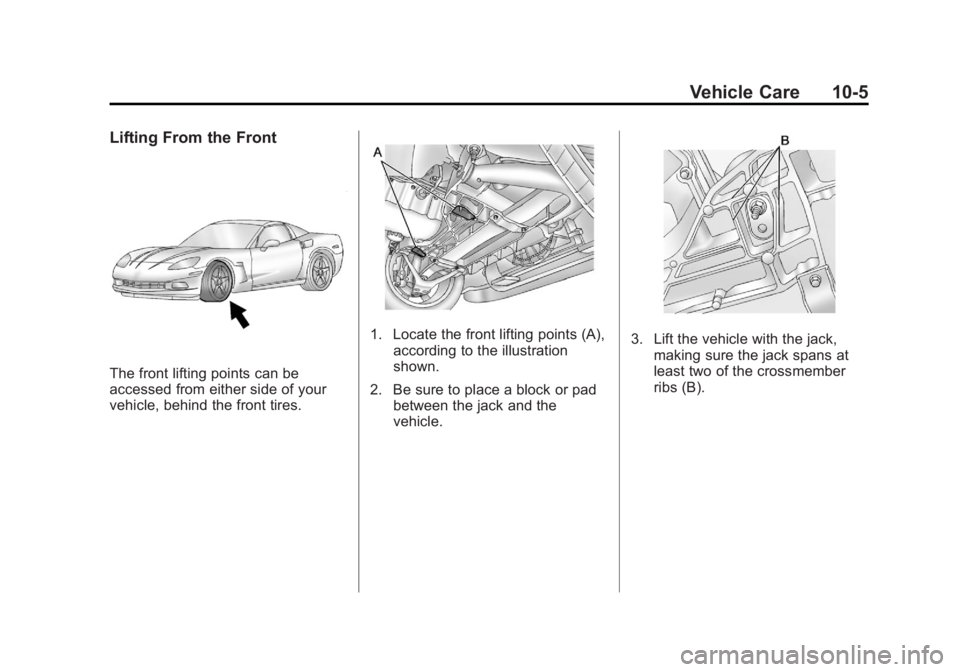
The front lifting points can be
accessed from either side of your
vehicle, behind the front tires.
1. Locate the front lifting points (A),according to the illustration
shown.
2. Be sure to place a block or pad between the jack and the
vehicle.3. Lift the vehicle with the jack,making sure the jack spans at
least two of the crossmember
ribs (B).
Page 282 of 432
Black plate (6,1)Chevrolet Corvette Owner Manual - 2012
10-6 Vehicle Care
Lifting From the Rear
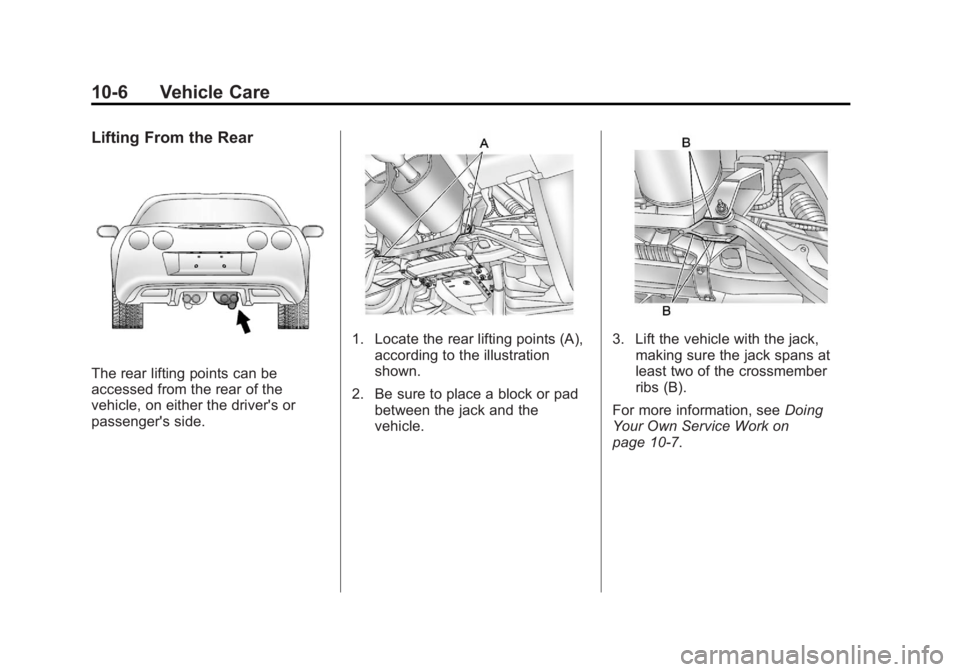
The rear lifting points can be
accessed from the rear of the
vehicle, on either the driver's or
passenger's side.
1. Locate the rear lifting points (A),according to the illustration
shown.
2. Be sure to place a block or pad between the jack and the
vehicle.3. Lift the vehicle with the jack,making sure the jack spans at
least two of the crossmember
ribs (B).
For more information, see Doing
Your Own Service Work on
page 10‑7.
Page 285 of 432
Black plate (9,1)Chevrolet Corvette Owner Manual - 2012
Vehicle Care 10-9
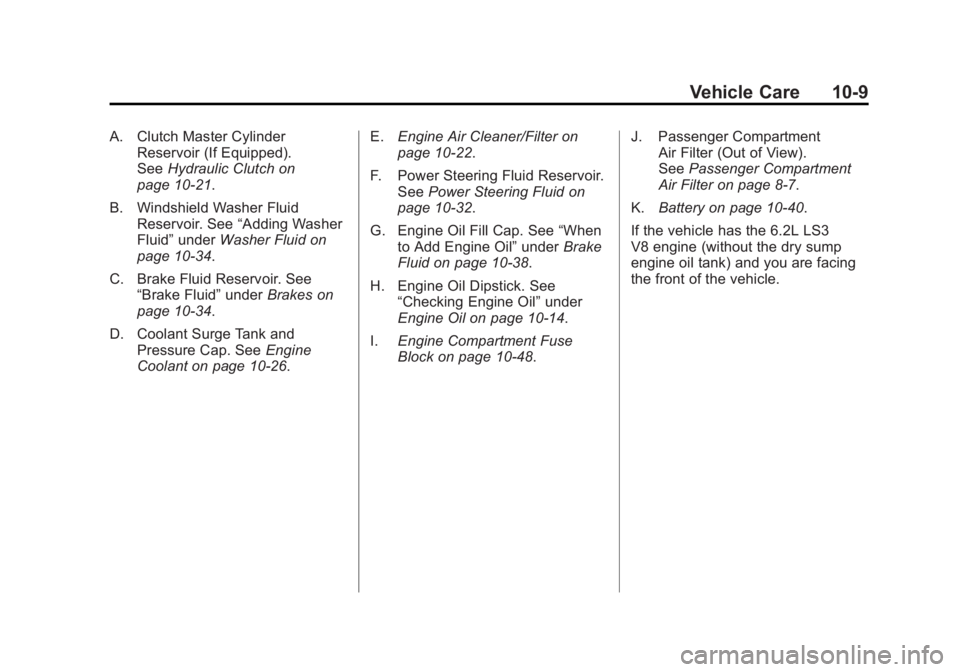
A. Clutch Master CylinderReservoir (If Equipped).
See Hydraulic Clutch on
page 10‑21.
B. Windshield Washer Fluid Reservoir. See “Adding Washer
Fluid” under Washer Fluid on
page 10‑34.
C. Brake Fluid Reservoir. See “Brake Fluid” underBrakes on
page 10‑34.
D. Coolant Surge Tank and Pressure Cap. See Engine
Coolant on page 10‑26. E.
Engine Air Cleaner/Filter on
page 10‑22.
F. Power Steering Fluid Reservoir. See Power Steering Fluid on
page 10‑32.
G. Engine Oil Fill Cap. See “When
to Add Engine Oil” underBrake
Fluid on page 10‑38.
H. Engine Oil Dipstick. See “Checking Engine Oil” under
Engine Oil on page 10‑14.
I. Engine Compartment Fuse
Block on page 10‑48. J. Passenger Compartment
Air Filter (Out of View).
See Passenger Compartment
Air Filter on page 8‑7.
K. Battery on page 10‑40.
If the vehicle has the 6.2L LS3
V8 engine (without the dry sump
engine oil tank) and you are facing
the front of the vehicle.
Page 287 of 432
Black plate (11,1)Chevrolet Corvette Owner Manual - 2012
Vehicle Care 10-11
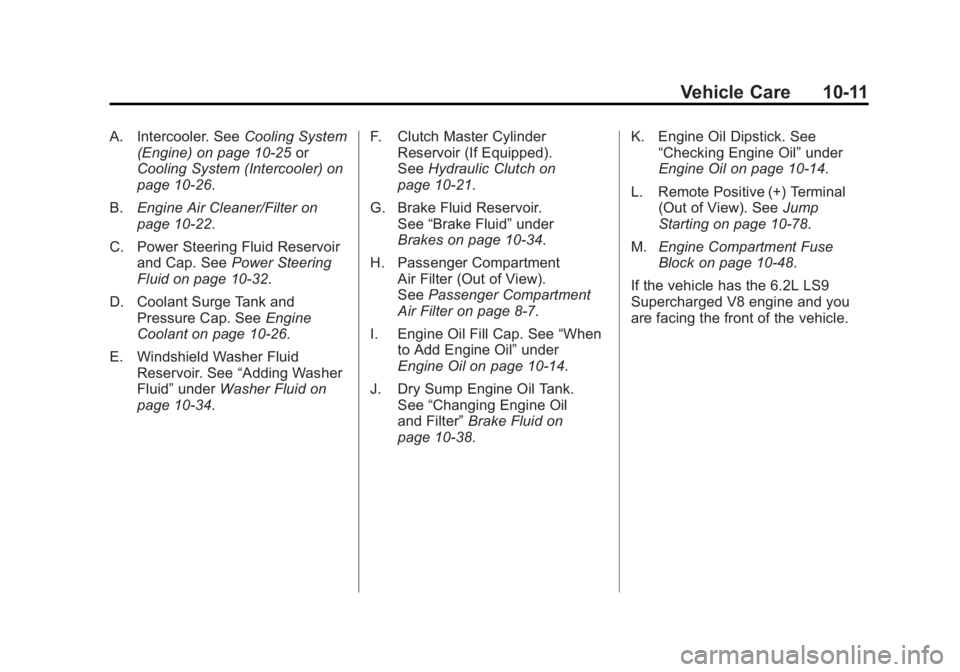
A. Intercooler. SeeCooling System
(Engine) on page 10‑25 or
Cooling System (Intercooler) on
page 10‑26.
B. Engine Air Cleaner/Filter on
page 10‑22.
C. Power Steering Fluid Reservoir and Cap. See Power Steering
Fluid on page 10‑32.
D. Coolant Surge Tank and Pressure Cap. See Engine
Coolant on page 10‑26.
E. Windshield Washer Fluid Reservoir. See “Adding Washer
Fluid” under Washer Fluid on
page 10‑34. F. Clutch Master Cylinder
Reservoir (If Equipped).
See Hydraulic Clutch on
page 10‑21.
G. Brake Fluid Reservoir. See “Brake Fluid” under
Brakes on page 10‑34.
H. Passenger Compartment Air Filter (Out of View).
See Passenger Compartment
Air Filter on page 8‑7.
I. Engine Oil Fill Cap. See “When
to Add Engine Oil” under
Engine Oil on page 10‑14.
J. Dry Sump Engine Oil Tank. See “Changing Engine Oil
and Filter” Brake Fluid on
page 10‑38. K. Engine Oil Dipstick. See
“Checking Engine Oil” under
Engine Oil on page 10‑14.
L. Remote Positive (+) Terminal (Out of View). See Jump
Starting on page 10‑78.
M. Engine Compartment Fuse
Block on page 10‑48.
If the vehicle has the 6.2L LS9
Supercharged V8 engine and you
are facing the front of the vehicle.
Page 289 of 432
Black plate (13,1)Chevrolet Corvette Owner Manual - 2012
Vehicle Care 10-13
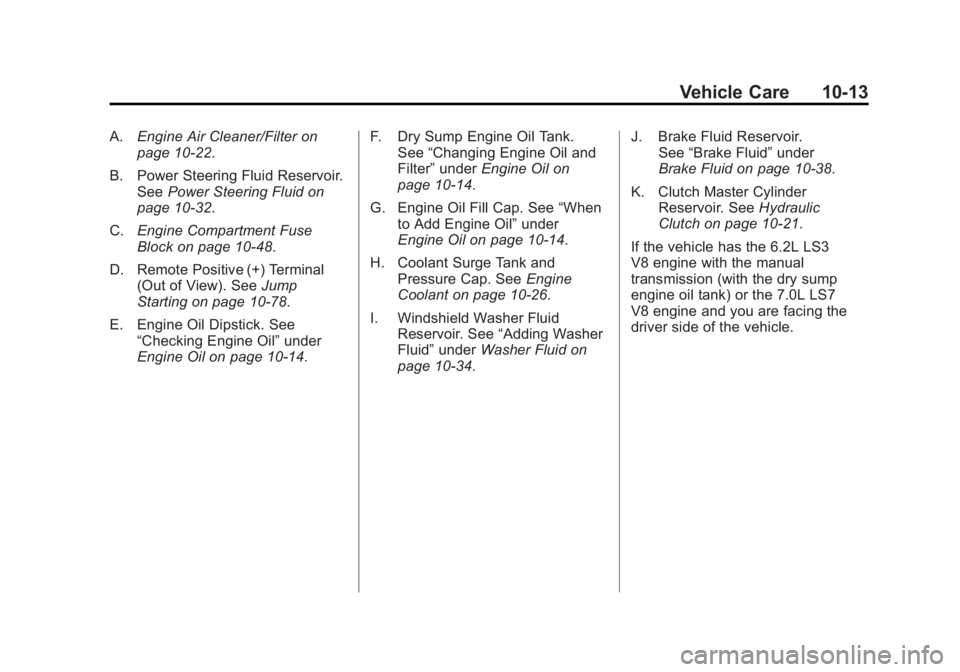
A.Engine Air Cleaner/Filter on
page 10‑22.
B. Power Steering Fluid Reservoir. See Power Steering Fluid on
page 10‑32.
C. Engine Compartment Fuse
Block on page 10‑48.
D. Remote Positive (+) Terminal (Out of View). See Jump
Starting on page 10‑78.
E. Engine Oil Dipstick. See “Checking Engine Oil” under
Engine Oil on page 10‑14. F. Dry Sump Engine Oil Tank.
See “Changing Engine Oil and
Filter” under Engine Oil on
page 10‑14.
G. Engine Oil Fill Cap. See “When
to Add Engine Oil” under
Engine Oil on page 10‑14.
H. Coolant Surge Tank and Pressure Cap. See Engine
Coolant on page 10‑26.
I. Windshield Washer Fluid Reservoir. See “Adding Washer
Fluid” under Washer Fluid on
page 10‑34. J. Brake Fluid Reservoir.
See “Brake Fluid” under
Brake Fluid on page 10‑38.
K. Clutch Master Cylinder Reservoir. See Hydraulic
Clutch on page 10‑21.
If the vehicle has the 6.2L LS3
V8 engine with the manual
transmission (with the dry sump
engine oil tank) or the 7.0L LS7
V8 engine and you are facing the
driver side of the vehicle.
Page 299 of 432
Black plate (23,1)Chevrolet Corvette Owner Manual - 2012
Vehicle Care 10-23
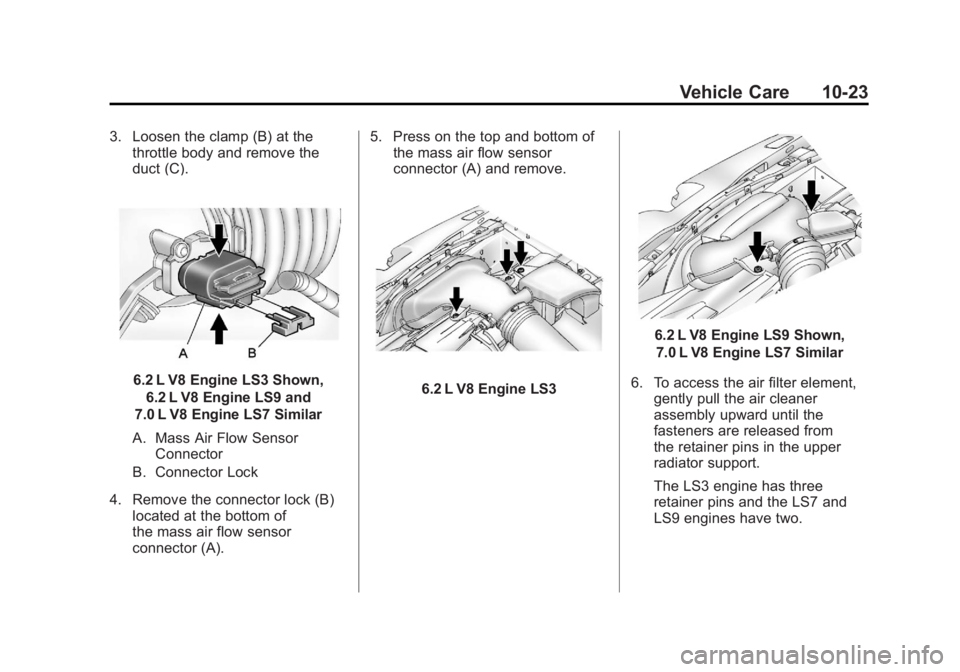
3. Loosen the clamp (B) at thethrottle body and remove the
duct (C).
6.2 L V8 Engine LS3 Shown,
6.2 L V8 Engine LS9 and
7.0 L V8 Engine LS7 Similar
A. Mass Air Flow Sensor Connector
B. Connector Lock
4. Remove the connector lock (B) located at the bottom of
the mass air flow sensor
connector (A). 5. Press on the top and bottom of
the mass air flow sensor
connector (A) and remove.6.2 L V8 Engine LS3
6.2 L V8 Engine LS9 Shown,
7.0 L V8 Engine LS7 Similar
6. To access the air filter element, gently pull the air cleaner
assembly upward until the
fasteners are released from
the retainer pins in the upper
radiator support.
The LS3 engine has three
retainer pins and the LS7 and
LS9 engines have two.
Page 305 of 432
Black plate (29,1)Chevrolet Corvette Owner Manual - 2012
Vehicle Care 10-29
WARNING (Continued)
Never turn the cap when the
cooling system, including the
coolant surge tank pressure cap,
is hot. Wait for the cooling system
and coolant surge tank pressure
cap to cool if you ever have to
turn the pressure cap.
If coolant is needed, add the proper
DEX-COOL coolant mixture directly
to the surge tank, but be sure the
cooling system is cool before this
is done.
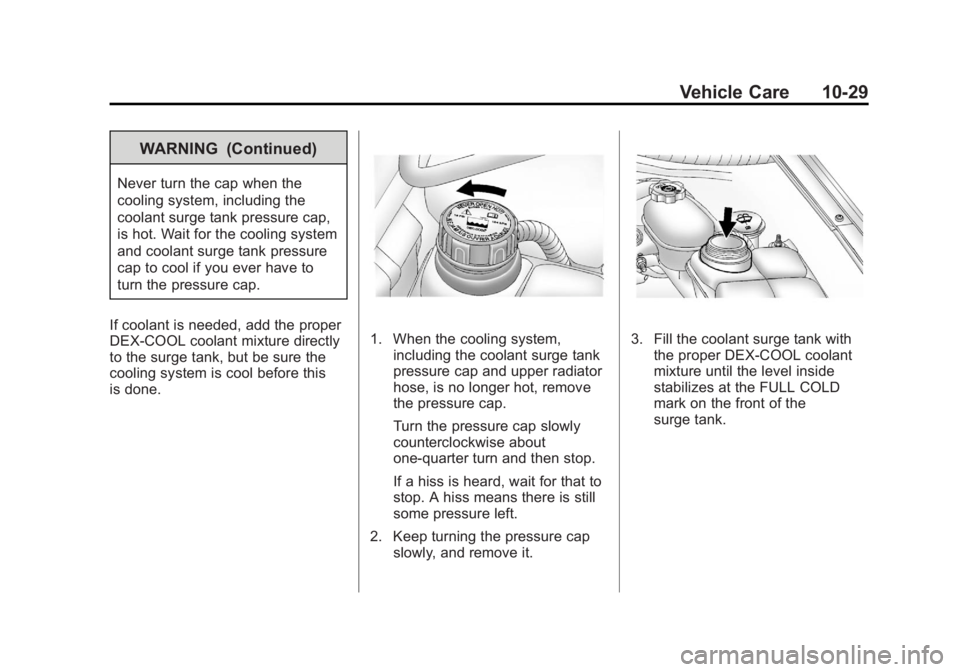
1. When the cooling system, including the coolant surge tank
pressure cap and upper radiator
hose, is no longer hot, remove
the pressure cap.
Turn the pressure cap slowly
counterclockwise about
one-quarter turn and then stop.
If a hiss is heard, wait for that to
stop. A hiss means there is still
some pressure left.
2. Keep turning the pressure cap slowly, and remove it.3. Fill the coolant surge tank withthe proper DEX-COOL coolant
mixture until the level inside
stabilizes at the FULL COLD
mark on the front of the
surge tank.
Page 318 of 432

Black plate (42,1)Chevrolet Corvette Owner Manual - 2012
10-42 Vehicle Care
Automatic Transmission
Shift Lock Control
Function Check
{WARNING
When you are doing this
inspection, the vehicle could
move suddenly. If the vehicle
moves, you or others could be
injured.
1. Before starting this check, be sure there is enough room
around the vehicle. It should be
parked on a level surface.
2. Firmly apply the parking brake. See Parking Brake on
page 9‑36.
Be ready to apply the regular
brake immediately if the vehicle
begins to move. 3. With the engine off, turn the
ignition on, but do not start the
engine. Without applying the
regular brake, try to move the
shift lever out of P (Park) with
normal effort. If the shift lever
moves out of P (Park), contact
your dealer for service.
Park Brake and P (Park)
Mechanism Check
{WARNING
When you are doing this check,
the vehicle could begin to move.
You or others could be injured
and property could be damaged.
Make sure there is room in front
of the vehicle in case it begins to
roll. Be ready to apply the regular
brake at once should the vehicle
begin to move. Park on a fairly steep hill, with the
vehicle facing downhill. Keeping
your foot on the regular brake, set
the parking brake.
.To check the parking brake's
holding ability: With the engine
running and the transmission in
N (Neutral), slowly remove foot
pressure from the regular brake
pedal. Do this until the vehicle is
held by the parking brake only.
.To check the P (Park)
mechanism's holding ability:
With the engine running, shift to
P (Park). Then release the
parking brake followed by the
regular brake.
Contact your dealer if service is
required.