engine CHEVROLET CRUZE 2015 1.G Manual PDF
[x] Cancel search | Manufacturer: CHEVROLET, Model Year: 2015, Model line: CRUZE, Model: CHEVROLET CRUZE 2015 1.GPages: 417, PDF Size: 5.89 MB
Page 243 of 417
Black plate (52,1)Chevrolet Cruze Owner Manual (GMNA-Localizing-U.S./Canada-7707493) -
2015 - crc - 11/24/14
9-52 Driving and Operating
other fuels containing more than
15% ethanol must be used only in
FlexFuel vehicles.
{Caution
Do not use fuel containing
methanol. It can corrode metal
parts in the fuel system and also
damage plastic and rubber parts.
That damage would not be
covered under the vehicle
warranty.
Some gasolines, mainly high octane
racing gasolines, can contain an
octane-enhancing additive called
methylcyclopentadienyl manganese
tricarbonyl (MMT). Do not use
gasolines and/or fuel additives with
MMT as they can reduce spark plug
life and affect emission control
system performance. The
malfunction indicator lamp may turn
on. If this occurs, see your dealer
for service.
California Fuel
Requirements
If the vehicle is certified to meet
California Emissions Standards, it is
designed to operate on fuels that
meet California specifications. See
the underhood emission control
label. If this fuel is not available in
states adopting California Emissions
Standards, the vehicle will operate
satisfactorily on fuels meeting
federal specifications, but emission
control system performance might
be affected. The malfunction
indicator lamp could turn on and the
vehicle may not pass a smog-check
test. See Malfunction Indicator
Lamp on page 5-14. If this occurs,
return to your authorized dealer for
diagnosis. If it is determined that the
condition is caused by the type of
fuel used, repairs may not be
covered by the vehicle warranty.
Fuels in Foreign
Countries
If planning to drive in countries
outside the U.S. or Canada, the
proper fuel might be hard to find.
Check regional auto club or fuel
retail brand websites for availability
in the country where driving. Never
use leaded gasoline, fuel containing
methanol, manganese, or any other
fuel not recommended. Costly
repairs caused by use of improper
fuel would not be covered by the
vehicle warranty.
Fuel Additives (Gasoline)
To keep fuel systems clean, TOP
TIER Detergent Gasoline is
recommended. See Fuel (Gasoline)
on page 9-51.
If TOP TIER Detergent Gasoline is
not available, one bottle of Fuel
System Treatment PLUS added to
the fuel tank at every engine oil
change, can help. Fuel System
Treatment PLUS is the only
Page 244 of 417
Black plate (53,1)Chevrolet Cruze Owner Manual (GMNA-Localizing-U.S./Canada-7707493) -
2015 - crc - 11/24/14
Driving and Operating 9-53
gasoline additive recommended by
General Motors. It is available at
your dealer.
Fuel for Diesel Engines
{Caution
Use of diesel fuel other than Ultra
Low Sulfur Diesel (15 ppm sulfur
maximum) will cause damage to
the exhaust after-treatment
system. This damage would not
be covered by the vehicle
warranty. Do not use marine,
locomotive, or boiler distillate fuel
since it may contain higher sulfur
levels.
The emission control system
requires the use of diesel fuel with
ultra low sulfur content (15 ppm or
0.0015% by weight, maximum).
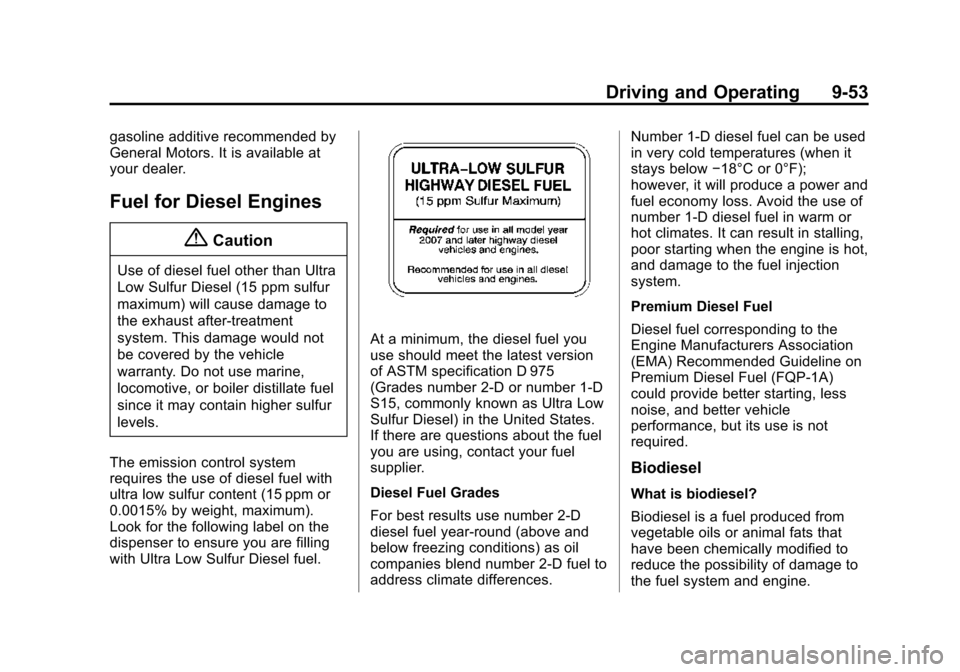
Look for the following label on the
dispenser to ensure you are filling
with Ultra Low Sulfur Diesel fuel.
At a minimum, the diesel fuel you
use should meet the latest version
of ASTM specification D 975
(Grades number 2-D or number 1-D
S15, commonly known as Ultra Low
Sulfur Diesel) in the United States.
If there are questions about the fuel
you are using, contact your fuel
supplier.
Diesel Fuel Grades
For best results use number 2-D
diesel fuel year-round (above and
below freezing conditions) as oil
companies blend number 2-D fuel to
address climate differences. Number 1-D diesel fuel can be used
in very cold temperatures (when it
stays below
−18°C or 0°F);
however, it will produce a power and
fuel economy loss. Avoid the use of
number 1-D diesel fuel in warm or
hot climates. It can result in stalling,
poor starting when the engine is hot,
and damage to the fuel injection
system.
Premium Diesel Fuel
Diesel fuel corresponding to the
Engine Manufacturers Association
(EMA) Recommended Guideline on
Premium Diesel Fuel (FQP-1A)
could provide better starting, less
noise, and better vehicle
performance, but its use is not
required.
Biodiesel
What is biodiesel?
Biodiesel is a fuel produced from
vegetable oils or animal fats that
have been chemically modified to
reduce the possibility of damage to
the fuel system and engine.
Page 245 of 417
Black plate (54,1)Chevrolet Cruze Owner Manual (GMNA-Localizing-U.S./Canada-7707493) -
2015 - crc - 11/24/14
9-54 Driving and Operating
{Caution
Do not use home-made biodiesel
or home test kits because the
quality cannot be verified by
approved scientific methods. Do
not use raw vegetable oil or other
unmodified bio-oils, fats,
or blends of vegetable oil with
diesel. They could damage the
fuel system and engine, and
damages would not be covered
by the vehicle warranty.
What not to use
Do not use home-made biodiesel in
your vehicle since its quality cannot
be verified by approved scientific
methods. Home test kits are not
approved scientific methods.
{Caution
Any damage caused by raw,
unmodified, or home-made
biodiesel would not be covered by
the vehicle warranty.
Biodiesel blends
It is acceptable to use diesel fuel
containing up to 20% biodiesel
(B20). The diesel fuel portion of the
blend must meet the same
specification, ASTM D975 (Grades
number 2-D or number 1-D S15
commonly known as Ultra Low
Sulfur Diesel), as other fuels used in
your vehicle, and the biodiesel used
for making this fuel must meet the
latest version of ASTM specification
D6751.
.Pump labeling —Retail pumps
dispensing blends containing up
to 5% biodiesel (B5) are not
required to be labeled with the
concentration of biodiesel.
Blends up to B5 must meet
ASTM D975 (Grades number
2-D or number 1-D S15
commonly known as Ultra Low
Sulfur Diesel).
{Caution
Do not use blends containing
more than 20% biodiesel. Any
engine, fuel system, or exhaust
after-treatment system damage
would not be covered by the
vehicle warranty.
Page 246 of 417
Black plate (55,1)Chevrolet Cruze Owner Manual (GMNA-Localizing-U.S./Canada-7707493) -
2015 - crc - 11/24/14
Driving and Operating 9-55
Pumps dispensing more than
5% and up to 20% biodiesel are
required to be labeled with the
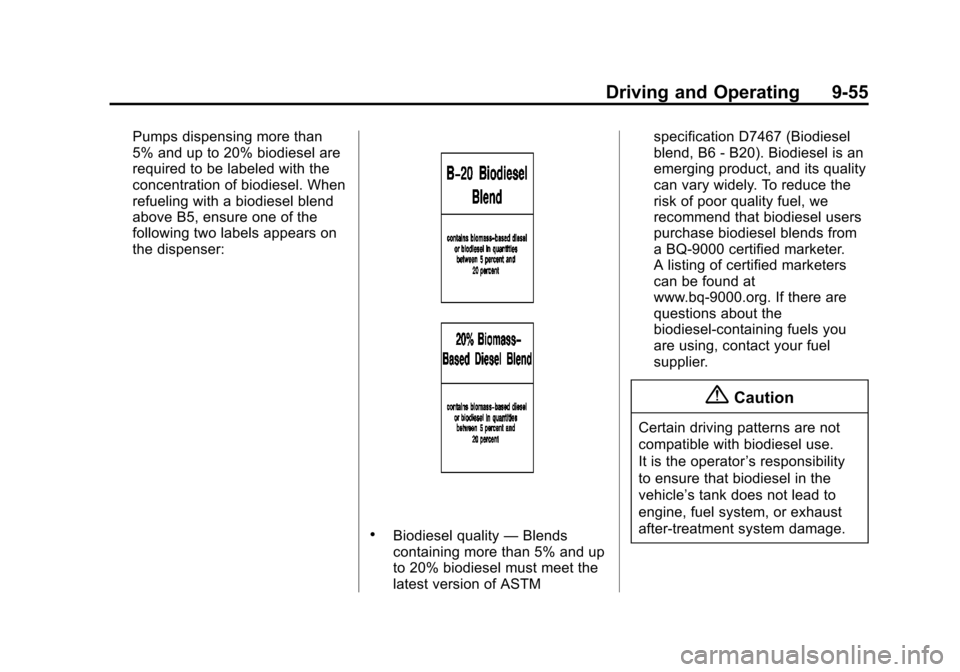
concentration of biodiesel. When
refueling with a biodiesel blend
above B5, ensure one of the
following two labels appears on
the dispenser:
.Biodiesel quality—Blends
containing more than 5% and up
to 20% biodiesel must meet the
latest version of ASTM specification D7467 (Biodiesel
blend, B6 - B20). Biodiesel is an
emerging product, and its quality
can vary widely. To reduce the
risk of poor quality fuel, we
recommend that biodiesel users
purchase biodiesel blends from
a BQ-9000 certified marketer.
A listing of certified marketers
can be found at
www.bq-9000.org. If there are
questions about the
biodiesel-containing fuels you
are using, contact your fuel
supplier.
{Caution
Certain driving patterns are not
compatible with biodiesel use.
It is the operator
’s responsibility
to ensure that biodiesel in the
vehicle’s tank does not lead to
engine, fuel system, or exhaust
after-treatment system damage.
Page 248 of 417
Black plate (57,1)Chevrolet Cruze Owner Manual (GMNA-Localizing-U.S./Canada-7707493) -
2015 - crc - 11/24/14
Driving and Operating 9-57
.Vehicles operated for extended
periods of time on conventional
diesel fuel and then switched to
biodiesel blends may experience
premature fuel filter clogging and
require more frequent fuel filter
service.
With long-term use of
conventional diesel fuel, gum
and varnish may be deposited
within the tank and fuel system.
These deposits, while not
problematic with the use of
conventional diesel fuel, may
become loosened with a sudden
switch to biodiesel blends and
cause fuel filter plugging.
.Use of biodiesel blends will
degrade the performance of your
vehicle’s water separator.
Biodiesel reduces the
effectiveness of the vehicle’s
water separator, and in the event
of water contamination of the
fuel, increases the risk of
damage to the fuel system.
Refueling
Diesel fuel can foam when you fill
the tank. This can cause the
automatic pump nozzle to shut off,
even though the tank is not full.
If this happens, wait for the foaming
to stop, and then try filling the tank
more slowly. See Filling the Tank on
page 9-60.
{Warning
Heat coming from the engine can
cause the fuel to expand and
force the fuel out of the tank.
If something ignites the fuel, a fire
could start. To help avoid this, fill
the tank slowly and only until the
nozzle shuts off. Do not top it off.
Clean up any spilled fuel. Accidental Refueling with
Gasoline
{Caution
If the vehicle is accidentally
refueled with gasoline, do not
continue driving the vehicle
except to get to a location where
it can be stopped safely. Driving
the vehicle will damage the fuel
system. Have the vehicle towed
to a qualified technician to have
the gasoline removed from the
tank, preferably until the fuel
gauge reads near E (Empty).
Refuel with Ultra Low Sulfur
Diesel fuel.
Page 249 of 417
Black plate (58,1)Chevrolet Cruze Owner Manual (GMNA-Localizing-U.S./Canada-7707493) -
2015 - crc - 11/24/14
9-58 Driving and Operating
What Fuel to Use in
Canada (Diesel)
Use only diesel fuel with ultra low
sulfur content (15 ppm maximum).
{Caution
Use of diesel fuel other than Ultra
Low Sulfur Diesel (15 ppm sulfur
maximum) will cause damage to
the exhaust after-treatment
system. This damage would not
be covered by the vehicle
warranty. Do not use marine,
locomotive, or boiler distillate fuel
since it may contain higher sulfur
levels.
Use diesel fuel that meets CAN/
CGSB-3.517 specification in
Canada. Contact a fuel supplier for
questions about fuel. Diesel Fuel Types
Fuels are blended for seasonal
changes. Diesel Type A fuel is
blended for better cold weather
starting in extreme conditions. This
may cause some power and fuel
economy loss. If Type A fuel is used
in warmer temperatures, stalling and
hard starting may occur. Diesel
Type B fuel is blended for higher
temperatures experienced during
most of the year.
Premium Diesel Fuel
If available, premium diesel fuel
(FQP-1A) corresponding to the
Engine Manufacturers Association
(EMA) Recommended Guideline
could provide better starting and
vehicle performance with less noise.
Biodiesel
Biodiesel is a renewable fuel
produced from vegetable oils or
animal fats that have been
chemically modified for normal
engine performance.
{Caution
Do not use home-made biodiesel
or home test kits because the
quality cannot be verified by
approved scientific methods. Do
not use raw vegetable oil or other
unmodified bio-oils, fats,
or blends of vegetable oil with
diesel. They could damage the
fuel system and engine, and
damages would not be covered
by the vehicle warranty.
Biodiesel blends
Biodiesel blends that meet the CAN/
CGSB-3.522 specifications up to
20% (B20) can be used. Avoid the
use of biodiesel blends above 20%,
as they may damage the engine
and fuel system. For detailed
information on the use of biodiesel,
see Fuel for Diesel Engines on
page 9-53.
Page 250 of 417
Black plate (59,1)Chevrolet Cruze Owner Manual (GMNA-Localizing-U.S./Canada-7707493) -
2015 - crc - 11/24/14
Driving and Operating 9-59
Refueling
Diesel fuel can foam when filling the
tank. This can cause the automatic
pump nozzle to shut off, even if the
tank is not full. If this happens, wait
for the foaming to stop, and then fill
the tank more slowly. SeeFilling the
Tank on page 9-60.
{Warning
Heat coming from the engine can
cause the fuel to expand and
force the fuel out of the tank.
If something ignites the fuel, a fire
could start. To help avoid this, fill
the tank slowly and only until the
nozzle shuts off. Do not top it off.
Clean up any spilled fuel. Accidental Refueling with
Gasoline
{Caution
If the vehicle is accidentally
refueled with gasoline, do not
continue driving the vehicle
except to get to a location where
it can be stopped safely. Driving
the vehicle will damage the fuel
system. Have the vehicle towed
to a qualified technician to have
the gasoline removed from the
tank, preferably until the fuel
gauge reads near E (Empty).
Refuel with Ultra Low Sulfur
Diesel fuel.
Cold Weather Operation
(Diesel)
Follow the instructions under
Fuel
for Diesel Engines on page 9-53.
{Caution
Using any fuel not approved for
this vehicle can cause engine
damage and would not be
covered by the vehicle warranty.
See “What Fuel to Use" for the
proper fuel.
In cold weather, the fuel filter could
become clogged by wax naturally
present in the fuel. To unclog it,
move the vehicle to a warm garage
area and allow the filter to warm up
to between 0°C (32°F) and 10°C
(50°F). You will not need to replace
the filter. Additional information on
the fuel filter follows.
Use of biodiesel blends greater than
B5 (5% blend) should be avoided in
cold temperatures.
Page 251 of 417
Black plate (60,1)Chevrolet Cruze Owner Manual (GMNA-Localizing-U.S./Canada-7707493) -
2015 - crc - 11/24/14
9-60 Driving and Operating
Water in Fuel (Diesel)
The fuel filter assembly has a
sensor to determine if there is water
in the fuel. If there is water in the
fuel, a WATER IN FUEL CONTACT
SERVICE message will display. See
Fuel System Messages on
page 5-29. The water will need to
be drained. See your dealer.
Running Out of Fuel
(Diesel)
Running out of diesel fuel requires
priming after fuel is added.
With engine switched off, turn
ignition key to ON, wait
approximately 15 seconds, and turn
key to LOCK to perform priming
operation. Perform this operation
three times or more while the
engine is switched off, to avoid air
entering the fuel line.
Filling the Tank
{Warning
Fuel vapors and fuel fires burn
violently and can cause injury or
death.
.To help avoid injuries to you
and others, read and follow
all the instructions on the fuel
pump island.
.Turn off the engine when
refueling.
.Keep sparks, flames, and
smoking materials away
from fuel.
.Do not leave the fuel pump
unattended.
.Do not reenter the vehicle
while pumping fuel.
.Keep children away from the
fuel pump and never let
children pump fuel.(Continued)
Warning (Continued)
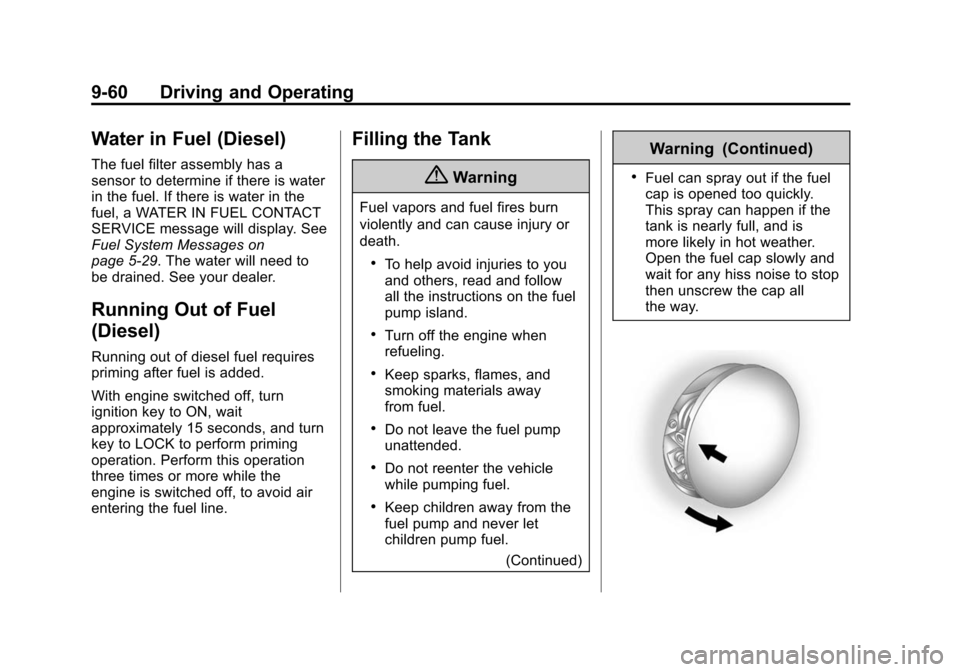
.Fuel can spray out if the fuel
cap is opened too quickly.
This spray can happen if the
tank is nearly full, and is
more likely in hot weather.
Open the fuel cap slowly and
wait for any hiss noise to stop
then unscrew the cap all
the way.
Page 252 of 417
Black plate (61,1)Chevrolet Cruze Owner Manual (GMNA-Localizing-U.S./Canada-7707493) -
2015 - crc - 11/24/14
Driving and Operating 9-61
The fuel cap is behind a hinged fuel
door on the passenger side of the
vehicle. To open the fuel door, push
and release the rearward center
edge of the door.
Turn the fuel cap counterclockwise
to remove. Reinstall the cap by
turning it clockwise until it clicks.
On vehicles with gasoline engines,
if the cap is not properly installed,
the malfunction indicator lamp will
come on. SeeMalfunction Indicator
Lamp on page 5-14.
Do not top off or overfill the tank.
Wait a few seconds before removing
the nozzle. Clean fuel from painted
surfaces as soon as possible. See
Exterior Care on page 10-88.
{Warning
If a fire starts while you are
refueling, do not remove the
nozzle. Shut off the flow of fuel by
(Continued)
Warning (Continued)
shutting off the pump or by
notifying the station attendant.
Leave the area immediately.
{Caution
If a new fuel cap is needed, be
sure to get the right type of cap
from your dealer. The wrong type
of fuel cap may not fit properly,
may cause the malfunction
indicator lamp to light, and could
damage the fuel tank and
emissions system. See
Malfunction Indicator Lamp on
page 5-14.
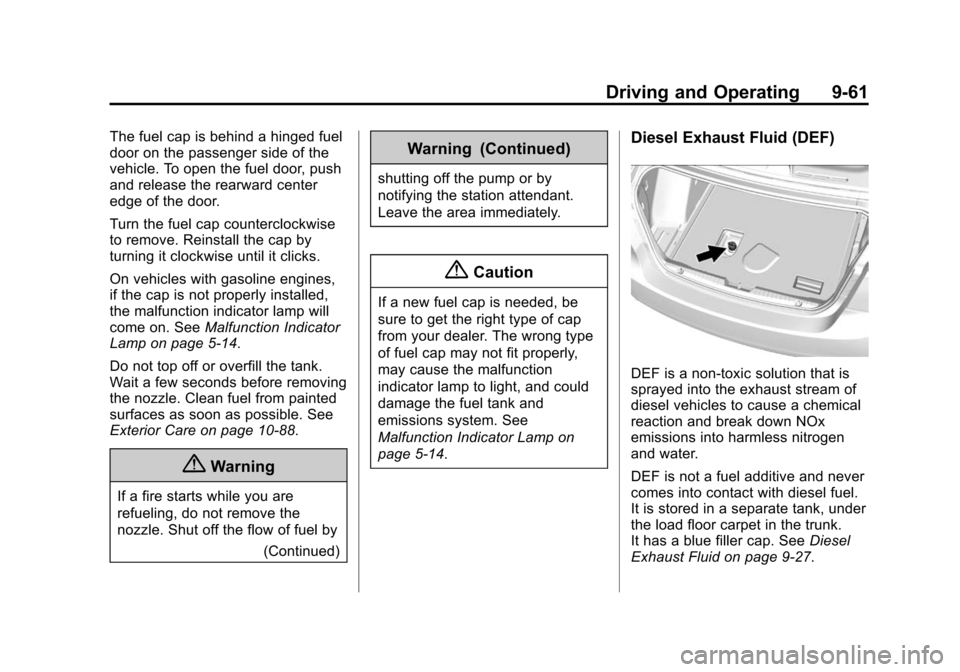
Diesel Exhaust Fluid (DEF)
DEF is a non-toxic solution that is
sprayed into the exhaust stream of
diesel vehicles to cause a chemical
reaction and break down NOx
emissions into harmless nitrogen
and water.
DEF is not a fuel additive and never
comes into contact with diesel fuel.
It is stored in a separate tank, under
the load floor carpet in the trunk.
It has a blue filler cap. See Diesel
Exhaust Fluid on page 9-27.
Page 254 of 417
Black plate (63,1)Chevrolet Cruze Owner Manual (GMNA-Localizing-U.S./Canada-7707493) -
2015 - crc - 11/24/14
Driving and Operating 9-63
.Do not tow a trailer during the
first 800 km (500 mi), to prevent
damage to the engine, axle or
other parts.
.Then, during the first 800 km
(500 mi) trailer towing, do not
drive over 80 km/h (50 mph) and
do not make starts at full throttle.
.Vehicles with automatic
transmissions can tow in D
(Drive) but M (Manual Mode) is
recommended. SeeManual
Mode on page 9-35. Use a lower
gear if the transmission shifts
too often. For vehicles with a
manual transmission, it is better
not to use the highest gear.
.Turn off Park Assist when
towing.
{Warning
When towing a trailer, exhaust
gases may collect at the rear of
the vehicle and enter if the
liftgate, trunk/hatch, or rear-most
window is open.
When towing a trailer:
.Do not drive with the liftgate,
trunk/hatch, or rear-most
window open.
.Fully open the air outlets on
or under the instrument
panel.
.Also adjust the Climate
Control system to a setting
that brings in only outside air.
See “Climate Control
Systems” in the Index.
For information about carbon
monoxide, see Engine Exhaust
on page 9-26. Towing a trailer requires a certain
amount of experience. The
combination you are driving is
longer and not as responsive as the
vehicle itself. Get acquainted with
the handling and braking of the rig
before setting out for the open road.
Before starting, check all trailer hitch
parts and attachments, safety
chains, electrical connectors, lamps,
tires and mirrors. If the trailer has
electric brakes, start the
combination moving and then apply
the trailer brake controller by hand
to be sure the brakes work.
During the trip, check occasionally
to be sure that the load is secure
and the lamps and any trailer
brakes still work.
Towing with a Stability Control
System
When towing, the sound of the
stability control system might be
heard. The system is reacting to the
vehicle movement caused by the