Diesel CHEVROLET CRUZE 2018 Owner's Guide
[x] Cancel search | Manufacturer: CHEVROLET, Model Year: 2018, Model line: CRUZE, Model: CHEVROLET CRUZE 2018Pages: 404, PDF Size: 4.64 MB
Page 221 of 404
Chevrolet Cruze Owner Manual (GMNA-Localizing-U.S./Canada/Mexico-
11348462) - 2018 - crc - 5/15/17
220 Driving and Operating
When adding DEF to an empty or
very low tank, always add at least
7.6 L (2 gal) of fluid to release the
vehicle from speed limitation.
To prevent damage to the system,
do not overfill the DEF tank. When
fluid reaches the top of the fill pipe,
stop filling. Do not top off the
DEF tank.
If you spill DEF during filling, wipe
any affected surface with a damp
cloth.
For information on the DEF tank,
seeFilling the Tank 0254.
Exhaust Fluid Low
A full DEF tank will last for several
thousand kilometers (miles),
depending on vehicle usage. As the
exhaust fluid level drops, warnings
will automatically be displayed in the
DIC. Exhaust fluid level status is
available on the DIC under the
Vehicle Information menu. See
“Diesel Exhaust Fluid (DEF) Level
(Diesel Engine Only)” inDriver
Information Center (DIC) (Base)
0 138 orDriver Information Center
(DIC) (Uplevel) 0141. To avoid vehicle speed limitations,
the DEF tank should be refilled at
the first opportunity after a low
warning indication. If DEF is added
before the EXHAUST FLUID
EMPTY REFILL NOW message
appears, it may take several km/mi
for the DIC message to update.
If the vehicle speed has been
limited and DEF has been added, it
may take up to 30 seconds after
engine start with the vehicle
stopped for the EXHAUST FLUID
EMPTY REFILL NOW message to
clear. If the vehicle is driven prior to
the DIC message clearing, the
vehicle speed will still be limited.
If the DIC message clears while
driving, the speed limitation will be
removed gradually.
If DEF is added under freezing
conditions, additional time may be
required to remove speed limitations
and may require less fluid to fill the
DEF tank.
The following actions describe
strategies required by the U.S.
Environmental Protection Agency
(EPA) and the California Air
Resource Board (CARB). The DEF
messages relate to these strategies.
The DIC message EXHAUST
FLUID RANGE: XXXX km (mi)
displays at approximately 1 600 km
(1,000 mi) of fluid range remaining.
This message appears again at
approximately 500 km (300 mi) of
remaining range before the exhaust
fluid tank becomes empty.
Below 500 km (300 mi) of range
remaining, these messages will
appear every time the vehicle is
started.
Below 121 km (75 mi) of range
remaining, the DIC message
EXHAUST FLUID LOW SPEED
LIMITED SOON displays. This
message will display every time the
vehicle is started.
If these warnings are ignored and
the DEF tank becomes empty, the
DIC message EXHAUST FLUID
EMPTY REFILL NOW - 644 KM
(400 MI) UNTIL 105 KM/H (65 MPH)
MAX SPEED displays. The
Page 222 of 404
Chevrolet Cruze Owner Manual (GMNA-Localizing-U.S./Canada/Mexico-
11348462) - 2018 - crc - 5/15/17
Driving and Operating 221
displayed mileage will decrease as
driving continues. A warning light
also comes on.
When the mileage countdown is
zero, the DIC message EXHAUST
FLUID EMPTY REFILL NOW -
TRANSITIONING TO 105 KM/H
(65 MPH) MAX SPEED displays.
A warning light and a chime also
come on. Vehicle speed will be
reduced to a maximum speed limit
of 105 km/h (65 mph).
After the transition to 105 km/h
(65 mph) is complete, the DIC
message EXHAUST FLUID EMPTY
REFILL NOW - SPEED LIMITED
TO 105 KM/H (65 MPH)–120 KM
(75 MI) UNTIL 89 KM/H (55 MPH)
MAX SPEED displays. The
displayed mileage will decrease as
driving continues. A warning light
and a chime also come on.
When the mileage countdown is
zero, the DIC message EXHAUST
FLUID EMPTY REFILL NOW -
TRANSITIONING TO 89 KM/H
(55 MPH) MAX SPEED displays.
A flashing warning light and a chime also come on. Vehicle speed will be
reduced to a maximum speed limit
of 89 km/h (55 mph).
After the transition to 89 km/h
(55 mph) is complete, the DIC
message EXHAUST FLUID EMPTY
REFILL NOW - SPEED LIMITED
TO 89 KM/H (55 MPH)
–120 KM
(75 MI) UNTIL 7 KM/H (4 MPH) MAX
SPEED displays. The displayed
mileage will decrease as driving
continues. A flashing warning light
and a chime also come on.
When the mileage countdown is
zero, the DIC message EXHAUST
FLUID EMPTY REFILL NOW -
TRANSITIONING TO 7 KM/H
(4 MPH) MAX SPEED displays.
A flashing warning light and a chime
also come on. Vehicle speed will be
reduced to a maximum speed limit
of 7 km/h (4 mph).
After the transition to 7 km/h (4 mph)
is complete, the DIC message
EXHAUST FLUID EMPTY REFILL
NOW - SPEED LIMITED TO 7 KM/H
(4 MPH) displays. A flashing
warning light and a chime also
come on. Add at least 7.6 L (2 gal) of fluid to
release the vehicle from speed
limitation from a very low or empty
tank. The capacity of the DEF tank
is 14.3 L (3.8 gal).
See
Diesel Exhaust Fluid (DEF)
Warning Light 0136, and
Recommended Fluids and
Lubricants 0359.
Exhaust Fluid Quality Poor
Use only exhaust fluid that is GM
approved, or fluid containing the API
certified or ISO 22241 label.
All DEF has an expiration date.
If the system detects poor quality,
or contaminated or diluted DEF, the
DIC message EXHAUST FLUID
QUALITY POOR - SEE OWNERS
MANUAL NOW –160 KM (99 MI)
UNTIL 105 KM/H (65 MPH) MAX
SPEED displays. The displayed
mileage will decrease as driving
continues. A warning light also
comes on. Adding fresh DEF to the
system may resolve the problem,
depending on several factors. If the
DIC message persists, see your
dealer or additional DIC messages
may display.
Page 247 of 404
Chevrolet Cruze Owner Manual (GMNA-Localizing-U.S./Canada/Mexico-
11348462) - 2018 - crc - 5/15/17
246 Driving and Operating
the fuel tank at every engine oil
change, can help. GM Fuel System
Treatment Cleaner is the only
gasoline additive recommended by
General Motors. It is available at
your dealer.
Fuel for Diesel Engines
The selection of a high quality fuel
is important for maintaining optimum
performance. Do not use diesel fuel
with more than 15 ppm sulfur
content. Do not use a diesel blend
containing more than 20% biodiesel
by volume. Both diesel and
biodiesel blends must meet all the
requirements as defined in the most
current versions of the local fuel
standards. See the recommended
fuels underWhat Fuel to Use in the
U.S. (Diesel) 0246 andWhat Fuel
to Use in Canada (Diesel) 0248.
Caution
Engine damage may occur if
recommended fuels are not used,
which may void the vehicle
warranty. Some improper
fuels are:
. Diesel fuel with the addition
of gasoline.
. Diesel fuel mixed with
engine oil or automatic
transmission fluid.
. Triglyceride fuels, such as
raw vegetable oil or animal
fat, in any form, including
with blends of diesel or
biodiesel.
. Marine diesel fuel and
fuel oils.
. Diesel-water emulsions,
such as Aquazole.
. Aftermarket diesel fuel
additives, which contain
alcohols, organo-metallic
additives, or water
emulsifiers.
(Continued)
Caution (Continued)
.Diesel fuel with sulfur
greater than 15 ppm.
. Diesel-biodiesel blends not
within the required
specification.
Some conditions, such as dirty fuel,
may decrease fuel filter life and a
CHANGE FUEL FILTER message
may come on in the Driver
Information Center (DIC).
What Fuel to Use in the
U.S. (Diesel)
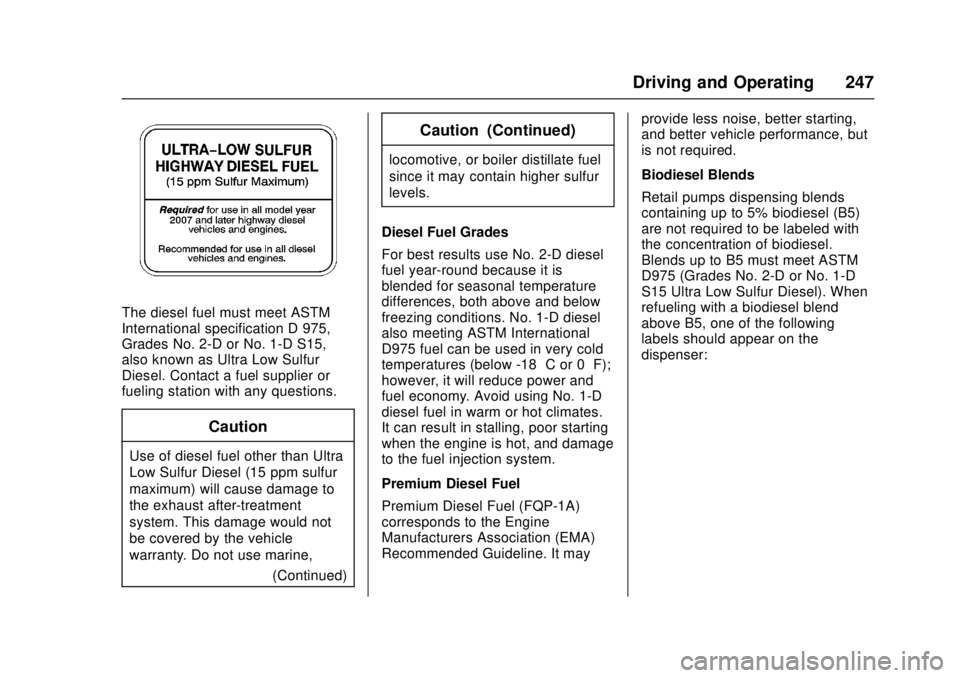
Use of diesel fuel with ultra low
sulfur content (15 ppm, maximum) is
required. Look for service station
fuel dispensers with this label in
green:
Page 248 of 404
Chevrolet Cruze Owner Manual (GMNA-Localizing-U.S./Canada/Mexico-
11348462) - 2018 - crc - 5/15/17
Driving and Operating 247
The diesel fuel must meet ASTM
International specification D 975,
Grades No. 2-D or No. 1-D S15,
also known as Ultra Low Sulfur
Diesel. Contact a fuel supplier or
fueling station with any questions.
Caution
Use of diesel fuel other than Ultra
Low Sulfur Diesel (15 ppm sulfur
maximum) will cause damage to
the exhaust after-treatment
system. This damage would not
be covered by the vehicle
warranty. Do not use marine,(Continued)
Caution (Continued)
locomotive, or boiler distillate fuel
since it may contain higher sulfur
levels.
Diesel Fuel Grades
For best results use No. 2-D diesel
fuel year-round because it is
blended for seasonal temperature
differences, both above and below
freezing conditions. No. 1-D diesel
also meeting ASTM International
D975 fuel can be used in very cold
temperatures (below -18 °C or 0 °F);
however, it will reduce power and
fuel economy. Avoid using No. 1-D
diesel fuel in warm or hot climates.
It can result in stalling, poor starting
when the engine is hot, and damage
to the fuel injection system.
Premium Diesel Fuel
Premium Diesel Fuel (FQP-1A)
corresponds to the Engine
Manufacturers Association (EMA)
Recommended Guideline. It may provide less noise, better starting,
and better vehicle performance, but
is not required.
Biodiesel Blends
Retail pumps dispensing blends
containing up to 5% biodiesel (B5)
are not required to be labeled with
the concentration of biodiesel.
Blends up to B5 must meet ASTM
D975 (Grades No. 2-D or No. 1-D
S15 Ultra Low Sulfur Diesel). When
refueling with a biodiesel blend
above B5, one of the following
labels should appear on the
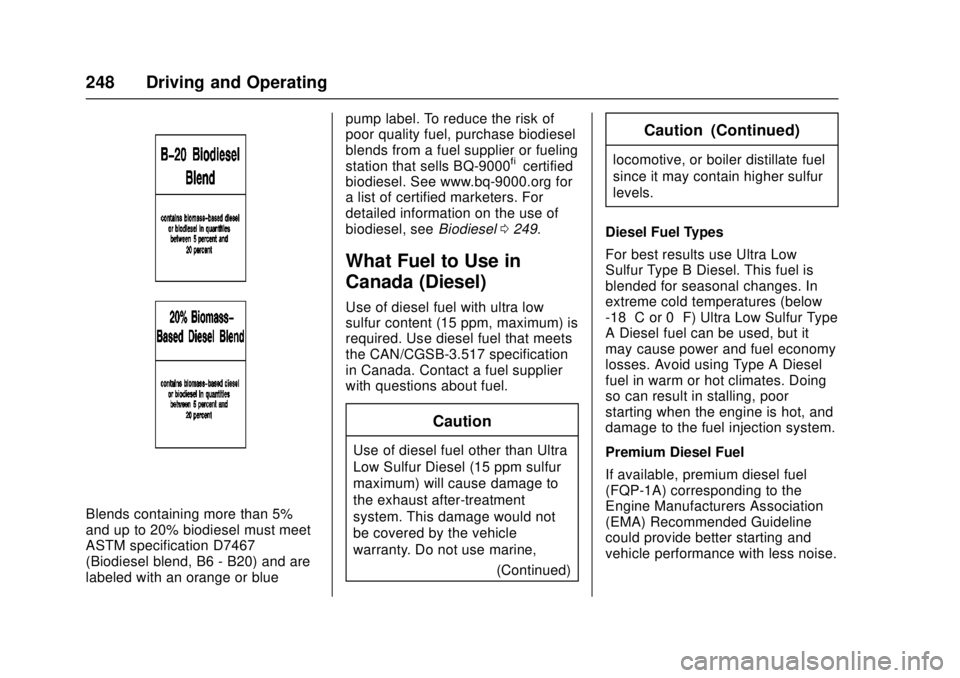
dispenser:
Page 249 of 404
Chevrolet Cruze Owner Manual (GMNA-Localizing-U.S./Canada/Mexico-
11348462) - 2018 - crc - 5/15/17
248 Driving and Operating
Blends containing more than 5%
and up to 20% biodiesel must meet
ASTM specification D7467
(Biodiesel blend, B6 - B20) and are
labeled with an orange or bluepump label. To reduce the risk of
poor quality fuel, purchase biodiesel
blends from a fuel supplier or fueling
station that sells BQ-9000
®certified
biodiesel. See www.bq-9000.org for
a list of certified marketers. For
detailed information on the use of
biodiesel, see Biodiesel0249.
What Fuel to Use in
Canada (Diesel)
Use of diesel fuel with ultra low
sulfur content (15 ppm, maximum) is
required. Use diesel fuel that meets
the CAN/CGSB-3.517 specification
in Canada. Contact a fuel supplier
with questions about fuel.
Caution
Use of diesel fuel other than Ultra
Low Sulfur Diesel (15 ppm sulfur
maximum) will cause damage to
the exhaust after-treatment
system. This damage would not
be covered by the vehicle
warranty. Do not use marine,
(Continued)
Caution (Continued)
locomotive, or boiler distillate fuel
since it may contain higher sulfur
levels.
Diesel Fuel Types
For best results use Ultra Low
Sulfur Type B Diesel. This fuel is
blended for seasonal changes. In
extreme cold temperatures (below
-18 °C or 0 °F) Ultra Low Sulfur Type
A Diesel fuel can be used, but it
may cause power and fuel economy
losses. Avoid using Type A Diesel
fuel in warm or hot climates. Doing
so can result in stalling, poor
starting when the engine is hot, and
damage to the fuel injection system.
Premium Diesel Fuel
If available, premium diesel fuel
(FQP-1A) corresponding to the
Engine Manufacturers Association
(EMA) Recommended Guideline
could provide better starting and
vehicle performance with less noise.
Page 250 of 404
Chevrolet Cruze Owner Manual (GMNA-Localizing-U.S./Canada/Mexico-
11348462) - 2018 - crc - 5/15/17
Driving and Operating 249
Biodiesel Blends in Canada
Biodiesel blends that meet the CAN/
CGSB-3.522 specifications up to
20% (B20) can be used. Avoid the
use of biodiesel blends above 20%,
as they may damage the engine
and fuel system. For detailed
information on the use of biodiesel,
seeBiodiesel 0249.
Refueling
Diesel fuel can foam when filling the
tank. This can cause the automatic
pump nozzle to shut off, even if the
tank is not full. If this happens, wait
for the foaming to stop, and then fill
the tank more slowly. See Filling the
Tank 0254.
{Warning
Heat coming from the engine can
cause the fuel to expand and
force the fuel out of the tank.
If something ignites the fuel, a fire
could start. To help avoid this, fill
the tank slowly and only until the
nozzle shuts off. Do not top it off.
Clean up any spilled fuel. Accidental Refueling with
Gasoline
Caution
If the vehicle is accidentally
refueled with gasoline, do not
continue driving the vehicle
except to get to a location where
it can be stopped safely. Driving
the vehicle will damage the fuel
system. Have the vehicle towed
to a qualified technician to have
the gasoline removed from the
tank and fuel system. Flush the
fuel system with Ultra Low Sulfur
Diesel fuel to ensure all gasoline
is removed.
Biodiesel
Biodiesel is a renewable fuel
produced from vegetable oils or
animal fats that have been
chemically modified to make it
compatible with diesel fuel.
Caution
Do not use home-made biodiesel
or home test kits because the
quality cannot be verified by
approved scientific methods. Do
not use raw vegetable oil or other
unmodified bio-oils, fats,
or blends of vegetable oil with
diesel. They could damage the
fuel system and engine, and
damages would not be covered
by the vehicle warranty.
Caution
Do not use blends containing
more than 20% biodiesel. Any
engine, fuel system, or exhaust
after-treatment system damage
would not be covered by the
vehicle warranty.
Biodiesel fuel quality degrades with
time and exposure to high
temperature quicker than Ultra Low
Sulfur Diesel fuel. More frequent
Page 251 of 404
Chevrolet Cruze Owner Manual (GMNA-Localizing-U.S./Canada/Mexico-
11348462) - 2018 - crc - 5/15/17
250 Driving and Operating
refueling provides the best
opportunity to have a supply of fresh
fuel. Storage at hot ambient
temperatures will accelerate
biodiesel degradation.
Owners who use very little fuel,
or who have vehicles stored for
extended periods of time, should
avoid the use of biodiesel blended
fuels above 5% by volume. When
vehicles are stored for longer than
one month, they should be run out
of biodiesel to below one-quarter
tank, refueled with Ultra Low Sulfur
Diesel fuel, and driven at least
32 km (20 mi) before storage.
At temperatures below 0 °C (32 °F),
it is recommended to switch to Ultra
Low Sulfur Diesel fuel with no
biodiesel content, or to blends with
biodiesel containing less than 5% by
volume. At these extreme cold
temperatures, biodiesel blends
higher than 5% by volume may
cause fuel filter plugging and
system gelling, which can lead to
vehicle operability problems.Fuels improperly blended for cold
temperature operation may result in
restricted fuel filters and degraded
vehicle performance. GM diesel
vehicles are equipped with a fuel
heating system to provide an extra
level of protection against filter
plugging from gelling or waxing of
conventional diesel fuel and
biodiesel blends. If the operating
temperature is far below the
temperature at which gelling or
waxing of the fuel occurs, the
system cannot prevent all cases of
filter plugging.
If the vehicle experiences a fuel
filter restriction, the on-board
monitoring system will alert the
driver that the fuel filter requires
service. The fuel filter, however, will
not prevent all damage caused by
poor quality biodiesel.
Cold Weather Operation
(Diesel)
In cold weather, the fuel filter may
become clogged by wax naturally
present in the fuel. To unclog it,
move the vehicle to a warm garagearea and allow the filter to warm up.
The fuel filter may need to be
replaced. See
Fuel Filter
Replacement (Diesel) 0254.
At temperatures below 0 °C (32 °F),
it is recommended to avoid using
biodiesel blends above 5% blend.
This blend may cause fuel filter
plugging, system gelling, and
freezing that may affect vehicle
starting. You may need to place the
ignition in Service Mode and off a
few times before the vehicle will
start.
See Ignition Positions (Key Access)
0 206 orIgnition Positions (Keyless
Access) 0208. Also, idle the vehicle
for a couple of minutes before
accelerating.
For additional information for better
cold weather operation, see Engine
Heater 0213.
Water in Fuel (Diesel)
Improper fuel tank inspection or
cleaning, or contaminated fuel from
suppliers, can cause water to be
pumped into the fuel tank along with
the diesel fuel. If a WATER IN FUEL
Page 252 of 404
Chevrolet Cruze Owner Manual (GMNA-Localizing-U.S./Canada/Mexico-
11348462) - 2018 - crc - 5/15/17
Driving and Operating 251
- CONTACT SERVICE message
displays, the water must be drained
immediately.
{Warning
Diesel fuel containing water is still
combustible. You or others could
be burned. If the fuel needs to be
drained, keep sparks, flames, and
smoking materials away from the
mixture.
As an added precaution, drain the
diesel fuel filter of residual water at
every engine oil change. If the
WATER IN FUEL - CONTACT
SERVICE message comes on
frequently, even after draining water
from the fuel filter, see your dealer. Water in Fuel Troubleshooting
If the WATER IN FUEL - CONTACT
SERVICE message comes on:
Problem Recommended
Action
Message
displays but
goes off during
the ignition
cycle. The fuel filter is
partially filled
with water. Drain
the water as
soon as
possible. See
"Removing
Water from the
Fuel Filter"
following. Problem
Recommended
Action
Message
displays and
stays on. Drain the fuel
filter
immediately.
If no water can
be drained, and
the temperature
is below
freezing, then
water may be
frozen in the
filter. Move the
vehicle to a
warm location to
thaw the water,
then drain the
fuel. If water still
does not drain,
see your dealer.
Page 253 of 404
Chevrolet Cruze Owner Manual (GMNA-Localizing-U.S./Canada/Mexico-
11348462) - 2018 - crc - 5/15/17
252 Driving and Operating
ProblemRecommended
Action
Immediately
after refueling,
message
displays and
stays on. A large amount
of water is in the
fuel tank. Drain
the fuel filter
immediately.
If the message
stays on or
comes back on
without
refueling, then
fuel tank purging
is required. See
your dealer.
If the message
displays and the
engine stalls or
runs rough, do
not drive until
the water
contaminated
fuel is drained.Caution
Driving with this message on can
damage the fuel injection system
and the engine. If the message
comes on right after a refuel,
water was pumped into the fuel
tank. Turn off the engine and
drain the water immediately.
Removing Water from the Fuel
Filter
To drain water: 1. Turn the engine off and apply the parking brake.
2. Place a container under the filter drain valve, which is on
the bottom of the fuel filter.
3. Turn the drain plugcounterclockwise using a
suitable tool.
4. With the engine off, press and hold ENGINE START/STOP
without applying the brake for
five seconds to place the
vehicle in Service Mode. Wait
approximately five seconds,
and then press ENGINE
START/STOP again to turn it
off. This operation will enhance
water flow out of the filter. The
filter is drained as soon as
diesel fuel emerges from
the port.
Page 254 of 404
Chevrolet Cruze Owner Manual (GMNA-Localizing-U.S./Canada/Mexico-
11348462) - 2018 - crc - 5/15/17
Driving and Operating 253
5. Retighten the drain plug byturning it clockwise.
6. Properly dispose of the water contaminated fuel.
7. Start the engine and let it run for a few minutes. During the
draining process, air may have
entered the fuel system. If the
engine stalls, the fuel system
may need to be primed. See
“Fuel Priming” following.
Fuel Priming
For the fuel system to work properly,
air cannot be in the fuel lines. If air
gets in, the engine may not start
and the fuel lines will need to be
primed before operating the vehicle.
If air is present, the following may
have happened:
. The vehicle ran out of fuel.
. The fuel filter was removed.
. The fuel lines were removed or
disconnected.
. The fuel filter water drain valve
was opened while the engine
was running. To prime the fuel system:
1. With the engine off, press and hold ENGINE START/STOP
without applying the brake for
five seconds to place the
vehicle in Service Mode. Wait
for 30 seconds to allow fuel to
fully cycle. Press ENGINE
START/STOP again to turn it
off. Do this step three times or
more while the engine is off.
2. Press ENGINE START/STOP with the brake applied for a
maximum of 40 seconds at a
time, with five seconds
between ignition attempts, until
the engine starts. If the engine
tries to run, but does not run
smoothly, increase the RPMs
slightly by using the accelerator
pedal. This will help force air
through the system.
3. Repeat Step 2 if the engine stalls and will not restart.
4. After a few attempts, if the engine still does not start, see
your dealer.Running Out of Fuel
(Diesel)
{Warning
Diesel fuel is flammable. It could
start a fire if something ignites it,
and people could be burned. Do
not let it get on hot engine parts,
and keep matches or other
ignition sources away.
If the engine has stalled due to
running out of fuel, add at least
7.6 L (2 gal) of fuel if parked on a
level surface, or up to 18.9 L (5 gal)
of fuel if parked on a slope, and
perform the procedure under “Fuel
Priming” previously in this section.