battery CHEVROLET CRUZE 2019 Owner's Manual
[x] Cancel search | Manufacturer: CHEVROLET, Model Year: 2019, Model line: CRUZE, Model: CHEVROLET CRUZE 2019Pages: 20, PDF Size: 2.8 MB
Page 5 of 20

5F Optional equipment
The Keyless Access System enables operation of the doors and trunk/liftg\
ate without removing the Remote Keyless Entry transmitter from a pocket or purse. Th\
e transmitter must be within 3 feet of a door or the trunk/liftgate.
KEYLESS UNLOCKING
With the transmitter within range:
Press the lock button on the driver’s door handle to unlock the driver’s door; press it again within 5 seconds to unlock all doors.
Press the lock button on the front passenger’s door handle to unlock all doors.
Press the touchpad either above the license plate or at the base of the liftgate to open the trunk/liftgate.
KEYLESS LOCKING
With the ignition off, the transmitter out of the vehicle, and all doors\
closed:
Press the lock button on any door handle to lock all doors immediately.
If Passive Locking is turned on, all doors will lock automatically after\
a short delay once all doors are closed.
Note: To change the door lock and unlock settings, go to Settings > Vehicle > Remote Lock, Unlock, Start.
See Keys, Doors and Windows in your Owner’s Manual.
KEYLESS ACCESS SYSTEMF
KEYLESS (PUSHBUTTON) STARTF
The Remote Keyless Entry (RKE) transmitter must be in the vehicle to turn on the ignition.
STARTING THE ENGINE
With the vehicle in Park, press the brake pedal and then press the ENGINE START/STOP button. The button indicator will be green.
Note: If the RKE transmitter battery is weak, place the transmitter in the front cupholder in the center console to enable the engine to start. Replace the transmitter battery as soon as possible.
STOPPING THE ENGINE/OFF
Shift to Park and press the ENGINE START/STOP button.
ACCESSORY MODE
With the engine off and the brake pedal not depressed, press the ENGINE START/STOP button. The button indicator will be amber.
See Driving and Operating in your Owner’s Manual.
Page 6 of 20
6F Optional equipment
FRONT SEATS
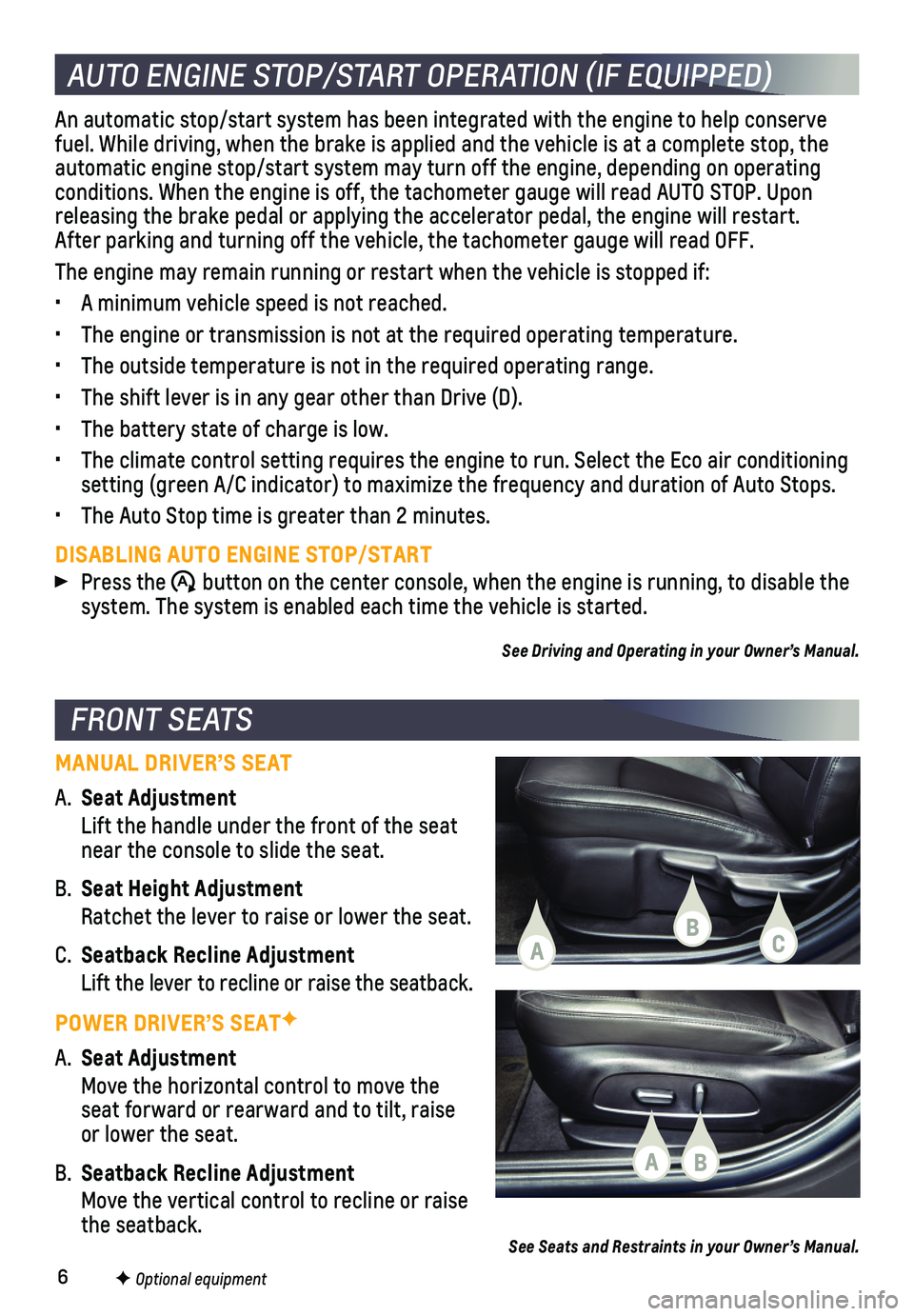
MANUAL DRIVER’S SEAT
A. Seat Adjustment
Lift the handle under the front of the seat near the console to slide the seat.
B. Seat Height Adjustment
Ratchet the lever to raise or lower the seat.
C. Seatback Recline Adjustment
Lift the lever to recline or raise the seatback.
POWER DRIVER’S SEATF
A. Seat Adjustment
Move the horizontal control to move the seat forward or rearward and to tilt, raise or lower the seat.
B. Seatback Recline Adjustment
Move the vertical control to recline or raise the seatback.See Seats and Restraints in your Owner’s Manual.
AUTO ENGINE STOP/START OPERATION (IF EQUIPPED)
An automatic stop/start system has been integrated with the engine to he\
lp conserve fuel. While driving, when the brake is applied and the vehicle is at a c\
omplete stop, the automatic engine stop/start system may turn off the engine, depending on\
operating conditions. When the engine is off, the tachometer gauge will read AUTO \
STOP. Upon releasing the brake pedal or applying the accelerator pedal, the engine \
will restart. After parking and turning off the vehicle, the tachometer gauge will read OFF.\
The engine may remain running or restart when the vehicle is stopped if:\
• A minimum vehicle speed is not reached.
• The engine or transmission is not at the required operating temperature.\
• The outside temperature is not in the required operating range.
• The shift lever is in any gear other than Drive (D).
• The battery state of charge is low.
• The climate control setting requires the engine to run. Select the Eco a\
ir conditioning setting (green A/C indicator) to maximize the frequency and duration o\
f Auto Stops.
• The Auto Stop time is greater than 2 minutes.
DISABLING AUTO ENGINE STOP/START
Press the $ button on the center console, when the engine is running, to disable the system. The system is enabled each time the vehicle is started.
See Driving and Operating in your Owner’s Manual.
CBA
BA
Page 19 of 20

19
TIRE PRESSURE MONITOR
The Low Tire Pressure warning light on the instrument cluster illuminates wh\
en one or more of the vehicle’s tires is significantly underinflated. Fi\
ll the tires to the proper tire pressures listed on the Tire and Loading Information label located below\
the driver’s door latch. Current tire pressures can be viewed on the Driver Information Ce\
nter.
See Vehicle Care in your Owner’s Manual.
HOOD RELEASE
BATTERY LOCATION
DIESEL FEATURES (IF EQUIPPED)
With the driver’s door open, pull and release the hood release handle\
on the lower-left side of the instrument panel. Pull and release the handle again to fully\
open the hood. There is not a secondary latch under the hood.
See Vehicle Care in your Owner’s Manual.
The battery is located behind the rear seat on the passenger’s side o\
f the vehicle and can be accessed through the trunk/rear hatch. Remote jump-start positive\
and negative
terminals are located under the hood on the driver’s side of the vehi\
cle.
See Vehicle Care in your Owner’s Manual.
DIESEL EXHAUST FLUID (DEF)
DEF reduces the amount of regulated emissions produced. The DEF level mu\
st be main-tained for the vehicle to run properly. As the DEF level becomes low, wa\
rnings begin with approximately 1,000 miles ( 1,600 km) of remaining range. These warnin\
gs will increase in intensity as the DEF level is reduced. Once the tank is empty, vehicl\
e speed will be
limited. The DEF fill port is located behind the fuel fill door.
DIESEL PARTICULATE FILTER (DPF)
The DPF filters the diesel exhaust gas. Occasionally, the DPF needs to\
be cleaned. When needed, the engine computer will automatically initiate a cleaning actio\
n.
See Driving and Operating in your Owner’s Manual.