radiator CHEVROLET DURAMAX 2006 User Guide
[x] Cancel search | Manufacturer: CHEVROLET, Model Year: 2006, Model line: DURAMAX, Model: CHEVROLET DURAMAX 2006Pages: 100, PDF Size: 0.71 MB
Page 69 of 100
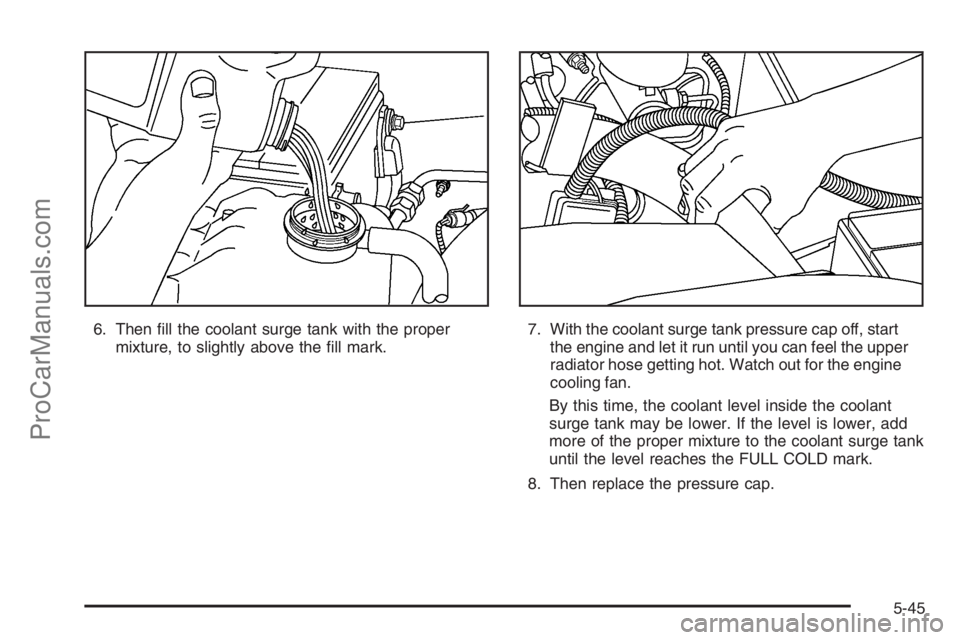
6. Then fill the coolant surge tank with the proper
mixture, to slightly above the fill mark.7. With the coolant surge tank pressure cap off, start
the engine and let it run until you can feel the upper
radiator hose getting hot. Watch out for the engine
cooling fan.
By this time, the coolant level inside the coolant
surge tank may be lower. If the level is lower, add
more of the proper mixture to the coolant surge tank
until the level reaches the FULL COLD mark.
8. Then replace the pressure cap.
5-45
ProCarManuals.com
Page 70 of 100
Van Models
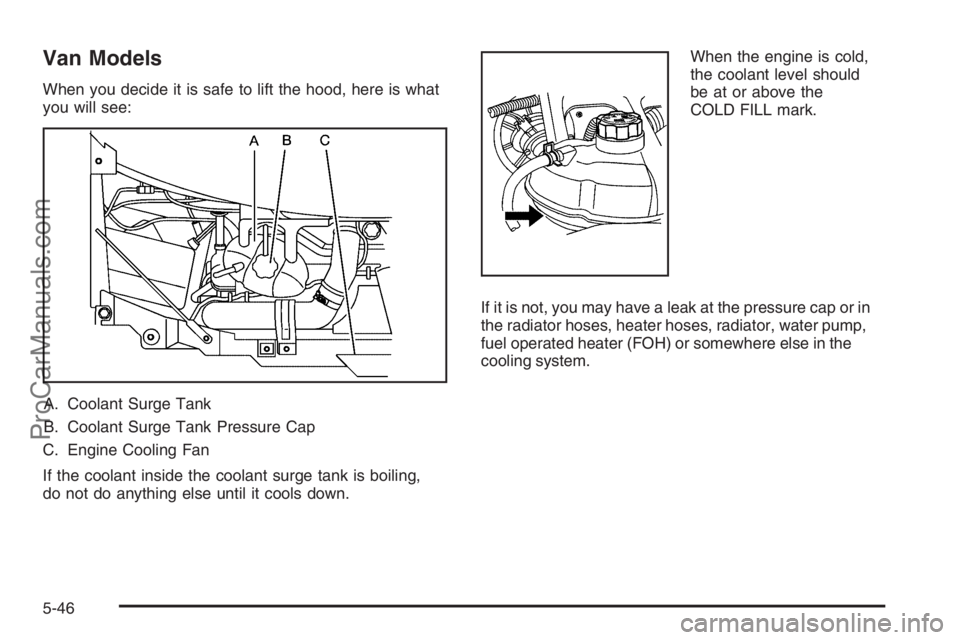
When you decide it is safe to lift the hood, here is what
you will see:
A. Coolant Surge Tank
B. Coolant Surge Tank Pressure Cap
C. Engine Cooling Fan
If the coolant inside the coolant surge tank is boiling,
do not do anything else until it cools down.When the engine is cold,
the coolant level should
be at or above the
COLD FILL mark.
If it is not, you may have a leak at the pressure cap or in
the radiator hoses, heater hoses, radiator, water pump,
fuel operated heater (FOH) or somewhere else in the
cooling system.
5-46
ProCarManuals.com
Page 71 of 100
{CAUTION:
Heater and radiator hoses, and other engine
parts, can be very hot. Do not touch them. If
you do, you can be burned.
Do not run the engine if there is a leak. If you
run the engine, it could lose all coolant. That
could cause an engine re, and you could be
burned. Get any leak xed before you drive the
vehicle.
If there seems to be no leak, start the engine again. See if
the engine cooling fan speed increases when idle speed
is doubled by pushing the accelerator pedal down. If it
does not, your vehicle needs service. Turn off the engine.
Notice:Engine damage from running your engine
without coolant is not covered by your warranty.Notice:Using coolant other than DEX-COOL
®may
cause premature engine, heater core, radiator and
fuel operated heater (FOH) corrosion. In addition,
the engine coolant may require changing sooner, at
30,000 miles (50 000 km) or 24 months, whichever
occurs rst. Any repairs would not be covered by
your warranty. Always use DEX-COOL
®(silicate-free)
coolant in your vehicle.
How to Add Coolant to the Coolant
Surge Tank
Notice:The diesel engine has a specic coolant ll
procedure. Failure to follow this procedure could
cause your engine to overheat and be severely
damaged.
If you have not found a problem yet, but the coolant level
is not at the COLD FILL mark, add a 50/50 mixture of
clean, drinkable water and DEX-COOL
®engine coolant
at the coolant surge tank. SeeEngine Coolant on
page 5-34for more information.
5-47
ProCarManuals.com
Page 72 of 100
If no coolant is visible in the surge tank, add coolant
as follows:
{CAUTION:
Steam and scalding liquids from a hot cooling
system can blow out and burn you badly. They
are under pressure, and if you turn the coolant
surge tank pressure cap — even a little — they
can come out at high speed. Never turn the
cap when the cooling system, including the
coolant surge tank pressure cap, is hot. Wait
for the cooling system and coolant surge tank
pressure cap to cool if you ever have to turn
the pressure cap.
{CAUTION:
Adding only plain water to your cooling
system can be dangerous. Plain water, or
some other liquid such as alcohol, can boil
before the proper coolant mixture will. Your
vehicle’s coolant warning system is set for the
proper coolant mixture. With plain water or the
wrong mixture, your engine could get too hot
but you would not get the overheat warning.
Your engine could catch re and you or others
could be burned. Use a 50/50 mixture of clean,
drinkable water and DEX-COOL
®coolant.
Notice:In cold weather, water can freeze and crack
the engine, radiator, fuel operated heater (FOH),
heater core and other parts. Use the recommended
coolant and the proper coolant mixture.
5-48
ProCarManuals.com
Page 73 of 100
{CAUTION:
You can be burned if you spill coolant on hot
components in the engine compartment.
Coolant contains ethylene glycol, and it will
burn if the engine parts are hot enough. Do not
spill coolant on a hot engine or components in
the engine compartment.
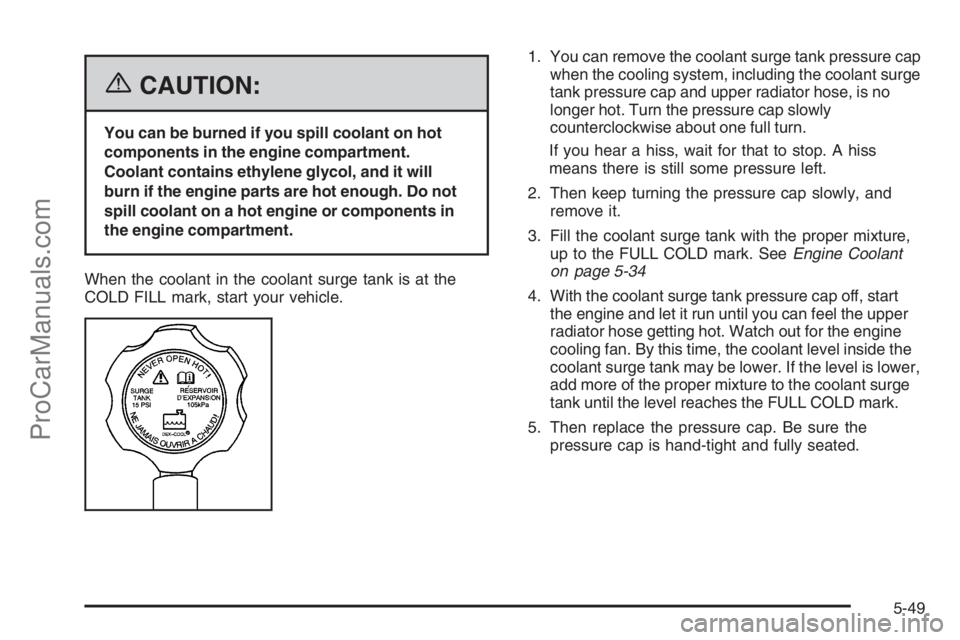
When the coolant in the coolant surge tank is at the
COLD FILL mark, start your vehicle.1. You can remove the coolant surge tank pressure cap
when the cooling system, including the coolant surge
tank pressure cap and upper radiator hose, is no
longer hot. Turn the pressure cap slowly
counterclockwise about one full turn.
If you hear a hiss, wait for that to stop. A hiss
means there is still some pressure left.
2. Then keep turning the pressure cap slowly, and
remove it.
3. Fill the coolant surge tank with the proper mixture,
up to the FULL COLD mark. SeeEngine Coolant
on page 5-34
4. With the coolant surge tank pressure cap off, start
the engine and let it run until you can feel the upper
radiator hose getting hot. Watch out for the engine
cooling fan. By this time, the coolant level inside the
coolant surge tank may be lower. If the level is lower,
add more of the proper mixture to the coolant surge
tank until the level reaches the FULL COLD mark.
5. Then replace the pressure cap. Be sure the
pressure cap is hand-tight and fully seated.
5-49
ProCarManuals.com
Page 83 of 100
Maintenance Footnotes
†The U.S. Environmental Protection Agency or the
California Air Resources Board has determined that the
failure to perform this maintenance item will not nullify
the emission warranty or limit recall liability prior to the
completion of the vehicle’s useful life. We, however,
urge that all recommended maintenance services be
performed at the indicated intervals and the maintenance
be recorded.
#Lubricate the front suspension, steering linkage,
transmission shift linkage (pickup models), rear driveline
center splines (van models), and parking brake cable
guides. Pickup models only: Control arm ball joints
require lubrication but should not be lubricated unless
their temperature is 10°F (-12°C) or higher, or they could
be damaged. Vehicles used under severe commercial
operating conditions require lubrication on a regular basis
every 3,000 miles (5 000 km).
(a)A uid loss in any vehicle system could indicate a
problem. Have the system inspected and repaired
and the uid level checked. Add uid if needed.
(b)If you drive regularly under dusty conditions, inspect
the lter or change indicator, if equipped, at each engine
oil change.(c)Visually inspect brake lines and hoses for proper
hook-up, binding, leaks, cracks, chang, etc. Inspect disc
brake pads for wear and rotors for surface condition.
Inspect drum brake linings/shoes for wear or cracks.
Inspect other brake parts, including drums, wheel
cylinders, calipers, parking brake, etc.
(d)Visually inspect front and rear suspension and
steering system for damaged, loose, or missing parts,
signs of wear or lack of lubrication. Inspect power
steering lines and hoses for proper hook-up, binding,
leaks, cracks, chang, etc. Pickup models: Visually
check constant velocity joints, rubber boots, and axle
seals for leaks.
(e)Visually inspect hoses and have them replaced if they
are cracked, swollen, or deteriorated. Inspect all pipes,
ttings, and clamps; replace with genuine GM parts as
needed. To help ensure proper operation, a pressure test
of the cooling system and pressure cap and cleaning the
outside of the radiator and air conditioning condenser is
recommended at least once a year.
(f)Visually inspect wiper blades for wear or cracking.
Replace wiper blades that appear worn or damaged
or that streak or miss areas of the windshield.
6-9
ProCarManuals.com
Page 85 of 100
(n)Change clutch uid (or every 24 months, whichever
occurs rst).
(p)Change automatic transmission uid and external
transmission lter if the vehicle is mainly driven
under one or more of these conditions:
-In heavy city traffic where the outside temperature
regularly reaches 90°F (32°C) or higher.
-In hilly or mountainous terrain.
-When doing frequent trailer towing.
-Uses such as found in taxi, police, or delivery
service.
(q)Check vent hose at transfer case for kinks and
proper installation.
(r)Drain, ush, and rell cooling system. This service
can be complex; you should have your dealer perform
this service. See Engine Coolant on page 5-34 for
what to use. Inspect hoses. Clean radiator, condenser,
van model fuel operated heater (if equipped), pressure
cap, and ller neck. Pressure test the cooling system
and pressure cap. For van models, see Fuel Operated
Heater (FOH) (Van Models Only) on page 2-8.
(s)Visually inspect belt for fraying, excessive cracks,
or obvious damage. Replace belt if necessary.Owner Checks and Services
These owner checks and services should be performed
at the intervals specified to help ensure the safety,
dependability, and emission control performance of your
vehicle. Your GM Goodwrench
®dealer can assist you
with these checks and services.
Be sure any necessary repairs are completed at once.
Whenever any fluids or lubricants are added to your
vehicle, make sure they are the proper ones, as shown
inRecommended Fluids and Lubricants on page 6-15.
At Each Fuel Fill
It is important to perform these underhood checks at
each fuel ll.
Engine Oil Level Check
Check the engine oil level and add the proper oil if
necessary. SeeEngine Oil on page 5-21for further
details.
Notice:It is important to check your oil regularly
and keep it at the proper level. Failure to keep your
engine oil at the proper level can cause damage
to your engine not covered by your warranty.
6-11
ProCarManuals.com
Page 99 of 100
M
Maintenance Schedule
At Each Fuel Fill.........................................6-11
At Least Once a Month................................6-12
At Least Once a Year..................................6-12
Introduction.................................................. 6-2
Maintenance Requirements............................. 6-2
Scheduled Maintenance................................. 6-4
Using.......................................................... 6-2
Your Vehicle and the Environment................... 6-2
Malfunction Indicator Lamp................................ 3-4
O
Oil, Engine.....................................................5-21
Oil Pressure Gage............................................ 3-6
Overheating, Engine........................................5-39
Owners, Canadian............................................... ii
P
Power
Reduced Engine Light.................................... 3-7
R
Radiator Pressure Cap....................................5-39
Reduced Engine Power Light............................. 3-7
Running Out of Fuel........................................5-11
S
Scheduled Maintenance..................................... 6-4
Specification Charts.........................................5-50
Starting the Diesel Engine................................. 2-2
Surge Tank Pressure Cap, Coolant....................5-39
3
ProCarManuals.com