service CHEVROLET DURAMAX 2006 Owner's Manual
[x] Cancel search | Manufacturer: CHEVROLET, Model Year: 2006, Model line: DURAMAX, Model: CHEVROLET DURAMAX 2006Pages: 100, PDF Size: 0.71 MB
Page 71 of 100
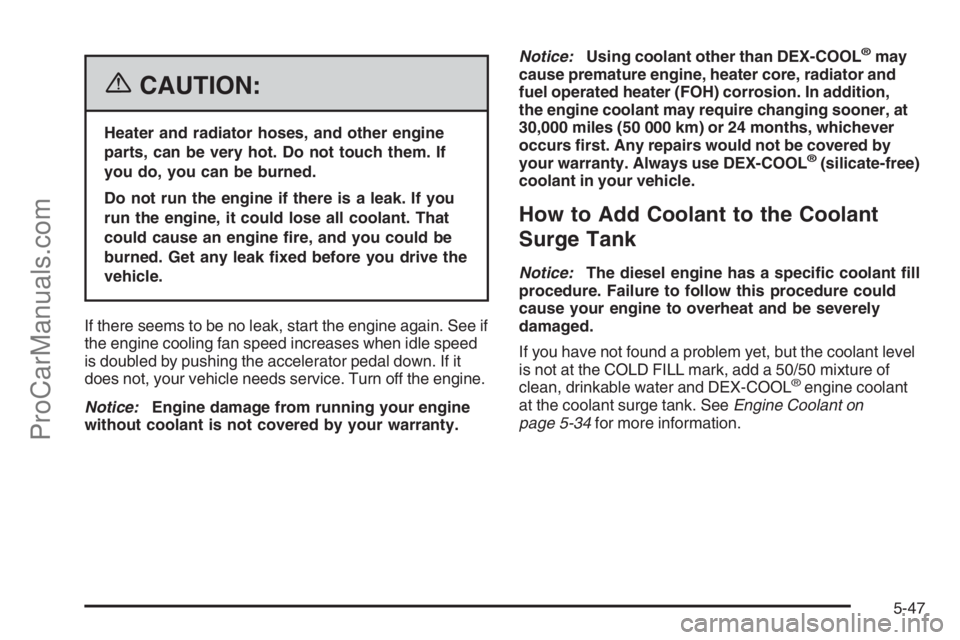
{CAUTION:
Heater and radiator hoses, and other engine
parts, can be very hot. Do not touch them. If
you do, you can be burned.
Do not run the engine if there is a leak. If you
run the engine, it could lose all coolant. That
could cause an engine re, and you could be
burned. Get any leak xed before you drive the
vehicle.
If there seems to be no leak, start the engine again. See if
the engine cooling fan speed increases when idle speed
is doubled by pushing the accelerator pedal down. If it
does not, your vehicle needs service. Turn off the engine.
Notice:Engine damage from running your engine
without coolant is not covered by your warranty.Notice:Using coolant other than DEX-COOL
®may
cause premature engine, heater core, radiator and
fuel operated heater (FOH) corrosion. In addition,
the engine coolant may require changing sooner, at
30,000 miles (50 000 km) or 24 months, whichever
occurs rst. Any repairs would not be covered by
your warranty. Always use DEX-COOL
®(silicate-free)
coolant in your vehicle.
How to Add Coolant to the Coolant
Surge Tank
Notice:The diesel engine has a specic coolant ll
procedure. Failure to follow this procedure could
cause your engine to overheat and be severely
damaged.
If you have not found a problem yet, but the coolant level
is not at the COLD FILL mark, add a 50/50 mixture of
clean, drinkable water and DEX-COOL
®engine coolant
at the coolant surge tank. SeeEngine Coolant on
page 5-34for more information.
5-47
ProCarManuals.com
Page 75 of 100
Maintenance Schedule......................................6-2
Introduction...................................................6-2
Maintenance Requirements..............................6-2
Your Vehicle and the Environment....................6-2
Using the Maintenance Schedule......................6-2
Scheduled Maintenance...................................6-4
Additional Required Services............................6-7
Maintenance Footnotes...................................6-9Owner Checks and Services..........................6-11
At Each Fuel Fill..........................................6-11
At Least Once a Month.................................6-12
At Least Once a Year...................................6-12
Recommended Fluids and Lubricants...............6-15
Normal Maintenance Replacement Parts..........6-18
Engine Drive Belt Routing..............................6-19
Maintenance Record.....................................6-20
Section 6 Maintenance Schedule
6-1
ProCarManuals.com
Page 77 of 100
This schedule is for vehicles that:
•carry passengers and cargo within recommended
limits. You will find these limits on the Tire and
Loading Information label. See “Loading Your
Vehicle” in your owner manual.
•are driven on reasonable road surfaces within legal
driving limits.
•are driven off-road in the recommended manner,
pickup models only. See “Off-Road Driving” in
your owner manual.
•use the recommended fuel. SeeDiesel Engine Fuel
on page 5-2.
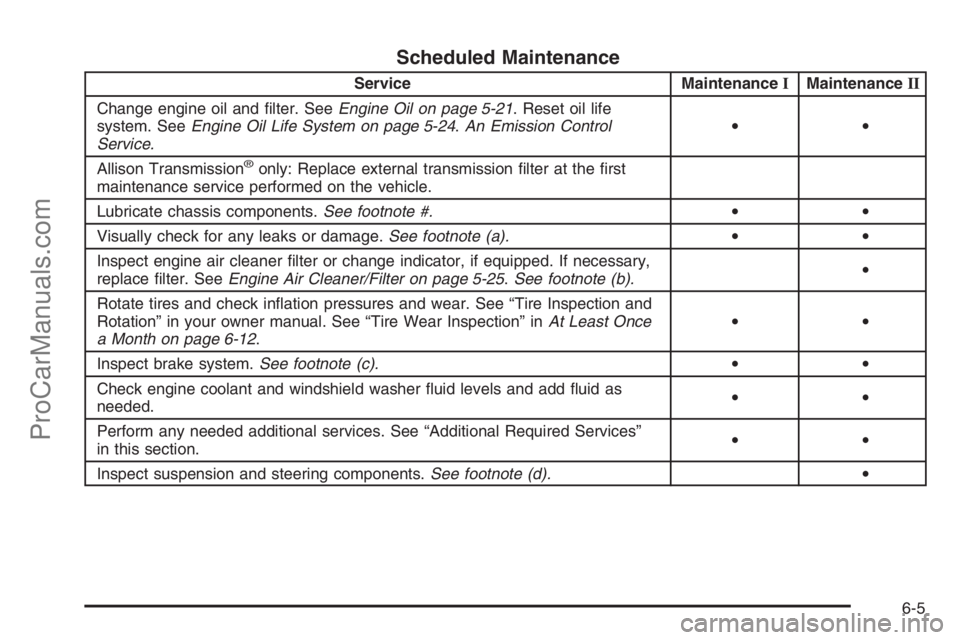
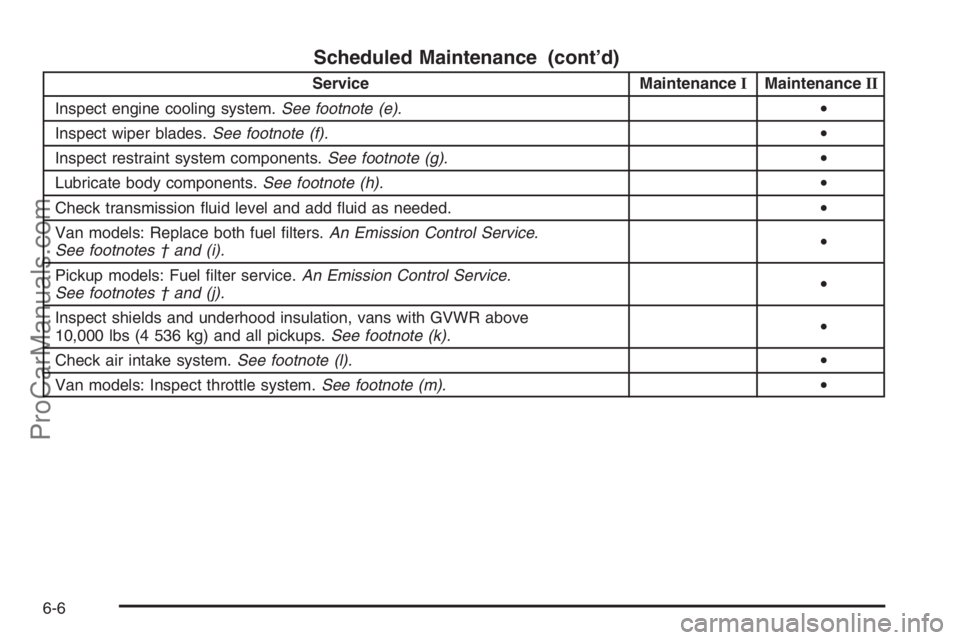
The services inScheduled Maintenance on page 6-4
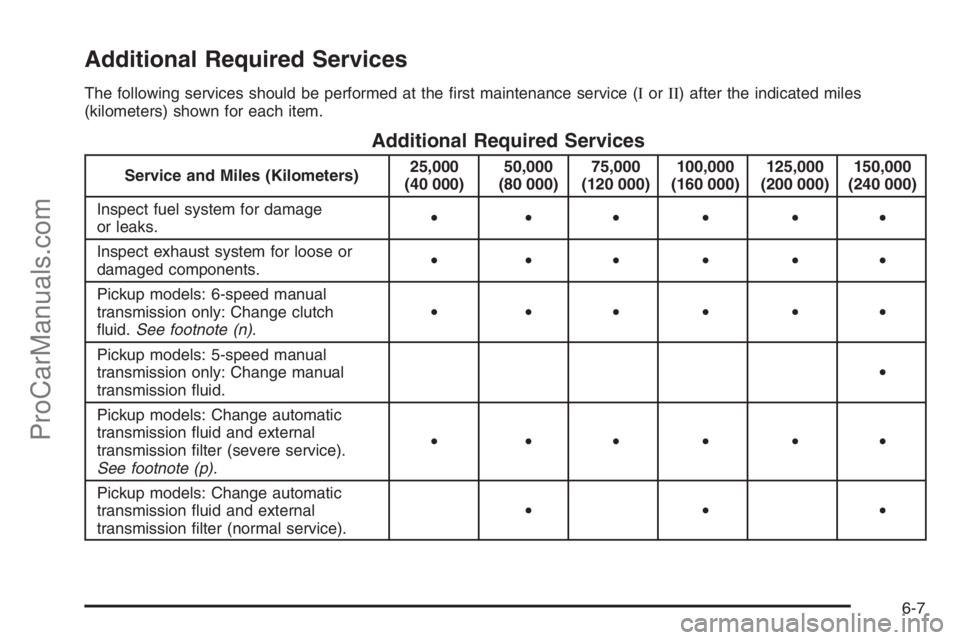
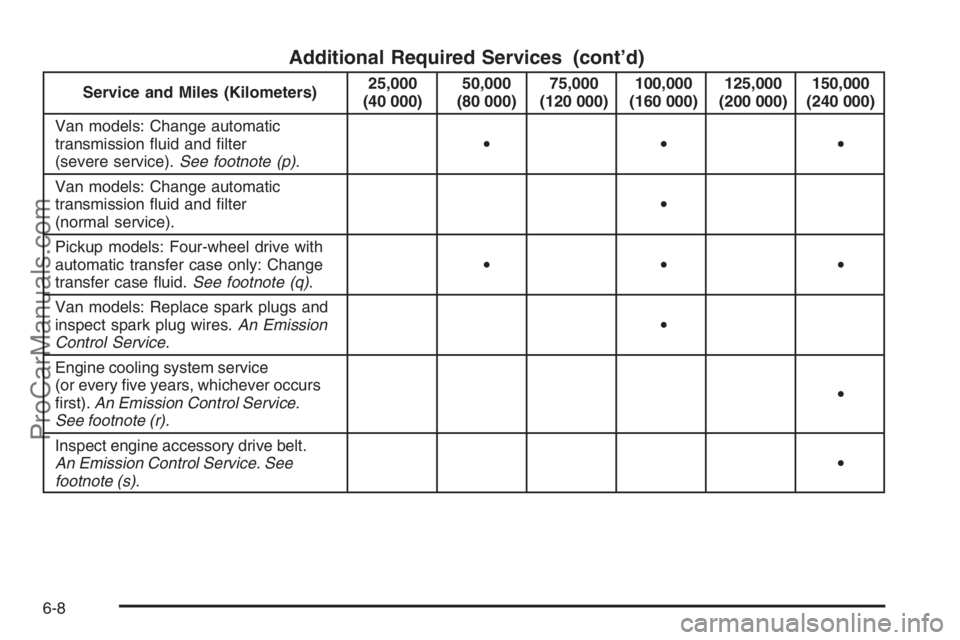
should be performed when indicated. SeeAdditional
Required Services on page 6-7andMaintenance
Footnotes on page 6-9for further information.
{CAUTION:
Performing maintenance work on a vehicle
can be dangerous. In trying to do some jobs,
you can be seriously injured. Do your own
maintenance work only if you have the required
know-how and the proper tools and equipment
for the job. If you have any doubt, see your
GM Goodwrench
®dealer to have a qualied
technician do the work. See “Doing Your
Own Service Work” in your owner manual.
Some maintenance services can be complex. So,
unless you are technically qualified and have the
necessary equipment, you should have your GM
Goodwrench
®dealer do these jobs.
When you go to your GM Goodwrench
®dealer for your
service needs, you will know that GM-trained and
supported service technicians will perform the work
using genuine GM parts.
If you want to purchase service information, see
“Service Publications Ordering Information” in your
owner manual.
6-3
ProCarManuals.com
Page 78 of 100
Owner Checks and Services on page 6-11tells you
what should be checked, when to check it, and what
you can easily do to help keep your vehicle in good
condition.
The proper replacement parts, fluids, and lubricants to
use are listed inRecommended Fluids and Lubricants
on page 6-15andNormal Maintenance Replacement
Parts on page 6-18. When your vehicle is serviced,
make sure these are used. All parts should be replaced
and all necessary repairs done before you or anyone
else drives the vehicle. We recommend the use of
genuine GM parts.
Scheduled Maintenance
When the CHANGE ENGINE OIL message (pickup
models) or the change engine oil light (van models)
comes on, it means that service is required for your
vehicle. Have your vehicle serviced as soon as possible
within the next 600 miles (1 000 km). It is possible that,
if you are driving under the best conditions, the engine
oil life system may not indicate that vehicle service is
necessary for over a year. However, your engine oil and
filter must be changed at least once a year and at this
time the system must be reset. Your GM Goodwrench
®
dealer has GM-trained service technicians who will
perform this work using genuine GM parts and reset
the system.If the engine oil life system is ever reset accidentally, you
must service your vehicle within 3,000 miles (5 000 km)
since your last service. Remember to reset the oil life
system whenever the oil is changed. SeeEngine Oil Life
System on page 5-24for information on the Engine Oil
Life System and resetting the system.
When the message or light appears, certain services,
checks, and inspections are required. Required services
are described in the following for “MaintenanceI” and
“MaintenanceII.” Generally, it is recommended that your
first service be MaintenanceI, your second service be
MaintenanceII, and that you alternate MaintenanceI
and MaintenanceIIthereafter. However, in some cases,
MaintenanceIImay be required more often.
MaintenanceI— Use MaintenanceIif the message
or light comes on within 10 months since the vehicle
was purchased or MaintenanceIIwas performed.
MaintenanceII— Use MaintenanceIIif the previous
service performed was MaintenanceI. Always use
MaintenanceIIwhenever the message or light comes
on 10 months or more since the last service or if the
message or light has not come on at all for one year.
6-4
ProCarManuals.com
Page 79 of 100
Scheduled Maintenance
Service MaintenanceIMaintenanceII
Change engine oil and filter. SeeEngine Oil on page 5-21. Reset oil life
system. SeeEngine Oil Life System on page 5-24.An Emission Control
Service.••
Allison Transmission
®only: Replace external transmission filter at the first
maintenance service performed on the vehicle.
Lubricate chassis components.See footnote #.••
Visually check for any leaks or damage.See footnote (a).••
Inspect engine air cleaner filter or change indicator, if equipped. If necessary,
replace filter. SeeEngine Air Cleaner/Filter on page 5-25.See footnote (b).•
Rotate tires and check inflation pressures and wear. See “Tire Inspection and
Rotation” in your owner manual. See “Tire Wear Inspection” inAt Least Once
a Month on page 6-12.••
Inspect brake system.See footnote (c).••
Check engine coolant and windshield washer fluid levels and add fluid as
needed.••
Perform any needed additional services. See “Additional Required Services”
in this section.••
Inspect suspension and steering components.See footnote (d).•
6-5
ProCarManuals.com
Page 80 of 100
Scheduled Maintenance (cont’d)
Service MaintenanceIMaintenanceII
Inspect engine cooling system.See footnote (e).•
Inspect wiper blades.See footnote (f).•
Inspect restraint system components.See footnote (g).•
Lubricate body components.See footnote (h).•
Check transmission fluid level and add fluid as needed.•
Van models: Replace both fuel filters.An Emission Control Service.
See footnotes † and (i).•
Pickup models: Fuel filter service.An Emission Control Service.
See footnotes † and (j).•
Inspect shields and underhood insulation, vans with GVWR above
10,000 lbs (4 536 kg) and all pickups.See footnote (k).•
Check air intake system.See footnote (l).•
Van models: Inspect throttle system.See footnote (m).•
6-6
ProCarManuals.com
Page 81 of 100
Additional Required Services
The following services should be performed at the first maintenance service (IorII) after the indicated miles
(kilometers) shown for each item.
Additional Required Services
Service and Miles (Kilometers)25,000
(40 000)50,000
(80 000)75,000
(120 000)100,000
(160 000)125,000
(200 000)150,000
(240 000)
Inspect fuel system for damage
or leaks.• •••••
Inspect exhaust system for loose or
damaged components.• •••••
Pickup models: 6-speed manual
transmission only: Change clutch
fluid.See footnote (n).• •••••
Pickup models: 5-speed manual
transmission only: Change manual
transmission fluid.•
Pickup models: Change automatic
transmission fluid and external
transmission filter (severe service).
See footnote (p).• •••••
Pickup models: Change automatic
transmission fluid and external
transmission filter (normal service).•••
6-7
ProCarManuals.com
Page 82 of 100
Additional Required Services (cont’d)
Service and Miles (Kilometers)25,000
(40 000)50,000
(80 000)75,000
(120 000)100,000
(160 000)125,000
(200 000)150,000
(240 000)
Van models: Change automatic
transmission fluid and filter
(severe service).See footnote (p).•••
Van models: Change automatic
transmission fluid and filter
(normal service).•
Pickup models: Four-wheel drive with
automatic transfer case only: Change
transfer case fluid.See footnote (q).•••
Van models: Replace spark plugs and
inspect spark plug wires.An Emission
Control Service.•
Engine cooling system service
(or every five years, whichever occurs
first).An Emission Control Service.
See footnote (r).•
Inspect engine accessory drive belt.
An Emission Control Service. See
footnote (s).•
6-8
ProCarManuals.com
Page 83 of 100
Maintenance Footnotes
†The U.S. Environmental Protection Agency or the
California Air Resources Board has determined that the
failure to perform this maintenance item will not nullify
the emission warranty or limit recall liability prior to the
completion of the vehicle’s useful life. We, however,
urge that all recommended maintenance services be
performed at the indicated intervals and the maintenance
be recorded.
#Lubricate the front suspension, steering linkage,
transmission shift linkage (pickup models), rear driveline
center splines (van models), and parking brake cable
guides. Pickup models only: Control arm ball joints
require lubrication but should not be lubricated unless
their temperature is 10°F (-12°C) or higher, or they could
be damaged. Vehicles used under severe commercial
operating conditions require lubrication on a regular basis
every 3,000 miles (5 000 km).
(a)A uid loss in any vehicle system could indicate a
problem. Have the system inspected and repaired
and the uid level checked. Add uid if needed.
(b)If you drive regularly under dusty conditions, inspect
the lter or change indicator, if equipped, at each engine
oil change.(c)Visually inspect brake lines and hoses for proper
hook-up, binding, leaks, cracks, chang, etc. Inspect disc
brake pads for wear and rotors for surface condition.
Inspect drum brake linings/shoes for wear or cracks.
Inspect other brake parts, including drums, wheel
cylinders, calipers, parking brake, etc.
(d)Visually inspect front and rear suspension and
steering system for damaged, loose, or missing parts,
signs of wear or lack of lubrication. Inspect power
steering lines and hoses for proper hook-up, binding,
leaks, cracks, chang, etc. Pickup models: Visually
check constant velocity joints, rubber boots, and axle
seals for leaks.
(e)Visually inspect hoses and have them replaced if they
are cracked, swollen, or deteriorated. Inspect all pipes,
ttings, and clamps; replace with genuine GM parts as
needed. To help ensure proper operation, a pressure test
of the cooling system and pressure cap and cleaning the
outside of the radiator and air conditioning condenser is
recommended at least once a year.
(f)Visually inspect wiper blades for wear or cracking.
Replace wiper blades that appear worn or damaged
or that streak or miss areas of the windshield.
6-9
ProCarManuals.com
Page 84 of 100
(g)Make sure the safety belt reminder light and all your
belts, buckles, latch plates, retractors, and anchorages
are working properly. Look for any other loose or
damaged safety belt system parts. If you see anything
that might keep a safety belt system from doing its
job, have it repaired. Have any torn or frayed safety belts
replaced. Also look for any opened or broken airbag
coverings, and have them repaired or replaced.
The airbag system does not need regular maintenance.
(h)Lubricate all key lock cylinders, body door hinges,
hood latch assembly, secondary latch, pivots, spring
anchor, release pawl, fuel door hinge, locks, latches,
and any folding or moving seat hardware. Pickup
models: Lubricate tailgate hinges, tailgate linkage,
tailgate handle pivot points, and latch bolt. Van models:
Lubricate hood hinges and rear compartment hinges.
More frequent lubrication may be required when
exposed to a corrosive environment. Applying silicone
grease on weatherstrips with a clean cloth will make
them last longer, seal better, and not stick or squeak.
(i)Van Models: If the two chassis mounted fuel
lters have not been replaced, or if the vehicle has
been driven 20,000 miles (32 000 km) or more since the
fuel lters were last replaced, replace both fuel lters.(j)Pickup Models: This vehicle has a CHANGE FUEL
FILTER message in the Driver Information Center (DIC)
to tell you when to replace the fuel lter. See Driver
Information Center (DIC) (Pickup Models Only) on
page 3-9 for more information and how to reset the
message after the fuel lter is replaced. If the fuel lter
has not been replaced, or if the vehicle has been driven
15,000 miles (25 000 km) or more since the fuel lter was
last replaced, replace the lter and reset the message.
(k)Inspect shields and underhood insulation for damage
or looseness. Adjust or replace as required. This is a
Noise Emission Control Service. Applicable to vehicles
sold in the United States and recommended for
vehicles sold in Canada.
(l)Check the air intake system installation to assure
that gaskets are properly sealed and that all hose
connections, fasteners, and other components are tight.
Also check to be sure that the air cleaner housing is
properly seated and the cover ts tightly. Tighten
connections and fasteners or replace damaged parts as
necessary. This is a Noise Emission Control Service.
Applicable to vehicles sold in the United States and
recommended for vehicles sold in Canada.
(m)Check system for interference or binding and for
damaged or missing parts. Replace parts as needed.
Replace any components that have high effort or
excessive wear. Do not lubricate accelerator or
cruise control cables.
6-10
ProCarManuals.com