fuel pump CHEVROLET DURAMAX 2006 Owners Manual
[x] Cancel search | Manufacturer: CHEVROLET, Model Year: 2006, Model line: DURAMAX, Model: CHEVROLET DURAMAX 2006Pages: 100, PDF Size: 0.71 MB
Page 20 of 100
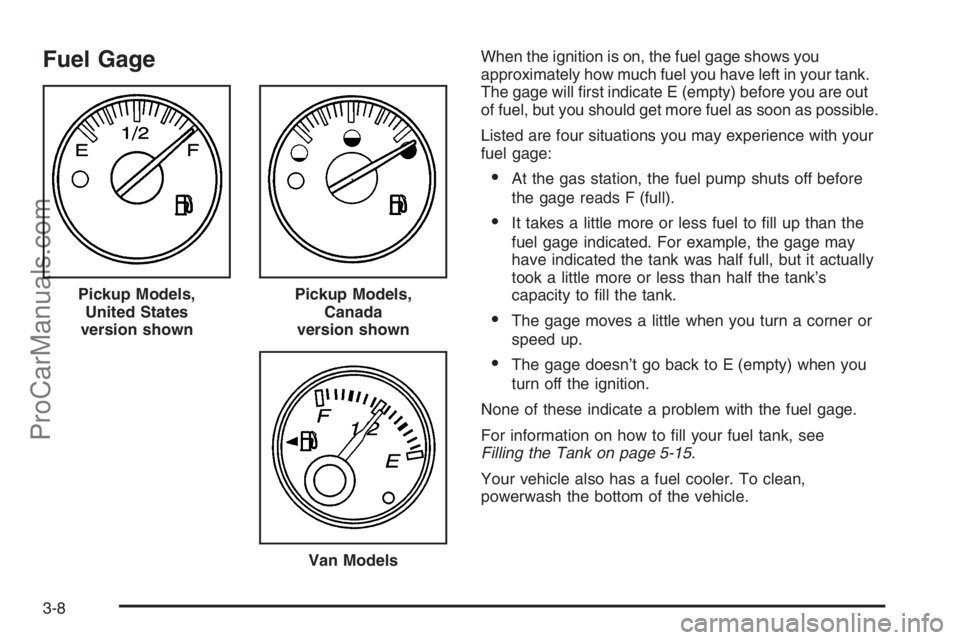
Fuel GageWhen the ignition is on, the fuel gage shows you
approximately how much fuel you have left in your tank.
The gage will first indicate E (empty) before you are out
of fuel, but you should get more fuel as soon as possible.
Listed are four situations you may experience with your
fuel gage:
•At the gas station, the fuel pump shuts off before
the gage reads F (full).
•It takes a little more or less fuel to fill up than the
fuel gage indicated. For example, the gage may
have indicated the tank was half full, but it actually
took a little more or less than half the tank’s
capacity to fill the tank.
•The gage moves a little when you turn a corner or
speed up.
•The gage doesn’t go back to E (empty) when you
turn off the ignition.
None of these indicate a problem with the fuel gage.
For information on how to fill your fuel tank, see
Filling the Tank on page 5-15.
Your vehicle also has a fuel cooler. To clean,
powerwash the bottom of the vehicle. Pickup Models,
United States
version shown
Pickup Models,
Canada
version shown
Van Models
3-8
ProCarManuals.com
Page 28 of 100
Diesel fuel may foam when you fill your tank. This can
cause the automatic pump nozzle to shut off, even
though your tank is not full. If this happens, just wait for
the foaming to stop and then continue to fill your tank.
{CAUTION:
Heat coming from the engine may cause the fuel
to expand and force the fuel out of your tank. If
something ignites the fuel, a re could start and
people could be burned. To help avoid this, ll
your fuel tank only until the automatic nozzle
shuts off. Do not try to top it off.
What Fuel to Use in Canada
Canadian fuels are blended for seasonal changes. Diesel
Type “A” fuel is blended for better cold weather starting
(below 0°F or−18°C); however, you may notice some
power and fuel economy loss. If Type “A” fuel is used in
warmer temperatures, stalling and hard starting may
occur. Diesel Type “B” fuel is blended for temperatures
above 0°F (−18°C). The emission control system requires
the use of diesel fuel with low-sulfur (.05% by weight)
content. Both low- and higher-sulfur fuels will be available
in Canada. Only low-sulfur diesel fuels are available in
the United States. It is important that diesel-powered
trucks are refueled only with low-sulfur fuel. Use of
fuels with higher-sulfur content will affect the function
of the emission components and may cause reduced
performance, excessive smoke, and unpleasant odor.
At a minimum, the diesel fuel you use should meet
the latest version of specification CAN/CGSB-3.517
(Low Sulfur Diesel) in Canada. In addition, the Engine
Manufacturers Association (EMA) has identified
properties of an improved diesel fuel for better engine
performance and durability (FQP-1A). Diesel fuels
corresponding to the EMA description could provide
better starting, less noise, and better vehicle
performance. If there are questions about the
fuel you are using, contact your fuel supplier.
5-4
ProCarManuals.com
Page 29 of 100
It is acceptable to use diesel fuel containing up to 5%
biodiesel (B5), but the final blended fuel must meet the
same specification, CAN/CGSB-3.517 (Low Sulfur
Diesel) in Canada, as other fuels used in your vehicle,
and the biodiesel used for making this fuel must meet the
latest version of ASTM specification D 6751. Biodiesel is
produced from vegetable oils or animal fat that have been
chemically modified to reduce the possibility of damage
to your fuel system and engine. Higher concentration
(i.e., greater than B5) biodiesel-containing fuels or the
use of unmodified bio-oils blended into diesel fuel at any
concentration is not recommended and could damage
your fuel system and engine. Such damage would not be
covered by your warranty. If there are questions about
the biodiesel-containing fuels you are using, contact your
fuel supplier.
Very Cold Weather Operation
Follow the instructions listed previously under the
heading “What Fuel to Use.”
Notice:Never use home heating oil or gasoline in
your diesel engine. They can cause engine damage.
In cold weather, your fuel filter may become clogged
(waxed). To unclog it, move the vehicle to a warm garage
area and warm the filter to between 32°F and 50°F
(0°C to 10°C). You will not need to replace it. Additional
information on the fuel filter follows.
Water in Fuel
{CAUTION:
Diesel fuel containing water is still ammable.
You could be burned. If you ever try to drain
water from your fuel, keep sparks, ames and
smoking materials away from the mixture.
Notice:If there is water in your diesel fuel and the
weather is warm or humid, fungus and bacteria can
grow in the fuel. They can damage your fuel system
and fuel operated heater (FOH) (if equipped). A diesel
fuel biocide can be used to sterilize your fuel system.
However, your fuel system may still need to be
cleaned. Your dealer can advise you of the
appropriate solution.
If your fuel tank needs to be purged to remove
water, see your dealer or a qualied technician.
Improper purging can damage your fuel system
and block your FOH.
Sometimes, water can be pumped into your fuel tank
along with your diesel fuel. This can happen if a service
station doesn’t regularly inspect and clean its fuel tanks,
or if it gets contaminated fuel from its suppliers.
5-5
ProCarManuals.com
Page 31 of 100
Water In Fuel Light/Message Chart
(cont’d)
Problem Recommended Action
•Immediately after
refueling, large
amount of water
possibly pumped
into fuel tank.Fuel tank purging
required. See your
dealer for assistance.
Notice:If you drive when this warning indicator is
on, you can damage your fuel injection system and
your engine. If the indicator comes on right after you
refuel, it means water was pumped into your fuel
tank. Turn off your engine immediately. Then, have
the water drained at once.
Hard starting, hesitation or flat performance at high speed
or during hard acceleration may be an indication of
premature fuel filter plugging due to dirty or contaminated
fuel. The filter element may need to be changed if this
happens. SeeFuel Filter Replacement on page 5-12.To drain water, do the following:
1. Stop and park the vehicle in a safe place.
Turn off the engine and apply the parking brake.
2. Remove the fuel cap.
3. Place a fuel-resistant container under the fuel
filter(s). For pickup models, the filter drain valve
is located in the engine compartment, on the
passenger’s side of the vehicle, on the bottom of the
fuel filter. For van models, the filter drain valves for
the primary and secondary fuel filters are located in
the chassis (inside frame rail) compartment. They
are on the driver’s side of the vehicle, below the
fuel filters.
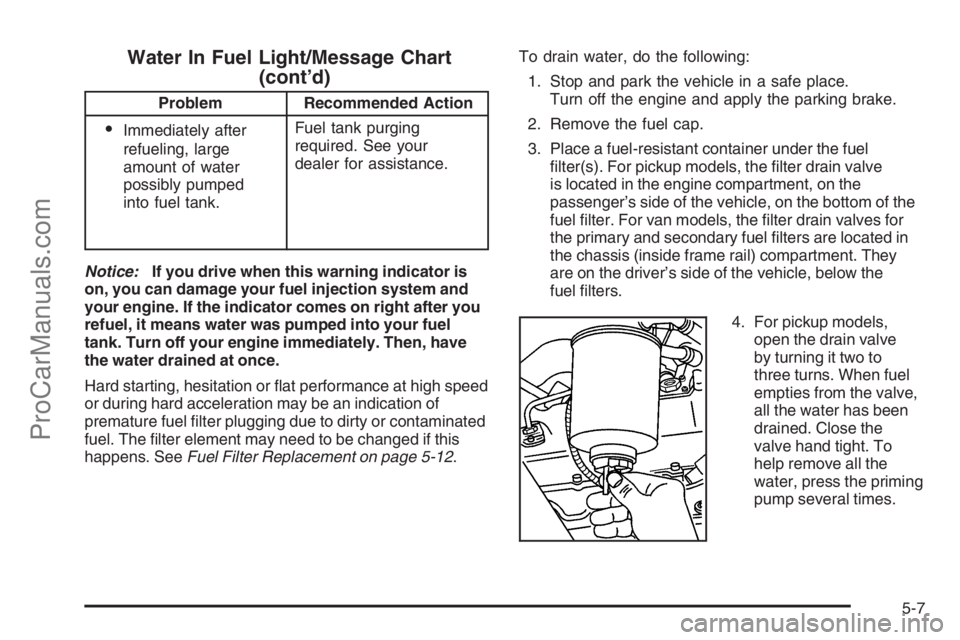
4. For pickup models,
open the drain valve
by turning it two to
three turns. When fuel
empties from the valve,
all the water has been
drained. Close the
valve hand tight. To
help remove all the
water, press the priming
pump several times.
5-7
ProCarManuals.com
Page 32 of 100
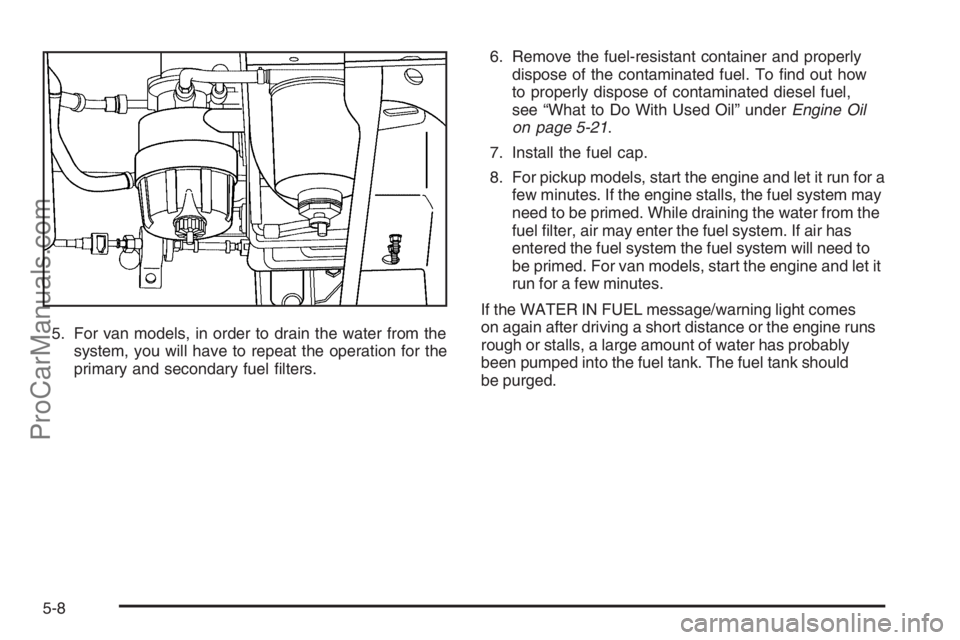
5. For van models, in order to drain the water from the
system, you will have to repeat the operation for the
primary and secondary fuel filters.6. Remove the fuel-resistant container and properly
dispose of the contaminated fuel. To find out how
to properly dispose of contaminated diesel fuel,
see “What to Do With Used Oil” underEngine Oil
on page 5-21.
7. Install the fuel cap.
8. For pickup models, start the engine and let it run for a
few minutes. If the engine stalls, the fuel system may
need to be primed. While draining the water from the
fuel filter, air may enter the fuel system. If air has
entered the fuel system the fuel system will need to
be primed. For van models, start the engine and let it
run for a few minutes.
If the WATER IN FUEL message/warning light comes
on again after driving a short distance or the engine runs
rough or stalls, a large amount of water has probably
been pumped into the fuel tank. The fuel tank should
be purged.
5-8
ProCarManuals.com
Page 33 of 100
Fuel Priming
In order for the fuel system to work properly, the fuel lines
must be full of fuel and contain no air. If air gets into the
fuel lines, it will be necessary to prime the fuel lines, to
eliminate air before operating the vehicle.
Q:How does air get into the fuel lines?
A:One of the following may have happened:
•The vehicle ran out of fuel
•The fuel filter was removed for servicing or
replacement
•The fuel lines were removed or disconnected for
servicing
•The fuel filter water drain valve was opened while
the engine was running
If one or more of the above occur, it is very likely that
air has entered your fuel system and that you will need
to prime the fuel system before operating the vehicle.
Air in the fuel lines will not harm the engine or the
vehicle.However, the engine may not be able to start until the
fuel system is primed and the air is removed.
Q:How do I prime the vehicle? (Pickup Models)
A:Your vehicle is equipped with a priming pump which
is part of the engine mounted fuel filter. The priming
pump is hand operated (pickup only) and is designed
to bring fuel to the engine to eliminate any air that
may be in the fuel lines. To prime the engine, do the
following:
1. You must correct the condition which caused the loss
of prime by making sure there is fuel in the tank.
2. Make sure the fuel filter has been installed and
properly tightened.
3. Make sure the fuel lines are properly connected
and the fuel filter is cool enough to touch.
4. Remove any dirt from the fuel filter head and vent
valve by wiping with a cloth.
5-9
ProCarManuals.com
Page 34 of 100
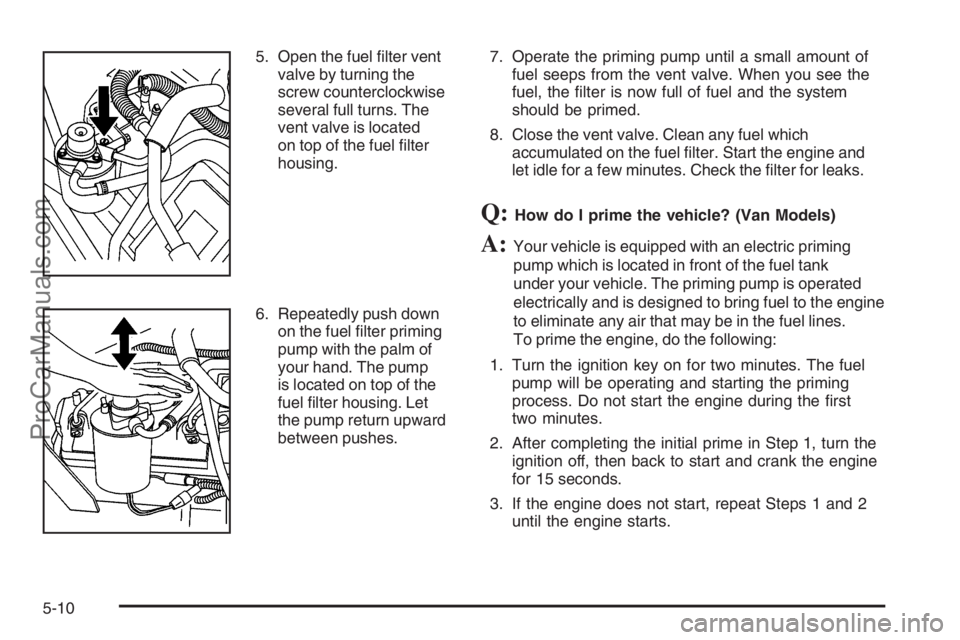
5. Open the fuel filter vent
valve by turning the
screw counterclockwise
several full turns. The
vent valve is located
on top of the fuel filter
housing.
6. Repeatedly push down
on the fuel filter priming
pump with the palm of
your hand. The pump
is located on top of the
fuel filter housing. Let
the pump return upward
between pushes.7. Operate the priming pump until a small amount of
fuel seeps from the vent valve. When you see the
fuel, the filter is now full of fuel and the system
should be primed.
8. Close the vent valve. Clean any fuel which
accumulated on the fuel filter. Start the engine and
let idle for a few minutes. Check the filter for leaks.
Q:How do I prime the vehicle? (Van Models)
A:Your vehicle is equipped with an electric priming
pump which is located in front of the fuel tank
under your vehicle. The priming pump is operated
electrically and is designed to bring fuel to the engine
to eliminate any air that may be in the fuel lines.
To prime the engine, do the following:
1. Turn the ignition key on for two minutes. The fuel
pump will be operating and starting the priming
process. Do not start the engine during the first
two minutes.
2. After completing the initial prime in Step 1, turn the
ignition off, then back to start and crank the engine
for 15 seconds.
3. If the engine does not start, repeat Steps 1 and 2
until the engine starts.
5-10
ProCarManuals.com
Page 39 of 100
Filling the Tank
{CAUTION:
Fuel vapor burns violently and a fuel re can
cause bad injuries. To help avoid injuries to you
and others, read and follow all the instructions
on the pump island. Turn off your engine when
you are refueling. Do not smoke if you are near
fuel or refueling your vehicle. Keep sparks,
ames, and smoking materials away from fuel.
Do not leave the fuel pump unattended when
refueling your vehicle — this is against the law
in some places. Keep children away from the
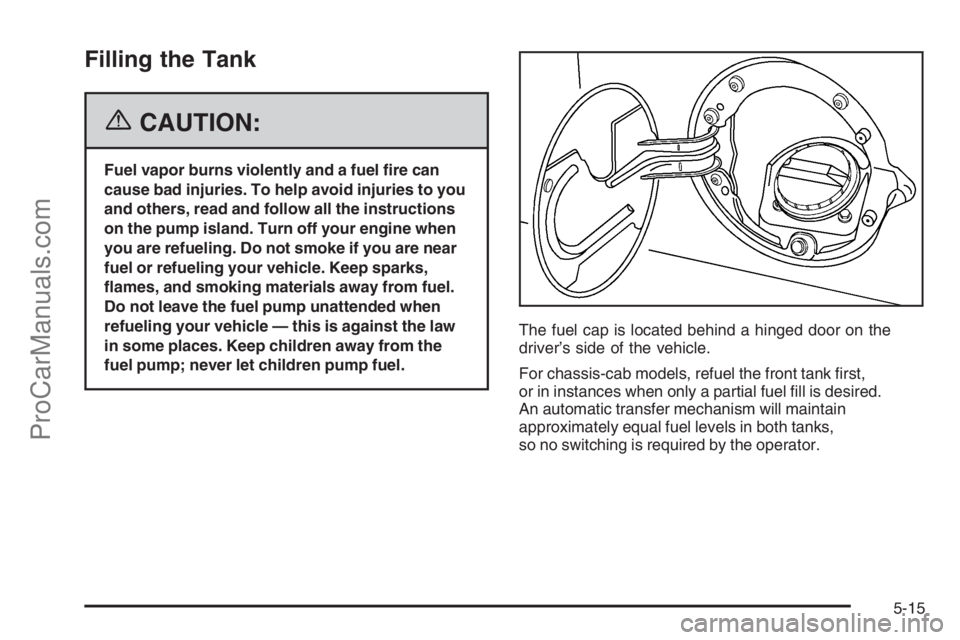
fuel pump; never let children pump fuel.The fuel cap is located behind a hinged door on the
driver’s side of the vehicle.
For chassis-cab models, refuel the front tank first,
or in instances when only a partial fuel fill is desired.
An automatic transfer mechanism will maintain
approximately equal fuel levels in both tanks,
so no switching is required by the operator.
5-15
ProCarManuals.com
Page 40 of 100
To remove the fuel cap, turn it slowly to the left
(counterclockwise).
{CAUTION:
If you spill fuel and then something ignites it,
you could be badly burned. Fuel can spray out
on you if you open the fuel cap too quickly. This
spray can happen if your tank is nearly full, and
is more likely in hot weather. Open the fuel cap
slowly and wait for any hiss noise to stop. Then
unscrew the cap all the way.Be careful not to spill diesel fuel. Don’t top off or overfill
your tank, and wait a few seconds after you’ve finished
pumping before you remove the nozzle. Clean fuel from
painted surfaces as soon as possible. See “Washing
Your Vehicle” in your owner’s manual. When you put the
fuel cap back on, turn it to the right (clockwise) until you
hear a clicking sound. Make sure you fully install the cap.
The diagnostic system can determine if the fuel cap has
been left off or improperly installed. This would allow fuel
to evaporate into the atmosphere. SeeMalfunction
Indicator Lamp on page 3-4.
5-16
ProCarManuals.com
Page 41 of 100
{CAUTION:
If a re starts while you are refueling, do not
remove the nozzle. Shut off the ow of fuel
by shutting off the pump or by notifying the
station attendant. Leave the area immediately.
Notice:If you need a new fuel cap, be sure to get
the right type. Your dealer can get one for you.
If you get the wrong type, it may not t properly.
This may cause your malfunction indicator lamp to
light and may damage your fuel tank and emissions
system. SeeMalfunction Indicator Lamp on
page 3-4.
Notice:If your vehicle has been accidentally lled
with gasoline, do not run the engine or severe engine
damage can occur. Contact your dealer to have the
fuel system ushed.
Filling a Portable Fuel Container
{CAUTION:
Never ll a portable fuel container while it is in
your vehicle. Static electricity discharge from
the container can ignite the gasoline vapor.
You can be badly burned and your vehicle
damaged if this occurs. To help avoid injury to
you and others:
Dispense gasoline only into approved
containers.
Do not ll a container while it is inside a
vehicle, in a vehicle’s trunk, pickup bed,
or on any surface other than the ground.
Bring the ll nozzle in contact with the
inside of the ll opening before operating
the nozzle. Contact should be maintained
until the lling is complete.
Do not smoke while pumping gasoline.
5-17
ProCarManuals.com