heater CHEVROLET DURAMAX 2006 Owners Manual
[x] Cancel search | Manufacturer: CHEVROLET, Model Year: 2006, Model line: DURAMAX, Model: CHEVROLET DURAMAX 2006Pages: 100, PDF Size: 0.71 MB
Page 3 of 100
Starting and Operating Your Vehicle.................2-2
Starting the Diesel Engine...............................2-2
Winter Cover (Pickup Models Only)...................2-6Fuel Operated Heater (FOH) (Van Models Only). . . .2-8
Engine Coolant Heater....................................2-8
Section 2 Features and Controls
2-1
ProCarManuals.com
Page 5 of 100
When your engine is cold, let it run for a few minutes
before you move your vehicle. This lets oil pressure
build up. Your engine will sound louder when it’s cold.
Notice:If you are not in an idling vehicle and the
engine overheats, you would not be there to see the
overheated engine indication. This could damage
your vehicle. Do not let your engine run when you are
not in your vehicle.
Cold Weather Starting (Diesel Engine)
The following tips will help you get good starting in
cold weather.
Use the recommended engine oil when the outside
temperature drops below freezing. SeeEngine Oil on
page 5-21. When the outside temperature drops below
0° F (–18°C), use of the engine coolant heater is
recommended.
If you experience longer cranking times, notice an
unusual amount of exhaust smoke or are at higher
altitudes (over 7,000 ft. or 2 135 m), you may use your
engine coolant heater. SeeEngine Coolant Heater
on page 2-8.
SeeDiesel Fuel Requirements and Fuel System on
page 5-2for information on what fuel to use in cold
weather.
If Your Diesel Engine Won’t Start
If you’ve run out of fuel, look atRunning Out of Fuel
on page 5-11. SeeDiesel Fuel Requirements and Fuel
System on page 5-2.
If you’re not out of fuel, and your engine won’t start,
do this:
Turn your ignition key to RUN. Immediately after the wait
to start light goes off, turn the ignition key to START.
If the light doesn’t go off, wait a few seconds, then try
starting your engine again. See your dealer as soon
as you can for a starting system check.
If the light comes on and then goes off and you know your
batteries are charged, but your engine still won’t start,
your vehicle needs service.
If the light does not come on when the engine is cold,
your vehicle needs service.
If your batteries don’t have enough charge to start your
engine, see “Battery” in the owner’s manual Index.
Be sure you have the right oil for your engine, and that
you’ve changed the oil at the proper times. If you use
the wrong oil, your engine may be harder to start.
2-3
ProCarManuals.com
Page 6 of 100
Be sure you are using the proper fuel for existing
weather conditions. SeeDiesel Fuel Requirements
and Fuel System on page 5-2.
If the engine starts, runs a short time, then stops, your
vehicle needs service.
{CAUTION:
Do not use gasoline or starting aids, such as
ether, in the air intake. They could damage
your engine. There could also be a re, which
could cause serious personal injury.
Elevated Idle/Exhaust Restrictor
The engine has a cold temperature high idle and exhaust
restrictor feature which elevates the engines idle speed
from 680 to 1200 rpms, and restricts the exhaust gas
flow, when outside temperatures are below 32°F (0°C),
and the engine coolant temperature is below 150°F
(65°C.) This feature enhances heater performance
by raising the engine coolant temperature faster.For pickup models, this feature can be turned off and
on using the DIC steering wheel control buttons. If your
vehicle is not equipped with the DIC steering wheel
control buttons, do the following to turn on this feature:
1. Turn the ignition to RUN, with the vehicle off.
2. Press the accelerator pedal to the floor and hold
while quickly pressing the brake pedal three times
in less than eight seconds.
3. Release the accelerator pedal and start the engine.
When the engine is started, it will slowly ramp up to the
high idle speed after a delay of a few seconds up to
approximately two minutes. For this method to work
properly there must be no throttle or brake pedal faults.
The engine idle speed will return to normal once the
following conditions are met:•Once engine coolant temperature reaches
150°F (65°C).
•Air intake temperature reaches 32°F (0°C).
2-4
ProCarManuals.com
Page 8 of 100
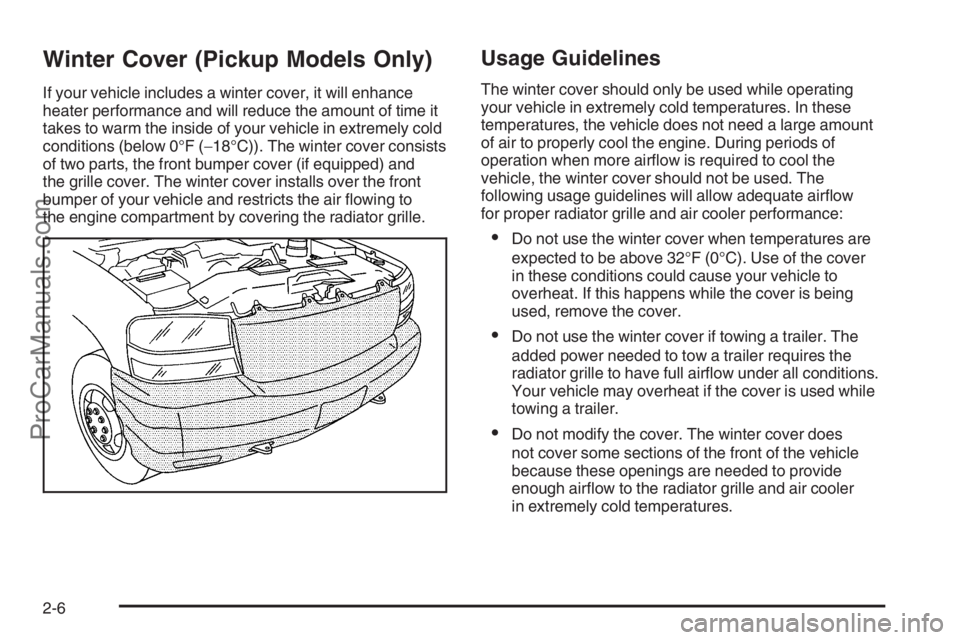
Winter Cover (Pickup Models Only)
If your vehicle includes a winter cover, it will enhance
heater performance and will reduce the amount of time it
takes to warm the inside of your vehicle in extremely cold
conditions (below 0°F (−18°C)). The winter cover consists
of two parts, the front bumper cover (if equipped) and
the grille cover. The winter cover installs over the front
bumper of your vehicle and restricts the air flowing to
the engine compartment by covering the radiator grille.
Usage Guidelines
The winter cover should only be used while operating
your vehicle in extremely cold temperatures. In these
temperatures, the vehicle does not need a large amount
of air to properly cool the engine. During periods of
operation when more airflow is required to cool the
vehicle, the winter cover should not be used. The
following usage guidelines will allow adequate airflow
for proper radiator grille and air cooler performance:
•Do not use the winter cover when temperatures are
expected to be above 32°F (0°C). Use of the cover
in these conditions could cause your vehicle to
overheat. If this happens while the cover is being
used, remove the cover.
•Do not use the winter cover if towing a trailer. The
added power needed to tow a trailer requires the
radiator grille to have full airflow under all conditions.
Your vehicle may overheat if the cover is used while
towing a trailer.
•Do not modify the cover. The winter cover does
not cover some sections of the front of the vehicle
because these openings are needed to provide
enough airflow to the radiator grille and air cooler
in extremely cold temperatures.
2-6
ProCarManuals.com
Page 10 of 100
Fuel Operated Heater (FOH)
(Van Models Only)
If your vehicle includes a fuel operated heater (FOH),
it will enhance heater performance and will reduce the
amount of time it takes to warm the inside of your vehicle
in cold conditions below 40°F (4.4°C). The fuel operated
heater is installed in the frame rail on the driver’s side of
the vehicle and uses diesel to warm up the engine
coolant, which finally warms up the passenger’s cabin
air. The FOH works automatically, depending on the
fuel level, engine coolant temperature and outside air
temperature. It works only with the engine running.
Engine Coolant Heater
In very cold weather, 0°F (−18°C) or colder, the engine
coolant heater can help. You’ll get easier starting
and better fuel economy during engine warm-up.
Usually, the coolant heater should be plugged in a
minimum of four hours prior to starting your vehicle.
To Use the Engine Coolant Heater
1. Turn off the engine.
2. Open the hood and unwrap the electrical cord.
The cord is located in the engine compartment,
on the passenger’s side of the vehicle, near the
right side engine mount.
3. Plug it into a normal, grounded 110-volt AC outlet.
{CAUTION:
Plugging the cord into an ungrounded outlet
could cause an electrical shock. Also, the
wrong kind of extension cord could overheat
and cause a re. You could be seriously injured.
Plug the cord into a properly grounded
three-prong 110-volt AC outlet. If the cord
will not reach, use a heavy-duty three-prong
extension cord rated for at least 15 amps.
2-8
ProCarManuals.com
Page 11 of 100
4. Before starting the engine, be sure to unplug and
store the cord as it was before to keep it away
from moving engine parts. If you don’t, it could
be damaged.
How long should you keep the coolant heater plugged in?
The answer depends on the outside temperature. You
may wish to use your coolant heater to improve ease
of starting at temperatures between 0°F (−18°C)
and−20°F (−29°C).Keep the coolant heater plugged in for
a minimum of four hours. At temperatures below−20°F
(−29°C), the coolant heater should remain plugged in for
at least eight hours. It will not harm either the coolant
heater or the vehicle to leave the coolant heater plugged
in longer than the times stated. Be sure to remove and
store the cord before starting the engine. SeeDiesel
Fuel Requirements and Fuel System on page 5-2for
information on what fuel to use in cold weather.
2-9
ProCarManuals.com
Page 26 of 100
Diesel Fuel Requirements and
Fuel System
Some states and provinces have restrictions on the
purchase of diesel fuel for light-duty vehicles and require
you to buy permits or pay special taxes. Some of these
restrictions apply only to residents, and others apply
to both residents and visitors. These restrictions can
change. To learn the current restrictions in any state
or province, contact your auto club, the police or other
officials.
Diesel Engine Fuel
Notice:Diesel fuel or fuel additives not
recommended in this manual could damage your
fuel system, fuel-operated heater (FOH) (Van models
only) and engine. Your warranty would not cover
this damage. And:
Diesel fuel that has been mixed with engine oil
or automatic transmission uid could damage
your engine and emission controls.
Aftermarket diesel fuel additives are not tested
by General Motors. Some additives, particularly
those which contain alcohol or water emulsiers,
may damage your fuel system. If you believe that
unique circumstances call for a fuel additive to
be used, consult your dealer for advice.
If you ever run out of diesel fuel, it can be difficult
to restart your engine. To avoid all this, never let
your tank get empty.
If gasoline is ever accidentally added to the fuel
tank, to avoid severe engine damage, do not run
the engine until the fuel tank can be drained.
If you run out of fuel,Running Out of Fuel on page 5-11
tells you how to restart your engine.
5-2
ProCarManuals.com
Page 29 of 100
It is acceptable to use diesel fuel containing up to 5%
biodiesel (B5), but the final blended fuel must meet the
same specification, CAN/CGSB-3.517 (Low Sulfur
Diesel) in Canada, as other fuels used in your vehicle,
and the biodiesel used for making this fuel must meet the
latest version of ASTM specification D 6751. Biodiesel is
produced from vegetable oils or animal fat that have been
chemically modified to reduce the possibility of damage
to your fuel system and engine. Higher concentration
(i.e., greater than B5) biodiesel-containing fuels or the
use of unmodified bio-oils blended into diesel fuel at any
concentration is not recommended and could damage
your fuel system and engine. Such damage would not be
covered by your warranty. If there are questions about
the biodiesel-containing fuels you are using, contact your
fuel supplier.
Very Cold Weather Operation
Follow the instructions listed previously under the
heading “What Fuel to Use.”
Notice:Never use home heating oil or gasoline in
your diesel engine. They can cause engine damage.
In cold weather, your fuel filter may become clogged
(waxed). To unclog it, move the vehicle to a warm garage
area and warm the filter to between 32°F and 50°F
(0°C to 10°C). You will not need to replace it. Additional
information on the fuel filter follows.
Water in Fuel
{CAUTION:
Diesel fuel containing water is still ammable.
You could be burned. If you ever try to drain
water from your fuel, keep sparks, ames and
smoking materials away from the mixture.
Notice:If there is water in your diesel fuel and the
weather is warm or humid, fungus and bacteria can
grow in the fuel. They can damage your fuel system
and fuel operated heater (FOH) (if equipped). A diesel
fuel biocide can be used to sterilize your fuel system.
However, your fuel system may still need to be
cleaned. Your dealer can advise you of the
appropriate solution.
If your fuel tank needs to be purged to remove
water, see your dealer or a qualied technician.
Improper purging can damage your fuel system
and block your FOH.
Sometimes, water can be pumped into your fuel tank
along with your diesel fuel. This can happen if a service
station doesn’t regularly inspect and clean its fuel tanks,
or if it gets contaminated fuel from its suppliers.
5-5
ProCarManuals.com
Page 37 of 100
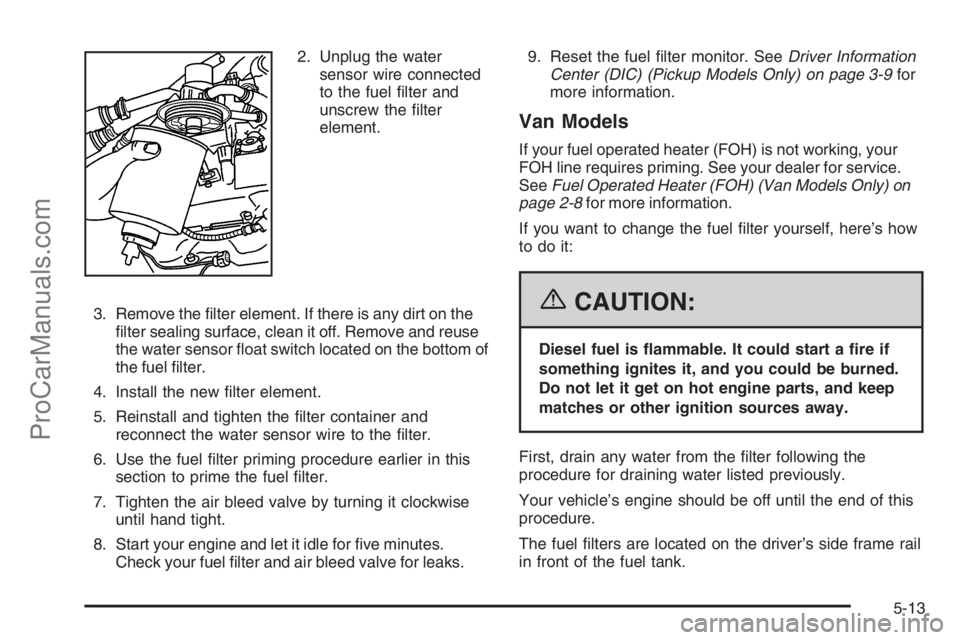
2. Unplug the water
sensor wire connected
to the fuel filter and
unscrew the filter
element.
3. Remove the filter element. If there is any dirt on the
filter sealing surface, clean it off. Remove and reuse
the water sensor float switch located on the bottom of
the fuel filter.
4. Install the new filter element.
5. Reinstall and tighten the filter container and
reconnect the water sensor wire to the filter.
6. Use the fuel filter priming procedure earlier in this
section to prime the fuel filter.
7. Tighten the air bleed valve by turning it clockwise
until hand tight.
8. Start your engine and let it idle for five minutes.
Check your fuel filter and air bleed valve for leaks.9. Reset the fuel filter monitor. SeeDriver Information
Center (DIC) (Pickup Models Only) on page 3-9for
more information.
Van Models
If your fuel operated heater (FOH) is not working, your
FOH line requires priming. See your dealer for service.
SeeFuel Operated Heater (FOH) (Van Models Only) on
page 2-8for more information.
If you want to change the fuel filter yourself, here’s how
to do it:
{CAUTION:
Diesel fuel is ammable. It could start a re if
something ignites it, and you could be burned.
Do not let it get on hot engine parts, and keep
matches or other ignition sources away.
First, drain any water from the filter following the
procedure for draining water listed previously.
Your vehicle’s engine should be off until the end of this
procedure.
The fuel filters are located on the driver’s side frame rail
in front of the fuel tank.
5-13
ProCarManuals.com
Page 58 of 100
How to Add Fluid
Refer to the Maintenance Schedule to determine what
kind of transmission fluid to use. SeeRecommended
Fluids and Lubricants on page 6-15.
Using a funnel, add fluid down the transmission dipstick
tube only after checking the transmission fluid while it is
hot. A cold check is used only as a reference. If the fluid
level is low, add only enough of the proper fluid to bring
the level up to the HOT area for a hot check. It does not
take much fluid, generally less than one pint (0.5L). Do
not overfill.
Notice:Use of the incorrect automatic transmission
uid may damage your vehicle, and the damages
may not be covered by your warranty. Always
use the automatic transmission uid listed in
Recommended Fluids and Lubricants on page 6-15.
•After adding fluid, recheck the fluid level as
described under “How to Check” earlier in
this section.
•When the correct fluid level is obtained, push the
dipstick back in all the way. Then flip the handle
down to lock the dipstick in place.
Engine Coolant
Pickup Models
The cooling system in your vehicle is filled with
DEX-COOL®engine coolant. This coolant is designed
to remain in your vehicle for 5 years or 150,000 miles
(240 000 km), whichever occurs first, if you add only
DEX-COOL
®extended life coolant.
The following explains your cooling system and how
to add coolant when it is low. If you have a problem
with engine overheating, seeEngine Overheating
on page 5-39.
A 50/50 mixture of clean, drinkable water and
DEX-COOL
®coolant will:
•Give freezing protection down to−34°F (−37°C)
•Give boiling protection up to 265°F (129°C)
•Protect against rust and corrosion
•Help keep the proper engine temperature
•Let the warning lights and gages work as they should
Notice:Using coolant other than DEX-COOL
®may
cause premature engine, heater core, or radiator
corrosion. In addition, the engine coolant may
require changing sooner, at the rst maintenance
service after each 30,000 miles (50 000 km) or
24 months, whichever occurs rst. Any repairs
would not be covered by your warranty. Always use
DEX-COOL
®(silicate-free) coolant in your vehicle.
5-34
ProCarManuals.com