service schedule CHEVROLET DURAMAX 2006 Owners Manual
[x] Cancel search | Manufacturer: CHEVROLET, Model Year: 2006, Model line: DURAMAX, Model: CHEVROLET DURAMAX 2006Pages: 100, PDF Size: 0.71 MB
Page 1 of 100
Features and Controls..................................... 2-1
Starting and Operating Your Vehicle ............. 2-2
Instrument Panel ............................................. 3-1
Warning Lights, Gages and Indicators ........... 3-2
Driving Your Vehicle ....................................... 4-1
Towing ..................................................... 4-2 Service and Appearance Care
.......................... 5-1
Diesel Fuel Requirements and Fuel System ..... 5-2
Checking Things Under the Hood ...............5-18
Capacities and Specifications .....................5-50
Maintenance Schedule ..................................... 6-1
Maintenance Schedule ................................ 6-2
2006 DURAMAX®Diesel EngineM
Index ......................................................................... 1
ProCarManuals.com
Page 18 of 100
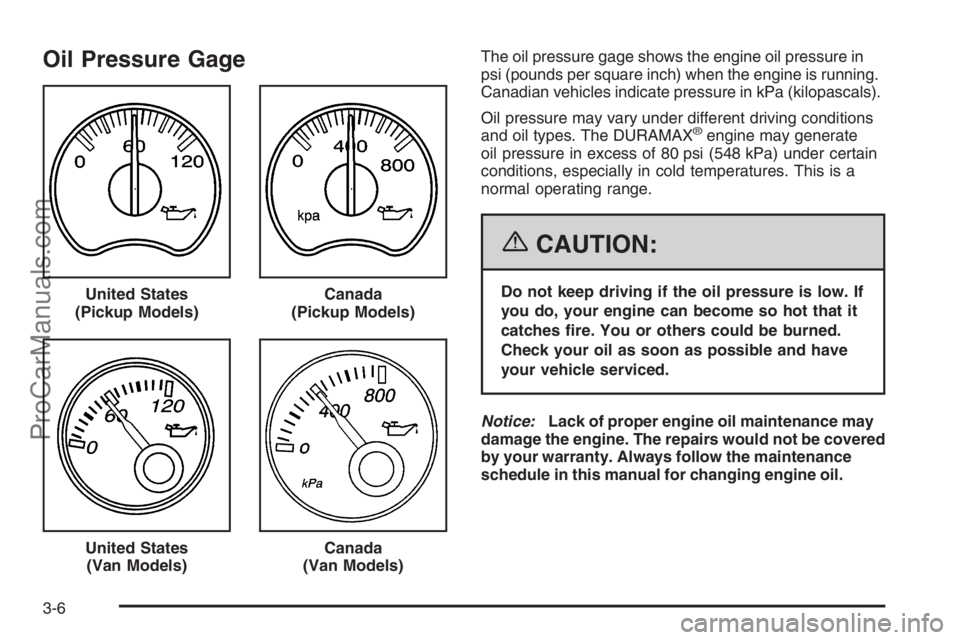
Oil Pressure GageThe oil pressure gage shows the engine oil pressure in
psi (pounds per square inch) when the engine is running.
Canadian vehicles indicate pressure in kPa (kilopascals).
Oil pressure may vary under different driving conditions
and oil types. The DURAMAX
®engine may generate
oil pressure in excess of 80 psi (548 kPa) under certain
conditions, especially in cold temperatures. This is a
normal operating range.
{CAUTION:
Do not keep driving if the oil pressure is low. If
you do, your engine can become so hot that it
catches re. You or others could be burned.
Check your oil as soon as possible and have
your vehicle serviced.
Notice:Lack of proper engine oil maintenance may
damage the engine. The repairs would not be covered
by your warranty. Always follow the maintenance
schedule in this manual for changing engine oil. United States
(Pickup Models)Canada
(Pickup Models)
United States
(Van Models)Canada
(Van Models)
3-6
ProCarManuals.com
Page 53 of 100
Automatic Transmission Fluid
When to Check and Change
(Pickup Models)
A good time to check your automatic transmission fluid
level is when the engine oil is changed.
Change both the fluid and filter every 25,000 miles
(41 500 km) if the vehicle is mainly driven under one
or more of these conditions:
•In heavy city traffic where the outside temperature
regularly reaches 90°F (32°C) or higher.
•In hilly or mountainous terrain.
•When doing frequent trailer towing.
•Uses such as found in taxi, police or
delivery service.
If you do not use your vehicle under any of
these conditions, change the fluid and filter
every 50,000 miles (83 000 km).
SeeScheduled Maintenance on page 6-4.
How to Check
Because this operation can be a little difficult, you may
choose to have this done at the dealership service
department.
If you do it yourself, be sure to follow all the instructions
here, or you could get a false reading on the dipstick.
Notice:Too much or too little uid can damage your
transmission. Too much can mean that some of the
uid could come out and fall on hot engine part or
exhaust system parts, starting a re. Too little uid
could cause the transmission to overheat. Be sure
to get an accurate reading if you check your
transmission uid.
Wait at least 30 minutes before checking the
transmission fluid level if you have been driving:
•When outside temperatures are above 90°F (32°C).
•At high speed for quite a while.
•In heavy traffic — especially in hot weather.
•While pulling a trailer.
5-29
ProCarManuals.com
Page 58 of 100
How to Add Fluid
Refer to the Maintenance Schedule to determine what
kind of transmission fluid to use. SeeRecommended
Fluids and Lubricants on page 6-15.
Using a funnel, add fluid down the transmission dipstick
tube only after checking the transmission fluid while it is
hot. A cold check is used only as a reference. If the fluid
level is low, add only enough of the proper fluid to bring
the level up to the HOT area for a hot check. It does not
take much fluid, generally less than one pint (0.5L). Do
not overfill.
Notice:Use of the incorrect automatic transmission
uid may damage your vehicle, and the damages
may not be covered by your warranty. Always
use the automatic transmission uid listed in
Recommended Fluids and Lubricants on page 6-15.
•After adding fluid, recheck the fluid level as
described under “How to Check” earlier in
this section.
•When the correct fluid level is obtained, push the
dipstick back in all the way. Then flip the handle
down to lock the dipstick in place.
Engine Coolant
Pickup Models
The cooling system in your vehicle is filled with
DEX-COOL®engine coolant. This coolant is designed
to remain in your vehicle for 5 years or 150,000 miles
(240 000 km), whichever occurs first, if you add only
DEX-COOL
®extended life coolant.
The following explains your cooling system and how
to add coolant when it is low. If you have a problem
with engine overheating, seeEngine Overheating
on page 5-39.
A 50/50 mixture of clean, drinkable water and
DEX-COOL
®coolant will:
•Give freezing protection down to−34°F (−37°C)
•Give boiling protection up to 265°F (129°C)
•Protect against rust and corrosion
•Help keep the proper engine temperature
•Let the warning lights and gages work as they should
Notice:Using coolant other than DEX-COOL
®may
cause premature engine, heater core, or radiator
corrosion. In addition, the engine coolant may
require changing sooner, at the rst maintenance
service after each 30,000 miles (50 000 km) or
24 months, whichever occurs rst. Any repairs
would not be covered by your warranty. Always use
DEX-COOL
®(silicate-free) coolant in your vehicle.
5-34
ProCarManuals.com
Page 75 of 100
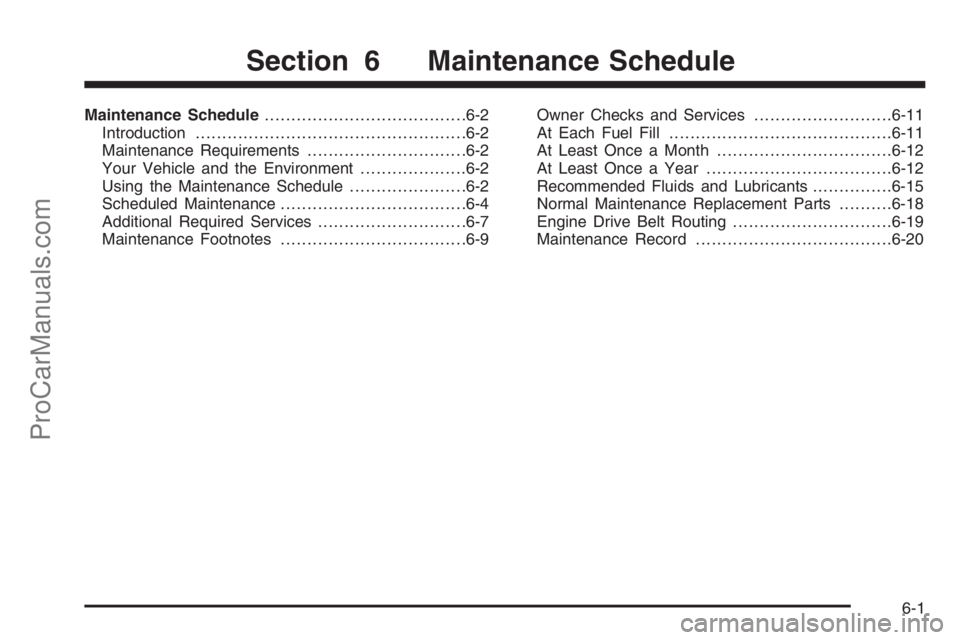
Maintenance Schedule......................................6-2
Introduction...................................................6-2
Maintenance Requirements..............................6-2
Your Vehicle and the Environment....................6-2
Using the Maintenance Schedule......................6-2
Scheduled Maintenance...................................6-4
Additional Required Services............................6-7
Maintenance Footnotes...................................6-9Owner Checks and Services..........................6-11
At Each Fuel Fill..........................................6-11
At Least Once a Month.................................6-12
At Least Once a Year...................................6-12
Recommended Fluids and Lubricants...............6-15
Normal Maintenance Replacement Parts..........6-18
Engine Drive Belt Routing..............................6-19
Maintenance Record.....................................6-20
Section 6 Maintenance Schedule
6-1
ProCarManuals.com
Page 77 of 100
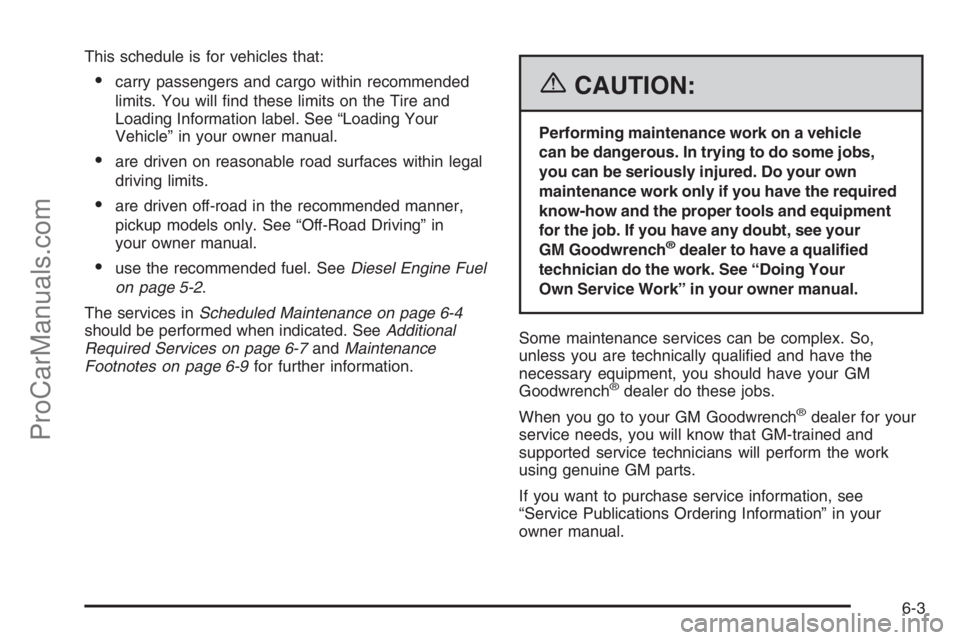
This schedule is for vehicles that:
•carry passengers and cargo within recommended
limits. You will find these limits on the Tire and
Loading Information label. See “Loading Your
Vehicle” in your owner manual.
•are driven on reasonable road surfaces within legal
driving limits.
•are driven off-road in the recommended manner,
pickup models only. See “Off-Road Driving” in
your owner manual.
•use the recommended fuel. SeeDiesel Engine Fuel
on page 5-2.
The services inScheduled Maintenance on page 6-4
should be performed when indicated. SeeAdditional
Required Services on page 6-7andMaintenance
Footnotes on page 6-9for further information.
{CAUTION:
Performing maintenance work on a vehicle
can be dangerous. In trying to do some jobs,
you can be seriously injured. Do your own
maintenance work only if you have the required
know-how and the proper tools and equipment
for the job. If you have any doubt, see your
GM Goodwrench
®dealer to have a qualied
technician do the work. See “Doing Your
Own Service Work” in your owner manual.
Some maintenance services can be complex. So,
unless you are technically qualified and have the
necessary equipment, you should have your GM
Goodwrench
®dealer do these jobs.
When you go to your GM Goodwrench
®dealer for your
service needs, you will know that GM-trained and
supported service technicians will perform the work
using genuine GM parts.
If you want to purchase service information, see
“Service Publications Ordering Information” in your
owner manual.
6-3
ProCarManuals.com
Page 78 of 100
Owner Checks and Services on page 6-11tells you
what should be checked, when to check it, and what
you can easily do to help keep your vehicle in good
condition.
The proper replacement parts, fluids, and lubricants to
use are listed inRecommended Fluids and Lubricants
on page 6-15andNormal Maintenance Replacement
Parts on page 6-18. When your vehicle is serviced,
make sure these are used. All parts should be replaced
and all necessary repairs done before you or anyone
else drives the vehicle. We recommend the use of
genuine GM parts.
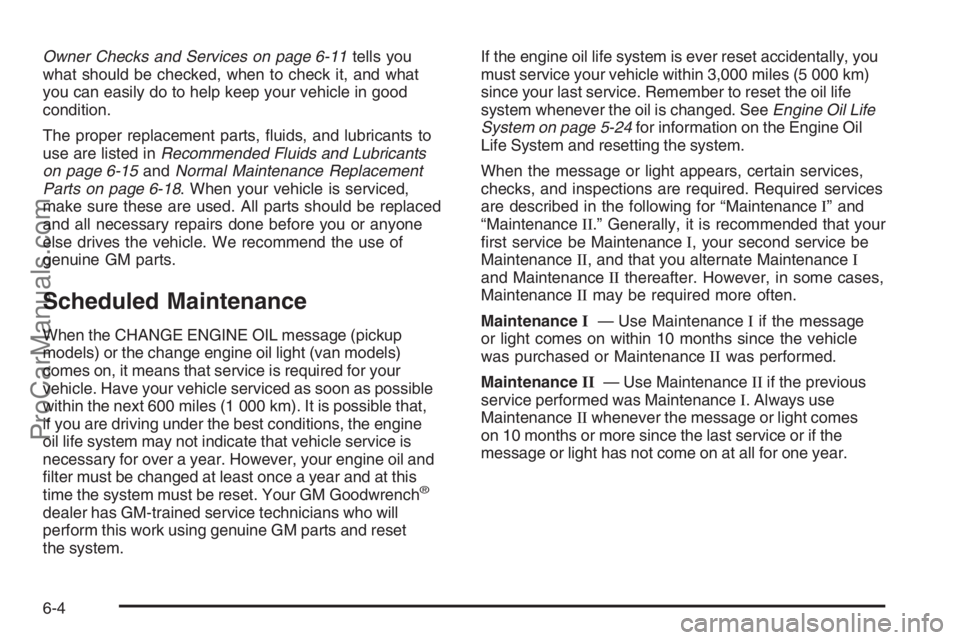
Scheduled Maintenance
When the CHANGE ENGINE OIL message (pickup
models) or the change engine oil light (van models)
comes on, it means that service is required for your
vehicle. Have your vehicle serviced as soon as possible
within the next 600 miles (1 000 km). It is possible that,
if you are driving under the best conditions, the engine
oil life system may not indicate that vehicle service is
necessary for over a year. However, your engine oil and
filter must be changed at least once a year and at this
time the system must be reset. Your GM Goodwrench
®
dealer has GM-trained service technicians who will
perform this work using genuine GM parts and reset
the system.If the engine oil life system is ever reset accidentally, you
must service your vehicle within 3,000 miles (5 000 km)
since your last service. Remember to reset the oil life
system whenever the oil is changed. SeeEngine Oil Life
System on page 5-24for information on the Engine Oil
Life System and resetting the system.
When the message or light appears, certain services,
checks, and inspections are required. Required services
are described in the following for “MaintenanceI” and
“MaintenanceII.” Generally, it is recommended that your
first service be MaintenanceI, your second service be
MaintenanceII, and that you alternate MaintenanceI
and MaintenanceIIthereafter. However, in some cases,
MaintenanceIImay be required more often.
MaintenanceI— Use MaintenanceIif the message
or light comes on within 10 months since the vehicle
was purchased or MaintenanceIIwas performed.
MaintenanceII— Use MaintenanceIIif the previous
service performed was MaintenanceI. Always use
MaintenanceIIwhenever the message or light comes
on 10 months or more since the last service or if the
message or light has not come on at all for one year.
6-4
ProCarManuals.com
Page 79 of 100
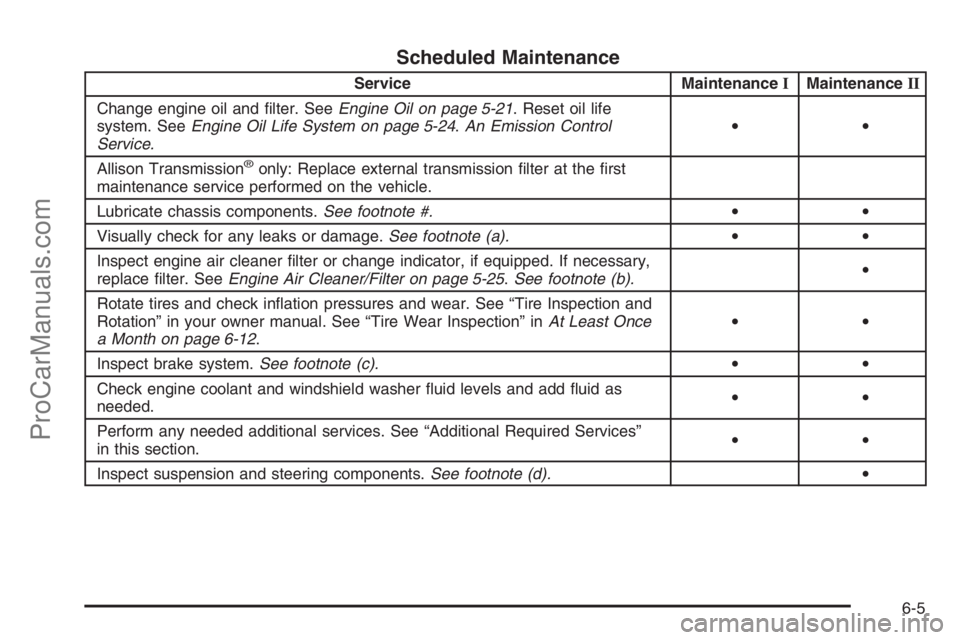
Scheduled Maintenance
Service MaintenanceIMaintenanceII
Change engine oil and filter. SeeEngine Oil on page 5-21. Reset oil life
system. SeeEngine Oil Life System on page 5-24.An Emission Control
Service.••
Allison Transmission
®only: Replace external transmission filter at the first
maintenance service performed on the vehicle.
Lubricate chassis components.See footnote #.••
Visually check for any leaks or damage.See footnote (a).••
Inspect engine air cleaner filter or change indicator, if equipped. If necessary,
replace filter. SeeEngine Air Cleaner/Filter on page 5-25.See footnote (b).•
Rotate tires and check inflation pressures and wear. See “Tire Inspection and
Rotation” in your owner manual. See “Tire Wear Inspection” inAt Least Once
a Month on page 6-12.••
Inspect brake system.See footnote (c).••
Check engine coolant and windshield washer fluid levels and add fluid as
needed.••
Perform any needed additional services. See “Additional Required Services”
in this section.••
Inspect suspension and steering components.See footnote (d).•
6-5
ProCarManuals.com
Page 80 of 100
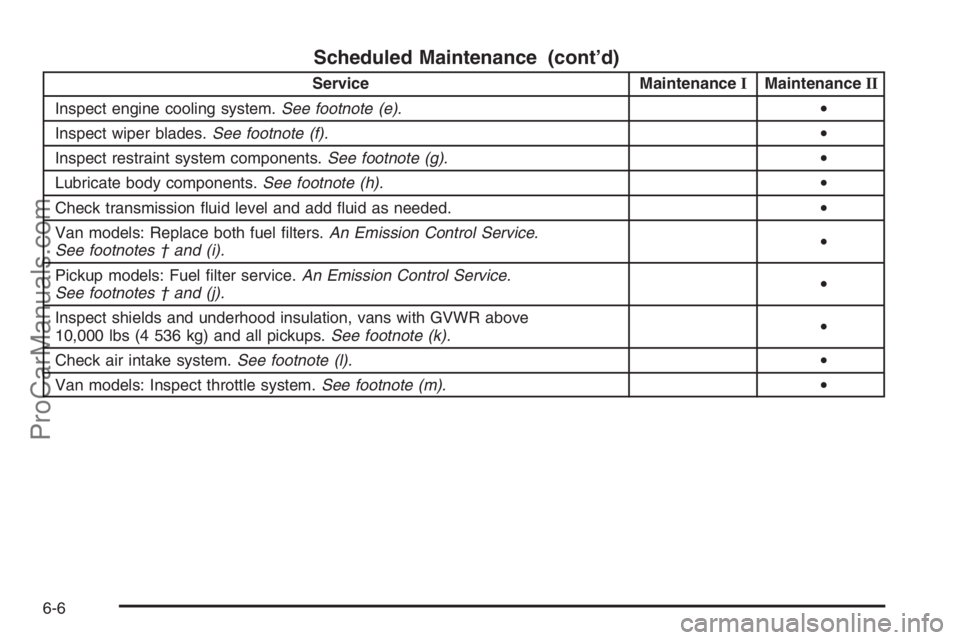
Scheduled Maintenance (cont’d)
Service MaintenanceIMaintenanceII
Inspect engine cooling system.See footnote (e).•
Inspect wiper blades.See footnote (f).•
Inspect restraint system components.See footnote (g).•
Lubricate body components.See footnote (h).•
Check transmission fluid level and add fluid as needed.•
Van models: Replace both fuel filters.An Emission Control Service.
See footnotes † and (i).•
Pickup models: Fuel filter service.An Emission Control Service.
See footnotes † and (j).•
Inspect shields and underhood insulation, vans with GVWR above
10,000 lbs (4 536 kg) and all pickups.See footnote (k).•
Check air intake system.See footnote (l).•
Van models: Inspect throttle system.See footnote (m).•
6-6
ProCarManuals.com
Page 94 of 100
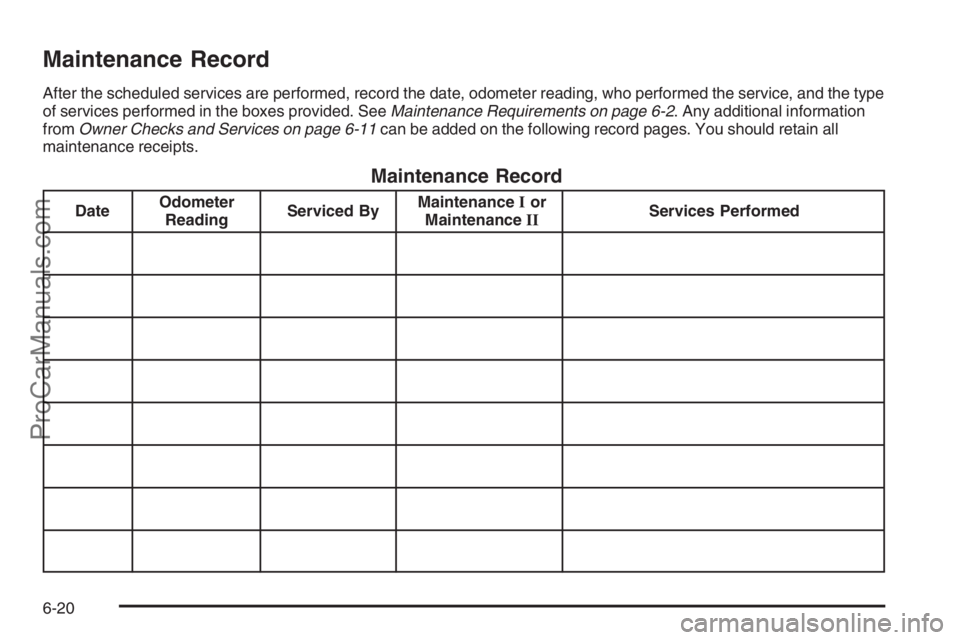
Maintenance Record
After the scheduled services are performed, record the date, odometer reading, who performed the service, and the type
of services performed in the boxes provided. SeeMaintenance Requirements on page 6-2. Any additional information
fromOwner Checks and Services on page 6-11can be added on the following record pages. You should retain all
maintenance receipts.
Maintenance Record
DateOdometer
ReadingServiced ByMaintenanceIor
MaintenanceIIServices Performed
6-20
ProCarManuals.com