engine CHEVROLET EPICA 2006 1.G Owners Manual
[x] Cancel search | Manufacturer: CHEVROLET, Model Year: 2006, Model line: EPICA, Model: CHEVROLET EPICA 2006 1.GPages: 368, PDF Size: 2.24 MB
Page 323 of 368
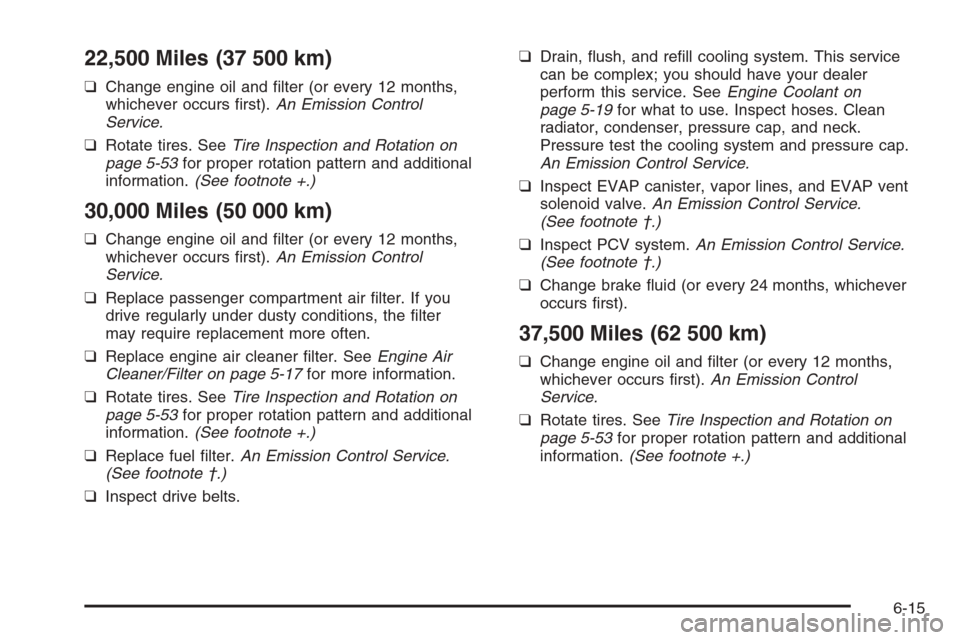
22,500 Miles (37 500 km)
❑Change engine oil and filter (or every 12 months,
whichever occurs first).An Emission Control
Service.
❑Rotate tires. SeeTire Inspection and Rotation on
page 5-53for proper rotation pattern and additional
information.(See footnote +.)
30,000 Miles (50 000 km)
❑Change engine oil and filter (or every 12 months,
whichever occurs first).An Emission Control
Service.
❑Replace passenger compartment air filter. If you
drive regularly under dusty conditions, the filter
may require replacement more often.
❑Replace engine air cleaner filter. SeeEngine Air
Cleaner/Filter on page 5-17for more information.
❑Rotate tires. SeeTire Inspection and Rotation on
page 5-53for proper rotation pattern and additional
information.(See footnote +.)
❑Replace fuel filter.An Emission Control Service.
(See footnote †.)
❑Inspect drive belts.❑Drain, flush, and refill cooling system. This service
can be complex; you should have your dealer
perform this service. SeeEngine Coolant on
page 5-19for what to use. Inspect hoses. Clean
radiator, condenser, pressure cap, and neck.
Pressure test the cooling system and pressure cap.
An Emission Control Service.
❑Inspect EVAP canister, vapor lines, and EVAP vent
solenoid valve.An Emission Control Service.
(See footnote †.)
❑Inspect PCV system.An Emission Control Service.
(See footnote †.)
❑Change brake fluid (or every 24 months, whichever
occurs first).
37,500 Miles (62 500 km)
❑Change engine oil and filter (or every 12 months,
whichever occurs first).An Emission Control
Service.
❑Rotate tires. SeeTire Inspection and Rotation on
page 5-53for proper rotation pattern and additional
information.(See footnote +.)
6-15
Page 324 of 368
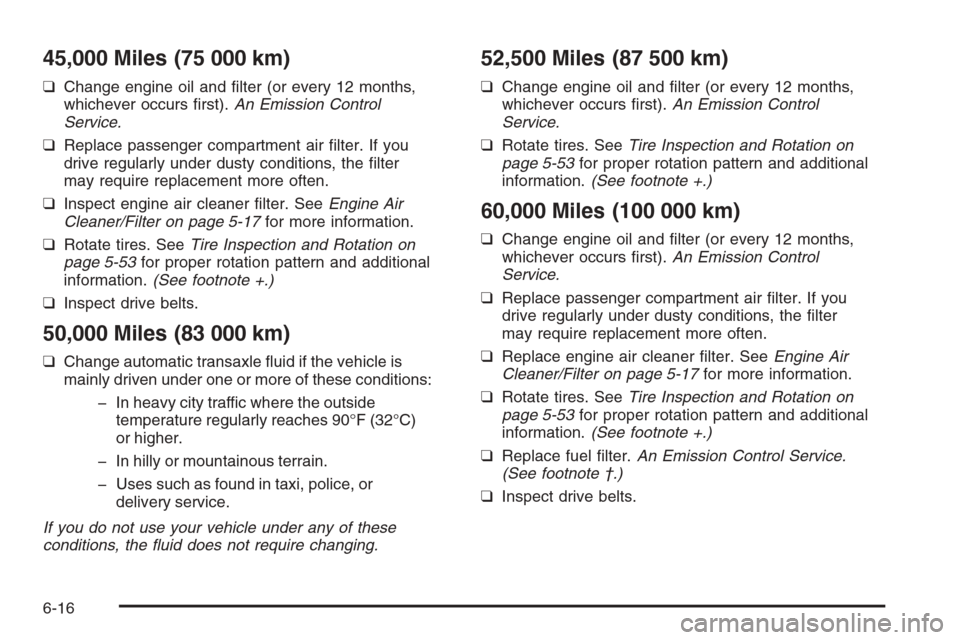
45,000 Miles (75 000 km)
❑Change engine oil and filter (or every 12 months,
whichever occurs first).An Emission Control
Service.
❑Replace passenger compartment air filter. If you
drive regularly under dusty conditions, the filter
may require replacement more often.
❑Inspect engine air cleaner filter. SeeEngine Air
Cleaner/Filter on page 5-17for more information.
❑Rotate tires. SeeTire Inspection and Rotation on
page 5-53for proper rotation pattern and additional
information.(See footnote +.)
❑Inspect drive belts.
50,000 Miles (83 000 km)
❑Change automatic transaxle fluid if the vehicle is
mainly driven under one or more of these conditions:
- In heavy city traffic where the outside
temperature regularly reaches 90°F (32°C)
or higher.
- In hilly or mountainous terrain.
- Uses such as found in taxi, police, or
delivery service.
If you do not use your vehicle under any of these
conditions, the fluid does not require changing.
52,500 Miles (87 500 km)
❑Change engine oil and filter (or every 12 months,
whichever occurs first).An Emission Control
Service.
❑Rotate tires. SeeTire Inspection and Rotation on
page 5-53for proper rotation pattern and additional
information.(See footnote +.)
60,000 Miles (100 000 km)
❑Change engine oil and filter (or every 12 months,
whichever occurs first).An Emission Control
Service.
❑Replace passenger compartment air filter. If you
drive regularly under dusty conditions, the filter
may require replacement more often.
❑Replace engine air cleaner filter. SeeEngine Air
Cleaner/Filter on page 5-17for more information.
❑Rotate tires. SeeTire Inspection and Rotation on
page 5-53for proper rotation pattern and additional
information.(See footnote +.)
❑Replace fuel filter.An Emission Control Service.
(See footnote †.)
❑Inspect drive belts.
6-16
Page 325 of 368
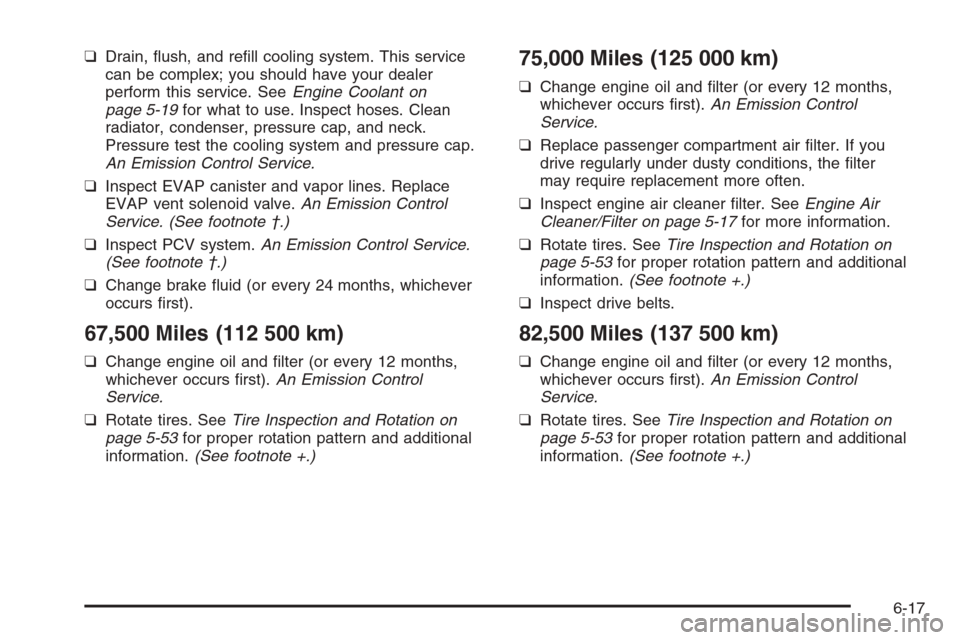
❑Drain, flush, and refill cooling system. This service
can be complex; you should have your dealer
perform this service. SeeEngine Coolant on
page 5-19for what to use. Inspect hoses. Clean
radiator, condenser, pressure cap, and neck.
Pressure test the cooling system and pressure cap.
An Emission Control Service.
❑Inspect EVAP canister and vapor lines. Replace
EVAP vent solenoid valve.An Emission Control
Service. (See footnote †.)
❑Inspect PCV system.An Emission Control Service.
(See footnote †.)
❑Change brake fluid (or every 24 months, whichever
occurs first).
67,500 Miles (112 500 km)
❑Change engine oil and filter (or every 12 months,
whichever occurs first).An Emission Control
Service.
❑Rotate tires. SeeTire Inspection and Rotation on
page 5-53for proper rotation pattern and additional
information.(See footnote +.)
75,000 Miles (125 000 km)
❑Change engine oil and filter (or every 12 months,
whichever occurs first).An Emission Control
Service.
❑Replace passenger compartment air filter. If you
drive regularly under dusty conditions, the filter
may require replacement more often.
❑Inspect engine air cleaner filter. SeeEngine Air
Cleaner/Filter on page 5-17for more information.
❑Rotate tires. SeeTire Inspection and Rotation on
page 5-53for proper rotation pattern and additional
information.(See footnote +.)
❑Inspect drive belts.
82,500 Miles (137 500 km)
❑Change engine oil and filter (or every 12 months,
whichever occurs first).An Emission Control
Service.
❑Rotate tires. SeeTire Inspection and Rotation on
page 5-53for proper rotation pattern and additional
information.(See footnote +.)
6-17
Page 326 of 368
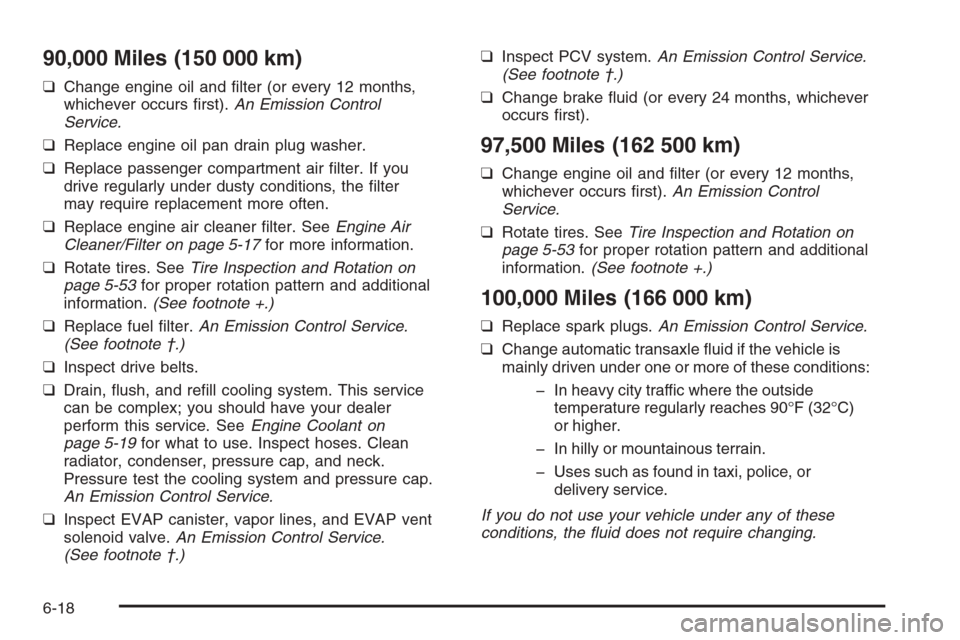
90,000 Miles (150 000 km)
❑Change engine oil and filter (or every 12 months,
whichever occurs first).An Emission Control
Service.
❑Replace engine oil pan drain plug washer.
❑Replace passenger compartment air filter. If you
drive regularly under dusty conditions, the filter
may require replacement more often.
❑Replace engine air cleaner filter. SeeEngine Air
Cleaner/Filter on page 5-17for more information.
❑Rotate tires. SeeTire Inspection and Rotation on
page 5-53for proper rotation pattern and additional
information.(See footnote +.)
❑Replace fuel filter.An Emission Control Service.
(See footnote †.)
❑Inspect drive belts.
❑Drain, flush, and refill cooling system. This service
can be complex; you should have your dealer
perform this service. SeeEngine Coolant on
page 5-19for what to use. Inspect hoses. Clean
radiator, condenser, pressure cap, and neck.
Pressure test the cooling system and pressure cap.
An Emission Control Service.
❑Inspect EVAP canister, vapor lines, and EVAP vent
solenoid valve.An Emission Control Service.
(See footnote †.)❑Inspect PCV system.An Emission Control Service.
(See footnote †.)
❑Change brake fluid (or every 24 months, whichever
occurs first).
97,500 Miles (162 500 km)
❑Change engine oil and filter (or every 12 months,
whichever occurs first).An Emission Control
Service.
❑Rotate tires. SeeTire Inspection and Rotation on
page 5-53for proper rotation pattern and additional
information.(See footnote +.)
100,000 Miles (166 000 km)
❑Replace spark plugs.An Emission Control Service.
❑Change automatic transaxle fluid if the vehicle is
mainly driven under one or more of these conditions:
- In heavy city traffic where the outside
temperature regularly reaches 90°F (32°C)
or higher.
- In hilly or mountainous terrain.
- Uses such as found in taxi, police, or
delivery service.
If you do not use your vehicle under any of these
conditions, the fluid does not require changing.
6-18
Page 327 of 368
Part B: Owner Checks and Services
Listed in this part are owner checks and services
which should be performed at the intervals specified to
help ensure the safety, dependability and emission
control performance of your vehicle.
Be sure any necessary repairs are completed at once.
Whenever any fluids or lubricants are added to your
vehicle, make sure they are the proper ones, as
shown in Part D.
At Each Fuel Fill
It is important for you or a service station attendant
to perform these underhood checks at each fuel fill.
Engine Oil Level Check
Check the engine oil level and add the proper oil if
necessary. SeeEngine Oil on page 5-13for further
details.
Engine Coolant Level Check
Check the engine coolant level and add the proper
coolant mixture if necessary. SeeEngine Coolant on
page 5-19for further details.
Windshield Washer Fluid Level Check
Check the windshield washer fluid level in the windshield
washer fluid reservoir and add the proper fluid if
necessary. SeeWindshield Washer Fluid on page 5-30
for further details.
At Least Once a Month
Tire Ination Check
Visually inspect your tires and make sure tires are
inflated to the correct pressures. Do not forget to check
your spare tire. SeeTires on page 5-46for further
details.
6-19
Page 329 of 368
Starter Switch Check
{CAUTION:
When you are doing this inspection, the
vehicle could move suddenly. If the vehicle
moves, you or others could be injured.
1. Before you start, be sure you have enough room
around the vehicle.
2. Firmly apply both the parking brake and the regular
brake. SeeParking Brake on page 2-25.
Do not use the accelerator pedal, and be ready to
turn off the engine immediately if it starts.
3. Try to start the engine in each gear. The vehicle
should start only in PARK (P) or NEUTRAL (N).
If the vehicle starts in any other position, your
vehicle needs service.
Automatic Transaxle Shift Lock Control
System Check
{CAUTION:
When you are doing this inspection, the
vehicle could move suddenly. If the vehicle
moves, you or others could be injured.
1. Before you start, be sure you have enough room
around the vehicle. It should be parked on a level
surface.
2. Firmly apply the parking brake. SeeParking Brake
on page 2-25.
Be ready to apply the regular brake immediately if
the vehicle begins to move.
3. With the engine off, turn the ignition to ON, but do
not start the engine. Without applying the regular
brake, try to move the shift lever out of PARK (P)
with normal effort. If the shift lever moves out
of PARK (P), your vehicle needs service.
6-21
Page 330 of 368
Ignition Transaxle Lock Check
While parked, and with the parking brake set, try to
turn the ignition to LOCK in each shift lever position.
•The ignition should turn to LOCK only when the
shift lever is in PARK (P).
•The key should come out only in LOCK.
Parking Brake and Automatic Transaxle
Park (P) Mechanism Check
{CAUTION:
When you are doing this check, your vehicle
could begin to move. You or others could
be injured and property could be damaged.
Make sure there is room in front of your
vehicle in case it begins to roll. Be ready to
apply the regular brake at once should the
vehicle begin to move.Park on a fairly steep hill, with the vehicle facing
downhill. Keeping your foot on the regular brake,
set the parking brake.
•To check the parking brake’s holding ability: With
the engine running and transaxle in NEUTRAL (N),
slowly remove foot pressure from the regular
brake pedal. Do this until the vehicle is held by
the parking brake only.
•To check the PARK (P) mechanism’s holding
ability: With the engine running, shift to PARK (P).
Then release the parking brake followed by the
regular brake.
Underbody Flushing Service
At least every spring, use plain water to flush any
corrosive materials from the underbody. Take care to
clean thoroughly any areas where mud and other
debris can collect.
6-22
Page 331 of 368
Part C: Periodic Maintenance
Inspections
Listed in this part are inspections and services which
should be performed at least twice a year (for instance,
each spring and fall).You should let your dealer’s
service department do these jobs. Make sure any
necessary repairs are completed at once.
Proper procedures to perform these services may be
found in a service manual. SeeService Publications
Ordering Information on page 7-14.
Steering, Suspension and Front
Drive Axle Boot and Seal Inspection
Inspect the front and rear suspension and steering
system for damaged, loose or missing parts, signs of
wear or lack of lubrication. Inspect the power steering
lines and hoses for proper hook-up, binding, leaks,
cracks, chafing, etc. Clean and then inspect the drive
axle boot seals for damage, tears or leakage. Replace
seals if necessary.
Exhaust System Inspection
Inspect the complete exhaust system. Inspect the body
near the exhaust system. Look for broken, damaged,
missing or out-of-position parts as well as open seams,
holes, loose connections or other conditions which
could cause a heat build-up in the floor pan or could let
exhaust fumes into the vehicle. SeeEngine Exhaust
on page 2-29.
6-23
Page 332 of 368
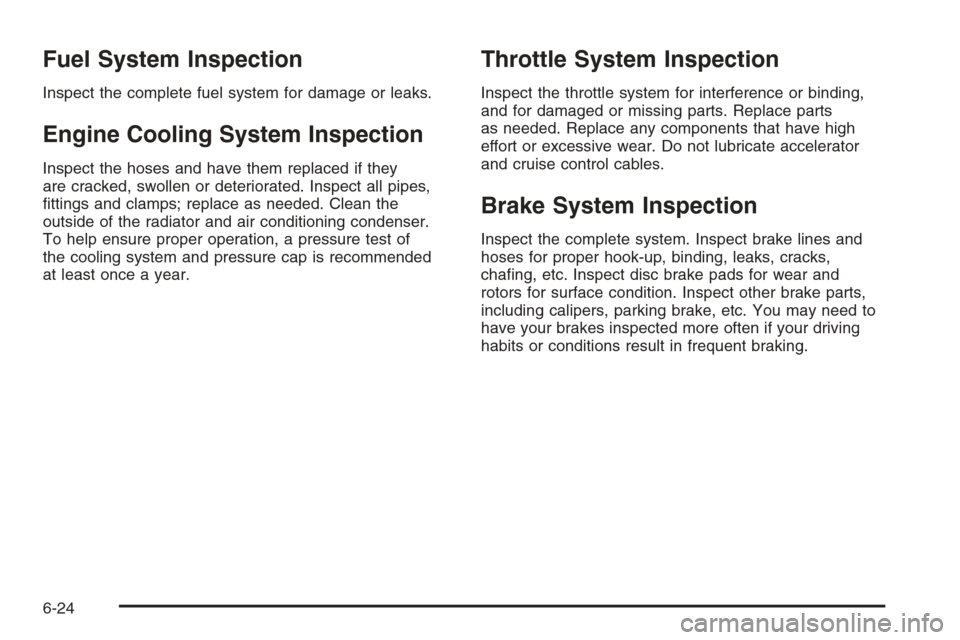
Fuel System Inspection
Inspect the complete fuel system for damage or leaks.
Engine Cooling System Inspection
Inspect the hoses and have them replaced if they
are cracked, swollen or deteriorated. Inspect all pipes,
fittings and clamps; replace as needed. Clean the
outside of the radiator and air conditioning condenser.
To help ensure proper operation, a pressure test of
the cooling system and pressure cap is recommended
at least once a year.
Throttle System Inspection
Inspect the throttle system for interference or binding,
and for damaged or missing parts. Replace parts
as needed. Replace any components that have high
effort or excessive wear. Do not lubricate accelerator
and cruise control cables.
Brake System Inspection
Inspect the complete system. Inspect brake lines and
hoses for proper hook-up, binding, leaks, cracks,
chafing, etc. Inspect disc brake pads for wear and
rotors for surface condition. Inspect other brake parts,
including calipers, parking brake, etc. You may need to
have your brakes inspected more often if your driving
habits or conditions result in frequent braking.
6-24
Page 333 of 368
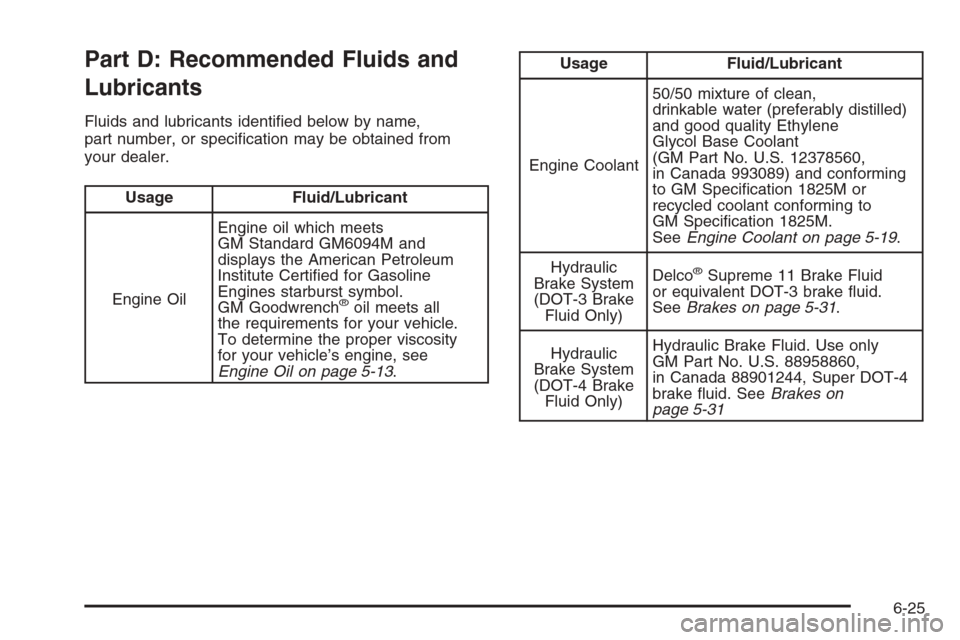
Part D: Recommended Fluids and
Lubricants
Fluids and lubricants identified below by name,
part number, or specification may be obtained from
your dealer.
Usage Fluid/Lubricant
Engine OilEngine oil which meets
GM Standard GM6094M and
displays the American Petroleum
Institute Certified for Gasoline
Engines starburst symbol.
GM Goodwrench
®oil meets all
the requirements for your vehicle.
To determine the proper viscosity
for your vehicle’s engine, see
Engine Oil on page 5-13.
Usage Fluid/Lubricant
Engine Coolant50/50 mixture of clean,
drinkable water (preferably distilled)
and good quality Ethylene
Glycol Base Coolant
(GM Part No. U.S. 12378560,
in Canada 993089) and conforming
to GM Specification 1825M or
recycled coolant conforming to
GM Specification 1825M.
SeeEngine Coolant on page 5-19.
Hydraulic
Brake System
(DOT-3 Brake
Fluid Only)Delco
®Supreme 11 Brake Fluid
or equivalent DOT-3 brake fluid.
SeeBrakes on page 5-31.
Hydraulic
Brake System
(DOT-4 Brake
Fluid Only)Hydraulic Brake Fluid. Use only
GM Part No. U.S. 88958860,
in Canada 88901244, Super DOT-4
brake fluid. SeeBrakes on
page 5-31
6-25