mirror CHEVROLET EPICA 2006 1.G User Guide
[x] Cancel search | Manufacturer: CHEVROLET, Model Year: 2006, Model line: EPICA, Model: CHEVROLET EPICA 2006 1.GPages: 368, PDF Size: 2.24 MB
Page 203 of 368
Loss of Control
Let us review what driving experts say about what
happens when the three control systems — brakes,
steering, and acceleration — do not have enough friction
where the tires meet the road to do what the driver
has asked.
In any emergency, do not give up. Keep trying to
steer and constantly seek an escape route or area of
less danger.
Skidding
In a skid, a driver can lose control of the vehicle.
Defensive drivers avoid most skids by taking reasonable
care suited to existing conditions, and by not overdriving
those conditions. But skids are always possible.
The three types of skids correspond to your vehicle’s
three control systems. In the braking skid, your wheels
are not rolling. In the steering or cornering skid, too
much speed or steering in a curve causes tires to
slip and lose cornering force. And in the acceleration
skid, too much throttle causes the driving wheels to spin.
A cornering skid is best handled by easing your foot
off the accelerator pedal.Remember: Any traction control system helps avoid only
the acceleration skid. If your traction control system is
off, then an acceleration skid is also best handled
by easing your foot off the accelerator pedal.
If your vehicle starts to slide, ease your foot off the
accelerator pedal and quickly steer the way you want
the vehicle to go. If you start steering quickly enough,
your vehicle may straighten out. Always be ready
for a second skid if it occurs.
Of course, traction is reduced when water, snow, ice,
gravel, or other material is on the road. For safety,
you will want to slow down and adjust your driving to
these conditions. It is important to slow down on slippery
surfaces because stopping distance will be longer and
vehicle control more limited.
While driving on a surface with reduced traction,
try your best to avoid sudden steering, acceleration,
or braking, including engine braking by shifting to
a lower gear. Any sudden changes could cause the
tires to slide. You may not realize the surface is slippery
until your vehicle is skidding. Learn to recognize
warning clues — such as enough water, ice, or packed
snow on the road to make a mirrored surface — and
slow down when you have any doubt.
Remember: Any Anti-Lock Brake System (ABS) helps
avoid only the braking skid.
4-15
Page 204 of 368
Driving at Night
Night driving is more dangerous than day driving.
One reason is that some drivers are likely to be
impaired — by alcohol or drugs, with night vision
problems, or by fatigue.
Here are some tips on night driving.
•Drive defensively.
•Do not drink and drive.
•Adjust the inside rearview mirror to reduce the
glare from headlamps behind you.
•Since you cannot see as well, you may need to
slow down and keep more space between you
and other vehicles.
•Slow down, especially on higher speed roads.
Your vehicle’s headlamps can light up only so
much road ahead.
•In remote areas, watch for animals.
•If you are tired, pull off the road in a safe place
and rest.
No one can see as well at night as in the daytime.
But as we get older these differences increase.
A 50-year-old driver may require at least twice as much
light to see the same thing at night as a 20-year-old.What you do in the daytime can also affect your night
vision. For example, if you spend the day in bright
sunshine you are wise to wear sunglasses. Your eyes
will have less trouble adjusting to night. But if you
are driving, do not wear sunglasses at night. They may
cut down on glare from headlamps, but they also
make a lot of things invisible.
You can be temporarily blinded by approaching
headlamps. It can take a second or two, or even
several seconds, for your eyes to re-adjust to the dark.
When you are faced with severe glare, as from a
driver who does not lower the high beams, or a vehicle
with misaimed headlamps, slow down a little. Avoid
staring directly into the approaching headlamps.
Keep the windshield and all the glass on your vehicle
clean — inside and out. Glare at night is made
much worse by dirt on the glass. Even the inside of
the glass can build up a film caused by dust. Dirty glass
makes lights dazzle and flash more than clean glass
would, making the pupils of your eyes contract
repeatedly.
Remember that the headlamps light up far less of a
roadway when you are in a turn or curve. Keep
your eyes moving; that way, it is easier to pick out
dimly lighted objects. Just as the headlamps should
be checked regularly for proper aim, so should
your eyes be examined regularly. Some drivers suffer
from night blindness — the inability to see in dim
light — and are not even aware of it.
4-16
Page 208 of 368
Freeway Driving
Mile for mile, freeways — also called thruways,
parkways, expressways, turnpikes, or
superhighways — are the safest of all roads.
But they have their own special rules.The most important advice on freeway driving is: Keep
up with traffic and keep to the right. Drive at the
same speed most of the other drivers are driving.
Too-fast or too-slow driving breaks a smooth traffic flow.
Treat the left lane on a freeway as a passing lane.
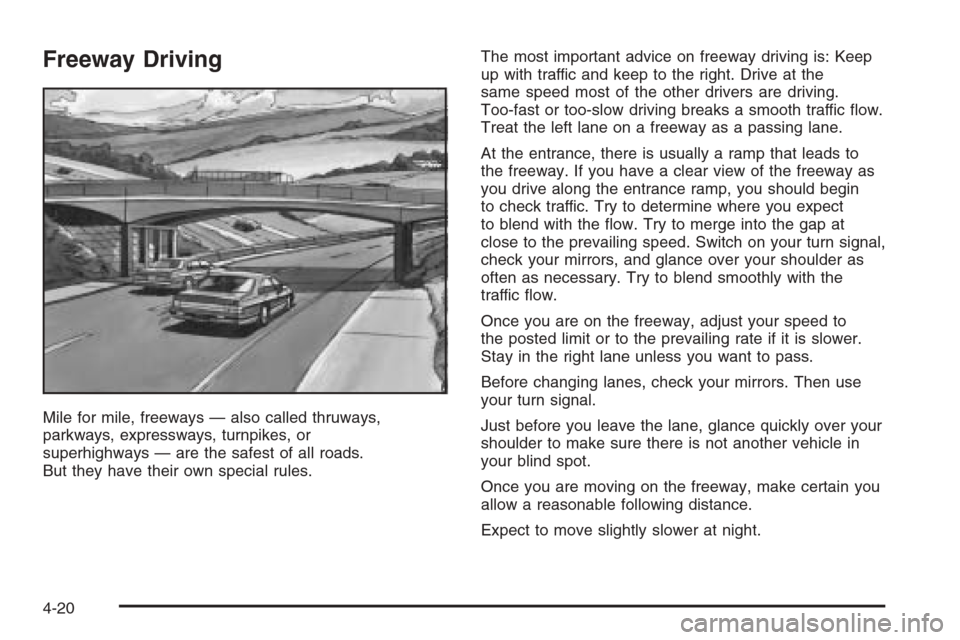
At the entrance, there is usually a ramp that leads to
the freeway. If you have a clear view of the freeway as
you drive along the entrance ramp, you should begin
to check traffic. Try to determine where you expect
to blend with the flow. Try to merge into the gap at
close to the prevailing speed. Switch on your turn signal,
check your mirrors, and glance over your shoulder as
often as necessary. Try to blend smoothly with the
traffic flow.
Once you are on the freeway, adjust your speed to
the posted limit or to the prevailing rate if it is slower.
Stay in the right lane unless you want to pass.
Before changing lanes, check your mirrors. Then use
your turn signal.
Just before you leave the lane, glance quickly over your
shoulder to make sure there is not another vehicle in
your blind spot.
Once you are moving on the freeway, make certain you
allow a reasonable following distance.
Expect to move slightly slower at night.
4-20
Page 210 of 368
Highway Hypnosis
Is there actually such a condition as highway hypnosis?
Or is it just plain falling asleep at the wheel? Call it
highway hypnosis, lack of awareness, or whatever.
There is something about an easy stretch of road with
the same scenery, along with the hum of the tires on
the road, the drone of the engine, and the rush of
the wind against the vehicle that can make you sleepy.
Do not let it happen to you! If it does, your vehicle
can leave the road in less than a second, and you
could crash and be injured.
What can you do about highway hypnosis? First, be
aware that it can happen.
Then here are some tips:
•Make sure your vehicle is well ventilated, with a
comfortably cool interior.
•Keep your eyes moving. Scan the road ahead and
to the sides. Check your rearview mirrors and your
instruments frequently.
•If you get sleepy, pull off the road into a rest,
service, or parking area and take a nap, get some
exercise, or both. For safety, treat drowsiness
on the highway as an emergency.
Hill and Mountain Roads
Driving on steep hills or mountains is different from
driving in flat or rolling terrain.
If you drive regularly in steep country, or if you are
planning to visit there, here are some tips that can make
your trips safer and more enjoyable.
•Keep your vehicle in good shape. Check all fluid
levels and also the brakes, tires, cooling system,
and transaxle. These parts can work hard on
mountain roads.
4-22
Page 303 of 368
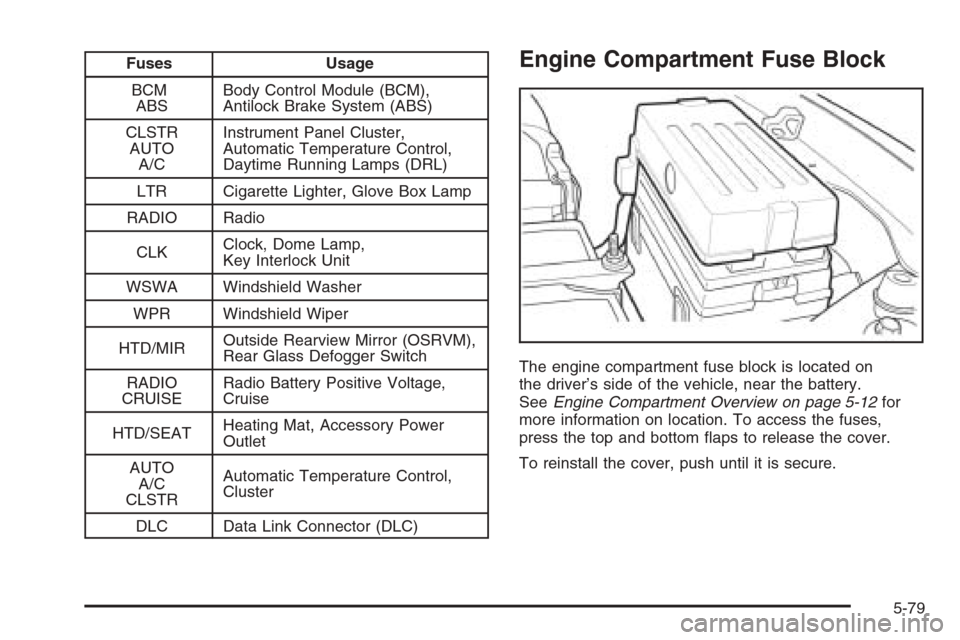
Fuses Usage
BCM
ABSBody Control Module (BCM),
Antilock Brake System (ABS)
CLSTR
AUTO
A/CInstrument Panel Cluster,
Automatic Temperature Control,
Daytime Running Lamps (DRL)
LTR Cigarette Lighter, Glove Box Lamp
RADIO Radio
CLKClock, Dome Lamp,
Key Interlock Unit
WSWA Windshield Washer
WPR Windshield Wiper
HTD/MIROutside Rearview Mirror (OSRVM),
Rear Glass Defogger Switch
RADIO
CRUISERadio Battery Positive Voltage,
Cruise
HTD/SEATHeating Mat, Accessory Power
Outlet
AUTO
A/C
CLSTRAutomatic Temperature Control,
Cluster
DLC Data Link Connector (DLC)Engine Compartment Fuse Block
The engine compartment fuse block is located on
the driver’s side of the vehicle, near the battery.
SeeEngine Compartment Overview on page 5-12for
more information on location. To access the fuses,
press the top and bottom flaps to release the cover.
To reinstall the cover, push until it is secure.
5-79
Page 305 of 368
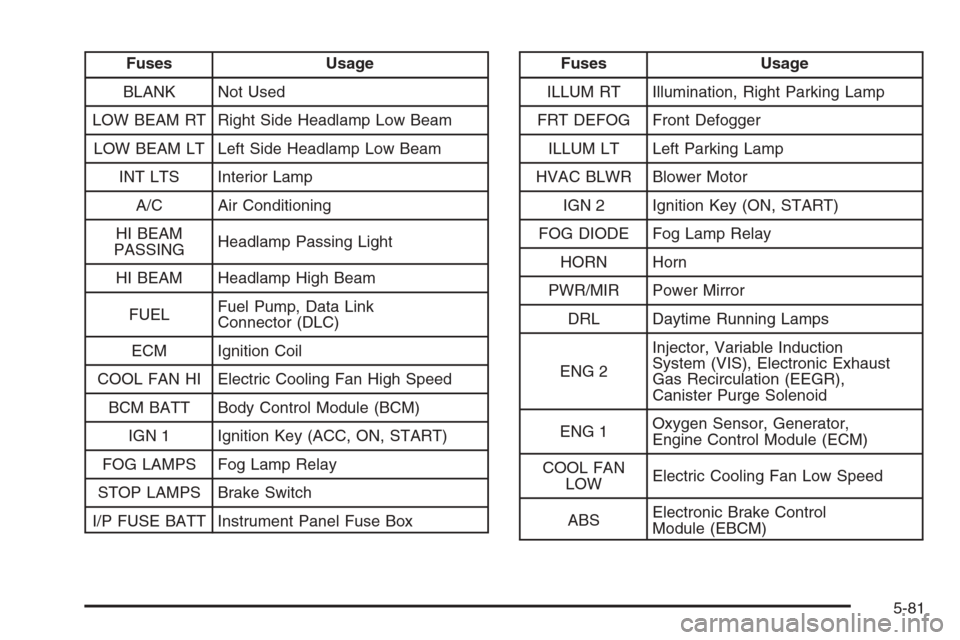
Fuses Usage
BLANK Not Used
LOW BEAM RT Right Side Headlamp Low Beam
LOW BEAM LT Left Side Headlamp Low Beam
INT LTS Interior Lamp
A/C Air Conditioning
HI BEAM
PASSINGHeadlamp Passing Light
HI BEAM Headlamp High Beam
FUELFuel Pump, Data Link
Connector (DLC)
ECM Ignition Coil
COOL FAN HI Electric Cooling Fan High Speed
BCM BATT Body Control Module (BCM)
IGN 1 Ignition Key (ACC, ON, START)
FOG LAMPS Fog Lamp Relay
STOP LAMPS Brake Switch
I/P FUSE BATT Instrument Panel Fuse BoxFuses Usage
ILLUM RT Illumination, Right Parking Lamp
FRT DEFOG Front Defogger
ILLUM LT Left Parking Lamp
HVAC BLWR Blower Motor
IGN 2 Ignition Key (ON, START)
FOG DIODE Fog Lamp Relay
HORN Horn
PWR/MIR Power Mirror
DRL Daytime Running Lamps
ENG 2Injector, Variable Induction
System (VIS), Electronic Exhaust
Gas Recirculation (EEGR),
Canister Purge Solenoid
ENG 1Oxygen Sensor, Generator,
Engine Control Module (ECM)
COOL FAN
LOWElectric Cooling Fan Low Speed
ABSElectronic Brake Control
Module (EBCM)
5-81
Page 363 of 368
Maintenance Schedule (cont.)
Steering, Suspension and Front Drive
Axle Boot and Seal Inspection...................6-23
Throttle System Inspection............................6-24
Using.......................................................... 6-4
Your Vehicle and the Environment................... 6-2
Malfunction Indicator Light................................3-40
Manual Lumbar Controls.................................... 1-4
Manual Seats................................................... 1-2
Map Lamps ....................................................3-16
Mirrors
Automatic Dimming Rearview........................2-31
Manual Rearview Mirror................................2-31
Outside Convex Mirror.................................2-33
Outside Heated Mirrors................................2-33
Outside Power Mirrors..................................2-32
MyGMLink.com................................................ 7-3
N
New Vehicle Break-In......................................2-17
Normal Maintenance Replacement Parts............5-84
O
Odometer......................................................3-31
Odometer, Trip...............................................3-31
Off-Road Recovery..........................................4-13
Oil
Engine.......................................................5-13
Pressure Light.............................................3-43
Older Children, Restraints................................1-28
Online Owner Center........................................ 7-3
Other Warning Devices...................................... 3-6
Outlet Adjustment............................................3-27
Outside
Convex Mirror.............................................2-33
Heated Mirrors............................................2-33
Power Mirrors.............................................2-32
Owners, Canadian............................................... ii
PPark (P)
Shifting Into................................................2-26
Shifting Out of............................................2-28
9
Page 364 of 368
Parking
Brake........................................................2-25
Over Things That Burn.................................2-29
Part A - Scheduled Maintenance Services............. 6-4
Part B - Owner Checks and Services.................6-19
Part C - Periodic Maintenance Inspections..........6-23
Part D - Recommended Fluids and Lubricants.....6-25
Part E - Maintenance Record............................6-27
Passenger Airbag Status Indicator.....................3-33
Passenger Compartment Air Filter.....................3-28
Passenger Sensing System..............................1-58
Passing.........................................................4-13
Power
Accessory Outlet(s)......................................3-16
Door Locks.................................................. 2-8
Electrical System.........................................5-76
Seat ............................................................ 1-3
Steering Fluid.............................................5-29
Windows....................................................2-13
Pretensioners, Safety Belt................................1-27
Q
Questions and Answers About Safety Belts.........1-14
R
Radios..........................................................3-46
Care of Your CD Player...............................3-80
Care of Your CDs ........................................3-80
Radio with CD............................3-48, 3-52, 3-59
Radio with Six-Disc CD................................3-67
Trunk-Mounted CD Changer..........................3-75
Understanding Reception..............................3-79
Rear Door Security Locks.................................. 2-9
Rear Seat Armrest..........................................2-35
Rear Seat Operation......................................... 1-8
Rear Seat Passengers, Safety Belts..................1-23
Rearview Mirror, Automatic Dimming..................2-31
Rearview Mirrors.............................................2-31
Reclining Seatbacks.......................................... 1-4
Recreational Vehicle Towing.............................4-33
Remote Keyless Entry System............................ 2-3
Remote Keyless Entry System, Operation............ 2-4
Removing the Flat Tire and Installing the
Spare Tire..................................................5-63
Removing the Spare Tire and Tools...................5-62
Replacement Bulbs.........................................5-44
10