speed CHEVROLET EPICA 2006 1.G Service Manual
[x] Cancel search | Manufacturer: CHEVROLET, Model Year: 2006, Model line: EPICA, Model: CHEVROLET EPICA 2006 1.GPages: 368, PDF Size: 2.24 MB
Page 250 of 368
If no coolant is visible in the surge tank, add coolant
as follows:
{CAUTION:
Steam and scalding liquids from a hot cooling
system can blow out and burn you badly. They
are under pressure, and if you turn the coolant
surge tank pressure cap — even a little — they
can come out at high speed. Never turn the
cap when the cooling system, including the
coolant surge tank pressure cap, is hot. Wait
for the cooling system and coolant surge tank
pressure cap to cool if you ever have to turn
the pressure cap.
{CAUTION:
Adding only plain water to your cooling
system can be dangerous. Plain water, or
some other liquid such as alcohol, can boil
before the proper coolant mixture will. Your
vehicle’s coolant warning system is set for
the proper coolant mixture. With plain water
or the wrong mixture, your engine could get
too hot but you would not get the overheat
warning. Your engine could catch re and you
or others could be burned. Use a 50/50 mixture
of clean, drinkable water and a proper coolant.
Notice:In cold weather, water can freeze and crack
the engine, radiator, heater core and other parts.
Use the recommended coolant and the proper
coolant mixture.
5-26
Page 272 of 368
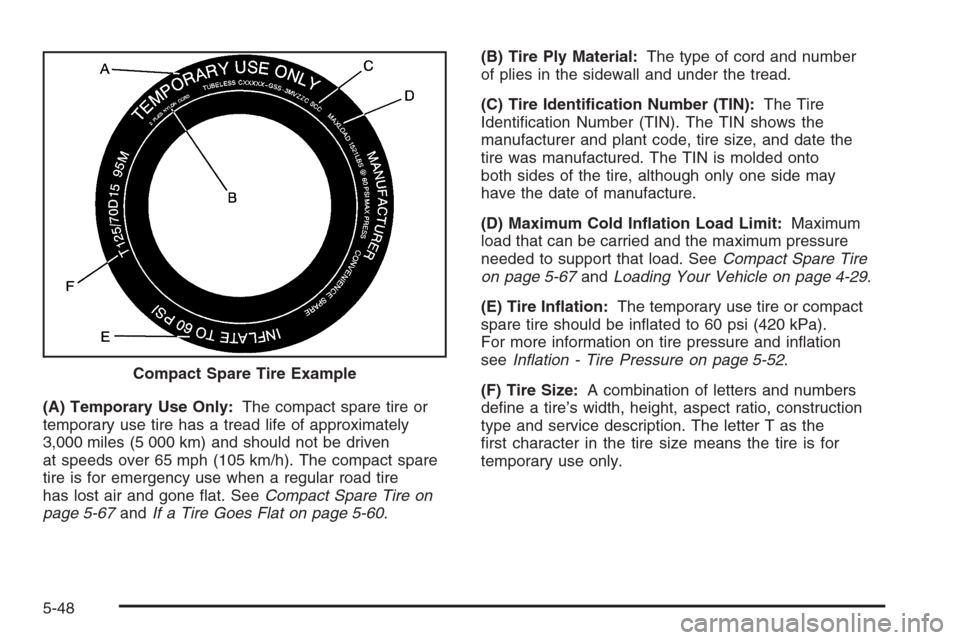
(A) Temporary Use Only:The compact spare tire or
temporary use tire has a tread life of approximately
3,000 miles (5 000 km) and should not be driven
at speeds over 65 mph (105 km/h). The compact spare
tire is for emergency use when a regular road tire
has lost air and gone flat. SeeCompact Spare Tire on
page 5-67andIf a Tire Goes Flat on page 5-60.(B) Tire Ply Material:The type of cord and number
of plies in the sidewall and under the tread.
(C) Tire Identication Number (TIN):The Tire
Identification Number (TIN). The TIN shows the
manufacturer and plant code, tire size, and date the
tire was manufactured. The TIN is molded onto
both sides of the tire, although only one side may
have the date of manufacture.
(D) Maximum Cold Ination Load Limit:Maximum
load that can be carried and the maximum pressure
needed to support that load. SeeCompact Spare Tire
on page 5-67andLoading Your Vehicle on page 4-29.
(E) Tire Ination:The temporary use tire or compact
spare tire should be inflated to 60 psi (420 kPa).
For more information on tire pressure and inflation
seeInflation - Tire Pressure on page 5-52.
(F) Tire Size:A combination of letters and numbers
define a tire’s width, height, aspect ratio, construction
type and service description. The letter T as the
first character in the tire size means the tire is for
temporary use only. Compact Spare Tire Example
5-48
Page 273 of 368
Tire Size
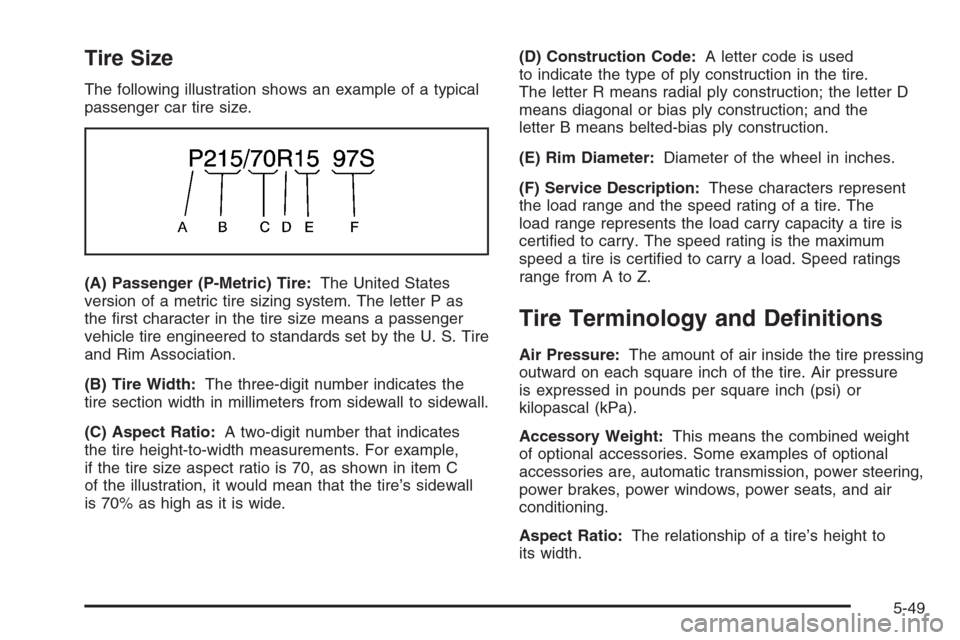
The following illustration shows an example of a typical
passenger car tire size.
(A) Passenger (P-Metric) Tire:The United States
version of a metric tire sizing system. The letter P as
the first character in the tire size means a passenger
vehicle tire engineered to standards set by the U. S. Tire
and Rim Association.
(B) Tire Width:The three-digit number indicates the
tire section width in millimeters from sidewall to sidewall.
(C) Aspect Ratio:A two-digit number that indicates
the tire height-to-width measurements. For example,
if the tire size aspect ratio is 70, as shown in item C
of the illustration, it would mean that the tire’s sidewall
is 70% as high as it is wide.(D) Construction Code:A letter code is used
to indicate the type of ply construction in the tire.
The letter R means radial ply construction; the letter D
means diagonal or bias ply construction; and the
letter B means belted-bias ply construction.
(E) Rim Diameter:Diameter of the wheel in inches.
(F) Service Description:These characters represent
the load range and the speed rating of a tire. The
load range represents the load carry capacity a tire is
certified to carry. The speed rating is the maximum
speed a tire is certified to carry a load. Speed ratings
range from A to Z.
Tire Terminology and Denitions
Air Pressure:The amount of air inside the tire pressing
outward on each square inch of the tire. Air pressure
is expressed in pounds per square inch (psi) or
kilopascal (kPa).
Accessory Weight:This means the combined weight
of optional accessories. Some examples of optional
accessories are, automatic transmission, power steering,
power brakes, power windows, power seats, and air
conditioning.
Aspect Ratio:The relationship of a tire’s height to
its width.
5-49
Page 275 of 368
Outward Facing Sidewall:The side of an
asymmetrical tire that has a particular side that faces
outward when mounted on a vehicle. The side of
the tire that contains a whitewall, bears white lettering,
or bears manufacturer, brand, and/or model name
molding that is higher or deeper than the same moldings
on the other sidewall of the tire.
Passenger (P-Metric) Tire:A tire used on passenger
cars and some light duty trucks and multipurpose
vehicles.
Recommended Ination Pressure:Vehicle
manufacturer’s recommended tire inflation pressure and
shown on the tire placard. SeeInflation - Tire Pressure
on page 5-52andLoading Your Vehicle on page 4-29.
Radial Ply Tire:A pneumatic tire in which the ply cords
that extend to the beads are laid at 90 degrees to the
centerline of the tread.
Rim:A metal support for a tire and upon which the
tire beads are seated.
Sidewall:The portion of a tire between the tread and
the bead.
Speed Rating:An alphanumeric code assigned to
a tire indicating the maximum speed at which a tire
can operate.
Traction:The friction between the tire and the road
surface. The amount of grip provided.Tread:The portion of a tire that comes into contact
with the road.
Treadwear Indicators:Narrow bands, sometimes
called wear bars, that show across the tread of a tire
when only 1/16 inch (1.6 mm) of tread remains.
SeeWhen It Is Time for New Tires on page 5-54.
UTQGS (Uniform Tire Quality Grading Standards):
A tire information system that provides consumers with
ratings for a tire’s traction, temperature, and treadwear.
Ratings are determined by tire manufacturers using
government testing procedures. The ratings are molded
into the sidewall of the tire. SeeUniform Tire Quality
Grading on page 5-56.
Vehicle Capacity Weight:The number of designated
seating positions multiplied by 150 lbs (68 kg) plus
the rated cargo load. SeeLoading Your Vehicle
on page 4-29.
Vehicle Maximum Load on the Tire:Load on an
individual tire due to curb weight, accessory weight,
occupant weight, and cargo weight.
Vehicle Placard:A label permanently attached to a
vehicle showing the vehicle’s capacity weight and
the original equipment tire size and recommended
inflation pressure. See “Tire and Loading Information
Label” underLoading Your Vehicle on page 4-29.
5-51
Page 279 of 368
Buying New Tires
To find out what kind and size of tires you need, look
at the tire and loading information label attached to your
vehicle. SeeLoading Your Vehicle on page 4-29for a
label example and where it is attached to your vehicle.
Make sure the replacements are the same size,
load range, speed rating and construction type
(bias, bias-belted or radial) as your original tires.
{CAUTION:
Mixing tires could cause you to lose control
while driving. If you mix tires of different sizes,
brands, or types (radial and bias-belted tires),
the vehicle may not handle properly, and
you could have a crash. Using tires of
different sizes, brands, or types may also
cause damage to your vehicle. Be sure to
use the correct size, brand, and type of
tires on all wheels. It is all right to drive
with your compact spare temporarily, as
it was developed for use on your vehicle.
SeeCompact Spare Tire on page 5-67.
{CAUTION:
If you use bias-ply tires on your vehicle, the
wheel rim anges could develop cracks after
many miles of driving. A tire and/or wheel
could fail suddenly, causing a crash. Use only
radial-ply tires with the wheels on your vehicle.
5-55
Page 281 of 368
Treadwear
The treadwear grade is a comparative rating based on
the wear rate of the tire when tested under controlled
conditions on a specified government test course.
For example, a tire graded 150 would wear one and
a half (1
1⁄2) times as well on the government course as
a tire graded 100. The relative performance of tires
depends upon the actual conditions of their use,
however, and may depart significantly from the norm
due to variations in driving habits, service practices and
differences in road characteristics and climate.
Traction — AA, A, B, C
The traction grades, from highest to lowest, are AA, A,
B, and C. Those grades represent the tire’s ability
to stop on wet pavement as measured under controlled
conditions on specified government test surfaces of
asphalt and concrete. A tire marked C may have poor
traction performance. Warning: The traction grade
assigned to this tire is based on straight-ahead braking
traction tests, and does not include acceleration,
cornering, hydroplaning, or peak traction characteristics.
Temperature — A, B, C
The temperature grades are A (the highest), B, and C,
representing the tire’s resistance to the generation
of heat and its ability to dissipate heat when tested
under controlled conditions on a specified indoor
laboratory test wheel. Sustained high temperature
can cause the material of the tire to degenerate and
reduce tire life, and excessive temperature can lead
to sudden tire failure. The grade C corresponds to
a level of performance which all passenger car tires
must meet under the Federal Motor Vehicle Safety
Standard No. 109. Grades B and A represent higher
levels of performance on the laboratory test wheel
than the minimum required by law.
Warning: The temperature grade for this tire is
established for a tire that is properly inflated and not
overloaded. Excessive speed, underinflation, or
excessive loading, either separately or in combination,
can cause heat buildup and possible tire failure.
5-57
Page 283 of 368
{CAUTION:
Using the wrong replacement wheels, wheel
bolts, or wheel nuts on your vehicle can be
dangerous. It could affect the braking and
handling of your vehicle, make your tires lose
air and make you lose control. You could have
a collision in which you or others could be
injured. Always use the correct wheel, wheel
bolts and wheel nuts for replacement.
Notice:The wrong wheel can also cause problems
with bearing life, brake cooling, speedometer or
odometer calibration, headlamp aim, bumper height,
vehicle ground clearance, and tire or tire chain
clearance to the body and chassis.
SeeChanging a Flat Tire on page 5-61for more
information.
Used Replacement Wheels
{CAUTION:
Putting a used wheel on your vehicle is
dangerous. You cannot know how it has been
used or how far it has been driven. It could
fail suddenly and cause a crash. If you have
to replace a wheel, use a new GM original
equipment wheel.
Tire Chains
Notice:Use tire chains only where legal and
only when you must. Use only SAE Class “S” type
chains that are the proper size for your tires.
Install them on the front tires and tighten them as
tightly as possible with the ends securely fastened.
Drive slowly and follow the chain manufacturer’s
instructions. If you can hear the chains contacting
your vehicle, stop and retighten them. If the contact
continues, slow down until it stops. Driving too
fast or spinning the wheels with chains on will
damage your vehicle.
5-59
Page 291 of 368
To store a flat or compact spare tire and tools,
do the following:
1. Store the flat or compact spare tire in the
spare tire compartment.
2. Place the tire in the compartment, then
secure the retainer.
3. Store the jack in its foam tray in the trunk.
4. Store the tools securely in the trunk.
5. Replace the trim cover.
The compact spare tire is for temporary use only.
Replace the compact spare tire with a full-size tire
as soon as you can. SeeCompact Spare Tire
on page 5-67.
Compact Spare Tire
Although the compact spare tire was fully inflated
when your vehicle was new, it can lose air after
a time. Check the inflation pressure regularly.
It should be 60 psi (420 kPa).
After installing the compact spare on your
vehicle, you should stop as soon as possible and
make sure your spare tire is correctly inflated.The compact spare is made to perform well at speeds
up to 50 mph (80 km/h), so you can finish your trip
and have your full-size tire repaired or replaced where
you want. Of course, it is best to replace your spare with
a full-size tire as soon as you can. Your spare will last
longer and be in good shape in case you need it again.
Notice:When the compact spare is installed,
do not take your vehicle through an automatic car
wash with guide rails. The compact spare can
get caught on the rails. That can damage the tire
and wheel, and maybe other parts of your vehicle.
Do not use your compact spare on other vehicles.
And do not mix your compact spare tire or wheel
with other wheels or tires. They will not fit. Keep your
spare tire and its wheel together.
Notice:Tire chains will not t your compact spare.
Using them can damage your vehicle and can
damage the chains too. Do not use tire chains
on your compact spare.
5-67
Page 305 of 368
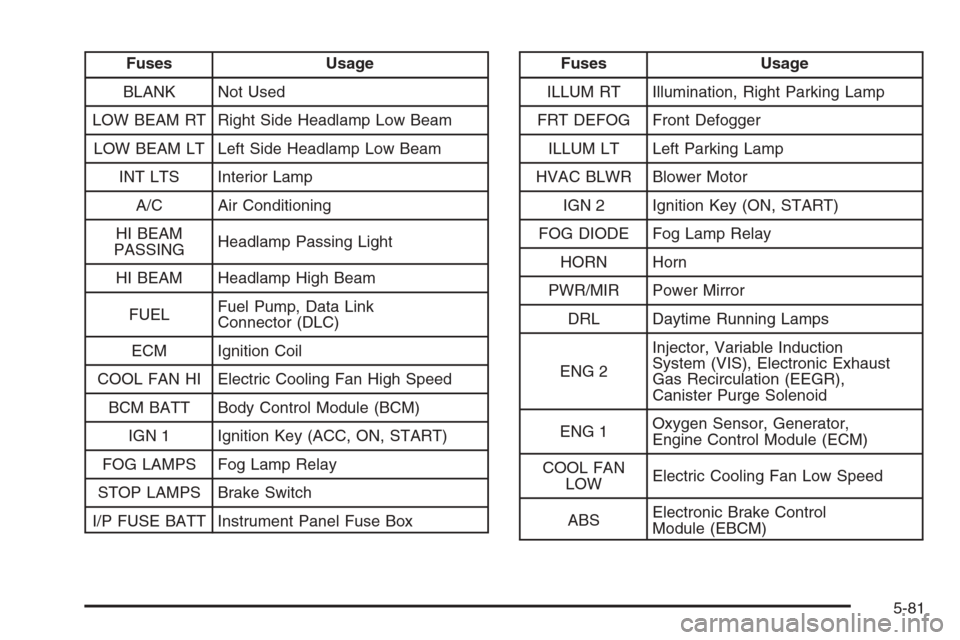
Fuses Usage
BLANK Not Used
LOW BEAM RT Right Side Headlamp Low Beam
LOW BEAM LT Left Side Headlamp Low Beam
INT LTS Interior Lamp
A/C Air Conditioning
HI BEAM
PASSINGHeadlamp Passing Light
HI BEAM Headlamp High Beam
FUELFuel Pump, Data Link
Connector (DLC)
ECM Ignition Coil
COOL FAN HI Electric Cooling Fan High Speed
BCM BATT Body Control Module (BCM)
IGN 1 Ignition Key (ACC, ON, START)
FOG LAMPS Fog Lamp Relay
STOP LAMPS Brake Switch
I/P FUSE BATT Instrument Panel Fuse BoxFuses Usage
ILLUM RT Illumination, Right Parking Lamp
FRT DEFOG Front Defogger
ILLUM LT Left Parking Lamp
HVAC BLWR Blower Motor
IGN 2 Ignition Key (ON, START)
FOG DIODE Fog Lamp Relay
HORN Horn
PWR/MIR Power Mirror
DRL Daytime Running Lamps
ENG 2Injector, Variable Induction
System (VIS), Electronic Exhaust
Gas Recirculation (EEGR),
Canister Purge Solenoid
ENG 1Oxygen Sensor, Generator,
Engine Control Module (ECM)
COOL FAN
LOWElectric Cooling Fan Low Speed
ABSElectronic Brake Control
Module (EBCM)
5-81
Page 306 of 368
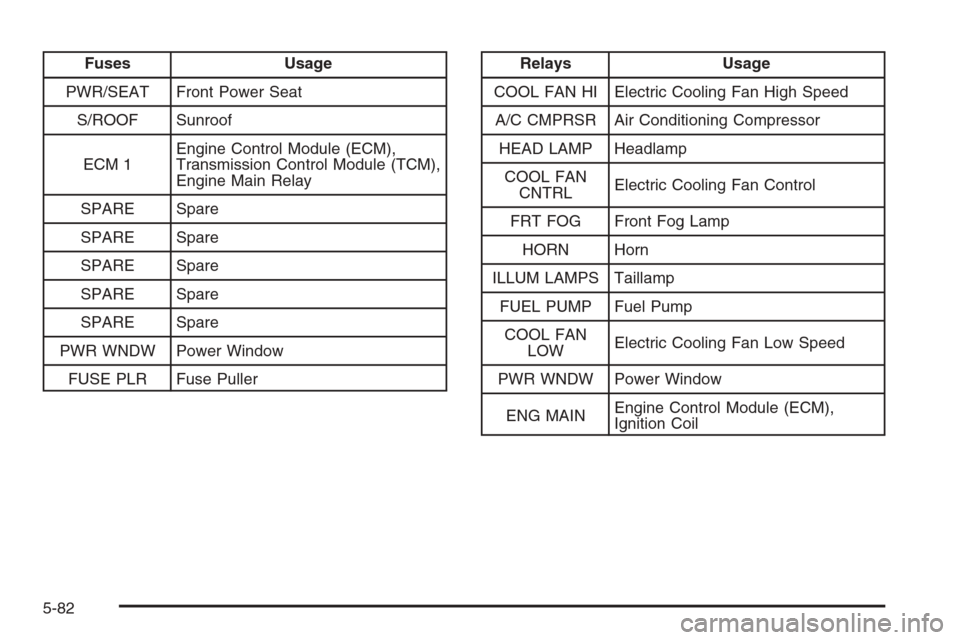
Fuses Usage
PWR/SEAT Front Power Seat
S/ROOF Sunroof
ECM 1Engine Control Module (ECM),
Transmission Control Module (TCM),
Engine Main Relay
SPARE Spare
SPARE Spare
SPARE Spare
SPARE Spare
SPARE Spare
PWR WNDW Power Window
FUSE PLR Fuse PullerRelays Usage
COOL FAN HI Electric Cooling Fan High Speed
A/C CMPRSR Air Conditioning Compressor
HEAD LAMP Headlamp
COOL FAN
CNTRLElectric Cooling Fan Control
FRT FOG Front Fog Lamp
HORN Horn
ILLUM LAMPS Taillamp
FUEL PUMP Fuel Pump
COOL FAN
LOWElectric Cooling Fan Low Speed
PWR WNDW Power Window
ENG MAINEngine Control Module (ECM),
Ignition Coil
5-82