radiator CHEVROLET EXPRESS 1996 1.G User Guide
[x] Cancel search | Manufacturer: CHEVROLET, Model Year: 1996, Model line: EXPRESS, Model: CHEVROLET EXPRESS 1996 1.GPages: 376, PDF Size: 18.83 MB
Page 252 of 376
Downloaded from www.Manualslib.com manuals search engine Thermostat
Engine coolant temperature is controlled by a thermostat
in the engine cooling system. The thermostat stops the
flow
of coolant through the radiator until the coolant
reaches a preset temperature.
When you replace your thermostat, an
AC@ thermostat
is recommended.
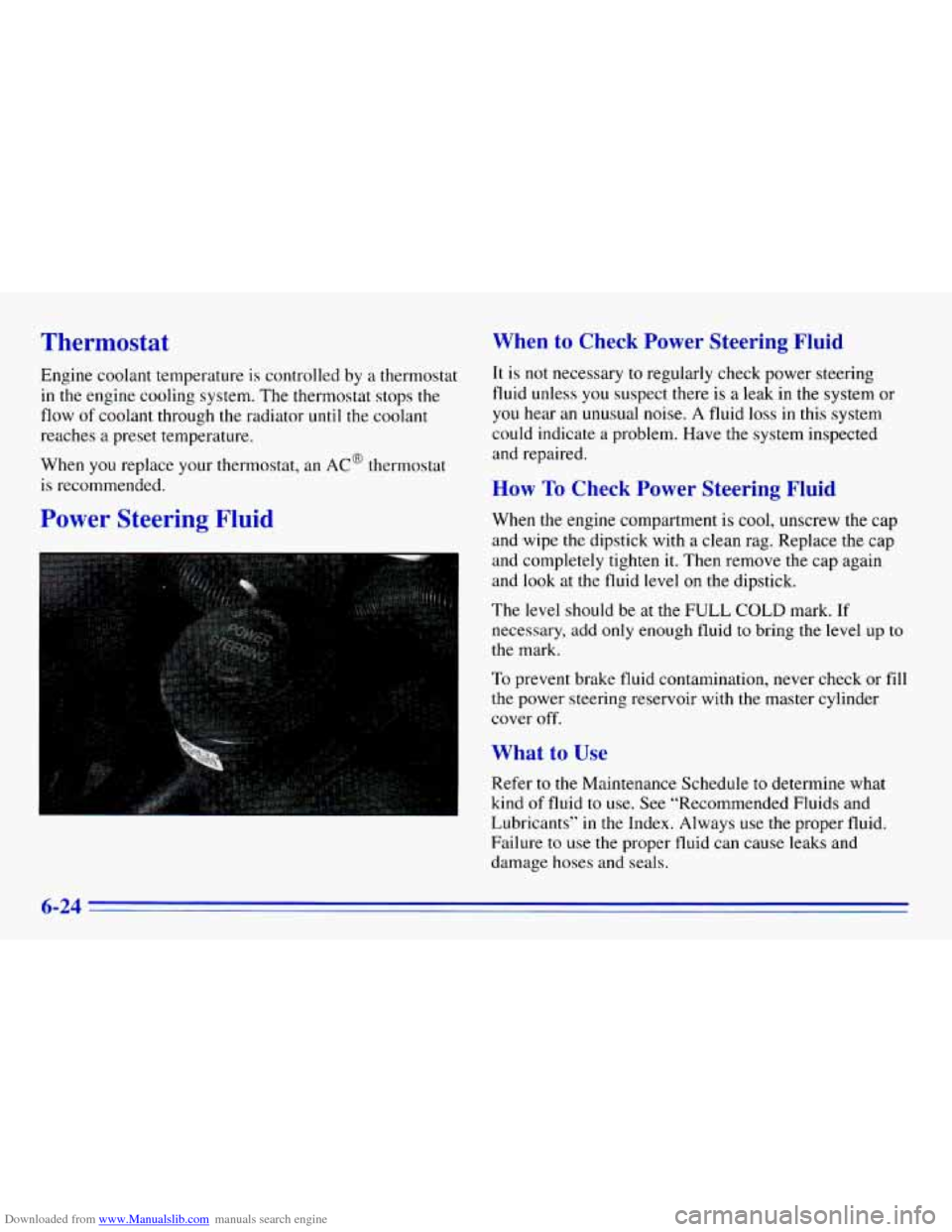
Power Steering Fluid
When to Check Power Steering Fluid
It is not necessary to regularly check power steering
fluid unless you suspect there is
a leak in the system or
you hear an unusual noise.
A fluid loss in this system
could indicate
a problem. Have the system inspected
and repaired.
How To Check Power Steering Fluid
When the engine compartment is cool, unscrew the cap
and ,wipe
the dipstick with a clean rag. Replace the cap
and completely tighten it. Then remove the cap again
and look at the fluid level
on the dipstick.
The level should be at the
FULL COLD mark. If
necessary, add only enough fluid to bring the
level up to
the mark.
To prevent brake fluid contamination, never check or fill
the power steering reservoir with the master cylinder
cover off.
What to Use
Refer to the Maintenance Schedule to determine what
kind of fluid
to use. See “Recommended Fluids and
Lubricants’’ in the Index. Always use the proper fluid.
Failure
to use the proper fluid can cause leaks and
damage hoses and seals.
6-24
Page 253 of 376
Downloaded from www.Manualslib.com manuals search engine Windshield Washer Fluid
What to Use
When you need windshield washer fluid, b, IP S‘ ure to re
:ad
the manufacturer’s instructions before use.
If you will be
operating your vehicle
in an area where the temperature
may fall below freezing, use a fluid that
has sufficient
protection against freezing.
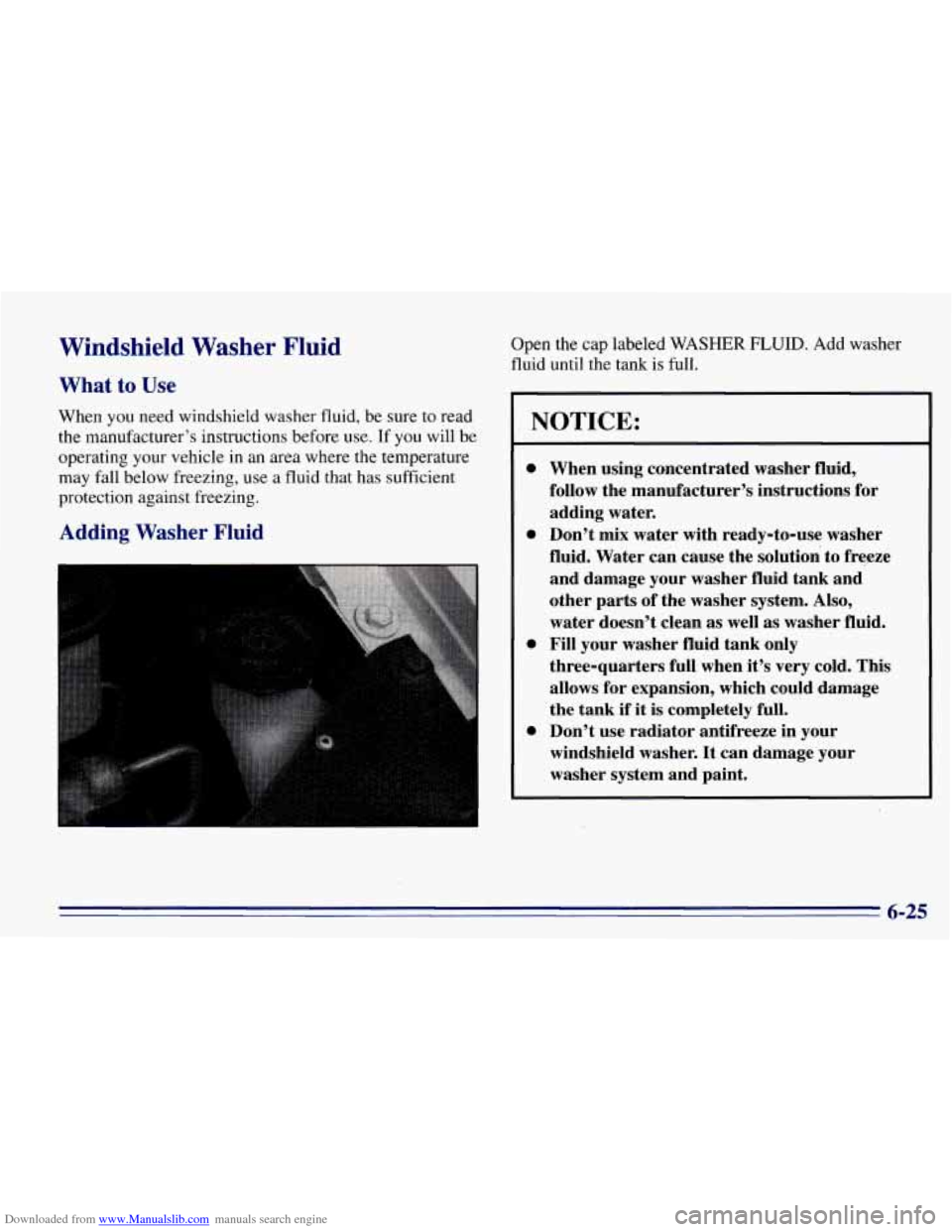
Adding Washer Fluid
I
Open the cap labeled WASHER FLUID. Add washer
fluid until the tank is full.
~
NOTICE:
0
0
0
0
When using concentrated washer fluid,
follow the manufacturer’s instructions for
adding water.
Don’t mix water with ready-to-use washer
fluid. Water can cause the solution to fre,eze
and damage your washer fluid tank and
other parts of the washer system. Also,
water doesn’t clean as well
as washer fluid.
Fill your washer fluid tank only
three-quarters full when it’s very cold. This
allows for expansion, which could damage
the tank
if it is completely full.
Don’t use radiator antifreeze in your
windshield washer.
It can damage your
washer system and paint.
Page 295 of 376
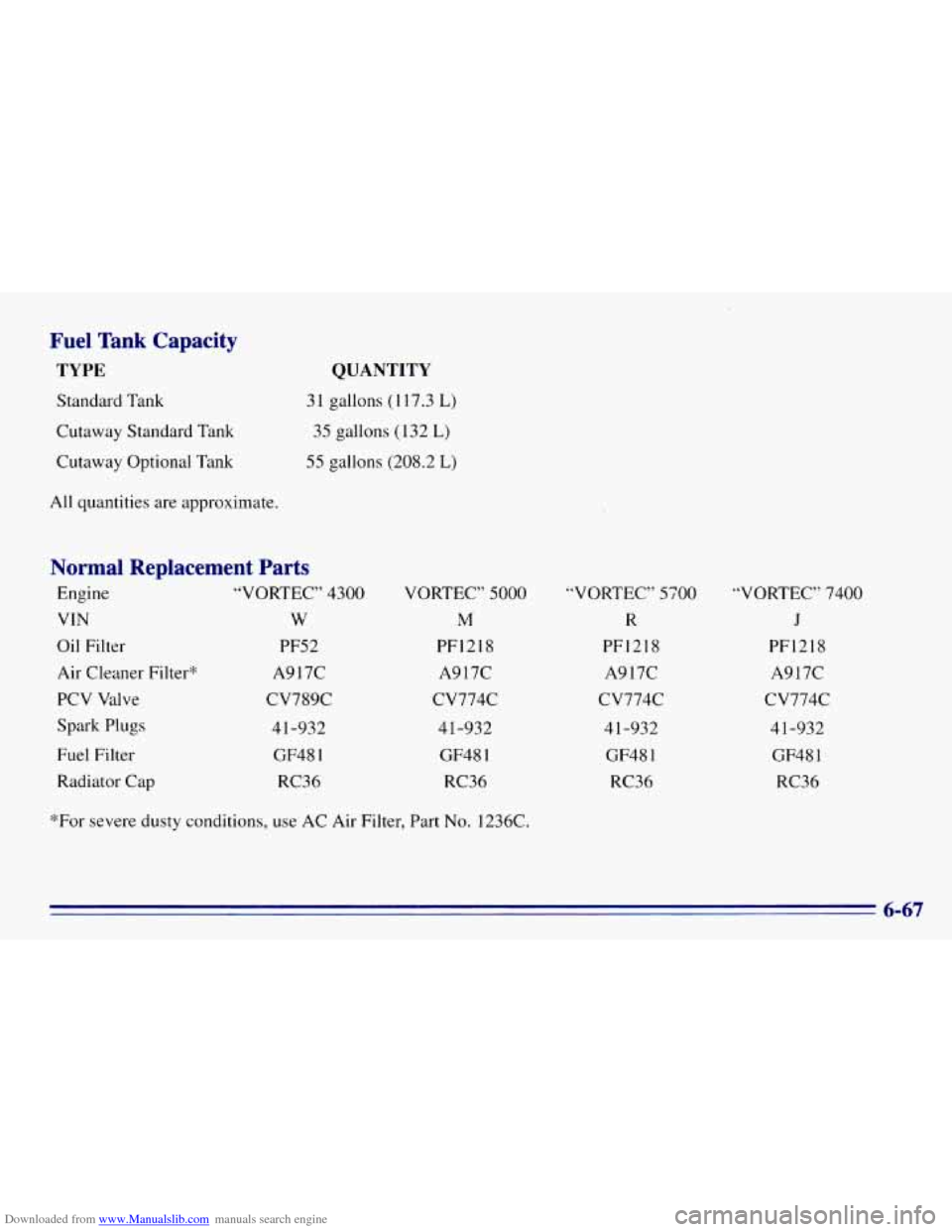
Downloaded from www.Manualslib.com manuals search engine Fuel Tank Capacity
TYPE
Standard Tank
Cutaway Standard Tank
Cutaway Optional Tank
All quantities are approximate.
QUANTITY
3 1 gallons (1 17.3 L)
35 gallons (132 L)
55 gallons (208.2 L)
Normal Replacement Parts
Engine “VORTEC” 4300
VIN w
Oil Filter PF52
Air Cleaner Filter* A9 17C
PCV Valve CV789C
Spark
Plugs 4 1-932
Fuel Filter GF48
1
Radiator Cap RC36 VORTEC”
5000
M
PF1218
A9 17C
cv774c
4 1-932
GF48
1
RC36
*For severe dusty conditions, use
AC Air Filter, Part No. 1236C. “VORTEC”
5700
R
PF1218
A9 17C
cv774c
4 1-932
GF48
1
RC36 “VORTEC” 7400
J
PF1218
A917C
cv774c
4 1-932
GF48
1
RC36
6-67
Page 329 of 376
Downloaded from www.Manualslib.com manuals search engine Short TripKity Maintenance Schedule -- Gasoline Engines
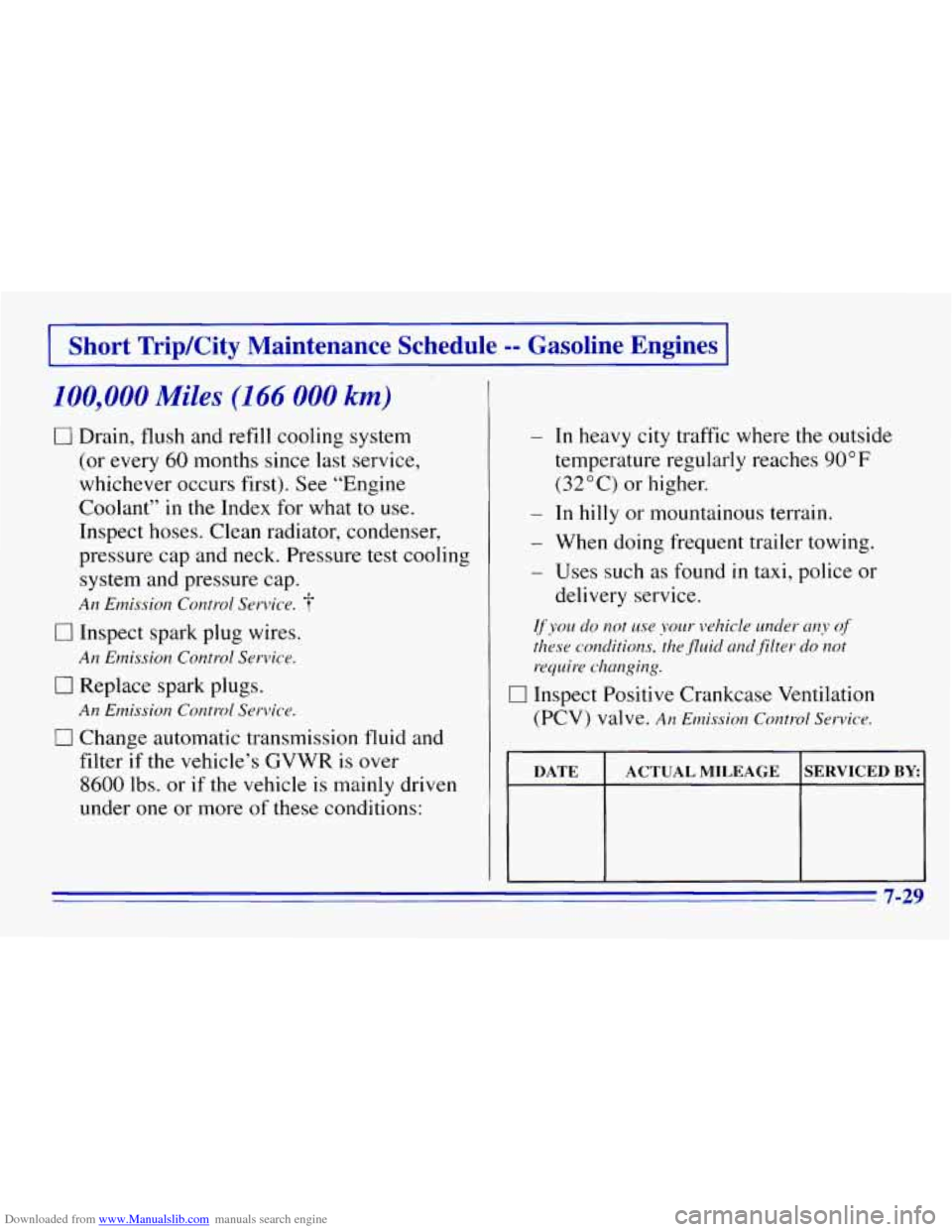
100,000 Miles (1 66 000 km)
0 Drain, flush and refill cooling system
(or every
60 months since last service,
whichever occurs first). See “Engine
Coolant’’
in the Index for what to use.
Inspect hoses. Clean radiator, condenser,
pressure cap and neck. Pressure test cooling
system and pressure cap.
0 Inspect spark plug wires.
0 Replace spark plugs.
0 Change automatic transmission fluid and
An Emission Control Service.
An Emission Control Service.
An Emission Control Service.
filter if the vehicle’s GVWR is over
8600 lbs. or if the vehicle is mainly driven
under one or more
of these conditions:
- In heavy city traffic where the outside
temperature regularly reaches
90°F
(32°C) or higher.
- In hilly or mountainous terrain.
- When doing frequent trailer towing.
- Uses such as found in taxi, police or
delivery service.
If’you do not use your vehicle under an? of
these conditions, the.fluid und
I7 Inspect Positive Crankcase Ventilation
(Pcv) valve. An Emission Control Service.
DATE SERVICED BY ACTUAL MILEAGE
7-29
Page 341 of 376
Downloaded from www.Manualslib.com manuals search engine I Long Tripmighway Maintenance Schedule I- Gasoline Engines
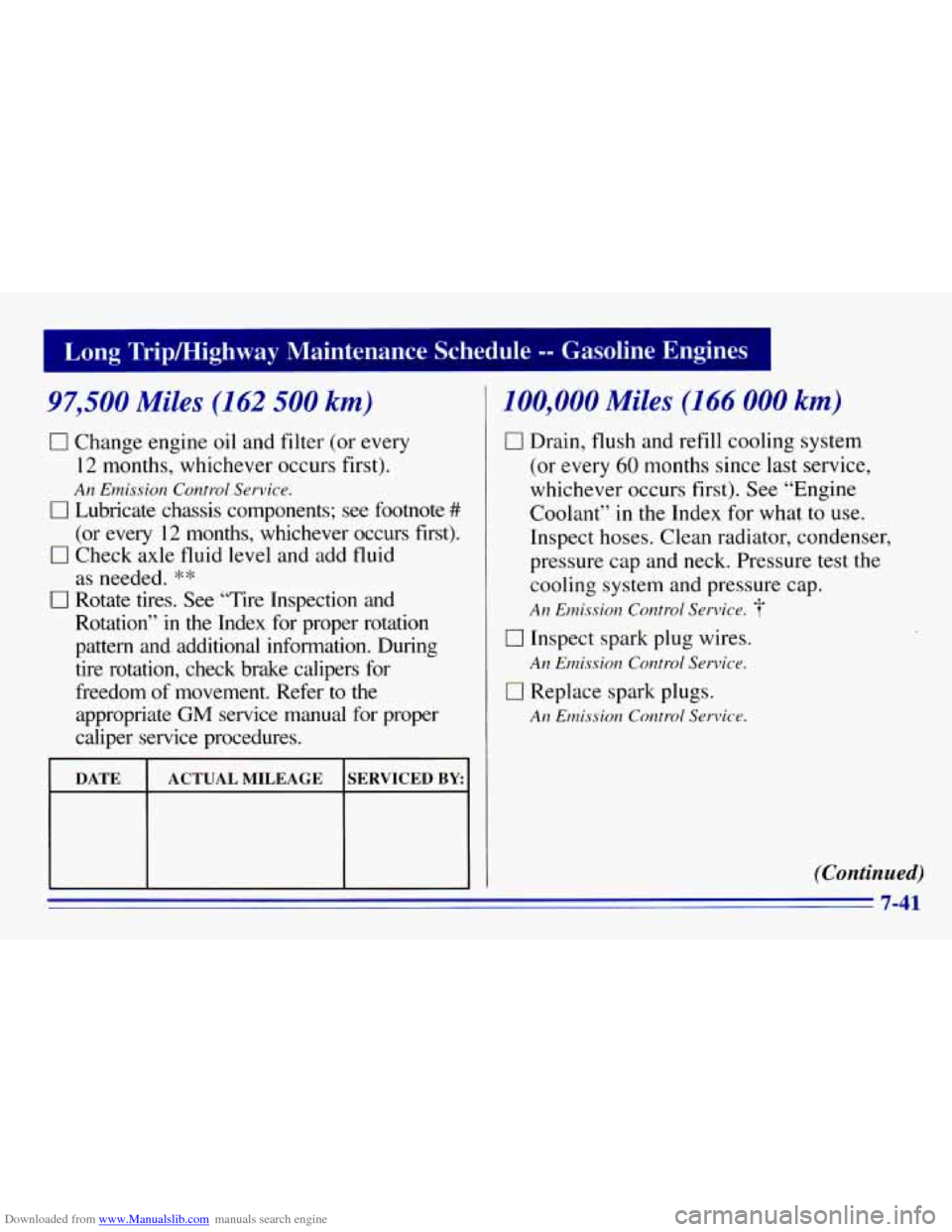
97,500 Miles (162 500 km)
0 Change engine oil and filter (or every
12 months, whichever occurs first).
An Ernissiorz Control Service.
0 Lubricate chassis components; see footnote ##
(or every 12 months, whichever occurs first).
0 Check axle fluid level and add fluid
as needed. *‘1:
0 Rotate tires. See “Tire Inspection and
Rotation”
in the Index for proper rotation
pattern and additional information. During
tire rotation, check brake calipers for
freedom of movement. Refer to the
appropriate
GM service manual for proper
caliper service procedures.
100,000 Miles (1 66 000 km)
0 Drain, flush and refill cooling system
(or every
60 months since last service,
whichever occurs first). See “Engine
Coolant’’
in the Index for what to use.
Inspect hoses. Clean radiator, condenser,
pressure cap and neck. Pressure test the
cooling system and pressure cap.
An Emission Control Service.
0 Inspect spark plug wires.
An Emission Control Service.
0 Replace spark plugs.
An Emission Control Service.
(Continued)
7-41
Page 347 of 376
Downloaded from www.Manualslib.com manuals search engine Part C: Periodic Maintenance
Inspections
Listed below are inspections and services which should
be performed at least twice a year (for instance, each
spring and fall). You should let your
GM dealer’s
service department or other qualified service center do
these jobs. Make sure any necessary repairs are
completed at once.
Proper procedures to perform these services may be
found
in a service manual. See “Service and Owner
Publications”
in the Index.
Steering and Suspension Inspection
Inspect the front and rear suspension and steering
system for damaged, loose or missing parts, signs
of
wear or lack of lubrication. Inspect the power steering
lines and hoses for proper hook-up, binding, leaks,
cracks, chafing, etc.
Exhaust System Inspection
Inspect the complete exhaust system. Inspect the body
near the exhaust system.
Look for broken, damaged,
missing or out-of-position parts
as well as open seams,
holes, loose connections or other conditions which could
cause a heat build-up
in the floor pan or could let
exhaust fumes
into the vehicle. See “Engine Exhaust”
in the Index.
Radiator and Heater Hose Inspection
Inspect the hoses and have them replaced if they are
cracked, swollen or deteriorated. Inspect all pipes,
fittings and clamps; replace as needed.
Throttle Linkage Inspection
Inspect the throttle linkage for interference or binding,
and for damage or missing parts. Replace parts as
needed. Replace
any cables that have high effort or
excessive wear. Do not lubricate accelerator and cruise
control cables.
7-47
Page 369 of 376
Downloaded from www.Manualslib.com manuals search engine Hearing Impaired. Customer Assistance .............. 8-3
Heating
........................................ 3-7
High-Beam Headlamps
.......................... 2-30
Highway Hypnosis
.............................. 4-21
Hill and Mountain Roads ......................... 4-21
Hitches. Trailer ................................. 4-32
Hood Checking Things Under
......................... 6-6
Prop ........................................ 6-7
Release
...................................... 6-6
Horn ......................................... 2-28
Hydroplaning
.................................. 4- I7
Ignition Switch ................................ 2- 13
Inflation. Tire
.................................. 6-42
Inside Daymight Rearview Mirror
................. 2-39
Inspections
.................................... 7-47
Brakesystem
................................ 7-48
Exhaust Systems
............................. 7-47
Radiator and Heater Hose
...................... 7-47
RearAxle
................................... 7-48
Steering
.................................... 7-47
Suspension
.................................. 7-47
Throttle Linkage
.............................. 7-47
Brightness Control
............................ 2-36
Cleaning
.................................... 6-51
Cluster
..................................... 2-44
FuseBlock
.................................. 6-62
Interior Lamps
................................. 2-38
Jack. Ere .................................... 5-22
Jump Starting ................................... 5-2
Key Lock Cylinders Service ..................... 7-44
Keyless Entry System
............................ 2-5
Keys
........................................... 2-1
Labels Certification
................................. 4-26
Certificationflire
............................. 4-26
Service Parts Identification
..................... 6-60
Tire-Loading Information
...................... 4-26
Vehicle Identification Number
................... 6-60
Lamps
........................................ 2-35
Dome
...................................... 2-37
Interior
..................................... 2-37
OnReminder
................................ 2-36
Onwarning
................................. 2-36
Panel
....................................... 2-35
Underhood
.................................. 2-38
Leaving Your Vehicle with the Engine Running
....... 2-23
Lighter
....................................... 2-42
Lights
............................................
Air Bag Readiness ....................... 1-23. 2-47
Anti-Lock Brake System Warning
............ 2.49. 4.6
Brake System Warning
......................... 2-48
Daytime Running Lamps Indicator
............... 2-49
Interior
..................................... 2-37
Safety Belt Reminder
...................... 1-23. 2-46
Service Engine
Soon .......................... 2-50
Loading Your Vehicle
........................... 4-26
9-5
Page 371 of 376
Downloaded from www.Manualslib.com manuals search engine Parking AtNight
.................................... 2-12
Brake
...................................... 2-20
Brake Mechanism Check
....................... 7-46
Lots
....................................... 2-12
Over Things That Burn
........................ 2-24
With a Trailer
................................ 4-36
Passenger Position
.............................. 1-29
Passenger Temperature Control
..................... 3-5
Passing
....................................... 4-11
Power Periodic Maintenance Inspections
.................. 7-47
Antenna Mast Care
............................ 3-29
DoorLocks
................................... 2-3
Option Fuses
................................ 6-61
Remote Control Mirror
........................ 2-39
Seat
......................................... 1-2
Steering
..................................... 4-8
Steering Fluid
................................ 6-24
Windows
................................... 2-26
Power Seat
Pregnancy. Use of Safety Belts
.................... 1-29
Problems on the Road
............................ 5-1
Publications. Service and Owner
.................... 8-9
Radiator ..................................... 5- 16
Radiator Pressure Cap
........................... 6-23
Radio Reception
................................ 3-26
Radios
......................... 3-9.3-11.3-13. 3-19
Rain. Driving In
................................ 4- 15
Reading Lamps
................................ 2-38
Rear
Axle
....................................... 6-19
Door Security Locks
........................... 2-4
Outside Seat Position
.......................... 1-30
Seat Passengers
.............................. 1-29
Storage
..................................... 2-41
Towing
...................................... 5-9
Window Defogger
............................. 3-8
Rearview Mirror
................................ 2-39
Reclining Front Seatbacks
......................... 1-3
Recovery Tank. Coolant
.......................... 5-13
Refrigerants. Air Conditioning
.................... 6-68
Remote Compact Disc Player
..................... 3-17
Removing the Rear Seat
........................... 1-6
Replacement Bulbs
...................................... 6-69
Parts
....................................... 6-65
Wheel
...................................... 6-48
Replacing Safety Belts
........................... 1-48
Replacing the Rear Seat
........................... 1-7
Reporting Safety Defects
.......................... 8-8
Restraints
Checking
................................... 1-48
Child
....................................... 1-37
Head
........................................ 1-5
Replacing Parts After a Crash
................... 1-48
System Check
................................ 7-44
Reverse. Automatic Transmission
.................. 2-18
Right Front Passenger Position
.................... 1-29
Roadside Assistance
.............................. 8-4
Roadside Assistance. Canadian
..................... 8-6
Rocking Your Vehicle
........................... 5-36
Rotation. Tires
................................. 6-43
9-7