tow CHEVROLET EXPRESS 1996 1.G User Guide
[x] Cancel search | Manufacturer: CHEVROLET, Model Year: 1996, Model line: EXPRESS, Model: CHEVROLET EXPRESS 1996 1.GPages: 376, PDF Size: 18.83 MB
Page 77 of 376
Downloaded from www.Manualslib.com manuals search engine 1. Without pushing the accelerator pedal, turn your
ignition key to
START. When the engine starts, let
go of the key, The idle speed will go down as your
engine gets warm.
NOTICE:
Holding your key in START for longer than
15 seconds at a time will cause your battery to be
drained much sooner. And the excessive heat can
damage your starter motor.
2. If it doesn’t start right away, hold your key in
START. If it doesn’t start in 10 seconds, push the
accelerator pedal all the way down for five more
seconds,
or until it starts.
3. If your engine still won’t start (or starts but then
stops), wait
15 seconds and start over.
When the engine starts, let
go of the key and the
accelerator pedal.
NOTICE:
Your engine is designed to work with the
electronics in your vehicle. If you add electrical
parts or accessories, you could change the
way
the engine operates. Before adding electrical
equipment, check with your dealer.
If you don’t,
your engine might not perform properly.
If you ever have to have your vehicle towed, see
the part of this manual that tells how to do it
without damaging your vehicle. See “Towing
Your Vehicle” in the Index.
2-15
Page 79 of 376
Downloaded from www.Manualslib.com manuals search engine Automatic Transmission Operation
There are several different positions for your shift lever.
If your vehicle is equipped with an automatic
transmission,
it now features an electronic shift position
indicator within the instrument cluster. This display
must be powered anytime the shift lever is capable
of
being moved out of the PARK (P) position. This means
that if your
key is in the OFF position, but not locked,
there will be a small current drain on your battery which
could discharge
your battery over a period of time. If
you have
a need to leave your key in the ignition in the
OFF position for an extended period for any reason, it is
recommended that
you disconnect the battery cable from
the battery to prevent discharging your battery.
PARK (P): This locks your rear wheels. It’s the best
position to use when
you start your engine because your
vehicle can’t move easily.
A CAUTIO :
It is dangerous to get out of your vehicle if the
shift lever
is not fully in PARK (P) with the
parking brake firmly set. Your vehicle can roll.
Don’t leave your vehicle when the engine
is
running unless you have to. If you have left the
engine running, the vehicle can move suddenly.
You or others could be injured. To be sure your
vehicle won’t move, even when you’re on fairly
level ground, always set your parking brake and
move the shift lever to
PARK (P).
See “Shifting Into PARK (P)” in the Index. If
you’re pulling
a trailer, see “Towing a Trailer’’
in the Index.
Your vehicle has a brake-transmission shift interlock.
With the ignition
in the RUN position, you must fully
apply your regular brakes before you can shift from
PARK (P).
2-17
Page 80 of 376
Downloaded from www.Manualslib.com manuals search engine I
If you cannot shift out of PARK (P), ease pressure on
the shift lever and push the shift lever all the way into
’ PARK (P) as you continue pressing the brake pedal.
Then move the shift lever into the gear you want. If you
still cannot shift the shift lever out of PARK (P), see
“Shifting Out of PARK
(P)” later in this section.
REVERSE (R): Use this gear to back up.
NOTICE:
Shifting into REVERSE (R) while your vehicle is
moving forward could damage your transmission.
Shift to REVERSE (R) only after your vehicle
is stopped.
To rock your vehicle back and forth to get out of snow,
ice or sand without damaging your transmission, see
“Stuck: In Sand, Mud, Ice or Snow” in the Index.
NEUTRAL (N): In this position, your engine doesn’t
connect with the wheels.
To restart when you’re
already moving, use NEUTRAL,
(N) only. Also, use
NEUTRAL (N) when your vehicle is being towed.
U
Shifting out of PARK (P) or NEUTRAL (N)
while your engine is “racing” (running at high
speed) is dangerous. Unless your
foot is firmly
on the brake pedal, your vehicle could move
very rapidly. You could lose control and hit
people or objects. Don’t shift out of PARK
(P)
or NEUTRAL (N) while your engine is racing.
NOTICE:
Damage to your transmission caused by shifting
out
of PARK (P) or NEUTRAL (N) with the
engine racing isn’t covered by your warranty.
2-18
Page 81 of 376
Downloaded from www.Manualslib.com manuals search engine DRIVE (D): This position is for normal driving. If you
need more power for passing, and you’re:
Going less than about 35 mph (56 km/h), push your
accelerator pedal about halfway down.
Going about 35 mph (56 kdh) or more, push the
accelerator all the way down.
You’ll
shift down to the next gear and have more power.
You should use DRIVE (D) (or, as
you need to, a lower
gear) when towing a trailer. Operating your vehicle
in
DRIVE (D) when towing a trailer will minimize heat
build-up and extend
the life of your transmission.
THIRD (3): This position is also used for normal
driving, however,
it offers more power and lower fuel
economy than DRIVE
(D). You should use THIRD (3)
when carrying a heavy load or driving on steep hills.
SECOND (2): This position gives you more power
but lower fuel economy.
You can use SECOND (2)
on hills. It can help control your speed as you go
down steep mountain roads, but then you would also
want to use your brakes off and on. If you manually
select SECOND
(2), the transmission will drive in
second gear. You may use this feature for reducing
torque
to the rear wheels when you are trying to start
your vehicle from a stop
on slippery road surfaces.
FIRST (1): This position gives you even more power
(but lower fuel economy) than SECOND
(2). You can
use it
on very steep hills, or in deep snow or mud. If
the selector lever is put in FIRST (l), the transmission
won’t shift into first gear until the vehicle is going
slowly enough.
NOTICE: -- --
If your rear wheels can’t rotate, don’t try to
drive. This might happen if you are stuck in
very deep sand or mud or are up against a solid
object. You could damage your transmission.
Also, if you stop when going uphill, don’t hold
your vehicle there with only the accelerator
pedal. This could overheat and damage the
transmission. Use your brakes
or shift into
PARK (P) to hold your vehicle in position on
a hill.
2-19
Page 83 of 376
Downloaded from www.Manualslib.com manuals search engine NOTICE:
Driving with the parking brake on can cause
your rear brakes to overheat. You may have to
replace them, and you could also damage other
parts of your vehicle. Always check to be sure
your parking brake is fully released before
you drive.
If you are towing a trailer and are parking on any hill,
see “Towing a Trailer” in the Index. That section shows
what to do first to keep the trailer from moving.
Shifting I: :o 11 C (P)
I A CAUTIJN:
I
It can be dangerous to get out of your vehicle if
the shift lever is not fully in
PARK (P) with the
parking brake firmly set. Your vehicle can roll.
If you have left the engine running, the vehicle
can move suddenly. You or others could be
injured. To be sure your vehicle won’t move,
even when you’re on fairly level ground, use the
steps that follow.
If you’re pulling a trailer, see
“Towing
a Trailer” in the Index.
1. Hold the brake pedal down with your right foot and
set the parking brake.
Page 84 of 376
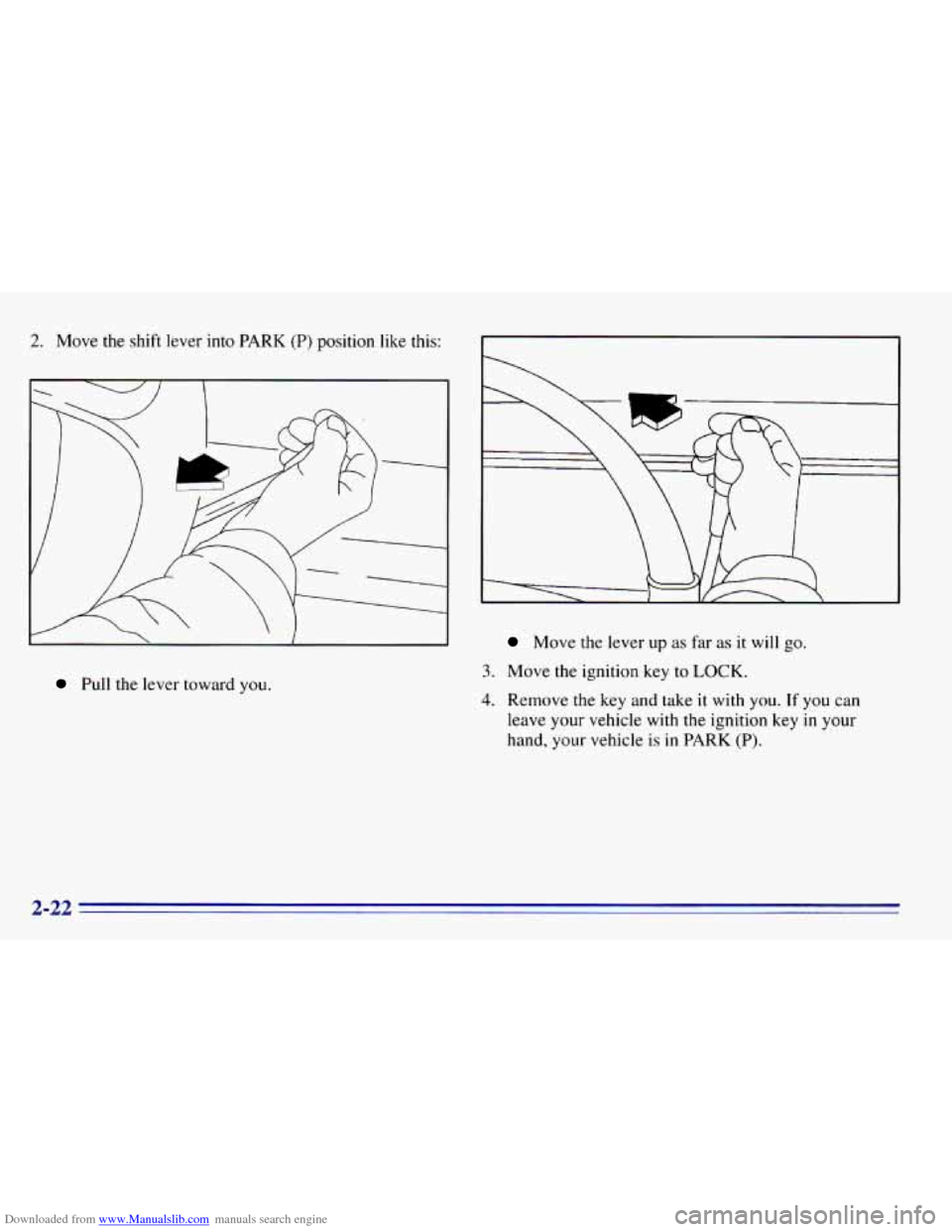
Downloaded from www.Manualslib.com manuals search engine 2. Move the shift lever into PARK (P) position like this:
Pull the lever toward you.
Move the lever up as far as it will go.
3. Move the ignition key to LOCK.
4. Remove the key and take it with you. If you can
leave your vehicle with the ignition key
in your
hand, your vehicle is in PARK (P).
2-22
Page 89 of 376
Downloaded from www.Manualslib.com manuals search engine Swing-Out Windows
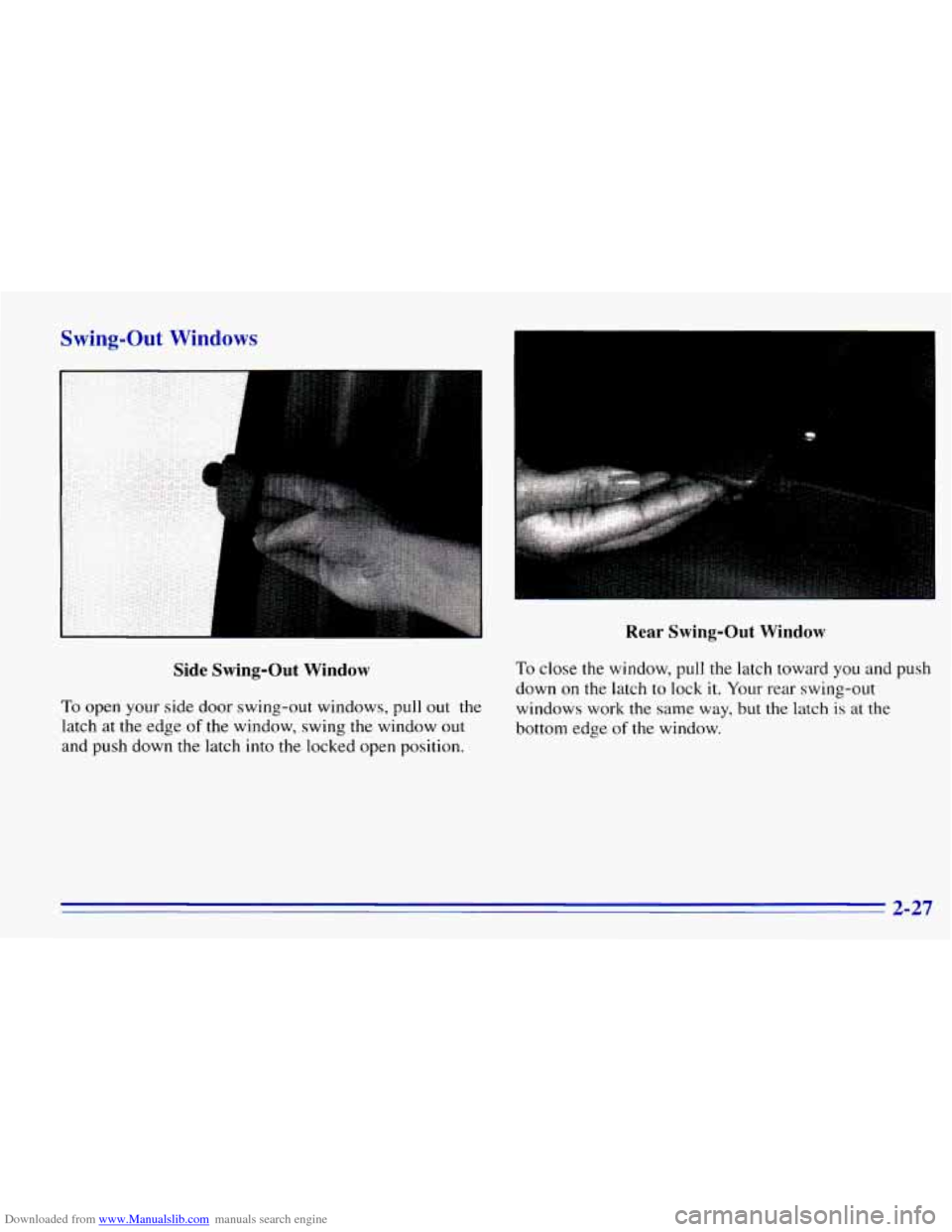
Side Swing-Out Window
To open your side door swing-out windows, pull out the
latch
at the edge of the window, swing the window out
and push down
the latch into the locked open position.
Rear Swing-Out Window
To close the window, pull the latch toward you and push
down
on the latch to lock it. Your rear swing-out
windows work the same way,
but the latch is at the
bottom edge of the window.
2-27
Page 92 of 376
Downloaded from www.Manualslib.com manuals search engine ’hrn Signal and Lane Change Signals
The turn signal has two upward (for right) and two
downward (for left) positions. These positions allow
you
to signal a turn or a lane change.
To signal
a turn, move the lever all the way up or down.
When the turn is finished, the lever will return
automatically.
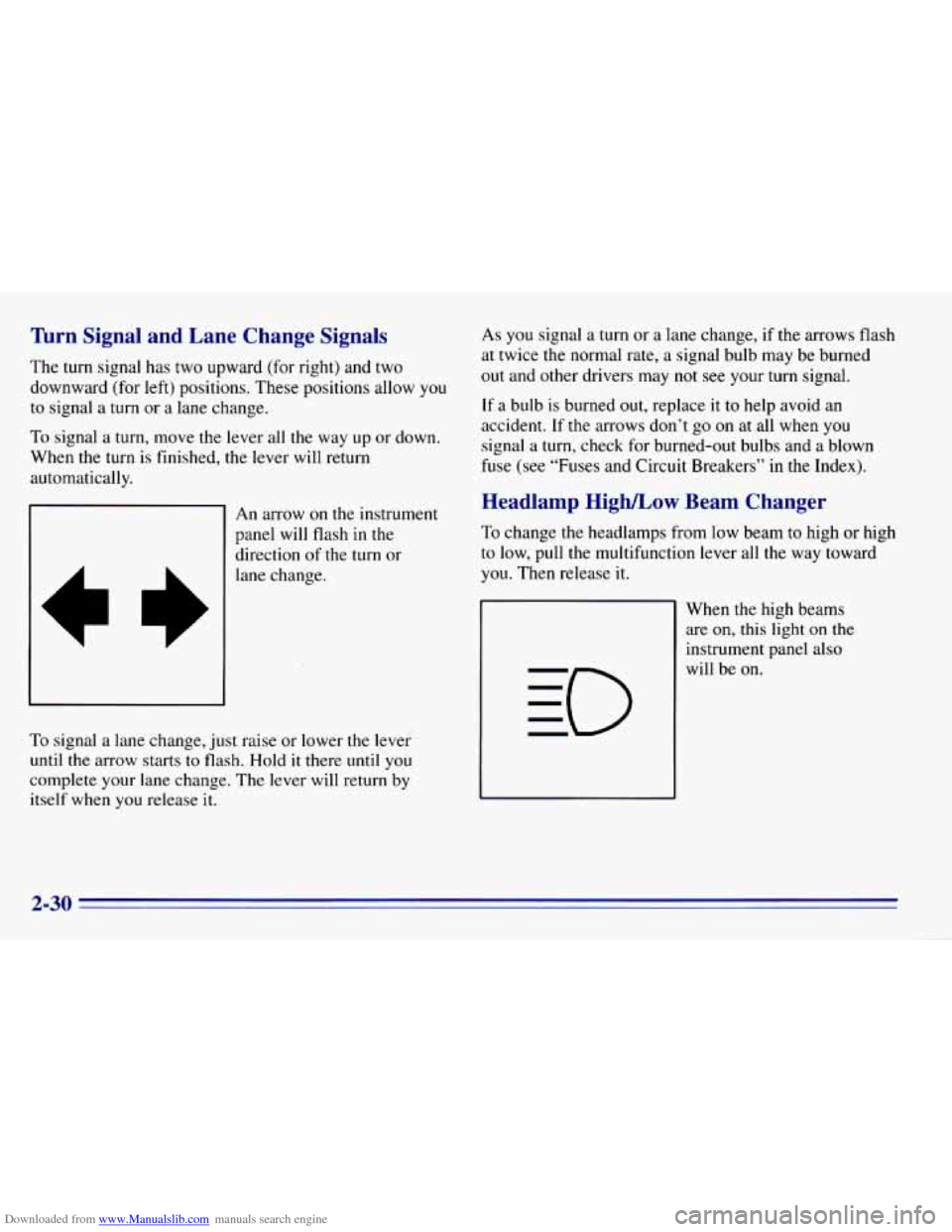
An arrow on the instrument
panel will flash in the
direction of the turn or
lane change.
To signal a lane change, just raise or lower the lever
until
the arrow starts to flash. Hold it there until you
complete your lane change. The lever will return by
itself when
you release it. As
you signal
a turn or a lane change, if the arrows flash
at twice the normal rate, a signal bulb may be burned
out and other drivers may not see your turn signal.
If a bulb is burned out, replace it to help avoid an
accident. If.the arrows don’t go on at all when
you
signal a turn, check for burned-out bulbs and a blown
fuse (see “Fuses and Circuit Breakers” in the Index).
Headlamp High/Low Beam Changer
To change the headlamps from low beam to high or high
to low, pull the multifunction lever all the way toward
you. Then release it.
When the high beams are
on, this light on the
instrument panel also
will be on.
2-30
.-
Page 110 of 376
Downloaded from www.Manualslib.com manuals search engine Brake System Warning Light
Your vehicle’s hydraulic brake system is divided into
two parts.
If one part isn’t working, the other part can
still work and stop
you. For good braking, though, you
need both parts working well.
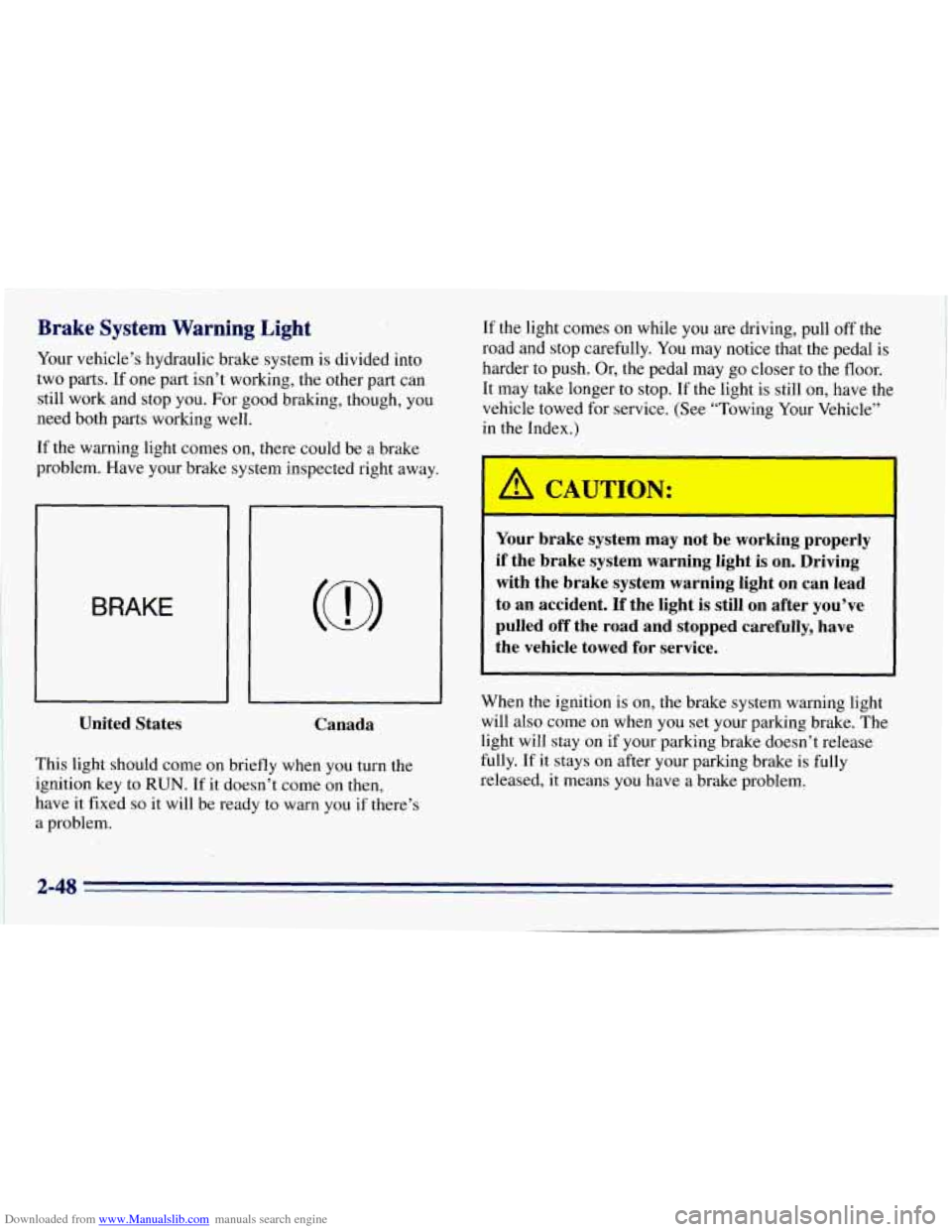
If the warning light comes on, there could be a brake
problem. Have your brake system inspected right away.
BRAKE
United States
Canada
This light should come on briefly when you turn the
ignition key
to RUN. If it doesn’t come on then,
have it fixed
so it will be ready to warn you if there’s
a problem. If
the light comes on while you are driving, pull off the
road and stop carefully. You may notice that the pedal
is
harder to push. Or, the pedal may go closer to the floor.
It may take longer
to stop. If the light is still on, have the
vehicle towed for service. (See “Towing Your Vehicle”
in the Index.)
Your brake system may not be working properly
if the brake system warning light is on. Driving
with the brake system warning light on can lead
to an accident. If the light is still on after you’ve
pulled off the road and stopped carefully, have
the vehicle towed for service.
When the ignition is on, the brake system warning light
will also coke on when you set your parking brake. The
light will stay on if your parking brake doesn’t release
fully. If it stays on after your parking brake is fully
released,
it means you have a brake problem.
2-48
Page 113 of 376
Downloaded from www.Manualslib.com manuals search engine If the Light Is Flashing Are you low on fuel?
The following may prevent more serious damage
to
your vehicle:
0 Reduce vehicle speed.
0 Avoid hard accelerations.
0 Avoid steep uphill grades.
If towing a trailer, reduce the amount of cargo being
hauled as soon as
it is possible.
If the light stops flashing and remains on steady, see
--IT
the Light Is On Steady” following.
If the light continues to flash, when
it is safe to do so,
stop the vehicle. Put your vehicle in PARK (P). Turn the
key off, wait at least
10 seconds and restart the engine.
If the light remains on steady, see “If the Light
Is On
Steady” following. If the light is still flashing follow the
previous steps, and drive the vehicle to your dealer or
qualified service center for service.
If the Light Is On Steady
You may be able to correct the emission system
malfunction by considering
the following:
Did
you just drive through a deep puddle of water?
If
so, your electrical system may be wet. The condition
will usually be corrected when
the electrical system
dries
out. A few driving trips should turn the light off. As
your engine starts
to run out of fuel, your engine may
not run
as efficiently as designed since small amounts of
air are sucked
into the fuel line causing a misfire. The
system can detect this. Adding fuel should correct this
condition. Make sure to install the fuel cap properly.
It
will take a few driving trips to turn the light off.
Have you recently changed brands
of fuel?
If
so, be sure to fuel your vehicle with quality fuel (see
“Fuel”
in the Index). Poor fuel quality will cause your
engine not to run as efficiently as designed. You may
notice
this as stalling after start-up, stalling when you put
the vehicle into gear, misfiring, hesitation on acceleration
or stumbling
on acceleration. (These conditions may go
away once the engine is warmed up.) This will be
detected by the system and cause the light
to turn on.
If you experience this condition, change the fuel brand
you use. It will require at least one full tank of the
proper fuel to turn the light off.
If none of the above steps have made the light turn off,
have your dealer or qualified service center check the
vehicle. Your dealer has the proper test equipment and
diagnostic tools to
fix any mechanical or electrical
problems that may have developed.
2-51