transmission CHEVROLET EXPRESS 1996 1.G User Guide
[x] Cancel search | Manufacturer: CHEVROLET, Model Year: 1996, Model line: EXPRESS, Model: CHEVROLET EXPRESS 1996 1.GPages: 376, PDF Size: 18.83 MB
Page 195 of 376
Downloaded from www.Manualslib.com manuals search engine If your vehicle has more than one battery, use the
battery that is under the hood
of the vehicle -- this
will reduce the electrical resistance.
2. Get the vehicles close enough so the jumper cables
can reach, but be sure the vehicles aren’t touching
each other.
If they are, it could cause a ground
connection you don’t want. You wouldn’t be able to
start your vehicle, and the bad grounding could
damage the electrical systems.
Set the parking brake firmly
on each vehicle. Put an
automatic transmission in
PARK (P) or a manual
transmission
in NEUTRAL (N).
3. Turn off the ignition on both vehicles. Turn off all
lamps that aren’t needed, and radios. This will avoid
sparks and help save both batteries, and could save
your radio!
NOTICE:
If you leave your radio on, it could be badly
damaged. The repairs would not be covered by
your warranty.
4. Open the hoods and locate the batteries. Find
the positive
(+) and negative (-) terminals on
each battery.
A CAUTION:
Using a match near a battery can cause battery
gas to explode. People have been hurt doing this,
and some have been blinded. Use a flashlight if
you need more light.
Be sure the battery (or batteries) has enough
water. You don’t need to add water to the Delco
Freedom@ battery (or batteries) installed in
every new
GM vehicle. But if a battery has filler
caps, be sure the right amount of fluid is there.
If
it is low, add water to take care of that first. If
you don’t, explosive gas could be present.
Battery fluid contains acid that can burn you.
Don’t get it on you.
If you accidentally get it in
your eyes or on your skin, flush the place with
water and get medical help immediately.
Page 198 of 376
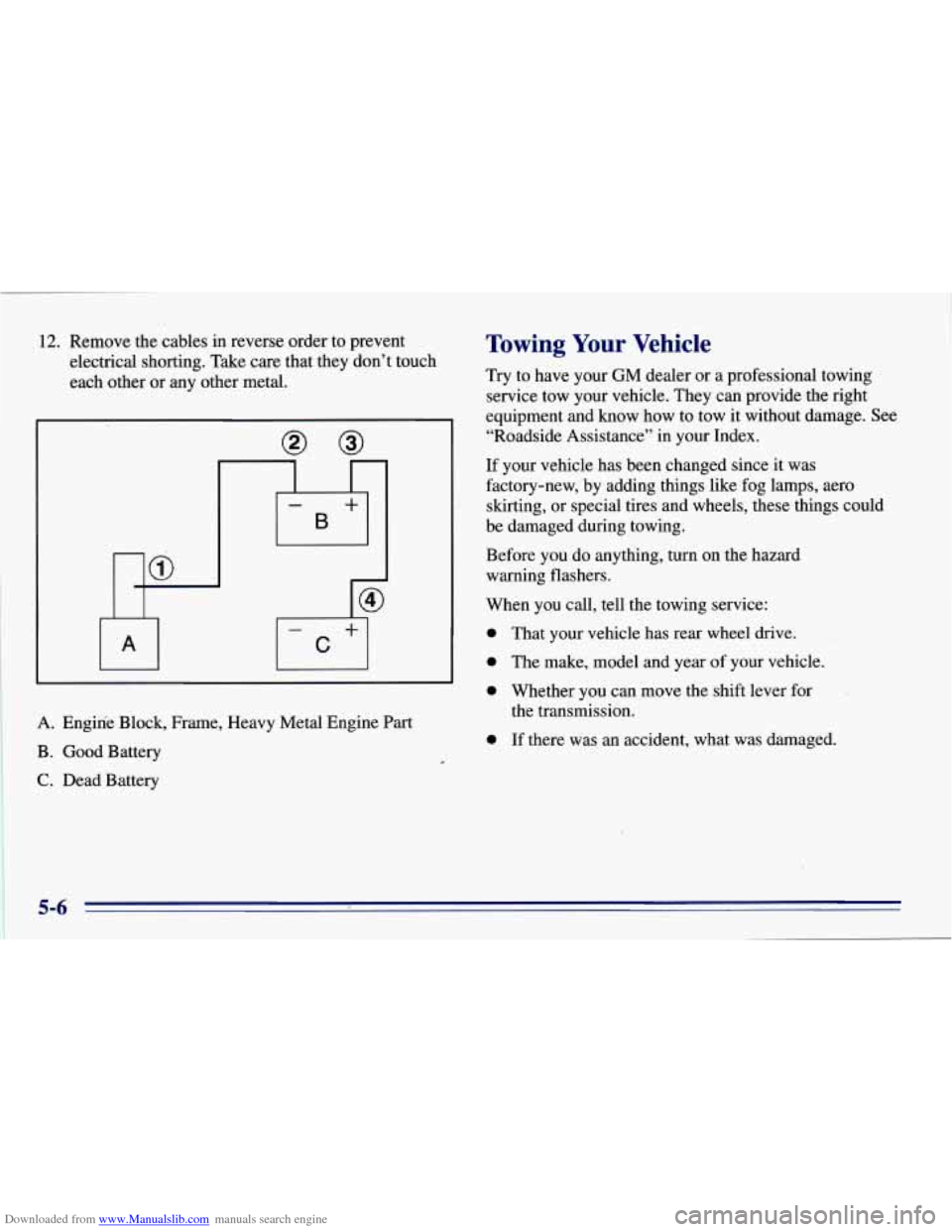
Downloaded from www.Manualslib.com manuals search engine 12. Remove the cables in reverse order to prevent
electrical shorting. Take care that they don’t touch
each other or any other metal.
I
- +
B
A. Engine Block, Frame, Heavy Metal Engine Part
B
. Good Battery
C. Dead Battery
Towing Your Vehicle
Try to have your GM dealer or a professional towing
service tow your vehicle. They can provide the right
equipment and know how to tow it without damage. See
“Roadside Assistance” in your Index.
If your vehicle has been changed since it was
factory-new, by adding things like fog lamps, aero skirting, or special tires and wheels, these things could
be damaged during towing.
Before you do anything, turn
on the hazard
warning flashers.
When you call, tell the towing service:
0 That your vehicle has rear wheel drive.
0 , The make, model and year of your vehicle.
0 Whether you can move the shift lever for
0 If there was an accident, what was damaged.
the transmission.
Page 199 of 376
Downloaded from www.Manualslib.com manuals search engine I A CAUTION:
I I To help avoid injury to you or others:
0 Never let passengers ride in a vehicle that is
Never tow faster than safe or posted speeds.
0 Never tow with damaged parts not
0 Never get under your vehicle after it has
Always use separate safety chains on each
being
towed.
fully secured.
been lifted by the tow truck.
side when towing
a vehicle.
When your vehicle is being towed, have the ignition
key
off. The steering wheel should be clamped in a
straight-ahead position, with
a clamping device
designed for towing service.
Do not use the vehicle’s
steering column lock for this. The transmission should
be in NEUTRAL
(N) and the parking brake should
be released.
A CAUTION:
I
A vehicle can fall from a car carrier if it isn’t
adequately secured. This can cause
a collision,
serious personal injury and vehicle damage. The
vehicle should be tightly secured with chains or
steel cables before
it is transported.
Don’t use substitutes (ropes, leather straps,
canvas webbing, etc.) that can be cut by sharp
edges underneath the towed vehicle.
5-7
Page 211 of 376
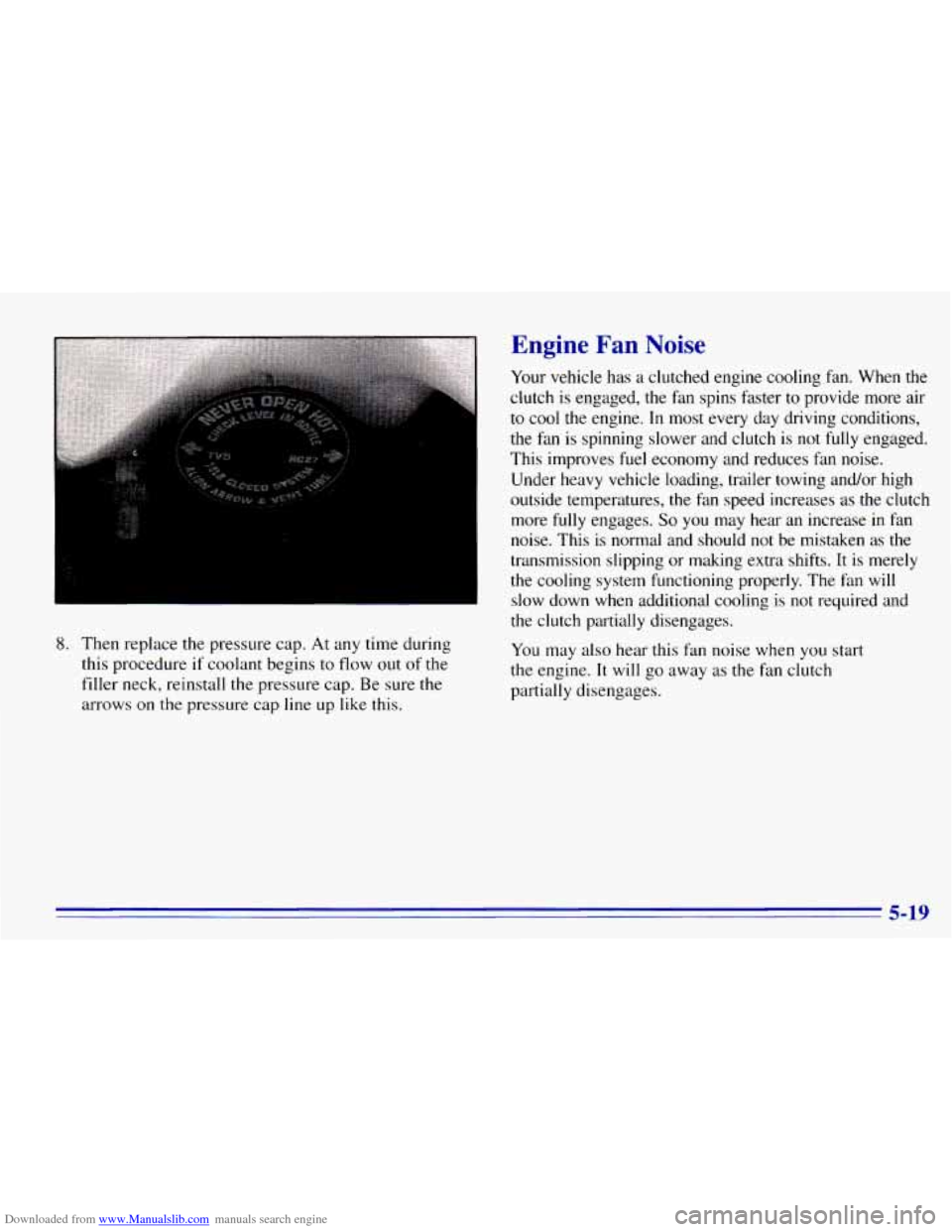
Downloaded from www.Manualslib.com manuals search engine 8. Then replace the pressure cap. At any time during
this procedure
if coolant begins to flow out of the
filler neck, reinstall the pressure cap. Be sure the
arrows
on the pressure cap line up like this.
Engine Fan Noise
Your vehicle has a clutched engine cooling fan. When the
clutch is engaged,
the fan spins faster to provide more air
to cool the engine. In most every day driving conditions,
the fan
is spinning slower and clutch is not fully engaged.
This improves fuel economy and reduces fan noise.
Under heavy vehicle loading, trailer towing and/or high
outside temperatures, the fan speed increases
as the clutch
more
fully engages. So you may hear an increase in fan
noise. This
is normal and should not be mistaken as the
transmission slipping
or making extra shifts. It is merely
the cooling system functioning properly. The fan will
slow down when additional cooling is not required and
the clutch partially disengages.
You may also hear this Fan noise when you start
the engine. It will go away as the fan clutch
partially disengages.
5-19
Page 227 of 376
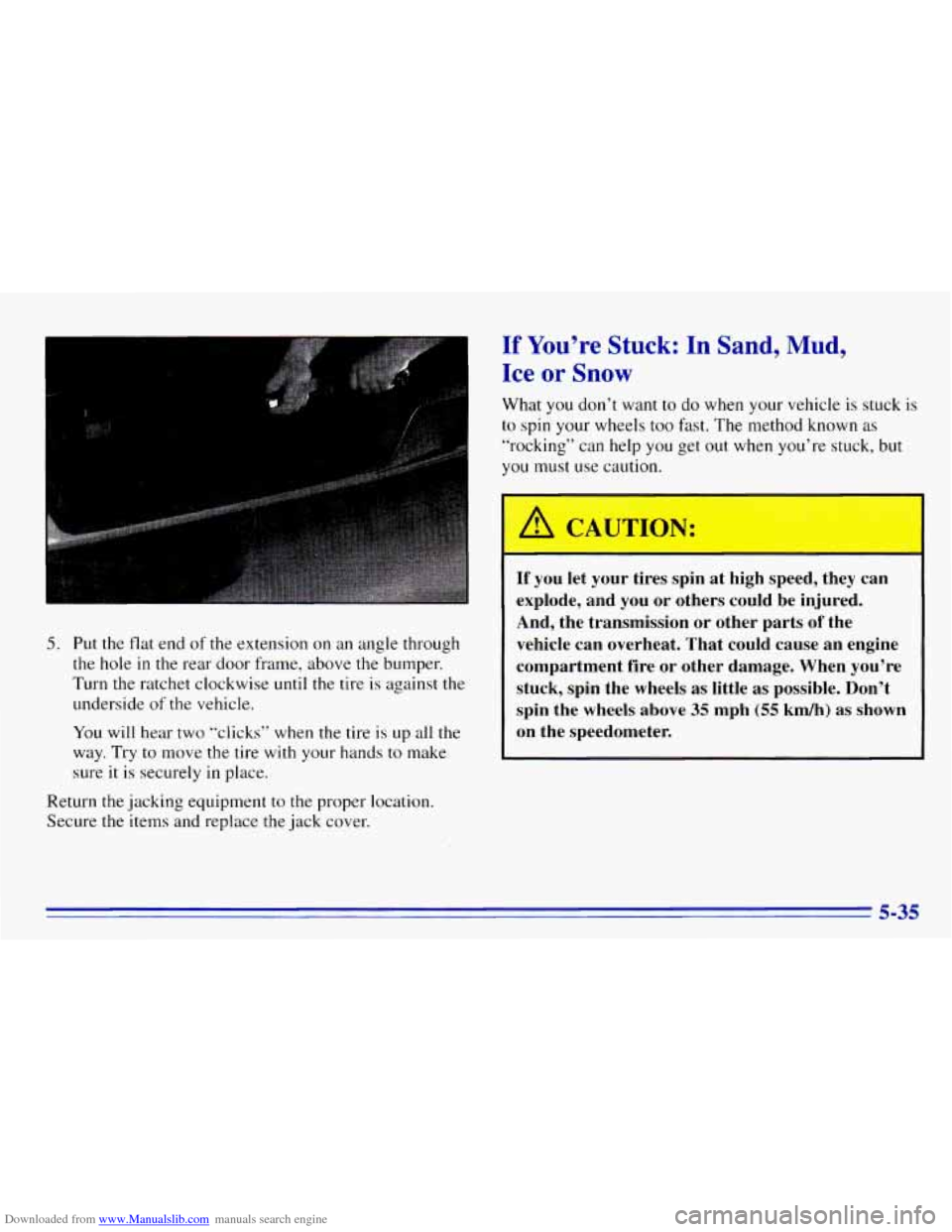
Downloaded from www.Manualslib.com manuals search engine 5. Put the flat end of the extension on an angle through
the
hole in the rear door frame, above the bumper.
Turn the ratchet clockwise until the tire is against the
underside
of the vehicle.
You will hear two “clicks”
when the tire is up all the
way. Try
to move the tire with your hands to make
sure
it is securely in place.
Return the jacking equipment to the proper location.
Secure the items and replace the jack cover.
If You’re Stuck: In Sand, Mud,
Ice or Snow
What you don’t want to do when your vehicle is stuck is
to spin your wheels too fast. The method known as
“rocking’’ can help you get out when you’re stuck, but
you must use caution.
If you let your tires spin at high speed, they can
explode, and you or others could be injured.
And, the transmission or other parts
of the
vehicle can overheat. That
could cause an engine
compartment fire or other damage. When you’re
stuck, spin the wheels
as little as possible. Don’t
spin the wheels above
35 mph (55 km/h) as shown
on the speedometer.
L 2t
Page 228 of 376
Downloaded from www.Manualslib.com manuals search engine I NOTICE:
Spinning your wheels can destroy parts of your vehicle as well as the tires. If you spin the wheels
too fast while shifting your transmission back
and forth, you can destroy your transmission.
~ ~ ~~
For information about using tire chains on your vehicle,
see “Tire Chains” in the Index.
Rocking your vehicle to get it out:
First, turn your steering wheel left and right. That will
clear the area around your front wheels. Then shift back
and forth between REVERSE (R) and
a forward gear,
spinning the wheels as little as possible. Release
the
accelerator pedal while you shift, and press lightly on
the accelerator pedal when the transmission is in gear. If
that doesn’t get
you out after a few tries, you may need
to be towed out. If you do need to be towed out, see
“Towing Your Vehicle”
in the Index.
5-36
Page 236 of 376
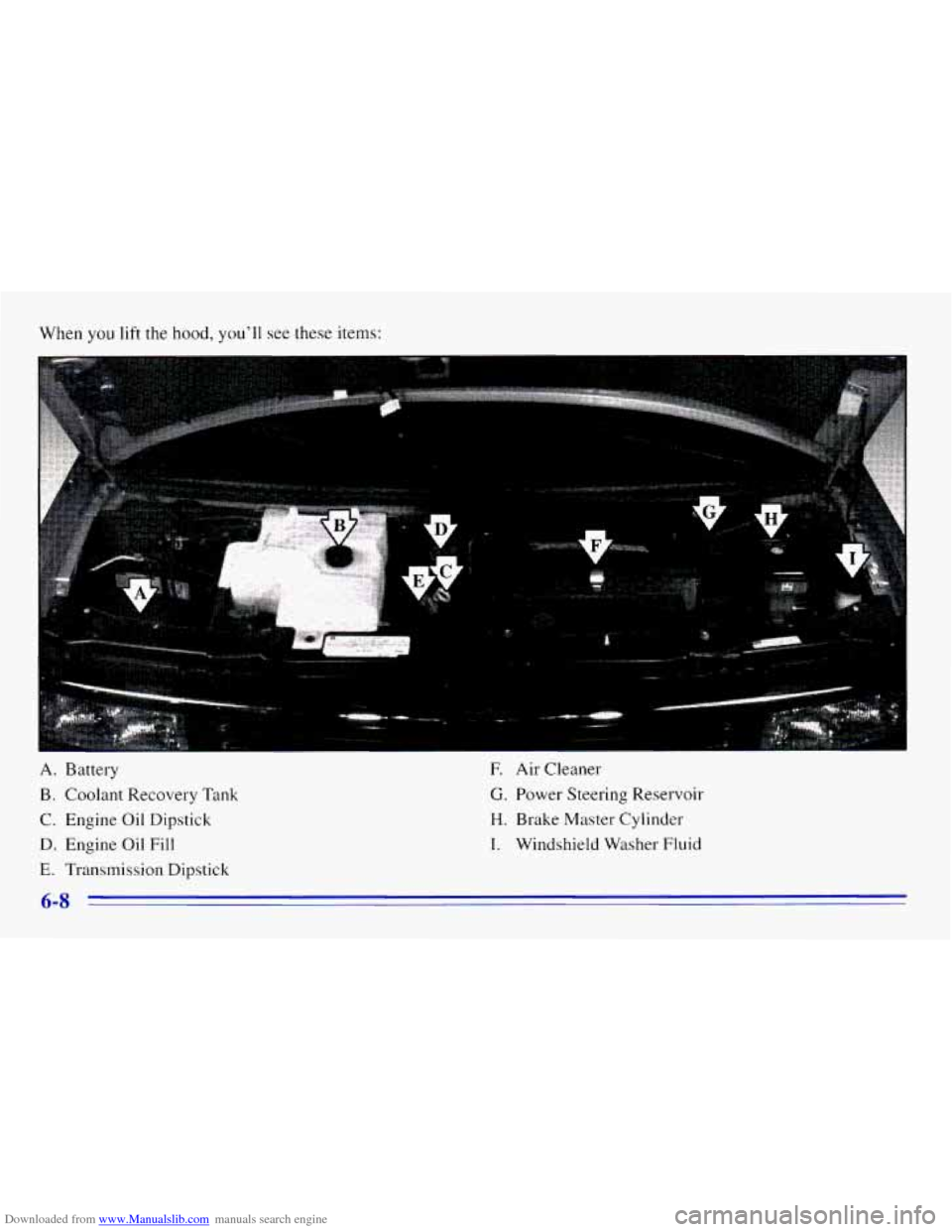
Downloaded from www.Manualslib.com manuals search engine When you lift the hood, you’ll see these items:
A. Battery
B. Coolant Recovery Tank
C. Engine Oil Dipstick
D. Engine Oil Fill
E. Transmission Dipstick
6-8
F. Air Cleaner
G. Power Steering Reservoir
H. Brake Master Cylinder
I. Windshield Washer Fluid
Page 244 of 376
Downloaded from www.Manualslib.com manuals search engine Automatic Transmission Fluid
When to Check and Change
A good time to check your automatic transmission fluid
level is when the engine oil is changed.
Change both the fluid and filter every
50,000 miles
(83
000 km) if the vehicle’s GVWR is over 8,600 or
if
the vehicle is mainly driven under one or more of
these conditions:
0 In heavy city traffic where the outside temperature
0 In hilly or mountainous terrain.
regularly reaches
90°F (32°C) or
higher.
0 When doing frequent trailer towing.
0 Uses such as found in taxi, police or delivery service.
If your vehicle’s
GVWR is not over 8,600 and you do
not use your vehicle under any
of these conditions, the
fluid and filter do
not require changing.
See “Scheduled Maintenance Services” in the Index.
How to Check
.Because this operation can be a little difficult, you
may choose to have this done at your GM dealer
Service Department.
If you do it yourself, be sure
to follow all the
instructions here, or you could get a false reading
on
the dipstick.
NOTICE:
Too much or too little fluid can damage your
transmission. Too much can mean that some of
the
fluid could come out and fall on hot engine
parts or exhaust system parts, starting a fire. Be
sure to get an accurate reading if you check your
transmission
fluid.
6-16
-
Page 245 of 376
Downloaded from www.Manualslib.com manuals search engine Wait at least 30 minutes before checking the
transmission fluid level if you have been driving:
0 When outside temperatures are above 90°F (32°C).
At high speed for quite a while.
0 In heavy traffic -- especially in hot weather.
0 While pulling a trailer.
To get the right reading, the fluid should be at normal
operating temperature, which is
180°F to 200°F
(82°C to 93°C).
Checking Transmission Fluid Hot
Get the vehicle warmed up by driving about 15 miles
(24 km) when outside temperatures are above 50°F
(10°C). If it's colder than 50°F (lO"C), drive the
vehicle in
DRIVE (D) until the engine temperature
gage moves and then remains steady for
10 minutes.
Then follow the hot check procedures.
Checking Transmission Fluid Cold
A cold check is made after the vehicle has been sitting
for eight hours or more with the engine
off and is
used only as
a reference. Let the engine run at idle for
five minutes if outside temperatures are
50°F (10°C) or
more. If it's colder than
50°F ( 10°C), you may have to
idle the engine longer. Should the fluid level be low
during a cold check, you
must perform a hot check
before adding fluid. This will give you
a more accurate
reading of the fluid level.
Checking the Fluid Hot or Cold
Park your vehicle on a level place. Keep the
engine running.
With the parking brake applied, place the shift lever
0 With your foot on the brake pedal, move the shift
in PARK (P).
lever through each gear range, pausing for about
three seconds
in each range. Then, position the shift
lever in
PARK (P).
Let the engine run at idle for three minutes or more.
- 6-17
Page 247 of 376
Downloaded from www.Manualslib.com manuals search engine How to Add Fluid Rear Axle
Refer to the Maintenance Schedule to determine what
kind
of transmission fluid to use. See “Recommended
Fluids and Lubricants” in the Index.
Add fluid only after checking the transmission fluid
HOT. (A COLD check is used only as a reference.) If
the fluid level is low, add only enough
of the proper
fluid to bring the
level up to the HOT area for a hot
check.
It doesn’t take much fluid, generally less than a
pint (0.5 L). Don ’t overjX. We recommend you use only
fluid labeled DEXRON@-111, because fluid with that
label is made especially for your automatic transmission.
Damage caused by fluid other than DEXRON-I11 is not
covered by your new vehicle warranty.
After adding fluid, recheck the fluid level as
described under
“How to Check.”
When to Check and Change Lubricant
Refer to the Maintenance Schedule to determine how
often to check
the lubricant and when to change it. See
“Scheduled Maintenance Services” in
the Index.
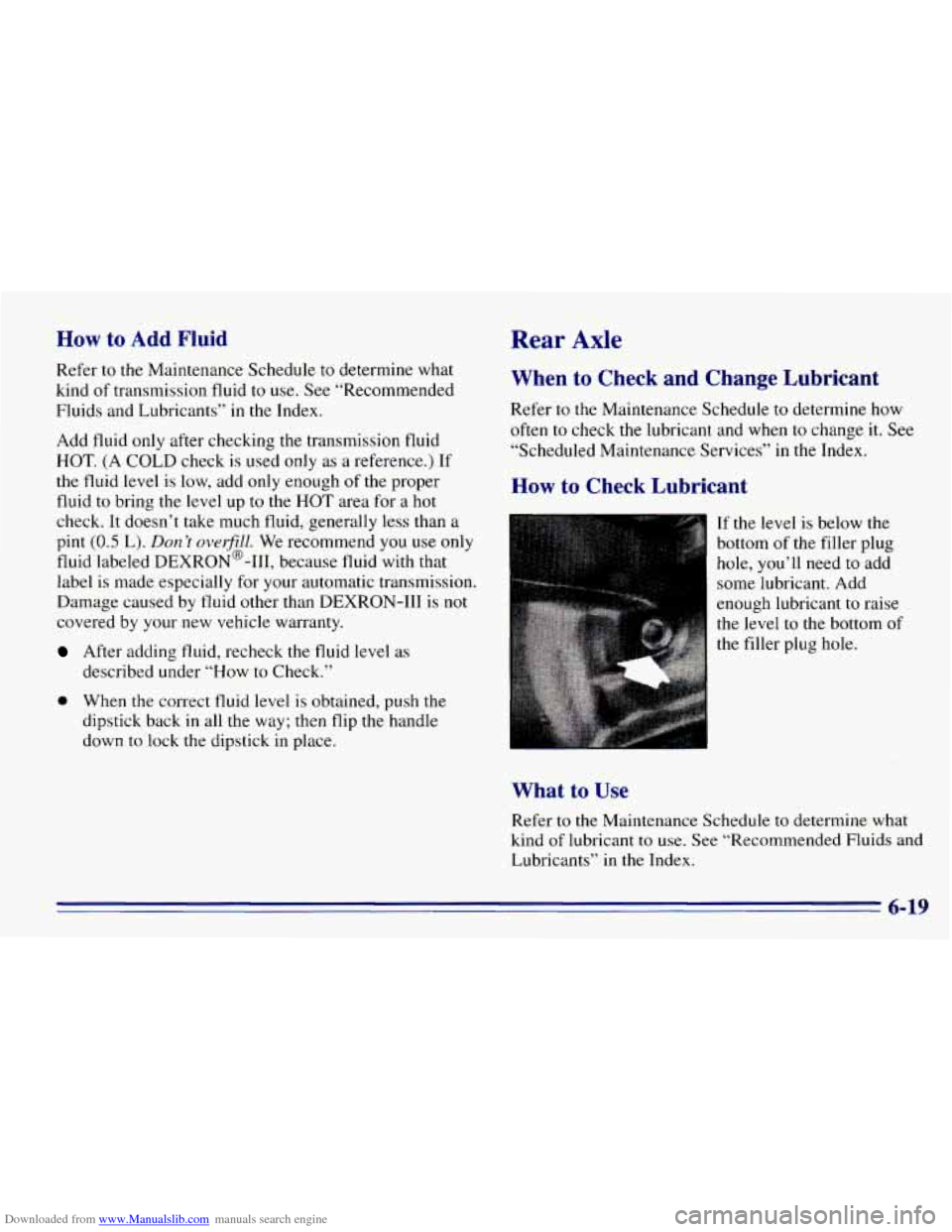
How to Check Lubricant
If the level is below the
bottom
of the filler plug
hole, you’ll need to add
some lubricant. Add
enough lubricant
to raise
the level to the bottom of
the filler plug hole.
0 When the correct fluid level is obtained, push the
dipstick back
in all the way; then flip the handle
down to lock the dipstick in place.
What to Use
Refer to the Maintenance Schedule to determine what
kind
of lubricant to use. See “Recommended Fluids and
Lubricants” in the Index.
6-19