wheel CHEVROLET EXPRESS 1996 1.G User Guide
[x] Cancel search | Manufacturer: CHEVROLET, Model Year: 1996, Model line: EXPRESS, Model: CHEVROLET EXPRESS 1996 1.GPages: 376, PDF Size: 18.83 MB
Page 79 of 376
Downloaded from www.Manualslib.com manuals search engine Automatic Transmission Operation
There are several different positions for your shift lever.
If your vehicle is equipped with an automatic
transmission,
it now features an electronic shift position
indicator within the instrument cluster. This display
must be powered anytime the shift lever is capable
of
being moved out of the PARK (P) position. This means
that if your
key is in the OFF position, but not locked,
there will be a small current drain on your battery which
could discharge
your battery over a period of time. If
you have
a need to leave your key in the ignition in the
OFF position for an extended period for any reason, it is
recommended that
you disconnect the battery cable from
the battery to prevent discharging your battery.
PARK (P): This locks your rear wheels. It’s the best
position to use when
you start your engine because your
vehicle can’t move easily.
A CAUTIO :
It is dangerous to get out of your vehicle if the
shift lever
is not fully in PARK (P) with the
parking brake firmly set. Your vehicle can roll.
Don’t leave your vehicle when the engine
is
running unless you have to. If you have left the
engine running, the vehicle can move suddenly.
You or others could be injured. To be sure your
vehicle won’t move, even when you’re on fairly
level ground, always set your parking brake and
move the shift lever to
PARK (P).
See “Shifting Into PARK (P)” in the Index. If
you’re pulling
a trailer, see “Towing a Trailer’’
in the Index.
Your vehicle has a brake-transmission shift interlock.
With the ignition
in the RUN position, you must fully
apply your regular brakes before you can shift from
PARK (P).
2-17
Page 80 of 376
Downloaded from www.Manualslib.com manuals search engine I
If you cannot shift out of PARK (P), ease pressure on
the shift lever and push the shift lever all the way into
’ PARK (P) as you continue pressing the brake pedal.
Then move the shift lever into the gear you want. If you
still cannot shift the shift lever out of PARK (P), see
“Shifting Out of PARK
(P)” later in this section.
REVERSE (R): Use this gear to back up.
NOTICE:
Shifting into REVERSE (R) while your vehicle is
moving forward could damage your transmission.
Shift to REVERSE (R) only after your vehicle
is stopped.
To rock your vehicle back and forth to get out of snow,
ice or sand without damaging your transmission, see
“Stuck: In Sand, Mud, Ice or Snow” in the Index.
NEUTRAL (N): In this position, your engine doesn’t
connect with the wheels.
To restart when you’re
already moving, use NEUTRAL,
(N) only. Also, use
NEUTRAL (N) when your vehicle is being towed.
U
Shifting out of PARK (P) or NEUTRAL (N)
while your engine is “racing” (running at high
speed) is dangerous. Unless your
foot is firmly
on the brake pedal, your vehicle could move
very rapidly. You could lose control and hit
people or objects. Don’t shift out of PARK
(P)
or NEUTRAL (N) while your engine is racing.
NOTICE:
Damage to your transmission caused by shifting
out
of PARK (P) or NEUTRAL (N) with the
engine racing isn’t covered by your warranty.
2-18
Page 81 of 376
Downloaded from www.Manualslib.com manuals search engine DRIVE (D): This position is for normal driving. If you
need more power for passing, and you’re:
Going less than about 35 mph (56 km/h), push your
accelerator pedal about halfway down.
Going about 35 mph (56 kdh) or more, push the
accelerator all the way down.
You’ll
shift down to the next gear and have more power.
You should use DRIVE (D) (or, as
you need to, a lower
gear) when towing a trailer. Operating your vehicle
in
DRIVE (D) when towing a trailer will minimize heat
build-up and extend
the life of your transmission.
THIRD (3): This position is also used for normal
driving, however,
it offers more power and lower fuel
economy than DRIVE
(D). You should use THIRD (3)
when carrying a heavy load or driving on steep hills.
SECOND (2): This position gives you more power
but lower fuel economy.
You can use SECOND (2)
on hills. It can help control your speed as you go
down steep mountain roads, but then you would also
want to use your brakes off and on. If you manually
select SECOND
(2), the transmission will drive in
second gear. You may use this feature for reducing
torque
to the rear wheels when you are trying to start
your vehicle from a stop
on slippery road surfaces.
FIRST (1): This position gives you even more power
(but lower fuel economy) than SECOND
(2). You can
use it
on very steep hills, or in deep snow or mud. If
the selector lever is put in FIRST (l), the transmission
won’t shift into first gear until the vehicle is going
slowly enough.
NOTICE: -- --
If your rear wheels can’t rotate, don’t try to
drive. This might happen if you are stuck in
very deep sand or mud or are up against a solid
object. You could damage your transmission.
Also, if you stop when going uphill, don’t hold
your vehicle there with only the accelerator
pedal. This could overheat and damage the
transmission. Use your brakes
or shift into
PARK (P) to hold your vehicle in position on
a hill.
2-19
Page 82 of 376
Downloaded from www.Manualslib.com manuals search engine Locking Rear Axle
If you have this feature, your rear axle can give you
additional traction on snow, mud, ice, sand or gravel. It
works like a standard axle most of the time, but when
one
of the rear wheels has no traction and the other does,
the locking feature will allow the wheel
with traction to
move the vehicle.
Parking Brake
To set the parking brake, hold the regular brake pedal
down with your right foot. Push down the parking brake
pedal with your left foot.
If the ignition is on, the brake system warning light will
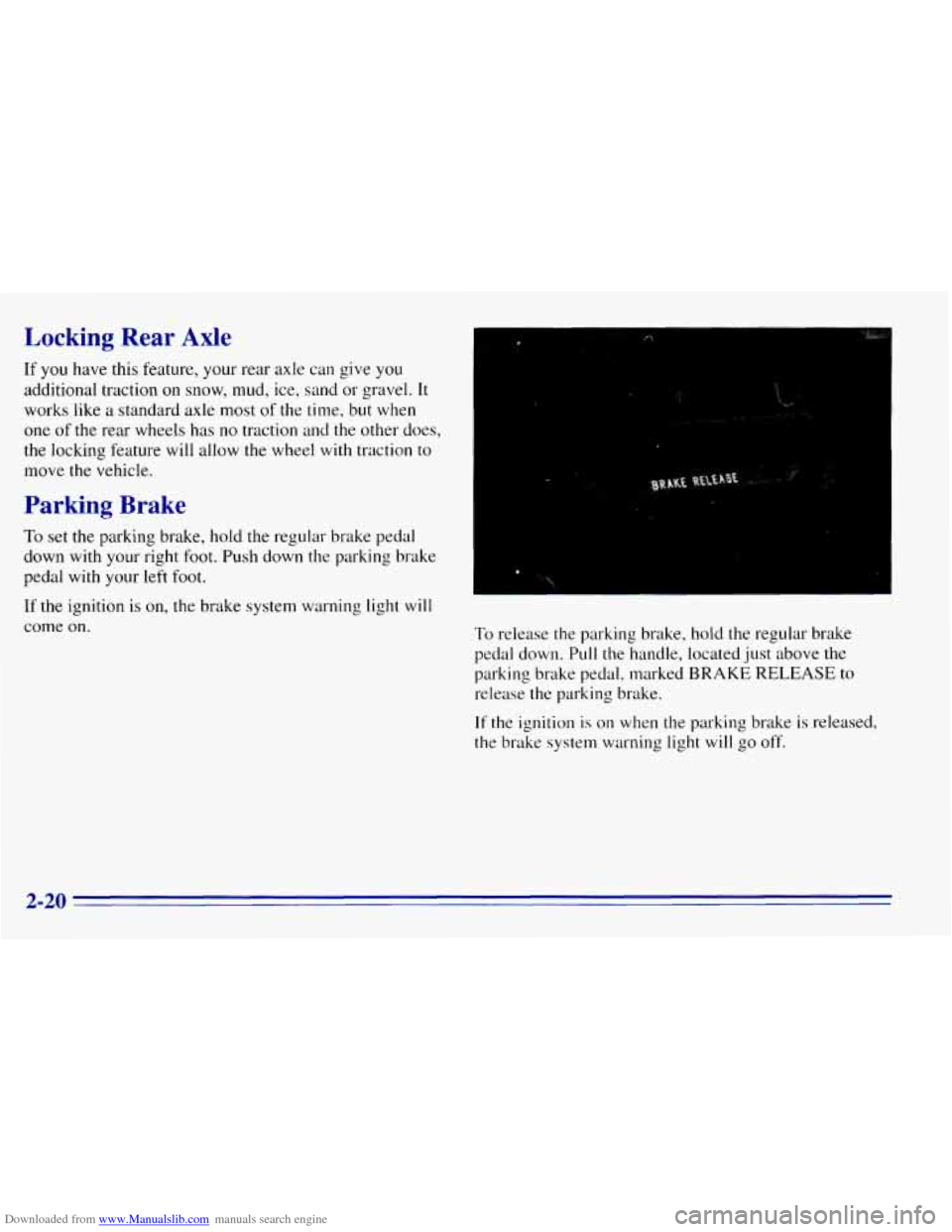
come on. To rclease the parking brake, hold the regular brake
pedal down. PLIII the handle, located
just above the
pal-king brake pedal. marked
BRAKE RELEASE to
release the parking brake.
If the ignition is on when the parking brake is released,
the brake system warning light
will go off.
2-20
Page 90 of 376
Downloaded from www.Manualslib.com manuals search engine CAUTION:
It can be dangerous to drive with the rear
swing-out windows or rear door(s) open because
carbon monoxide (CO) gas can come into your
vehicle. You can’t see or smell CO. It can cause
unconsciousness and even death.
If you must drive with the rear swing-out
windows or rear door(s) open or if electrical
wiring or other cable connections must pass
through the seal between the body and the rear
swing-out windows or rear door(s):
Make sure all windows are shut.
CAUTION: (Continued) CAUTION:
(Continued)
Turn the fan on your heating or cooling
system to its highest speed with the setting
on VENT, HEAT, BLEND or DEF.
Additionally, on vehicles with heatingair
conditioning systems, NORM A/C or
BI-LEV
A/C can be used. That will force
outside air into your vehicle. See “Comfort
Controls” in the Index.
instrument panel, open them all the way.
If you have air outlets on or under the
See “Engine Exhaust” in the Index.
Horn
Press one of the horn buttons at each side of the steering
wheel to sound the horn.
2-28
Page 91 of 376
Downloaded from www.Manualslib.com manuals search engine Tilt Wheel (Option)
A tilt steering wheel allows you to adjust the steering
wheel before you drive. You can also raise
it to the
highest level to give your legs more room when you
enter and exit the vehicle.
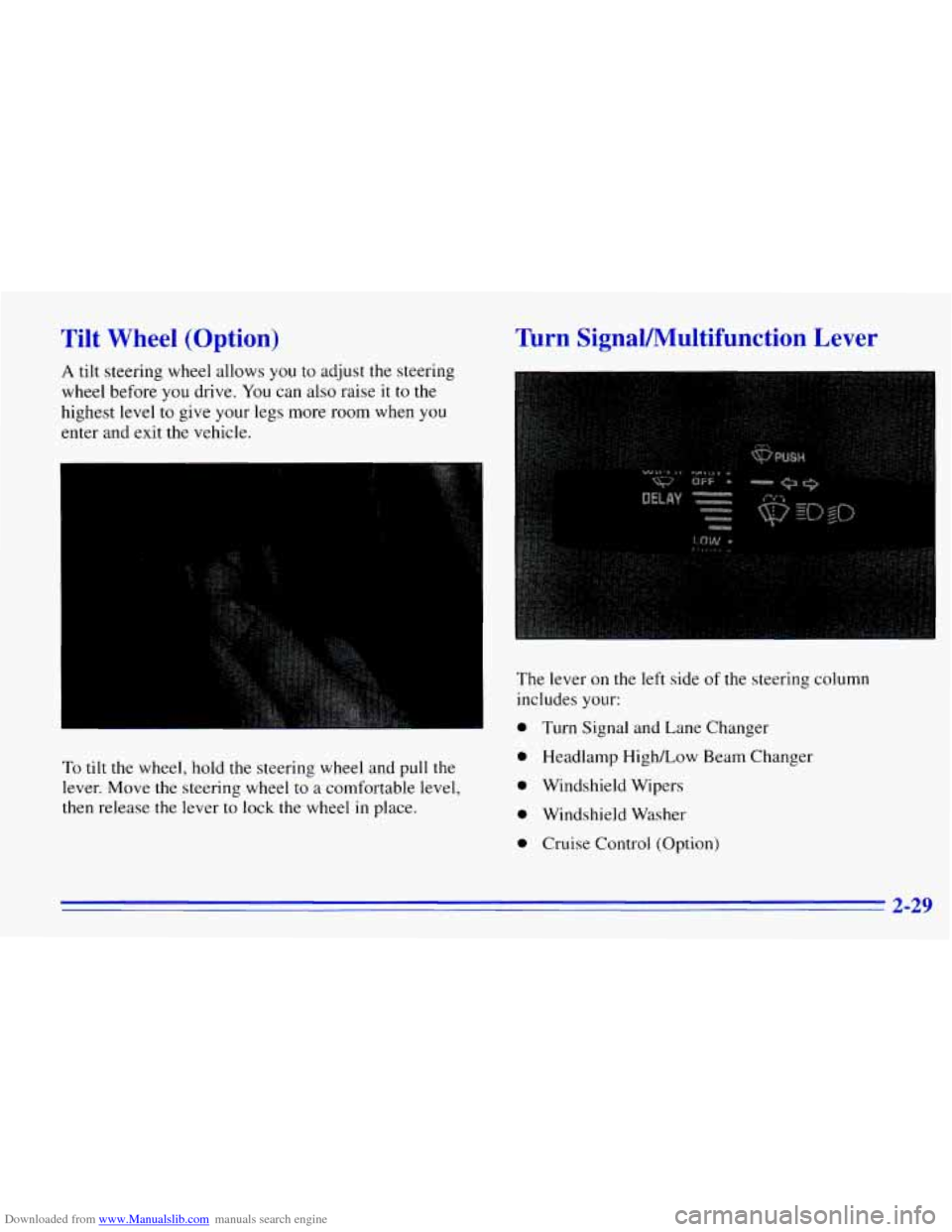
To tilt the wheel, hold the steering wheel and pull the
lever. Move the steering wheel
to a comfortable level,
then release the lever to lock the wheel
in place.
Turn SignaVMultifunction Lever
The lever on the left side of the steering column
includes your:
0 Turn Signal and Lane Changer
0 Headlamp High/Low Beam Changer
0 Windshield Wipers
0 Windshield Washer
0 Cruise Control (Option)
2-29
Page 94 of 376
Downloaded from www.Manualslib.com manuals search engine Windshield Washer
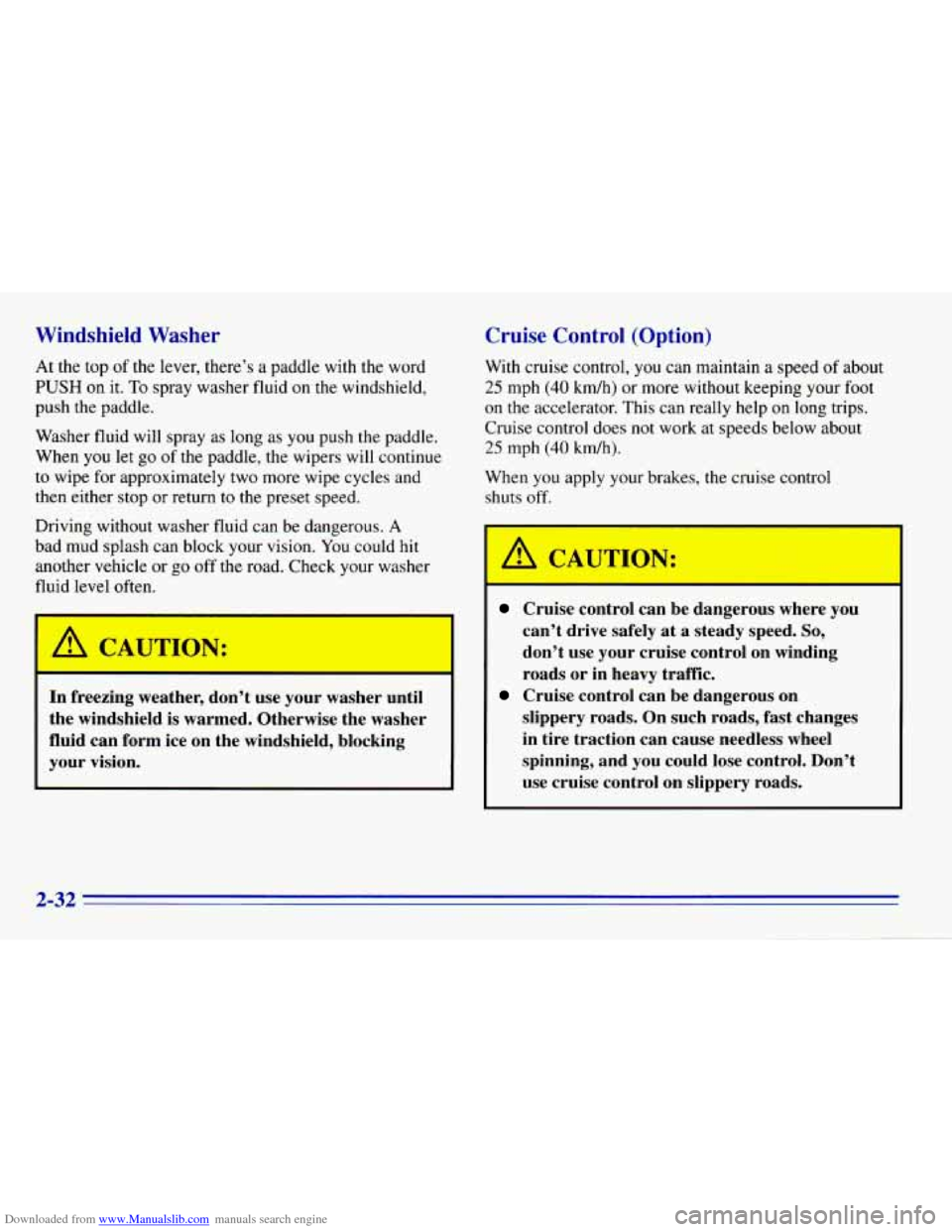
At the top of the lever, there’s a paddle with the word
PUSH on it. To spray washer fluid on the windshield,
push the paddle.
Washer fluid will spray
as long as you push the paddle.
When
you let go of the paddle, the wipers will continue
to wipe for approximately two more wipe cycles and
then either stop or return to the preset speed.
Driving without washer fluid can be dangerous. A
bad mud splash can block your vision.
You could hit
another vehicle
or go off the road. Check your washer
fluid level often.
I A CAUTION:
I
Cruise Control (Option)
With cruise control, you can maintain a speed of about
25 mph (40 kmk) or more without keeping your foot
on
the accelerator. This can really help on long trips.
Cruise control does not work at speeds below about
25 mph (40 krnk).
When you apply your brakes, the cruise control
shuts off.
In freezing weather, don’t use your washer until
the windshield is warmed. Otherwise the washer
fluid can form ice on the windshield, blocking
your vision.
A CAUTION:
I
Cruise control can be dangerous where you
can’t drive safely at a steady speed. So,
don’t use your cruise control on winding
roads or in heavy traffic.
slippery roads. On such roads, fast changes
in tire traction can cause needless wheel
spinning, and you could lose control. Don’t
use cruise control on slippery roads.
Cruise control can be dangerous on
2-32
Page 97 of 376
Downloaded from www.Manualslib.com manuals search engine Lamps
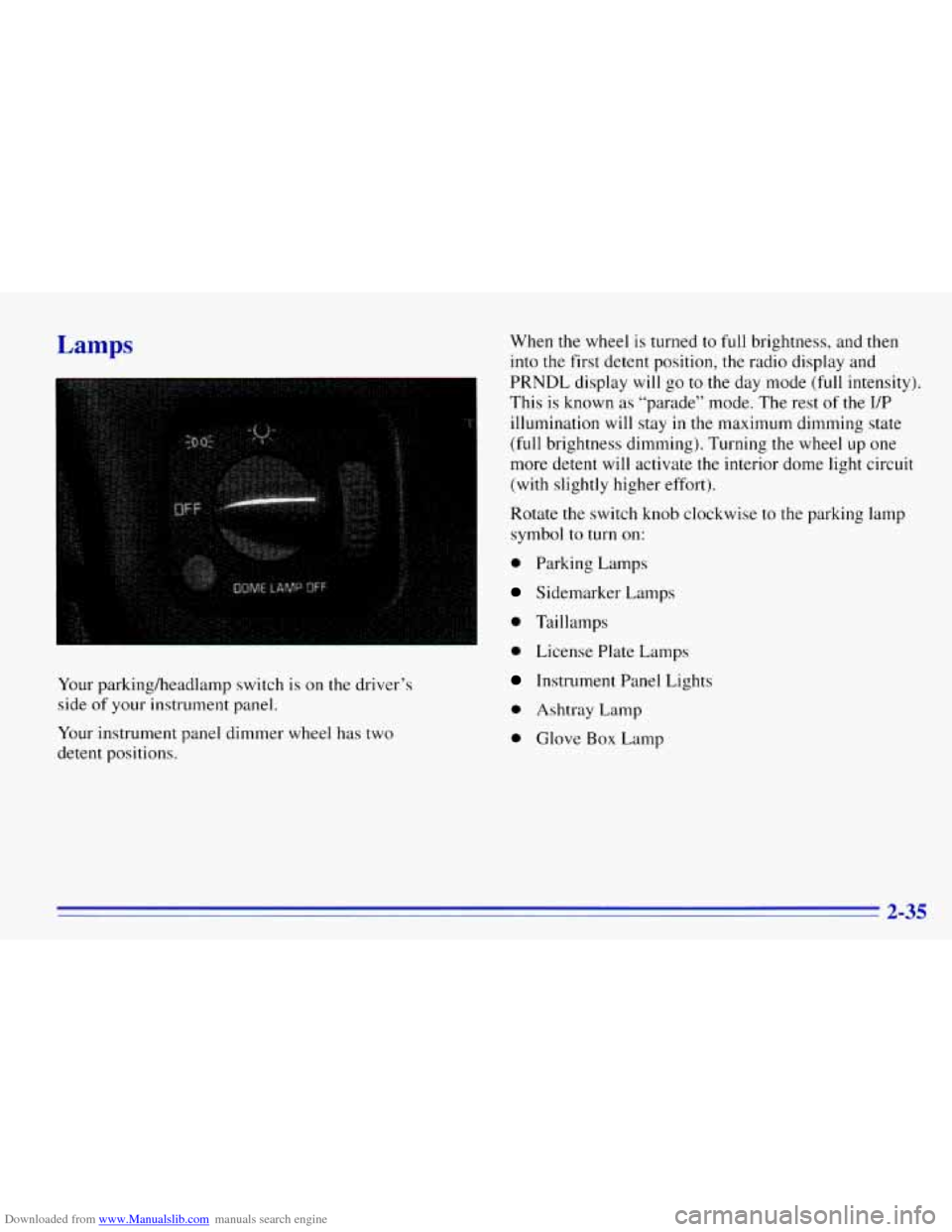
Your parking/headlamp switch is on the driver’s
side
of your instrument panel.
Your instrument panel dimmer wheel has two
detent positions. When
the wheel is turned
to full brightness, and then
into
the first detent position, the radio display and
PRNDL display
will go to the day mode (full intensity).
This is known as “parade” mode. The rest
of the I/P
illumination will stay
in the maximum dimming state
(full brightness dimming). Turning the wheel up one
more detent will activate the interior dome light circuit
(with slightly higher effort).
Rotate the switch knob clockwise
to the parking lamp
symbol to
turn on:
0 Parking Lamps
Sidemarker Lamps
0 Taillamps
0 License Plate Lamps
Instrument Panel Lights
0 Ashtray Lamp
0 Glove Box Lamp
2-35
Page 98 of 376
Downloaded from www.Manualslib.com manuals search engine Rotate the switch knob clockwise again to the master
lighting symbol
to turn on all the lamps listed as well as
the headlamps.
Rotate the switch counterclockwise to
OFF to turn off
your lamps.
Rotate the thumb wheel next
to the switch knob up to
adjust instrument panel lights. Rotate the thumb wheel up
to the first notch to return the radio display and gearshift
indicator display
to full intensity when the headlamps or
parking lamps are
on.
Rotate the thumb wheel up to the second notch to
activate the interior dome lamps.
You can switch your headlamps from high to low beam
by pulling
on the turn signalhigh beam lever.
A circuit breaker protects your headlamps. If you have
an electrical overload, your headlamps will flicker on
and off. Have your headlamp wiring checked right away
if this happens.
Headlamps On Reminder
A buzzer will sound when your headlamps are turned on
and your ignition is in OFF, LOCK or ACCESSORY.
If
you need to use your headlamps when the ignition
switch is in
OFF, LOCK or ACCESSORY, the buzzer
can be turned off by turning the thumb wheel next to the
parking lampheadlamp switch all the way down.
Daytime Running Lamps (If Equipped)
Daytime Running Lamps (DRL) can make it easier for
others
to see the front of your vehicle during the day.
DRL can be helpful in many different driving
conditions, but they can be especially helpful in the
short periods after dawn and before sunset.
The DRL system will make your headlamps come
on at
a reduced brightness when:
0 The ignition is on,
The headlamp switch is off and
0 The parking brake is released.
If your vehicle was first sold, when new, in Canada,
your headlamps will come
on at reduced brightness.
2-36
Page 99 of 376
Downloaded from www.Manualslib.com manuals search engine If your vehicle was first sold, when new, in the United
States, your vehicle may be equipped with DRL. If your
vehicle has DRL,
you will see the the DRL indicator
light
on your instrument panel and your low-beam
headlamps will come
on at reduced brightness.
When the DRL are on, only your headlamps will be on.
The taillamps, sidemarker and other lamps won’t be on.
Your instrument panel won’t be lit up either,
When it begins to get dark, your DRL indicator light
is a reminder
to turn your headlamp switch on. The
other lamps that come on with your headlamps will also
come on.
When-you turn off the headlamp switch, the regular
lamps will go
off, and your headlamps will change to
the reduced brightness of DRL.
To idle your vehicle with the engine on and the DRL
off,
set the parking brake. The DRL will stay off until you
release the parking brake.
As with any vehicle, you should turn on the regular
headlamp system when you need it.
Dome Lamps
The dome lamps will come on when you open the doors.
You can also turn the dome lamps on by rotating the
thumb wheel, located next
to the headlamp knob, all
the way up
to the second notch. In this position, the
dome lamps will remain on whether the doors are
opened or closed.
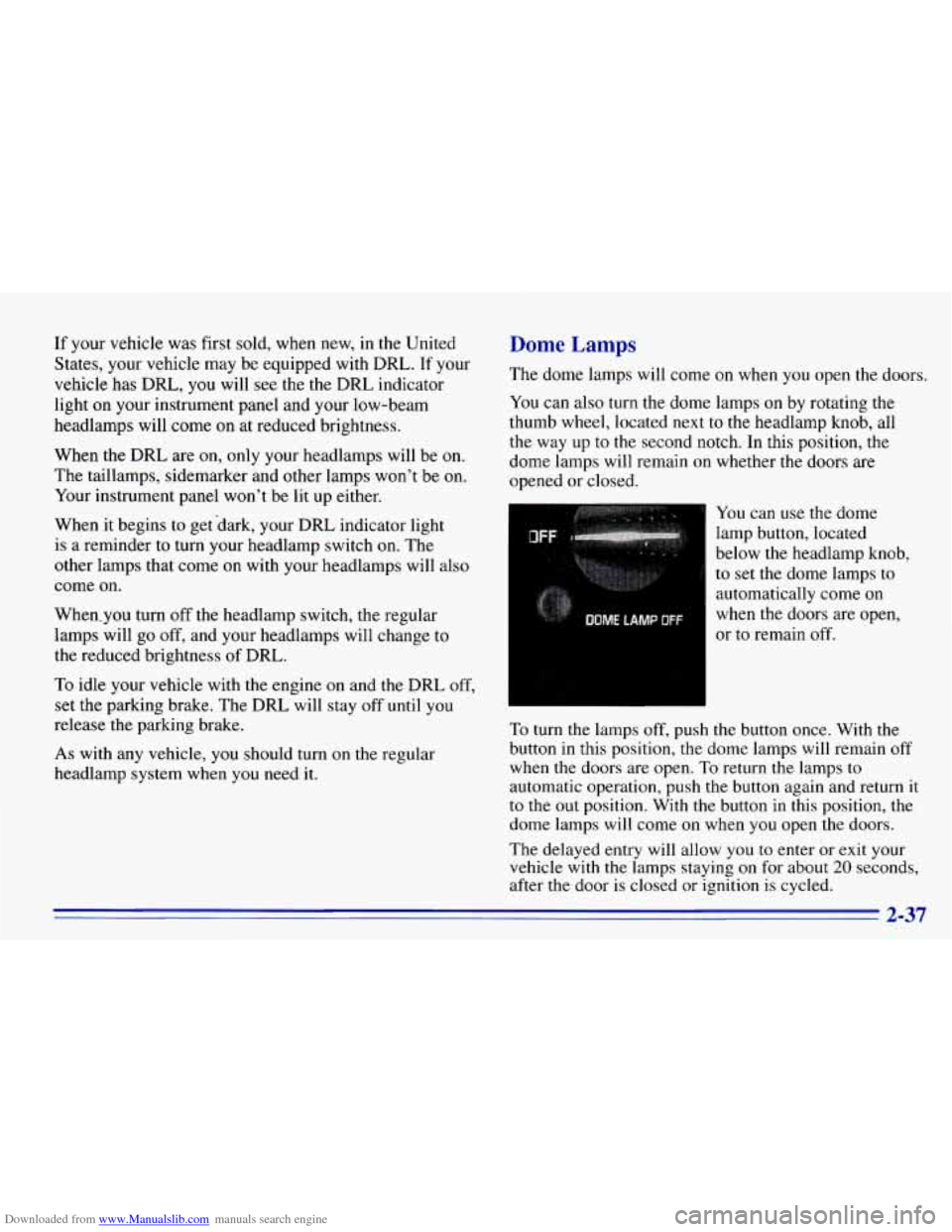
You can use the dome
lamp button, located
below the headlamp knob,
to set the dome lamps to
automatically come
on
when the doors are open,
or to remain off.
To turn
the lamps off, push the button once. With the
button in this position, the dome lamps will remain off
when the doors are open. To return the lamps
to
automatic operation, push the button again and return it
to the out position. With the button in this position, the
dome lamps will come
on when you open the doors.
The delayed entry will allow you
to enter or exit your
vehicle with the lamps staying
on for about 20 seconds,
after the door is closed
or ignition is cycled.
2-37