lock CHEVROLET EXPRESS 1996 1.G Owner's Manual
[x] Cancel search | Manufacturer: CHEVROLET, Model Year: 1996, Model line: EXPRESS, Model: CHEVROLET EXPRESS 1996 1.GPages: 376, PDF Size: 18.83 MB
Page 75 of 376
Downloaded from www.Manualslib.com manuals search engine New Vehicle “Break-In” NOTICE:
Your modern vehicle doesn’t need an elaborate
“break-in.” But
it will perform better in the long
run if you follow these guidelines:
0
0
0
0
Keep your speed at 55 mph (88 km/h) or
less for the first
500 miles (804 km).
Don’t1 drive at any one speed
-- fast or
slow
-- for the first 500 miles -(SO4 km).7
Don’t make full-throttle starts.
Avoid making hard stops for the first
200 miles (322 km) or so. During this time
your new brake linings aren’t yet broken
in. Hard stops with new linings can mean
premature wear and earlier replacement.
Follow this breaking-in guideline every
time you get new brake linings.
Don’t tow a trailer during break-in. See
“Towing a Trailer” in the Index for more
information.
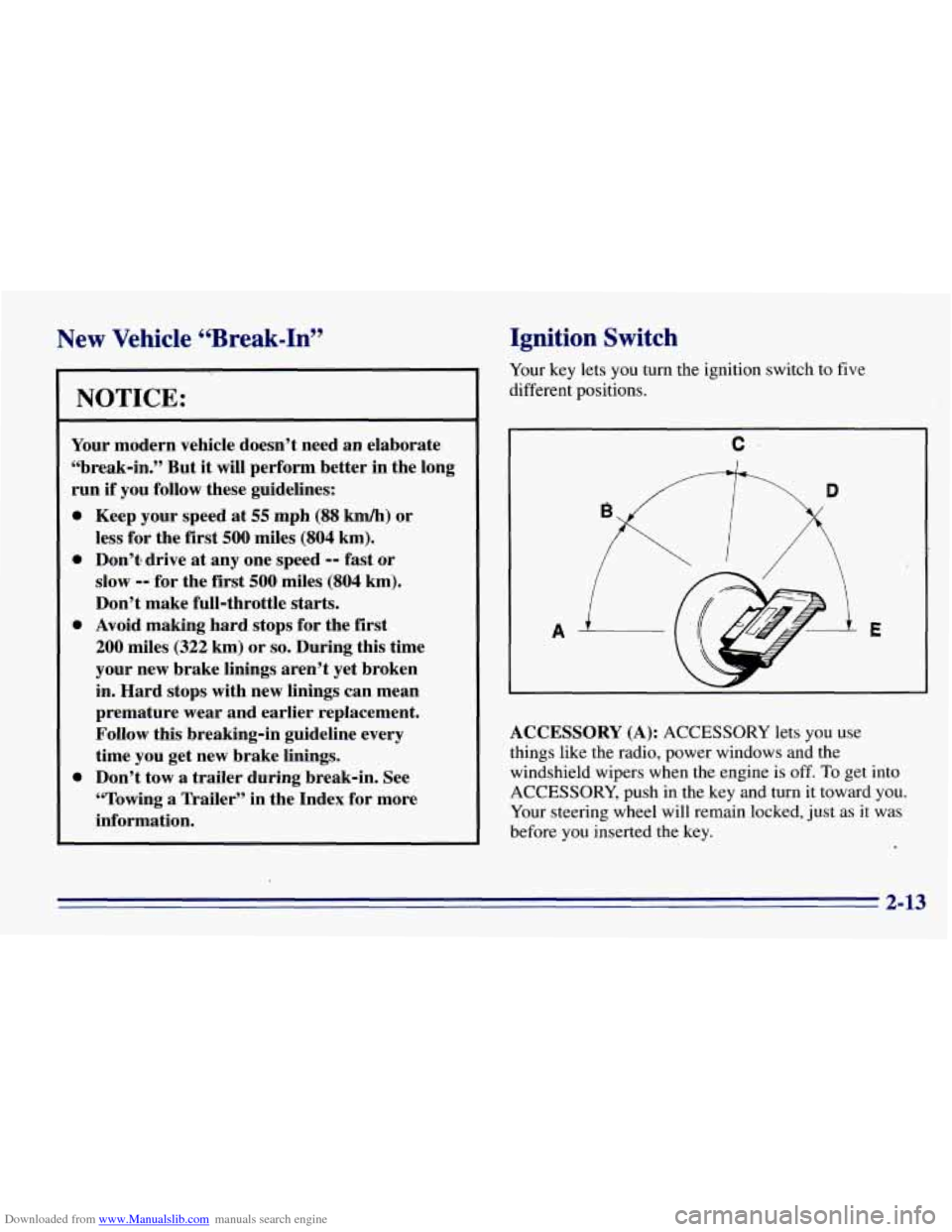
Ignition Switch
Your key lets you turn the ignition switch to five
different positions.
C
I
E
ACCESSORY (A): ACCESSORY lets you use
things like the radio, power windows and the
windshield wipers when the engine is off.
To get into
ACCESSORY, push in the key and turn it toward you.
Your steering wheel will remain locked, just
as it was
before you inserted the key.
2-13
Page 76 of 376
Downloaded from www.Manualslib.com manuals search engine LOCK (B): This position locks your ignition, steering
wheel and transmission. It’s
a theft-deterrent feature.
You will
only be able to remove your key when the
ignition
is turned to LOCK.
OFF (C): This position lets you turn off the engine but
still turn the steering wheel. It doesn’t lock the steering
wheel like
LOCK. Use OFF if you must have your
vehicle in motion while the engine is off (for example,
if your vehicle is being pushed).
RUN (D): This is the position for driving.
START (E): This starts your engine.
I NOTICE:
If your key seems stuck in LOCK and you can’t
turn it, be sure
it is all the way in. If it is, then
turn the steering wheel left and right while you
turn the key hard. But turn the key only with
your hand. Using
a tool to force it could break
the key
or the ignition switch. If none of this
works, then your vehicle needs service.
Starting Your Gasoline Engine
If you have a diesel engine, see “Starting Your Diesel
Engine” in the Diesel Engine Supplement.
Move your shift lever
to PARK (P) or NEUTRAL (N).
Your engine won’t start in any other position -- that’s a
safety feature. To restart when you’re already moving,
use NEUTRAL
(N) only.
I NOTICE:
Don’t try to shift to PARK (P) if your vehicle
~ is moving. If you do, you could damage the
transmission. Shift to
PARK (P) only when
your vehicle is stopped.
2-14
Page 79 of 376
Downloaded from www.Manualslib.com manuals search engine Automatic Transmission Operation
There are several different positions for your shift lever.
If your vehicle is equipped with an automatic
transmission,
it now features an electronic shift position
indicator within the instrument cluster. This display
must be powered anytime the shift lever is capable
of
being moved out of the PARK (P) position. This means
that if your
key is in the OFF position, but not locked,
there will be a small current drain on your battery which
could discharge
your battery over a period of time. If
you have
a need to leave your key in the ignition in the
OFF position for an extended period for any reason, it is
recommended that
you disconnect the battery cable from
the battery to prevent discharging your battery.
PARK (P): This locks your rear wheels. It’s the best
position to use when
you start your engine because your
vehicle can’t move easily.
A CAUTIO :
It is dangerous to get out of your vehicle if the
shift lever
is not fully in PARK (P) with the
parking brake firmly set. Your vehicle can roll.
Don’t leave your vehicle when the engine
is
running unless you have to. If you have left the
engine running, the vehicle can move suddenly.
You or others could be injured. To be sure your
vehicle won’t move, even when you’re on fairly
level ground, always set your parking brake and
move the shift lever to
PARK (P).
See “Shifting Into PARK (P)” in the Index. If
you’re pulling
a trailer, see “Towing a Trailer’’
in the Index.
Your vehicle has a brake-transmission shift interlock.
With the ignition
in the RUN position, you must fully
apply your regular brakes before you can shift from
PARK (P).
2-17
Page 82 of 376
Downloaded from www.Manualslib.com manuals search engine Locking Rear Axle
If you have this feature, your rear axle can give you
additional traction on snow, mud, ice, sand or gravel. It
works like a standard axle most of the time, but when
one
of the rear wheels has no traction and the other does,
the locking feature will allow the wheel
with traction to
move the vehicle.
Parking Brake
To set the parking brake, hold the regular brake pedal
down with your right foot. Push down the parking brake
pedal with your left foot.
If the ignition is on, the brake system warning light will
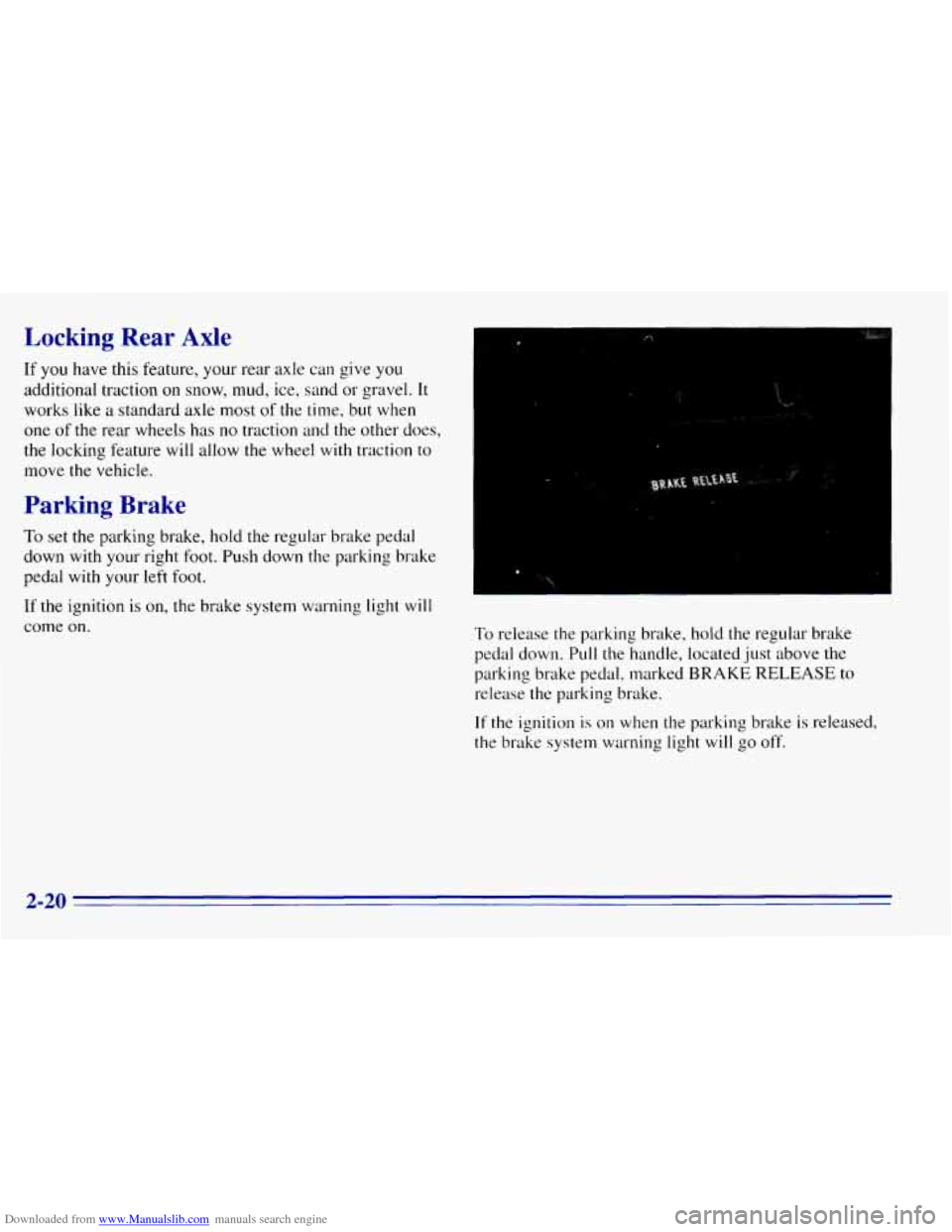
come on. To rclease the parking brake, hold the regular brake
pedal down. PLIII the handle, located
just above the
pal-king brake pedal. marked
BRAKE RELEASE to
release the parking brake.
If the ignition is on when the parking brake is released,
the brake system warning light
will go off.
2-20
Page 84 of 376
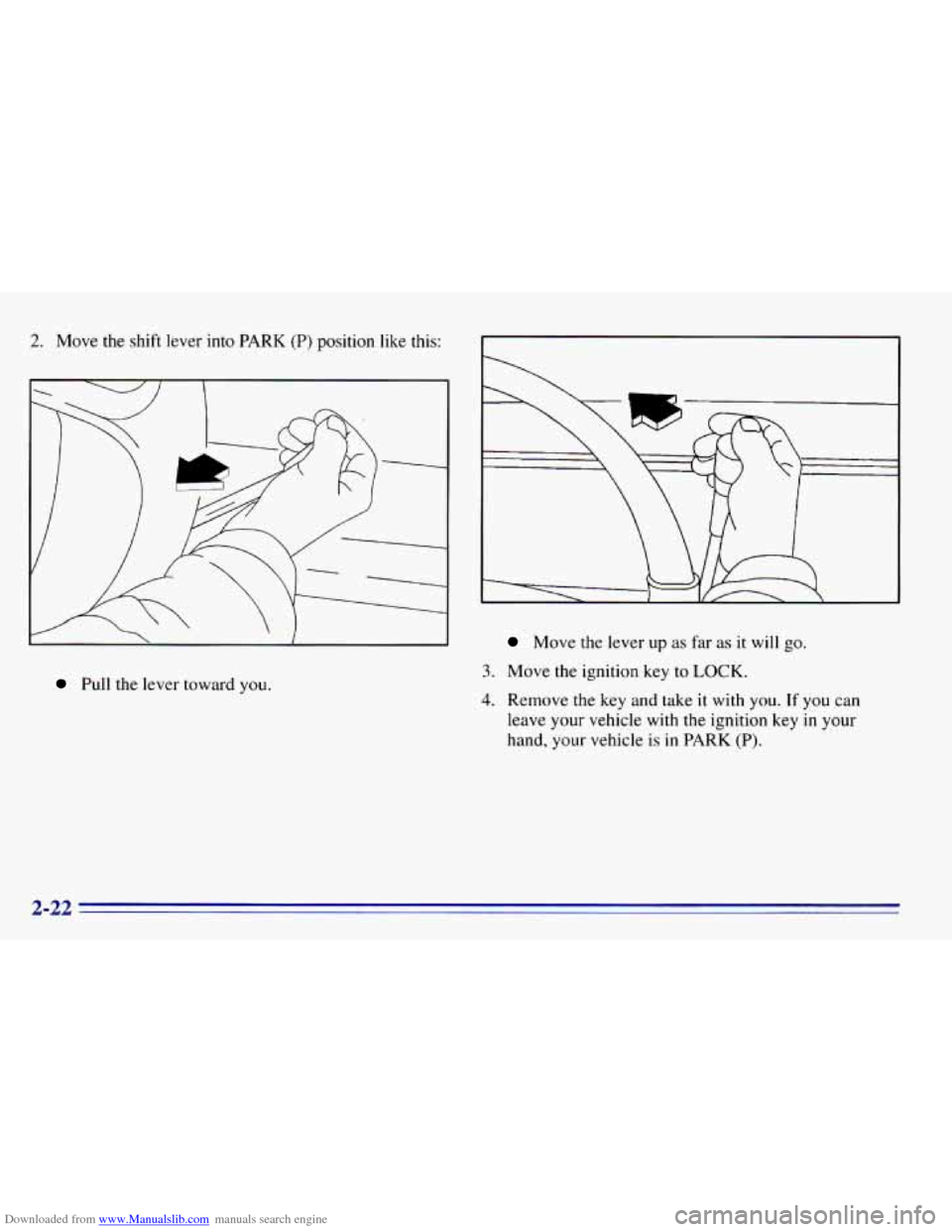
Downloaded from www.Manualslib.com manuals search engine 2. Move the shift lever into PARK (P) position like this:
Pull the lever toward you.
Move the lever up as far as it will go.
3. Move the ignition key to LOCK.
4. Remove the key and take it with you. If you can
leave your vehicle with the ignition key
in your
hand, your vehicle is in PARK (P).
2-22
Page 85 of 376
Downloaded from www.Manualslib.com manuals search engine Leaving Your Vehicle With the
Engine Running
A CAUTION:
It can be dangerous to leave your vehicle with
the engine running. Your vehicle could move
suddenly if the shift lever is not fully in
PARK (P)
with the parking brake firmly set. And, if you
leave the vehicle with the engine running, it could
overheat and even catch fire. You or others could
be injured. Don’t leave your vehicle with the
engine running unless you have to.
Torque Lock
If you are parking on a hill and you don’t shift your
transmission
into PARK (P) properly, the weight of the
vehicle may put too much force
on the parking pawl in
the transmission. You may find it difficult to pull the
shift lever
out of PARK (P). This is called “torque lock.”
To prevent torque lock, set the parking brake and then
shift
into PARK (P) properly before you leave the
driver’s seat. To find
out how, see “Shifting Into
PARK
(P)” in the Index. When
you are
ready to drive, move the shift lever out of
PARK (P) before you release the parking brake.
If torque lock does occur,
you may need to have another
vehicle push yours a little uphill
to take some of the
pressure from the transmission, so you can pull the shift
lever out
of PARK (P).
Shifting Out of PARK (P)
Your vehicle has a brake-transmission shift interlock
system. You have to fully apply your regular brakes
before you can shift from PARK (P). See “Automatic
Transmission”
in the Index.
If you cannot shift
out of PARK (P), ease pressure on
the shift lever and push the shift lever all the way up
into PARK (P) as you maintain brake application. Then,
move the shift lever into
the gear you want.
If
you ever hold the brake pedal down but still can’t
shift out
of PARK (P), try this:
1. Turn the key to OFF.
2. Apply and hold the brake until the end of Step 4.
3. Shift to NEUTRAL (N).
4. Start the vehicle and then shift to the drive gear you
5. Have the brake-transmission shift interlock system
want.
fixed
as soon as you can.
2-23
Page 89 of 376
Downloaded from www.Manualslib.com manuals search engine Swing-Out Windows
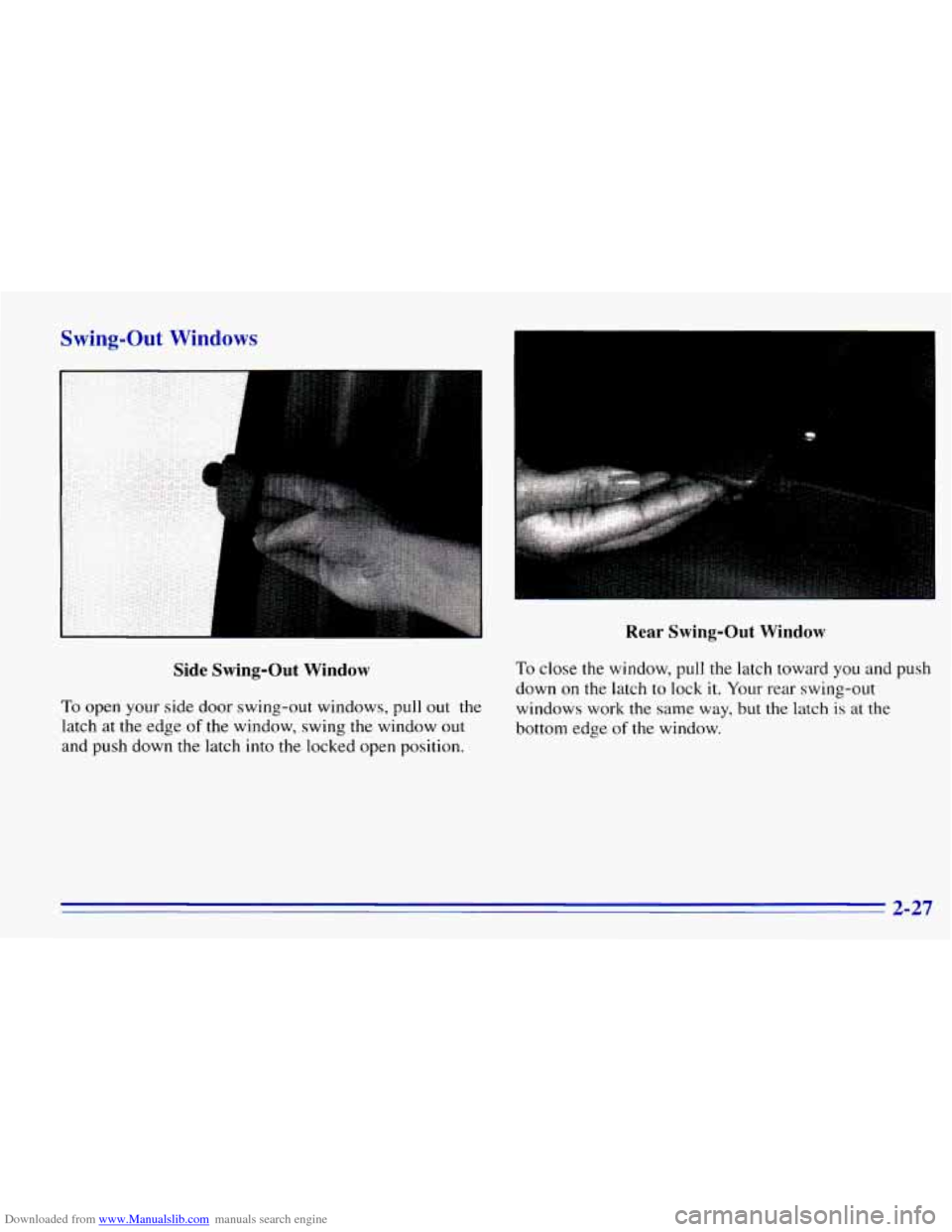
Side Swing-Out Window
To open your side door swing-out windows, pull out the
latch
at the edge of the window, swing the window out
and push down
the latch into the locked open position.
Rear Swing-Out Window
To close the window, pull the latch toward you and push
down
on the latch to lock it. Your rear swing-out
windows work the same way,
but the latch is at the
bottom edge of the window.
2-27
Page 91 of 376
Downloaded from www.Manualslib.com manuals search engine Tilt Wheel (Option)
A tilt steering wheel allows you to adjust the steering
wheel before you drive. You can also raise
it to the
highest level to give your legs more room when you
enter and exit the vehicle.
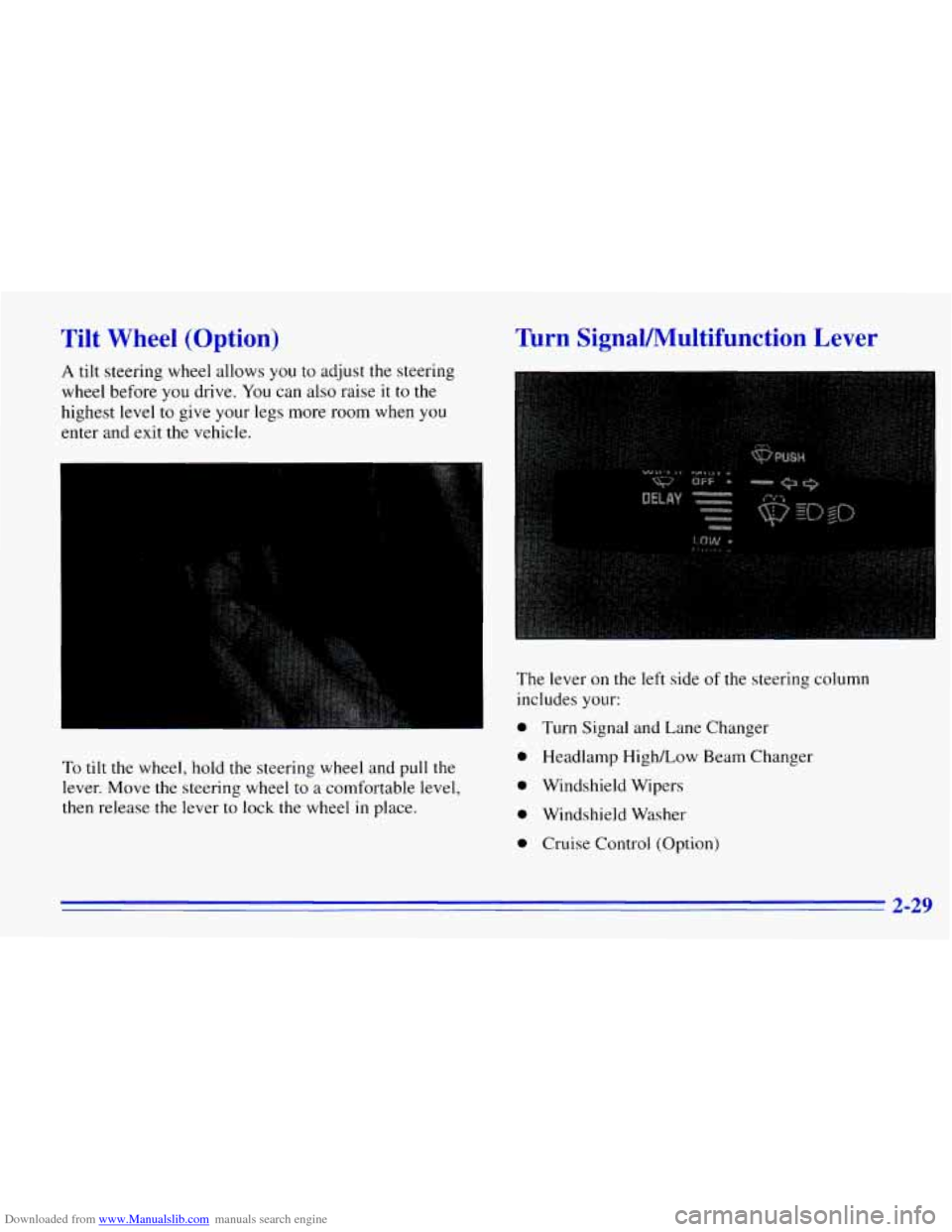
To tilt the wheel, hold the steering wheel and pull the
lever. Move the steering wheel
to a comfortable level,
then release the lever to lock the wheel
in place.
Turn SignaVMultifunction Lever
The lever on the left side of the steering column
includes your:
0 Turn Signal and Lane Changer
0 Headlamp High/Low Beam Changer
0 Windshield Wipers
0 Windshield Washer
0 Cruise Control (Option)
2-29
Page 94 of 376
Downloaded from www.Manualslib.com manuals search engine Windshield Washer
At the top of the lever, there’s a paddle with the word
PUSH on it. To spray washer fluid on the windshield,
push the paddle.
Washer fluid will spray
as long as you push the paddle.
When
you let go of the paddle, the wipers will continue
to wipe for approximately two more wipe cycles and
then either stop or return to the preset speed.
Driving without washer fluid can be dangerous. A
bad mud splash can block your vision.
You could hit
another vehicle
or go off the road. Check your washer
fluid level often.
I A CAUTION:
I
Cruise Control (Option)
With cruise control, you can maintain a speed of about
25 mph (40 kmk) or more without keeping your foot
on
the accelerator. This can really help on long trips.
Cruise control does not work at speeds below about
25 mph (40 krnk).
When you apply your brakes, the cruise control
shuts off.
In freezing weather, don’t use your washer until
the windshield is warmed. Otherwise the washer
fluid can form ice on the windshield, blocking
your vision.
A CAUTION:
I
Cruise control can be dangerous where you
can’t drive safely at a steady speed. So,
don’t use your cruise control on winding
roads or in heavy traffic.
slippery roads. On such roads, fast changes
in tire traction can cause needless wheel
spinning, and you could lose control. Don’t
use cruise control on slippery roads.
Cruise control can be dangerous on
2-32
Page 97 of 376
Downloaded from www.Manualslib.com manuals search engine Lamps
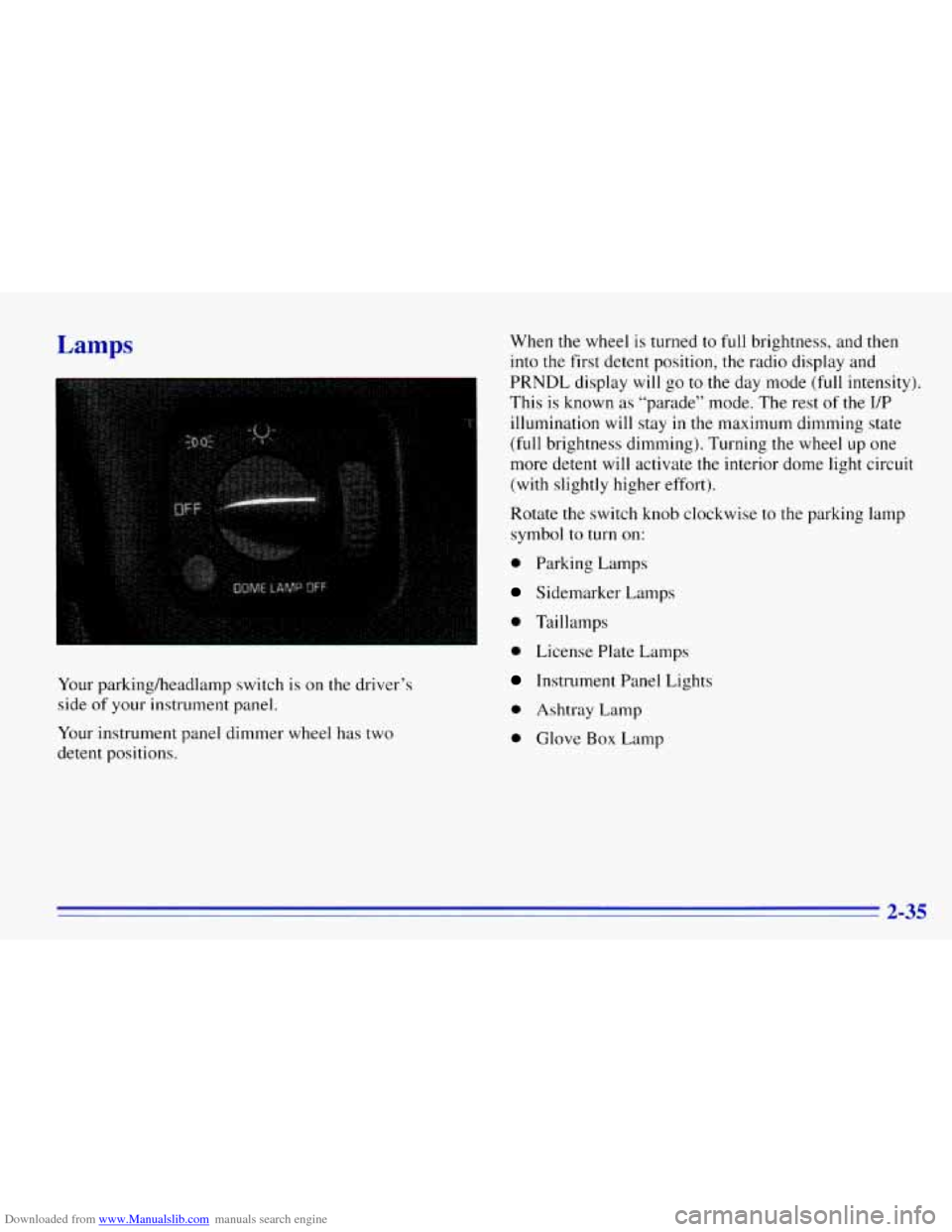
Your parking/headlamp switch is on the driver’s
side
of your instrument panel.
Your instrument panel dimmer wheel has two
detent positions. When
the wheel is turned
to full brightness, and then
into
the first detent position, the radio display and
PRNDL display
will go to the day mode (full intensity).
This is known as “parade” mode. The rest
of the I/P
illumination will stay
in the maximum dimming state
(full brightness dimming). Turning the wheel up one
more detent will activate the interior dome light circuit
(with slightly higher effort).
Rotate the switch knob clockwise
to the parking lamp
symbol to
turn on:
0 Parking Lamps
Sidemarker Lamps
0 Taillamps
0 License Plate Lamps
Instrument Panel Lights
0 Ashtray Lamp
0 Glove Box Lamp
2-35