passenger seat CHEVROLET EXPRESS 1996 1.G Owners Manual
[x] Cancel search | Manufacturer: CHEVROLET, Model Year: 1996, Model line: EXPRESS, Model: CHEVROLET EXPRESS 1996 1.GPages: 376, PDF Size: 18.83 MB
Page 11 of 376
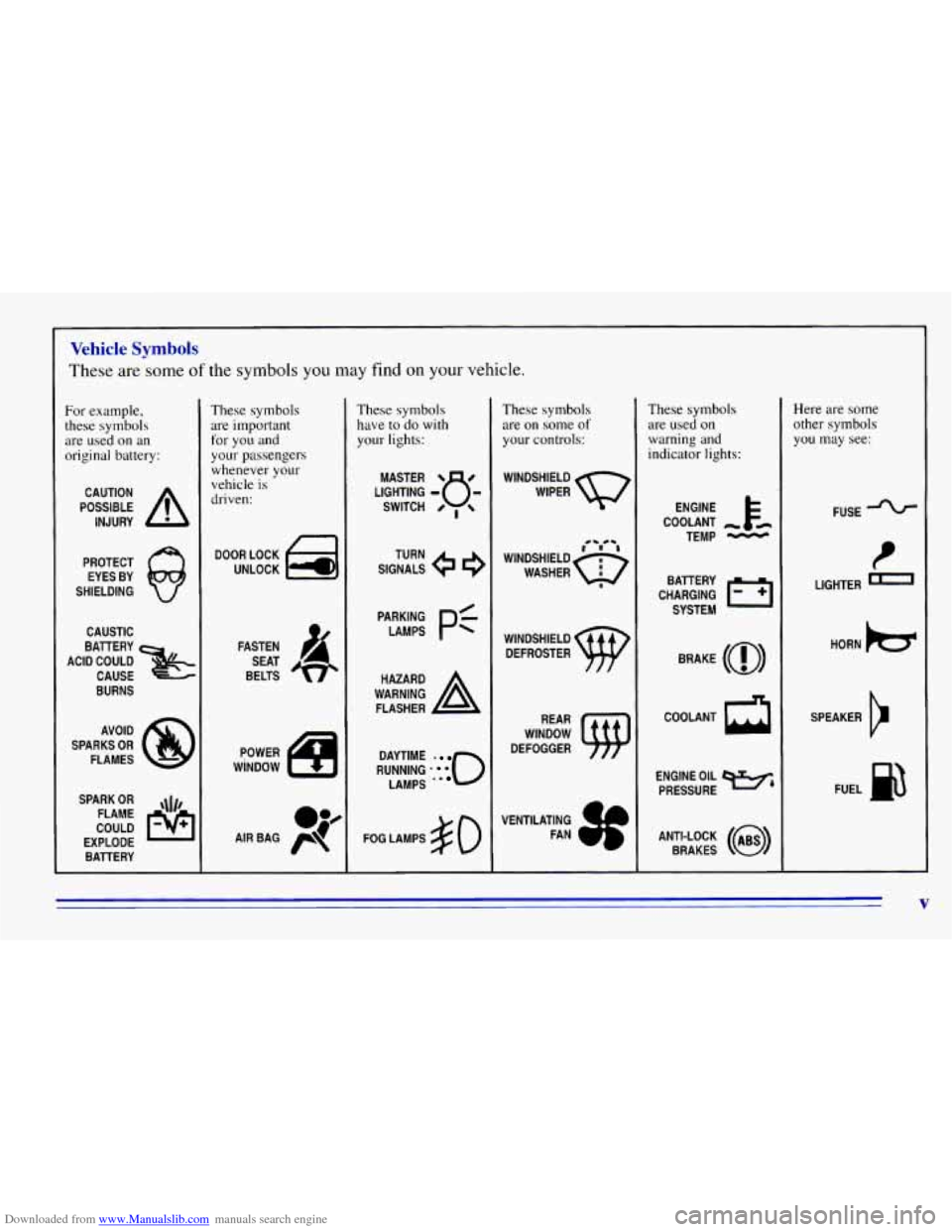
Downloaded from www.Manualslib.com manuals search engine Vehicle Symbols
These are some of the symbols you may find on your vehicle.
For example,
these symbols
are used
on an
original battery:
POSSIBLE A
CAUTION
INJURY
PROTECT EYES BY
SHIELDING
CAUSTIC
ACID COULD BATTERY
CAUSE
BURNS
SPARK
OR ,\I/,
COULD FLAME
EXPLODE BATTERY
These symbols
are important
for
you and
your passengers
whenever your
vehicle
is
driven:
DOOR LOCK
UNLOCK
FASTEN SEAT
BELTS
These symbols have to do with
your lights:
SIGNALS e e
TURN
RUNNING
-0
DAYTIME
LAMPS -*
FOG LAMPS # 0
These symbols
are on some of
your controls:
WINDSHIELD
DEFROSTER
VENTILATING FAN
These symbols
are used on
warning and
indicator lights:
COOLANT -
TEMP -
CHARGING BATTERY
SYSTEM
BRAKE
(0)
COOLANT a
ENGINE OIL e,
PRESSURE
ANTI-LOCK
(@)
BRAKES
Here are some
other symbols
you may see:
FUSE
t
LIGHTER -
HORN )tr
SPEAKER
b
FUEL m
V
Page 14 of 376
Downloaded from www.Manualslib.com manuals search engine The bucket seats can be adjusted forward or rearward
with the lever at the front
of the seat.
To adjust the seat, pull the lever up to release the seat
bottom and slide the seat where
you want it. Then
release the lever and try to move the seat with
your
body, to make sure the seat is locked into place.
’
A CAUTION:
You can lose control of the vehicle if you try to
adjust a manual driver’s seat while the vehicle is
moving. The sudden movement could startle and
confuse
you, or make you push a pedal when you
don’t want to. Adjust the driver’s seat only when
the vehicle
is not moving.
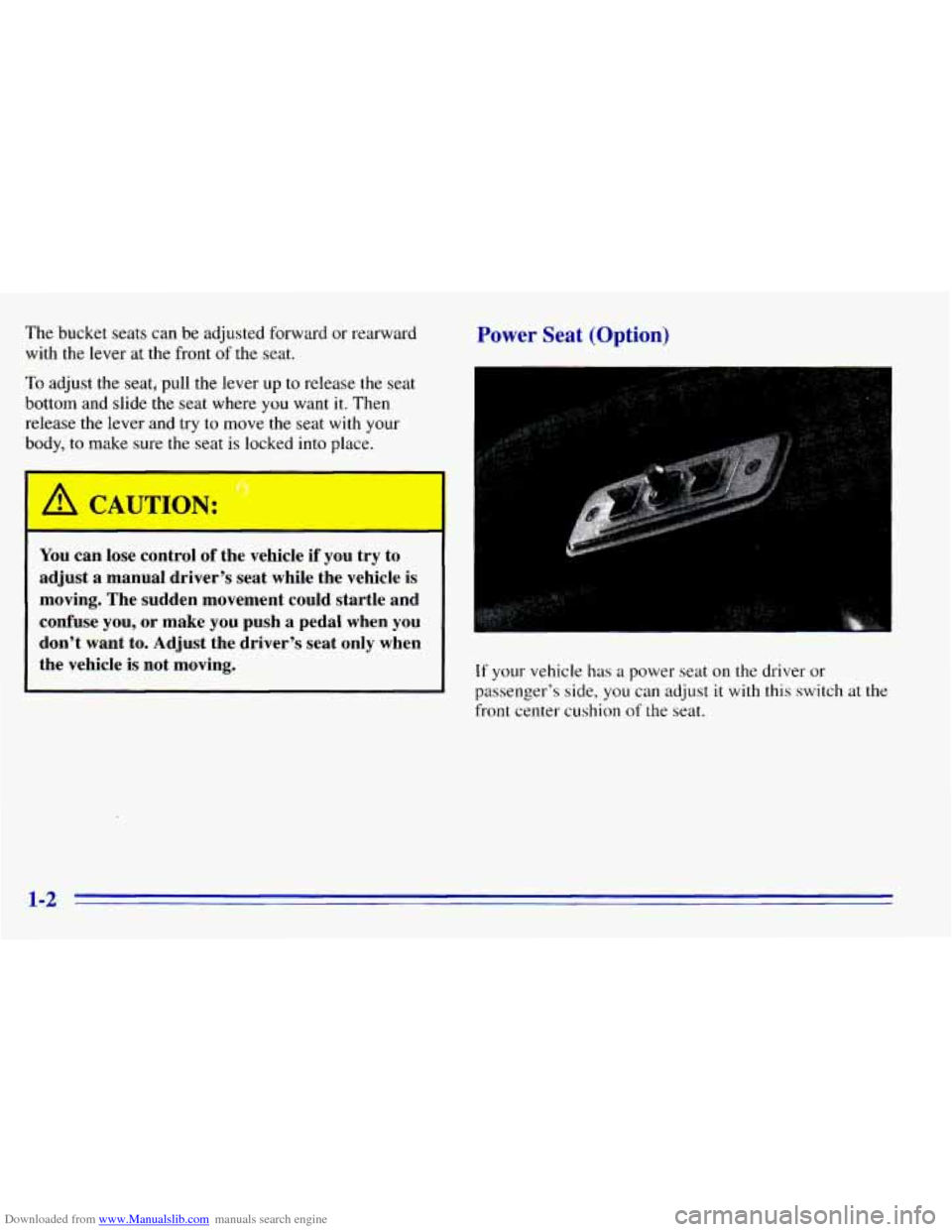
Power Seat (Option)
I
I
If your vehicle has a power seat on the driver or
passenger’s side, you
can adjust it with this switch at the
front center cushion
of the seat.
1-2
Page 33 of 376
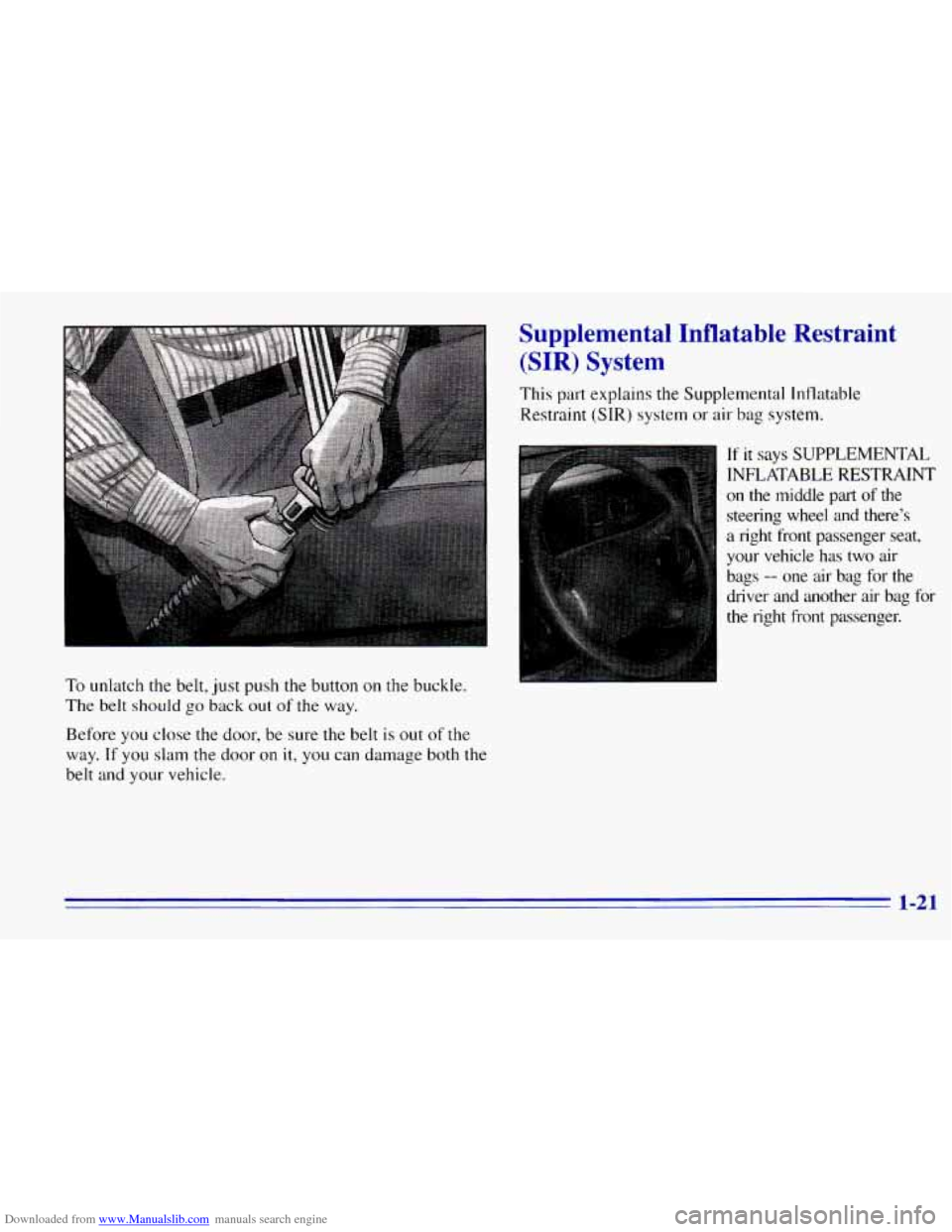
Downloaded from www.Manualslib.com manuals search engine To unlatch the belt, just push the button on the buckle.
The belt should
go back out of the way.
Before you close
the door, be sure the belt is out of the
way.
If you slam the door on it, you can damage both the
belt and your vehicle.
Supplemental Inflatable Restraint
(SIR) System
This part explains the Supplemental Inflatable
Restraint (SIR) system or
air bag system.
If it says SUPPLEMENTAL
INFLATABLE RESTRAINT
on the middle part of the
steering wheel and there’s
a right front passenger seat,
your vehicle has two air
bags
-- one air bag for the
driver and another air bag for
the right front passenger.
1-21
Page 34 of 376
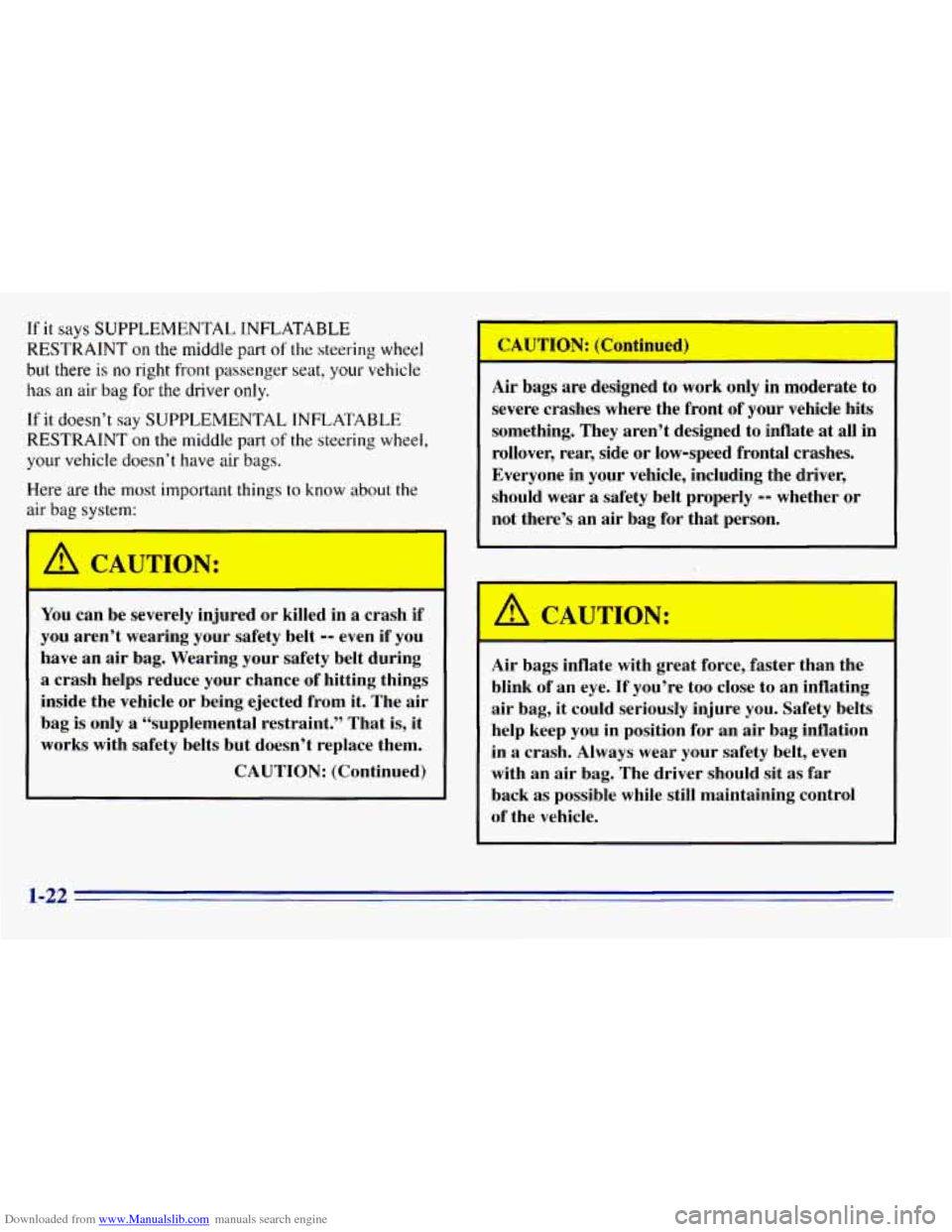
Downloaded from www.Manualslib.com manuals search engine If it says SUPPLEMENTAL INFLATABLE
RESTRAINT on the middle part
of the steering wheel
but there
is no right front passenger seat, your vehicle
has an air bag for the driver only.
If it doesn’t say SUPPLEMENTAL INFLATABLE
RESTRAINT
on the middle part of the steering wheel,
your vehicle doesn’t have air bags.
Here are the most important things to know about the
air bag system:
You can be severely injured or killed in a crash if
you aren’t wearing your safety belt -- even if you
have an air bag. Wearing your safety belt during
a crash helps reduce your chance of hitting things
inside the vehicle or being ejected from it. The air
bag is only
a “supplemental restraint.” That is, it
works with safety belts but doesn’t replace them.
CAUTION: (Continued)
CAUTION: 0
Air bags are designed to work only in moderate to
severe crashes where the front of your vehicle hits
something. They aren’t designed to inflate
at all in
rollover,
rear, side or low-speed frontal crashes.
Everyone in your vehicle, including the driver,
should wear
a safety belt properly -- whether or
not there’s an air bag for that person.
I A C1”’ L ION:
Air bags inflate with great force, faster than the
blink of
an eye. If you’re too close to an inflating
air bag, it could seriously injure you. Safety belts
help keep you in position for an
air bag inflation
in
a crash. Always wear your safety belt, even
with an
air bag. The driver should sit as far
back
as possible while still maintaining control
of the vehicle.
1-22
Page 41 of 376
Downloaded from www.Manualslib.com manuals search engine Safety Belt Use During Pregnancy
Safety belts work for everyone, including pregnant
women. Like
all occupants, they are more likely to be
seriously injured if
they don’t wear safety belts.
i
...I
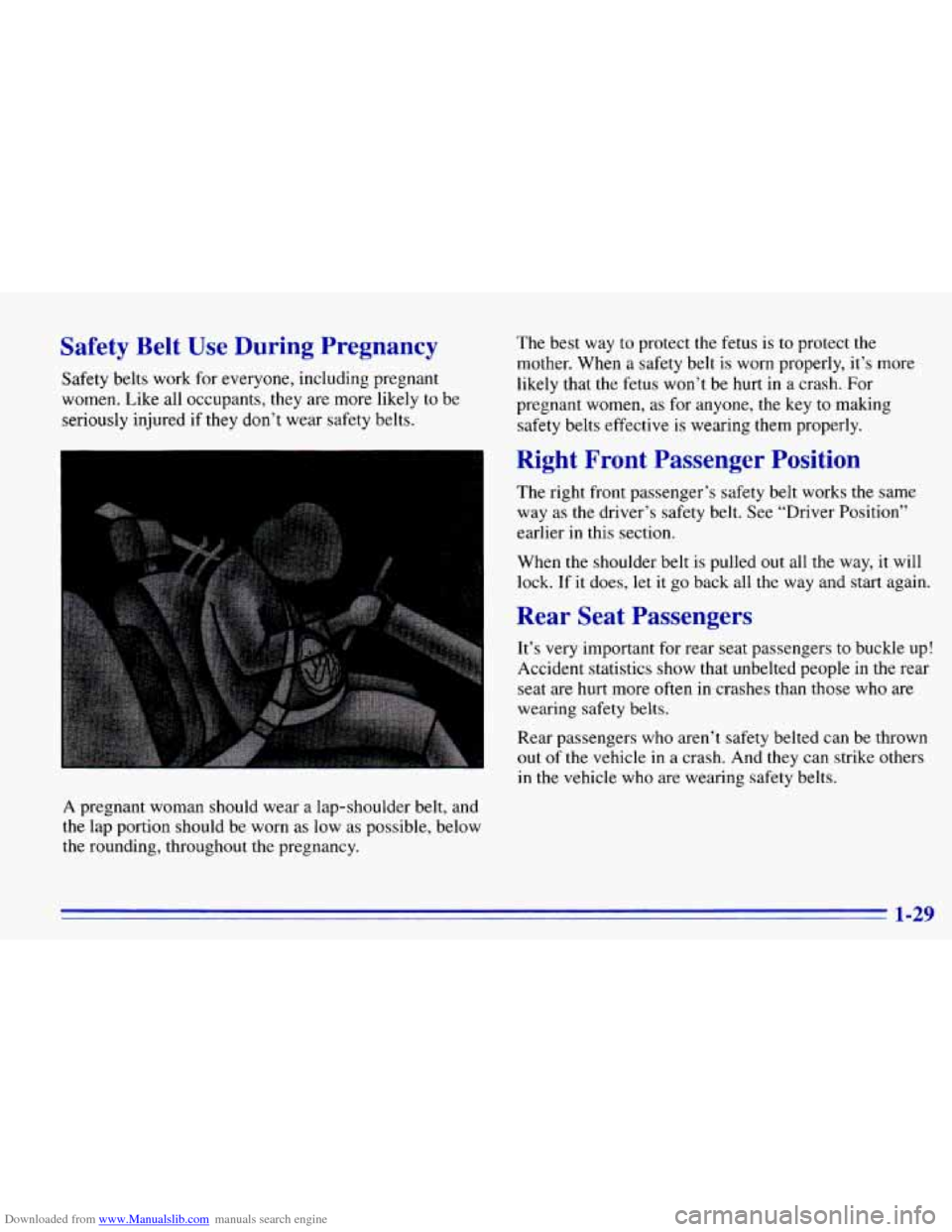
A pregnant woman should wear a lap-shoulder belt, and
the lap portion should
be worn as low as possible, below
the rounding, throughout the pregnancy. The
best way to protect
the fetus is to protect the
mother. When
a safety belt is worn properly, it’s more
likely that the fetus won’t be
hurt in a crash. For
pregnant women, as for anyone, the key to making
safety belts effective is wearing them properly.
Right Front Passenger Position
The right front passenger’s safety belt works the same
way as the driver’s safety belt. See “Driver Position”
earlier
in this section.
When the shoulder belt is pulled out all the way, it will
~ lock. If it does, let it go back all the way and start again.
Rear Seat Passengers
It’s very important for rear seat passengers to buckle up!
Accident statistics show that unbelted people in the rear
seat are hurt more
often in crashes than those who are
wearing safety belts.
Rear passengers who aren’t safety belted can be thrown
out of the vehicle in a crash. And they can strike others
in the vehicle who are wearing safety belts.
Page 42 of 376
Downloaded from www.Manualslib.com manuals search engine Rear Seat Outside Passenger Positions
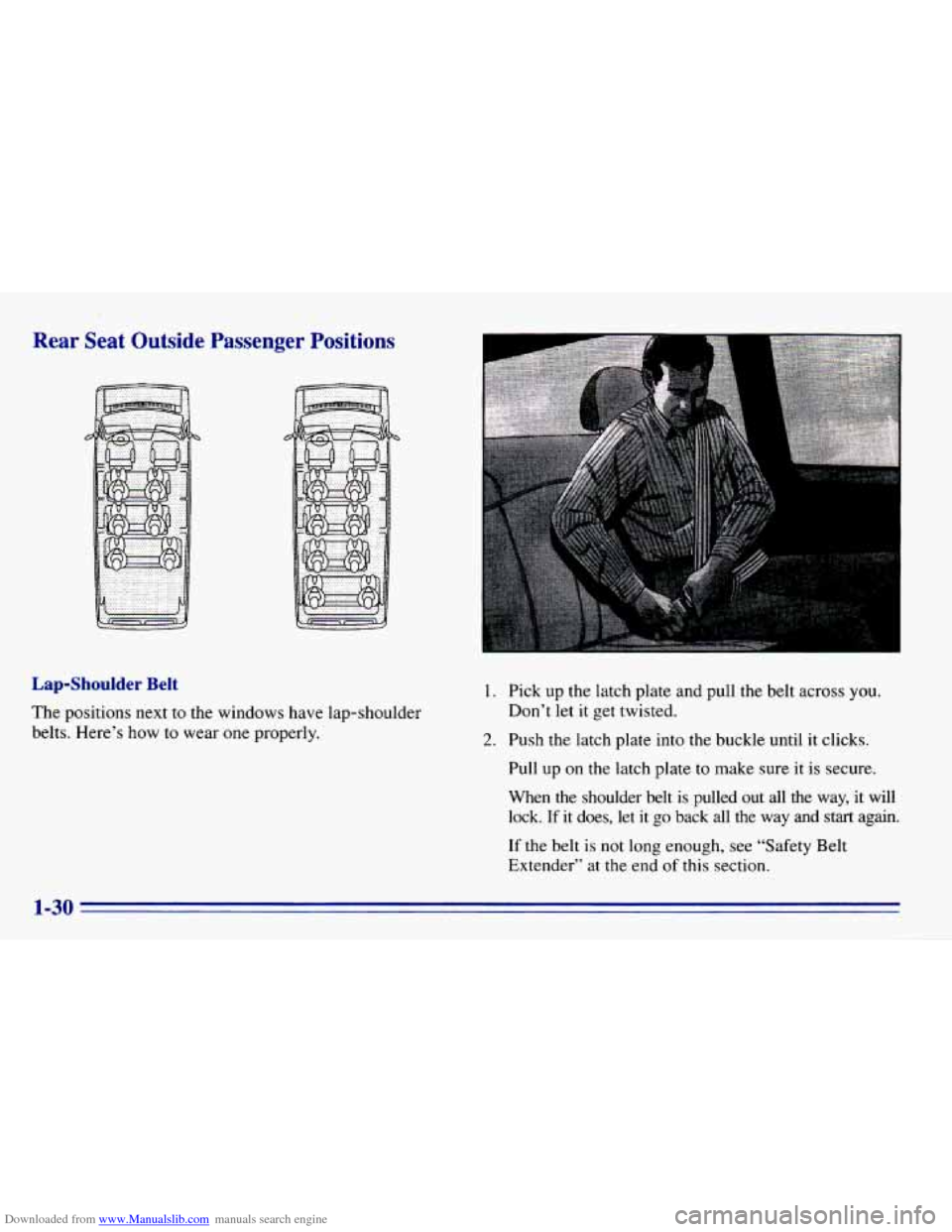
Lap-Shoulder Belt
The positions next to the windows have lap-shoulder
belts. Here’s
how to wear one properly.
1. Pick up the latch plate and pull the belt across you.
2. Push the latch plate into the buckle until it clicks.
Don’t let
it get twisted.
Pull up
on the latch plate to make sure it is secure.
When
the shoulder belt is pulled out all the way, it will
lock.
If it does, let it go back all the way and start again.
If the belt is not long enough, see “Safety Belt
Extender” at the end of this section.
1-30
Page 45 of 376
Downloaded from www.Manualslib.com manuals search engine Center Passenger Position
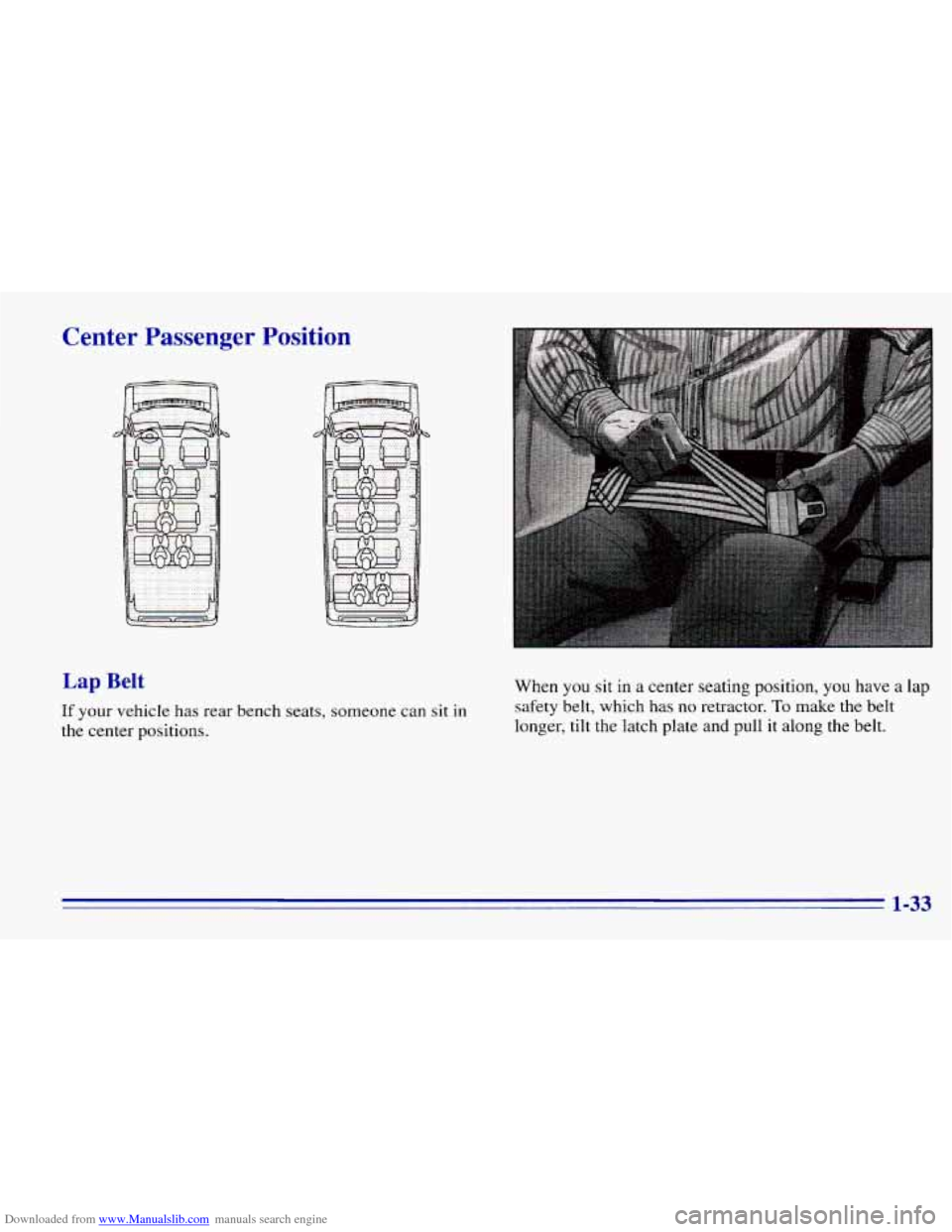
Lap Belt
If your vehicle has rear bench seats, someone can sit in
the center positions. When
you sit
in a center seating position, you have a lap
safety belt, which has no retractor. To make the belt
longer, tilt the latch plate and
pull it along the belt.
1-33
Page 49 of 376
Downloaded from www.Manualslib.com manuals search engine CAUTIOPT. ipontinuedi
at only 25 mph (40 km/h), a 12-1b. (5.5 kg) baby
will suddenly become
a 240-lb. (110 kg) force on
your arms. The baby
would be almost impossible
to hold.
Child Restraints
Be sure the child restraint is designed to be used in a
vehicle. If it is, it will have
a label saying that it meets
Federal Motor Vehicle Safety Standards.
Then follow the instructions for the restraint. You may
find these instructions on the restraint itself or in a
booklet, or both. These restraints
use the belt system in
your vehicle, but the child also has to be secured within
the restraint to help reduce the chance
of personal injury.
The instructions that come with the infant
or child
restraint will show you how to do that.
Where to Put the Restraint (Except Cargo
Vans and Cab and Chassis Models)
Accident statistics show that children are safer if they
are restrained in the rear rather than the front seat. We at
General Motors therefore recommend that you put your
child restraint in a rear seat. If your vehicle has a front passenger air bag,
neuer put a rear-facing child restraint
in the front passenger seat. Here’s why:
I A CAUTION: I
A child in a rear-facing child restraint can be
seriously injured
if the right front passenger’s
air bag inflates. This is because the back of a
rear-facing child restraint would be very close to
the inflating air bag.
If your vehicle has a right
front passenger’s air bag, always secure a
rear-facing child restraint in a rear seat.
You may, however, secure a forward-facing child
restraint in the right front seat. Before you secure
a forward-facing child restraint, always move the
front passenger seat
as far back as it will go. Or,
secure the child restraint in a
rear seat.
Wherever you install it, be sure to secure the child
-estraint properly.
Keep in mind that an unsecured child restraint can move
around in a collision or sudden stop and injure people in
the vehicle. Be sure
to properly secure any child
restraint in your vehicle
-- even when no child is in it.
1-37
Page 50 of 376
Downloaded from www.Manualslib.com manuals search engine Where to. Put the Restraint (Cargo Vans
and Cab and Chassis Models)
The child restraint must be secured properly in the
passenger seat. If your vehicle has a passenger air bag,
never- put a rear-facing child restraint in this vehicle.
Here's why:
r"
A child in a rear-facing child restraint can be
seriously injured if the passenger's
air bag
inflates. This
is because the back of a rear-facing
child restraint would
be very close to the inflating
air bag. Do not use a rear-facing child restraint in
this vehicle.
If a forward-facing child restraint is suitable for
your child, always move the passenger seat as
far
back as it will go.
Keep in mind that an unsecured child restraint can move
around in a collision or sudden stop and injure people
in the vehicle. Be sure to properly secure any child
restraint in your vehicle'
-- even when no child is in it.
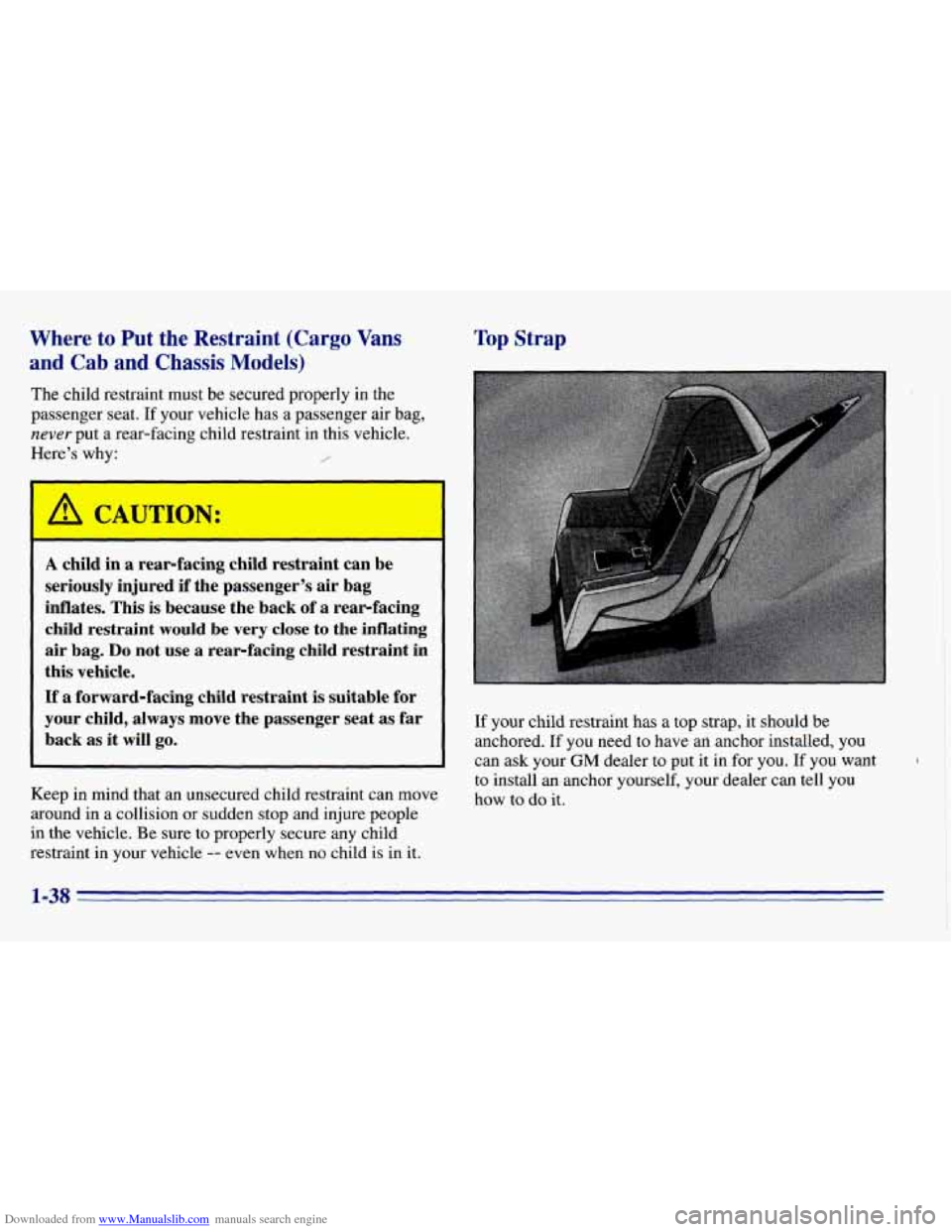
Top Strap
If your child restraint has a top strap, it should be
anchored. If
you need to have an anchor installed, you
can ask your GM dealer to put it in for you. If you want
to install an anchor yourself, your 'dealer can tell you
how to
do it.
1-38
Page 54 of 376
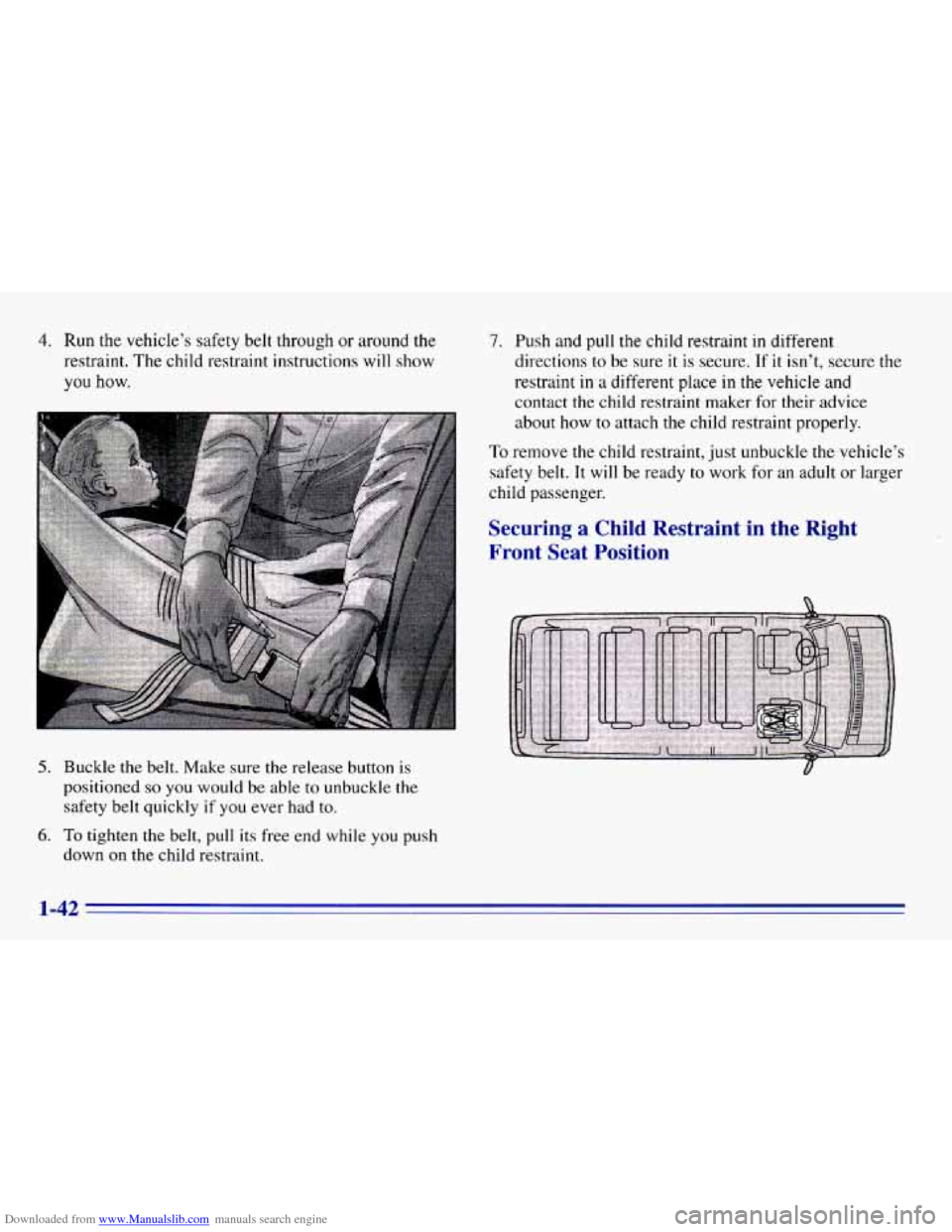
Downloaded from www.Manualslib.com manuals search engine 4. Run the vehicle’s safety belt through or around the
restraint. The child restraint instructions will show
you how.
5. Buckle the belt. Make sure the release button is
positioned
so you would be able to unbuckle the
safety belt quickly
if you ever had to.
6. To tighten the belt, pull its free end while you push
down
on the child restraint.
7. Push and pull the child restraint in different
directions
to be sure it is secure. If it isn’t, secure the
restraint
in a different place in the vehicle and
contact the child restraint maker for their advice
about how
to attach the child restraint properly.
To remove the child restraint, just unbuckle
the vehicle’s
safety belt.
It will be ready to work for an adult or larger
child passenger.
Securing a Child Restraint in the Right
Front Seat Position
1-42