wiring CHEVROLET EXPRESS 1996 1.G Owners Manual
[x] Cancel search | Manufacturer: CHEVROLET, Model Year: 1996, Model line: EXPRESS, Model: CHEVROLET EXPRESS 1996 1.GPages: 376, PDF Size: 18.83 MB
Page 73 of 376
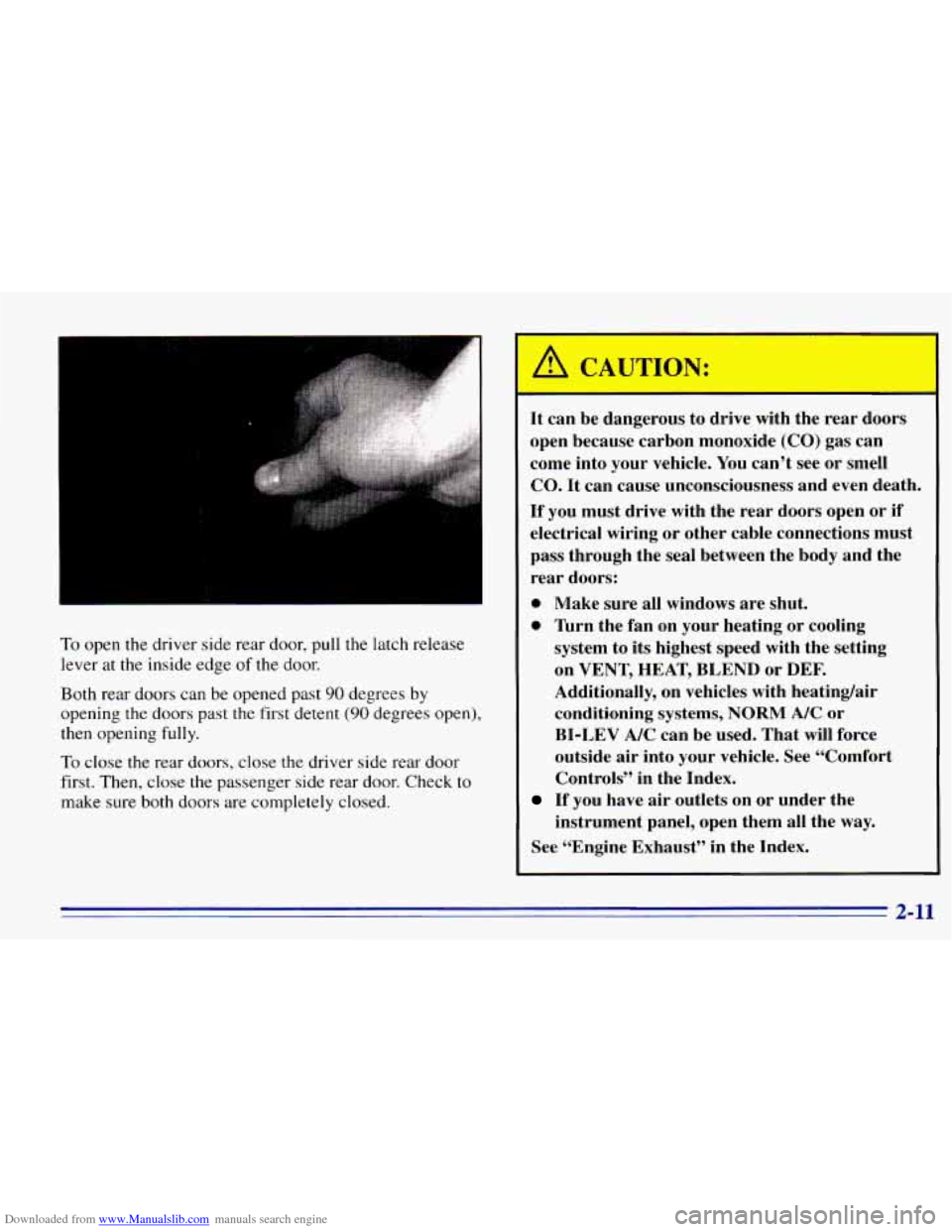
Downloaded from www.Manualslib.com manuals search engine To open the driver side rear door, pull the latch release
lever
at the inside edge of the door.
Both rear doors can be opened past
90 degrees by
opening
the doors past the first detent (90 degrees open),
then opening fully.
To close the rear doors, close the driver side rear door
first. Then, close the passenger side rear door. Check to
make sure both doors are completely closed.
A CAUTION:
It can be dangerous to drive with the rear doors
open because carbon monoxide (CO) gas can
come into your vehicle. You can’t see or smell
CO. It can cause unconsciousness and even death.
If you must drive with the rear doors open or if
electrical wiring or other cable connections must
pass through the seal between the body and the
rear doors:
0 Make sure all windows are shut.
0 lbrn the fan on your heating or cooling
system to its highest speed with the setting
on VENT, HEAT,
BLEND or DEF.
Additionally, on vehicles with heatinglair
conditioning systems,
NORM A/C or
BI-LEV A/C can be used. That will force
outside air into your vehicle. See “Comfort
Controls” in the Index.
instrument panel, open them all the way.
If you have air outlets on or under the
See “Engine Exhaust” in the Index.
2-11
Page 90 of 376
Downloaded from www.Manualslib.com manuals search engine CAUTION:
It can be dangerous to drive with the rear
swing-out windows or rear door(s) open because
carbon monoxide (CO) gas can come into your
vehicle. You can’t see or smell CO. It can cause
unconsciousness and even death.
If you must drive with the rear swing-out
windows or rear door(s) open or if electrical
wiring or other cable connections must pass
through the seal between the body and the rear
swing-out windows or rear door(s):
Make sure all windows are shut.
CAUTION: (Continued) CAUTION:
(Continued)
Turn the fan on your heating or cooling
system to its highest speed with the setting
on VENT, HEAT, BLEND or DEF.
Additionally, on vehicles with heatingair
conditioning systems, NORM A/C or
BI-LEV
A/C can be used. That will force
outside air into your vehicle. See “Comfort
Controls” in the Index.
instrument panel, open them all the way.
If you have air outlets on or under the
See “Engine Exhaust” in the Index.
Horn
Press one of the horn buttons at each side of the steering
wheel to sound the horn.
2-28
Page 98 of 376
Downloaded from www.Manualslib.com manuals search engine Rotate the switch knob clockwise again to the master
lighting symbol
to turn on all the lamps listed as well as
the headlamps.
Rotate the switch counterclockwise to
OFF to turn off
your lamps.
Rotate the thumb wheel next
to the switch knob up to
adjust instrument panel lights. Rotate the thumb wheel up
to the first notch to return the radio display and gearshift
indicator display
to full intensity when the headlamps or
parking lamps are
on.
Rotate the thumb wheel up to the second notch to
activate the interior dome lamps.
You can switch your headlamps from high to low beam
by pulling
on the turn signalhigh beam lever.
A circuit breaker protects your headlamps. If you have
an electrical overload, your headlamps will flicker on
and off. Have your headlamp wiring checked right away
if this happens.
Headlamps On Reminder
A buzzer will sound when your headlamps are turned on
and your ignition is in OFF, LOCK or ACCESSORY.
If
you need to use your headlamps when the ignition
switch is in
OFF, LOCK or ACCESSORY, the buzzer
can be turned off by turning the thumb wheel next to the
parking lampheadlamp switch all the way down.
Daytime Running Lamps (If Equipped)
Daytime Running Lamps (DRL) can make it easier for
others
to see the front of your vehicle during the day.
DRL can be helpful in many different driving
conditions, but they can be especially helpful in the
short periods after dawn and before sunset.
The DRL system will make your headlamps come
on at
a reduced brightness when:
0 The ignition is on,
The headlamp switch is off and
0 The parking brake is released.
If your vehicle was first sold, when new, in Canada,
your headlamps will come
on at reduced brightness.
2-36
Page 109 of 376
Downloaded from www.Manualslib.com manuals search engine Air Bag Readiness Light
There is an air bag readiness light on the instrument
panel, which shows AIR BAG. The system checks the
air bag’s electrical system for malfunctions. The light
tells
you if there is an electrical problem. The system
check includes the air bag sensor, the air bag modules,
the wiring and the crash sensing and diagnostic module.
For more information
on the air bag system, see “Air
Bag” in
the Index.
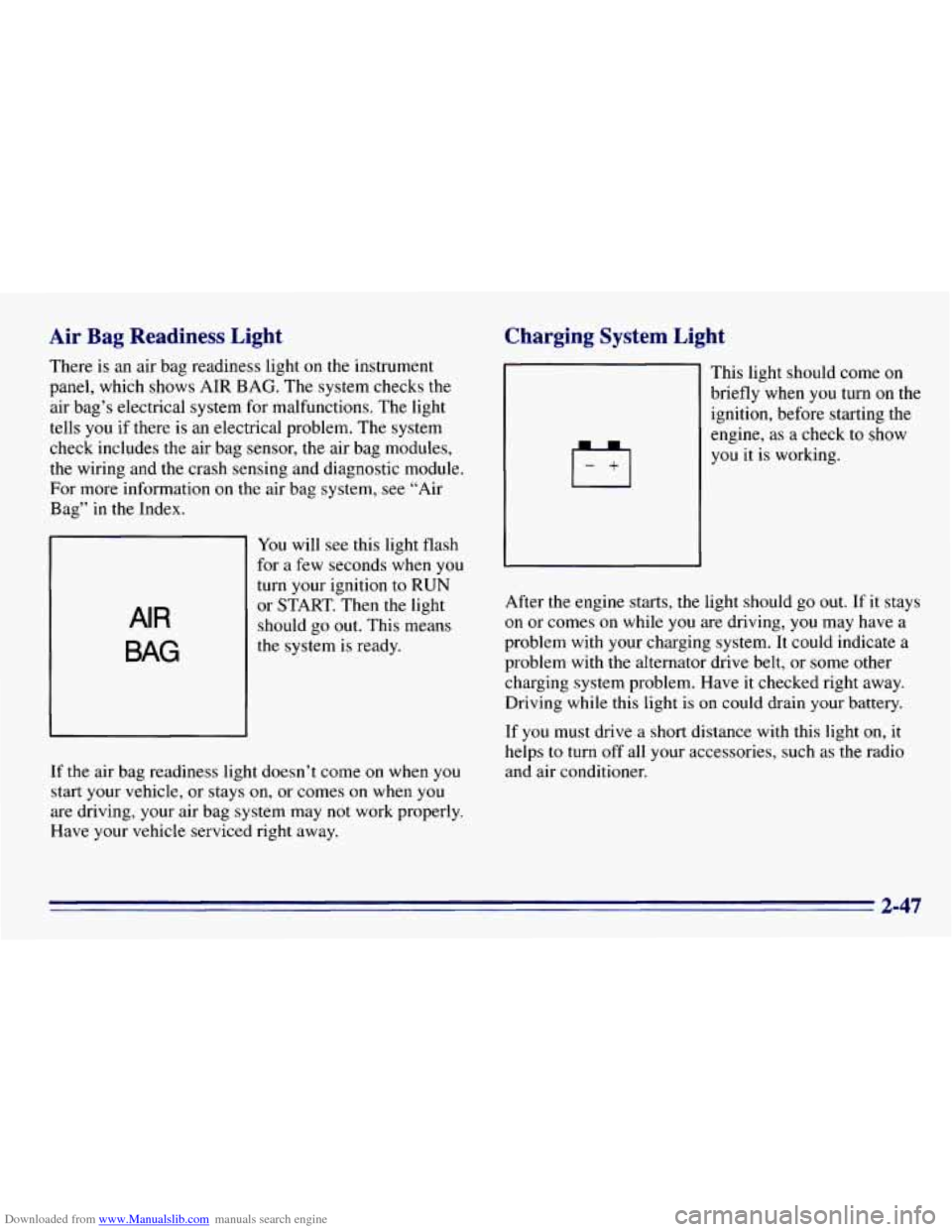
AIR
BAG
You will see this light flash
for a few seconds when you
turn your ignition to
RUN
or START. Then the light
should go
out. This means
the system is ready.
If the air bag readiness light doesn’t come on when you
start your vehicle, or stays on, or comes on when you
are driving, your air bag system may not work properly.
Have your vehicle serviced right away.
Charging System Light
This light should come on
briefly when you turn on the
ignition, before starting the
engine, as a check to show
you
it is working.
After the engine starts, the light should go out. If it stays
on or comes on while you are driving, you may have a
problem with your charging system. It could indicate a
problem with the alternator drive belt, or some other
charging system problem. Have it checked right away.
Driving while this light is on could drain your battery.
If you must drive a short distance with this light
on, it
helps
to turn off all your accessories, such as the radio
and air conditioner.
2-47
Page 185 of 376
Downloaded from www.Manualslib.com manuals search engine 0 Will you have to make any holes in the body of your
vehicle when you install a trailer hitch?
If you’re using the wiring provided by the
factory-installed hitch,
you should not need to make
any holes in the body of your
vehicle. However, if
you have an aftermarket hitch installed,
:you may
need
to make holes in the body.
If you
do, then be sure to seal the holes later when
you remove the hitch. If you don’t seal them, deadly
carbon monoxide
(CO) from your exhaust can get
into your vehicle (see “Carbon Monoxide”
in the
Index). Dirt and water can, too.
Safety Chains
You should always attach chains between your vehicle
and your trailer. Cross the safety chains under the tongue
of the trailer so that the tongue will not drop to the road
if it becomes separated from the hitch. Instructions
about safety chains may be provided by the hitch
manufacturer or by the trailer manufacturer. Follow the
manufacturer’s recommendation for attaching safety
chains and do not attach them
to the bumper. Always
leave just enough slack
so you can turn with your rig.
And, never allow safety chains to drag on the ground.
Trailer Brakes
If your trailer weighs more than 1,000 lbs. (450 kg)
loaded, then it needs
its own brakes -- and they must be
adequate.
Be sure to read and follow the instructions for
the trailer brakes
so you’ll be able to install, adjust and
maintain them properly.
Page 187 of 376
Downloaded from www.Manualslib.com manuals search engine Passing
You’ll need more passing distance up ahead when
you’re towing a trailer. And, because you’re a good deal
longer, you’ll need to go much farther beyond the
passed vehicle before you can return to your lane.
Backing Up
Hold the bottom of the steering wheel with one hand.
Then, to move the trailer
to the left, just move that hand
to the left. To move the trailer to the right, move your
hand to the right. Always back up slowly and, if
possible, have someone guide
you.
Making firns
I NOTICE:
Making very sharp turns while trailering could
cause the trailer to come in contact with the
vehicle. Your vehicle could be damaged. Avoid
making very sharp turns while trailering.
When you’re turning with a trailer, make wider
turns than normal.
Do this so your trailer won’t
strike soft shoulders, curbs, road signs, trees or other
objects. Avoid jerky or sudden maneuvers. Signal well
in advance.
lhrn Signals When Towing a Trailer
When you tow a trailer, your vehicle has to have extra
wiring and a heavy-duty turn signal flasher (included in
the optional trailering package).
The green arrows
on your instrument panel will flash
whenever
you signal a turn or lane change. Properly
hooked up, the trailer lamps will also flash, telling other
drivers you’re about to turn, change lanes or stop.
When towing a trailer, the green arrows on your
instrument panel will flash for turns even
if the bulbs on
the trailer are burned out. Thus, you may think drivers
behind
you are seeing your signal when they are not. It’s
important to check occasionally
to be sure the trailer
bulbs are still working.
4-35
Page 189 of 376
Downloaded from www.Manualslib.com manuals search engine When You Are Ready to Leave After
Parking on a
Hill
1. Apply your regular brakes and hold the pedal down
while you:
Start your engine;
Shift into a gear; and
Release the parking brake.
2. Let up on the brake pedal.
3. Drive slowly until the trailer is clear of the chocks.
4. Stop and have someone pick up and store the chocks.
Main ~ mr ~ ce When Trailer Towing
Your vehicle will need service more often when you’re
pulling a trailer. See the Maintenance Schedule for more
on this. Things that are especially important in trailer
operation are automatic transmission fluid (don’t
overfill), engine oil, axle lubricant, belt, cooling system
and brake adjustment. Each
of these is covered in this
manual, and the Index will help you find them quickly.
If you’re trailering, it’s a good idea
to review these
sections before
you start your trip.
Check periodically to see that all hitch nuts and bolts
are tight.
Trailer Wiring Harness
The eight-wire harness, if you have one, is stored under
your vehicle along the rear frame crossmember. It is
wrapped and bound with a plastic strap. The harness has
a 30-amp battery feed and no connector, and
you should
have a qualified electrical service person wire your
harness for
you. Attach the harness to the trailer, then
tape or strap
it to your vehicle’s frame rail. Be sure you
leave it loose enough so the wiring doesn’t bend or
break, but not
so loose that it drags on the ground.
Store the harness in its original place. Wrap the harness
together and tie it neatly
so it won’t be damaged.
The five-wire harness, if you have one, is stored inside
the vehicle at
the passenger side rear corner, behind the
jack. This should be wired by a qualified electrical
service person.
It must be routed out of your vehicle
between the rear door and the floor, with enough of the
harness left on both sides
so that the trailer or the body
won’t pull
it.
Store the harness in its original place. Wrap the harness
together and tie it neatly
so it won’t be damaged.
4-37
Page 289 of 376
Downloaded from www.Manualslib.com manuals search engine Electrical System
Add-on Electrical Equipment
NOTICE:
Don’t add anything electrical to your vehicle unless
you check with your dealer first. Some electrical
equipment can damage your vehicle and the
damage wouldn’t be covered by your warranty. Some add-on electrical equipment can keep other
components from working as they should.
Your vehicle has an air bag system. Before attempting to
add anything electrical to your vehicle, see “Servicing
Your Air Bag-Equipped Vehicle” in the Index.
Headlamp Wiring
The headlamp wiring is protected by a circuit breaker in
the lamp switch.
An electrical overload will cause the
lamps to flicker on and off,
or in some cases to remain
off. If this happens, have your headlamp wiring checked
right away.
Windshield Wiper Fuses
The windshield wiper motor is protected by a circuit
breaker and
a fuse. If the motor overheats due to heavy
snow, etc., the wiper will stop until the motor cools.
Although the circuit is protected from electrical
overload, overload due
to heavy snow, etc., may cause
wiper linkage damage. Always clear ice and heavy snow
from the the windshield before using the windshield
wipers. If the overload is caused by some electrical
problem and not snow, etc., be sure to get
it fixed.
Power Windows and Other Power Options
Circuit breakers in the fuse panel protect the power
windows and other power accessories. When the current
load is too heavy, the circuit breaker opens and closes.
This protects the circuit until the current load returns
to
normal or the problem is fixed.
6-61
Page 368 of 376
Downloaded from www.Manualslib.com manuals search engine Engine ........................................ 6-8
Coolant
..................................... 6-20
Coolant Level Check
.......................... 7-43
Coolant Temperature Gage
..................... 2-54
Cooling System
.............................. 6-66
Exhaust
..................................... 2-24
Identification
........................... 6-60. 6-65
OilLevelCheck
.............................. 7-43
Overheating
................................. 5- 10
Running While Parked ......................... 2-25
StartingYour
................................ 2-14
Engineoil
.................................... 6-11
Additives ................................... 6-13
Checking
................................... 6-11
Pressure Gage
................................ 2-52
Used
....................................... 6-14
Whentochange
.............................. 6-14
Ethanol
........................................ 6-3
Exhaust, Engine
................................ 2-24
Fabric Cleaning
............................... 6-5 I
Fan Control, Climate Control System ................ 3-2
FillingYourTank
................................ 6-4
Filter, Air
..................................... 6-15
Finish Care
.................................... 6-56
Finish Damage ................................. 6-57
First Gear, Automatic Transmission
................ 2- I9
Flashers, Hazard Warning ......................... 5-1
Flat Tire. Changing
............................. 5-20
Fluid Capacities
................................ 6-65
Fluids and Lubricants
............................ 7-49
Foreign Countries, Fuel
........................... 6-4
Adding ..................................... 6-11
French Language Manual 11
Front Parkingflurn Signal Lamp Bulb Replacement .... 6-34
Front Storage Area
.............................. 2-41
FrontTowing
................................... 5-8
Fuel .......................................... 6-2
Canada
...................................... 6-3
Filling Your Tank
.............................. 6-4
Gage
....................................... 2-53
In Foreign Countries ........................... 6-4
Tank Capacity
............................... 6-67
Fuses and Circuit Breakers
....................... 6-62
Gages
.. ...........................
Engine Coolant Temperature .................... 2-54
Engine Oil Pressure
........................... 2-52
Fuel
....................................... 2-53
Speedometer
................................. 2-45
Voltmeter
................................... 2-55
Gear Positions. Automatic Transmission
............. 2-17
Gross Axle Weight Rating
........................ 4-27
Gross Vehicle Weight Rating
...................... 4-26
Guide en Franpis
11
GAWR ....................................... 4-27
.. .................................
GVWR ....................................... 4-26
Halogen
Bulbs ................................ 6-31
Hazard Warning Flashers .......................... 5-1
Head Restraints
................................. 1-5
Headlamps
.................................... 2-35
Bulb Replacement
............................ 6-31
HighLow Beam Changer ...................... 2-30
OnReminder
................................ 2-36
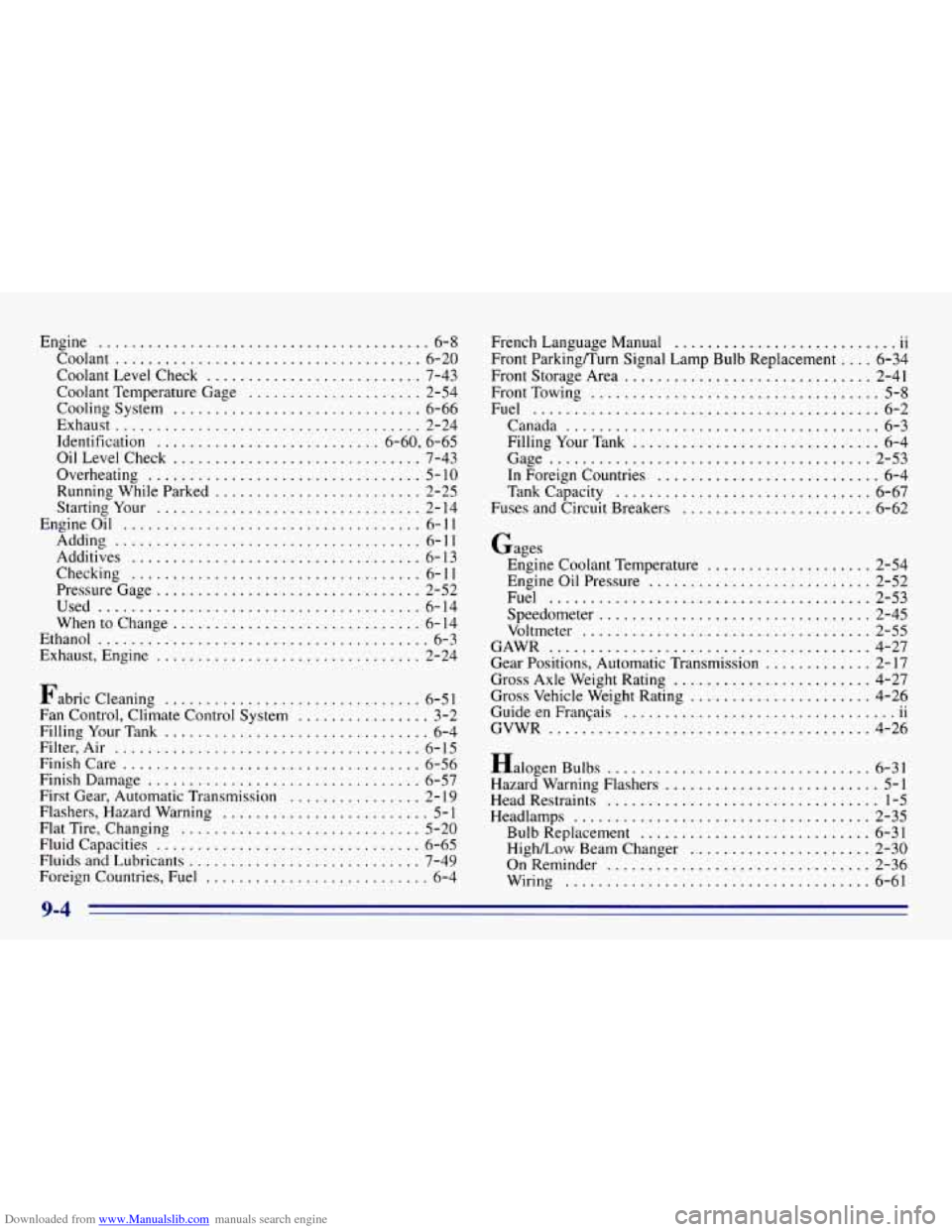
Wiring
..................................... 6-61
9-4
Page 373 of 376
Downloaded from www.Manualslib.com manuals search engine Steering ....................................... 4-8
Column Lock Check
.......................... 7-46
In Emergencies
................................ 4-9
Power
....................................... 4-8
Tips
......................................... 4-8
Wheel. Tilt
.................................. 2-29
StorageAreas
.................................. 2-41
Storage. Vehicle
................................ 6-30
Stuck: In Sand. Mud. Ice or Snow
............ ". ..... 5-35
SunVisors
.................................... 2-41
Supplemental Inflatable Restraint
.................. 1-2 1
Symbols, Vehicle .................................. v
Taillamp Bulb Replacement ...................... 6-36
Tape Player Care
............................... 3-28
Temperature Control. Climate Control System
......... 3- 1
Temperature Control. Passenger .................... 3-5
Theft
......................................... 2-12
Theft-Deterrent Feature
.......................... 3-23
Thermostat
.................................... 6-24
Third Gear. Automatic Transmission
................ 2- 19
Tilt Steering Wheel
............................. 2-29
Time. Setting the
................................ 3-9
Tire Chains
.................................... 6-50
TireLoading ................................... 4-26
Tire-Loading Information Label
................... 4-26
Tires
......................................... 6-41
Alignment and Balance
........................ 6-48
Buying New
................................. 6-45
Chains
..................................... 6-50
Changing
a Flat .............................. 5-20
Cleaning
.................................... 6-54
Dual Operation ............................... 6-45
Inflation
.................................... 6-42
Inflation Check
............................... 7-44
Inspection and Rotation
........................ 6-43
Loading
.................................... 4-26
Pressure
.................................... 6-42
Temperature
................................. 6-47
Traction
.................................... 6-47
Treadwear
................................... 6-47
Uniform Quality Grading
....................... 6-46
Wear Indicators
.............................. 6-44
Wheel Replacement
........................... 6-48
When It's Time for New
....................... 6-44
TopStrap
..................................... 1-38
TorqueLock
................................... 2-23
Torque. Wheel
Nut .............................. 6-65
Torque. Wheel
Nut .............................. 5-32
TowingaTrailer
................................ 4-28
Trailer Towing Your Vehicle
............................. 5-6
Brakes
..................................... 4-33
Driving on Grades
............................ 4-36
Driving
with ................................. 4-34
Hitches
..................................... 4-32
Maintenance When Towing ..................... 4-37
Parking on Hills
.............................. 4-36
Safety Chains
................................ 4-33
Tongueweight
............................... 4-31
Total Weight on Tires
.......................... 4-32
Towing
..................................... 4-28
Weight
..................................... 4-30
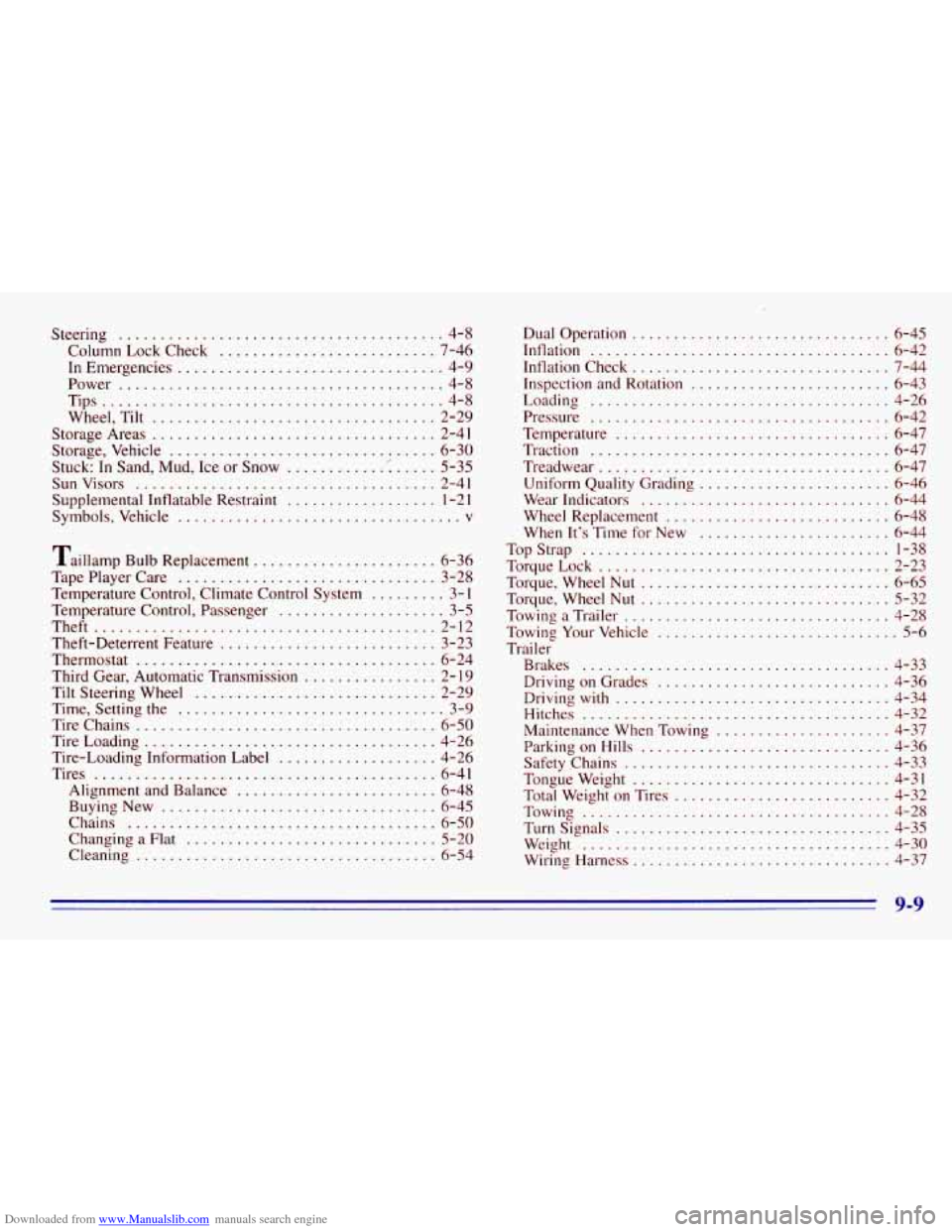
Wiring Harness
............................... 4-37
Turnsignals
................................. 4-35
9-9