ignition CHEVROLET EXPRESS 1997 1.G Owner's Manual
[x] Cancel search | Manufacturer: CHEVROLET, Model Year: 1997, Model line: EXPRESS, Model: CHEVROLET EXPRESS 1997 1.GPages: 386, PDF Size: 20.32 MB
Page 114 of 386
Downloaded from www.Manualslib.com manuals search engine A CAUTIOd:
2
Your brake system may not be working properly
if the brake system warning light is on. Driving
with the brake system warning light
on can lead
to an accident.
If the light is still on after you’ve
pulled off the road and stopped carefully, have
the vehicle towed for service.
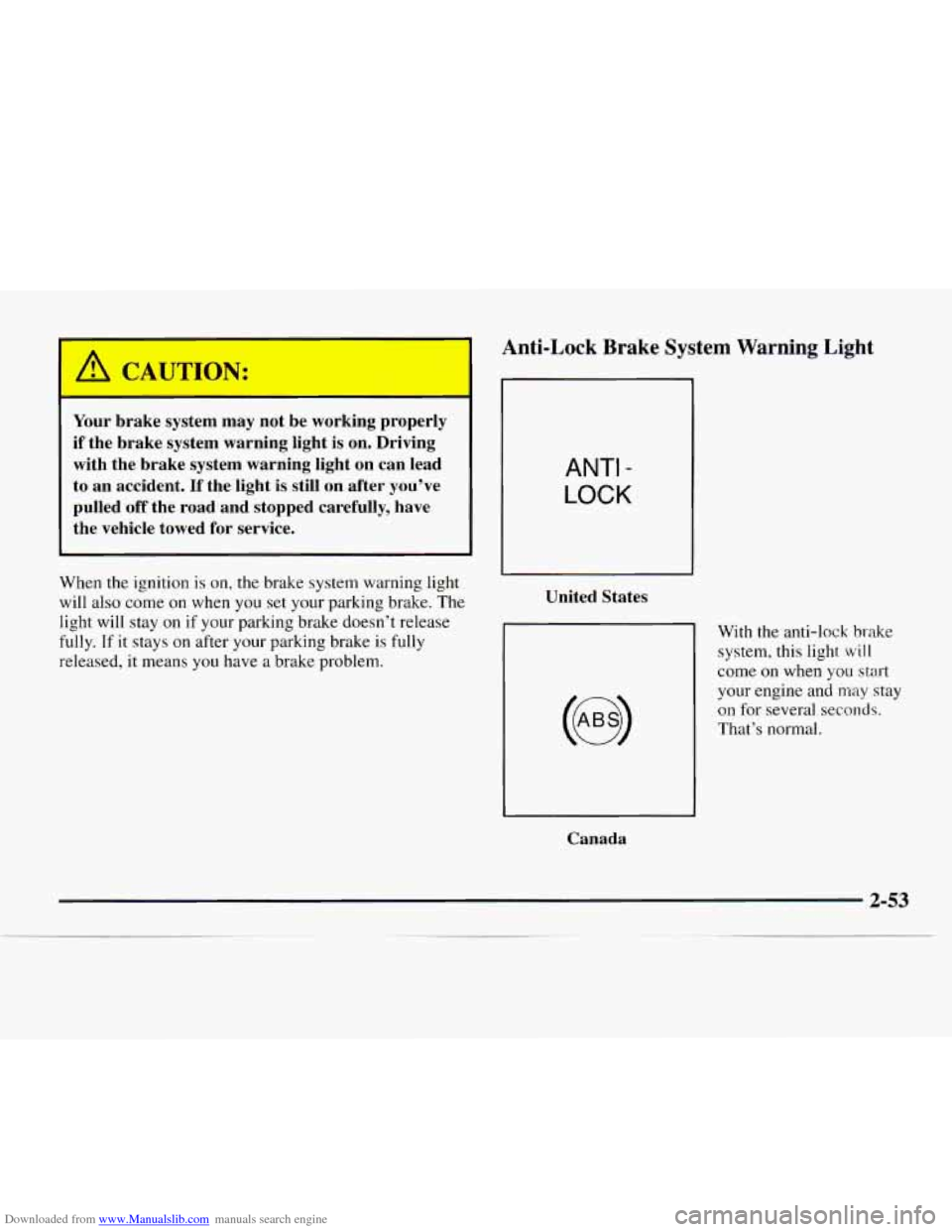
When the ignition is on, the brake system warning light
will also come
on when you set your parking brake. The
light will stay on
if your parking brake doesn’t release
fully. If it stays on after your parking brake is fully
released, it means you have a brake problem.
Anti-Lock Brake System Warning Light
ANTI -
LOCK
United States
Canada
With the anti-lock brake system, this light
will
come on when you start
your engine and may stay
on for several
seconds.
That’s normal.
Page 115 of 386
Downloaded from www.Manualslib.com manuals search engine If the light stays on, or comes on when you’re driving,
your vehicle needs service. If the regular brake system
warning light isn’t on, you still have brakes, but you
don’t have anti-lock brakes. If the regular brake system
warning light is also on, you don’t have anti-lock brakes
and there’s a problem with your regular brakes. See
“Brake System Warning Light” earlier
in this section.
The anti-lock brake system warning light should come
on briefly when you turn the ignition key to RUN. If the
light doesn’t come on then, have it fixed
so it will be
ready to warn
you if there is a problem.
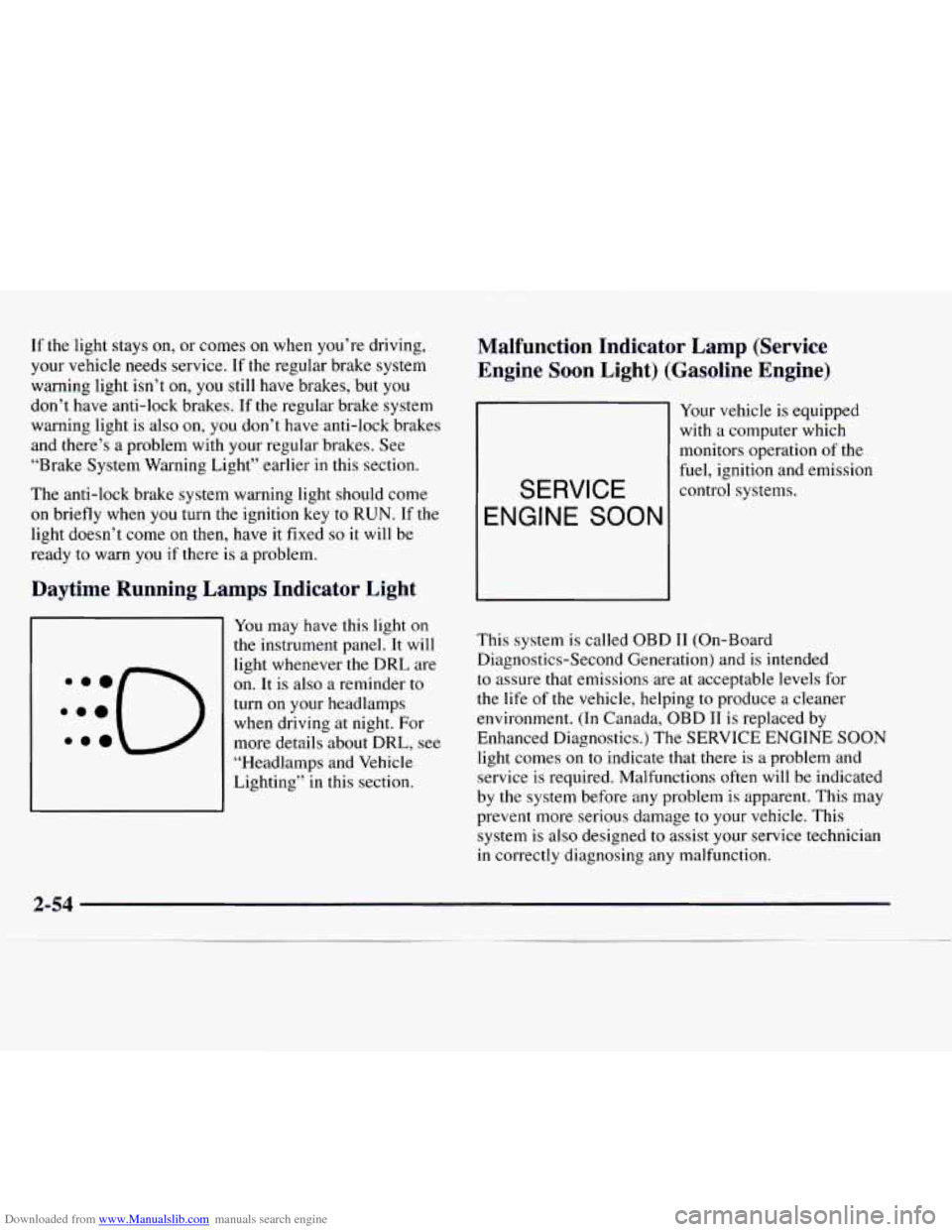
Daytime Running Lamps Indicator Light
You may have this light on
the instrument panel. It will
light whenever
the DRL are
on.
It is also a reminder to
turn on your headlamps when driving at night. For
more details about DRL, see
“Headlamps and Vehicle
Lighting” in this section.
Malfunction Indicator Lamp (Service
Engine Soon Light) (Gasoline Engine)
Your vehicle is equipped
with
a computer which
monitors operation of the
fuel, ignition and emission
control systems.
SERVICE
ENGINE SOON
This system is called OBD I1 (On-Board
Diagnostics-Second Generation) and is intended
to assure that emissions
are at acceptable levels for
the life of the vehicle, helping to produce a cleaner
environment.
(In Canada, OBD IT is replaced by
Enhanced Diagnostics.) The SERVICE
ENGINE SOON
light comes on to indicate that there is a problem and
service is required. Malfunctions often
will be indicated
by the system before any problem is apparent. This may
prevent more serious damage to
your vehicle. This
system is
also designed to assist your service technician
in correctly diagnosing any malfunction.
Page 116 of 386
Downloaded from www.Manualslib.com manuals search engine If the Light Is Flashing
1 NOTICE:
If you keep driving your vehicle with this light
on, after
a while, your emission controls may not
work
as well, your fuel economy may not be as
good and your engine may not run as smoothly.
This could lead
to costly repairs that may not be
l covered by your warranty.
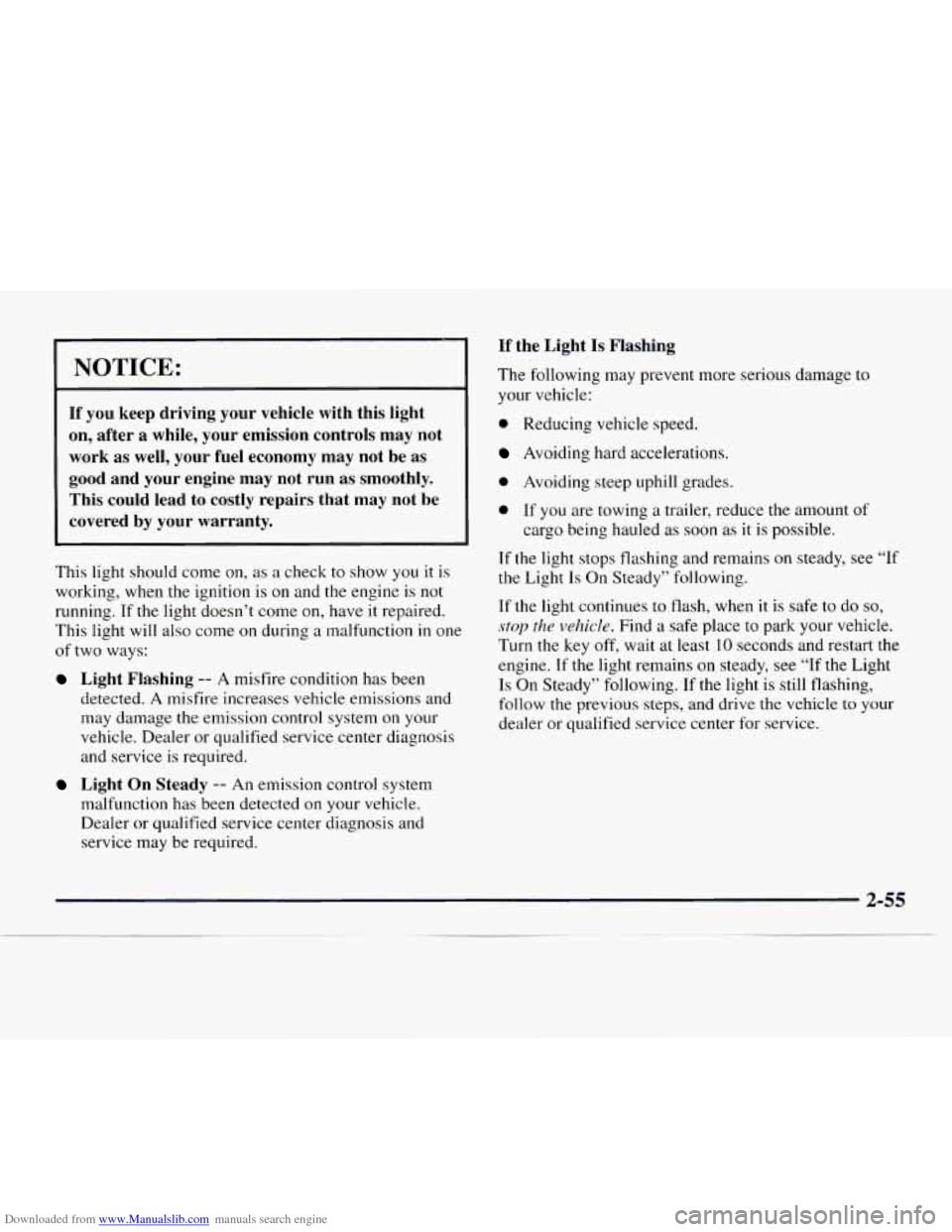
This light should come on, as a check to show you it is
working, when the ignition is on and the engine is not
running. If the light doesn’t come on, have it repaired.
This light
will also come on during a malfunction in one
of two ways:
Light Flashing -- A misfire condition has been
detected.
A misfire increases vehicle emissions and
may damage the emission control system
on your
vehicle. Dealer or qualified service center diagnosis
and service is required.
Light On Steady -- An emission control system
malfunction has been detected on your vehicle.
Dealer or qualified service center diagnosis and
service may be required. The following
may prevent more serious damage
to
your vehicle:
0 Reducing vehicle speed.
Avoiding hard accelerations.
0 Avoiding steep uphill grades.
0 If you are towing a trailer, reduce the amount of
cargo being hauled
as soon as it is possible.
If the light stops flashing and remains on steady, see “If
the Light
Is On Steady” following.
If the light continues to flash, when it is safe to do so,
stop the vehicle. Find a safe place to park your vehicle.
Turn
the key off, wait at least 10 seconds and restart the
engine.
If the light remains on steady, see “If the Light
Is On Steady” following. If the light is still flashing,
follow the previous steps, and drive the vehicle
to your
dealer or qualified service center for service.
Page 119 of 386
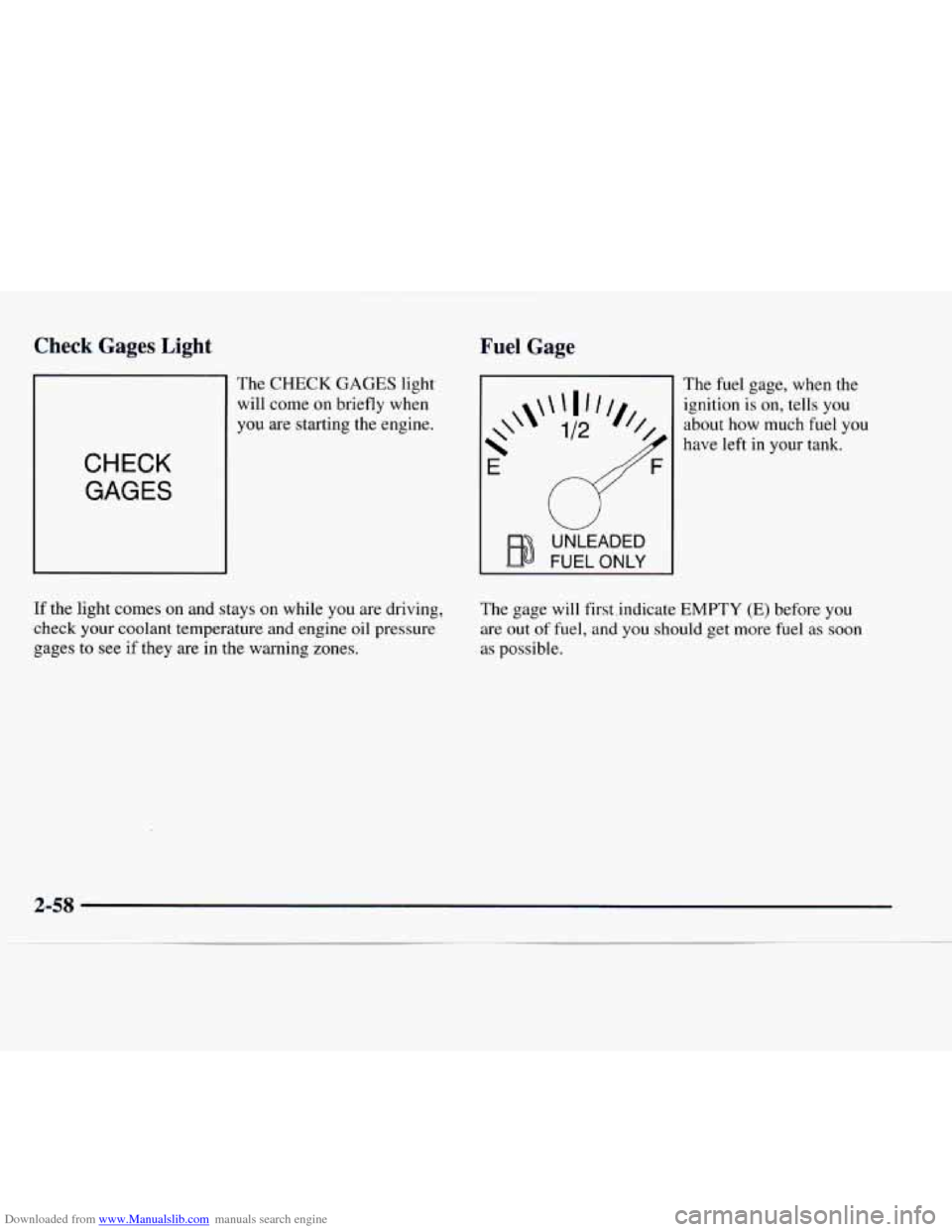
Downloaded from www.Manualslib.com manuals search engine Check Gages Light
The CHECK GAGES light
will come on briefly when
you are starting the engine.
CHECK
GAGES
Fuel Gage
UNLEADED
FUEL ONLY
The fuel gage, when the
ignition
is on, tells you
about how much fuel you
have
left in your tank.
If the light comes on and stays on while you are driving,
check your coolant temperature and engine oil pressure
gages to see if they are in
the warning zones. The gage
will first.indicate EMPTY
(E) before you
are out of fuel, and you should get more fuel as soon
as possible.
Page 120 of 386
Downloaded from www.Manualslib.com manuals search engine Listed are four situations you may experience with your
fuel gage:
0
0
0
0
At the gas station, the fuel pump shuts off before the
gage reads
FULL (F).
It takes a little more or less fuel to fill up than the
fuel gage indicated. For example, the gage may have
indicated the tank was half full, but it actually took a
little more or less than half the tank’s capacity to
fill
the tank.
The gage moves a little when you turn
a corner or
speed up.
The gage doesn’t
go back to EMPTY (E) when you
turn off the ignition.
None
of these indicate a problem with the fuel gage.
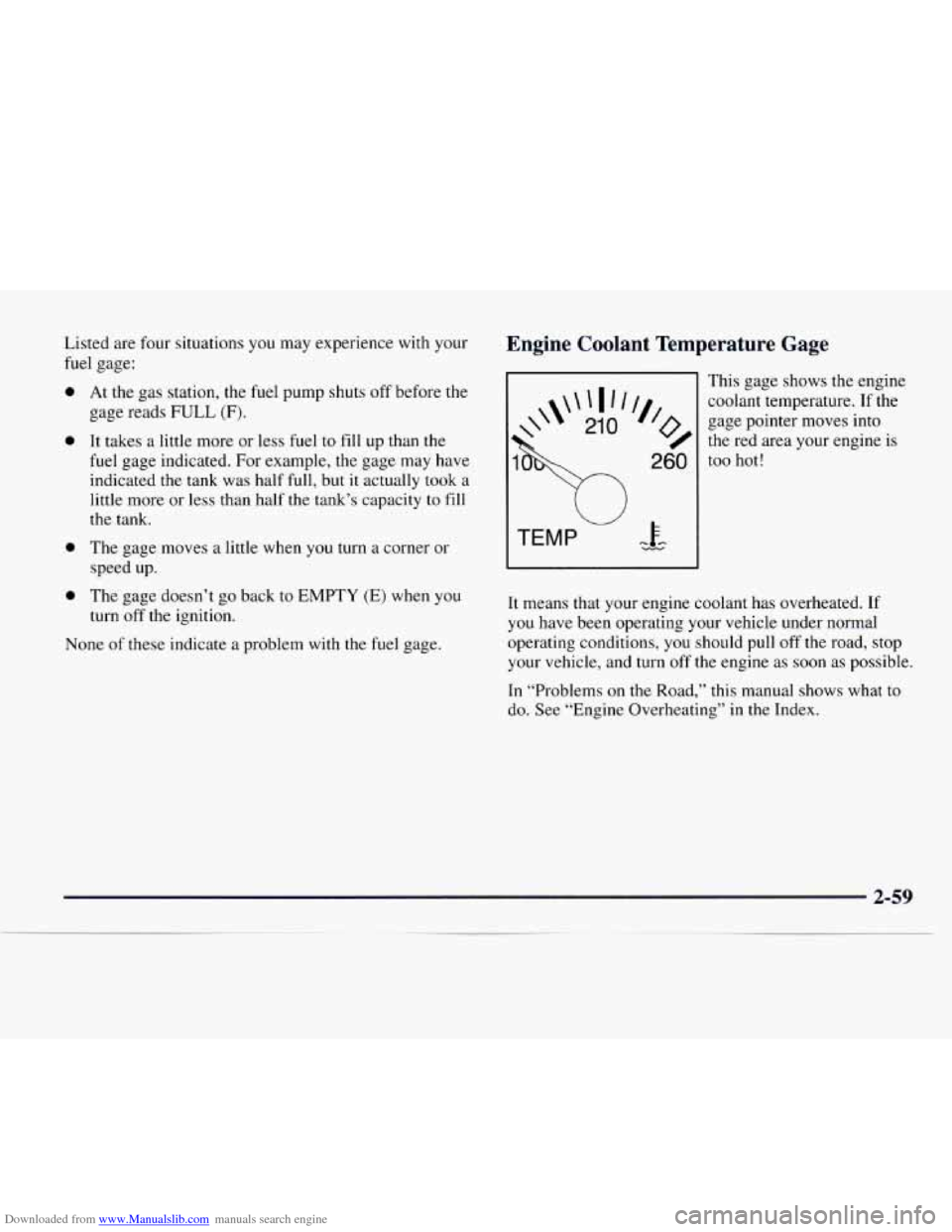
Engine Coolant Temperature Gage
This gage shows the engine
gage pointer moves into
the red area your engine is
coolant
temperature.
If the
’% 260
too hot!
It means that your engine coolant has overheated. If
you have been operating your vehicle under normal
operating conditions,
you should pull off the road, stop
your vehicle, and turn
off the engine as soon as possible.
In “Problems on the Road,” this manual shows what to
do. See “Engine Overheating” in the Index.
Page 121 of 386
Downloaded from www.Manualslib.com manuals search engine Voltmeter
u
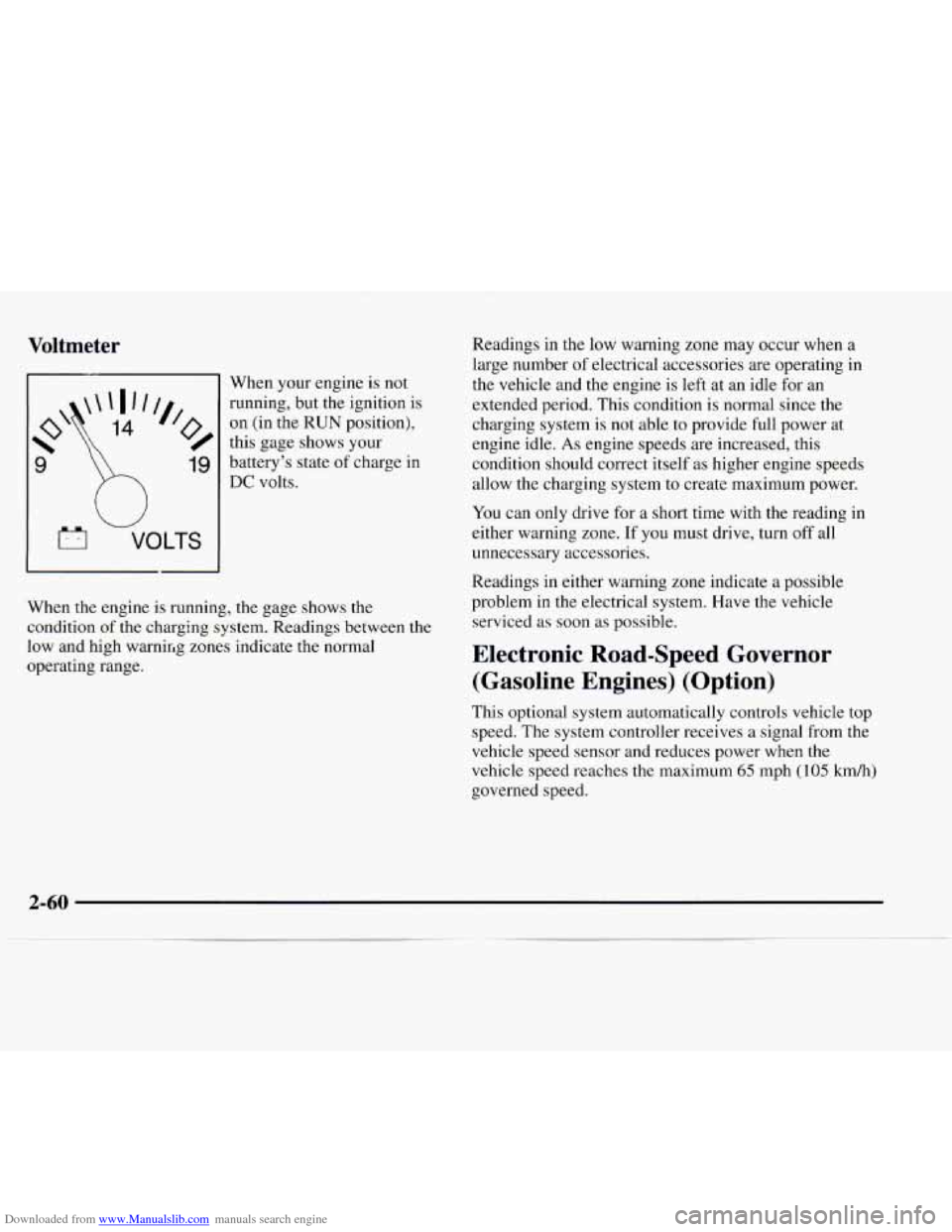
VOLTS
When your engine is not
running, but the ignition is
on (in the RUN position),
this gage shows your
battery’s state of charge in
DC volts.
When the engine
is running, the gage shows the
condition of the charging system. Readings between the
low and high warnir,g zones indicate the normal
operating range. Readings
in the low warning zone may occur when a
large number
of electrical accessories are operating in
the vehicle and the engine is left at an idle for an
extended period. This condition is normal since the
charging system is not able to provide full power at
engine idle.
As engine speeds are increased, this
condition should correct itself
as higher engine speeds
allow the charging system to create maximum power.
You can only drive for a short time with the reading
in
either warning zone. If you must drive, turn off all
unnecessary accessories.
Readings in either warning zone indicate a possible
problem in the electrical system. Have the vehicle
serviced as soon as possible.
Electronic Road-Speed Governor
(Gasoline Engines) (Option)
This optional system automatically controls vehicle top
speed. The system controller receives a signal from the
vehicle speed sensor and reduces power when the
vehicle speed reaches
the maximum 65 mph (105 km/h)
governed speed.
Page 133 of 386
Downloaded from www.Manualslib.com manuals search engine 0 Keep the air path under the front seats clear of
objects. This helps air to circulate throughout
your vehicle.
Your vehicle has air vents in the center and
on the sides
of your instrument panel.
You can move the vents from side to side or up and
down to direct the flow of air,
or close the vents
altogether. When you close a vent, it will increase the
flow of air coming out
of any vents that are open.
Audio Systems
Your Delco@ audio system has been designed to operate
easily and give years of listening pleasure. You will get
the most enjoyment out of it if you acquaint yourself
with
it first. Find out what your Delco system can do
and how to operate all its controls, to be sure you’re
getting the most out of the advanced engineering that
went into it.
Setting the Clock for Systems without
Automatic Tone Control
Press SET. Within five seconds, press and hold the
SEEK right arrow
until the correct minute appears on
the display. Press and hold the SEEK left arrow until
the correct hour appears
on the display.
Setting the Clock for Systems with
Automatic
Tone Control
Press and hold HR until the correct hour appears on
the display. Press and hold MIN until the correct
minute appears
on the display. To display the clock
with the ignition off, press RECALL or
HRMIN and
the time will be displayed for a few seconds. There is
an initial two-second delay before the clock goes into
the time-set mode.
Page 134 of 386
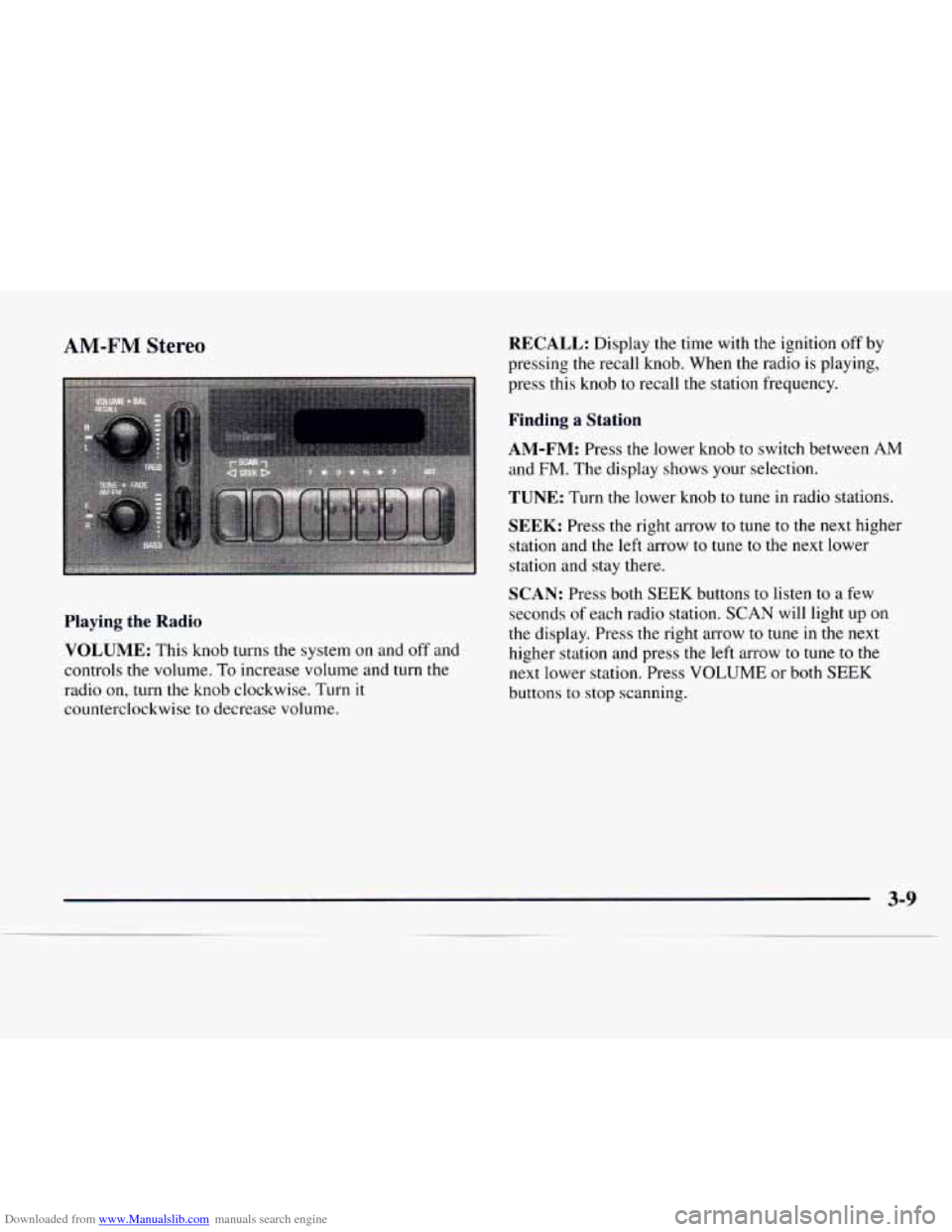
Downloaded from www.Manualslib.com manuals search engine AM-FM Stereo RECALL: Display the time with the ignition off by
pressing the recall knob. When the radio is playing,
press this knob to recall the station frequency.
Finding a Station
AM-FM:
Press the lower knob to switch between AM
and FM. The display shows your selection.
TUNE: Turn the lower knob to tune in radio stations.
SEEK: Press the right arrow to tune to the next higher
station and the left arrow
to tune to the next lower
station and stay there.
Playing the Radio
VOLUME:
This knob turns the system on and off and
controls the volume. To increase volume and turn the
radio on, turn the knob clockwise. Turn it
counterclockwise to decrease volume.
SCAN: Press both SEEK buttons to listen to a few
seconds
of each radio station. SCAN will light up on
the display. Press the right arrow to tune in the next
higher station and press
the left arrow to tune to the
next lower station. Press
VOLUME or both SEEK
buttons to stop scanning.
Page 136 of 386
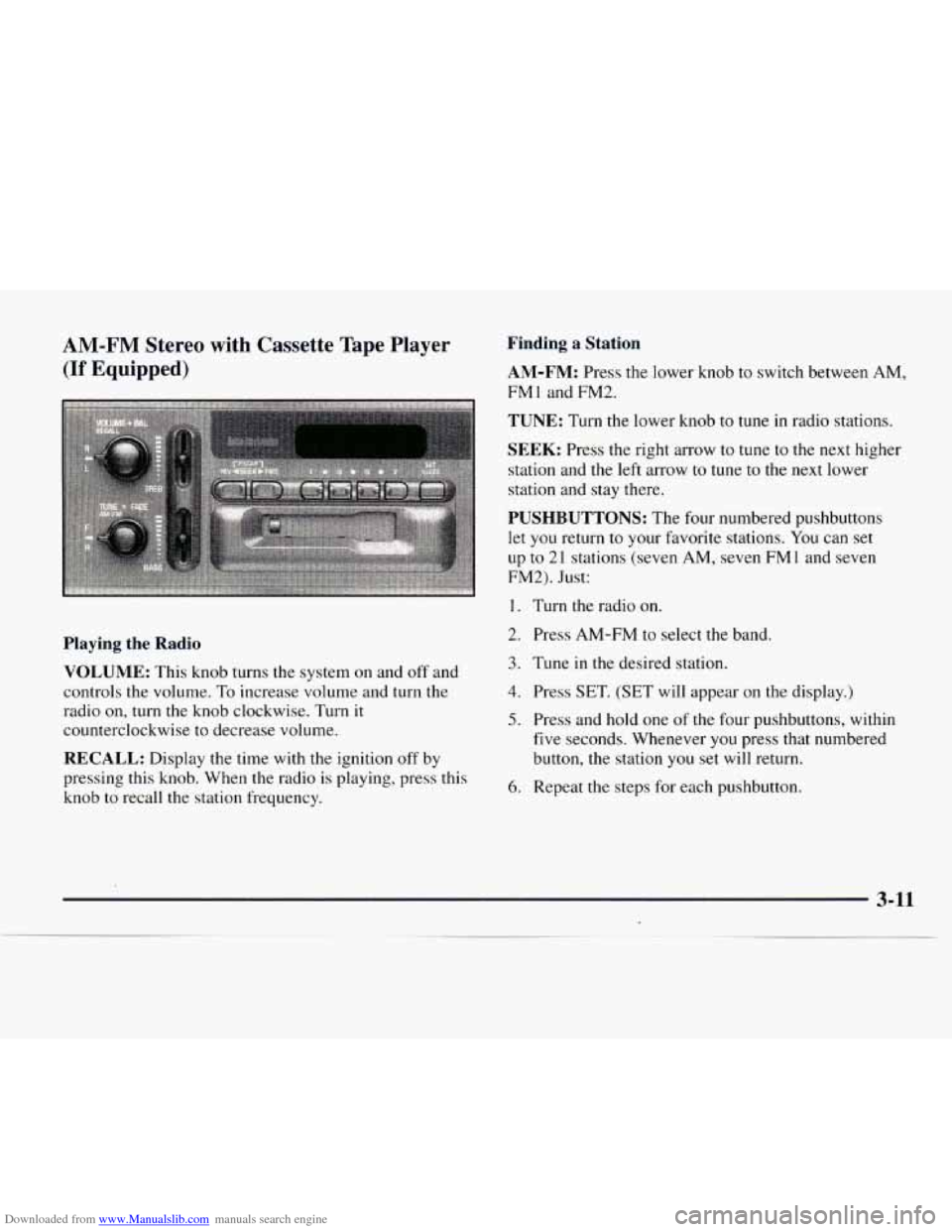
Downloaded from www.Manualslib.com manuals search engine AM-FM Stereo with Cassette Tape Player
(If Equipped)
Playing the Radio
VOLUME:
This knob turns the system on and off and
controls the volume. To increase volume and turn the
radio on, turn the knob clockwise. Turn it
counterclockwise to decrease volume.
RECALL: Display the time with the ignition off by
pressing this knob. When the radio is playing, press this
knob to recall the station frequency.
Finding a Station
AM-FM:
Press the lower knob to switch between AM,
FMl and FM2.
TUNE: Turn the lower knob to tune in radio stations.
SEEK: Press the right arrow to tune to the next higher
station and the left arrow to tune
to the next lower
station and stay there.
PUSHBUTTONS: The four numbered pushbuttons
let you return to your favorite stations. You can set
up to
21 stations (seven AM, seven FM 1 and seven
FM2). Just:
1. Turn the radio on.
2. Press AM-FM to select the band.
3. Tune in the desired station.
4. Press SET. (SET will appear on the display.)
5. Press and hold one of the four pushbuttons, within
five seconds. Whenever you press that numbered
button, the station you set will return.
6. Repeat the steps for each pushbutton.
Page 139 of 386
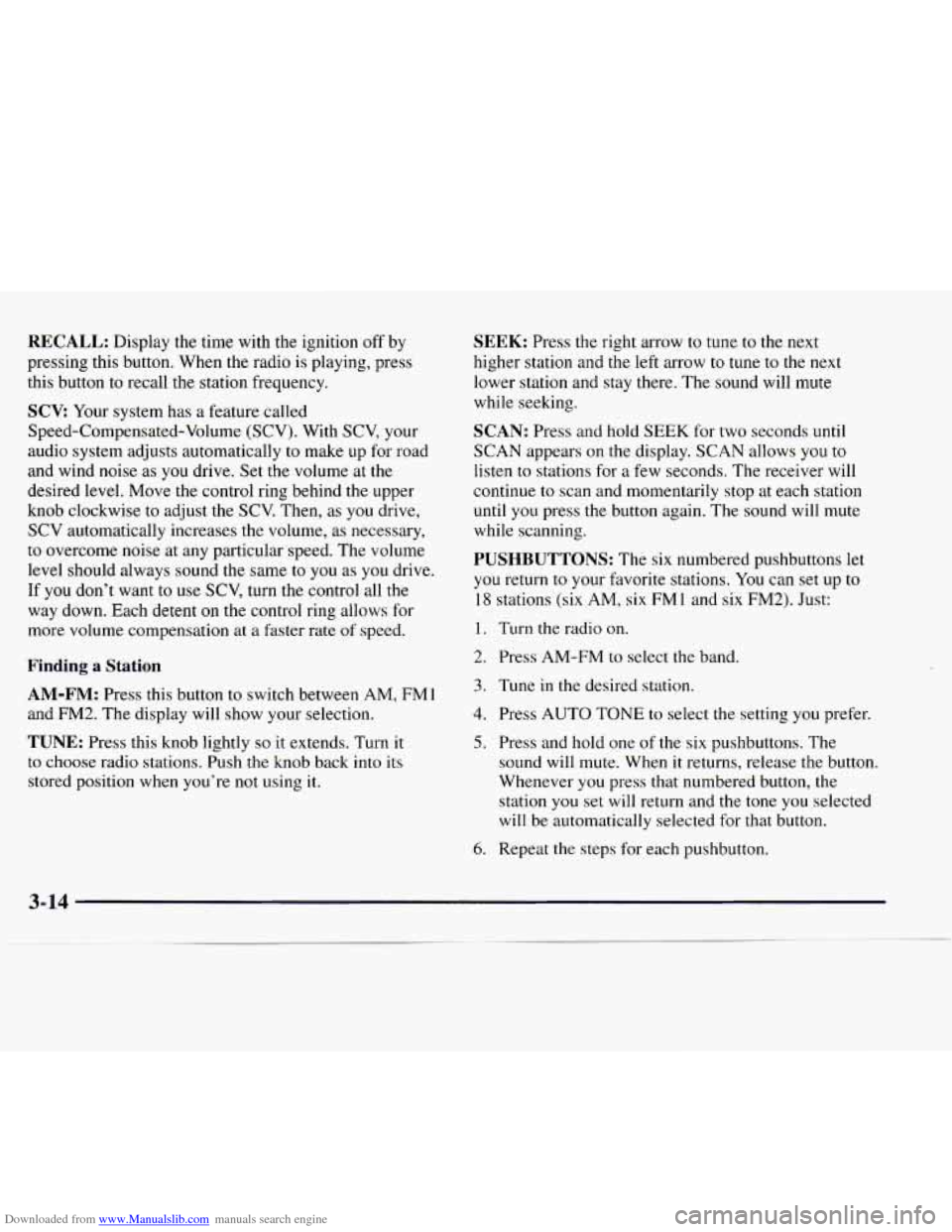
Downloaded from www.Manualslib.com manuals search engine RECALL: Display the time with the ignition off by
pressing this button. When the radio is playing, press
this button to recall the station frequency.
SCV Your system has a feature called
Speed-Compensated-Volume (SCV). With SCV, your
audio system adjusts automatically
to make up for road
and wind noise
as you drive. Set the volume at the
desired level. Move the control ring behind
the upper
knob clockwise to adjust the SCV. Then, as you drive,
SCV automatically increases the volume, as necessary,
to overcome noise at any particular speed. The volume
level should always sound the same
to you as you drive.
If you don’t want to use SCV, turn the control all the
way down. Each detent on the control ring allows for
more volume compensation at a faster rate
of speed.
Finding a Station
AM-FM: Press this button to switch between AM, FM 1
and FM2. The display will show your selection.
TUNE: Press this knob lightly so it extends. Turn it
to choose radio stations. Push the knob back into its
stored position when you’re not using
it.
SEEK: Press the right arrow to tune to the next
higher station and the left arrow
to tune to the next
lower station and stay there. The sound will mute
while seeking.
SCAN: Press and hold SEEK for two seconds until
SCAN appears
on the display. SCAN allows you to
listen to stations for a few seconds. The receiver will
continue to scan and momentarily stop at each station
until you press the button again. The sound will mute
while scanning.
PUSHBUTTONS: The six numbered pushbuttons let
you return to your favorite stations. You can set up to
18 stations (six AM, six FM 1 and six FM2). Just:
1. Turn the radio on.
2. Press AM-FM to select the band.
3. Tune in the desired station.
4. Press AUTO TONE to select the setting you prefer.
5. Press and hold one of the six pushbuttons. The
sound will mute. When it returns, release the button.
Whenever you press that numbered button, the
station you
set will return and the tone you selected
will be automatically selected for that button.
6. Repeat the steps for each pushbutton.
3-14