ground clearance CHEVROLET EXPRESS 1997 1.G Owners Manual
[x] Cancel search | Manufacturer: CHEVROLET, Model Year: 1997, Model line: EXPRESS, Model: CHEVROLET EXPRESS 1997 1.GPages: 386, PDF Size: 20.32 MB
Page 203 of 386
Downloaded from www.Manualslib.com manuals search engine Front Towing
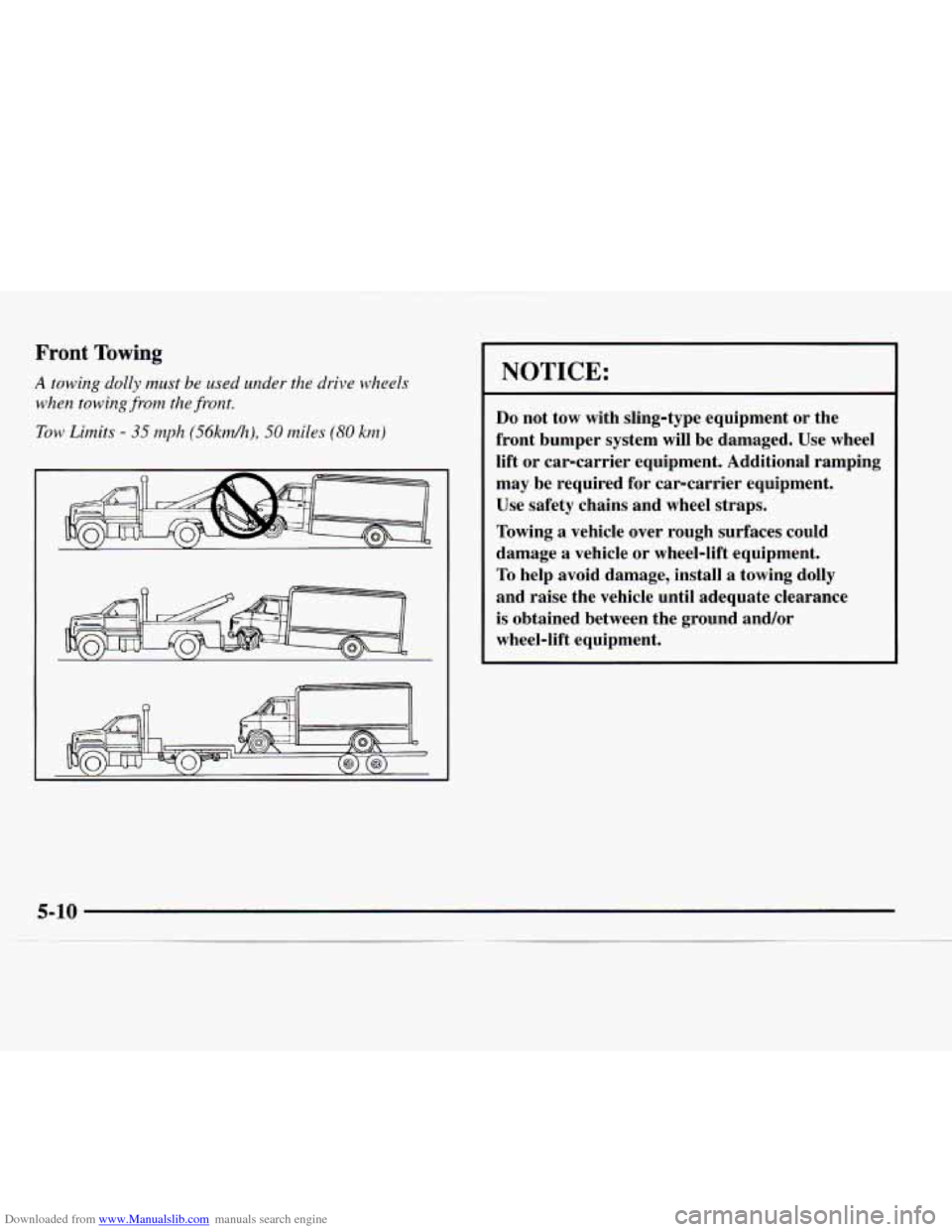
A towing dolly must be used under the drive wheels
when towing
from the front.
Tow Limits - 35 mph (56knz/h), 50 miles (80 km)
NOTICE:
Do not tow with sling-type equipment or the
front bumper system will be damaged. Use wheel
lift or car-carrier equipment. Additional ramping
may be required for car-carrier equipment.
Use safety chains and wheel straps.
Towing
a vehicle over rough surfaces could
damage
a vehicle or wheel-lift equipment.
To help avoid damage, install a towing dolly
and raise the vehicle until adequate clearance
is obtained between the ground and/or
wheel-lift equipment.
Page 204 of 386
Downloaded from www.Manualslib.com manuals search engine Rear Towing
a
NOTICE:
Do not tow the vehicle from the rear with loads
approaching the rated
GVW as the weight
transfer will cause the front suspension
to
become overloaded.
NOTICE:
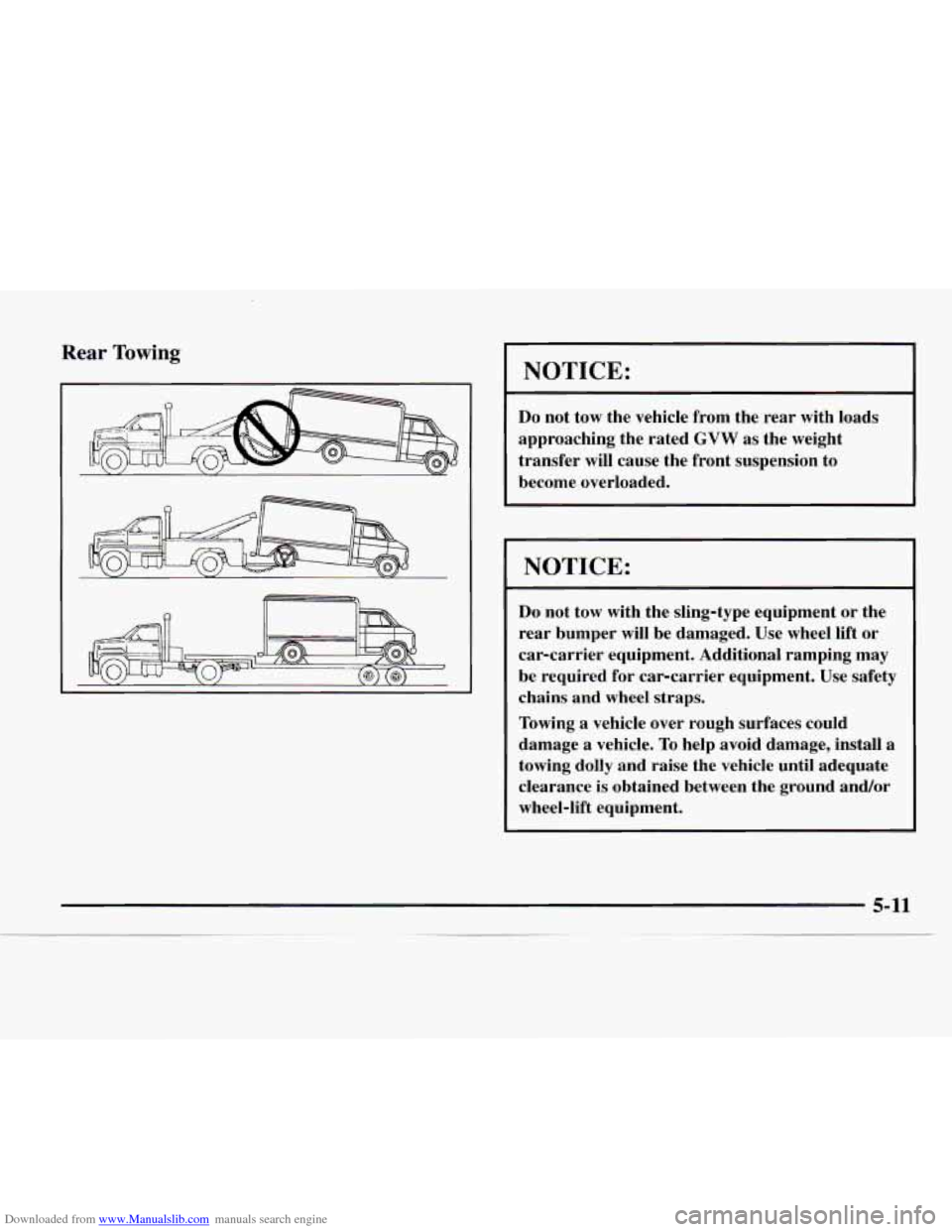
Do not tow with the sling-type equipment or the
rear bumper will be damaged. Use wheel lift or
car-carrier equipment. Additional ramping may
be required for car-carrier equipment. Use safety
chains and wheel straps.
Towing
a vehicle over rough surfaces could
damage a vehicle.
To help avoid damage, install a
towing dolly and raise the vehicle until adequate
clearance is obtained between the ground and/or
wheel-lift equipment.
Page 217 of 386
Downloaded from www.Manualslib.com manuals search engine Removing the Spare Tire and Tools
I
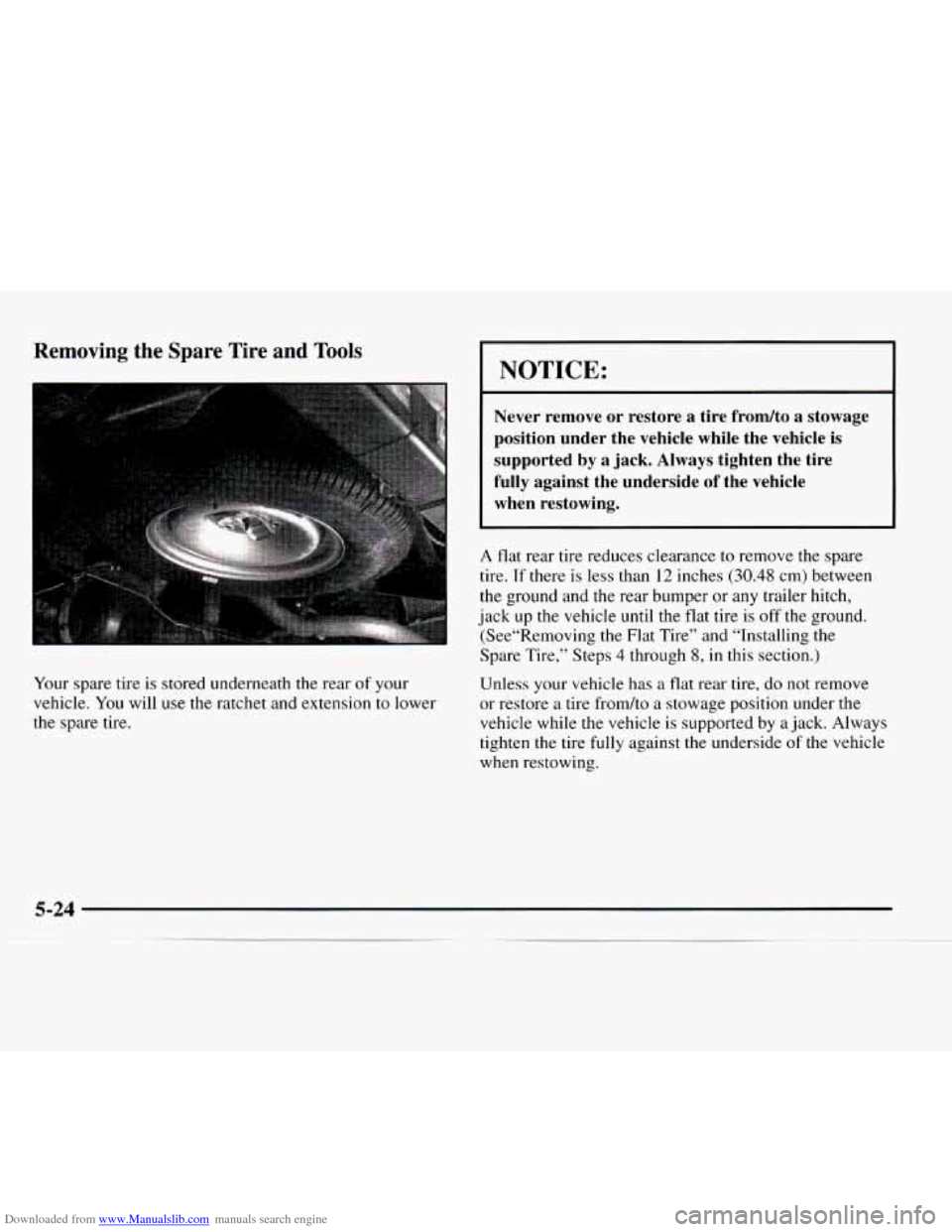
Your spare tire is stored underneath the rear of your
vehicle.
You will use the ratchet and extension to lower
the spare tire.
I
NOTICE:
Never remove or restore a tire frondto a stowage
position under the vehicle while the vehicle is
supported by a jack. Always tighten the tire
fully against the underside
of the vehicle
when restowing.
A flat rear tire reduces clearance to remove the spare
tire.
If there is less than 12 inches (30.48 cm) between
the ground and the rear bumper or any trailer hitch,
jack up the vehicle until the flat tire is
off the ground.
(See“Removing the Flat Tire” and “Installing the
Spare Tire,” Steps
4 through 8, in this section.)
Unless your vehicle has a flat rear tire, do not remove
or restore a tire fromho a stowage position under the
vehicle while the vehicle is supported by a jack. Always
tighten the tire
fully against the underside of the vehicle
when restowing.
Page 281 of 386
Downloaded from www.Manualslib.com manuals search engine Using the wrong replacement wheels, wheel
bolts or wheel nuts on your vehicle can be
dangerous.
It could affect the braking and
handling
of your vehicle, make your tires lose
air and make you lose control. You could have a
collision in which you
or others could be injured.
Always use the correct wheel, wheel bolts and
wheel nuts
for replacement.
I NOTICE:
The wrong wheel can also cause problems with
bearing life, brake cooling, speedometer or
odometer calibration, headlamp aim, bumper
height, vehicle ground clearance and tire or tire
chain clearance to the body and chassis.
Whenever a wheel, wheel bolt or wheel nut is replaced
on a dual wheel setup, check the wheel nut torque after
100, 1,000 and 6,000 miles (I 60, 1 600 and 10 000 km)
of driving. For proper torque, see “Wheel Nut Torque”
in the Index.
See “Changing a Flat Tire” in the Index for
more information.
Used Replacement Wheels
Putting a used wheel on your vehicle is
dangerous. You can’t know how it’s been used or
how far it’s been driven. It could fail suddenly
and cause an accident.
If you have to replace a
wheel, use a new GM original equipment wheel.
6-48