trailer CHEVROLET EXPRESS 1998 1.G Owner's Manual
[x] Cancel search | Manufacturer: CHEVROLET, Model Year: 1998, Model line: EXPRESS, Model: CHEVROLET EXPRESS 1998 1.GPages: 386, PDF Size: 20.74 MB
Page 222 of 386
Downloaded from www.Manualslib.com manuals search engine Engine Fan Noise If a Tire Goes Flat
Your vehicle has a clutched engine cooling fan. When the
clutch is engaged, the
fan spins faster to provide more air
to cool the engine. In most everyday driving conditions,
the fan is spinning slower and the clutch is not fully
engaged. This improves fuel economy and reduces fan
noise. Under heavy vehicle loading, trailer towing and/or
high outside temperatures, the fan speed increases as the
clutch more fully engages.
So you may hear an increase in
fan
noise. This is normal and should not be mistaken as
the transmission slipping or making extra shifts. It is
merely the cooling system functioning properly. The fan will slow down when additional cooling is not required and the clutch partially disengages.
You may also hear this fan noise when you start
the engine. It will go away as the fan clutch
partially disengages. It’s unusual
for
a tire to “blow out” while you’re driving,
especially if you maintain your tires properly. If air goes
out of a tire, it’s much more likely to leak out slowly.
But if
you should ever have a “blowout,” here are a few
tips about what to expect and what
to do:
If a front tire fails, the flat tire will create a drag that
pulls the vehicle toward that side. Take your foot off the
accelerator pedal and grip the steering wheel firmly.
Steer to maintain lane position, and then gently brake
to
a stop well out of the traffic lane.
A rear blowout, particularly on a curve, acts much like a
skid and may require the same correction you’d
use in a
skid. In any rear blowout, remove your foot from the
accelerator pedal. Get the vehicle under control by
steering the way you want the vehicle to go.
It may be
very bumpy and noisy, but you can still steer. Gently
brake
to a stop -- well off the road if possible.
If
a tire goes flat, the next part shows how to use your
jacking equipment
to change a flat tire safely.
Page 224 of 386
Downloaded from www.Manualslib.com manuals search engine Removing the Spare Tire and Tools
::.. ..,. .. .
. . . . , . . .. . .j
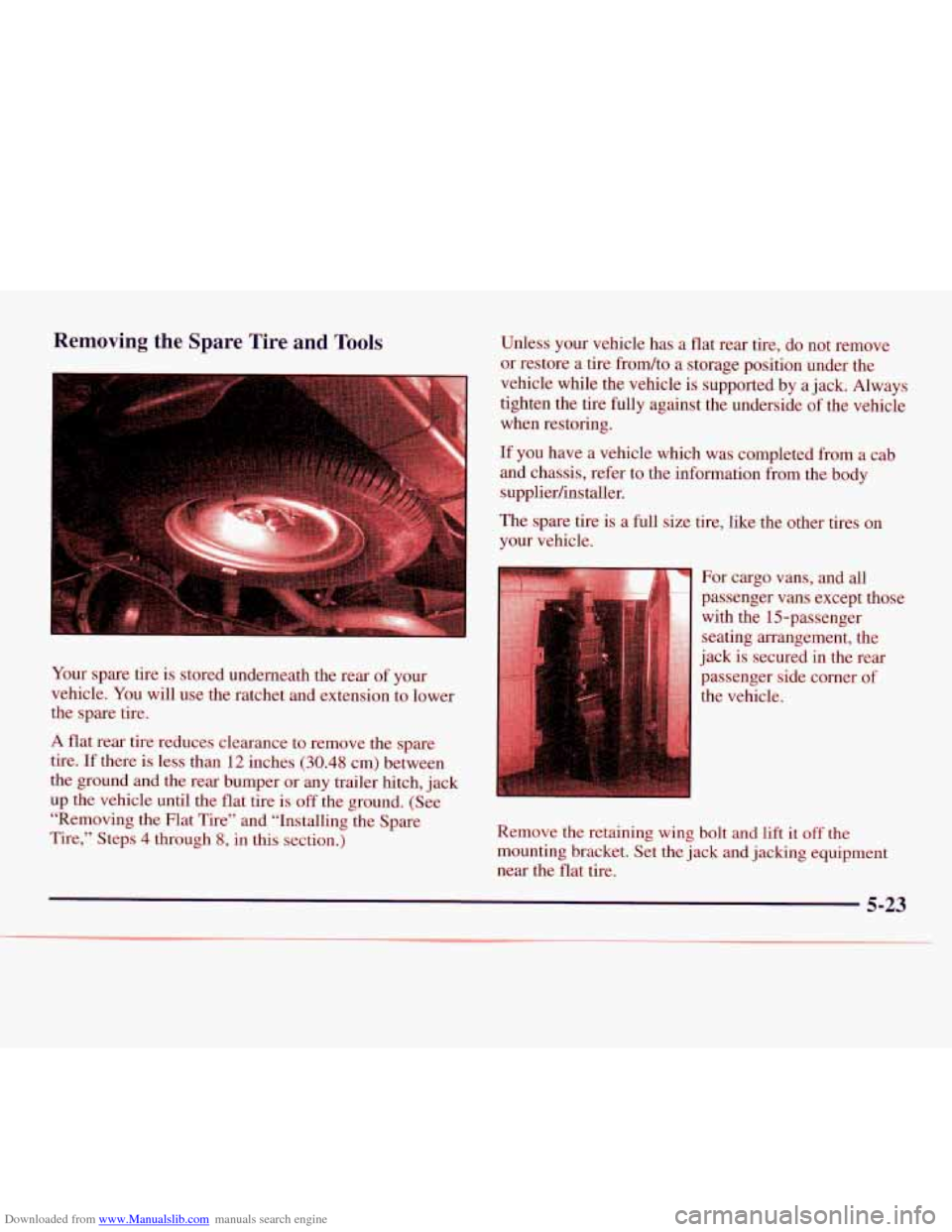
Your spare tire is stored underneath the rear of your
vehicle. You will use the ratchet and extension to lower
the spare tire.
A flat rear tire reduces clearance to remove the spare
tire. If there is less than 12 inches (30.48 cm) between
the ground and the rear bumper or any trailer hitch, jack
up the vehicle until the flat tire is
off the ground. (See
“Removing the Flat Tire” and “Installing the Spare
Tire,” Steps
4 through 8, in this section.) Unless your vehicle has
a flat rear tire, do not remove
or restore a tire frodto a storage position under the
vehicle while the vehicle is supported by a jack. Always
tighten the tire fully against the underside
of the vehicle
when restoring.
If you have a vehicle which was completed from a cab
and chassis, refer to the information from the body
supplierhnstaller.
The spare
tire is a full size tire, like the other tires on
your vehicle.
For cargo vans, and all
passenger vans except those
with the 15-passenger
seating arrangement, the
jack is secured in the rear
passenger side corner
of
the vehicle.
Remove the retaining wing
bolt and lift it off the
mounting bracket. Set the jack and jacking equipment
near the flat tire.
5-23
Page 254 of 386
Downloaded from www.Manualslib.com manuals search engine As shown in the chart, SAE 5W-30 is best for your
vehicle. However, you can
use SAE 1OW-30 if it's going
to be
0" F (- 18 " C) or above. These numbers on an oil
container show its viscosity, or thickness. Do not use
other viscosity oils, such as
SAE 20W-50.
NOTICE:
Use only engine oil with the American Petroleum
Institute Certified For Gasoline Engines "Starburst" symbol. Failure to use the
recommended oil can result in engine damage not covered by your warranty.
GM Goodwrench@ oil meets all the requirements for
your vehicle.
If you are in an area where the temperature falls
below -20°F
(-29 "C), consider using either an
SAE 5W-30 synthetic oil or an SAE OW-30 oil. Both
will provide easier cold starting and better protection
for your engine at extremely low temperatures.
Engine Oil Additives
Don't add anything to your oil. Your dealer is ready to
advise if
you think something should be added.
When to Change Engine Oil
If any one of these is true for you, use the short tripkity
maintenance schedule:
Most trips are less than 5 to 10 miles (8 to 16 km).
This is particularly important when outside
temperatures are below freezing.
Most trips include extensive idling (such as frequent
driving
in stop-and-go traffic).
Most trips are through dusty areas.
You frequently tow a trailer or use a carrier on top of
The vehicle is used for delivery service, police, taxi
your
vehicle.
or other commercial application.
Driving under these conditions causes engine oil
to
break down sooner. If any one of these is true for your
vehicle,
then you need to change your oil and filter
every
3,000 miles (5 000 km) or 3 months -- whichever
occurs first.
Page 256 of 386
Downloaded from www.Manualslib.com manuals search engine 5. Install a new filter element with the folds in the
down position.
Reverse Steps 1 through
4 to replace the air cleaner.
See “Normal Replacement Parts” for the proper filter
to use.
Refer to the Maintenance Schedule
to determine when to
replace the air filter and crankcase ventilation filter.
See “Scheduled Maintenance Services” in the Index.
I /!1 CAUTION:
Operating the engine with the air cleaner off can
cause
you or others to be burned. The air cleaner
not only cleans the air, it stops flame
if the engine
backfires.
If it isn’t there, and the engine
backfires, you could be burned. Don’t drive with
it
off, and be careful working on the engine with
the air cleaner
off.
I NOTICE: I
If the air cleaner is off, a backfire can cause a
damaging engine fire. And, dirt can easily get
into your engine, which will damage it. Always
have the air cleaner in place when you’re driving.
Automatic Transmission Fluid
If your vehicle has a diesel engine, see “Automatic
Transmission Fluid” in the Diesel Supplement.
When to Check and Change
A good time to check your automatic transmission fluid
level is when the engine oil
is changed.
Change both the fluid and filter every
50,000 miles
(83 000 km) if the vehicle’s GVWR is over 8,600 or
if the vehicle
is mainly driven under one or more of
these conditions:
In heavy city traffic where the outside temperature
regularly reaches
90” F (32” C) or higher.
In hilly or mountainous terrain.
0 When doing frequent trailer towing.
6-17
Page 257 of 386
Downloaded from www.Manualslib.com manuals search engine Uses such as found in taxi, police or delivery service.
If your vehicle’s GVWR is not over
8,600 and you
do not use your vehicle under any of these conditions,
change the fluid and filter every 100,000 miles
(166 000 km).
See “Scheduled Maintenance Services”
in the Index.
How to Check
Because this operation can be a little difficult, you
may choose to have this done at your GM dealership
Service Department.
If you do it yourself, be sure to follow all the
instructions here, or you could get a false reading
on the dipstick.
NOTICE:
Too much or too little fluid can damage your
transmission.
Too much can mean that some of
the fluid could come out and fall on hot engine
parts
or exhaust system parts, starting a fire. Be
sure to get an accurate reading if you check your
transmission fluid.
Wait at least 30 minutes before checking the
transmission fluid level
if you have been driving:
0 When outside temperatures are above 90°F (32°C).
0 At high speed for quite a while.
In heavy traffic -- especially in hot weather.
0 While pulling a trailer.
To get the right reading, the fluid should be at normal
operating temperature, which is
180°F to 200°F
(82°C to 93 “C). See “Checking Transmission Fluid
Hot” in the Index.
Checking Transmission Fluid Hot
Get the vehicle warmed up by driving about 15 miles
(24 km) when outside temperatures are above
50°F
(10°C). If it’s colder than 50°F (lO”C), drive the
vehicle in
in DRIVE (D) until the engine temperature
gage moves and then remains steady for 10 minutes.
Then follow the hot check procedures.
Page 316 of 386
Downloaded from www.Manualslib.com manuals search engine Maintenance Schedule
Short Trip/City Definition -- Gasoline Engines
Follow the Short Trip/City Maintenance Schedule if any
one of these conditions is true for your vehicle:
Most trips are less than 5 to 10 miles (8 to 16 km).
This is particularly important when outside
temperatures are below freezing.
Most trips include extensive idling (such as frequent
driving
in stop-and-go traffic).
Most trips are through dusty areas.
You frequently tow a trailer or use a carrier on top of
If the vehicle is used for delivery service, police, taxi
One of the reasons you should follow this schedule if
you operate your vehicle under any of these conditions
is that these conditions cause engine oil
to break
down sooner:
your vehicle.
or other commercial application.
Short Trip/City Intervals -- Gasoline Engines
Every
3,000 Miles (5 000 km): Engine Oil and Filter
Change (or
3 months, whichever occurs first). Chassis
Lubrication (or
3 months, whichever occurs first). Drive
Axle Service (or
3 months, whichever occurs first).
Every 6,000 Miles (10 000 km): Tire Rotation.
Every 15,000 Miles (25 000 km): Air Cleaner Filter
Inspection, if driving in dusty conditions. Shields and
Underhood Insulation Inspection (GVWR above
8,500 lbs. only). Front Wheel Bearing Repack (or at
each brake relining, whichever occurs first).
Every 30,000 Miles (50 000 km): Air Cleaner Filter
Replacement. Fuel Filter Replacement.
Every 50,000 Miles (83 000 km): Automatic
Transmission Service (vehicles over
8600 GVWR or
driven under severe conditions only).
7-5
Page 317 of 386
Downloaded from www.Manualslib.com manuals search engine Maintenance Schedule
I Short Trip/City Intervals -- Gasoline Engines I
Every 60,000 Miles (100 000 km): Engine Accessory
Drive Belt Inspection. Fuel Tank, Cap and Lines
Inspection. Exhaust Gas Recirculation System
Inspection. Evaporative Control System Inspection.
Every 100,000 Miles (166 000 km): Spark Plug Wire
Inspection. Spark Plug Replacement. Automatic
Transmission Service (normal conditions). Positive
Crankcase Ventilation (PCV) Valve Inspection.
Every 150,000 Miles (240 000 km): Cooling System
Service (or every
60 months, whichever occurs first).
These intervals only summarize maintenance services.
Be sure to follow the complete maintenance schedule on
the following pages.
bmng TripMighway Definition -- Gasoline Engines I
Follow this maintenance schedule only if none of the
conditions from the Short Trip/City Maintenance
Schedule is true.
Do not use this schedule if the vehicle
is used for trailer towing, driven in a dusty area
or used
off paved roads. Use the Short Trip/City schedule for
these conditions.
Driving a vehicle with a fully warmed engine
under highway conditions causes engine oil to break
down slowex
7-6
Page 319 of 386
Downloaded from www.Manualslib.com manuals search engine Short Trip/City Maintenance Schedule -- Gasoline Engines
The services shown in this schedule up to 100,000 miles
(166 000 km) should be performed after 100,000 miles
(166 000 km) at the same intervals. The services shown
at 150,000 miles (240
000 km) should be performed at
the same interval after 150,000 miles (240
000 km).
See “Owner Checks and Services” and “Periodic
Maintenance Inspections” following.
Footnotes
The U.S. Environmental Protection Agency or the
California Air Resources Board has determined that the
failure to perform this maintenance item will not nullify
the emission warranty or limit recall liability prior to the
completion of the vehicle’s useful life. We, however,
urge that all recommended maintenance services be
performed at the indicated intervals and the maintenance
be recorded.
# Lubricate the front suspension, kingpin bushings,
steering linkage and rear driveline center splines.
+ A good time to check your brakes is during tire
rotation. See “Brake System Inspection” under “Periodic
Maintenance Inspections” in
Part C of this schedule.
* * Drive axle service (see “Recommended Fluids and
Lubricants” in the Index for proper lubricant to use):
0
0
0
Locking Differential -- Drain fluid and refill at first
engine oil change. At subsequent oil changes, check
fluid level and add fluid as needed. If driving in
dusty areas or towing a trailer, drain fluid and refill
every 15,000 miles (25
000 km).
Standard Differential -- Check fluid level and add
fluid as needed at every oil change. If driving in
dusty areas
or towing a trailer, drain fluid and refill
every 15,000 miles
(25 000 km).
More frequent lubrication may be required for
heavy-duty use.
7-8
Page 327 of 386
Downloaded from www.Manualslib.com manuals search engine -
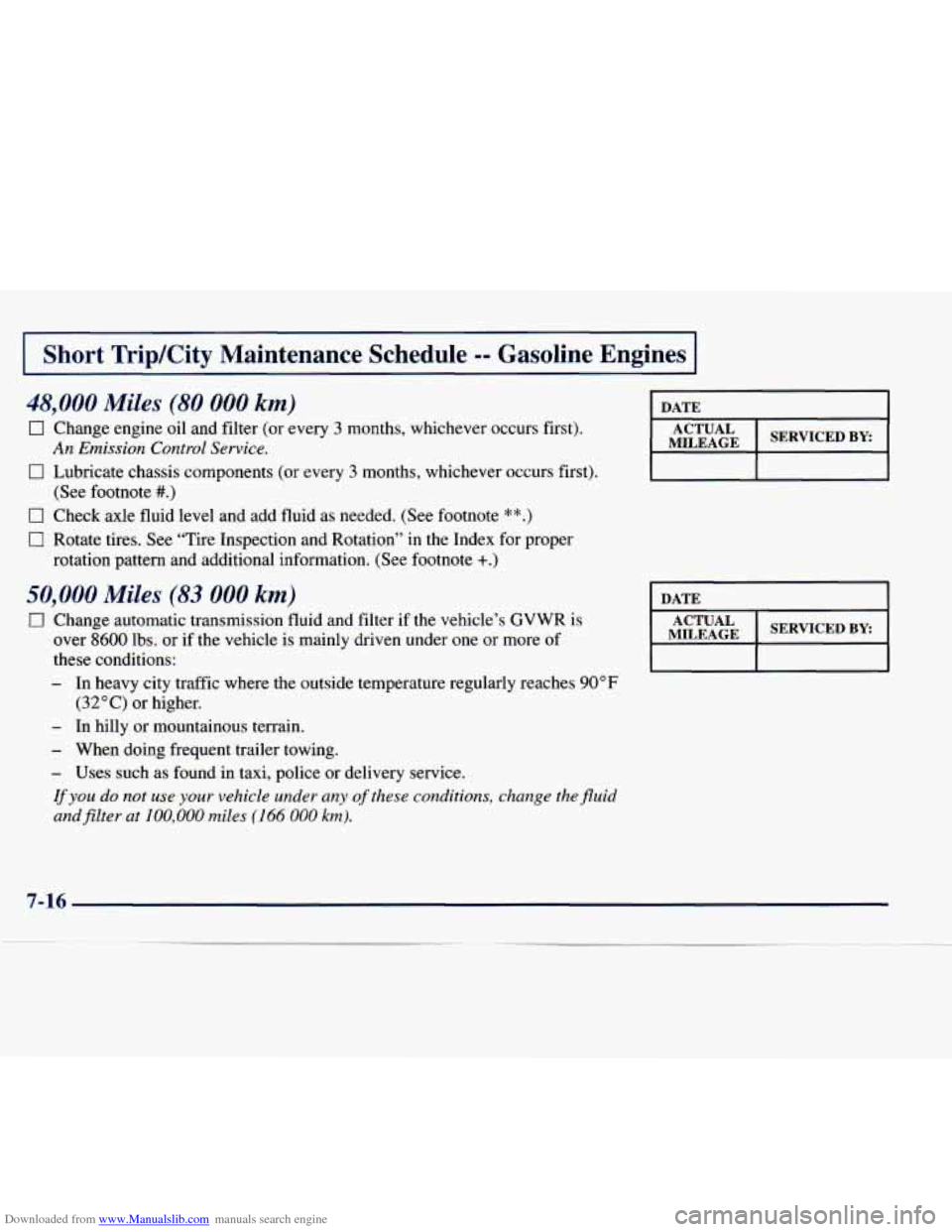
Short Trip/City Maintenance Schedule -- Gasoline Engines
48.000 Miles (80 000 km) , ,
Change engine oil and filter (or every 3 months, whichever occurs first).
An Emission Control Service.
Lubricate chassis components (or every 3 months, whichever occurs first).
(See footnote
#.)
Check axle fluid level and add fluid as needed. (See footnote **.)
Rotate tires. See “Tire Inspection and Rotation” in the Index for proper
rotation pattern and additional information. (See footnote
+.)
DATE I
50,000 Miles (83 000 km)
17 Change automatic transmission fluid and filter if the vehicle’s GVWR is
over 8600 lbs. or if the vehicle is mainly driven under one or more of
these conditions:
- In heavy city traffic where the outside temperature regularly reaches 90°F
- In hilly or mountainous terrain.
- When doing frequent trailer towing.
- Uses such as found in taxi, police or delivery service.
If you do not use your vehicle under any of these conditions, change the fluid
and filter at
IO0,OOO miles (I 66 000 km).
(32°C) or higher.
7-16
Page 337 of 386
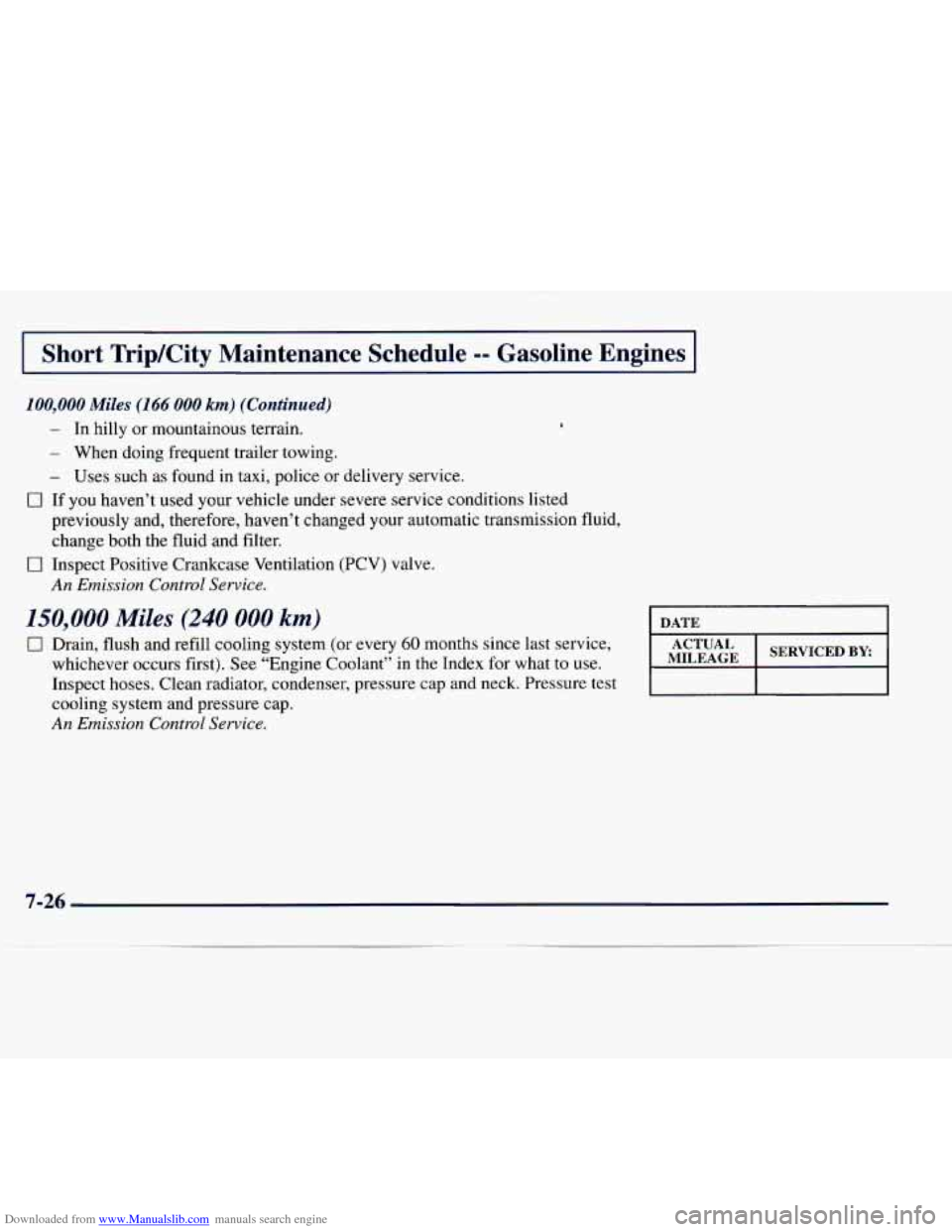
Downloaded from www.Manualslib.com manuals search engine I Short TripKity Maintenance Schedule -- Gasoline Engines 1
100,000 Miles (166 000 km) (Continued)
- In hilly or mountainous terrain.
- When doing frequent trailer towing.
- Uses such as found in taxi, police or delivery service.
0 If you haven’t used your vehicle under severe service conditions listed
previously and, therefore, haven’t changed your automatic transmission fluid,
change both the fluid and filter.
An Emission Control Service.
0 Inspect Positive Crankcase Ventilation (PCV) valve.
150,000 Miles (240 000 km)
0 Drain, flush and refill cooling system (or every 60 months since last service,
whichever occurs first). See “Engine Coolant”
in the Index for what to use.
Inspect hoses. Clean radiator, condenser, pressure cap and neck. Pressure test
cooling system and pressure cap.
An Emission Control Service.
MILEAGE
7-26