brake CHEVROLET EXPRESS 1998 1.G Owners Manual
[x] Cancel search | Manufacturer: CHEVROLET, Model Year: 1998, Model line: EXPRESS, Model: CHEVROLET EXPRESS 1998 1.GPages: 386, PDF Size: 20.74 MB
Page 6 of 386
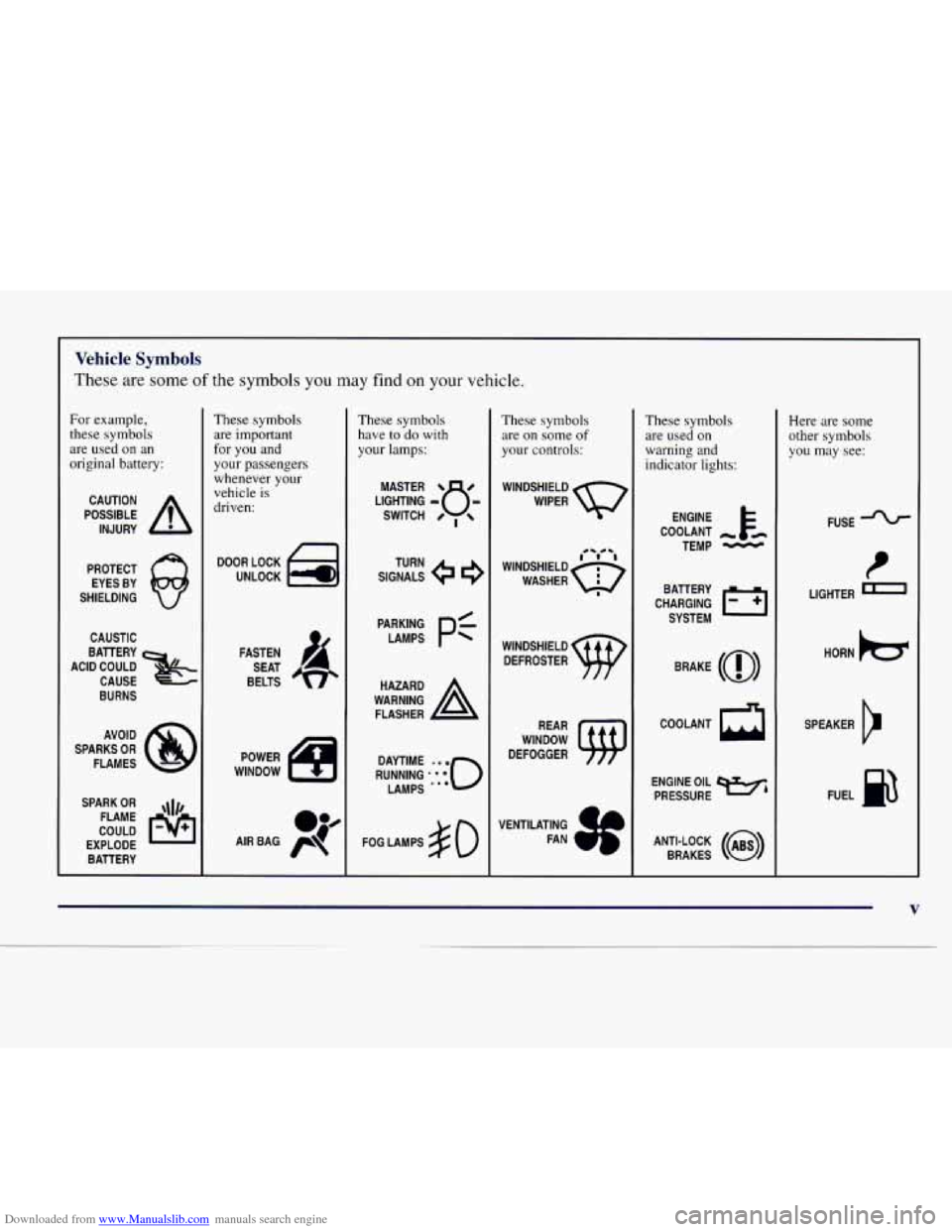
Downloaded from www.Manualslib.com manuals search engine Vehicle Symbols
These are some of the symbols you may find on your vehicle.
For example,
these symbols
are used on an
original battery:
POSSIBLE A
CAUTION
INJURY
PROTECT EYES BY
SHIELDING
CAUSTIC
ACID COULD
x
BATTERY
CAUSE
BURNS
AVOID
SPARKS
OR
FLAMES
SPARK
OR ,111,
COULD FLAME
EXPLODE BATTERY
These symbols are important
for you and
your passengers
whenever your
vehicle is
driven
:
DOOR LOCK
UNLOCK
FASTEN SEAT
BELTS
These symbols
have
to do with
your lamps:
SIGNALS e
TURN
WARNING
A
HAZARD
FLASHER
FOG LAMPS
$0
These symbols
are on some
of
your controls:
WINDSHIELD
WIPER
WINDSHIELD DEFROSTER
WINDOW
DEFOGGER
VENTILATING FAN
These symbols are used on
warning and
indicator lights:
COOLANT -
TEMP -
CHARGING BATTERY
SYSTEM
BRAKE
(a)
COOLANT a
ENGINE OIL
PRESSURE
Wh
ANTI-LOCK (@)
BRAKES
Here are some
other symbols
you may see:
FUSE -%-
I
LIGHTER
HORN
b
SPEAKER
b
FUEL p3
V
Page 72 of 386
Downloaded from www.Manualslib.com manuals search engine Section 2 Features and Controls
Here you can learn about the many standard and optional features on your vehicle, and information on starting,
shifting and braking. Also explained are the instrument panel and the warning systems that tell you if everything is
working properly
-- and what to do if you have a problem.
2-2 2-4
2-6
2-9
2- 15
2- 16
2- 17
2- 17
2-18
2-20
2-2 1
2-24
2-25 2-28
2-29
2-29 Keys
Door Locks
Keyless Entry System (If Equipped)
Your Doors and How They Work
Theft
Passlock@
New Vehicle “Break-In”
Ignition Positions
Starting Your Gasoline Engine
Engine Coolant Heater (If Equipped)
Automatic Transmission Operation
Parking Brake
Shifting Into PARK
(P)
Shifting Out of PARK (P)
Parking Over Things That Burn
Engine Exhaust 2-30
2-30
2-3
1
2-33
2-34
2-34
2-40
2-43
2-45
2-48
2-48
2-49 2-50
2-5
1
2-53 Running
Your Engine While You’re Parked
Locking Rear Axle (If Equipped)
Windows Horn
Tilt Wheel (Option)
Turn SignalMultifunction Lever
Exterior Lamps
Interior Lamps
Mirrors Storage Compartments
Cigarette LightedAshtray
Sun Visors
Instrument Panel
Instrument Cluster
Warning Lights, Gages and Indicators
Page 88 of 386
Downloaded from www.Manualslib.com manuals search engine New Vehicle 44Break-In”
NOTICE:
Your vehicle doesn’t need an elaborate
“break-in.” But it will perform better in the long
run
if you follow these guidelines:
Keep your speed at 55 mph (88 km/h) or
less for the first
500 miles (805 km).
Don’t drive at any one speed -- fast or
slow
-9 for the first 500 miles (805 km).
Don’t make full-throttle starts.
200 miles (322 km) or so. During this time
your new brake linings aren’t yet broken
in. Hard stops with new linings can mean
premature wear and earlier replacement.
Follow this breaking-in guideline every
time you get new brake linings.
See “Towing
a Trailer” in the Index for
more information.
Avoid making hard stops for the first
Don’t tow a trailer during break-in.
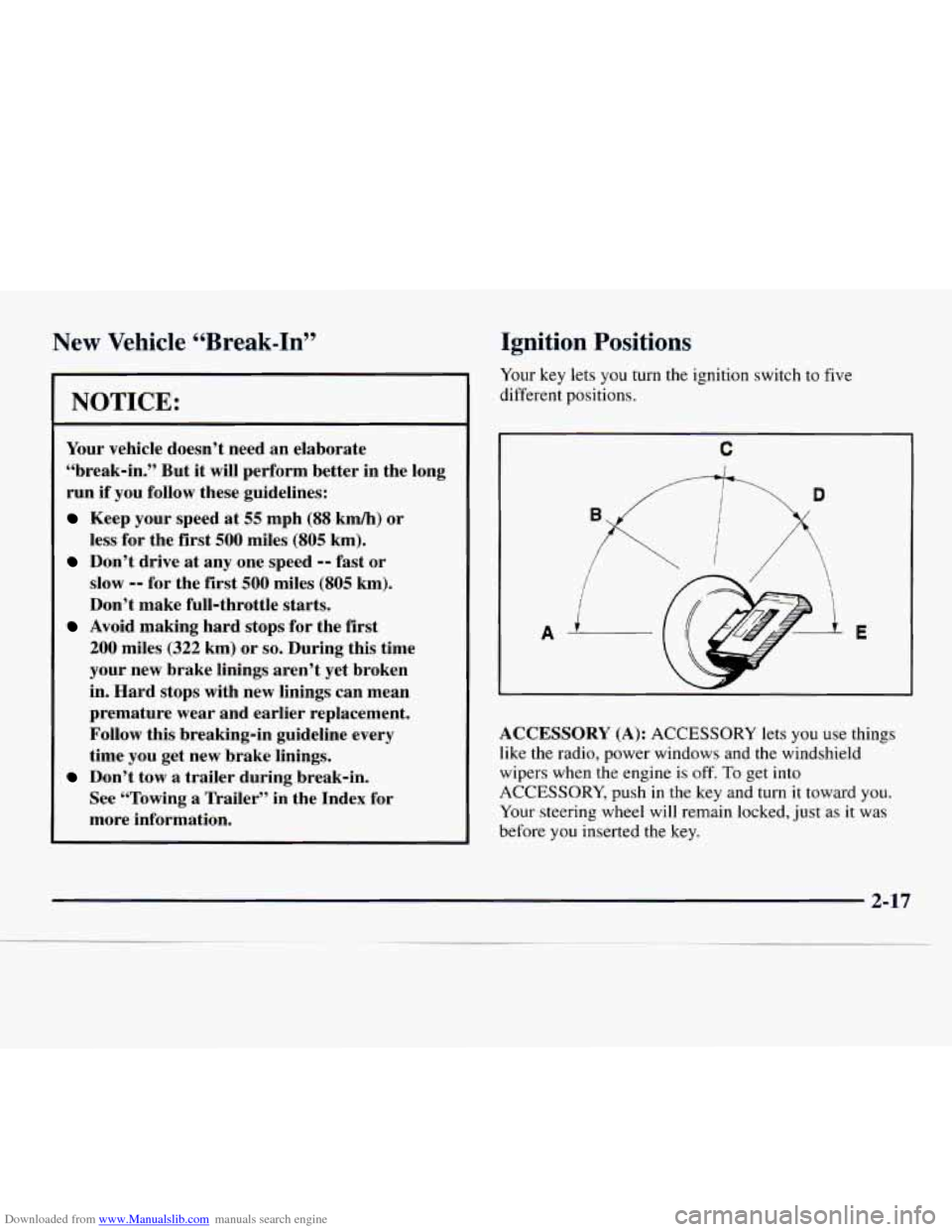
Ignition Positions
Your key lets you turn the ignition switch to five
different positions.
,------1---\D
C
A E
ACCESSORY (A): ACCESSORY lets you use things
like the radio, power windows and the windshield
wipers when the engine
is off. To get into
ACCESSORY, push in the key and turn it toward you.
Your steering wheel will remain locked, just
as it was
before you inserted
the key.
2-17
Page 93 of 386
Downloaded from www.Manualslib.com manuals search engine It is dangerous to get out of your vehicle if the
shift lever is not fully in
PARK (P) with the
parking brake firmly set. Your vehicle can roll.
Don’t leave your vehicle when the engine is
running unless you have to.
If you have left the
engine running, the vehicle can move suddenly.
You
or others could be injured. To be sure your
vehicle won’t move, even when you’re on fairly
level ground, always set your parking brake and
move the shift lever to
PARK (P).
See “Shifting Into PARK (P)” in the Index. If
you’re pulling a trailer, see “Towing a Trailer” in
the Index.
Ensure the shift lever is fully in PARK (P) before
starting the engine. Your vehicle has a
brake-transmission shift interlock. With the ignition in the RUN position, you must fully apply your regular
brakes before you can shift from PARK (P).
If you cannot shift out of PARK (P), ease pressure on
the shift lever and push the shift lever all the way into
PARK (P) as you continue pressing the brake pedal.
Then move the shift lever into the gear you want. See
“Shifting Out
of PARK (P)” later in this section.
REVERSE (R): Use this gear to back up.
NOTICE:
Shifting into REVERSE (R) while your vehicle is
moving forward could damage your
transmission. Shift to
REVERSE (R) only after
your vehicle is stopped.
To rock your vehicle back and forth to get out of snow,
ice or sand without damaging
your transmission, see
“Stuck: In Sand, Mud, Ice or Snow” in the Index.
NEUTRAL (N): In this position, your engine doesn’t
connect with the wheels.
To restart when you’re already
moving, use NEUTRAL (N) only. Also, use
NEUTRAL (N) when your vehicle is being towed.
2-22
Page 94 of 386
Downloaded from www.Manualslib.com manuals search engine I A CAUTION:
Shifting out of PARK (P) or NEUTRAL (N) while
your engine is “racing” (running at high speed) is dangerous. Unless your foot is firmly on the
brake pedal, your vehicle could move very
rapidly. You could lose control and hit people or
objects. Don’t shift out of PARK
(P) or
NEUTRAL
(N) while your engine is racing.
NOTICE:
Damage to your transmission caused by shifting
out
of PARK (P) or NEUTRAL (N) with the
engine racing isn’t covered by your warranty.
DRIVE (D):
This position is for normal driving. If you
need more power for passing, and you’re:
Going less than about 35 mph (55 km/h), push your
accelerator pedal about halfway down.
Going about 35 mph (55 kmh) or more, push the
You’ll shift down to the next gear and have
more power.
You should use DRIVE (D) (or, as you need to, a lower
gear) when towing a trailer
to minimize heat build-up
and extend the life
of your transmission.
THIRD (3): This position is also used for normal
driving, however, it offers more power and lower fuel
economy than DRIVE
(D). You should use THIRD (3)
when carrying a heavy load or driving on steep hills.
SECOND (2): This position gives you more power but
lower fuel economy. You can use SECOND (2) on hills.
It can help control your speed as
you go down steep
mountain roads, but then you would also want to
use
your brakes off and on. If you manually select
SECOND
(2), the transmission will drive in
SECOND
(2). You may use this feature for reducing
torque
to the rear wheels when you are trying to start
your vehicle from a stop
on slippery road surfaces.
FIRST (1): This position gives you even more power
(but lower fuel economy) than SECOND
(2). You can
use it
on very steep hills, or in deep snow or mud. If
the selector lever
is put in FIRST( 1 ), the transmission
won’t shift into first gear until the vehicle is going
slowly enough.
accelerator
all the way down.
Page 95 of 386
Downloaded from www.Manualslib.com manuals search engine NOTICE:
If your rear wheels can’t rotate, don’t try to
drive. This might happen if you are stuck in very
deep sand or mud or are up against a solid
object. You could damage your transmission.
Also, if you stop when going uphill, don’t hold
your vehicle there with only the accelerator
pedal. This could overheat and damage the
transmission. Use your brakes or shift into
PARK (P) to hold your vehicle in position on
a hill.
Parking Brake
To set the parking brake, hold the regular brake pedal
down with your right foot. Push down the parking brake
pedal with your left foot.
If the ignition is on, the brake system warning light will
come
on.
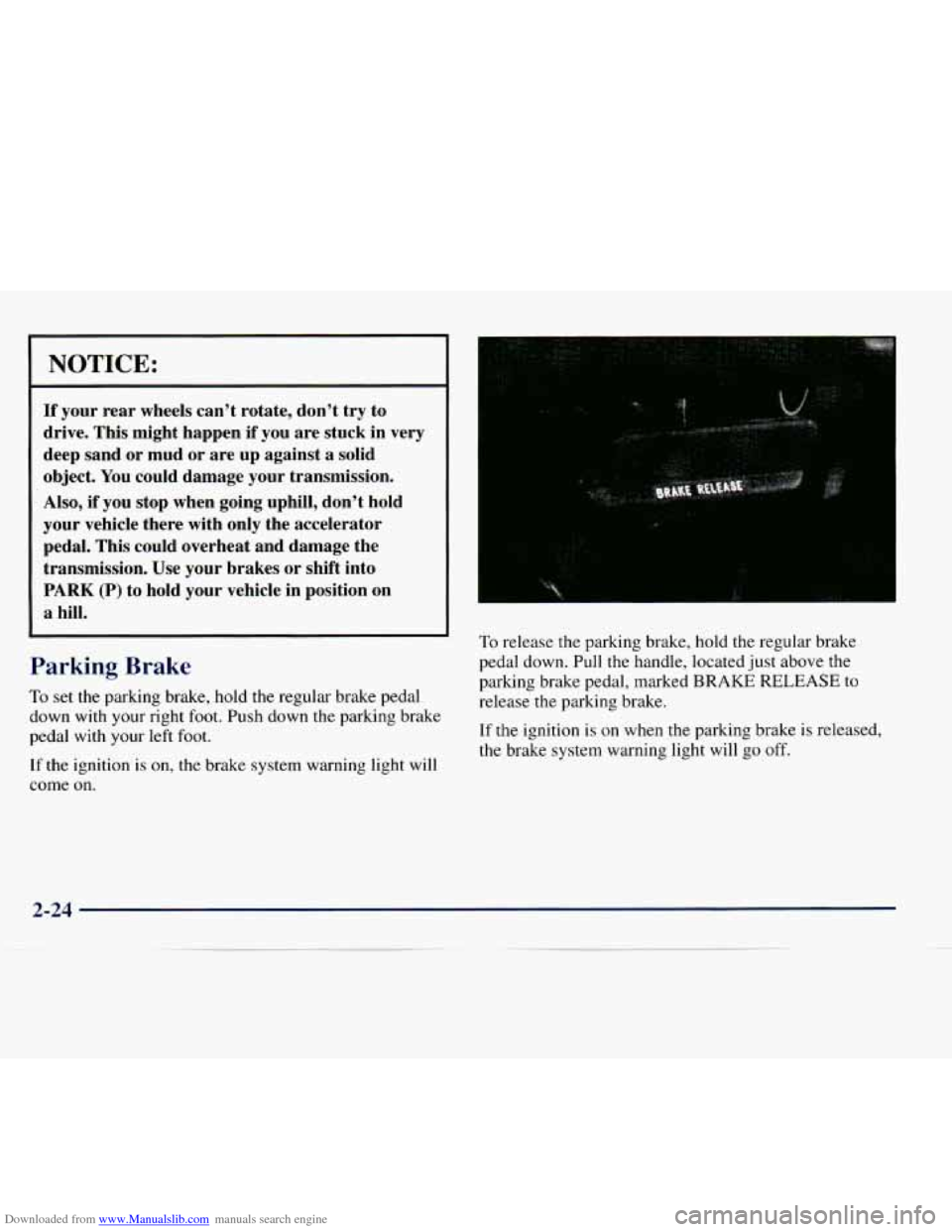
To release the parking brake, hold the regular brake
pedal down. Pull the handle, located just above the
parking brake pedal, marked
BRAKE RELEASE to
release
the parking brake.
If the ignition is on when the parking brake
is released,
the brake system warning light will
go off.
2-24
Page 96 of 386
Downloaded from www.Manualslib.com manuals search engine NOTICE:
Driving with the parking brake on can cause your
rear brakes to overheat.
You may have to replace
them, and you could also damage other parts of
your vehicle. Always check to be
sure your parking
brake is fully released before you drive.
If
you are towing a trailer and are parking on any hill,
see “Towing a Trailer” in the Index. That section shows
what to do first to keep the trailer from moving.
It can be dangerous to get out of your vehicle if
the shift lever
is not fully in PARK (P) with the
parking brake firmly set. Your vehicle can roll.
If
you have left the engine running, the vehicle can
move suddenly.
You or others could be injured.
To be sure your vehicle won’t move, even when
you’re on fairly level ground, use the steps that
follow.
If you’re pulling a trailer, see “Towing a
Trailer” in the Index.
1. Hold the brake pedal down with your right foot and
set the parking brake.
Page 98 of 386
Downloaded from www.Manualslib.com manuals search engine Leaving Your Vehicle With the
Engine Running
I A CAUTION:
It can be dangerous to leave your vehicle with the
engine running. Your vehicle could move
suddenly if the shift lever
is not fully in PARK (P)
with the parking brake firmly set. And, if you
leave the vehicle with the engine running, it could
overheat and even catch fire.
You or others could
be injured. Don’t leave your vehicle with the
engine running unless you have to.
Torque Lock
If you are parking on a hill and you don’t shift your
transmission into PARK (P) properly, the weight of the
vehicle may put
too much force on the parking pawl in
the transmission. You may find it difficult to pull the
shift lever out of PARK
(P). This is called “torque lock.”
To prevent torque lock, set the parking brake and then
shift into
PARK (P) properly before you leave the
driver’s seat.
To find out how, see “Shifting Into
PARK (P)” in the Index.
When you are ready
to drive, move the shift lever out of
PARK (P) before you release the parking brake.
If torque
lock does occur, you may need to have another
vehicle push yours
a little uphill to take some of the
pressure from the parking pawl in the transmission,
so
you can pull the shift lever out of PARK (P).
Page 99 of 386
Downloaded from www.Manualslib.com manuals search engine Shifting Out of PARK (P) If you ever hold the brake pedal down but still can’t
shift out of PARK (P), try this:
Your vehicle has a brake-transmission shift interlock
system. You have to fully apply your regular brakes
1.
before you can shift from PARK (P) when the ignition is 2,
in RUN. See “Automatic Transmission” in the Index. 3.
If you cannot shift out of PARK (P), ease pressure on
the shift lever and push the shift lever all the way up 4.
into PARK (P) as you maintain brake application. Then,
move the shift lever into the gear you want.
5.
Turn the key to OFF.
Apply and hold the brake until the end of Step 4.
Shift to NEUTRAL (N).
Start the vehicle and then shift to the drive gear
you want.
Have the brake-transmission shift interlock system
fixed as soon as
you can.
2-28
Page 101 of 386
Downloaded from www.Manualslib.com manuals search engine Running Your Engine While
You’re Parked
It’s better not to park with the engine running. But if
ever
you have to, here are some things to know.
Idling the engine with the air system control
off
could allow dangerous exhaust into your vehicle
(see the earlier Caution under “Engine Exhaust”).
Also, idling in
a closed-in place can let deadly
carbon monoxide (CO) into your vehicle even
if the fan switch
is at the highest setting. One
place this can happen
is a garage. Exhaust -- with
CO -- can come in easily. NEVER park in a
garage with the engine running.
Another closed-in place can be
a blizzard.
(See “Blizzard” in the Index.)
A CAUTlON:
~
It can be dangerbus to get out of your vehicle if
the shift lever is not fully in PARK
(P) with the
parking brake firmly set. Your vehicle can roll.
Don’t leave your vehicle when the engine is
running unless you have to. If you’ve left the
engine running, the vehicle can move suddenly.
You or others could be injured. To be sure your
vehicle won’t move, even when you’re on fairly
level ground, always set your parking brake and
move the shift lever to
PARK (P).
Follow the proper steps to be sure your vehicle won’t
move. See “Shifting Into
PARK (P)” in the Index.
If you’re pulling a trailer, see “Towing a Trailer” in
the Index.
Locking Rear Axle (If Equipped)
If you have this feature, your locking rear axle can give
you additional traction on snow, mud, ice, sand or
gravel. It works like
a standard axle most of the time,
but when one
of the rear wheels has no traction and the
other does, this feature will allow the wheel with
traction to move the vehicle.
2-30