fuel CHEVROLET EXPRESS 1998 1.G Owners Manual
[x] Cancel search | Manufacturer: CHEVROLET, Model Year: 1998, Model line: EXPRESS, Model: CHEVROLET EXPRESS 1998 1.GPages: 386, PDF Size: 20.74 MB
Page 6 of 386
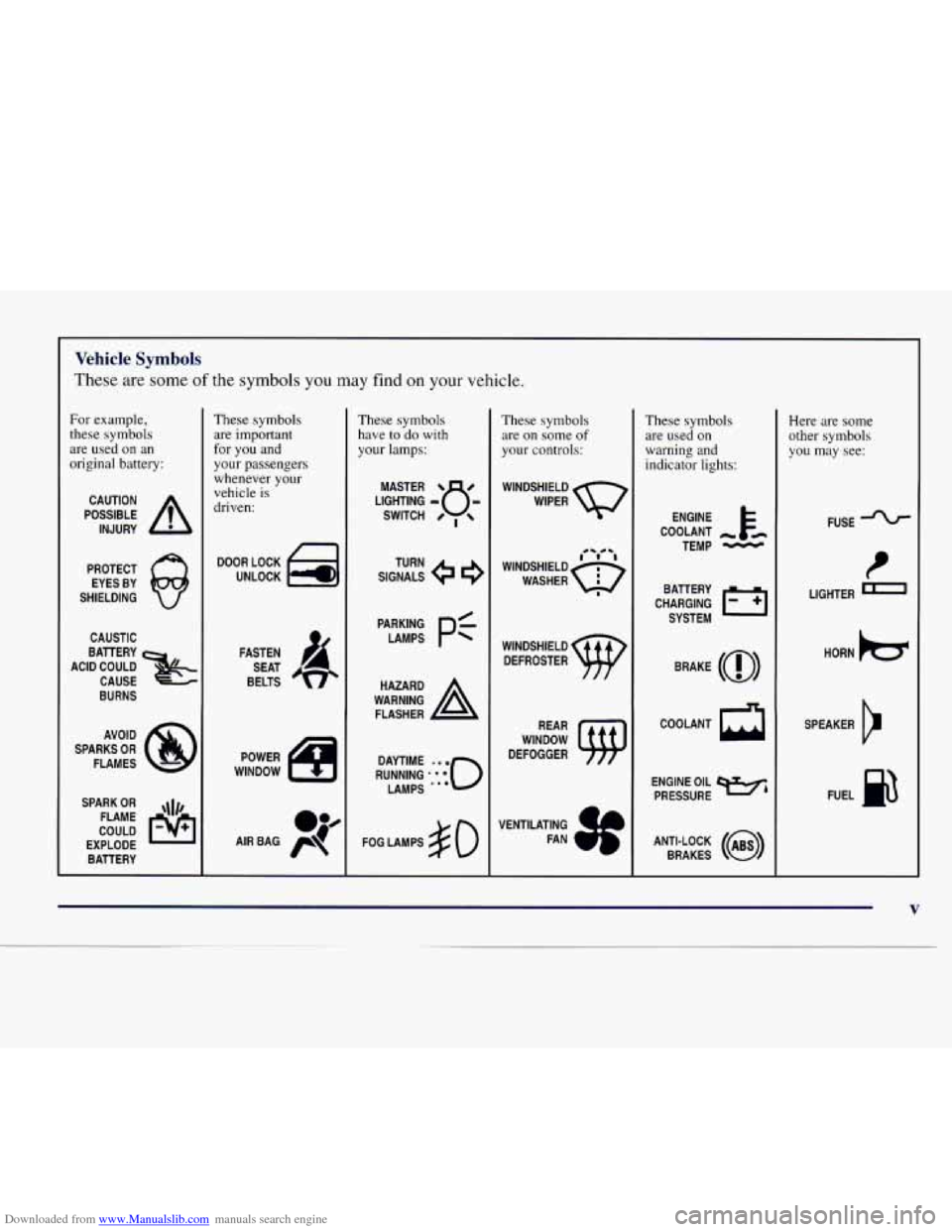
Downloaded from www.Manualslib.com manuals search engine Vehicle Symbols
These are some of the symbols you may find on your vehicle.
For example,
these symbols
are used on an
original battery:
POSSIBLE A
CAUTION
INJURY
PROTECT EYES BY
SHIELDING
CAUSTIC
ACID COULD
x
BATTERY
CAUSE
BURNS
AVOID
SPARKS
OR
FLAMES
SPARK
OR ,111,
COULD FLAME
EXPLODE BATTERY
These symbols are important
for you and
your passengers
whenever your
vehicle is
driven
:
DOOR LOCK
UNLOCK
FASTEN SEAT
BELTS
These symbols
have
to do with
your lamps:
SIGNALS e
TURN
WARNING
A
HAZARD
FLASHER
FOG LAMPS
$0
These symbols
are on some
of
your controls:
WINDSHIELD
WIPER
WINDSHIELD DEFROSTER
WINDOW
DEFOGGER
VENTILATING FAN
These symbols are used on
warning and
indicator lights:
COOLANT -
TEMP -
CHARGING BATTERY
SYSTEM
BRAKE
(a)
COOLANT a
ENGINE OIL
PRESSURE
Wh
ANTI-LOCK (@)
BRAKES
Here are some
other symbols
you may see:
FUSE -%-
I
LIGHTER
HORN
b
SPEAKER
b
FUEL p3
V
Page 87 of 386
Downloaded from www.Manualslib.com manuals search engine Parking Lots
If you park in a lot where someone will be watching
your vehicle, it’s best
to lock it up and take your keys.
But what
if you have to leave your ignition key? What if
you have to leave something valuable in your vehicle?
Put your valuables in a storage area, like your front
Lock all the doors except the driver’s.
storage
compartment.
Passlock@
Your vehicle is equipped with the Passlock
theft-deterrent system.
Passlock
is a passive theft-deterrent system. The system
is armed once the key is removed from the ignition.
Passlock enables fuel if the ignition lock cylinder is
turned with
a valid key. If a correct key is not used,
fuel
is disabled. During normal
operation, the SECURITY light will
go
off after the engine is started.
If the engine stalls and the SECURITY light flashes,
wait
until the light stops flashing before trying to restart
the engine. Remember
to release the key from the
START position as soon as the engine starts.
If you are driving and the SECURITY light comes on, you
will be able to restart the engine if you turn the engine off.
However, your Passlock system is not working properly
and must be serviced by your dealer. Your vehicle is not
protected by Passlock at this time. You may
also want to
check the fuse (see “Fuses
and Circuit Breakers” in the
Index). See your dealer for service.
If the SECURITY light comes on while the engine is
running, a problem has been detected and the system
may need service. See your dealer for service.
In an emergency, call the
GM Roadside Assistance
Center. See “Roadside Assistance’’ in the Index.
2-16
Page 91 of 386
Downloaded from www.Manualslib.com manuals search engine Engine Cool-nt Heater (If Equipped) To Use the Engine Coolant Heater
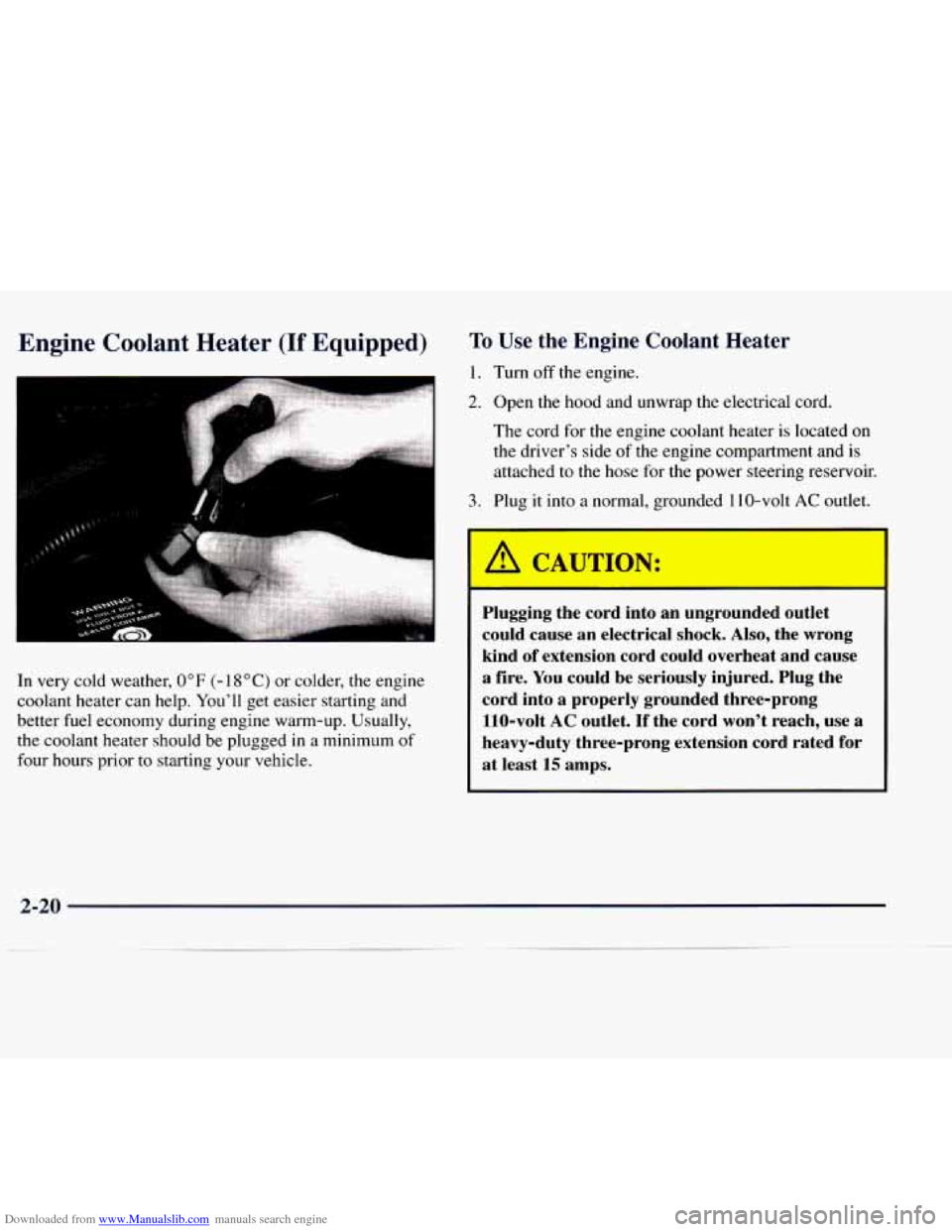
1. Turn off the engine. I
2. Open the hood and unwrap the electrical cord.
The cord for the engine coolant heater is located
on
the driver’s side of the engine compartment and is
attached
to the hose for the power steering reservoir.
In very cold weather,
0°F (- I 8OC) or colder, the engine
coolant heater can help. You’ll get easier starting and
better fuel economy during engine warm-up. Usually,
the coolant heater should be plugged in a minimum
of
four hours prior to starting your vehicle.
I
3. Plug it into a normal, grounded 1 IO-volt AC outlet.
1 A
CAUTION:
Plugging the cord into an ungrounded outlet
could cause an electrical
shock. Also, the wrong
kind
of extension cord could overheat and cause
a fire. You could be seriously injured. Plug the
cord into
a properly grounded three-prong
110-volt
AC outlet. If the cord won’t reach, use a
heavy-duty three-prong extension cord rated for
at least 15 amps.
2-20
Page 94 of 386
Downloaded from www.Manualslib.com manuals search engine I A CAUTION:
Shifting out of PARK (P) or NEUTRAL (N) while
your engine is “racing” (running at high speed) is dangerous. Unless your foot is firmly on the
brake pedal, your vehicle could move very
rapidly. You could lose control and hit people or
objects. Don’t shift out of PARK
(P) or
NEUTRAL
(N) while your engine is racing.
NOTICE:
Damage to your transmission caused by shifting
out
of PARK (P) or NEUTRAL (N) with the
engine racing isn’t covered by your warranty.
DRIVE (D):
This position is for normal driving. If you
need more power for passing, and you’re:
Going less than about 35 mph (55 km/h), push your
accelerator pedal about halfway down.
Going about 35 mph (55 kmh) or more, push the
You’ll shift down to the next gear and have
more power.
You should use DRIVE (D) (or, as you need to, a lower
gear) when towing a trailer
to minimize heat build-up
and extend the life
of your transmission.
THIRD (3): This position is also used for normal
driving, however, it offers more power and lower fuel
economy than DRIVE
(D). You should use THIRD (3)
when carrying a heavy load or driving on steep hills.
SECOND (2): This position gives you more power but
lower fuel economy. You can use SECOND (2) on hills.
It can help control your speed as
you go down steep
mountain roads, but then you would also want to
use
your brakes off and on. If you manually select
SECOND
(2), the transmission will drive in
SECOND
(2). You may use this feature for reducing
torque
to the rear wheels when you are trying to start
your vehicle from a stop
on slippery road surfaces.
FIRST (1): This position gives you even more power
(but lower fuel economy) than SECOND
(2). You can
use it
on very steep hills, or in deep snow or mud. If
the selector lever
is put in FIRST( 1 ), the transmission
won’t shift into first gear until the vehicle is going
slowly enough.
accelerator
all the way down.
Page 122 of 386
Downloaded from www.Manualslib.com manuals search engine Instrument Cluster
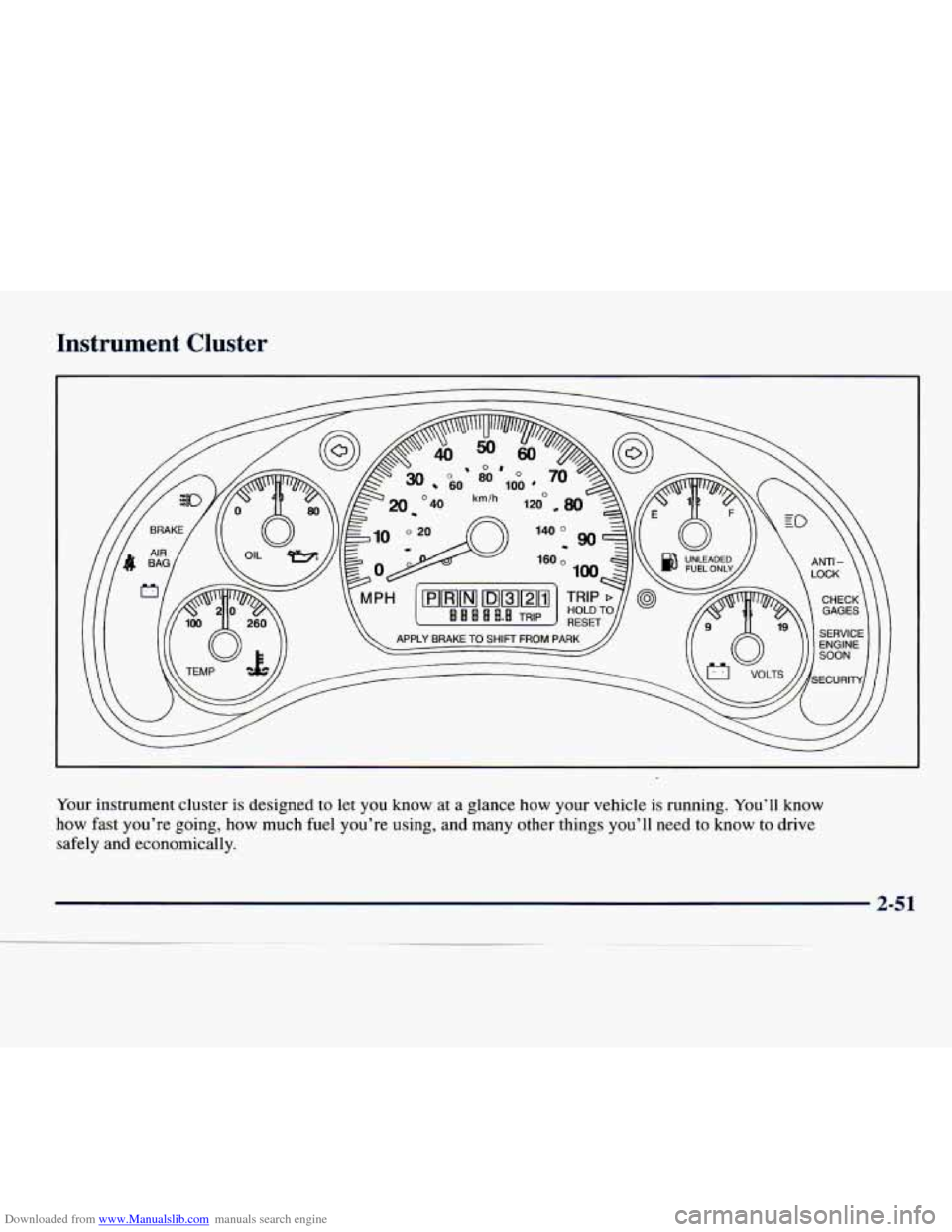
Your instrument cluster is designed to let you know at a glance how your vehicle is running. You’ll know
how fast you’re going, how much fuel you’re using, and many other things you’ll need
to know to drive
safely and economically.
2-51
Page 129 of 386
Downloaded from www.Manualslib.com manuals search engine Malfunction Indicator Lamp (Service Engine Soon Light) (Gasoline Engine)
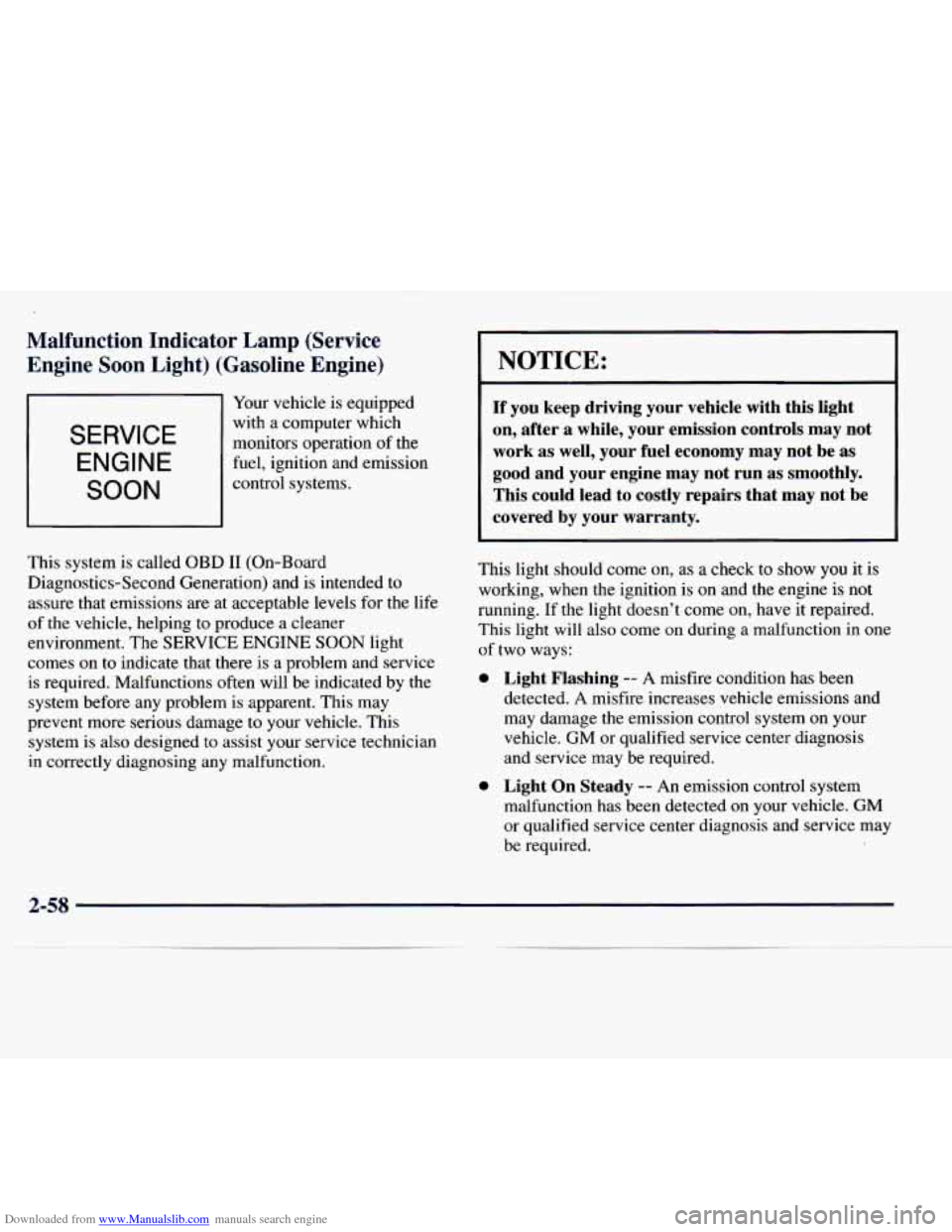
81 Your vehicle is equipped
SERVICE
ENGINE
I
SOON
with a computer which
monitors operation
of the
fuel, ignition and emission
control systems.
This system is called OBD I1 (On-Board
Diagnostics-Second Generation) and
is intended to
assure that emissions
are at acceptable levels for the life
of the vehicle, helping
to produce a cleaner
environment. The
SERVICE ENGINE SOON light
comes on to indicate that there
is a problem and service
is required. Malfunctions often will be indicated by the
system before any problem is apparent. This may
prevent more serious damage to your vehicle. This
system
is also designed to assist your service technician
in correctly diagnosing any malfunction.
NOTICE:
If you keep driving your vehicle with this light
on, after a while, your emission controls may not
work as well, your fuel economy may not be
as
good and your engine may not run as smoothly.
This could lead
to costly repairs that may not be
covered by your warranty.
This light should come on, as a check to show you it is
working, when
the ignition is on and the engine is not
running. If the light doesn’t come on, have it repaired.
This light
will also come on during a malfunction in one
of two ways:
0
0
Light Flashing -- A misfire condition has been
detected.
A misfire increases vehicle emissions and
may damage the emission control system
on your
vehicle.
GM or qualified service center diagnosis
and service may be required.
Light On Steady -- An emission control system
malfunction has been detected on your vehicle.
GM
or qualified service center diagnosis and service may
be required.
2-58
Page 130 of 386
Downloaded from www.Manualslib.com manuals search engine If the Light Is Flashing If the Light Is On Steady
b I
The following may prevent more serious damage to
your vehicle:
Reducing vehicle speed.
0 Avoiding hard accelerations.
Avoiding steep uphill grades.
If you are towing a trailer, reduce the amount of
cargo being hauled as soon as it is possible.
If
the light stops flashing and remains on steady, see “If
the Light Is On Steady” following.
If the light continues to flash, when it is safe
to do so,
stop the vehicle. Find a safe place to park your vehicle.
Turn the key off, wait at least
10 seconds and restart the
engine. If the light remains on steady, see “If the Light
Is On Steady” following. If the light is still flashing,
follow the previous steps, and drive the vehicle
to your
dealer or qualified service center for service.
You may be able to correct the emission system
malfunction by considering the following:
Did you recently put fuel into your vehicle?
If so, reinstall the fuel cap, making sure to fully install
the cap. The diagnostic system can determine if the fuel
cap has been left
off or improperly installed. A loose or
missing fuel cap will allow fuel to evaporate into the
atmosphere. A few driving trips with the cap properly
installed should turn the light off.
Did you just drive through a deep puddle of water?
If
so, your electrical system may be wet. The condition
will usually be corrected when the electrical system
dries out. A few driving trips should turn the light off.
Are
you low on fuel?
As your engine starts
to run out of fuel, your engine may
not run as efficiently as designed since small amounts of
air are sucked into the
fuel line causing a misfire. The
system can detect this. Adding fuel should correct this
condition. Make sure to install
the fuel cap properly. It
will take a few driving trips to turn the light off.
2-59
Page 131 of 386
Downloaded from www.Manualslib.com manuals search engine Have you recently changed brands of fuel?
If
so, be sure to fuel your vehicle with quality fuel (see
“Fuel” in the Index). Poor fuel quality will cause your
engine not to run as efficiently as designed. You may
notice this as stalling after start-up, stalling when you
put the vehicle into gear, misfiring, hesitation on
acceleration or stumbling on acceleration. (These
conditions may
go away once the engine is warmed up.)
This will be detected by the system and cause the light
to turn on.
If you experience one or more of these conditions,
change the fuel brand you use. It will require at least one
full tank
of the proper fuel to turn the light off.
If none of the above steps have made the light turn off,
have your dealer or qualified service center check the
vehicle. Your dealer has the proper test equipment and
diagnostic tools to fix any mechanical or electrical
problems that may have developed.
Oil Pressure Gage
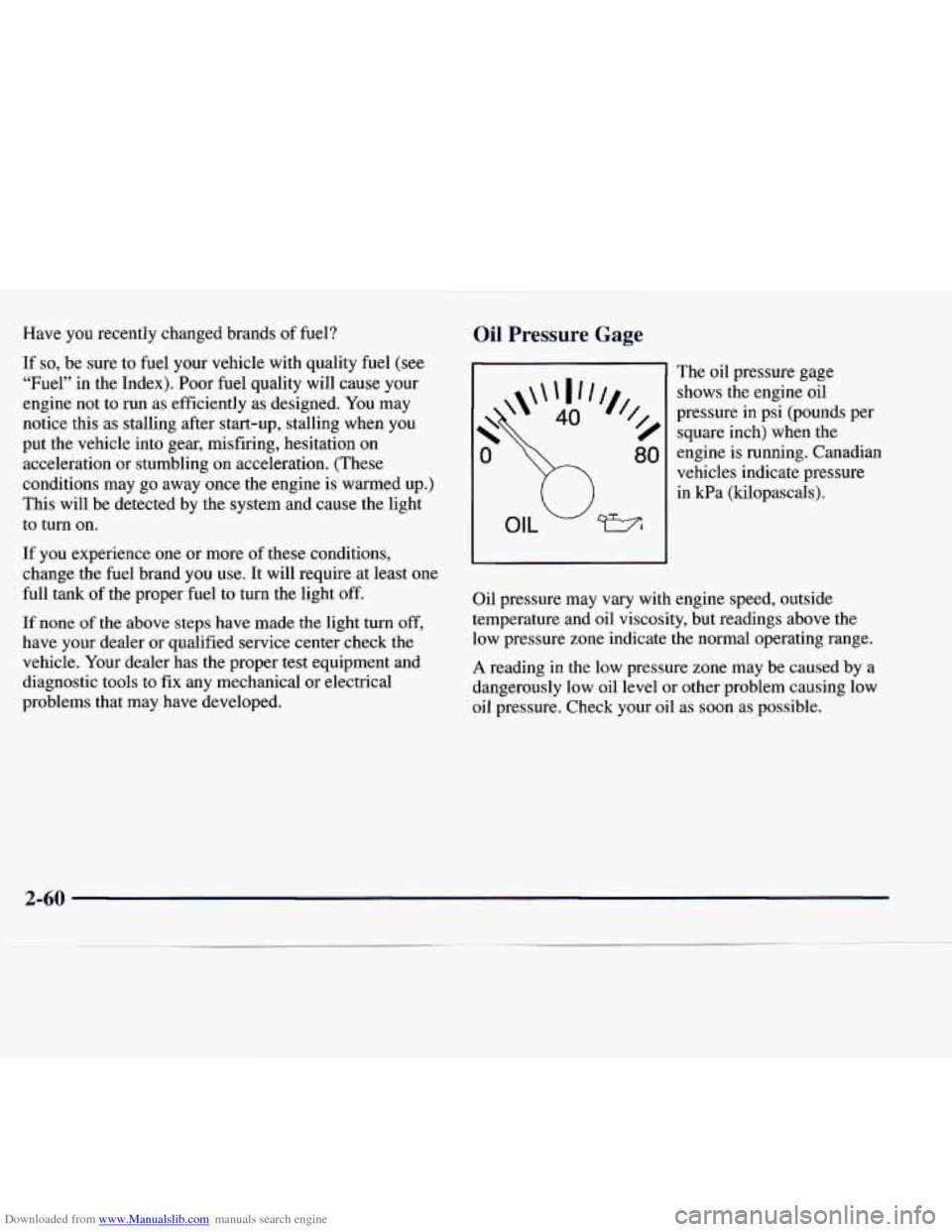
The oil pressure gage
pressure in psi (pounds per
square inch) when the
shows the engine oil
8o I
engine is running. Canadian
vehicles indicate pressure in kPa (kilopascals).
OIL Wh
Oil pressure may vary with engine speed, outside
temperature and oil viscosity, but readings above the low pressure zone indicate the normal operating range.
A reading in the low pressure zone may be caused by a
dangerously low oil level or other problem causing low
oil pressure. Check your oil as soon as possible.
2-60
Page 134 of 386
Downloaded from www.Manualslib.com manuals search engine .~ 1 Gage
\\'
E
FUEL ONLY UNLEADED
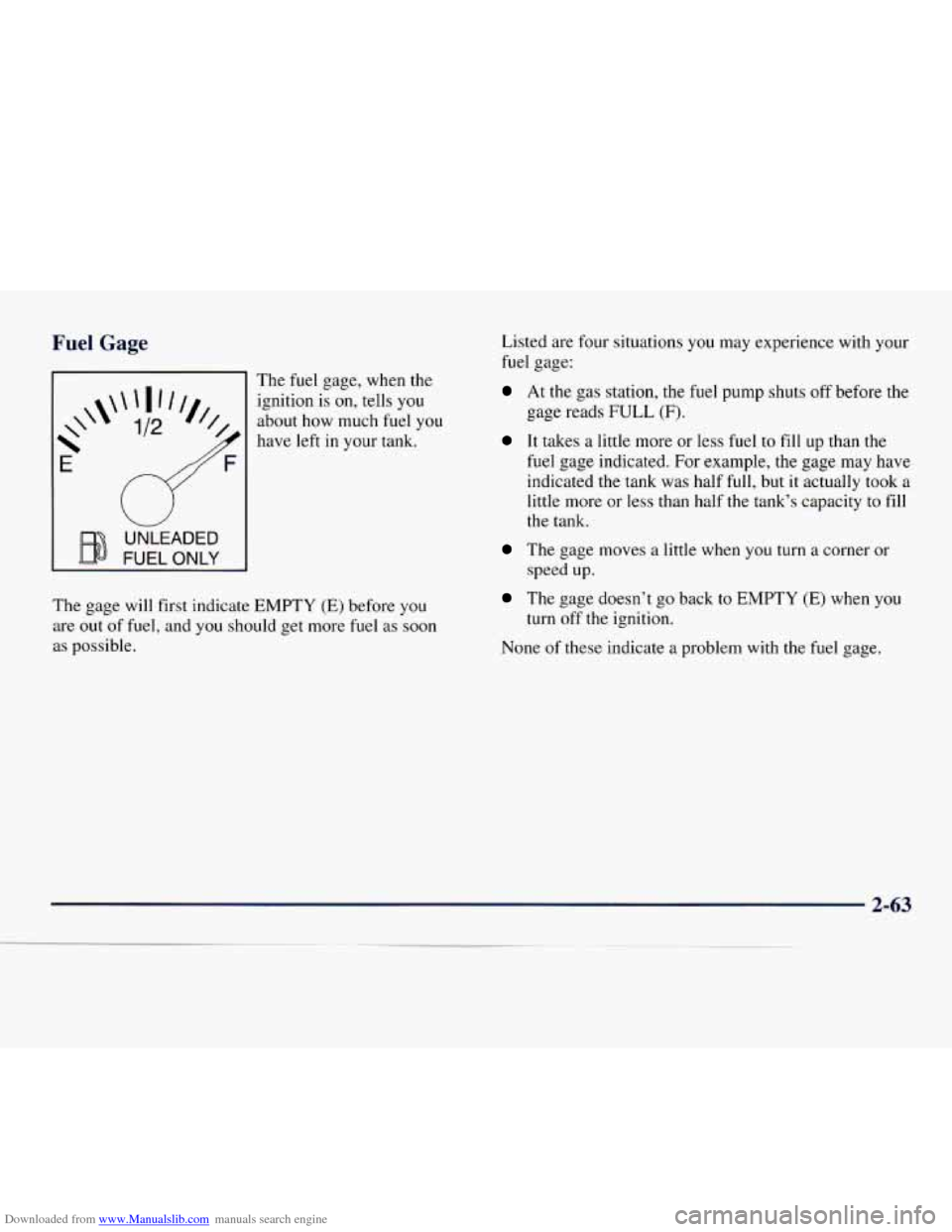
The
fuel gage, when the
ignition is
on, tells you
about how much fuel you
have left in your tank. Listed are
four situations you may experience with your
fuel gage:
At the gas station, the fuel pump shuts off before the
gage reads FULL
(F).
It takes a little more or less fuel to fill up than the
fuel gage indicated. For example, the gage may have
indicated the tank was half full, but
it actually took a
little more or less than half the tank's capacity
to fill
the tank.
The gage moves a little when you turn a corner or
speed up.
The gage will first indicate EMPTY
(E) before you
are out of fuel, and you should get more fuel as soon
as possible.
The gage doesn't go back to EMPTY (E) when you
turn off the ignition.
None
of these indicate a problem with the fuel gage.
2-63
Page 138 of 386
Downloaded from www.Manualslib.com manuals search engine w.
+’ HEAT/DEFROST Use this setting to divide
airflow between the heater floor vents and windshield.
DEFROST This setting directs air through the
windshield defroster vents. This setting is useful when
you have fog or ice
on the windshield.
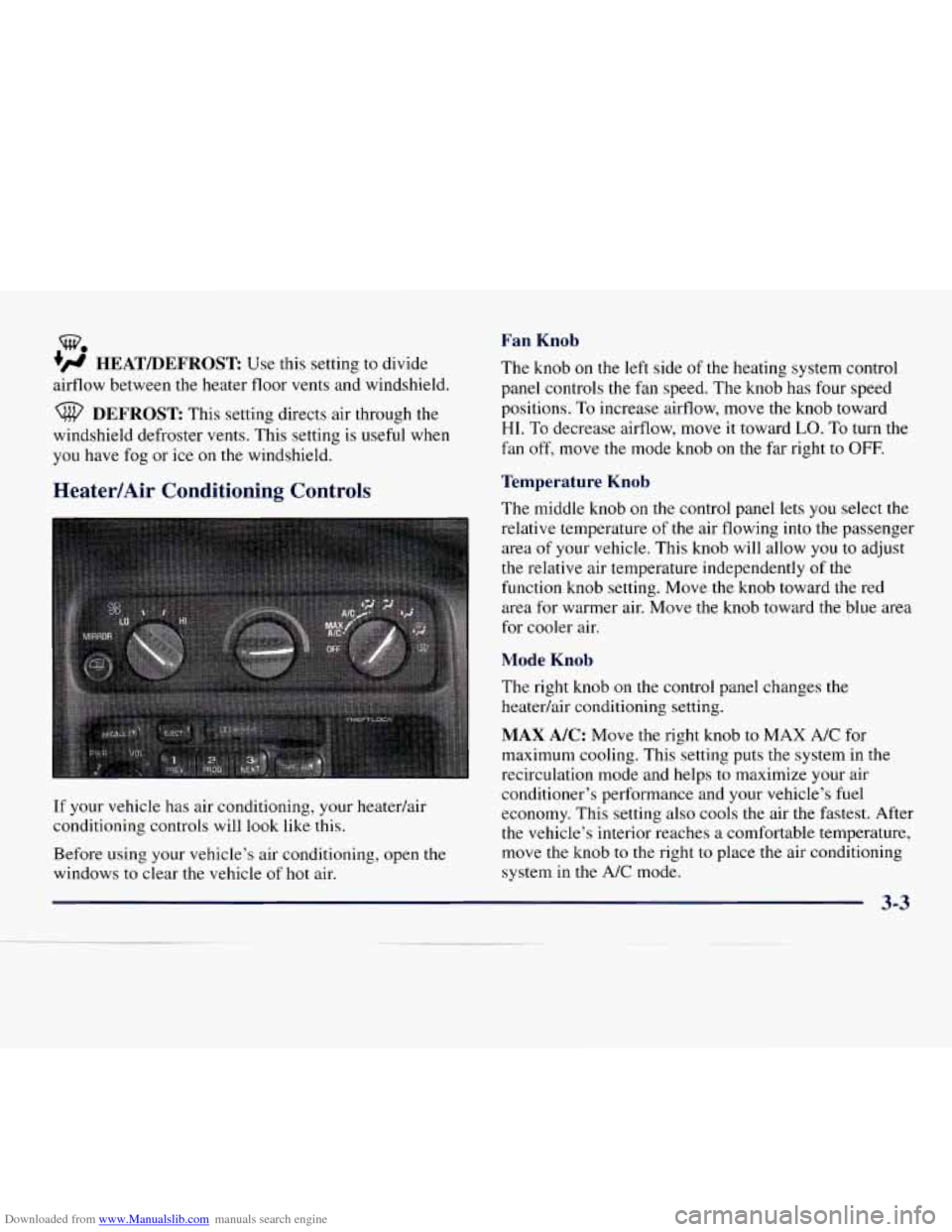
Heater/Air Conditioning Controls
If your vehicle has air conditioning, your heatedair
conditioning controls will look like
this.
Before using your vehicle’s air conditioning, open the
windows to clear the vehicle
of hot air.
Fan Knob
The knob on the left side of the heating system control
panel controls
the fan speed. The knob has four speed
positions. To increase airflow, move the knob toward
HI. To decrease airflow, move it toward LO. To turn the
fan off, move the mode knob
on the far right to OFF.
Temperature Knob
The middle knob on the control panel lets you select the
relative temperature
of the air flowing into the passenger
area
of your vehicle. This knob will allow you to adjust
the relative air temperature independently
of the
function knob setting. Move the knob toward the red
area for warmer air. Move the knob toward the blue area
for cooler air.
Mode Knob
The right knob on the control panel changes the
heatedair conditioning setting.
MAX A/C: Move the right knob to MAX A/C for
maximum cooling. This setting puts the system in the
recirculation mode and helps
to maximize your air
conditioner’s performance and your vehicle’s fuel
economy. This setting also cools the air the fastest. After
the vehicle’s interior reaches
a comfortable temperature,
move the knob
to the right to place the air conditioning
system in the
A/C mode.
3-3