tire pressure CHEVROLET EXPRESS 2003 User Guide
[x] Cancel search | Manufacturer: CHEVROLET, Model Year: 2003, Model line: EXPRESS, Model: CHEVROLET EXPRESS 2003Pages: 370, PDF Size: 2.42 MB
Page 287 of 370
Intended Outboard Sidewall:The side of an
asymmetrical tire, that must always face outward when
mounted on a vehicle.
KiloPascal (kPa):The metric unit for air pressure.
Light Truck (LT-Metric) Tire:A tire used on light duty
trucks and some multipurpose passenger vehicles.
Load Index:An assigned number ranging from
1 to 279 that corresponds to the load carrying capacity
of a tire.
Maximum Ination Pressure:The maximum air
pressure to which a cold tire may be inated. The
maximum air pressure is molded onto the sidewall.
Maximum Load Rating:The load rating for a tire at the
maximum permissible ination pressure for that tire.
Maximum Loaded Vehicle Weight:The sum of curb
weight; accessory weight; vehicle capacity weight;
and production options weight.
Normal Occupant Weight:The number of occupants a
vehicle is designed to seat multiplied by 150 lbs (68 kg).
SeeLoading Your Vehicle on page 4-29.
Occupant Distribution:Designated seating positions.Outward Facing Sidewall:The side of an
asymmetrical tire that has a particular side that faces
outward when mounted on a vehicle. The side of the tire
that contains a whitewall, bears white lettering or
bears manufacturer, brand, and/or model name molding
that is higher or deeper than the same moldings on
the other sidewall of the tire.
Passenger (P-Metric) Tire:A tire used on passenger
cars and some light duty trucks and multipurpose
vehicles.
Recommended Ination Pressure:Vehicle
manufacturer’s recommended tire ination pressure and
shown on the tire placard. SeeInation - Tire Pressure
on page 5-58andLoading Your Vehicle on page 4-29.
Radial Ply Tire:A pneumatic tire in which the ply cords
that extend to the beads are laid at 90 degrees to the
centerline of the tread.
Rim:A metal support for a tire and upon which the tire
beads are seated.
Sidewall:The portion of a tire between the tread and
the bead.
Speed Rating:An alphanumeric code assigned to a
tire indicating the maximum speed at which a tire
can operate.
Traction:The friction between the tire and the road
surface. The amount of grip provided.
5-57
Page 288 of 370
Tread:The portion of a tire that comes into contact
with the road.
Treadwear Indicators:Narrow bands, sometimes
called “wear bars,” that show across the tread of a tire
when only 1/16 inch (1.6 mm) of tread remains. See
When It Is Time for New Tires on page 5-62.
UTQGS (Uniform Tire Quality Grading Standards):A
tire information system that provides consumers with
ratings for a tire’s traction, temperature, and treadwear.
Ratings are determined by tire manufacturers using
government testing procedures. The ratings are molded
into the sidewall of the tire. SeeUniform Tire Quality
Grading on page 5-63.
Vehicle Capacity Weight:The number of designated
seating positions multiplied by 150 lbs (68 kg) plus
the rated cargo load. SeeLoading Your Vehicle
on page 4-29.
Vehicle Maximum Load on the Tire:Load on an
individual tire due to curb weight, accessory weight,
occupant weight, and cargo weight.
Vehicle Placard:A label permanently attached to a
vehicle showing the vehicle’s capacity weight and
the original equipment tire size and recommended
ination pressure. See “Tire and Loading Information
Label” underLoading Your Vehicle on page 4-29.Ination - Tire Pressure
Tires need the correct amount of air pressure to
operate effectively.
Notice:Do not let anyone tell you that
under-ination or over-ination is all right. It is not.
If your tires do not have enough air (under-ination),
you can get the following:
Too much exing
Too much heat
Tire overloading
Premature or irregular wear
Poor handling
Reduced fuel economy
If your tires have too much air (over-ination), you
can get the following:
Unusual wear
Poor handling
Rough ride
Needless damage from road hazards
5-58
Page 289 of 370
A Tire and Loading Information label is attached to the
vehicle’s center pillar (B-pillar), below the driver’s
door latch. This label shows your vehicle’s original
equipment tires and the correct ination pressures for
your tires when they are cold. The recommended
cold tire ination pressure, shown on the label, is the
minimum amount of air pressure needed to support your
vehicle’s maximum load carrying capacity.
For additional information regarding how much weight
your vehicle can carry, and an example of the tire
and loading information label, seeLoading Your Vehicle
on page 4-29. How you load your vehicle affects
vehicle handling and ride comfort, never load your
vehicle with more weight than it was designed to carry.
When to Check
Check your tires once a month or more.
Also, check the tire pressure of the spare tire.
How to Check
Use a good quality pocket-type gage to check tire
pressure. You cannot tell if your tires are properly
inated simply by looking at them. Radial tires may
look properly inated even when they’re underinated.
Check the tire’s ination pressure when the tires
are cold. Cold means your vehicle has been sitting
for at least three hours or driven no more than
1 mile (1.6 km).Remove the valve cap from the tire valve stem. Press
the tire gage rmly onto the valve to get a pressure
measurement. If the cold tire ination pressure matches
the recommended pressure on the tire and loading
information label, no further adjustment is necessary. If
the pressure is low, add air until you reach the
recommended amount.
If you overll the tire, release air by pushing on the
metal stem in the center of the tire valve. Recheck the
tire pressure with the tire gage.
Be sure to put the valve caps back on the valve stems.
They help prevent leaks by keeping out dirt and
moisture.
Dual Tire Operation
When the vehicle is new, or whenever a wheel,
wheel bolt or wheel nut is replaced, check the wheel
nut torque after 100, 1,000 and 6,000 miles
(160, 1 600 and 10 000 km) of driving. For proper wheel
nut tightening information, see “Removing the Flat
Tire and Installing the Spare Tire” later in this section,
underChanging a Flat Tire on page 5-68. Also see
“Wheel Nut Torque” underCapacities and Specications
on page 5-97.
5-59
Page 290 of 370
The outer tire on a dual wheel setup generally wears
faster than the inner tire. Your tires will wear more
evenly and last longer if you rotate the tires periodically.
SeeTire Inspection and Rotation on page 5-60. Also
seeScheduled Maintenance on page 6-4.
{CAUTION:
If you operate your vehicle with a tire that is
badly underinated, the tire can overheat. An
overheated tire can lose air suddenly or catch
re. You or others could be injured. Be sure all
tires (including the spare) are properly inated.
SeeTires on page 5-52andInation - Tire Pressure on
page 5-58for more information on proper tire ination.
Tire Inspection and Rotation
Tires should be rotated every 5,000 to 8,000 miles
(8 000 to 13 000 km).
Any time you notice unusual wear, rotate your tires as
soon as possible and check wheel alignment. Also
check for damaged tires or wheels. SeeWhen It Is Time
for New Tires on page 5-62andWheel Replacement
on page 5-65for more information.Make sure the spare tire is stored securely. Push, pull,
and then try to rotate or turn the tire. If it moves,
use the ratchet/wheel wrench to tighten the cable. See
Changing a Flat Tire on page 5-68.
If your vehicle has dual rear wheels, also seeDual Tire
Operation on page 5-59.
The purpose of regular rotation is to achieve more
uniform wear for all tires on the vehicle. The rst rotation
is the most important. SeeScheduled Maintenance
on page 6-4.
If your vehicle has single rear wheels, always use the
correct rotation pattern shown here when rotating
your vehicle’s tires. Do not include the spare tire in the
tire rotation.Single Rear Wheels
5-60
Page 291 of 370
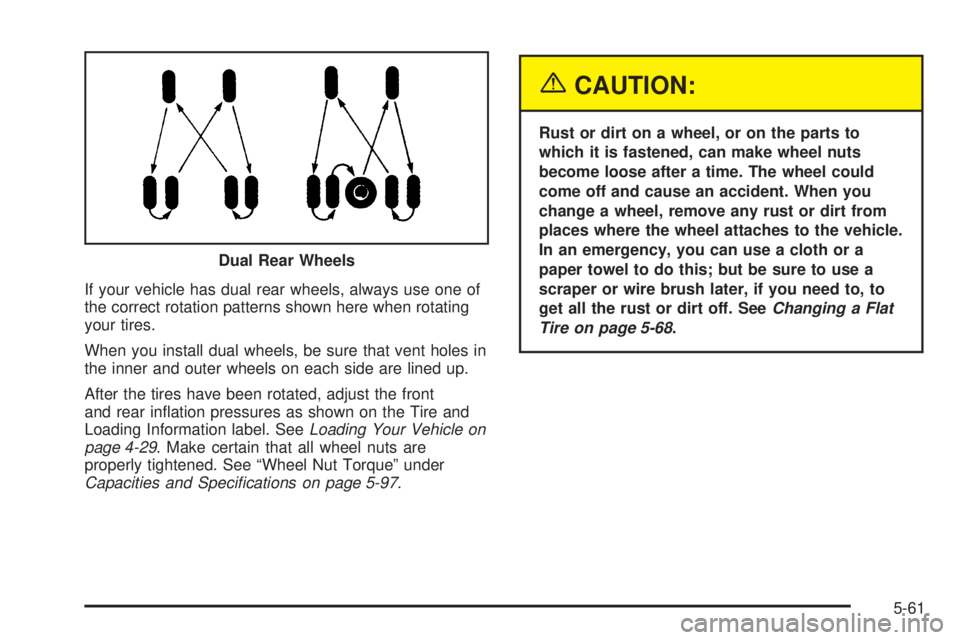
If your vehicle has dual rear wheels, always use one of
the correct rotation patterns shown here when rotating
your tires.
When you install dual wheels, be sure that vent holes in
the inner and outer wheels on each side are lined up.
After the tires have been rotated, adjust the front
and rear ination pressures as shown on the Tire and
Loading Information label. SeeLoading Your Vehicle on
page 4-29. Make certain that all wheel nuts are
properly tightened. See “Wheel Nut Torque” under
Capacities and Specications on page 5-97.
{CAUTION:
Rust or dirt on a wheel, or on the parts to
which it is fastened, can make wheel nuts
become loose after a time. The wheel could
come off and cause an accident. When you
change a wheel, remove any rust or dirt from
places where the wheel attaches to the vehicle.
In an emergency, you can use a cloth or a
paper towel to do this; but be sure to use a
scraper or wire brush later, if you need to, to
get all the rust or dirt off. SeeChanging a Flat
Tire on page 5-68. Dual Rear Wheels
5-61
Page 312 of 370
6. Raise the tire fully against the underside of the
vehicle. Continue turning the ratchet until the tire
is secure and the cable is tight. The spare tire hoist
cannot be overtightened.
7. Make sure the tire is stored securely. Push, pull,
and then try to rotate or turn the tire. If the tire
moves, use the ratchet to tighten the cable.
You will hear two clicks when the tire is up all the way.
Return the jacking equipment to the proper location.
Secure the items and replace the jack cover.
Spare Tire
Your vehicle, when new, had a fully inated spare tire.
A spare tire may lose air over time, so check its
ination pressure regularly. SeeInation - Tire Pressure
on page 5-58andLoading Your Vehicle on page 4-29
for information regarding proper tire ination and loading
your vehicle. For instructions on how to remove,
install or store a spare tire, seeRemoving the Flat Tire
and Installing the Spare Tire on page 5-72and
Storing a Flat or Spare Tire and Tools on page 5-80.After installing the spare tire on your vehicle, you should
stop as soon as possible and make sure the spare is
correctly inated. Have the damaged or at road
tire repaired or replaced as soon as you can and
installed back onto your vehicle. This way, a spare tire
will be available in case you need it again.
Your vehicle may have a different size spare tire than
the road tires — those originally installed on your
vehicle. This spare tire was developed for use on your
vehicle, so it’s all right to drive on it.
If your vehicle has a spare tire that does not match your
vehicle’s original road tires and wheels in size and
type, do not include the spare in the tire rotation.Appearance Care
Cleaning products can be hazardous. Some are toxic.
Other cleaning products can burst into ames if a match
is struck near them or if they get on a hot part of the
vehicle. Some are dangerous if their fumes are inhaled
in an enclosed space. When anything from a container
is used to clean the vehicle, be sure to follow the
manufacturer’s warnings and instructions. Always open
the doors or windows of the vehicle when cleaning
the inside.
5-82
Page 333 of 370

Scheduled Maintenance
Service MaintenanceIMaintenanceII
Change engine oil and lter. SeeEngine Oil on page 5-13. Reset oil
life system. SeeEngine Oil Life System on page 5-16.An Emission
Control Service.••
Lubricate chassis components.See footnote #.••
Visually check for any leaks or damage.See footnote (j).••
Inspect engine air cleaner lter or change indicator (if equipped). If necessary,
replace lter. SeeEngine Air Cleaner/Filter on page 5-17.An Emission Control
Service. See footnotes † and (l).•
Rotate tires and check ination pressures and wear. SeeTires on page 5-52.••
Inspect brake system.See footnote (a).••
Check engine coolant and windshield washer uid levels and add uid
as needed.••
Perform any needed additional services. See “Additional Required Services” in
this section.••
Inspect suspension and steering components.See footnote (b).•
Inspect engine cooling system.See footnote (c).•
Inspect wiper blades.See footnote (d).•
Inspect restraint system components.See footnote (e).•
Lubricate body components.See footnote (f).•
Check transmission uid level and add uid as needed.•
Inspect shields, vehicles with GVWR above 10,000 lbs (4 536 kg) only.See
footnote (g).•
Inspect throttle system.See footnote (m).•
6-5
Page 338 of 370

Owner Checks and Services
These owner checks and services should be performed
at the intervals specied to help ensure the safety,
dependability and emission control performance of your
vehicle. Your GM Goodwrench dealer can assist you
with these checks and services.
Be sure any necessary repairs are completed at once.
Whenever any uids or lubricants are added to your
vehicle, make sure they are the proper ones, as shown
inRecommended Fluids and Lubricants on page 6-13.
At the First 100, 1,000 and
6,000 Miles (160, 1 600
and 10 000km)
For vehicles with dual wheels, check dual wheel nut
torque. For proper torque, seeCapacities and
Specications on page 5-97.
At Each Fuel Fill
It is important to perform these underhood checks at
each fuel ll.
Engine Oil Level Check
Check the engine oil level and add the proper oil if
necessary. SeeEngine Oil on page 5-13for further
details.
Notice:It is important to check your oil regularly
and keep it at the proper level. Failure to keep your
engine oil at the proper level can cause damage
to your engine not covered by your warranty.
Engine Coolant Level Check
Check the engine coolant level and add
DEX-COOL®coolant mixture if necessary. SeeEngine
Coolant on page 5-22for further details.
Windshield Washer Fluid Level Check
Check the windshield washer uid level in the windshield
washer tank and add the proper uid if necessary.
At Least Once a Month
Tire Ination Check
Visually inspect your tires and make sure tires are
inated to the correct pressures. Do not forget to check
your spare tire. SeeTires on page 5-52for further
details. Check to make sure the spare tire is stored
securely. Push, pull and then try to turn the spare tire. If
it moves, tighten it. SeeChanging a Flat Tire on
page 5-68.
6-10
Page 363 of 370
Extender, Safety Belt.......................................1-30
Exterior Lamps...............................................3-13
F
Filter
Engine Air Cleaner......................................5-17
Finish Damage...............................................5-89
Fixed Mast Antenna........................................3-74
Flash-to-Pass................................................... 3-9
Flat Tire........................................................5-67
Flat Tire, Changing.........................................5-68
Flat Tire, Storing.............................................5-80
Fluid
Automatic Transmission................................5-19
Power Steering...........................................5-32
Windshield Washer......................................5-33
Front Axle......................................................5-44
Fuel............................................................... 5-5
Additives...................................................... 5-6
California Fuel.............................................. 5-6
Filling a Portable Fuel Container....................5-10
Filling Your Tank........................................... 5-8
Fuels in Foreign Countries.............................. 5-7
Gage.........................................................3-38
Gasoline Octane........................................... 5-5
Gasoline Specications.................................. 5-5
Regulator...................................................2-20Fuses
Engine Compartment Fuse Block...................5-94
Floor Console Fuse Block.............................5-93
Fuses and Circuit Breakers...........................5-92
Windshield Wiper.........................................5-92
G
Gage
Check Gages Warning Light..........................3-38
Engine Coolant Temperature.........................3-31
Fuel..........................................................3-38
Oil Pressure...............................................3-34
Speedometer..............................................3-24
Voltmeter Gage...........................................3-28
Gasoline
Octane........................................................ 5-5
Specications............................................... 5-5
GM Mobility Reimbursement Program.................. 7-5
H
Hazard Warning Flashers................................... 3-6
Headlamp Wiring............................................5-92
Headlamps....................................................5-47
Bulb Replacement.......................................5-46
Daytime Running Lamps...............................3-14
Flash-to-Pass............................................... 3-9
5
Page 364 of 370
Headlamps (cont.)
Front Turn Signal, Sidemarker and
Parking Lamps.........................................5-48
Halogen Bulbs............................................5-47
High/Low Beam Changer................................ 3-8
On Reminder..............................................3-14
Heater...........................................................3-18
Highbeam On Light.........................................3-37
Highway Hypnosis...........................................4-21
Hill and Mountain Roads..................................4-22
Hood
Checking Things Under................................5-10
Release.....................................................5-11
Horn............................................................... 3-6
How to Use This Manual...................................... ii
How to Wear Safety Belts Properly...................1-15
I
Ignition Positions.............................................2-19
Infants and Young Children, Restraints...............1-33
Ination -- Tire Pressure..................................5-58
Instrument Panel
Brightness..................................................3-15
Cluster.......................................................3-23
Overview..................................................... 3-4
J
Jump Starting.................................................5-38
K
Keyless Entry System....................................... 2-3
Keys............................................................... 2-2
L
Labelling, Tire Sidewall....................................5-53
Lamps
Battery Run-Down Protection.........................3-16
Dome........................................................3-15
Dome Lamp Override...................................3-15
Exterior......................................................3-13
Reading.....................................................3-16
LATCH System
Child Restraints...........................................1-49
Securing a Child Restraint Designed for
the LATCH System...................................1-51
Light
Airbag Off..................................................3-26
Airbag Readiness........................................3-25
Anti-Lock Brake System Warning...................3-30
6