audio CHEVROLET EXPRESS 2003 Owner's Manual
[x] Cancel search | Manufacturer: CHEVROLET, Model Year: 2003, Model line: EXPRESS, Model: CHEVROLET EXPRESS 2003Pages: 370, PDF Size: 2.42 MB
Page 170 of 370
Radio with Six-Disc CD
Playing the Radio
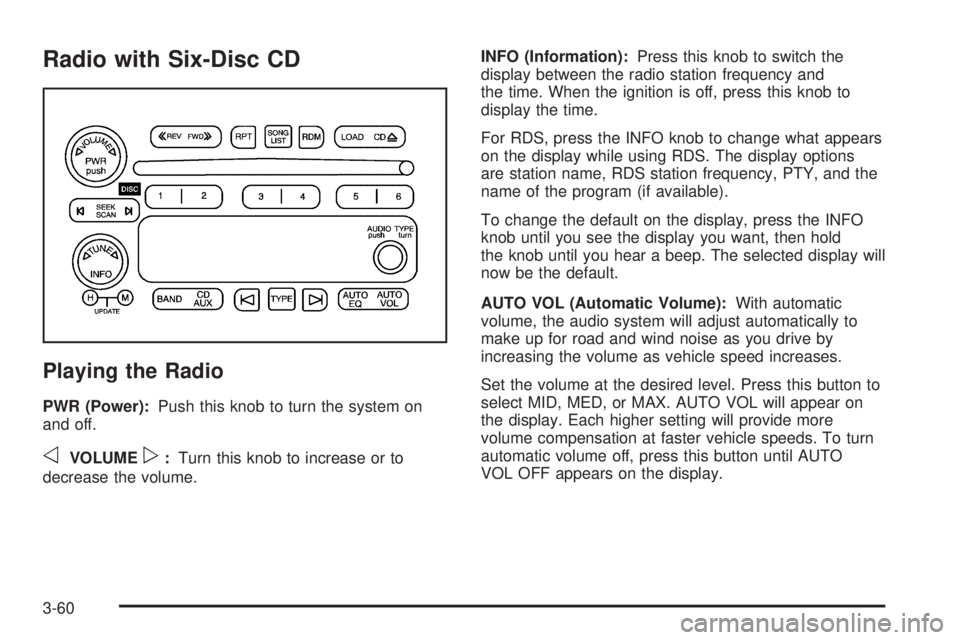
PWR (Power):Push this knob to turn the system on
and off.
oVOLUMEp:Turn this knob to increase or to
decrease the volume.INFO (Information):Press this knob to switch the
display between the radio station frequency and
the time. When the ignition is off, press this knob to
display the time.
For RDS, press the INFO knob to change what appears
on the display while using RDS. The display options
are station name, RDS station frequency, PTY, and the
name of the program (if available).
To change the default on the display, press the INFO
knob until you see the display you want, then hold
the knob until you hear a beep. The selected display will
now be the default.
AUTO VOL (Automatic Volume):With automatic
volume, the audio system will adjust automatically to
make up for road and wind noise as you drive by
increasing the volume as vehicle speed increases.
Set the volume at the desired level. Press this button to
select MID, MED, or MAX. AUTO VOL will appear on
the display. Each higher setting will provide more
volume compensation at faster vehicle speeds. To turn
automatic volume off, press this button until AUTO
VOL OFF appears on the display.
3-60
Page 172 of 370
Setting the Tone (Bass/Treble)
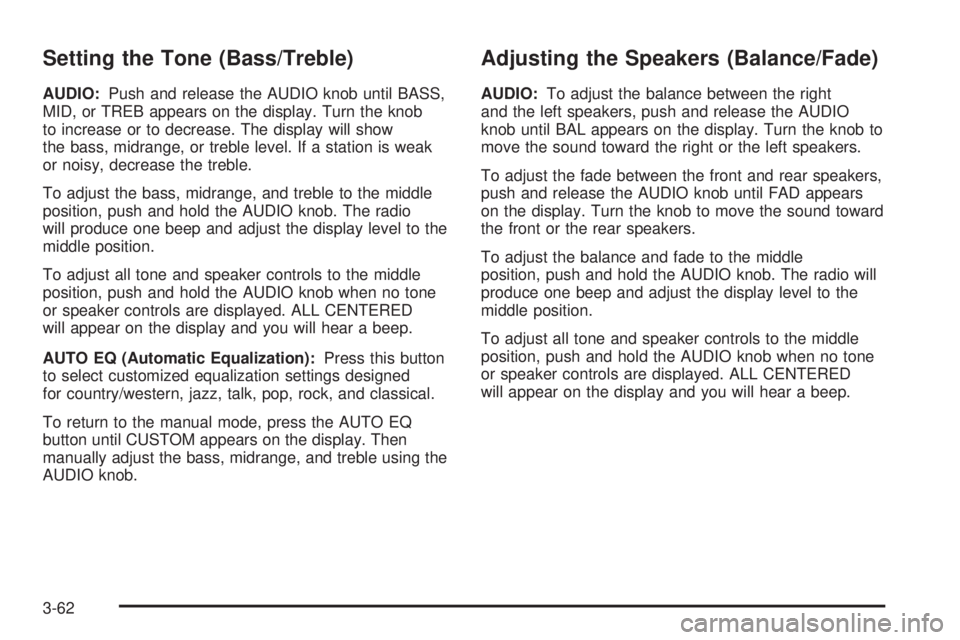
AUDIO:Push and release the AUDIO knob until BASS,
MID, or TREB appears on the display. Turn the knob
to increase or to decrease. The display will show
the bass, midrange, or treble level. If a station is weak
or noisy, decrease the treble.
To adjust the bass, midrange, and treble to the middle
position, push and hold the AUDIO knob. The radio
will produce one beep and adjust the display level to the
middle position.
To adjust all tone and speaker controls to the middle
position, push and hold the AUDIO knob when no tone
or speaker controls are displayed. ALL CENTERED
will appear on the display and you will hear a beep.
AUTO EQ (Automatic Equalization):Press this button
to select customized equalization settings designed
for country/western, jazz, talk, pop, rock, and classical.
To return to the manual mode, press the AUTO EQ
button until CUSTOM appears on the display. Then
manually adjust the bass, midrange, and treble using the
AUDIO knob.
Adjusting the Speakers (Balance/Fade)
AUDIO:To adjust the balance between the right
and the left speakers, push and release the AUDIO
knob until BAL appears on the display. Turn the knob to
move the sound toward the right or the left speakers.
To adjust the fade between the front and rear speakers,
push and release the AUDIO knob until FAD appears
on the display. Turn the knob to move the sound toward
the front or the rear speakers.
To adjust the balance and fade to the middle
position, push and hold the AUDIO knob. The radio will
produce one beep and adjust the display level to the
middle position.
To adjust all tone and speaker controls to the middle
position, push and hold the AUDIO knob when no tone
or speaker controls are displayed. ALL CENTERED
will appear on the display and you will hear a beep.
3-62
Page 173 of 370
Radio Data System (RDS)
The audio system has a Radio Data System (RDS).
RDS features are available for use only on FM stations
that broadcast RDS information.
With RDS, the radio can do the following:
Seek to stations broadcasting the selected type of
programming
Receive announcements concerning local and
national emergencies
Display messages from radio stations
This system relies upon receiving specic information
from these stations and will only work when the
information is available. In rare cases, a radio station
may broadcast incorrect information that will cause
the radio features to work improperly. If this happens,
contact the radio station.
While the radio is tuned to an RDS station, the station
name or call letters will appear on the display instead of
the frequency. RDS stations may also provide the
time of day, a program type (PTY) for current
programming, and the name of the program
being broadcast.
Finding a Program Type (PTY) Station
To select and nd a desired PTY perform the
following:
1. Press the TYPE button to activate program type
select mode. P-TYPE and the last selected PTY
will appear on the display.
2. Turn the TYPE knob or press and release the
TYPE button to select a PTY.
3. Once the desired PTY is displayed, press either the
TYPE or the SEEK arrows to select and to take you
to the PTY’s rst station.
4. To go to another station within that PTY and the
PTY is displayed, press either the TYPE or the
SEEK arrows once. If the PTY is not displayed, go
back to Step 1.
5. Press either the TYPE or the SEEK arrows to exit
program type select mode.
3-63
Page 175 of 370
RDS Messages
INFO (Information):If the current station has a
message, INFO will appear on the display. Press this
button to see the message. The message may display
the artist, song title, call in phone numbers, etc.
If the entire message is not displayed, parts of the
message will appear every three seconds. To scroll
through the message, press and release the INFO
button. A new group of words will appear on the display
after every press of this button. Once the complete
message has been displayed, INFO will disappear from
the display until another new message is received.
The last message can be displayed by pressing
the INFO button. You can view the last message
until a new message is received or a different station is
tuned to.
Radio Messages
CAL ERR (Calibration Error):The audio system has
been calibrated for your vehicle from the factory. If
CAL ERR appears on the display, it means that the radio
has not been congured properly for the vehicle and
must be returned to your GM dealer for service.
LOCKED:This message is displayed when the
THEFTLOCK
®system has locked up. Take the vehicle
to your GM dealer for service.
If any error occurs repeatedly, or if an error cannot be
corrected, contact your GM dealer.
3-65
Page 176 of 370

Playing a CD
If the ignition or radio is turned off, with a CD in the
player, it will stay in the player. When the ignition
or radio is turned on, the CD will start playing where it
stopped, if it was the last selected audio source.
When a CD is inserted, the CD symbol will appear on
the display. As each new track starts to play, the
track number will appear on the display.
The CD player can play the smaller 3 inch (8 cm) single
CDs with an adapter ring. Full-size CDs and the
smaller CDs are loaded in the same manner.
If playing a CD-R the sound quality may be reduced
due to CD-R quality, the method of recording, the quality
of the music that has been recorded, and the way the
CD-R has been handled. There may be an increase
in skipping, difficulty in nding tracks, and/or difficulty in
loading and ejecting. If these problems occur try a
known good CD.Do not add paper labels to CDs, they could get caught
in the CD player.
If an error appears on the display, see “CD Messages”
later in this section.
LOAD:Press this button to load CDs into the CD
player. This CD player will hold up to six CDs.
To insert one CD, do the following:
1. Turn the ignition on.
2. Press and release the LOAD button.
3. Wait for the indicator light, located to the right of the
slot, to turn green.
4. Load a CD. Insert the CD partway into the slot,
label side up. The player will pull the CD in.
3-66
Page 268 of 370
Vehicle Storage
If you are not going to drive your vehicle for 25 days
or more, remove the black, negative (−) cable from
the battery. This will help keep your battery from
running down.
{CAUTION:
Batteries have acid that can burn you and gas
that can explode. You can be badly hurt if you
are not careful. SeeJump Starting on
page 5-38for tips on working around a battery
without getting hurt.
Also, for your audio system, seeTheft-Deterrent
Feature (Non-RDS Radios) on page 3-71or
Theft-Deterrent Feature (RDS Radios) on page 3-71.
Jump Starting
If your battery has run down, you may want to use
another vehicle and some jumper cables to start your
vehicle. Be sure to use the following steps to do it safely.
{CAUTION:
Batteries can hurt you. They can be dangerous
because:
They contain acid that can burn you.
They contain gas that can explode
or ignite.
They contain enough electricity to
burn you.
If you do not follow these steps exactly, some
or all of these things can hurt you.
5-38
Page 359 of 370
A
Accessory Power Outlets.................................3-16
Adding Equipment to Your
Airbag-Equipped Vehicle...............................1-70
Additives, Fuel................................................. 5-6
Add-On Electrical Equipment............................5-92
Air Cleaner/Filter, Engine.................................5-17
Air Conditioning..............................................3-18
Airbag
Off Light.....................................................3-26
Readiness Light..........................................3-25
Airbag Sensing and Diagnostic Module (SDM)........ 7-9
Airbag System................................................1-59
Adding Equipment to Your
Airbag-Equipped Vehicle............................1-70
Airbag Off Switch........................................1-66
How Does an Airbag Restrain?......................1-65
Servicing Your Airbag-Equipped Vehicle..........1-69
What Makes an Airbag Inate?......................1-64
What Will You See After an Airbag Inates?........1-65
When Should an Airbag Inate?....................1-63
Where Are the Airbags?...............................1-62
All-Wheel Drive...............................................5-43
All-Wheel Drive (AWD) System.........................2-24
AM-FM Radio.................................................3-40
Antenna, Fixed Mast.......................................3-74
Anti-Lock Brake System (ABS)........................... 4-6
Anti-Lock Brake, System Warning Light..............3-30
Appearance Care............................................5-82Aluminum Wheels........................................5-88
Care of Safety Belts....................................5-85
Chemical Paint Spotting...............................5-89
Cleaning Exterior Lamps/Lenses....................5-86
Fabric/Carpet..............................................5-83
Finish Care.................................................5-86
Finish Damage............................................5-89
Glass Surfaces............................................5-85
Instrument Panel.........................................5-85
Interior Plastic Components...........................5-85
Sheet Metal Damage...................................5-89
Tires..........................................................5-88
Underbody Maintenance...............................5-89
Vehicle Care/Appearance Materials................5-90
Vinyl..........................................................5-85
Washing Your Vehicle...................................5-86
Weatherstrips..............................................5-86
Windshield and Wiper Blades........................5-87
Ashtrays........................................................3-17
Audio System(s).............................................3-39
AM-FM Radio.............................................3-40
Care of Your Cassette Tape Player................3-72
Care of Your CD Player...............................3-74
Care of Your CDs........................................3-74
Chime Level Adjustment...............................3-74
Fixed Mast Antenna.....................................3-74
Radio with Cassette and CD.........................3-47
Radio with CD............................................3-43
Radio with Six-Disc CD................................3-60
1
Page 360 of 370

Audio System(s) (cont.)
Setting the Time for Radios with
Radio Data Systems (RDS).......................3-40
Setting the Time for Radios without
Radio Data Systems (RDS).......................3-40
Theft-Deterrent Feature................................3-71
Understanding Radio Reception.....................3-72
Automatic Transmission
Fluid..........................................................5-19
Operation...................................................2-22
B
Battery..........................................................5-37
Run-Down Protection...................................3-16
Before Leaving on a Long Trip.........................4-21
Brake
Anti-Lock Brake System (ABS)........................ 4-6
Emergencies................................................ 4-7
Parking......................................................2-24
System Warning Light..................................3-29
Brakes..........................................................5-34
Braking........................................................... 4-5
Braking in Emergencies..................................... 4-7
Break-In, New Vehicle.....................................2-18
Bulb Replacement...........................................5-46
Center High-Mounted Stoplamp (CHMSL)........5-49
Front Turn Signal, Sidemarker and
Parking Lamps.........................................5-48Bulb Replacement (cont.)
Halogen Bulbs............................................5-47
Headlamps.................................................5-47
Replacement Bulbs......................................5-50
Taillamps....................................................5-49
Buying New Tires...........................................5-62
C
California Fuel.................................................. 5-6
Canadian Owners................................................ ii
Capacities and Specications............................5-97
Carbon Monoxide...........................2-27, 4-24, 4-34
Care of
Safety Belts................................................5-85
Your Cassette Tape Player............................3-72
Your CD Player...........................................3-74
Your CDs ...................................................3-74
Cargo Door Relocking....................................... 2-8
Center High-Mounted Stoplamp (CHMSL)...........5-49
Center Passenger Position, Safety Belts.......1-23, 1-24
Chains, Tire...................................................5-66
Charging System Light....................................3-28
Check
Engine Light...............................................3-32
Gages Warning Light...................................3-38
Checking Things Under the Hood......................5-10
Chemical Paint Spotting...................................5-89
2