wheel CHEVROLET EXPRESS 2004 Owner's Guide
[x] Cancel search | Manufacturer: CHEVROLET, Model Year: 2004, Model line: EXPRESS, Model: CHEVROLET EXPRESS 2004Pages: 370, PDF Size: 2.42 MB
Page 220 of 370
Tow/Haul Mode
Tow/haul is designed to assist while your vehicle is
pulling a large or heavy load or trailer. Tow/haul is most
useful while pulling such a load in rolling terrain, in
stop-and-go traffic, or when you need improved
low-speed control, such as when parking. The purpose
of the tow/haul mode is to:
Reduce the frequency and improve the predictability
of transmission shifts,
provide the same solid shift feel when pulling a
heavy load as when the vehicle is unloaded,
improve control of vehicle speed while requiring
less throttle pedal activity.
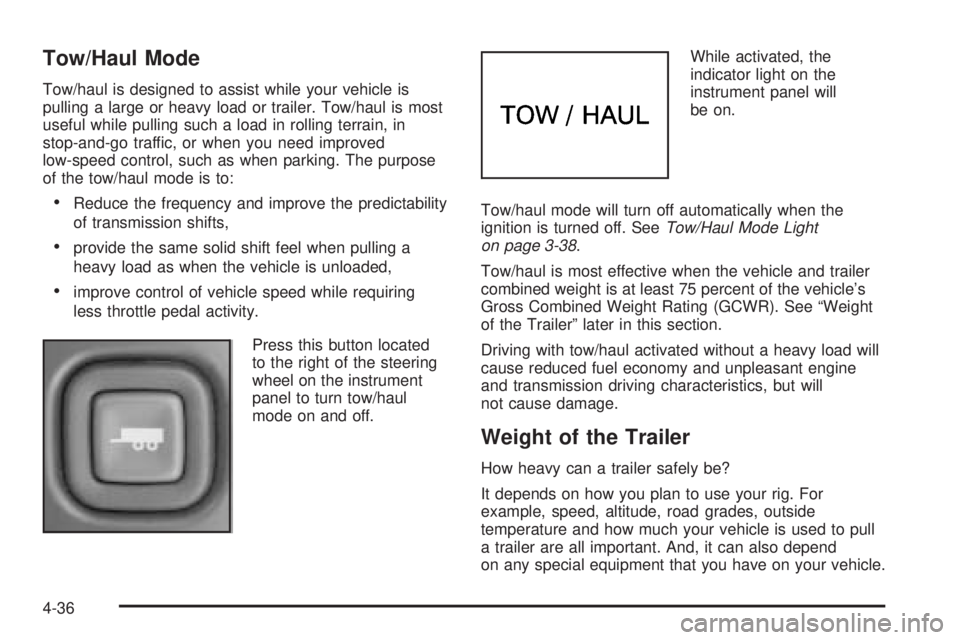
Press this button located
to the right of the steering
wheel on the instrument
panel to turn tow/haul
mode on and off.While activated, the
indicator light on the
instrument panel will
be on.
Tow/haul mode will turn off automatically when the
ignition is turned off. SeeTow/Haul Mode Light
on page 3-38.
Tow/haul is most effective when the vehicle and trailer
combined weight is at least 75 percent of the vehicle’s
Gross Combined Weight Rating (GCWR). See “Weight
of the Trailer” later in this section.
Driving with tow/haul activated without a heavy load will
cause reduced fuel economy and unpleasant engine
and transmission driving characteristics, but will
not cause damage.
Weight of the Trailer
How heavy can a trailer safely be?
It depends on how you plan to use your rig. For
example, speed, altitude, road grades, outside
temperature and how much your vehicle is used to pull
a trailer are all important. And, it can also depend
on any special equipment that you have on your vehicle.
4-36
Page 222 of 370
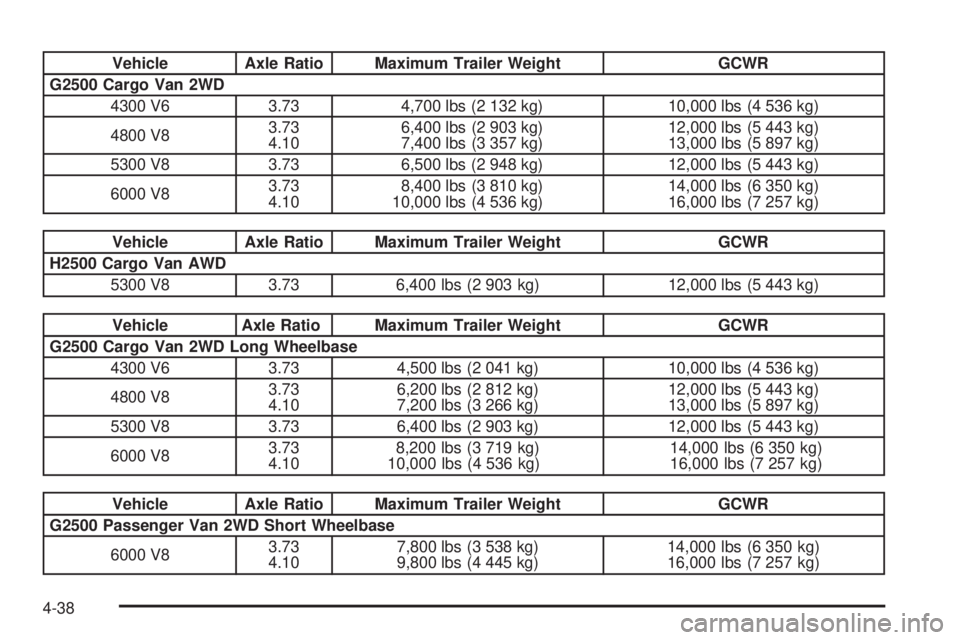
Vehicle Axle Ratio Maximum Trailer Weight GCWR
G2500 Cargo Van 2WD
4300 V6 3.73 4,700 lbs (2 132 kg) 10,000 lbs (4 536 kg)
4800 V83.73
4.106,400 lbs (2 903 kg)
7,400 lbs (3 357 kg)12,000 lbs (5 443 kg)
13,000 lbs (5 897 kg)
5300 V8 3.73 6,500 lbs (2 948 kg) 12,000 lbs (5 443 kg)
6000 V83.73
4.108,400 lbs (3 810 kg)
10,000 lbs (4 536 kg)14,000 lbs (6 350 kg)
16,000 lbs (7 257 kg)
Vehicle Axle Ratio Maximum Trailer Weight GCWR
H2500 Cargo Van AWD
5300 V8 3.73 6,400 lbs (2 903 kg) 12,000 lbs (5 443 kg)
Vehicle Axle Ratio Maximum Trailer Weight GCWR
G2500 Cargo Van 2WD Long Wheelbase
4300 V6 3.73 4,500 lbs (2 041 kg) 10,000 lbs (4 536 kg)
4800 V83.73
4.106,200 lbs (2 812 kg)
7,200 lbs (3 266 kg)12,000 lbs (5 443 kg)
13,000 lbs (5 897 kg)
5300 V8 3.73 6,400 lbs (2 903 kg) 12,000 lbs (5 443 kg)
6000 V83.73
4.108,200 lbs (3 719 kg)
10,000 lbs (4 536 kg)14,000 lbs (6 350 kg)
16,000 lbs (7 257 kg)
Vehicle Axle Ratio Maximum Trailer Weight GCWR
G2500 Passenger Van 2WD Short Wheelbase
6000 V83.73
4.107,800 lbs (3 538 kg)
9,800 lbs (4 445 kg)14,000 lbs (6 350 kg)
16,000 lbs (7 257 kg)
4-38
Page 223 of 370
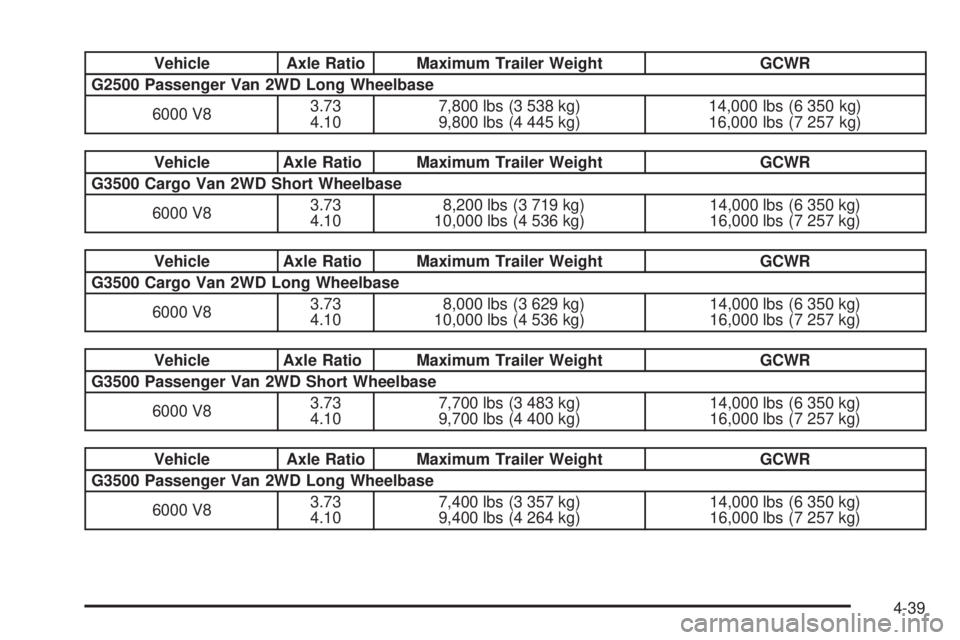
Vehicle Axle Ratio Maximum Trailer Weight GCWR
G2500 Passenger Van 2WD Long Wheelbase
6000 V83.73
4.107,800 lbs (3 538 kg)
9,800 lbs (4 445 kg)14,000 lbs (6 350 kg)
16,000 lbs (7 257 kg)
Vehicle Axle Ratio Maximum Trailer Weight GCWR
G3500 Cargo Van 2WD Short Wheelbase
6000 V83.73
4.108,200 lbs (3 719 kg)
10,000 lbs (4 536 kg)14,000 lbs (6 350 kg)
16,000 lbs (7 257 kg)
Vehicle Axle Ratio Maximum Trailer Weight GCWR
G3500 Cargo Van 2WD Long Wheelbase
6000 V83.73
4.108,000 lbs (3 629 kg)
10,000 lbs (4 536 kg)14,000 lbs (6 350 kg)
16,000 lbs (7 257 kg)
Vehicle Axle Ratio Maximum Trailer Weight GCWR
G3500 Passenger Van 2WD Short Wheelbase
6000 V83.73
4.107,700 lbs (3 483 kg)
9,700 lbs (4 400 kg)14,000 lbs (6 350 kg)
16,000 lbs (7 257 kg)
Vehicle Axle Ratio Maximum Trailer Weight GCWR
G3500 Passenger Van 2WD Long Wheelbase
6000 V83.73
4.107,400 lbs (3 357 kg)
9,400 lbs (4 264 kg)14,000 lbs (6 350 kg)
16,000 lbs (7 257 kg)
4-39
Page 228 of 370
Passing
You’ll need more passing distance up ahead when
you’re towing a trailer. And, because you’re a good deal
longer, you’ll need to go much farther beyond the
passed vehicle before you can return to your lane.
Backing Up
Hold the bottom of the steering wheel with one hand.
Then, to move the trailer to the left, just move that hand
to the left. To move the trailer to the right, move your
hand to the right. Always back up slowly and, if possible,
have someone guide you.
Making Turns
Notice:Making very sharp turns while trailering
could cause the trailer to come in contact with the
vehicle. Your vehicle could be damaged. Avoid
making very sharp turns while trailering.
When you’re turning with a trailer, make wider turns than
normal. Do this so your trailer won’t strike soft shoulders,
curbs, road signs, trees or other objects. Avoid jerky or
sudden maneuvers. Signal well in advance.
Turn Signals When Towing a Trailer
When you tow a trailer, your vehicle has to have extra
wiring and a heavy-duty turn signal asher (included
in the optional trailering package).
The arrows on your instrument panel will ash whenever
you signal a turn or lane change. Properly hooked up,
the trailer lamps will also ash, telling other drivers
you’re about to turn, change lanes or stop.
When towing a trailer, the arrows on your instrument
panel will ash for turns even if the bulbs on the trailer
are burned out. Thus, you may think drivers behind
you are seeing your signal when they are not. It’s
important to check occasionally to be sure the trailer
bulbs are still working.
4-44
Page 229 of 370
Driving On Grades
Reduce speed and shift to a lower gearbeforeyou start
down a long or steep downgrade. If you don’t shift
down, you might have to use your brakes so much that
they would get hot and no longer work well.
You can tow in DRIVE (D). You may want to shift the
transmission to THIRD (3) or a lower gear under heavy
loads and/or hilly conditions.
When towing at high altitude on steep uphill grades,
consider the following: Engine coolant will boil at a lower
temperature than at normal altitudes. If you turn your
engine off immediately after towing at high altitude
on steep uphill grades, your vehicle may show signs
similar to engine overheating. To avoid this, let the
engine run while parked (preferably on level ground)
with the automatic transmission in PARK (P) for a
few minutes before turning the engine off. If you do get
the overheat warning, seeEngine Overheating on
page 5-24.
Parking on Hills
{CAUTION:
You really should not park your vehicle, with a
trailer attached, on a hill. If something goes
wrong, your rig could start to move. People
can be injured, and both your vehicle and the
trailer can be damaged.
But if you ever have to park your rig on a hill, here’s
how to do it:
1. Apply your regular brakes, but don’t shift into
PARK (P) yet. Then turn your wheels into the curb if
facing downhill or into traffic if facing uphill.
2. Have someone place chocks under the
trailer wheels.
3. When the wheel chocks are in place, release the
regular brakes until the chocks absorb the load.
4. Reapply the regular brakes. Then apply your
parking brake and then shift to PARK (P).
5. Release the regular brakes.
4-45
Page 231 of 370
Service............................................................5-3
Doing Your Own Service Work.........................5-4
Adding Equipment to the Outside of Your
Vehicle......................................................5-5
Fuel................................................................5-5
Gasoline Octane............................................5-5
Gasoline Specications....................................5-5
California Fuel...............................................5-6
Additives.......................................................5-6
Fuels in Foreign Countries...............................5-7
Filling Your Tank............................................5-8
Filling a Portable Fuel Container.....................5-10
Checking Things Under the Hood....................5-10
Hood Release..............................................5-11
Engine Compartment Overview.......................5-12
Engine Oil...................................................5-13
Engine Oil Life System..................................5-16
Engine Air Cleaner/Filter................................5-17
Automatic Transmission Fluid.........................5-19
Engine Coolant.............................................5-22
Radiator Pressure Cap..................................5-24
Engine Overheating.......................................5-24
Cooling System............................................5-26
Engine Fan Noise.........................................5-32
Power Steering Fluid.....................................5-32
Windshield Washer Fluid................................5-33Brakes........................................................5-34
Battery........................................................5-37
Jump Starting...............................................5-38
All-Wheel Drive..............................................5-43
Rear Axle.......................................................5-44
Front Axle......................................................5-44
Noise Control System.....................................5-45
Tampering with Noise Control System
Prohibited.................................................5-45
Bulb Replacement..........................................5-46
Halogen Bulbs..............................................5-47
Headlamps..................................................5-47
Front Turn Signal, Sidemarker and
Parking Lamps..........................................5-48
Center High-Mounted Stoplamp (CHMSL).........5-49
Taillamps.....................................................5-49
Replacement Bulbs.......................................5-50
Windshield Wiper Blade Replacement..............5-51
Tires..............................................................5-52
Tire Sidewall Labelling...................................5-53
Tire Terminology and Denitions.....................5-56
Ination - Tire Pressure.................................5-58
Dual Tire Operation.......................................5-59
Tire Inspection and Rotation...........................5-60
When It Is Time for New Tires.......................5-62
Section 5 Service and Appearance Care
5-1
Page 232 of 370
Buying New Tires.........................................5-62
Uniform Tire Quality Grading..........................5-63
Wheel Alignment and Tire Balance..................5-64
Wheel Replacement......................................5-65
Tire Chains..................................................5-66
If a Tire Goes Flat........................................5-67
Changing a Flat Tire.....................................5-68
Removing the Spare Tire and Tools................5-69
Removing the Flat Tire and Installing the
Spare Tire................................................5-72
Secondary Latch System...............................5-77
Storing a Flat or Spare Tire and Tools............5-80
Spare Tire...................................................5-82
Appearance Care............................................5-82
Fabric/Carpet...............................................5-83
Vinyl...........................................................5-85
Instrument Panel..........................................5-85
Interior Plastic Components............................5-85
Glass Surfaces.............................................5-85
Care of Safety Belts......................................5-85
Weatherstrips...............................................5-86
Washing Your Vehicle...................................5-86Cleaning Exterior Lamps/Lenses.....................5-86
Finish Care..................................................5-86
Windshield and Wiper Blades.........................5-87
Aluminum Wheels.........................................5-88
Tires...........................................................5-88
Sheet Metal Damage.....................................5-89
Finish Damage.............................................5-89
Underbody Maintenance................................5-89
Chemical Paint Spotting.................................5-89
Vehicle Care/Appearance Materials..................5-90
Vehicle Identication......................................5-91
Vehicle Identication Number (VIN).................5-91
Service Parts Identication Label.....................5-91
Electrical System............................................5-92
Add-On Electrical Equipment..........................5-92
Headlamp Wiring..........................................5-92
Windshield Wiper Fuses................................5-92
Fuses and Circuit Breakers............................5-92
Floor Console Fuse Block..............................5-93
Engine Compartment Fuse Block....................5-94
Capacities and Specications..........................5-97
Section 5 Service and Appearance Care
5-2
Page 266 of 370
Brake Wear
Your vehicle has four-wheel disc brakes.
Disc brake pads have built-in wear indicators that make
a high-pitched warning sound when the brake pads
are worn and new pads are needed. The sound
may come and go or be heard all the time your vehicle
is moving, except when you are pushing on the
brake pedal rmly.
{CAUTION:
The brake wear warning sound means that
soon your brakes will not work well. That
could lead to an accident. When you hear the
brake wear warning sound, have your vehicle
serviced.
Notice:Continuing to drive with worn-out brake
pads could result in costly brake repair.Some driving conditions or climates may cause a brake
squeal when the brakes are rst applied or lightly
applied. This does not mean something is wrong with
your brakes.
Properly torqued wheel nuts are necessary to help
prevent brake pulsation. When tires are rotated, inspect
brake pads for wear and evenly tighten wheel nuts in
the proper sequence to GM torque specications.
Brake linings should always be replaced as complete
axle sets.
Brake Pedal Travel
See your dealer if the brake pedal does not return to
normal height, or if there is a rapid increase in
pedal travel. This could be a sign of brake trouble.
Brake Adjustment
Every time you make a brake stop, your disc brakes
adjust for wear.
5-36
Page 273 of 370
3. Disconnect the red positive (+) cable from the
vehicle with the good battery.
4. Disconnect the red positive (+) cable from the
other vehicle.
5. Return the remote positive (+) terminal cover to its
original position.
All-Wheel Drive
Lubricant checks in this section also apply to these
vehicles. However, there are two additional systems that
need lubrication.
Transfer Case
When to Check Lubricant
Refer to the Maintenance Schedule to determine how
often to check the lubricant. SeeScheduled
Maintenance on page 6-4.
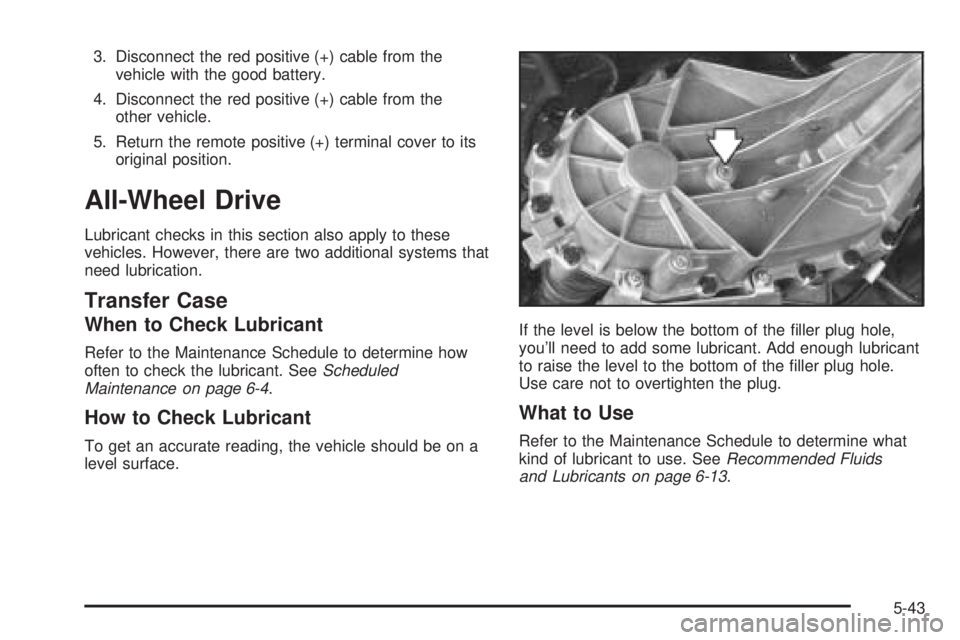
How to Check Lubricant
To get an accurate reading, the vehicle should be on a
level surface.If the level is below the bottom of the ller plug hole,
you’ll need to add some lubricant. Add enough lubricant
to raise the level to the bottom of the ller plug hole.
Use care not to overtighten the plug.
What to Use
Refer to the Maintenance Schedule to determine what
kind of lubricant to use. SeeRecommended Fluids
and Lubricants on page 6-13.
5-43
Page 285 of 370
Tire Size
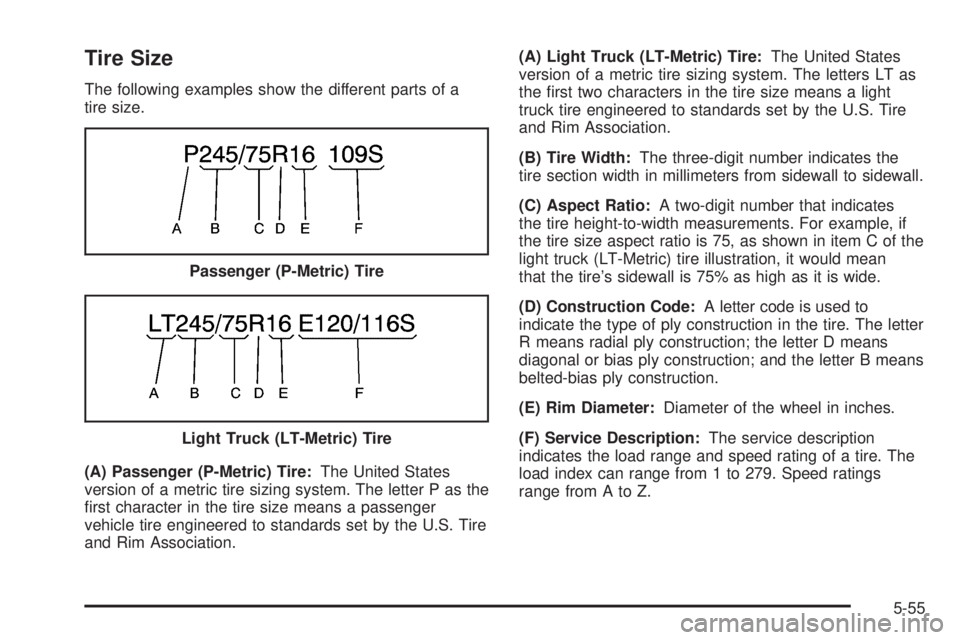
The following examples show the different parts of a
tire size.
(A) Passenger (P-Metric) Tire:The United States
version of a metric tire sizing system. The letter P as the
rst character in the tire size means a passenger
vehicle tire engineered to standards set by the U.S. Tire
and Rim Association.(A) Light Truck (LT-Metric) Tire:The United States
version of a metric tire sizing system. The letters LT as
the rst two characters in the tire size means a light
truck tire engineered to standards set by the U.S. Tire
and Rim Association.
(B) Tire Width:The three-digit number indicates the
tire section width in millimeters from sidewall to sidewall.
(C) Aspect Ratio:A two-digit number that indicates
the tire height-to-width measurements. For example, if
the tire size aspect ratio is 75, as shown in item C of the
light truck (LT-Metric) tire illustration, it would mean
that the tire’s sidewall is 75% as high as it is wide.
(D) Construction Code:A letter code is used to
indicate the type of ply construction in the tire. The letter
R means radial ply construction; the letter D means
diagonal or bias ply construction; and the letter B means
belted-bias ply construction.
(E) Rim Diameter:Diameter of the wheel in inches.
(F) Service Description:The service description
indicates the load range and speed rating of a tire. The
load index can range from 1 to 279. Speed ratings
range from A to Z. Passenger (P-Metric) Tire
Light Truck (LT-Metric) Tire
5-55