change wheel CHEVROLET EXPRESS 2007 User Guide
[x] Cancel search | Manufacturer: CHEVROLET, Model Year: 2007, Model line: EXPRESS, Model: CHEVROLET EXPRESS 2007Pages: 440, PDF Size: 2.42 MB
Page 247 of 440
Rocking Your Vehicle to Get It Out
Turn the steering wheel left and right to clear the
area around the front wheels. Turn off any traction or
stability system. Shift back and forth between
R (Reverse) and a forward gear, spinning the wheels as
little as possible. To prevent transmission wear, wait
until the wheels stop spinning before shifting gears.
Release the accelerator pedal while shifting, and press
lightly on the accelerator pedal when the transmission
is in gear. Slowly spinning the wheels in the forward and
reverse directions causes a rocking motion that could
free the vehicle. If that does not get the vehicle out after
a few tries, it might need to be towed out. If the
vehicle does need to be towed out, seeTowing Your
Vehicle on page 5-26.
Loading the Vehicle
It is very important to know how much weight your
vehicle can carry. This weight is called the vehicle
capacity weight and includes the weight of all
occupants, cargo, and all nonfactory-installed
options. Two labels on your vehicle show how much
weight it was designed to carry, the Tire and
Loading Information label and the Certification/Tire
label.
{WARNING:
Do not load the vehicle any heavier than the
Gross Vehicle Weight Rating (GVWR), or
either the maximum front or rear Gross Axle
Weight Rating (GAWR). If you do, parts on the
vehicle can break, and it can change the way
your vehicle handles. These could cause you
to lose control and crash. Also, overloading
can shorten the life of the vehicle.
5-19
Page 268 of 440
Backing Up
Hold the bottom of the steering wheel with one hand.
Then, to move the trailer to the left, move that hand
to the left. To move the trailer to the right, move your
hand to the right. Always back up slowly and, if possible,
have someone guide you.
Making Turns
Notice:Making very sharp turns while trailering
could cause the trailer to come in contact with the
vehicle. The vehicle could be damaged. Avoid
making very sharp turns while trailering.
When turning with a trailer, make wider turns than
normal. Do this so the trailer will not strike soft
shoulders, curbs, road signs, trees or other objects.
Avoid jerky or sudden maneuvers. Signal well in
advance.
Turn Signals When Towing a Trailer
The arrows on the instrument panel flash whenever
signaling a turn or lane change. Properly hooked up, the
trailer lamps also flash, telling other drivers the vehicle
is turning, changing lanes or stopping.When towing a trailer, the arrows on the instrument
panel flash for turns even if the bulbs on the trailer are
burned out. For this reason you may think other
drivers are seeing the signal when they are not. It is
important to check occasionally to be sure the
trailer bulbs are still working.
Driving On Grades
Reduce speed and shift to a lower gearbeforestarting
down a long or steep downgrade. If the transmission is
not shifted down, the brakes might have to be used so
much that they would get hot and no longer work well.
The vehicle can tow in D (Drive). Shift the transmission
to a lower gear if the transmission shifts too often
under heavy loads and/or hilly conditions.
When towing at high altitude on steep uphill grades,
consider the following: Engine coolant will boil at a lower
temperature than at normal altitudes. If the engine is
turned off immediately after towing at high altitude on
steep uphill grades, the vehicle may show signs similar to
engine overheating. To avoid this, let the engine run while
parked, preferably on level ground, with the automatic
transmission in P (Park) for a few minutes before turning
the engine off. If the overheat warning comes on, see
Engine Overheating on page 6-35.
5-40
Page 347 of 440
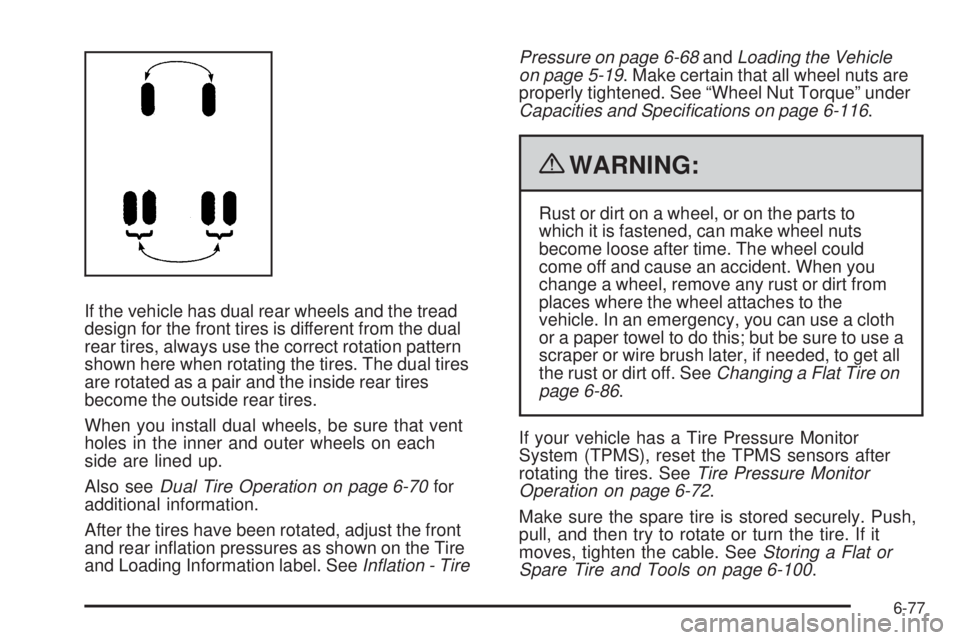
If the vehicle has dual rear wheels and the tread
design for the front tires is different from the dual
rear tires, always use the correct rotation pattern
shown here when rotating the tires. The dual tires
are rotated as a pair and the inside rear tires
become the outside rear tires.
When you install dual wheels, be sure that vent
holes in the inner and outer wheels on each
side are lined up.
Also seeDual Tire Operation on page 6-70for
additional information.
After the tires have been rotated, adjust the front
and rear inflation pressures as shown on the Tire
and Loading Information label. SeeInation - TirePressure on page 6-68andLoading the Vehicle
on page 5-19. Make certain that all wheel nuts are
properly tightened. See “Wheel Nut Torque” under
Capacities and Specications on page 6-116.
{WARNING:
Rust or dirt on a wheel, or on the parts to
which it is fastened, can make wheel nuts
become loose after time. The wheel could
come off and cause an accident. When you
change a wheel, remove any rust or dirt from
places where the wheel attaches to the
vehicle. In an emergency, you can use a cloth
or a paper towel to do this; but be sure to use a
scraper or wire brush later, if needed, to get all
the rust or dirt off. SeeChanging a Flat Tire on
page 6-86.
If your vehicle has a Tire Pressure Monitor
System (TPMS), reset the TPMS sensors after
rotating the tires. SeeTire Pressure Monitor
Operation on page 6-72.
Make sure the spare tire is stored securely. Push,
pull, and then try to rotate or turn the tire. If it
moves, tighten the cable. SeeStoring a Flat or
Spare Tire and Tools on page 6-100.
6-77
Page 355 of 440
If a Tire Goes Flat
It is unusual for a tire to blowout while you are driving,
especially if you maintain your vehicle’s tires properly.
If air goes out of a tire, it is much more likely to leak out
slowly. But if you should ever have a blowout, here
are a few tips about what to expect and what to do:
If a front tire fails, the flat tire creates a drag that pulls
the vehicle toward that side. Take your foot off the
accelerator pedal and grip the steering wheel firmly.
Steer to maintain lane position, and then gently brake
to a stop well out of the traffic lane.
A rear blowout, particularly on a curve, acts much like a
skid and may require the same correction you would use
in a skid. In any rear blowout remove your foot from the
accelerator pedal. Get the vehicle under control by
steering the way you want the vehicle to go. It may be
very bumpy and noisy, but you can still steer. Gently
brake to a stop, well off the road if possible.{WARNING:
Lifting a vehicle and getting under it to do
maintenance or repairs is dangerous without the
appropriate safety equipment and training. If a jack
is provided with the vehicle, it is designed only for
changing a flat tire. If it is used for anything else,
you or others could be badly injured or killed if the
vehicle slips off the jack. If a jack is provided with
the vehicle, only use it for changing a flat tire.
If a tire goes flat, the next part shows how to use the
jacking equipment to change a flat tire safely.
6-85
Page 356 of 440
Changing a Flat Tire
If a tire goes flat, avoid further tire and wheel damage
by driving slowly to a level place. Turn on the hazard
warning flashers. SeeHazard Warning Flashers
on page 4-3.
{WARNING:
Changing a tire can be dangerous. The vehicle
can slip off the jack and roll over or fall on you or
other people. You and they could be badly injured
or even killed. Find a level place to change your
tire. To help prevent the vehicle from moving:
1. Set the parking brake firmly.
2. Put the shift lever in P (Park).
3. Turn off the engine and do not restart while
the vehicle is raised.
4. Do not allow passengers to remain in the
vehicle.
WARNING: (Continued)
WARNING: (Continued)
To be even more certain the vehicle will not move,
you should put blocks at the front and rear of the
tire farthest away from the one being changed.
That would be the tire, on the other side, at the
opposite end of the vehicle.
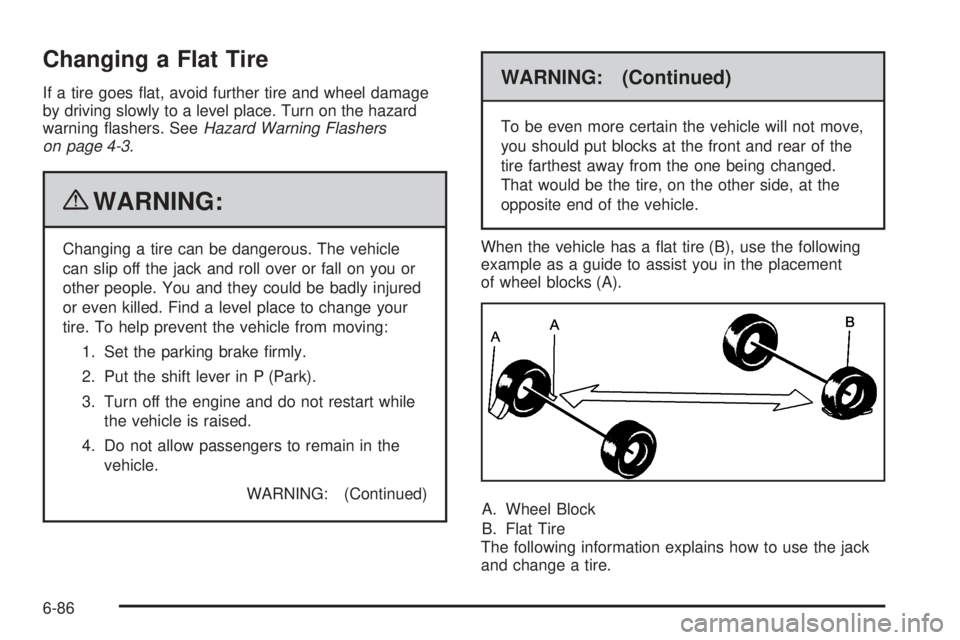
When the vehicle has a flat tire (B), use the following
example as a guide to assist you in the placement
of wheel blocks (A).
A. Wheel Block
B. Flat Tire
The following information explains how to use the jack
and change a tire.
6-86
Page 395 of 440
•Exhaust system and nearby heat shields inspection
for loose or damaged components.
•Throttle system inspection for interference, binding
or for damaged or missing parts. Replace parts
as needed. Replace any components that have
high effort or excessive wear. Do not lubricate
accelerator or cruise control cables.
First Engine Oil Change After Every
40 000 km/25,000 Miles
•
Fuel system inspection for damage or leaks.
First Engine Oil Change After Every
80 000 km/50,000 Miles
•
Engine air cleaner filter replacement. SeeEngine
Air Cleaner/Filter on page 6-20.
•Automatic transmission fluid change (severe
service) for vehicles mainly driven in heavy
city traffic in hot weather, in hilly or mountainous
terrain, when frequently towing a trailer, or used
for taxi, police, or delivery service. SeeAutomatic
Transmission Fluid (4-Speed Transmission) on
page 6-21orAutomatic Transmission Fluid
(6-Speed Transmission) on page 6-24.
•All-wheel drive only: Transfer case fluid change
(severe service) for vehicles mainly driven when
frequently towing a trailer, or used for taxi, police, or
delivery service. Check vent hose at transfer case for
kinks and proper installation. Check to be sure vent
hose is unobstructed, clear, and free of debris.
During any maintenance, if a power washer is used
to clean mud and dirt from the underbody, care
should be taken to not directly spray the transfer
case output seals. High pressure water can
overcome the seals and contaminate the transfer
case fluid. Contaminated fluid will decrease the life
of the transfer case and should be replaced.
•Evaporative control system inspection. Check all
fuel and vapor lines and hoses for proper hook-up,
routing, and condition. Check that the purge valve, if
the vehicle has one, works properly. Replace as
needed.An Emission Control Service. The U.S.
Environmental Protection Agency or the California
Air Resources Board has determined that the failure
to perform this maintenance item will not nullify the
emission warranty or limit recall liability prior to the
completion of the vehicle’s useful life. We, however,
urge that all recommended maintenance services
be performed at the indicated intervals and the
maintenance be recorded.
7-7
Page 396 of 440
First Engine Oil Change After Every
160 000 km/100,000 Miles
•
Automatic transmission fluid change (normal
service). SeeAutomatic Transmission Fluid
(4-Speed Transmission) on page 6-21orAutomatic
Transmission Fluid (6-Speed Transmission) on
page 6-24.
•All-wheel drive only: Transfer case fluid change
(normal service). Check vent hose at transfer
case for kinks and proper installation. Check to be
sure vent hose is unobstructed, clear, and free
of debris. During any maintenance, if a power
washer is used to clean mud and dirt from the
underbody, care should be taken to not directly
spray the transfer case output seals. High pressure
water can overcome the seals and contaminate
the transfer case fluid. Contaminated fluid will
decrease the life of the transfer case and should
be replaced.
•Spark plug replacement and spark plug wires
inspection.An Emission Control Service.
First Engine Oil Change After Every
240 000 km/150,000 Miles
•
Engine cooling system drain, flush, and refill,
cooling system and cap pressure check, and
cleaning of outside of radiator and air conditioning
condenser (or every 5 years, whichever occurs
first). SeeEngine Coolant on page 6-29.
An Emission Control Service.
•Engine accessory drive belt inspection for fraying,
excessive cracks, or obvious damage and
replacement, if needed.An Emission Control
Service.
7-8
Page 397 of 440
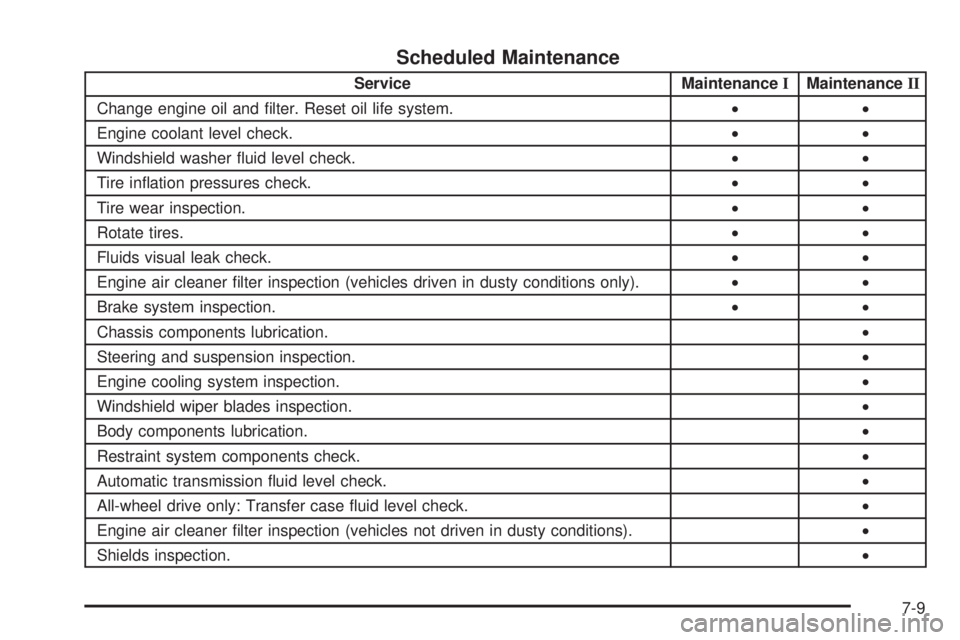
Scheduled Maintenance
Service MaintenanceIMaintenanceII
Change engine oil and filter. Reset oil life system.••
Engine coolant level check.••
Windshield washer fluid level check.••
Tire inflation pressures check.••
Tire wear inspection.••
Rotate tires.••
Fluids visual leak check.••
Engine air cleaner filter inspection (vehicles driven in dusty conditions only).••
Brake system inspection.••
Chassis components lubrication.•
Steering and suspension inspection.•
Engine cooling system inspection.•
Windshield wiper blades inspection.•
Body components lubrication.•
Restraint system components check.•
Automatic transmission fluid level check.•
All-wheel drive only: Transfer case fluid level check.•
Engine air cleaner filter inspection (vehicles not driven in dusty conditions).•
Shields inspection.•
7-9
Page 437 of 440
Safety Warnings and Symbols.............................. iv
Scheduled Maintenance..................................... 7-3
Scheduling Appointments.................................8-10
Seats
Head Restraints............................................ 2-2
Power Seat.................................................. 2-3
Rear Seat Operation...................................... 2-6
Reclining Seatbacks...................................... 2-4
Secondary Latch System.................................6-97
Securing a Child Restraint
Rear Seat Position......................................2-49
Right Front Seat Position......................2-52, 2-56
Security
Light..........................................................4-34
Service........................................................... 6-3
Accessories and Modifications......................... 6-3
Adding Equipment to the Outside of the
Vehicle..................................................... 6-5
Doing Your Own Work................................... 6-4
Engine Soon Lamp......................................4-30
Parts Identification Label.............................6-109
Publications Ordering Information...................8-17
Scheduling Appointments..............................8-10
Servicing Your Airbag-Equipped Vehicle..............2-78
Setting the Clock............................................4-60Sheet Metal Damage.....................................6-107
Shifting
Out of Park................................................3-38
Shifting Into Park............................................3-37
Signals, Turn and Lane-Change.......................... 4-4
Sliding Side Door............................................3-12
Spare Tire....................................................6-101
Installing....................................................6-90
Removing...................................................6-87
Storing.....................................................6-100
Specifications and Capacities..........................6-116
Speedometer..................................................4-22
StabiliTrak
®Indicator Light...............................4-29
StabiliTrak®System.......................................... 5-5
Start Vehicle, Remote....................................... 3-7
Starting the Engine.........................................3-23
Steering.......................................................... 5-8
Steering Wheel Controls, Audio.........................4-77
Steering Wheel, Tilt Wheel................................. 4-3
Storage Areas................................................3-44
Stuck in Sand, Mud, Ice, or Snow.....................5-18
Sun Visors.....................................................3-19
Swing-Out Side Door, 60/40.............................3-13
Swing-Out Windows........................................3-18
11
Page 439 of 440
Traction
StabiliTrak®System....................................... 5-5
Transmission
Fluid, Automatic..................................6-21, 6-24
Transmission Operation, Automatic............3-27, 3-32
Transportation Program, Courtesy......................8-11
Trip Odometer................................................4-22
Turn and Lane-Change Signals.......................... 4-4
Turn Signal/Multifunction Lever........................... 4-4
U
Uniform Tire Quality Grading............................6-81
V
Vehicle
Control........................................................ 5-3
Loading......................................................5-19
Remote Start................................................ 3-7
Running While Parked..................................3-41
Symbols......................................................... ivVehicle Customization, DIC..............................4-52
Vehicle Data Recording and Privacy..................8-18
Vehicle Identification
Number (VIN)............................................6-109
Service Parts Identification Label..................6-109
Ventilation Adjustment......................................4-17
Visors...........................................................3-19
Voltmeter Gage..............................................4-27
W
Warning Lights, Gages, and Indicators...............4-20
Warnings
DIC Warnings and Messages........................4-44
Hazard Flashers............................................ 4-3
Safety and Symbols......................................... iv
Wheels
Alignment and Tire Balance..........................6-82
Different Size..............................................6-80
Replacement...............................................6-82
When It Is Time for New Tires..........................6-78
Where to Put the Child Restraint.......................2-40
13