tire pressure CHEVROLET EXPRESS 2007 Owner's Guide
[x] Cancel search | Manufacturer: CHEVROLET, Model Year: 2007, Model line: EXPRESS, Model: CHEVROLET EXPRESS 2007Pages: 440, PDF Size: 2.42 MB
Page 349 of 440

Buying New Tires
GM has developed and matched specific tires for your
vehicle. The original equipment tires installed on your
vehicle, when it was new, were designed to meet
General Motors Tire Performance Criteria Specification
(TPC spec) system rating. If you need replacement tires,
GM strongly recommends that you get tires with the same
TPC Spec rating. This way, your vehicle will continue
to have tires that are designed to give the same
performance and vehicle safety, during normal use,
as the original tires.
GM’s exclusive TPC Spec system considers over a
dozen critical specifications that impact the overall
performance of your vehicle, including brake system
performance, ride and handling, traction control, and
tire pressure monitoring performance. GM’s TPC Spec
number is molded onto the tire’s sidewall near the tire
size. If the tires have an all-season tread design, the TPC
spec number will be followed by a MS, for mud and snow.
SeeTire Sidewall Labeling on page 6-61for additional
information.
GM recommends replacing tires in sets of four (or six
if your vehicle has dual rear wheels). This is because
uniform tread depth on all tires will help keep your vehicle
performing most like it did when the tires were new.
Replacing less than a full set of tires can affect the
braking and handling performance of your vehicle.
SeeTire Inspection and Rotation on page 6-75for
information on proper tire rotation.{WARNING:
Mixing tires could cause you to lose control
while driving. If you mix tires of different
sizes, brands, or types (radial and bias-belted
tires) the vehicle may not handle properly,
and you could have a crash. Using tires of
different sizes, brands, or types may also
cause damage to your vehicle. Be sure to
use the correct size, brand, and type of tires
on your vehicle’s wheels.
{WARNING:
If you use bias-ply tires on the vehicle, the
wheel rim flanges could develop cracks after
many miles of driving. A tire and/or wheel
could fail suddenly, causing a crash. Use only
radial-ply tires with the wheels on the vehicle.
If you must replace your vehicle’s tires with those that do
not have a TPC Spec number, make sure they are the
same size, load range, speed rating, and construction
type (radial and bias-belted tires) as your vehicle’s
original tires.
6-79
Page 350 of 440

Vehicles that have a tire pressure monitoring system
could give an inaccurate low-pressure warning if
non-TPC Spec rated tires are installed on your vehicle.
Non-TPC Spec rated tires may give a low-pressure
warning that is higher or lower than the proper warning
level you would get with TPC Spec rated tires. See
Tire Pressure Monitor System on page 6-70.
Your vehicle’s original equipment tires are listed on the
Tire and Loading Information label. SeeLoading the
Vehicle on page 5-19, for more information about
the Tire and Loading Information label and its location
on your vehicle.
Different Size Tires and Wheels
If you add wheels or tires that are a different size than
your original equipment wheels and tires, this could affect
the way your vehicle performs, including its braking, ride
and handling characteristics, stability, and resistance
to rollover. Additionally, if your vehicle has electronicsystems such as anti-lock brakes, rollover airbags,
traction control, and electronic stability control, the
performance of these systems can be affected.
{WARNING:
If you add different sized wheels, your vehicle may
not provide an acceptable level of performance and
safety if tires not recommended for those wheels
are selected. You may increase the chance that you
will crash and suffer serious injury. Only use GM
specific wheel and tire systems developed for your
vehicle, and have them properly installed by a GM
certified technician.
SeeBuying New Tires on page 6-79andAccessories
and Modications on page 6-3for additional information.
6-80
Page 353 of 440
Your dealer/retailer will know the kind of wheel
you need.
Each new wheel should have the same load-carrying
capacity, diameter, width, offset and be mounted
the same way as the one it replaces.
If you need to replace any of the wheels, wheel bolts,
wheel nuts or Tire Pressure Monitor System (TPMS)
sensors, replace them only with new GM original
equipment parts. This way, you will be sure to have
the right wheel, wheel bolts, wheel nuts, and TPMS
sensors for the vehicle.
{WARNING:
Using the wrong replacement wheels, wheel bolts,
or wheel nuts on your vehicle can be dangerous.
It could affect the braking and handling of your
vehicle, make your tires lose air and make you
lose control. You could have a collision in which
you or others could be injured. Always use the
correct wheel, wheel bolts, and wheel nuts for
replacement.Notice:The wrong wheel can also cause problems
with bearing life, brake cooling, speedometer or
odometer calibration, headlamp aim, bumper height,
vehicle ground clearance, and tire or tire chain
clearance to the body and chassis.
Whenever a wheel, wheel bolt or wheel nut is replaced
on a dual wheel setup, check the wheel nut torque after
100, 1,000 and 6,000 miles (160, 1 600 and 10 000 km)
of driving. For proper torque, see “Wheel Nut Torque”
underCapacities and Specications on page 6-116.
SeeChanging a Flat Tire on page 6-86for more
information.
Used Replacement Wheels
{WARNING:
Putting a used wheel on the vehicle is dangerous.
You cannot know how it has been used or how
far it has been driven. It could fail suddenly and
cause a crash. If you have to replace a wheel,
use a new GM original equipment wheel.
6-83
Page 371 of 440

6. Make sure the tire is stored securely. Push, pull (A),
and then try to turn (B) the tire. If the tire moves,
use the wheel wrench to tighten the cable.
You will hear two clicks when the tire is up all
the way.
7. Return the jacking equipment to the proper location.
Secure the items and replace the jack cover.
Spare Tire
This vehicle, when new, may have had a fully-inflated
spare tire. A spare tire may lose air over time, so check its
inflation pressure regularly. SeeInation - Tire Pressure
on page 6-68andLoading the Vehicle on page 5-19for
information regarding proper tire inflation and loading the
vehicle. For instruction on how to remove, install or store
a spare tire, seeRemoving the Flat Tire and Installing the
Spare Tire on page 6-90andStoring a Flat or Spare Tire
and Tools on page 6-100.
After installing the spare tire on the vehicle, you should
stop as soon as possible and make sure the spare is
correctly inflated. The spare tire is made to perform well
at speeds up to 70 mph (112 km/h) at the recommended
inflation pressure, so you can finish your trip.
Have the damaged or flat road tire repaired or replaced
as soon as you can and installed back onto the vehicle.
This way, a spare tire will be available in case you need
it again. Do not mix tires and wheels of different sizes,
because they will not fit. Keep the spare tire and its
wheel together.
6-101
Page 381 of 440
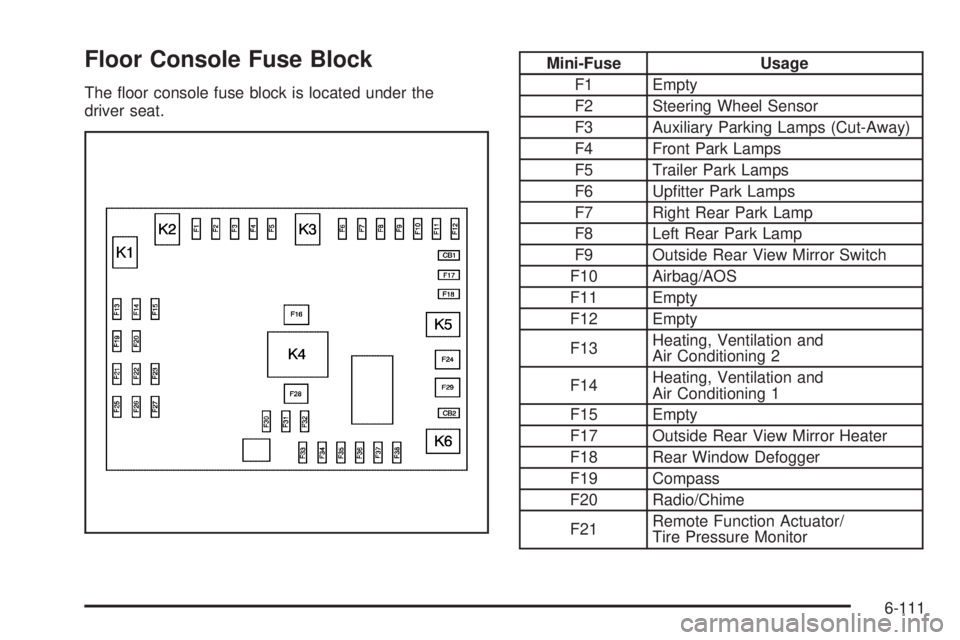
Floor Console Fuse Block
The floor console fuse block is located under the
driver seat.
Mini-Fuse Usage
F1 Empty
F2 Steering Wheel Sensor
F3 Auxiliary Parking Lamps (Cut-Away)
F4 Front Park Lamps
F5 Trailer Park Lamps
F6 Upfitter Park Lamps
F7 Right Rear Park Lamp
F8 Left Rear Park Lamp
F9 Outside Rear View Mirror Switch
F10 Airbag/AOS
F11 Empty
F12 Empty
F13Heating, Ventilation and
Air Conditioning 2
F14Heating, Ventilation and
Air Conditioning 1
F15 Empty
F17 Outside Rear View Mirror Heater
F18 Rear Window Defogger
F19 Compass
F20 Radio/Chime
F21Remote Function Actuator/
Tire Pressure Monitor
6-111
Page 392 of 440
When the Change Engine Oil Soon message displays,
certain services, checks, and inspections are required.
The services described for MaintenanceIshould be
performed at every engine oil change. The services
described for MaintenanceIIshould be performed when:
•MaintenanceIwas performed the last time the
engine oil was changed.
•It has been 10 months or more since the Change
Engine Oil Soon message has displayed or since the
last service.
MaintenanceI
•Change engine oil and filter. SeeEngine Oil on
page 6-15.An Emission Control Service.
•Engine coolant level check. SeeEngine Coolant on
page 6-29.
•Windshield washer fluid level check. SeeWindshield
Washer Fluid on page 6-39.
•Tire inflation check. SeeInation - Tire Pressure on
page 6-68.
•Tire wear inspection. SeeTire Inspection and
Rotation on page 6-75.
•Rotate tires. SeeTire Inspection and Rotation on
page 6-75.
•Fluids visual leak check (or every 12 months,
whichever occurs first). A leak in any system must
be repaired and the fluid level checked.
•Engine air cleaner filter inspection (vehicles driven
in dusty conditions only). SeeEngine Air
Cleaner/Filter on page 6-20.
•Brake system inspection (or every 12 months,
whichever occurs first).
7-4
Page 394 of 440
•Engine air cleaner filter inspection. SeeEngine Air
Cleaner/Filter on page 6-20.
•Vehicles with diesel engine or GVWR above
4 536 kg (10,000 lbs) only: Shields inspection
for damage or looseness. Adjust or replace as
required. This is a Noise Emission Control Service.
Applicable to vehicles sold in the United States
and recommended for vehicles sold in Canada.
Additional Required Services
At the First 160 km/100 Miles,
1 600 km/1,000 Miles, and 10 000 km/
6,000 Miles
•
For vehicles with dual wheels: Check dual wheel
nut torque. For proper torque, seeCapacities
and Specications on page 6-116.
At Each Fuel Stop
•
Engine oil level check. SeeEngine Oil on
page 6-15.
•Engine coolant level check. SeeEngine Coolant on
page 6-29.
•Windshield washer fluid level check. SeeWindshield
Washer Fluid on page 6-39.
Once a Month
•
Tire inflation check. SeeInation - Tire Pressure on
page 6-68.
•Tire wear inspection. SeeTire Inspection and
Rotation on page 6-75.
Once a Year
•
Starter switch check. SeeOwner Checks and
Services on page 7-10.
•Parking brake and automatic transmission P (Park)
mechanism check. SeeOwner Checks and
Services on page 7-10.
•Automatic transmission shiftlock control system
check. SeeOwner Checks and Services on
page 7-10.
•Ignition transmission lock check. SeeOwner
Checks and Services on page 7-10.
•Engine cooling system and pressure cap pressure
check. Radiator and air conditioning condenser
outside cleaning. SeeCooling System on
page 6-28.
7-6
Page 397 of 440
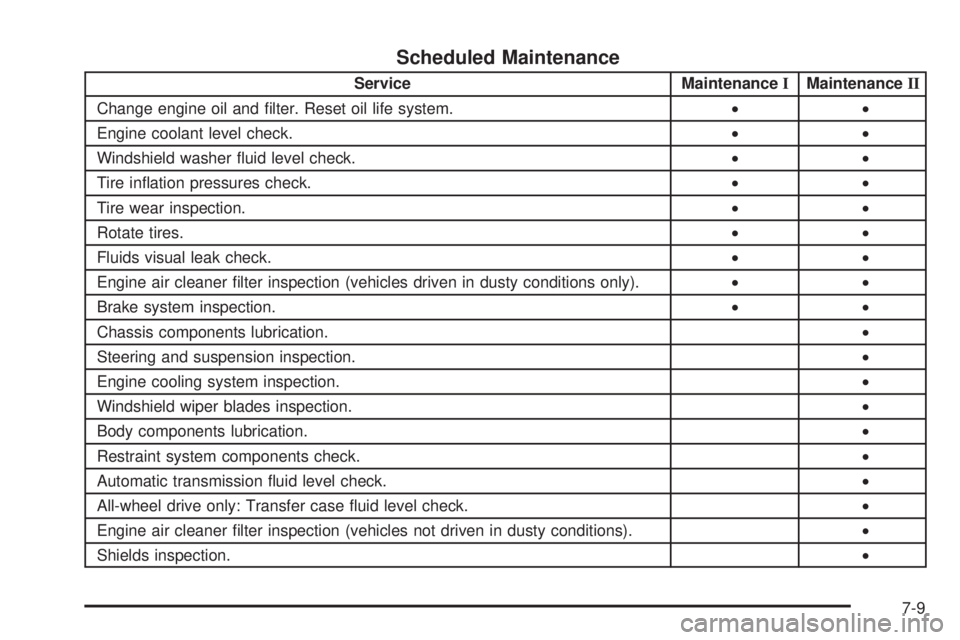
Scheduled Maintenance
Service MaintenanceIMaintenanceII
Change engine oil and filter. Reset oil life system.••
Engine coolant level check.••
Windshield washer fluid level check.••
Tire inflation pressures check.••
Tire wear inspection.••
Rotate tires.••
Fluids visual leak check.••
Engine air cleaner filter inspection (vehicles driven in dusty conditions only).••
Brake system inspection.••
Chassis components lubrication.•
Steering and suspension inspection.•
Engine cooling system inspection.•
Windshield wiper blades inspection.•
Body components lubrication.•
Restraint system components check.•
Automatic transmission fluid level check.•
All-wheel drive only: Transfer case fluid level check.•
Engine air cleaner filter inspection (vehicles not driven in dusty conditions).•
Shields inspection.•
7-9
Page 426 of 440
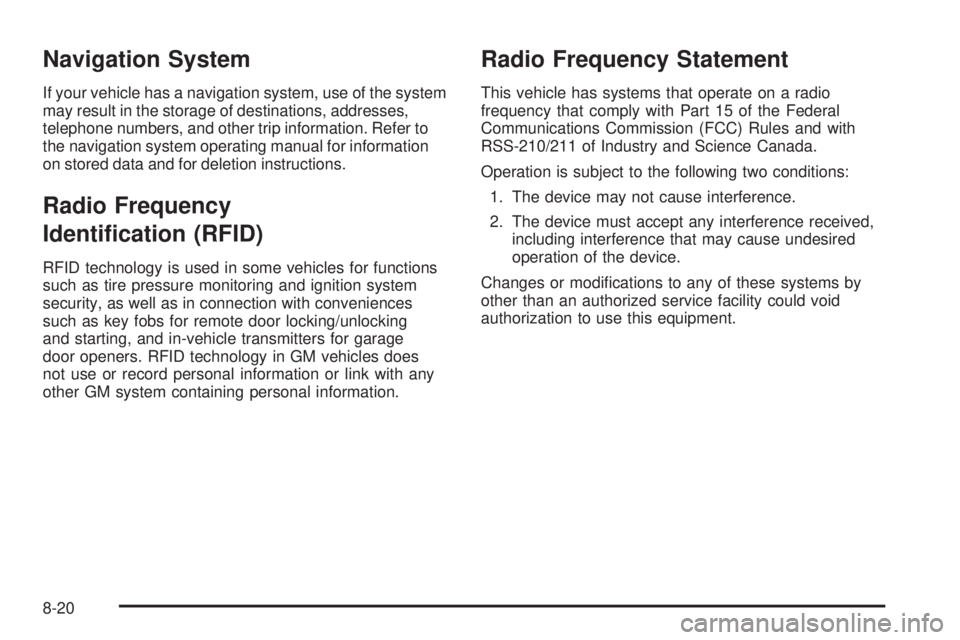
Navigation System
If your vehicle has a navigation system, use of the system
may result in the storage of destinations, addresses,
telephone numbers, and other trip information. Refer to
the navigation system operating manual for information
on stored data and for deletion instructions.
Radio Frequency
Identication (RFID)
RFID technology is used in some vehicles for functions
such as tire pressure monitoring and ignition system
security, as well as in connection with conveniences
such as key fobs for remote door locking/unlocking
and starting, and in-vehicle transmitters for garage
door openers. RFID technology in GM vehicles does
not use or record personal information or link with any
other GM system containing personal information.
Radio Frequency Statement
This vehicle has systems that operate on a radio
frequency that comply with Part 15 of the Federal
Communications Commission (FCC) Rules and with
RSS-210/211 of Industry and Science Canada.
Operation is subject to the following two conditions:
1. The device may not cause interference.
2. The device must accept any interference received,
including interference that may cause undesired
operation of the device.
Changes or modifications to any of these systems by
other than an authorized service facility could void
authorization to use this equipment.
8-20
Page 432 of 440
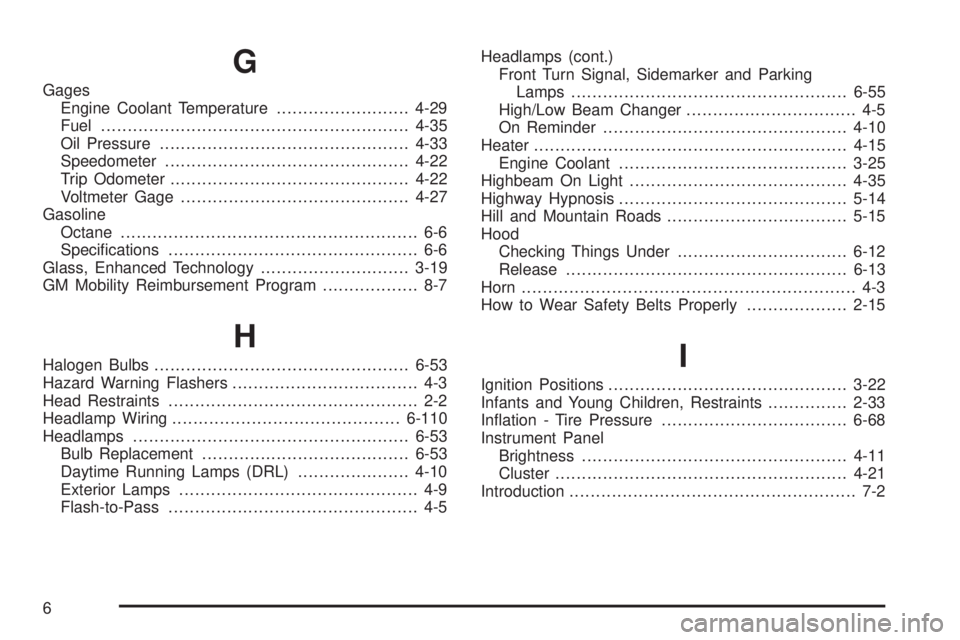
G
Gages
Engine Coolant Temperature.........................4-29
Fuel..........................................................4-35
Oil Pressure...............................................4-33
Speedometer..............................................4-22
Trip Odometer.............................................4-22
Voltmeter Gage...........................................4-27
Gasoline
Octane........................................................ 6-6
Specifications............................................... 6-6
Glass, Enhanced Technology............................3-19
GM Mobility Reimbursement Program.................. 8-7
H
Halogen Bulbs................................................6-53
Hazard Warning Flashers................................... 4-3
Head Restraints............................................... 2-2
Headlamp Wiring...........................................6-110
Headlamps....................................................6-53
Bulb Replacement.......................................6-53
Daytime Running Lamps (DRL).....................4-10
Exterior Lamps............................................. 4-9
Flash-to-Pass............................................... 4-5Headlamps (cont.)
Front Turn Signal, Sidemarker and Parking
Lamps ....................................................6-55
High/Low Beam Changer................................ 4-5
On Reminder..............................................4-10
Heater...........................................................4-15
Engine Coolant...........................................3-25
Highbeam On Light.........................................4-35
Highway Hypnosis...........................................5-14
Hill and Mountain Roads..................................5-15
Hood
Checking Things Under................................6-12
Release.....................................................6-13
Horn ............................................................... 4-3
How to Wear Safety Belts Properly...................2-15I
Ignition Positions.............................................3-22
Infants and Young Children, Restraints...............2-33
Inflation - Tire Pressure...................................6-68
Instrument Panel
Brightness..................................................4-11
Cluster.......................................................4-21
Introduction...................................................... 7-2
6