seats CHEVROLET EXPRESS 2008 Owner's Manual
[x] Cancel search | Manufacturer: CHEVROLET, Model Year: 2008, Model line: EXPRESS, Model: CHEVROLET EXPRESS 2008Pages: 440, PDF Size: 2.42 MB
Page 170 of 440
Air Delivery Mode Control:Turn clockwise or
counterclockwise to change the direction of the airflow
in the rear seating area.
To change the current mode, select one of the following:
H(Vent):Air is directed to the upper outlets, with
some directed to the floor outlets.
2(Floor):Air is directed to the floor outlets.
Be sure to keep the area under the front seats clear of
any objects so that the air inside of the vehicle can
circulate effectively.
For information on how to use the main climate control
system, seeClimate Control System on page 4-15.
For information on ventilation, seeOutlet Adjustment on
page 4-17.
Warning Lights, Gages, and
Indicators
Warning lights and gages can signal that something is
wrong before it becomes serious enough to cause
an expensive repair or replacement. Paying attention to
the warning lights and gages could prevent injury.
Warning lights come on when there might be or there is
a problem with one of the vehicle’s functions. Some
warning lights come on briefly when the engine is started
to indicate they are working.
Gages can indicate when there might be or there is a
problem with one of the vehicle’s functions. Often gages
and warning lights work together to indicate a problem
with the vehicle.
When one of the warning lights comes on and stays on
while driving, or when one of the gages shows there
could be a problem, check the section that explains what
to do. Follow this manual’s advice. Waiting to do
repairs can be costly and even dangerous.
4-20
Page 193 of 440
Compass Calibration
The compass can be manually calibrated. Only calibrate
the compass in a magnetically clean and safe location,
such as an open parking lot, where driving the vehicle
in circles is not a danger. It is suggested to calibrate
away from tall buildings, utility wires, manhole covers,
or other industrial structures, if possible.
If CAL should ever appear in the DIC display, the
compass should be calibrated.
If the DIC display does not show a heading, for example,
N for North, or the heading does not change after
making turns, there may be a strong magnetic field
interfering with the compass. Such interference may
be caused by a magnetic CB or cell phone antenna
mount, a magnetic emergency light, magnetic note
pad holder, or any other magnetic item. Turn off
the vehicle, move the magnetic item, then turn on
the vehicle and calibrate the compass.To calibrate the compass, use the following procedure:Compass Calibration Procedure
1. Before calibrating the compass, make sure the
compass zone is set to the variance zone in
which the vehicle is located. See “Compass
Variance (Zone) Procedure” earlier in this section.
Do not operate any switches such as window,
sunroof, climate controls, seats, etc. during
the calibration procedure.
2. Press the vehicle information button until
PRESS
VTO CALIBRATE COMPASS displays.
3. Press the set/reset button to start the compass
calibration.
4. The DIC will display CALIBRATING: DRIVE IN
CIRCLES. Drive the vehicle in tight circles at
less than 5 mph (8 km/h) to complete the calibration.
The DIC will display CALIBRATION COMPLETE
for a few seconds when the calibration is complete.
The DIC display will then return to PRESS
VTO
CALIBRATE COMPASS.
4-43
Page 253 of 440
{WARNING:
Do not load the vehicle any heavier than the
Gross Vehicle Weight Rating (GVWR), or
either the maximum front or rear Gross Axle
Weight Rating (GAWR). If you do, parts on the
vehicle can break, and it can change the way
your vehicle handles. These could cause you
to lose control and crash. Also, overloading
can shorten the life of the vehicle.
{WARNING:
Things you put inside your vehicle can strike
and injure people in a sudden stop or turn, or
in a crash.
•Put things in the cargo area of your
vehicle. Try to spread the weight evenly.
•Never stack heavier things, like
suitcases, inside the vehicle so that some
of them are above the tops of the seats.
•Do not leave an unsecured child restraint
in your vehicle.
•When you carry something inside the
vehicle, secure it whenever you can.
•Do not leave a seat folded down unless
you need to.
5-25
Page 335 of 440
(D) Construction Code:A letter code is used to
indicate the type of ply construction in the tire. The
letter R means radial ply construction; the letter D
means diagonal or bias ply construction; and the
letter B means belted-bias ply construction.
(E) Rim Diameter
:Diameter of the wheel in
inches.
(F) Load Range
:Load Range.
(G) Service Description
:The service description
indicates the load index and speed rating of a tire.
If two numbers are given as in the example,
120/116, then this represents the load index for
single versus dual wheel usage (single/dual).
The speed rating is the maximum speed a tire is
certified to carry a load. This does not apply to
Goodyear LT225/75R16 G949 RSA and Goodyear
LT225/75R16 G933 RSD commercial truck tires;
see the dual tire and single tire maximum load and
load range letter designations on the tire sidewall.
Tire Terminology and Denitions
Air Pressure:The amount of air inside the
tire pressing outward on each square inch of
the tire. Air pressure is expressed in pounds
per square inch (psi) or kilopascal (kPa).
Accessory Weight
:This means the combined
weight of optional accessories. Some examples of
optional accessories are, automatic transmission,
power steering, power brakes, power windows,
power seats, and air conditioning.
Aspect Ratio
:The relationship of a tire’s height
to its width.
Belt
:A rubber coated layer of cords that is
located between the plies and the tread. Cords
may be made from steel or other reinforcing
materials.
Bead
:The tire bead contains steel wires wrapped
by steel cords that hold the tire onto the rim.
Bias Ply Tire
:A pneumatic tire in which the plies
are laid at alternate angles less than 90 degrees
to the centerline of the tread.
6-65
Page 382 of 440
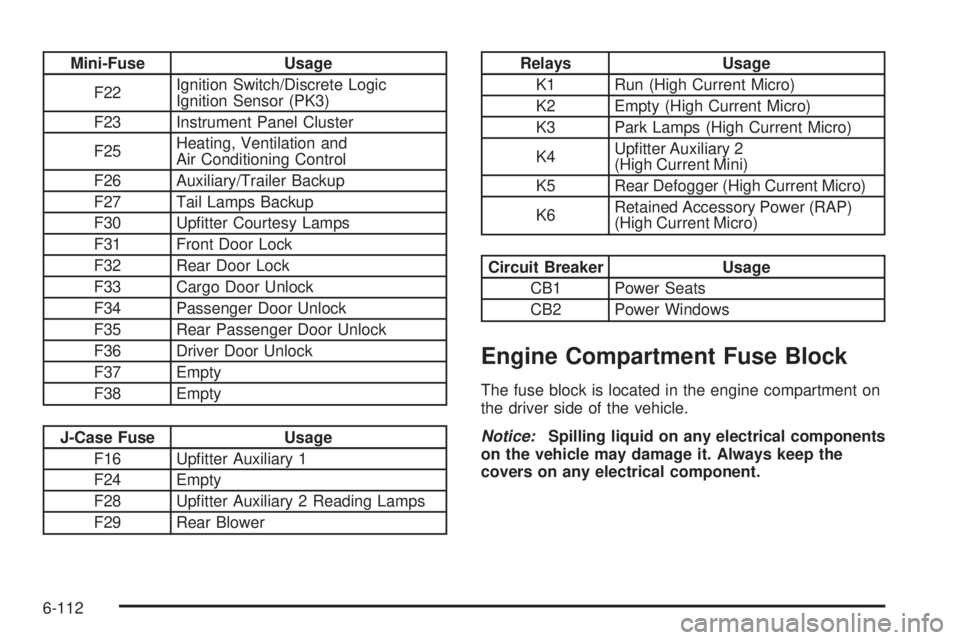
Mini-Fuse Usage
F22Ignition Switch/Discrete Logic
Ignition Sensor (PK3)
F23 Instrument Panel Cluster
F25Heating, Ventilation and
Air Conditioning Control
F26 Auxiliary/Trailer Backup
F27 Tail Lamps Backup
F30 Upfitter Courtesy Lamps
F31 Front Door Lock
F32 Rear Door Lock
F33 Cargo Door Unlock
F34 Passenger Door Unlock
F35 Rear Passenger Door Unlock
F36 Driver Door Unlock
F37 Empty
F38 Empty
J-Case Fuse Usage
F16 Upfitter Auxiliary 1
F24 Empty
F28 Upfitter Auxiliary 2 Reading Lamps
F29 Rear Blower
Relays Usage
K1 Run (High Current Micro)
K2 Empty (High Current Micro)
K3 Park Lamps (High Current Micro)
K4Upfitter Auxiliary 2
(High Current Mini)
K5 Rear Defogger (High Current Micro)
K6Retained Accessory Power (RAP)
(High Current Micro)
Circuit Breaker Usage
CB1 Power Seats
CB2 Power Windows
Engine Compartment Fuse Block
The fuse block is located in the engine compartment on
the driver side of the vehicle.
Notice:Spilling liquid on any electrical components
on the vehicle may damage it. Always keep the
covers on any electrical component.
6-112
Page 434 of 440
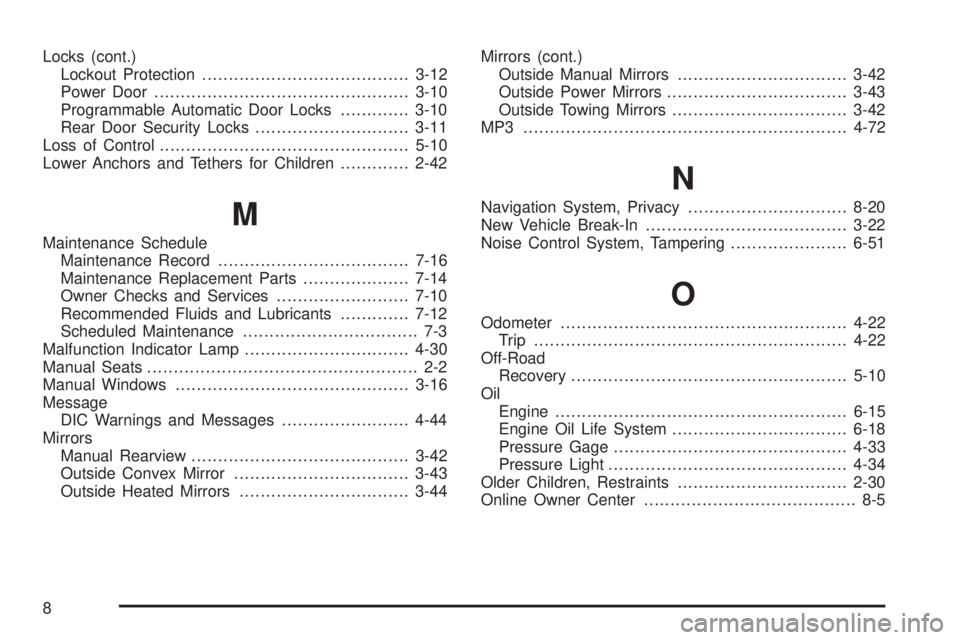
Locks (cont.)
Lockout Protection.......................................3-12
Power Door ................................................3-10
Programmable Automatic Door Locks.............3-10
Rear Door Security Locks.............................3-11
Loss of Control...............................................5-10
Lower Anchors and Tethers for Children.............2-42
M
Maintenance Schedule
Maintenance Record....................................7-16
Maintenance Replacement Parts....................7-14
Owner Checks and Services.........................7-10
Recommended Fluids and Lubricants.............7-12
Scheduled Maintenance................................. 7-3
Malfunction Indicator Lamp...............................4-30
Manual Seats................................................... 2-2
Manual Windows............................................3-16
Message
DIC Warnings and Messages........................4-44
Mirrors
Manual Rearview.........................................3-42
Outside Convex Mirror.................................3-43
Outside Heated Mirrors................................3-44Mirrors (cont.)
Outside Manual Mirrors................................3-42
Outside Power Mirrors..................................3-43
Outside Towing Mirrors.................................3-42
MP3 .............................................................4-72
N
Navigation System, Privacy..............................8-20
New Vehicle Break-In......................................3-22
Noise Control System, Tampering......................6-51
O
Odometer......................................................4-22
Trip ...........................................................4-22
Off-Road
Recovery....................................................5-10
Oil
Engine.......................................................6-15
Engine Oil Life System.................................6-18
Pressure Gage............................................4-33
Pressure Light.............................................4-34
Older Children, Restraints................................2-30
Online Owner Center........................................ 8-5
8
Page 437 of 440
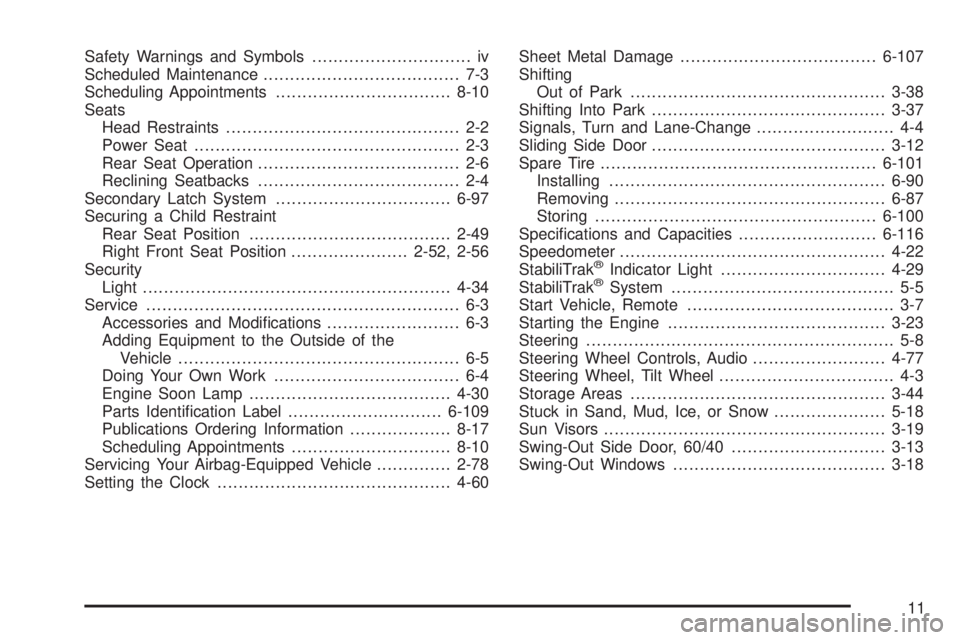
Safety Warnings and Symbols.............................. iv
Scheduled Maintenance..................................... 7-3
Scheduling Appointments.................................8-10
Seats
Head Restraints............................................ 2-2
Power Seat.................................................. 2-3
Rear Seat Operation...................................... 2-6
Reclining Seatbacks...................................... 2-4
Secondary Latch System.................................6-97
Securing a Child Restraint
Rear Seat Position......................................2-49
Right Front Seat Position......................2-52, 2-56
Security
Light..........................................................4-34
Service........................................................... 6-3
Accessories and Modifications......................... 6-3
Adding Equipment to the Outside of the
Vehicle..................................................... 6-5
Doing Your Own Work................................... 6-4
Engine Soon Lamp......................................4-30
Parts Identification Label.............................6-109
Publications Ordering Information...................8-17
Scheduling Appointments..............................8-10
Servicing Your Airbag-Equipped Vehicle..............2-78
Setting the Clock............................................4-60Sheet Metal Damage.....................................6-107
Shifting
Out of Park................................................3-38
Shifting Into Park............................................3-37
Signals, Turn and Lane-Change.......................... 4-4
Sliding Side Door............................................3-12
Spare Tire....................................................6-101
Installing....................................................6-90
Removing...................................................6-87
Storing.....................................................6-100
Specifications and Capacities..........................6-116
Speedometer..................................................4-22
StabiliTrak
®Indicator Light...............................4-29
StabiliTrak®System.......................................... 5-5
Start Vehicle, Remote....................................... 3-7
Starting the Engine.........................................3-23
Steering.......................................................... 5-8
Steering Wheel Controls, Audio.........................4-77
Steering Wheel, Tilt Wheel................................. 4-3
Storage Areas................................................3-44
Stuck in Sand, Mud, Ice, or Snow.....................5-18
Sun Visors.....................................................3-19
Swing-Out Side Door, 60/40.............................3-13
Swing-Out Windows........................................3-18
11