towing CHEVROLET EXPRESS 2009 Owner's Guide
[x] Cancel search | Manufacturer: CHEVROLET, Model Year: 2009, Model line: EXPRESS, Model: CHEVROLET EXPRESS 2009Pages: 440, PDF Size: 2.42 MB
Page 268 of 440
Backing Up
Hold the bottom of the steering wheel with one hand.
Then, to move the trailer to the left, move that hand
to the left. To move the trailer to the right, move your
hand to the right. Always back up slowly and, if possible,
have someone guide you.
Making Turns
Notice:Making very sharp turns while trailering
could cause the trailer to come in contact with the
vehicle. The vehicle could be damaged. Avoid
making very sharp turns while trailering.
When turning with a trailer, make wider turns than
normal. Do this so the trailer will not strike soft
shoulders, curbs, road signs, trees or other objects.
Avoid jerky or sudden maneuvers. Signal well in
advance.
Turn Signals When Towing a Trailer
The arrows on the instrument panel flash whenever
signaling a turn or lane change. Properly hooked up, the
trailer lamps also flash, telling other drivers the vehicle
is turning, changing lanes or stopping.When towing a trailer, the arrows on the instrument
panel flash for turns even if the bulbs on the trailer are
burned out. For this reason you may think other
drivers are seeing the signal when they are not. It is
important to check occasionally to be sure the
trailer bulbs are still working.
Driving On Grades
Reduce speed and shift to a lower gearbeforestarting
down a long or steep downgrade. If the transmission is
not shifted down, the brakes might have to be used so
much that they would get hot and no longer work well.
The vehicle can tow in D (Drive). Shift the transmission
to a lower gear if the transmission shifts too often
under heavy loads and/or hilly conditions.
When towing at high altitude on steep uphill grades,
consider the following: Engine coolant will boil at a lower
temperature than at normal altitudes. If the engine is
turned off immediately after towing at high altitude on
steep uphill grades, the vehicle may show signs similar to
engine overheating. To avoid this, let the engine run while
parked, preferably on level ground, with the automatic
transmission in P (Park) for a few minutes before turning
the engine off. If the overheat warning comes on, see
Engine Overheating on page 6-35.
5-40
Page 269 of 440
Parking on Hills
{WARNING:
Parking the vehicle on a hill with the trailer
attached can be dangerous. If something goes
wrong, the rig could start to move. People can be
injured, and both the vehicle and the trailer can be
damaged. When possible, always park the rig on a
flat surface.
If parking the rig on a hill:
1. Press the brake pedal, but do not shift the
transmission into P (Park) yet. Turn the wheels into
the curb if facing downhill or into traffic if facing
uphill.
2. Have someone place chocks under the trailer
wheels.
3. When the wheel chocks are in place, release the
brake pedal until the chocks absorb the load.
4. Reapply the brake pedal. Then apply the parking
brake and shift into P (Park).
5. Release the brake pedal.
Leaving After Parking on a Hill
1. Apply and hold the brake pedal while you:
•start the engine,
•shift into a gear, and
•release the parking brake.
2. Let up on the brake pedal.
3. Drive slowly until the trailer is clear of the chocks.
4. Stop and have someone pick up and store the
chocks.
Maintenance When Trailer Towing
The vehicle needs service more often when pulling a
trailer. See this manual’s Maintenance Schedule
or Index for more information. Things that are especially
important in trailer operation are automatic transmission
fluid, engine oil, axle lubricant, belts, cooling system
and brake system. It is a good idea to inspect
these before and during the trip.
Check periodically to see that all hitch nuts and bolts
are tight.
5-41
Page 306 of 440
If Steam Is Coming From The Engine
Compartment
{WARNING:
Steam from an overheated engine can burn you
badly, even if you just open the hood. Stay away
from the engine if you see or hear steam coming
from it. Just turn it off and get everyone away from
the vehicle until it cools down. Wait until there
is no sign of steam or coolant before you open
the hood.
If you keep driving when your engine is
overheated, the liquids in it can catch fire. You or
others could be badly burned. Stop your engine if
it overheats, and get out of the vehicle until the
engine is cool.
If No Steam Is Coming From The
Engine Compartment
If an engine overheat warning is displayed but no steam
can be seen or heard, the problem may not be too
serious. Sometimes the engine can get a little too
hot when the vehicle:
•Climbs a long hill on a hot day.
•Stops after high-speed driving.
•Idles for long periods in traffic.
•Tows a trailer. See “Driving on Grades” under
Towing a Trailer on page 5-30.
If the overheat warning is displayed with no sign of
steam:
1. Turn the air off.
2. Turn the heater on to the highest temperature and
to the highest fan speed. Open the windows as
necessary.
3. In heavy traffic, let the engine idle in N (Neutral)
while stopped. If it is safe to do so, pull off the
road, shift to P (Park) or N (Neutral) and let
the engine idle.
6-36
Page 307 of 440
If the temperature overheat gage is no longer in the
overheat zone or an overheat warning no longer
displays, the vehicle can be driven. Continue to drive
the vehicle slow for about 10 minutes. Keep a safe
vehicle distance from the car in front of you. If the
warning does not come back on, continue to drive
normally.
If the warning continues, pull over, stop, and park the
vehicle right away.
If there is still no sign of steam, push down the
accelerator until the engine speed is about twice
as fast as normal idle speed for at least three minutes
while you are parked. If you still have the warning,
turn off the engine until it cools down.
You may decide not to lift the hood but to get service
help right away.Engine Fan Noise
Your vehicle has a clutched engine cooling fan. When the
clutch is engaged, the fan spins faster to provide more air
to cool the engine. In most everyday driving conditions,
the fan is spinning slower and the clutch is not fully
engaged. This improves fuel economy and reduces fan
noise. Under heavy vehicle loading, trailer towing, and/
or high outside temperatures, the fan speed increases
as the clutch more fully engages, so you may hear an
increase in fan noise. This is normal and should not be
mistaken as the transmission slipping or making extra
shifts. It is merely the cooling system functioning properly.
The fan will slow down when additional cooling is not
required and the clutch partially disengages.
You may also hear this fan noise when you start the
engine. It will go away as the fan clutch partially
disengages.
6-37
Page 395 of 440
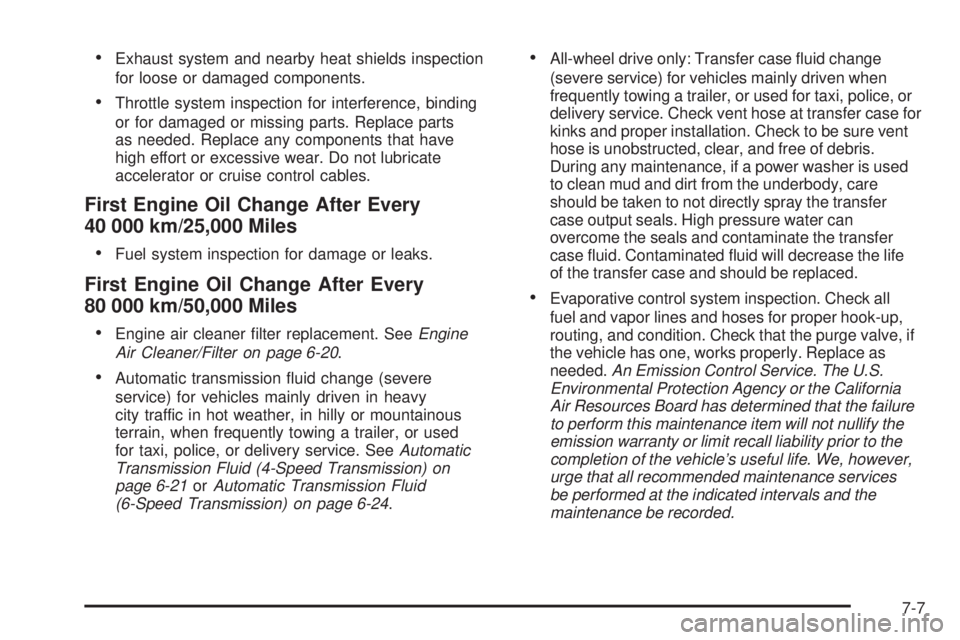
•Exhaust system and nearby heat shields inspection
for loose or damaged components.
•Throttle system inspection for interference, binding
or for damaged or missing parts. Replace parts
as needed. Replace any components that have
high effort or excessive wear. Do not lubricate
accelerator or cruise control cables.
First Engine Oil Change After Every
40 000 km/25,000 Miles
•
Fuel system inspection for damage or leaks.
First Engine Oil Change After Every
80 000 km/50,000 Miles
•
Engine air cleaner filter replacement. SeeEngine
Air Cleaner/Filter on page 6-20.
•Automatic transmission fluid change (severe
service) for vehicles mainly driven in heavy
city traffic in hot weather, in hilly or mountainous
terrain, when frequently towing a trailer, or used
for taxi, police, or delivery service. SeeAutomatic
Transmission Fluid (4-Speed Transmission) on
page 6-21orAutomatic Transmission Fluid
(6-Speed Transmission) on page 6-24.
•All-wheel drive only: Transfer case fluid change
(severe service) for vehicles mainly driven when
frequently towing a trailer, or used for taxi, police, or
delivery service. Check vent hose at transfer case for
kinks and proper installation. Check to be sure vent
hose is unobstructed, clear, and free of debris.
During any maintenance, if a power washer is used
to clean mud and dirt from the underbody, care
should be taken to not directly spray the transfer
case output seals. High pressure water can
overcome the seals and contaminate the transfer
case fluid. Contaminated fluid will decrease the life
of the transfer case and should be replaced.
•Evaporative control system inspection. Check all
fuel and vapor lines and hoses for proper hook-up,
routing, and condition. Check that the purge valve, if
the vehicle has one, works properly. Replace as
needed.An Emission Control Service. The U.S.
Environmental Protection Agency or the California
Air Resources Board has determined that the failure
to perform this maintenance item will not nullify the
emission warranty or limit recall liability prior to the
completion of the vehicle’s useful life. We, however,
urge that all recommended maintenance services
be performed at the indicated intervals and the
maintenance be recorded.
7-7
Page 415 of 440
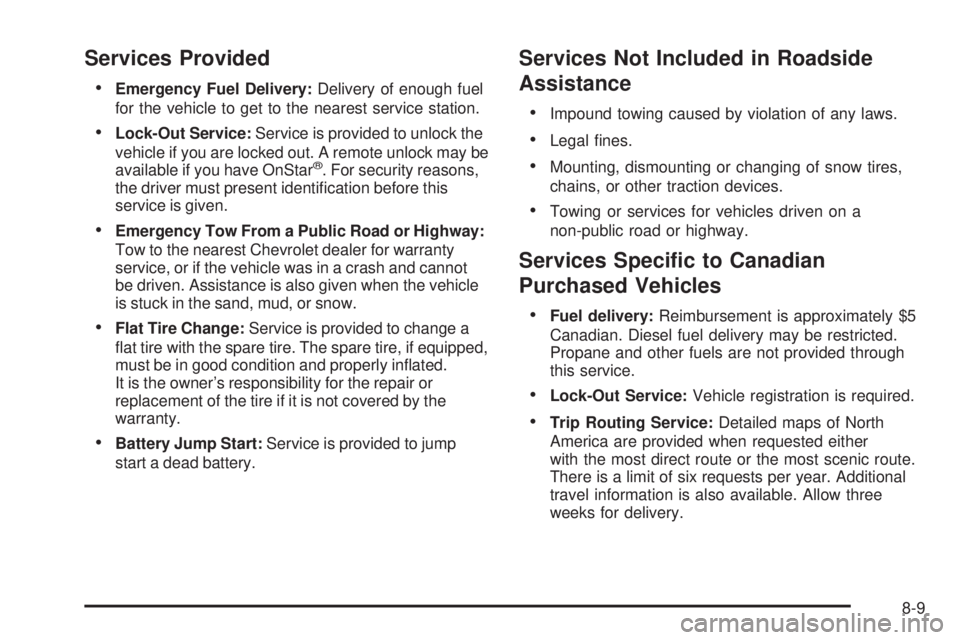
Services Provided
•Emergency Fuel Delivery:Delivery of enough fuel
for the vehicle to get to the nearest service station.
•Lock-Out Service:Service is provided to unlock the
vehicle if you are locked out. A remote unlock may be
available if you have OnStar
®. For security reasons,
the driver must present identification before this
service is given.
•Emergency Tow From a Public Road or Highway:
Tow to the nearest Chevrolet dealer for warranty
service, or if the vehicle was in a crash and cannot
be driven. Assistance is also given when the vehicle
is stuck in the sand, mud, or snow.
•Flat Tire Change:Service is provided to change a
flat tire with the spare tire. The spare tire, if equipped,
must be in good condition and properly inflated.
It is the owner’s responsibility for the repair or
replacement of the tire if it is not covered by the
warranty.
•Battery Jump Start:Service is provided to jump
start a dead battery.
Services Not Included in Roadside
Assistance
•Impound towing caused by violation of any laws.
•Legal fines.
•Mounting, dismounting or changing of snow tires,
chains, or other traction devices.
•Towing or services for vehicles driven on a
non-public road or highway.
Services Specic to Canadian
Purchased Vehicles
•Fuel delivery:Reimbursement is approximately $5
Canadian. Diesel fuel delivery may be restricted.
Propane and other fuels are not provided through
this service.
•Lock-Out Service:Vehicle registration is required.
•Trip Routing Service:Detailed maps of North
America are provided when requested either
with the most direct route or the most scenic route.
There is a limit of six requests per year. Additional
travel information is also available. Allow three
weeks for delivery.
8-9
Page 420 of 440
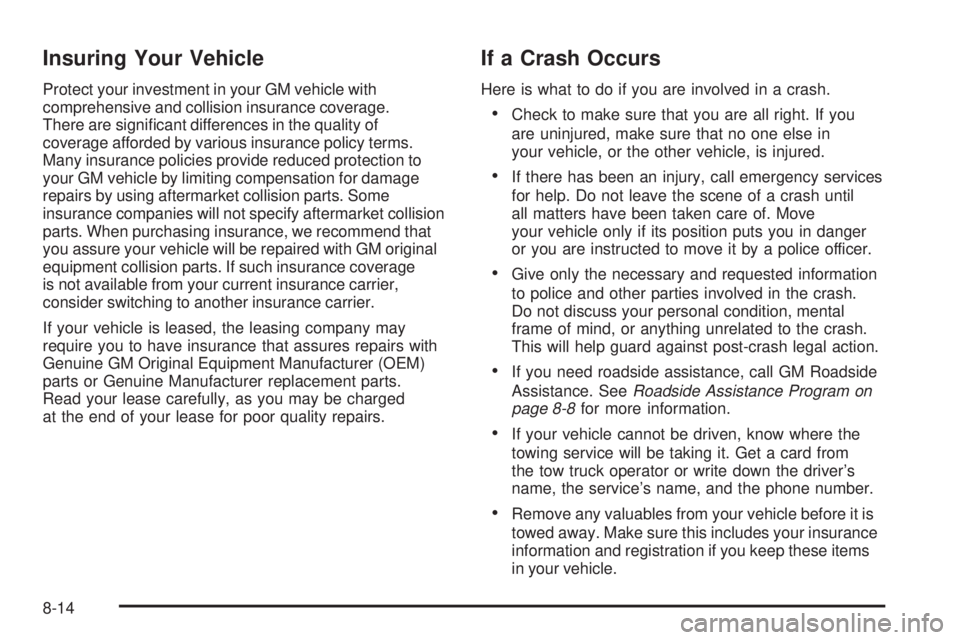
Insuring Your Vehicle
Protect your investment in your GM vehicle with
comprehensive and collision insurance coverage.
There are significant differences in the quality of
coverage afforded by various insurance policy terms.
Many insurance policies provide reduced protection to
your GM vehicle by limiting compensation for damage
repairs by using aftermarket collision parts. Some
insurance companies will not specify aftermarket collision
parts. When purchasing insurance, we recommend that
you assure your vehicle will be repaired with GM original
equipment collision parts. If such insurance coverage
is not available from your current insurance carrier,
consider switching to another insurance carrier.
If your vehicle is leased, the leasing company may
require you to have insurance that assures repairs with
Genuine GM Original Equipment Manufacturer (OEM)
parts or Genuine Manufacturer replacement parts.
Read your lease carefully, as you may be charged
at the end of your lease for poor quality repairs.
If a Crash Occurs
Here is what to do if you are involved in a crash.
•Check to make sure that you are all right. If you
are uninjured, make sure that no one else in
your vehicle, or the other vehicle, is injured.
•If there has been an injury, call emergency services
for help. Do not leave the scene of a crash until
all matters have been taken care of. Move
your vehicle only if its position puts you in danger
or you are instructed to move it by a police officer.
•Give only the necessary and requested information
to police and other parties involved in the crash.
Do not discuss your personal condition, mental
frame of mind, or anything unrelated to the crash.
This will help guard against post-crash legal action.
•If you need roadside assistance, call GM Roadside
Assistance. SeeRoadside Assistance Program on
page 8-8for more information.
•If your vehicle cannot be driven, know where the
towing service will be taking it. Get a card from
the tow truck operator or write down the driver’s
name, the service’s name, and the phone number.
•Remove any valuables from your vehicle before it is
towed away. Make sure this includes your insurance
information and registration if you keep these items
in your vehicle.
8-14
Page 434 of 440
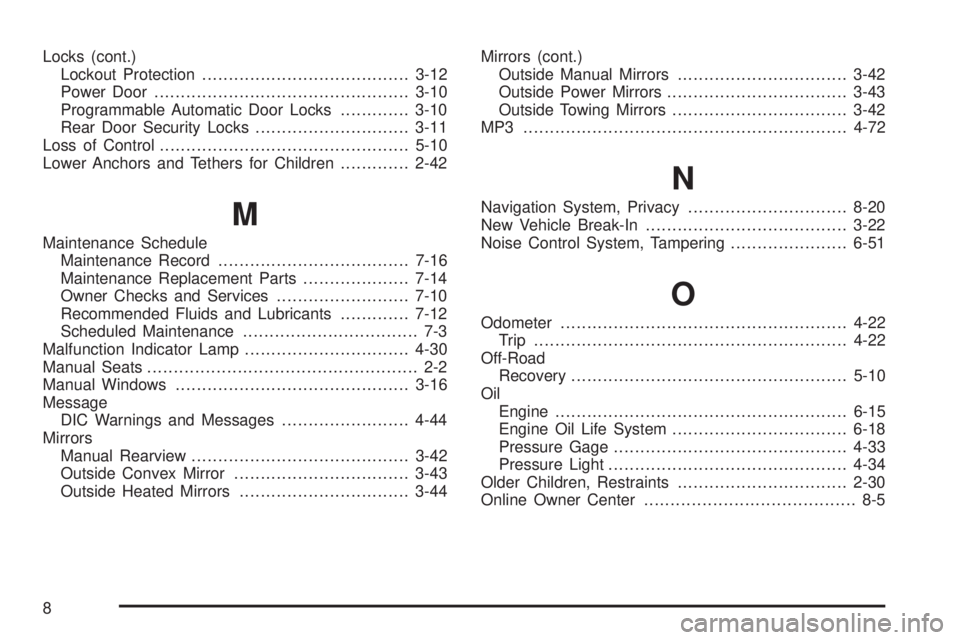
Locks (cont.)
Lockout Protection.......................................3-12
Power Door ................................................3-10
Programmable Automatic Door Locks.............3-10
Rear Door Security Locks.............................3-11
Loss of Control...............................................5-10
Lower Anchors and Tethers for Children.............2-42
M
Maintenance Schedule
Maintenance Record....................................7-16
Maintenance Replacement Parts....................7-14
Owner Checks and Services.........................7-10
Recommended Fluids and Lubricants.............7-12
Scheduled Maintenance................................. 7-3
Malfunction Indicator Lamp...............................4-30
Manual Seats................................................... 2-2
Manual Windows............................................3-16
Message
DIC Warnings and Messages........................4-44
Mirrors
Manual Rearview.........................................3-42
Outside Convex Mirror.................................3-43
Outside Heated Mirrors................................3-44Mirrors (cont.)
Outside Manual Mirrors................................3-42
Outside Power Mirrors..................................3-43
Outside Towing Mirrors.................................3-42
MP3 .............................................................4-72
N
Navigation System, Privacy..............................8-20
New Vehicle Break-In......................................3-22
Noise Control System, Tampering......................6-51
O
Odometer......................................................4-22
Trip ...........................................................4-22
Off-Road
Recovery....................................................5-10
Oil
Engine.......................................................6-15
Engine Oil Life System.................................6-18
Pressure Gage............................................4-33
Pressure Light.............................................4-34
Older Children, Restraints................................2-30
Online Owner Center........................................ 8-5
8
Page 435 of 440
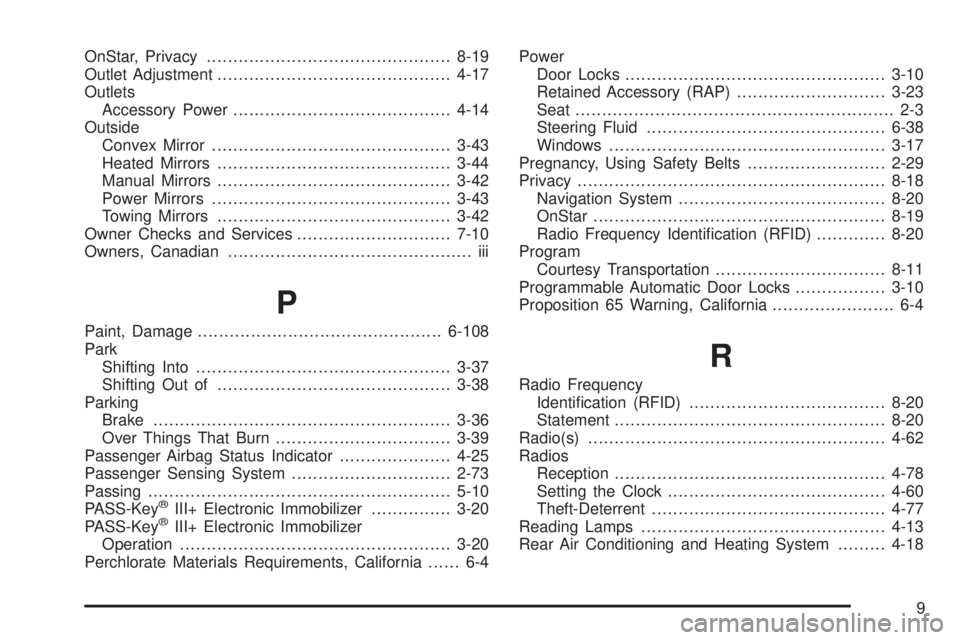
OnStar, Privacy..............................................8-19
Outlet Adjustment............................................4-17
Outlets
Accessory Power.........................................4-14
Outside
Convex Mirror.............................................3-43
Heated Mirrors............................................3-44
Manual Mirrors............................................3-42
Power Mirrors.............................................3-43
Towing Mirrors............................................3-42
Owner Checks and Services.............................7-10
Owners, Canadian.............................................. iii
P
Paint, Damage..............................................6-108
Park
Shifting Into................................................3-37
Shifting Out of............................................3-38
Parking
Brake........................................................3-36
Over Things That Burn.................................3-39
Passenger Airbag Status Indicator.....................4-25
Passenger Sensing System..............................2-73
Passing.........................................................5-10
PASS-Key
®III+ Electronic Immobilizer...............3-20
PASS-Key®III+ Electronic Immobilizer
Operation...................................................3-20
Perchlorate Materials Requirements, California...... 6-4Power
Door Locks.................................................3-10
Retained Accessory (RAP)............................3-23
Seat............................................................ 2-3
Steering Fluid.............................................6-38
Windows....................................................3-17
Pregnancy, Using Safety Belts..........................2-29
Privacy..........................................................8-18
Navigation System.......................................8-20
OnStar.......................................................8-19
Radio Frequency Identification (RFID).............8-20
Program
Courtesy Transportation................................8-11
Programmable Automatic Door Locks.................3-10
Proposition 65 Warning, California....................... 6-4
R
Radio Frequency
Identification (RFID).....................................8-20
Statement...................................................8-20
Radio(s)........................................................4-62
Radios
Reception...................................................4-78
Setting the Clock.........................................4-60
Theft-Deterrent............................................4-77
Reading Lamps..............................................4-13
Rear Air Conditioning and Heating System.........4-18
9
Page 436 of 440
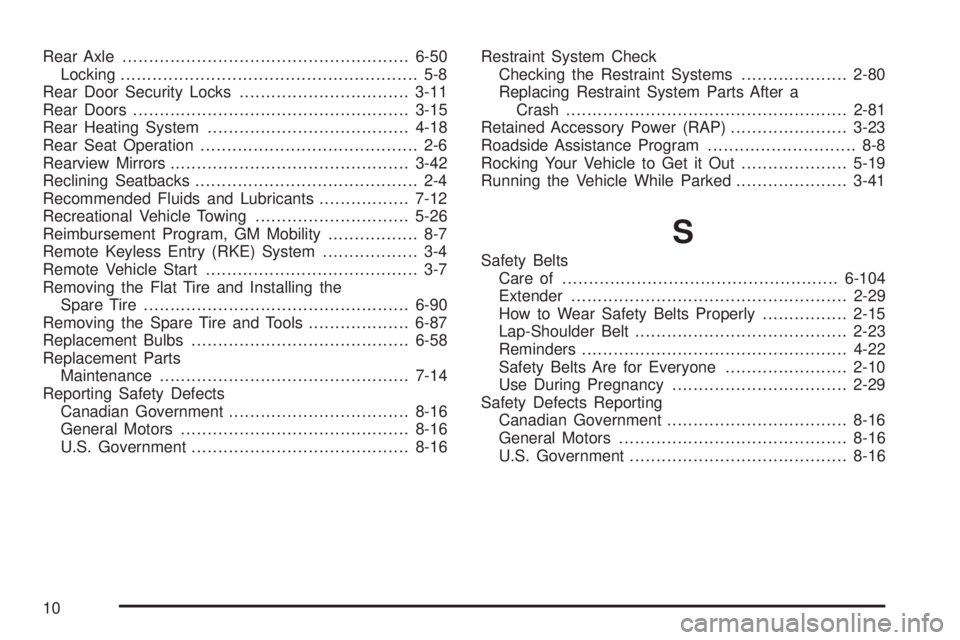
Rear Axle......................................................6-50
Locking........................................................ 5-8
Rear Door Security Locks................................3-11
Rear Doors....................................................3-15
Rear Heating System......................................4-18
Rear Seat Operation......................................... 2-6
Rearview Mirrors.............................................3-42
Reclining Seatbacks.......................................... 2-4
Recommended Fluids and Lubricants.................7-12
Recreational Vehicle Towing.............................5-26
Reimbursement Program, GM Mobility................. 8-7
Remote Keyless Entry (RKE) System.................. 3-4
Remote Vehicle Start........................................ 3-7
Removing the Flat Tire and Installing the
Spare Tire..................................................6-90
Removing the Spare Tire and Tools...................6-87
Replacement Bulbs.........................................6-58
Replacement Parts
Maintenance...............................................7-14
Reporting Safety Defects
Canadian Government..................................8-16
General Motors...........................................8-16
U.S. Government.........................................8-16Restraint System Check
Checking the Restraint Systems....................2-80
Replacing Restraint System Parts After a
Crash.....................................................2-81
Retained Accessory Power (RAP)......................3-23
Roadside Assistance Program............................ 8-8
Rocking Your Vehicle to Get it Out....................5-19
Running the Vehicle While Parked.....................3-41
S
Safety Belts
Care of ....................................................6-104
Extender....................................................2-29
How to Wear Safety Belts Properly................2-15
Lap-Shoulder Belt........................................2-23
Reminders..................................................4-22
Safety Belts Are for Everyone.......................2-10
Use During Pregnancy.................................2-29
Safety Defects Reporting
Canadian Government..................................8-16
General Motors...........................................8-16
U.S. Government.........................................8-16
10