battery CHEVROLET EXPRESS 2016 Owner's Manual
[x] Cancel search | Manufacturer: CHEVROLET, Model Year: 2016, Model line: EXPRESS, Model: CHEVROLET EXPRESS 2016Pages: 289, PDF Size: 11.46 MB
Page 169 of 289

Chevrolet Express Owner Manual (GMNA-Localizing-U.S./Canada/Mexico-
15555951) - 2022 - CRC - 1/27/22
168 Driving and Operating
Tires
.Do not tow a trailer while using a
compact spare tire on the vehicle.
.Tires must be properly inflated to support
loads while towing a trailer. SeeTires
0 204 for instructions on proper tire
inflation.
Safety Chains
Always attach chains between the vehicle
and the trailer, and attach the chains to the
holes on the trailer hitch platform.
Instructions about safety chains may be
provided by the hitch manufacturer or by
the trailer manufacturer.
Cross the safety chains under the tongue of
the trailer to help prevent the tongue from
contacting the road if it becomes separated
from the hitch. Always leave just enough
slack so the combination can turn. Never
allow safety chains to drag on the ground.
Trailer Brakes
Loaded trailers over 675 kg (1,500 lb) must
be equipped with brake systems and with
brakes for each axle. Trailer braking
equipment conforming to Canadian Standards Association (CSA) requirement
CAN3-D313, or its equivalent, is
recommended.
State or local regulations may require the
trailer to have its own braking system if the
loaded weight of the trailer exceeds certain
minimums. These requirements vary from
state to state. Read and follow the
instructions for the trailer brakes so they are
installed, adjusted, and maintained properly.
Never attempt to tap into your vehicle's
hydraulic brake system. If you do, both the
vehicle anti-lock brakes and the trailer
brakes may not function, which could result
in a crash.
Trailer Wiring Harness
Basic Trailer Wiring
If the vehicle is not equipped with a trailer
connector on the rear bumper, a seven-wire
trailering harness is tied to the vehicle’s
frame. The harness requires the installation
of a trailer connector, which is available
through your dealer.
Use only a round, seven-wire connector with
flat blade terminals meeting SAE J2863
specifications for proper electrical
connectivity.The seven-wire harness connector contains
the following trailer circuits:
.Yellow: Stop/Turn Signal Left*
.Dark Green: Stop/Turn Signal Right*
.Brown: Tail/Parking Lamps**
.Light Green: Reverse Lamps**
.Red/Black: Battery Feed
.White: Ground
.Dark Blue: Electric Trailer Brake
* If the vehicle is a cutaway with trailer
provisions, each stop/turn signal has a
15 amp fuse. However, the cutaway lighting
connector will have a 10 amp fuse for each
signal.
**If the vehicle is a cutaway with trailer
provisions, there is a 15 amp fuse for the
trailer park lamps and a 15 amp fuse for the
cutaway rear lighting connector park lamps.
Also, a 10 amp fuse will be shared for trailer
back-up lamps and cutaway rear lighting
connector back-up lamps.
Heavy-Duty Trailer Wiring Harness Package
lf equipped, the trailer wiring harness, with
a seven-pin connector is mounted on the
trailer hitch.
Page 170 of 289

Chevrolet Express Owner Manual (GMNA-Localizing-U.S./Canada/Mexico-
15555951) - 2022 - CRC - 1/27/22
Driving and Operating 169
1. Ground
2. Left Turn/Brake
3. Reverse Lamps
4. Taillamps
5. Battery Feed
6. Right Turn/Brake
7. Electric Brakes
Electric Brake Control Wiring Provisions
If the vehicle is not equipped with an
integrated trailer brake controller, and the
trailer has electric brakes, a trailer brake
controller needs to be installed on the
vehicle. The brake controller should be
installed by your dealer or a qualified
service center.If equipped, wiring provisions for an
aftermarket electric trailer brake controller
are included with the vehicle as part of the
trailer wiring package. The harness contains
the following circuits:
.Dark Blue: Electric Trailer Brakes
.Red/White: Battery Feed
.Lt Blue/White: Brake Apply Signal
.Black: Ground
There are four blunt cut wires under the
floor carpeting in front of the brake pedal.
It will be necessary to have a technician
connect the 12-volt power to the engine
compartment fuse block.
Refer to the aftermarket electric trailer brake
controller owner's manual to determine wire
color coding of the electric trailer brake
controller. The wire colors on the brake
controller may be different from the vehicle.
Trailer Lamps
Always check all trailer lamps are working at
the beginning of each trip, and periodically
on longer trips.
Turn Signals When Towing a Trailer
When properly connected, the trailer turn
signals will illuminate to indicate the vehicle
is turning, changing lanes, or stopping.
When towing a trailer, the arrows on the
instrument cluster will illuminate even if the
trailer is not properly connected or the bulbs
are burned out.
Tow/Haul Mode
Tow/Haul assists when pulling a heavy
trailer or a large or heavy load. For
instructions on how to enter Tow/Haul
mode, see Tow/Haul Mode 0140.
Tow/Haul Mode is designed to be most
effective when the vehicle and trailer
combined weight is at least 75% of the
vehicle's Gross Combined Weight Rating
(GCWR). See “Trailer Weight” underTrailer
Towing 0159.
Tow/Haul Mode is most useful when towing
a heavy trailer or carrying a large or
heavy load:
.Through rolling terrain
.In stop-and-go traffic
.In busy parking lots
Page 172 of 289
Chevrolet Express Owner Manual (GMNA-Localizing-U.S./Canada/Mexico-
15555951) - 2022 - CRC - 1/27/22
Driving and Operating 171
Conversions and Add-Ons
Add-On Electrical Equipment
{Warning
The Data Link Connector (DLC) is used for
vehicle service and Emission Inspection/
Maintenance testing. SeeMalfunction
Indicator Lamp (Check Engine Light) 077.
A device connected to the DLC —such as
an aftermarket fleet or driver-behavior
tracking device —may interfere with
vehicle systems. This could affect vehicle
operation and cause a crash. Such devices
may also access information stored in the
vehicle’s systems.
Caution
Some electrical equipment can damage
the vehicle or cause components to not
work and would not be covered by the
vehicle warranty. Always check with your
dealer before adding electrical equipment.
Add-on equipment can drain the vehicle's
12-volt battery, even if the vehicle is not
operating. The vehicle has an airbag system. Before
attempting to add anything electrical to the
vehicle, see
Servicing the Airbag-Equipped
Vehicle 045 and
Adding Equipment to the Airbag-Equipped
Vehicle 045.
Page 173 of 289
Chevrolet Express Owner Manual (GMNA-Localizing-U.S./Canada/Mexico-
15555951) - 2022 - CRC - 1/27/22
172 Vehicle Care
Vehicle Care
General Information
General Information . . . . . . . . . . . . . . . . . . . 173
California Perchlorate MaterialsRequirements . . . . . . . . . . . . . . . . . . . . . . . . 173
Accessories and Modifications . . . . . . . . . . 173
Vehicle Checks
Doing Your Own Service Work . . . . . . . . . 173
Hood . . . . . . . . . . . . . . . . . . . . . . . . . . . . . . . . . . 174
Engine Compartment Overview . . . . . . . . 176
Engine Oil . . . . . . . . . . . . . . . . . . . . . . . . . . . . . 179
Engine Oil Life System . . . . . . . . . . . . . . . . . 181
Automatic Transmission Fluid . . . . . . . . . . 181
Engine Air Cleaner/Filter . . . . . . . . . . . . . . . 182
Cooling System . . . . . . . . . . . . . . . . . . . . . . . . 183
Engine Overheating . . . . . . . . . . . . . . . . . . . . 187
Engine Fan . . . . . . . . . . . . . . . . . . . . . . . . . . . . 188
Power Steering Fluid . . . . . . . . . . . . . . . . . . 188
Washer Fluid . . . . . . . . . . . . . . . . . . . . . . . . . . 189
Brakes . . . . . . . . . . . . . . . . . . . . . . . . . . . . . . . . . 189
Brake Fluid . . . . . . . . . . . . . . . . . . . . . . . . . . . . 190
Battery - North America . . . . . . . . . . . . . . . 191
Rear Axle . . . . . . . . . . . . . . . . . . . . . . . . . . . . . . 192
Noise Control System . . . . . . . . . . . . . . . . . . 192
Starter Switch Check . . . . . . . . . . . . . . . . . . . 193
Automatic Transmission Shift Lock Control Function Check . . . . . . . . . . . . . . 193
Ignition Transmission Lock Check . . . . . . 193 Park Brake and P (Park) Mechanism
Check . . . . . . . . . . . . . . . . . . . . . . . . . . . . . . . . 193
Wiper Blade Replacement . . . . . . . . . . . . . 194
Windshield Replacement . . . . . . . . . . . . . . 194
Headlamp Aiming
Front Headlamp Aiming . . . . . . . . . . . . . . . 194
Bulb Replacement
Bulb Replacement . . . . . . . . . . . . . . . . . . . . . 195
Halogen Bulbs . . . . . . . . . . . . . . . . . . . . . . . . . 195
Front Turn Signal, Sidemarker, and Parking Lamps . . . . . . . . . . . . . . . . . . . . . . . 195
Taillamps . . . . . . . . . . . . . . . . . . . . . . . . . . . . . . 195
Center High-Mounted Stoplamp (CHMSL) . . . . . . . . . . . . . . . . . . . . . . . . . . . . . 196
License Plate Lamp . . . . . . . . . . . . . . . . . . . . 197
Electrical System
Electrical System Overload . . . . . . . . . . . . . 197
Fuses and Circuit Breakers . . . . . . . . . . . . . 198
Engine Compartment Fuse Block . . . . . . 199
Floor Console Fuse Block . . . . . . . . . . . . . . 202
Wheels and Tires
Tires . . . . . . . . . . . . . . . . . . . . . . . . . . . . . . . . . . 204
All-Season Tires . . . . . . . . . . . . . . . . . . . . . . . 204
Winter Tires . . . . . . . . . . . . . . . . . . . . . . . . . . . 205
Tire Sidewall Labeling . . . . . . . . . . . . . . . . . 205
Tire Designations . . . . . . . . . . . . . . . . . . . . . . 207
Tire Terminology and Definitions . . . . . 208
Tire Pressure . . . . . . . . . . . . . . . . . . . . . . . . . . 210 Tire Pressure Monitor System . . . . . . . . . . 211
Tire Pressure Monitor Operation . . . . . . . 212
Tire Inspection . . . . . . . . . . . . . . . . . . . . . . . . . 214
Tire Rotation . . . . . . . . . . . . . . . . . . . . . . . . . . 214
When It Is Time for New Tires . . . . . . . . 216
Buying New Tires . . . . . . . . . . . . . . . . . . . . . . 217
Different Size Tires and Wheels . . . . . . . . 218
Uniform Tire Quality Grading . . . . . . . . . . 218
Wheel Alignment and Tire Balance . . . . 219
Wheel Replacement . . . . . . . . . . . . . . . . . . . 220
Tire Chains . . . . . . . . . . . . . . . . . . . . . . . . . . . . 220
If a Tire Goes Flat . . . . . . . . . . . . . . . . . . . . . 221
Tire Changing . . . . . . . . . . . . . . . . . . . . . . . . . 222
Full-Size Spare Tire . . . . . . . . . . . . . . . . . . . . 230
Jump Starting
Jump Starting - North America . . . . . . . . 230
Towing the Vehicle
Towing the Vehicle . . . . . . . . . . . . . . . . . . . . 233
Recreational Vehicle Towing . . . . . . . . . . . 234
Appearance Care
Exterior Care . . . . . . . . . . . . . . . . . . . . . . . . . . 235
Interior Care . . . . . . . . . . . . . . . . . . . . . . . . . . . 239
Floor Mats . . . . . . . . . . . . . . . . . . . . . . . . . . . . 242
Page 178 of 289
Chevrolet Express Owner Manual (GMNA-Localizing-U.S./Canada/Mexico-
15555951) - 2022 - CRC - 1/27/22
Vehicle Care 177
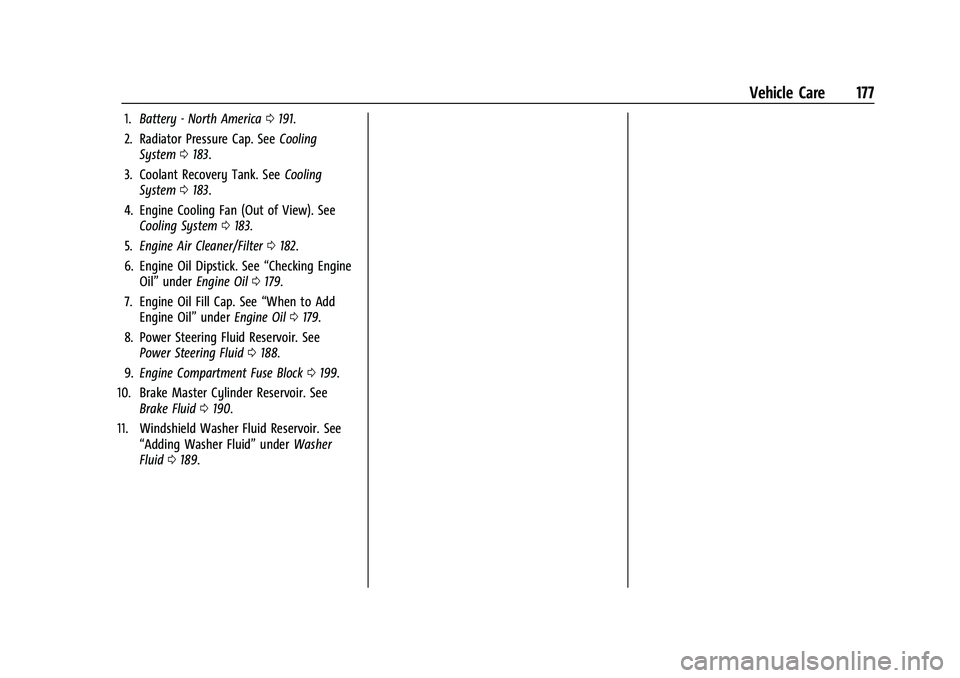
1.Battery - North America 0191.
2. Radiator Pressure Cap. See Cooling
System 0183.
3. Coolant Recovery Tank. See Cooling
System 0183.
4. Engine Cooling Fan (Out of View). See Cooling System 0183.
5. Engine Air Cleaner/Filter 0182.
6. Engine Oil Dipstick. See “Checking Engine
Oil” under Engine Oil 0179.
7. Engine Oil Fill Cap. See “When to Add
Engine Oil” underEngine Oil 0179.
8. Power Steering Fluid Reservoir. See Power Steering Fluid 0188.
9. Engine Compartment Fuse Block 0199.
10. Brake Master Cylinder Reservoir. See Brake Fluid 0190.
11. Windshield Washer Fluid Reservoir. See “Adding Washer Fluid” underWasher
Fluid 0189.
Page 179 of 289
Chevrolet Express Owner Manual (GMNA-Localizing-U.S./Canada/Mexico-
15555951) - 2022 - CRC - 1/27/22
178 Vehicle Care
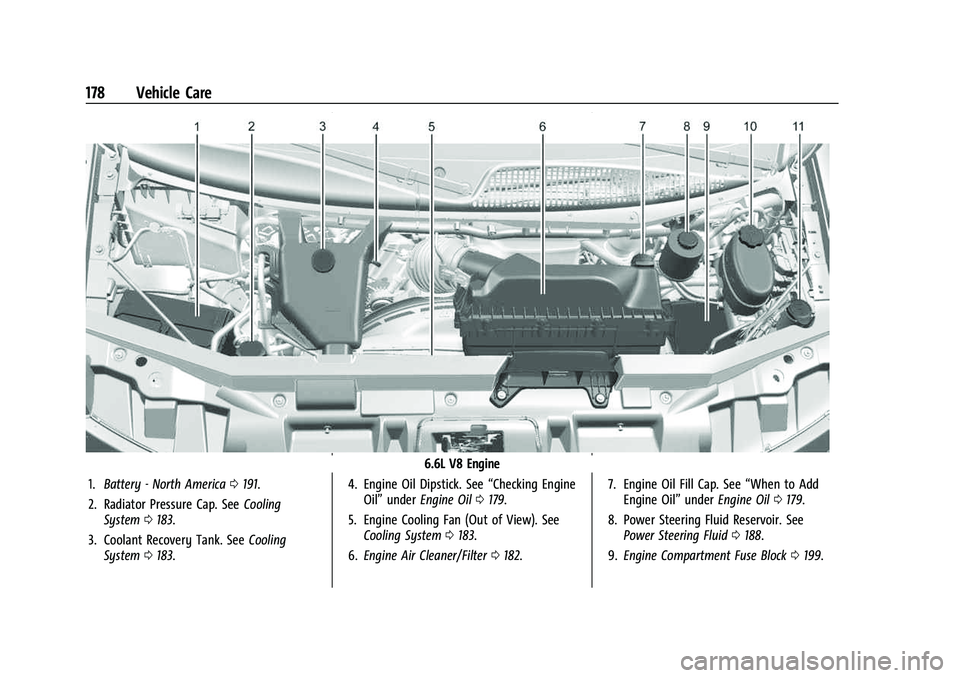
6.6L V8 Engine
1. Battery - North America 0191.
2. Radiator Pressure Cap. See Cooling
System 0183.
3. Coolant Recovery Tank. See Cooling
System 0183. 4. Engine Oil Dipstick. See
“Checking Engine
Oil” under Engine Oil 0179.
5. Engine Cooling Fan (Out of View). See Cooling System 0183.
6. Engine Air Cleaner/Filter 0182. 7. Engine Oil Fill Cap. See
“When to Add
Engine Oil” underEngine Oil 0179.
8. Power Steering Fluid Reservoir. See Power Steering Fluid 0188.
9. Engine Compartment Fuse Block 0199.
Page 192 of 289
Chevrolet Express Owner Manual (GMNA-Localizing-U.S./Canada/Mexico-
15555951) - 2022 - CRC - 1/27/22
Vehicle Care 191
{Warning
If too much brake fluid is added, it can
spill on the engine and burn, if the
engine is hot enough. You or others could
be burned, and the vehicle could be
damaged. Add brake fluid only when
work is done on the brake hydraulic
system.
When the brake fluid falls to a low level,
the brake warning light comes on. See Brake
System Warning Light 078.
Brake fluid absorbs water over time which
degrades the effectiveness of the brake fluid.
Replace brake fluid at the specified intervals
to prevent increased stopping distance. See
Maintenance Schedule 0245.
What to Add
Use only GM approved DOT 4 brake fluid
from a clean, sealed container. See
Recommended Fluids and Lubricants 0251.
{Warning
The wrong or contaminated brake fluid
could result in damage to the brake
system. This could result in the loss of
(Continued)
Warning (Continued)
braking leading to a possible injury.
Always use the proper GM approved
brake fluid.
Caution
If brake fluid is spilled on the vehicle's
painted surfaces, the paint finish can be
damaged. Immediately wash off any
painted surface.
Battery - North America
The original equipment battery is
maintenance free. Do not remove the cap
and do not add fluid.
Refer to the replacement number shown on
the original battery label when a new
battery is needed. SeeEngine Compartment
Overview 0176 for battery location.
{Warning
WARNING: Battery posts, terminals and
related accessories can expose you to
chemicals including lead and lead
compounds, which are known to the
(Continued)
Warning (Continued)
State of California to cause cancer and
birth defects or other reproductive harm.
Wash hands after handling. For more
information go to
www.P65Warnings.ca.gov.
See the warning on the back cover.
Vehicle Storage
{Warning
Batteries have acid that can burn you and
gas that can explode. You can be badly
hurt if you are not careful. Always wear
eye protection. See Jump Starting - North
America 0230 for tips on working
around a battery without getting hurt.
Infrequent Usage: Remove the black,
negative (−) cable from the battery to keep
the battery from running down.
Extended Storage: Remove the black,
negative (−) cable from the battery or use a
battery trickle charger.
Page 201 of 289

Chevrolet Express Owner Manual (GMNA-Localizing-U.S./Canada/Mexico-
15555951) - 2022 - CRC - 1/27/22
200 Vehicle Care
FusesUsage
3 Right Trailer Stoplamp/ Turn Signal Lamp
4 –
5 –
6 Fuel System Control Module/Ignition
7 Body Control Module 5
8 Body Control Module 7
9 Body Control Module 4
10 Instrument Cluster 11 Trailer Wiring
12 –
13 Interior Rear Vision Camera Module
14 Windshield Washer
16 Horn 17 Transmission
18 A/C
19 Engine Control Module Battery Fuses
Usage
20 Left Stop/Turn Cutaway Lamp
21 Left Stop/Turn Trailer Lamp
22 Right Stop/Turn Cutaway Lamp
23 NOX Sensor (Diesel Only)
24 Fuel Pump 25 Auxiliary Power Outlet
26 Body Control Module 3 27 Special Equipment Option
28 Airbag
29 Steering Wheel Sensor
30 Engine Control Module Ignition
31 Transmission Control Module Ignition
32 Transmission Control Module 1 Battery
33 Rear Parking Aid Module Fuses
Usage
34 NOX Sensor (Diesel Only)
35 Fuel Heater Control Module (Diesel Only)
36 Fuel System Control Module Battery
41 Transmission Control Module 2, Battery
Signal
42 Trailer Wiring
43 Electro Viscous Fan Clutch (Diesel Only)
44 Starter Solenoid 45 Engine Control Module/ Powertrain Signal 2
46 DC-AC Inverter 47 Fan Low Speed 51 Left High-Beam Headlamp
52 Right High-Beam Headlamp
53 Left Low-Beam Headlamp
Page 231 of 289
Chevrolet Express Owner Manual (GMNA-Localizing-U.S./Canada/Mexico-
15555951) - 2022 - CRC - 1/27/22
230 Vehicle Care
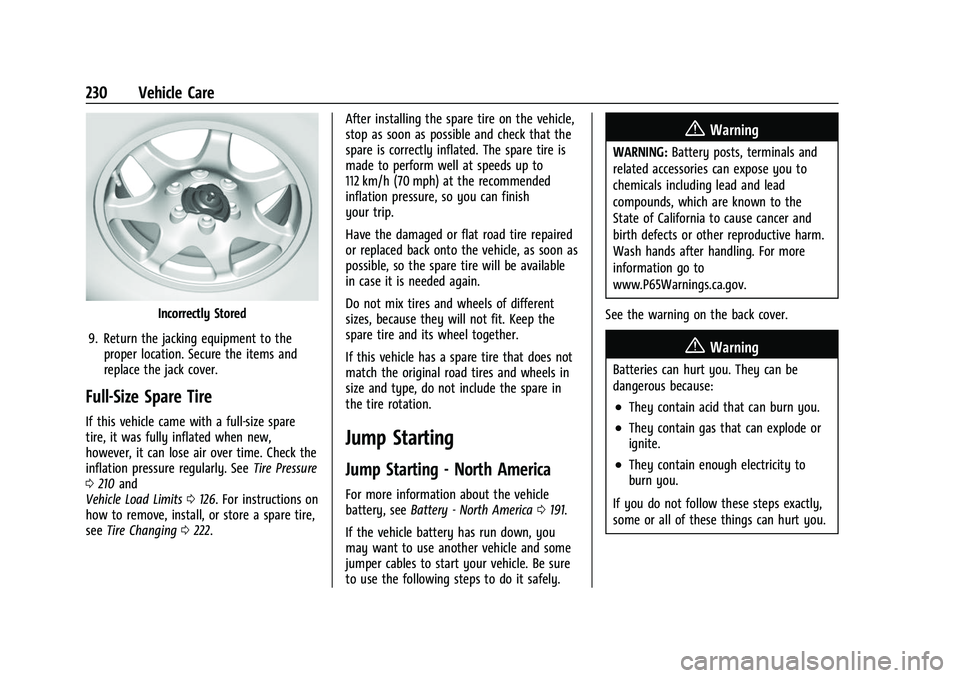
Incorrectly Stored
9. Return the jacking equipment to the proper location. Secure the items and
replace the jack cover.
Full-Size Spare Tire
If this vehicle came with a full-size spare
tire, it was fully inflated when new,
however, it can lose air over time. Check the
inflation pressure regularly. See Tire Pressure
0 210 and
Vehicle Load Limits 0126. For instructions on
how to remove, install, or store a spare tire,
see Tire Changing 0222. After installing the spare tire on the vehicle,
stop as soon as possible and check that the
spare is correctly inflated. The spare tire is
made to perform well at speeds up to
112 km/h (70 mph) at the recommended
inflation pressure, so you can finish
your trip.
Have the damaged or flat road tire repaired
or replaced back onto the vehicle, as soon as
possible, so the spare tire will be available
in case it is needed again.
Do not mix tires and wheels of different
sizes, because they will not fit. Keep the
spare tire and its wheel together.
If this vehicle has a spare tire that does not
match the original road tires and wheels in
size and type, do not include the spare in
the tire rotation.
Jump Starting
Jump Starting - North America
For more information about the vehicle
battery, see
Battery - North America 0191.
If the vehicle battery has run down, you
may want to use another vehicle and some
jumper cables to start your vehicle. Be sure
to use the following steps to do it safely.
{Warning
WARNING: Battery posts, terminals and
related accessories can expose you to
chemicals including lead and lead
compounds, which are known to the
State of California to cause cancer and
birth defects or other reproductive harm.
Wash hands after handling. For more
information go to
www.P65Warnings.ca.gov.
See the warning on the back cover.
{Warning
Batteries can hurt you. They can be
dangerous because:
.They contain acid that can burn you.
.They contain gas that can explode or
ignite.
.They contain enough electricity to
burn you.
If you do not follow these steps exactly,
some or all of these things can hurt you.
Page 232 of 289
Chevrolet Express Owner Manual (GMNA-Localizing-U.S./Canada/Mexico-
15555951) - 2022 - CRC - 1/27/22
Vehicle Care 231
Caution
Ignoring these steps could result in costly
damage to the vehicle that would not be
covered by the vehicle warranty. Trying
to start the vehicle by pushing or pulling
it will not work, and it could damage the
vehicle.
1. Check the other vehicle. It must have a 12-volt battery with a negative ground
system.
Caution
If the other vehicle does not have a
12-volt system with a negative ground,
both vehicles can be damaged. Only use
a vehicle that has a 12-volt system with a
negative ground for jump starting.
2. Get the vehicles close enough so the jumper cables can reach, but be sure the
vehicles are not touching each other.
If they are, it could cause a ground
connection you do not want. You would
not be able to start your vehicle, and the
bad grounding could damage the
electrical systems. To avoid the possibility of the vehicles
rolling, set the parking brake firmly on
both vehicles involved in the jump start
procedure. Put an automatic transmission
in P (Park) or a manual transmission in
Neutral before setting the parking brake.
Caution
If any accessories are left on or plugged
in during the jump starting procedure,
they could be damaged. The repairs
would not be covered by the vehicle
warranty. Whenever possible, turn off or
unplug all accessories on either vehicle
when jump starting.
3. Turn the ignition off on both vehicles. Unplug unnecessary accessories plugged
into the cigarette lighter or the accessory
power outlet. Turn off the radio and all
lamps that are not needed. This will
avoid sparks and help save both
batteries. And it could save the radio!
4. Open the hoods and locate the positive (+) and negative (−) terminal
locations of the other vehicle.
On your van, use the unpainted radio
antenna bracket as a remote negative (−)
terminal.
{Warning
Using a match near a battery can cause
battery gas to explode. People have been
hurt doing this, and some have been
blinded. Use a flashlight if you need
more light.
Battery fluid contains acid that can burn
you. Do not get it on you. If you
accidentally get it in your eyes or on
your skin, flush the place with water and
get medical help immediately.
{Warning
Fans or other moving engine parts can
injure you badly. Keep your hands away
from moving parts once the engine is
running.
5. Check that the jumper cables do not have loose or missing insulation. If they
do, you could get a shock. The vehicles
could be damaged too.
Before you connect the cables, here are
some basic things you should know.
Positive (+) will go to positive (+) or to a
remote positive (+) terminal if the vehicle