engine overheat CHEVROLET EXPRESS 2018 User Guide
[x] Cancel search | Manufacturer: CHEVROLET, Model Year: 2018, Model line: EXPRESS, Model: CHEVROLET EXPRESS 2018Pages: 356, PDF Size: 5.14 MB
Page 225 of 356
Chevrolet Express Owner Manual (GMNA-Localizing-U.S./Canada/Mexico-
11374212) - 2018 - crc - 2/2/18
224 Vehicle Care
suspected, use the following
procedures to check the fluid level.
However, if there is a large leak, it
may be necessary to have the
vehicle towed to a dealer and have
it repaired before driving the vehicle
further.
Change the fluid and filter at the
intervals listed inMaintenance
Schedule 0303, and be sure to use
the transmission fluid listed in
Recommended Fluids and
Lubricants 0310.
How to Check Automatic
Transmission Fluid
Because this operation can be
difficult, it is recommended to have
this check done at your dealer,
which can monitor the transmission
temperature. The transmission fluid
level increases with temperature. To
obtain a highly accurate fluid level
check, the transmission temperature
must be measured.
If it is decided to check the fluid
level, be sure to follow all the
instructions here, or a false reading
on the dipstick may occur.
Caution
Too much or too little fluid can
damage the transmission. Too
much can mean that some of the
fluid could come out and fall on
hot engine parts or exhaust
system parts, starting a fire. Too
little fluid could cause the
transmission to overheat. Be sure
to get an accurate reading if
checking the transmission fluid.
Wait at least 30 minutes with the
engine off, before checking the
transmission fluid level if the vehicle
has been driven:
. In hot weather, when outside
temperatures are above 32 °C
(90 °F).
. The vehicle is heavily loaded.
. At high speed for quite a while in
hot weather.
. In heavy traffic and hot weather.
. While pulling a trailer. After driving under these conditions,
a hot check can be performed. The
fluid should be hot, which is 71 °C to
93 °C (160 °F to 200 °F).
A cold fluid level check can be
performed after the vehicle has
been sitting for eight hours or more
with the engine off, but this is used
only as a reference. Let the engine
run at idle for five minutes if the
outside temperature is between
15 °C to 32 °C (60 °F to 90 °F).
Should the fluid level be low during
this cold check, the fluid must be
checked warm or hot before adding
fluid. If the outside temperature is
colder than 15 °C (60 °F) or hotter
than
32 °C (90 °F), a cold check cannot
be performed.
A warm fluid level check can be
performed by driving the vehicle
under lightly loaded conditions and
outside temperatures between 10 °C
to 27 °C (50 °F to 80 °F). The
vehicle should be driven for at least
24 km (15 mi) before performing a
warm check. Checking the fluid
Page 230 of 356
Chevrolet Express Owner Manual (GMNA-Localizing-U.S./Canada/Mexico-
11374212) - 2018 - crc - 2/2/18
Vehicle Care 229
Cooling System
The cooling system allows the
engine to maintain the correct
working temperature.
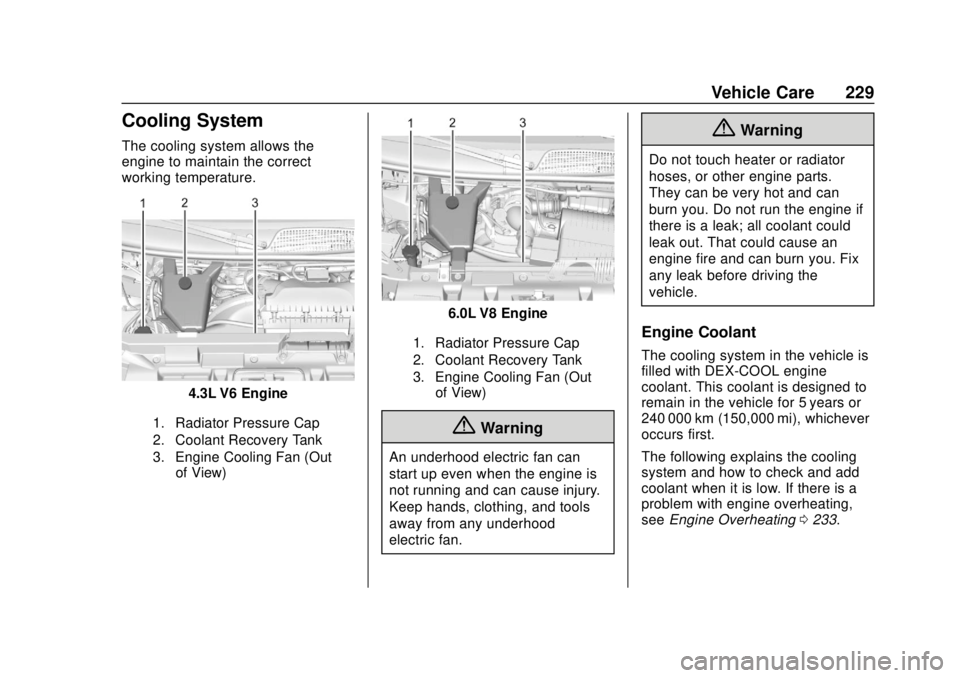
4.3L V6 Engine
1. Radiator Pressure Cap
2. Coolant Recovery Tank
3. Engine Cooling Fan (Outof View)
6.0L V8 Engine
1. Radiator Pressure Cap
2. Coolant Recovery Tank
3. Engine Cooling Fan (Outof View)
{Warning
An underhood electric fan can
start up even when the engine is
not running and can cause injury.
Keep hands, clothing, and tools
away from any underhood
electric fan.
{Warning
Do not touch heater or radiator
hoses, or other engine parts.
They can be very hot and can
burn you. Do not run the engine if
there is a leak; all coolant could
leak out. That could cause an
engine fire and can burn you. Fix
any leak before driving the
vehicle.
Engine Coolant
The cooling system in the vehicle is
filled with DEX-COOL engine
coolant. This coolant is designed to
remain in the vehicle for 5 years or
240 000 km (150,000 mi), whichever
occurs first.
The following explains the cooling
system and how to check and add
coolant when it is low. If there is a
problem with engine overheating,
see Engine Overheating 0233.
Page 231 of 356
Chevrolet Express Owner Manual (GMNA-Localizing-U.S./Canada/Mexico-
11374212) - 2018 - crc - 2/2/18
230 Vehicle Care
What to Use
{Warning
Plain water, or other liquids such
as alcohol, can boil before the
proper coolant mixture will. With
plain water or the wrong mixture,
the engine could get too hot but
there would not be an overheat
warning. The engine could catch
fire and you or others could be
burned.
Use a 50/50 mixture of clean,
drinkable water and DEX-COOL
coolant. If using this mixture,
nothing else needs to be added.
This mixture:
. Gives freezing protection down
to−37 °C (−34 °F), outside
temperature.
. Gives boiling protection up to
129 °C (265 °F), engine
temperature.
. Protects against rust and
corrosion. .
Will not damage aluminum parts.
. Helps keep the proper engine
temperature.Caution
Do not use anything other than a
mix of DEX-COOL coolant that
meets GM Standard
GMW3420 and clean, drinkable
water. Anything else can cause
damage to the engine cooling
system and the vehicle, which
would not be covered by the
vehicle warranty.
Never dispose of engine coolant by
putting it in the trash, pouring it on
the ground, or into sewers, streams,
or bodies of water. Have the coolant
changed by an authorized service
center, familiar with legal
requirements regarding used
coolant disposal. This will help
protect the environment and your
health.
Checking Coolant
The vehicle must be on a level
surface when checking the coolant
level.
Check to see if coolant is visible in
the coolant recovery tank. If the
coolant inside the coolant recovery
tank is boiling, do not do anything
else until it cools down. If coolant is
visible but the coolant level is not at
or above the indicated mark, add a
50/50 mixture of clean, drinkable
water and DEX-COOL coolant at the
coolant recovery tank, but be sure
the cooling system is cool before
this is done.
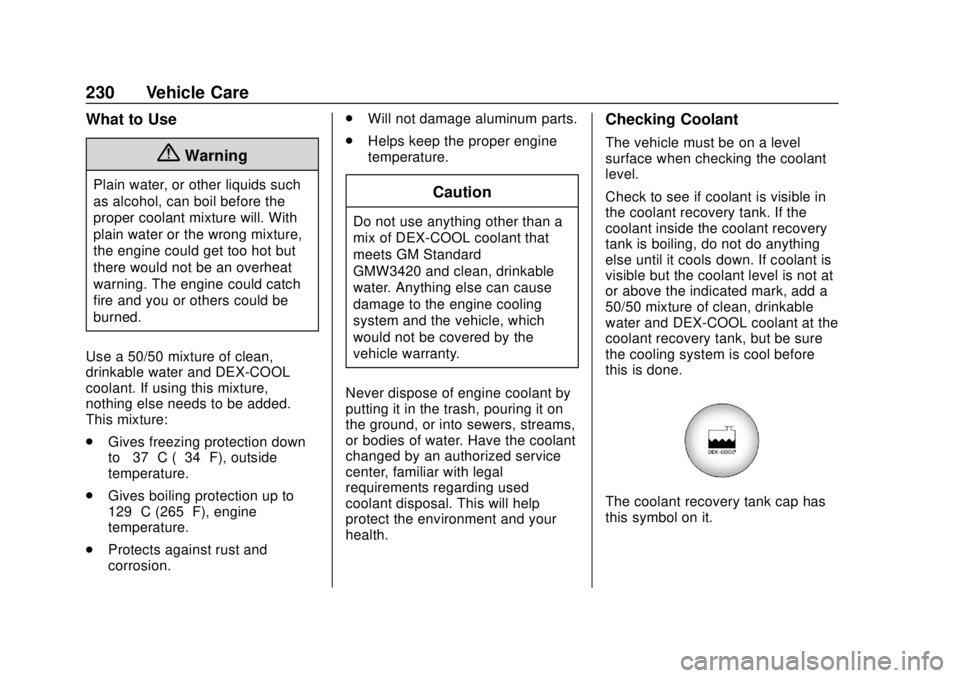
The coolant recovery tank cap has
this symbol on it.
Page 232 of 356
Chevrolet Express Owner Manual (GMNA-Localizing-U.S./Canada/Mexico-
11374212) - 2018 - crc - 2/2/18
Vehicle Care 231
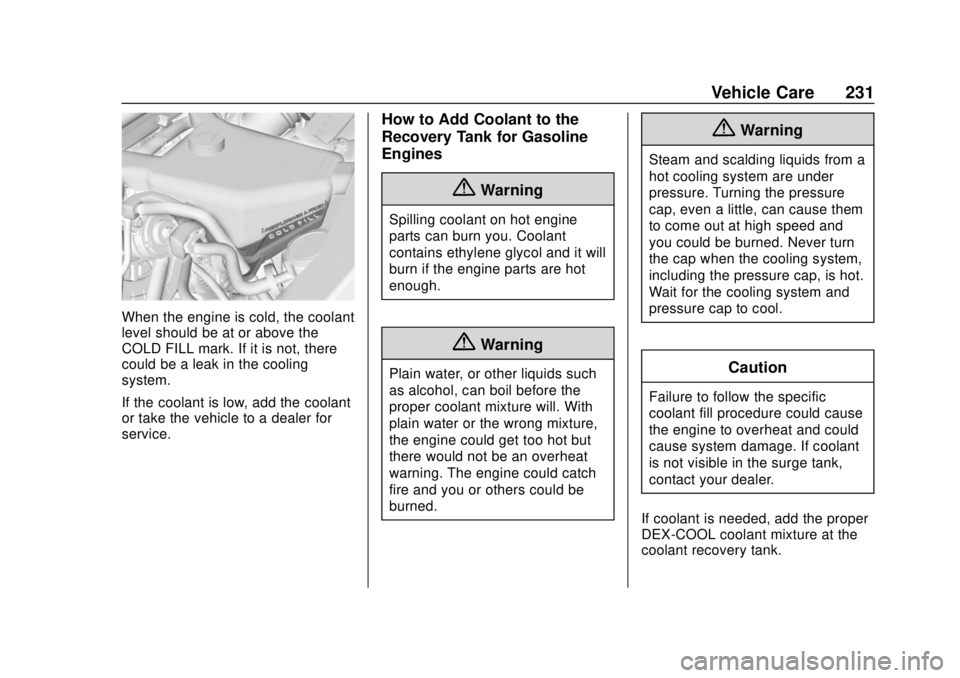
When the engine is cold, the coolant
level should be at or above the
COLD FILL mark. If it is not, there
could be a leak in the cooling
system.
If the coolant is low, add the coolant
or take the vehicle to a dealer for
service.
How to Add Coolant to the
Recovery Tank for Gasoline
Engines
{Warning
Spilling coolant on hot engine
parts can burn you. Coolant
contains ethylene glycol and it will
burn if the engine parts are hot
enough.
{Warning
Plain water, or other liquids such
as alcohol, can boil before the
proper coolant mixture will. With
plain water or the wrong mixture,
the engine could get too hot but
there would not be an overheat
warning. The engine could catch
fire and you or others could be
burned.
{Warning
Steam and scalding liquids from a
hot cooling system are under
pressure. Turning the pressure
cap, even a little, can cause them
to come out at high speed and
you could be burned. Never turn
the cap when the cooling system,
including the pressure cap, is hot.
Wait for the cooling system and
pressure cap to cool.
Caution
Failure to follow the specific
coolant fill procedure could cause
the engine to overheat and could
cause system damage. If coolant
is not visible in the surge tank,
contact your dealer.
If coolant is needed, add the proper
DEX-COOL coolant mixture at the
coolant recovery tank.
Page 234 of 356
Chevrolet Express Owner Manual (GMNA-Localizing-U.S./Canada/Mexico-
11374212) - 2018 - crc - 2/2/18
Vehicle Care 233
mixture through the filler neck
until the level reaches the base
of the filler neck.
8. Replace the pressure cap. At any time during this procedure
if coolant begins to flow out of
the filler neck, reinstall the
pressure cap.
Caution
If the pressure cap is not tightly
installed, coolant loss and engine
damage may occur. Be sure the
cap is properly and tightly
secured.
Engine Overheating
If the vehicle has a diesel engine,
see the Duramax diesel
supplement.
Caution
Do not run the engine if there is a
leak in the engine cooling system.
This can cause a loss of all
coolant and can damage the
system and vehicle. Have any
leaks fixed right away.
The vehicle has an indicator to warn
of engine overheating.
There is an engine coolant
temperature gauge on the vehicle's
instrument cluster. See Engine
Coolant Temperature Gauge 0101.
If the decision is made not to lift the
hood when this warning appears,
but instead get service help right
away, see Roadside Assistance
Program 0322.
If the decision is made to lift the
hood, make sure the vehicle is
parked on a level surface.
Then check to see if the engine
cooling fans are running. If the
engine is overheating, the fan should be running. If it is not, do not
continue to run the engine and have
the vehicle serviced.
See if the engine cooling fan speed
increases when idle speed is
doubled by pushing the accelerator
pedal down. If it does not, the
vehicle needs service. Turn off the
engine.
If Steam is Coming from the
Engine Compartment
{Warning
Steam and scalding liquids from a
hot cooling system are under
pressure. Turning the pressure
cap, even a little, can cause them
to come out at high speed and
you could be burned. Never turn
the cap when the cooling system,
including the pressure cap, is hot.
Wait for the cooling system and
pressure cap to cool.
Page 235 of 356
Chevrolet Express Owner Manual (GMNA-Localizing-U.S./Canada/Mexico-
11374212) - 2018 - crc - 2/2/18
234 Vehicle Care
If No Steam is Coming from
the Engine Compartment
If an engine overheat warning is
displayed but no steam can be seen
or heard, the problem may not be
too serious. Sometimes the engine
can get a little too hot when the
vehicle:
.Climbs a long hill on a hot day.
. Stops after high-speed driving.
. Idles for long periods in traffic.
. Tows a trailer. See “Driving on
Grades” underTrailer Towing
0 205.
If the overheat warning is displayed
with no sign of steam: 1. Turn the air conditioning off.
2. Turn the heater on to the highest temperature and to the
highest fan speed. Open the
windows as necessary.
3. When it is safe to do so, pull off the road, shift to P (Park) or
N (Neutral) and let the
engine idle. If the engine coolant temperature
gauge is no longer in the overheat
zone or an overheat warning no
longer displays, the vehicle can be
driven. Continue to drive the vehicle
slowly for about 10 minutes. Keep a
safe vehicle distance from the
vehicle in front. If the warning does
not come back on, continue to drive
normally and have the cooling
system checked for proper fill and
function.
If the warning continues, pull over,
stop, and park the vehicle
right away.
If there is still no sign of steam,
push down the accelerator until the
engine speed is about twice as fast
as normal idle speed for at least
three minutes while parked. If the
warning is still on, turn off the
engine until it cools down.
If the decision is made not to lift the
hood, get service help right away.
Engine Fan
The vehicle has a clutched engine
cooling fan. When the clutch is
engaged, the fan spins faster to
provide more air to cool the engine.
In most everyday driving conditions,
the fan is spinning slower and the
clutch is not fully engaged. This
improves fuel economy and reduces
fan noise. Under heavy vehicle
loading, trailer towing, and/or high
outside temperatures, the fan speed
increases as the clutch more fully
engages, so an increase in fan
noise may be heard. This is normal
and should not be mistaken as the
transmission slipping or making
extra shifts. It is merely the cooling
system functioning properly. The fan
will slow down when additional
cooling is not required and the
clutch partially disengages.
This fan noise may be heard when
starting the engine. It will go away
as the fan clutch partially
disengages.
Page 249 of 356
Chevrolet Express Owner Manual (GMNA-Localizing-U.S./Canada/Mexico-
11374212) - 2018 - crc - 2/2/18
248 Vehicle Care
Electrical System
Electrical System
Overload
The vehicle has fuses and circuit
breakers to protect against an
electrical system overload.
When the current electrical load is
too heavy, the circuit breaker opens
and closes, protecting the circuit
until the current load returns to
normal or the problem is fixed. This
greatly reduces the chance of circuit
overload and fire caused by
electrical problems.
Fuses and circuit breakers protect
power devices in the vehicle.
Replace a bad fuse with a new one
of the identical size and rating.
If there is a problem on the road and
a fuse needs to be replaced, the
same amperage fuse can be
borrowed. Choose some feature of
the vehicle that is not needed to use
and replace it as soon as possible.
Headlamp Wiring
An electrical overload may cause
the lamps to go on and off, or in
some cases to remain off. Have the
headlamp wiring checked right away
if the lamps go on and off or
remain off.
Windshield Wipers
If the wiper motor overheats due to
heavy snow or ice, the windshield
wipers will stop until the motor cools
and will then restart.
Although the circuit is protected
from electrical overload, overload
due to heavy snow or ice may
cause wiper linkage damage.
Always clear ice and heavy snow
from the windshield before using the
windshield wipers.
If the overload is caused by an
electrical problem and not snow or
ice, be sure to get it fixed.
Fuses and Circuit
Breakers
The wiring circuits in the vehicle are
protected from short circuits by a
combination of fuses and circuit
breakers. This greatly reduces the
chance of fires caused by electrical
problems.
Look at the silver-colored band
inside the fuse. If the band is broken
or melted, replace the fuse. Be sure
you replace a bad fuse with a new
one of the identical size and rating.
Engine Compartment
Fuse Block
The fuse block is located in the
engine compartment on the driver
side of the vehicle.
Vehicles with upfitter content
See www.gmupfitter.com for upfitter
provisions and best practices.
Page 348 of 356

Chevrolet Express Owner Manual (GMNA-Localizing-U.S./Canada/Mexico-
11374212) - 2018 - crc - 2/2/18
Index 347
Driving (cont'd)Wet Roads . . . . . . . . . . . . . . . . . . . 166
Winter . . . . . . . . . . . . . . . . . . . . . . . . 167
Dual Tire
Rotation . . . . . . . . . . . . . . . . . . . . . . 270
E
E85 or FlexFuel . . . . . . . . . . . . . . . . 199
Electrical Equipment,Add-On . . . . . . . . . . . . . . . . . . . . . . . 212
Electrical System Engine Compartment FuseBlock . . . . . . . . . . . . . . . . . . . . . . . . 248
Floor Console Fuse Block . . . . 253
Fuses and Circuit Breakers . . . 248
Overload . . . . . . . . . . . . . . . . . . . . . 248
Emergency OnStar . . . . . . . . . . . . . . . . . . . . . . . 333
Engine
Air Cleaner/Filter . . . . . . . . . . . . . 227
Check Light (MalfunctionIndicator) . . . . . . . . . . . . . . . . . . . . 105
Compartment Overview . . . . . . . 217
Coolant Heater . . . . . . . . . . . . . . . 177
Coolant Temperature Gauge . . . . . . . . . . . . . . . . . . . . . . 101
Cooling System . . . . . . . . . . . . . . . 229 Engine (cont'd)
Drive Belt Routing . . . . . . . . . . . . 317
Exhaust . . . . . . . . . . . . . . . . . . . . . . 181
Fan . . . . . . . . . . . . . . . . . . . . . . . . . . . 234
Oil Life System . . . . . . . . . . . . . . . 222
Oil Pressure Gauge . . . . . . . . . . 100
Oil Pressure Light . . . . . . . . . . . . 109
Overheating . . . . . . . . . . . . . . . . . . 233
Power Messages . . . . . . . . . . . . . .116
Running While Parked . . . . . . . . 181
Starting . . . . . . . . . . . . . . . . . . . . . . . 175
Enhanced Technology Glass . . . . 40
Entry/Exit Lighting . . . . . . . . . . . . . . 127
Equipment, Towing . . . . . . . . . . . . . 209
Event Data Recorders . . . . . . . . . . 330
Extender, Seat Belt . . . . . . . . . . . . . . 55
Exterior Lamp Controls . . . . . . . . . 122
Exterior Lamps Off Reminder . . . 123
Exterior Lighting Battery Saver . . . . . . . . . . . . . . . . . . . . . . . . . 127
F
FanEngine . . . . . . . . . . . . . . . . . . . . . . . . 234
Fast Idle System . . . . . . . . . . . . . . . . 176
Filter, Engine Air Cleaner . . . . . . . . . . . 227 Flash-to-Pass . . . . . . . . . . . . . . . . . . . 123
Flashers, Hazard Warning . . . . . . 125
Flat Tire . . . . . . . . . . . . . . . . . . . . . . . . 276
Changing . . . . . . . . . . . . . . . . . . . . . 278
FlexFuel E85 . . . . . . . . . . . . . . . . . . . . . . . . . . . 199
Floor Mats . . . . . . . . . . . . . . . . . . . . . . 300
Fluid
AutomaticTransmission . . . . . . . . . . . 223, 226
Brakes . . . . . . . . . . . . . . . . . . . . . . . . 237
Power Steering . . . . . . . . . . . . . . . 235
Washer . . . . . . . . . . . . . . . . . . . . . . . 235
Folding Mirrors . . . . . . . . . . . . . . . . . . 37
Frequency Statement Radio . . . . . . . . . . . . . . . . . . . . . . . . . 328
Front Seats Adjustment . . . . . . . . . . . . . . . . . . . . . 42
Front Storage . . . . . . . . . . . . . . . . . . . . 88
Front Turn Signal Bulb Replacement . . . . . . . . . . . . 245
Fuel . . . . . . . . . . . . . . . . . . . . . . . . . . . . 197 Additives . . . . . . . . . . . . . . . . . . . . . 198
Economy Driving . . . . . . . . . . . . . . . 23
Filling a Portable FuelContainer . . . . . . . . . . . . . . . . . . . 201
Page 351 of 356

Chevrolet Express Owner Manual (GMNA-Localizing-U.S./Canada/Mexico-
11374212) - 2018 - crc - 2/2/18
350 Index
MirrorsConvex . . . . . . . . . . . . . . . . . . . . . . . . . 36
Folding . . . . . . . . . . . . . . . . . . . . . . . . . 37
Heated . . . . . . . . . . . . . . . . . . . . . . . . . 37
Manual . . . . . . . . . . . . . . . . . . . . . . . . . 36
Manual Rearview . . . . . . . . . . . . . . . 37
Power . . . . . . . . . . . . . . . . . . . . . . . . . . 36
Trailer Tow . . . . . . . . . . . . . . . . . . . . . . 36
Mirrors, Interior Rearview . . . . . . . . 37
Monitor System, Tire Pressure . . . . . . . . . . . . . . . . . . . . . . 264
Multi-band Antenna . . . . . . . . . . . . . 138
N
Navigation OnStar . . . . . . . . . . . . . . . . . . . . . . . 334
New Vehicle Break-In . . . . . . . . . . . 173
Noise Control System . . . . . . . . . . 240
O
Odometer . . . . . . . . . . . . . . . . . . . . . . . . 99 Trip . . . . . . . . . . . . . . . . . . . . . . . . . . . . . 99
Off-Road Recovery . . . . . . . . . . . . . . . . . . . . . 165
Oil Engine . . . . . . . . . . . . . . . . . . . . . . . . 220
Engine Oil Life System . . . . . . . 222
Engine Oil Pressure Gauge . . . 100 Oil (cont'd)
Pressure Light . . . . . . . . . . . . . . . . 109
Older Children, Restraints . . . . . . . 68
Online Owner Center . . . . . . . . . . . 321
OnStar . . . . . . . . . . . . . . . . . . . . . . . . . 331
OnStar Additional Information . . . . . . . . . . . . . . . . . . . . 338
OnStar Connections . . . . . . . . . . . . 335
OnStar Diagnostics . . . . . . . . . . . . . 337
OnStar Emergency . . . . . . . . . . . . . 333
OnStar Navigation . . . . . . . . . . . . . . 334
OnStar Overview . . . . . . . . . . . . . . . 332
OnStar Security . . . . . . . . . . . . . . . . 334
OnStar System . . . . . . . . . . . . . . . . . 148
Operation Infotainment System . . . . . . . . . . 133
Ordering Service Publications . . . . . . . . . . 327
Outlets Power . . . . . . . . . . . . . . . . . . . . . . . . . . 95
Overheating, Engine . . . . . . . . . . . . 233
Overview . . . . . . . . . . . . . . . . . . 130, 132
P
Park Shifting Into . . . . . . . . . . . . . . . . . . . 179
Shifting Out of . . . . . . . . . . . . . . . . 180 Parking
Brake . . . . . . . . . . . . . . . . . . . . . . . . . 187
Brake and P (Park)
Mechanism Check . . . . . . . . . . 242
Over Things That Burn . . . . . . . 180
Parking Assist . . . . . . . . . . . . . . . . . . 194
Perchlorate Materials Requirements, California . . . . . . 215
Personalization Vehicle . . . . . . . . . . . . . . . . . . . . . . . .116
Phone
Bluetooth . . . . . . . . . . . . . . . . . . . . . 148
Power Door Locks . . . . . . . . . . . . . . . . . . . . . 30
Mirrors . . . . . . . . . . . . . . . . . . . . . . . . . . 36
Outlets . . . . . . . . . . . . . . . . . . . . . . . . . 95
Protection, Battery . . . . . . . . . . . . 127
Retained Accessory (RAP) . . . 177
Seat Adjustment . . . . . . . . . . . . . . . . 42
Steering Fluid . . . . . . . . . . . . . . . . . 235
Windows . . . . . . . . . . . . . . . . . . . . . . . 38
Pregnancy, Using Seat Belts . . . . 54
Privacy Vehicle Data Recording . . . . . . . 330
Program
Courtesy Transportation . . . . . . 324