clock CHEVROLET EXPRESS 2023 User Guide
[x] Cancel search | Manufacturer: CHEVROLET, Model Year: 2023, Model line: EXPRESS, Model: CHEVROLET EXPRESS 2023Pages: 283, PDF Size: 16.23 MB
Page 155 of 283

Chevrolet Express Owner Manual (GMNA-Localizing-U.S./Canada/Mexico-
16547501) - 2023 - CRC - 6/10/22
154 Driving and Operating
Warning (Continued)
.Before touching the fill nozzle, touch a
metallic object to discharge static
electricity from your body.
.Fuel can spray out if the fuel cap is
opened too quickly. This spray can
happen if the tank is nearly full, and is
more likely in hot weather. Open the
fuel cap slowly and wait for any hiss
noise to stop, then unscrew the cap all
the way.
Turn the fuel cap counterclockwise to
remove. When refueling, hang the fuel cap
from the hook on the fuel door. Fully insert
and latch the fill nozzle, begin fueling.
{Warning
Overfilling the fuel tank by more than
three clicks of a standard fill nozzle may
cause:
.Vehicle performance issues, including
engine stalling and damage to the fuel
system.
.Fuel spills.
.Under certain conditions, fuel fires.
Be careful not to spill fuel. Wait five seconds
after you have finished pumping before
removing the fill nozzle. Clean fuel from
painted surfaces as soon as possible. See
Exterior Care 0233. Reinstall the cap by
turning it clockwise until it clicks. Push the
fuel door closed.
{Warning
If a fire starts while you are refueling, do
not remove the fill nozzle. Shut off the
flow of fuel by shutting off the pump or
by notifying the station attendant. Leave
the area immediately.
Caution
If a new fuel cap is needed, get the right
type of cap from your dealer. The wrong
type of fuel cap may not fit properly,
may turn on the malfunction indicator
lamp, and could damage the fuel system
and emissions system. See Malfunction
Indicator Lamp (Check Engine Light) 077.
Filling a Portable Fuel Container
{Warning
Never fill a portable fuel container while
it is in the vehicle. Static electricity
discharge from the container can ignite
the fuel vapor. You or others could be
badly burned and the vehicle could be
damaged. To help avoid injury to you
and others:
.Dispense fuel only into approved
containers.
.Do not fill a container while it is
inside a vehicle, in a vehicle's trunk, in
a pickup bed, or on any surface other
than the ground.
(Continued)
Page 187 of 283
Chevrolet Express Owner Manual (GMNA-Localizing-U.S./Canada/Mexico-
16547501) - 2023 - CRC - 6/10/22
186 Vehicle Care
Warning (Continued)
including the pressure cap, is hot. Wait
for the cooling system and pressure cap
to cool.
If coolant is needed, add the proper mixture
directly to the radiator, but be sure the
cooling system is cool before this is done.
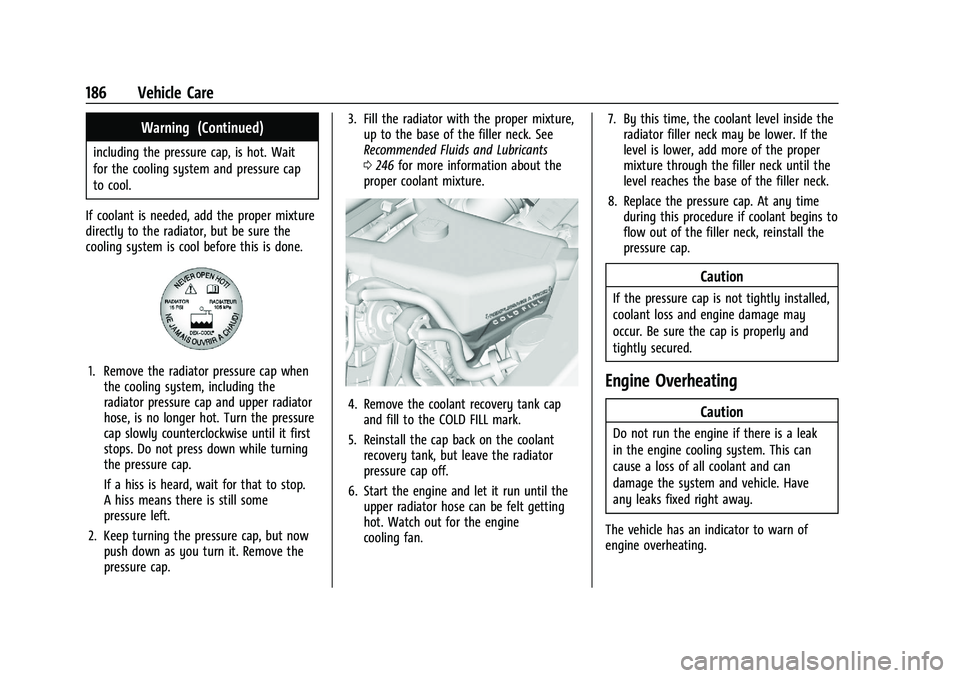
1. Remove the radiator pressure cap when the cooling system, including the
radiator pressure cap and upper radiator
hose, is no longer hot. Turn the pressure
cap slowly counterclockwise until it first
stops. Do not press down while turning
the pressure cap.
If a hiss is heard, wait for that to stop.
A hiss means there is still some
pressure left.
2. Keep turning the pressure cap, but now push down as you turn it. Remove the
pressure cap. 3. Fill the radiator with the proper mixture,
up to the base of the filler neck. See
Recommended Fluids and Lubricants
0246 for more information about the
proper coolant mixture.
4. Remove the coolant recovery tank cap
and fill to the COLD FILL mark.
5. Reinstall the cap back on the coolant recovery tank, but leave the radiator
pressure cap off.
6. Start the engine and let it run until the upper radiator hose can be felt getting
hot. Watch out for the engine
cooling fan. 7. By this time, the coolant level inside the
radiator filler neck may be lower. If the
level is lower, add more of the proper
mixture through the filler neck until the
level reaches the base of the filler neck.
8. Replace the pressure cap. At any time during this procedure if coolant begins to
flow out of the filler neck, reinstall the
pressure cap.
Caution
If the pressure cap is not tightly installed,
coolant loss and engine damage may
occur. Be sure the cap is properly and
tightly secured.
Engine Overheating
Caution
Do not run the engine if there is a leak
in the engine cooling system. This can
cause a loss of all coolant and can
damage the system and vehicle. Have
any leaks fixed right away.
The vehicle has an indicator to warn of
engine overheating.
Page 196 of 283

Chevrolet Express Owner Manual (GMNA-Localizing-U.S./Canada/Mexico-
16547501) - 2023 - CRC - 6/10/22
Vehicle Care 195
To replace the front turn signal, sidemarker,
and/or parking lamp bulb(s):
1. Use a small tool to unlatch the outboardclip on the lamp by pushing inboard and
prying the lamp assembly forward.
2. Remove the lamp from the grille.
3. Turn the bulb socket counterclockwise one-quarter turn and remove it from the
lamp assembly.
4. Remove the bulb from the socket by pulling it straight out.
5. Replace the bulb.
6. Turn the bulb socket clockwise to reinstall it in the lamp assembly.
7. Reinstall the lamp assembly into the grille until the outboard clip snaps into
place.
Taillamps
To replace a taillamp/turn signal lamp or
back-up lamp bulb:
1. Remove the two inboard nuts from theinside of the taillamp assembly.
2. The third nut (3) is under the appliquepiece (2) above the lamp. Remove the
two inboard applique nuts. Pull the
applique (2) straight rearward slightly to
clear the studs. Then rotate the
applique (2) just far enough to gain
access to the outer push pins (1).
3. Carefully disconnect the push pins (1) from the applique bracket.
4. Remove the third nut (3) from the upper outboard side of the lamp.
5. Remove the taillamp assembly from the vehicle.
Page 197 of 283

Chevrolet Express Owner Manual (GMNA-Localizing-U.S./Canada/Mexico-
16547501) - 2023 - CRC - 6/10/22
196 Vehicle Care
6. Remove the taillamp/turn signal lamp (1)or back-up lamp (2) bulb socket by
turning it counterclockwise one-quarter
turn and pulling it out of the lamp
assembly.
7. Remove the bulb by pulling it straight out.
8. Push the new bulb into the socket.
9. Reinstall the bulb socket by turning it clockwise into the lamp assembly.
10. Reverse Steps 1–5 to reinstall the taillamp assembly and applique.
Center High-Mounted Stoplamp
(CHMSL)
The Center High-Mounted Stoplamp (CHMSL)
is above the rear doors at the center of the
vehicle. To replace a bulb:
1. Remove the two screws from the CHMSL
assembly.
2. Remove the CHMSL assembly.
3. Turn the bulb socket counterclockwise one-quarter turn to remove it from the
lamp assembly.
4. Pull the old bulb straight out of the socket and push the new bulb into the
socket.
5. Turn the bulb socket clockwise one-quarter turn to install it in the lamp
assembly.
6. Reinstall the CHMSL assembly and two screws. Do not block or damage the CHMSL when
items are loaded on the roof of the vehicle.
License Plate Lamp
1. Bulb Socket
2. License Plate Bulb Assembly
3. Screws
To replace one of these bulbs:
1. Remove the screws (3) that secure the license plate bulb assembly (2).
2. Turn the bulb socket (1) counterclockwise and pull the bulb straight out of the
socket.
3. Install the new bulb.
Page 222 of 283

Chevrolet Express Owner Manual (GMNA-Localizing-U.S./Canada/Mexico-
16547501) - 2023 - CRC - 6/10/22
Vehicle Care 221
Remove the retaining wing bolt and lift it
out of the mounting bracket to access the
equipment.
The tools you will be using include:
1. Jack
2. Hoist Handle
3. Extension(s)
4. Wheel Wrench
5. Jack Handle
The spare tire is mounted in the rear
underbody of the vehicle.
Use the hoist handle, extension(s), and the
wheel wrench to remove the
underbody-mounted spare tire.
To lower the spare tire from the vehicle:
1. Spare Tire
2. Tire/Wheel Retainer
3. Hoist Cable
4. Hoist Assembly5. Hoist Shaft
6. Hoist Handle and Extension(s)
7. Wheel Wrench
1. Assemble the wheel wrench (7) to the
hoist handle and the extension(s) (6).
2. Open the passenger side rear door.
3. Insert the chisel end of the hoist handle, on an angle, through the hole in the rear
floor panel above the bumper.
Be sure the hoist handle connects to the
hoist shaft. The chiseled end of the hoist
handle is used to lower the spare tire.
4. Turn the wheel wrench counterclockwise to lower the spare tire to the ground.
Continue to turn the wheel wrench until
the spare tire can be pulled out from
under the vehicle.
5. Pull the spare tire out from under the vehicle.
Page 223 of 283

Chevrolet Express Owner Manual (GMNA-Localizing-U.S./Canada/Mexico-
16547501) - 2023 - CRC - 6/10/22
222 Vehicle Care
6. Tilt the tire toward the vehicle withsome slack in the cable to access the
tire/wheel retainer.
Tilt the retainer and pull it through the
center of the wheel along with the cable
and spring.
For a vehicle that was completed from a
cab and chassis, refer to the information
from the body supplier/installer.
The spare tire is a full-size tire, like the
other tires on the vehicle. 7. Put the spare tire near the flat tire.
8. Close the passenger side rear door.
Removing the Flat Tire and Installing the
Spare Tire
If the vehicle has plastic wheel nut caps,
loosen them by turning the wheel wrench
counterclockwise. The wheel nut caps are
designed to remain with the center cap.
Remove the center cap.
If the wheel has a smooth center piece,
place the chisel end of the wheel wrench in
the slot on the wheel and gently pry it out.
1. Jack
2. Hoist Handle
3. Extension(s) 4. Wheel Wrench
5. Jack Handle
1. Do a safety check before proceeding. See
If a Tire Goes Flat 0219.
2. Turn the wheel wrench counterclockwise
to loosen all the wheel nuts, but do not
remove them yet.
Caution
Make sure that the jack lift head is in the
correct position or you may damage your
vehicle. The repairs would not be covered
by your warranty.
Page 225 of 283

Chevrolet Express Owner Manual (GMNA-Localizing-U.S./Canada/Mexico-
16547501) - 2023 - CRC - 6/10/22
224 Vehicle Care
Warning (Continued)
the vehicle, it is designed only for
changing a flat tire. If it is used for
anything else, you or others could be
badly injured or killed if the vehicle slips
off the jack. If a jack is provided with the
vehicle, only use it for changing a
flat tire.
Caution
Using a jack to raise the vehicle without
positioning it correctly could damage
your vehicle. When raising your vehicle
on a jack, be sure to position it correctly
under the frame and avoid contact with
the plastic molding.
5. Turn the wheel wrench clockwise to raise the vehicle. Raise the vehicle far enough
off the ground so there is enough room
for the spare tire to fit.6. Remove all the wheel nuts.
7. Take the flat tire off of the mountingsurface.
{Warning
Rust or dirt on a wheel, or on the
parts to which it is fastened, can
cause wheel nuts to become loose
over time. The wheel could come off
and cause a crash. When changing a
wheel, remove any rust or dirt from
places where the wheel attaches to
the vehicle. In an emergency, a cloth
(Continued)
Warning (Continued)
or paper towel can be used; however,
use a scraper or wire brush later to
remove all rust or dirt.
8. Remove any rust or dirt from the wheel bolts, mounting surfaces, and spare
wheel.
{Warning
Never use oil or grease on bolts or nuts
because the nuts might come loose. The
vehicle's wheel could fall off, causing a
crash.
Page 226 of 283
Chevrolet Express Owner Manual (GMNA-Localizing-U.S./Canada/Mexico-
16547501) - 2023 - CRC - 6/10/22
Vehicle Care 225
9. Put the wheel nuts back on with therounded end of the nuts toward the
wheel. Tighten each wheel nut by hand
until the wheel is held against the hub.
10. Turn the jack handle counterclockwise to lower the vehicle. Lower the jack
completely.
{Warning
Wheel nuts that are improperly or
incorrectly tightened can cause the
wheels to become loose or come off. The
wheel nuts should be tightened with a
torque wrench to the proper torque
specification after replacing. Follow the
(Continued)
Warning (Continued)
torque specification supplied by the
aftermarket manufacturer when using
accessory locking wheel nuts. See
Capacities and Specifications0250 for
original equipment wheel nut torque
specifications.
Caution
Improperly tightened wheel nuts can lead
to brake pulsation and rotor damage. To
avoid expensive brake repairs, evenly
tighten the wheel nuts in the proper
sequence and to the proper torque
specification. See Capacities and
Specifications 0250 for the wheel nut
torque specification.
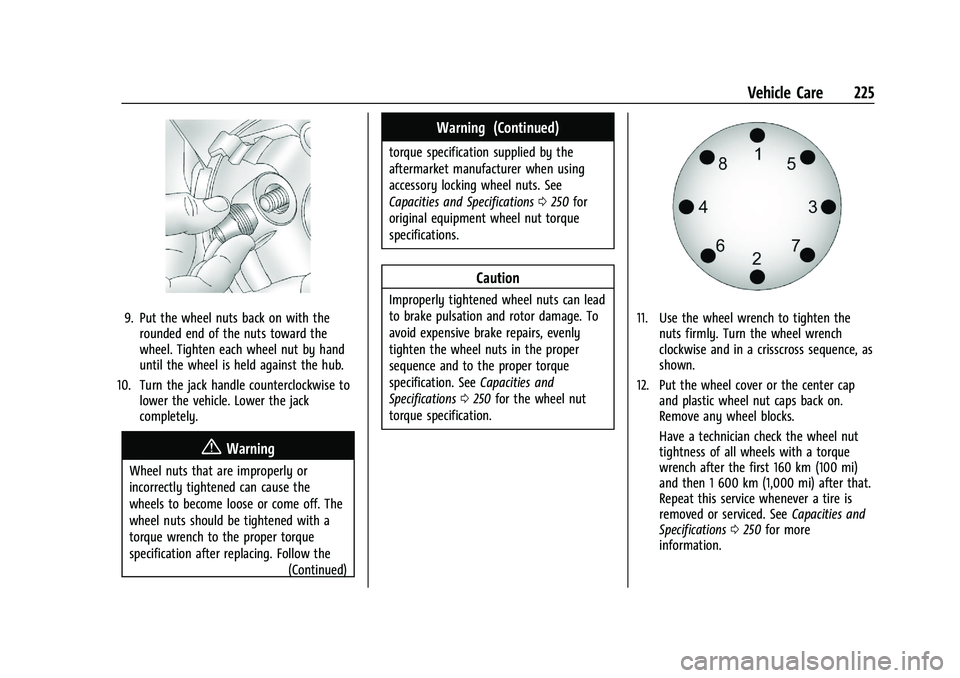
11. Use the wheel wrench to tighten the nuts firmly. Turn the wheel wrench
clockwise and in a crisscross sequence, as
shown.
12. Put the wheel cover or the center cap and plastic wheel nut caps back on.
Remove any wheel blocks.
Have a technician check the wheel nut
tightness of all wheels with a torque
wrench after the first 160 km (100 mi)
and then 1 600 km (1,000 mi) after that.
Repeat this service whenever a tire is
removed or serviced. See Capacities and
Specifications 0250 for more
information.
Page 228 of 283

Chevrolet Express Owner Manual (GMNA-Localizing-U.S./Canada/Mexico-
16547501) - 2023 - CRC - 6/10/22
Vehicle Care 227
5. Insert the chisel end of the hoist handle,on an angle, through the hole in the rear
floor panel above the bumper and onto
the hoist shaft.
Do not use the chiseled end of the wheel
wrench.
6. Raise the tire part way upward. Make sure the retainer is seated in the wheel
opening.
7. Raise the tire fully against the underside of the vehicle by turning the wheel
wrench clockwise until you hear two
clicks or feel it skip twice. You cannot
overtighten the cable.8. Make sure the tire is stored securely.Push, pull (1), and then try to turn (2) the
tire. If the tire moves, use the wheel
wrench to tighten the cable.
Two clicks mean the tire is up all
the way.
Repeat this tightness check procedure
when checking the spare tire pressure
according to the scheduled maintenance
information or any time the spare tire is
handled due to service of other
components.
Correctly Stored
Incorrectly Stored
9. Return the jacking equipment to the proper location. Secure the items and
replace the jack cover.
Full-Size Spare Tire
If this vehicle came with a full-size spare
tire, it was fully inflated when new,
however, it can lose air over time. Check the
inflation pressure regularly. See Tire Pressure
0 208 and Vehicle Load Limits 0126 for
information regarding proper tire inflation
and loading the vehicle. For instructions on
how to remove, install, or store a spare tire,
see Tire Changing 0220.
Page 274 of 283

Chevrolet Express Owner Manual (GMNA-Localizing-U.S./Canada/Mexico-
16547501) - 2023 - CRC - 6/10/22
Index 273
Automatic (cont'd)Transmission Shift Lock Control
Function Check . . . . . . . . . . . . . . . . . . . . . . . 193
Automatic Transmission Manual Mode . . . . . . . . . . . . . . . . . . . . . . . . . 139
Auxiliary Devices . . . . . . . . . . . . . . . . . . . . . . . . . . . . . . . . 103
Avoiding Untrusted Media Devices . . . . . . . 103
Axle Rear . . . . . . . . . . . . . . . . . . . . . . . . . . . . . . . . . . . . 191
B
BatteryExterior Lighting Battery Saver . . . . . . . . . 96
Load Management . . . . . . . . . . . . . . . . . . . . . . 95
Power Protection . . . . . . . . . . . . . . . . . . . . . . . 96
Battery - North America . . . . . . . . . . . . . 191, 228
Blade Replacement, Wiper . . . . . . . . . . . . . . . 193
Bluetooth
Overview . . . . . . . . . . . . . . . . . . . . . . . . . . . . . . 107
Brake Fluid . . . . . . . . . . . . . . . . . . . . . . . . . . . . . . . . . . . 190
System Warning Light . . . . . . . . . . . . . . . . . . 78
Brakes . . . . . . . . . . . . . . . . . . . . . . . . . . . . . . . . . . . 189 Antilock . . . . . . . . . . . . . . . . . . . . . . . . . . . . . . . . 140
Brake Assist . . . . . . . . . . . . . . . . . . . . . . . . . . . . 141
Parking Brake . . . . . . . . . . . . . . . . . . . . . . . . . . . 141
Braking . . . . . . . . . . . . . . . . . . . . . . . . . . . . . . . . . . . 122 Break-In, New Vehicle . . . . . . . . . . . . . . . . . . . . 129
Bulb Replacement . . . . . . . . . . . . . . . . . . . . . . . . 194
Center High-Mounted Stoplamp(CHMSL) . . . . . . . . . . . . . . . . . . . . . . . . . . . . . 196
Front Turn Signal, Sidemarker, and Parking Lamps . . . . . . . . . . . . . . . . . . . . . . . 194
Halogen Bulbs . . . . . . . . . . . . . . . . . . . . . . . . . 194
Headlamp Aiming . . . . . . . . . . . . . . . . . . . . . . 194
License Plate Lamps . . . . . . . . . . . . . . . . . . . 196
Taillamps . . . . . . . . . . . . . . . . . . . . . . . . . . . . . . 195
Buying New Tires . . . . . . . . . . . . . . . . . . . . . . . . . 215C
Calibration
Compass . . . . . . . . . . . . . . . . . . . . . . . . . . . . . . . . 68
California Perchlorate Materials Requirements . . . . 173
California Proposition 65 Warning . . . . . 1, 228
Camera Rear Vision (RVC) . . . . . . . . . . . . . . . . . . . . . . 146
Canadian Vehicle Owners . . . . . . . . . . . . . . . . . . .2
Capacities and Specifications . . . . . . . . . . . . . 250
Carbon Monoxide
Engine Exhaust . . . . . . . . . . . . . . . . . . . . . . . . 136
Winter Driving . . . . . . . . . . . . . . . . . . . . . . . . . 125
Cargo
Door Relocking . . . . . . . . . . . . . . . . . . . . . . . . . . 12
Tie-Downs . . . . . . . . . . . . . . . . . . . . . . . . . . . . . . 64 Caution, Danger, and Warning . . . . . . . . . . . . . .2
Center . . . . . . . . . . . . . . . . . . . . . . . . . . . . . . . . . . . 196
Chains, Tire . . . . . . . . . . . . . . . . . . . . . . . . . . . . . . .218
Charging
System Light . . . . . . . . . . . . . . . . . . . . . . . . . . . 77
Check Ignition Transmission Lock . . . . . . . . . . . . . 193
Check Engine Light (Malfunction Indicator) . . . . . . . . . . . . . . . . . . . . . . . . . . . . . . . .77
Child Restraints Infants and Young Children . . . . . . . . . . . . . 46
Lower Anchors and Tethers for
Children . . . . . . . . . . . . . . . . . . . . . . . . . . . . . . . . 51
Older Children . . . . . . . . . . . . . . . . . . . . . . . . . . 45
Securing . . . . . . . . . . . . . . . . . . . . . . . . . . . . 58, 60
Systems . . . . . . . . . . . . . . . . . . . . . . . . . . . . . . . . 48
Child Safety Locks . . . . . . . . . . . . . . . . . . . . . . . . . 12
Cigarette Lighter . . . . . . . . . . . . . . . . . . . . . . . . . . . 71
Circuit Breakers . . . . . . . . . . . . . . . . . . . . . . . . . . 198
Cleaning Exterior Care . . . . . . . . . . . . . . . . . . . . . . . . . . . 233
Interior Care . . . . . . . . . . . . . . . . . . . . . . . . . . . 237
Climate Control Systems . . . . . . . . . . . . . . . . . . 114 Air Conditioning . . . . . . . . . . . . . . . . . . . . . . . . 114
Heating . . . . . . . . . . . . . . . . . . . . . . . . . . . . . . . . . 114
Rear . . . . . . . . . . . . . . . . . . . . . . . . . . . . . . . . . . . . 116
Rear Heating System . . . . . . . . . . . . . . . . . . . 116
Clock . . . . . . . . . . . . . . . . . . . . . . . . . . . . . . . . . . . . . 70