engine coolant CHEVROLET EXPRESS 2023 User Guide
[x] Cancel search | Manufacturer: CHEVROLET, Model Year: 2023, Model line: EXPRESS, Model: CHEVROLET EXPRESS 2023Pages: 283, PDF Size: 16.23 MB
Page 179 of 283
Chevrolet Express Owner Manual (GMNA-Localizing-U.S./Canada/Mexico-
16547501) - 2023 - CRC - 6/10/22
178 Vehicle Care
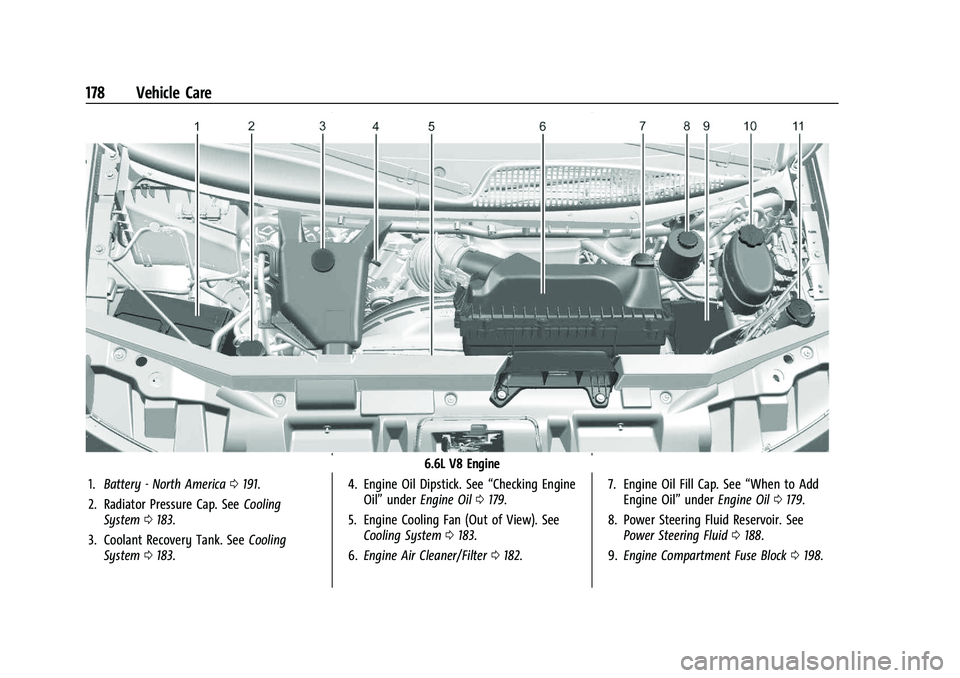
6.6L V8 Engine
1. Battery - North America 0191.
2. Radiator Pressure Cap. See Cooling
System 0183.
3. Coolant Recovery Tank. See Cooling
System 0183. 4. Engine Oil Dipstick. See
“Checking Engine
Oil” under Engine Oil 0179.
5. Engine Cooling Fan (Out of View). See Cooling System 0183.
6. Engine Air Cleaner/Filter 0182. 7. Engine Oil Fill Cap. See
“When to Add
Engine Oil” underEngine Oil 0179.
8. Power Steering Fluid Reservoir. See Power Steering Fluid 0188.
9. Engine Compartment Fuse Block 0198.
Page 184 of 283
Chevrolet Express Owner Manual (GMNA-Localizing-U.S./Canada/Mexico-
16547501) - 2023 - CRC - 6/10/22
Vehicle Care 183
Warning (Continued)
drive the vehicle with the air cleaner/
filter off, as flames may be present if the
engine backfires.
Caution
If the air cleaner/filter is off, dirt can
easily get into the engine, which could
damage it. Always have the air cleaner/
filter in place when driving.
Cooling System
The cooling system allows the engine to
maintain the correct working temperature.
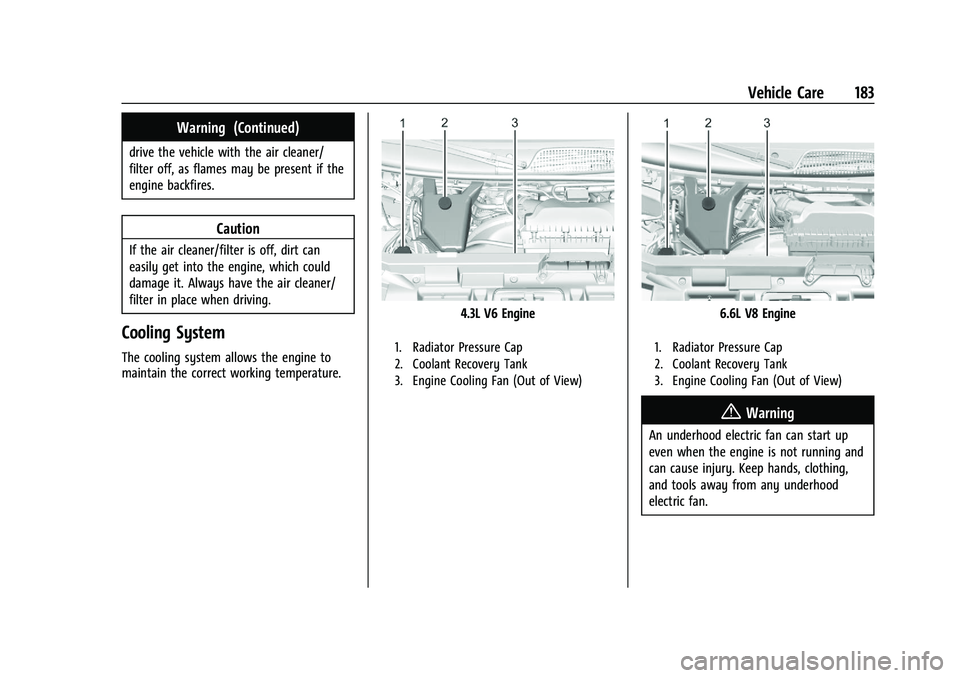
4.3L V6 Engine
1. Radiator Pressure Cap
2. Coolant Recovery Tank
3. Engine Cooling Fan (Out of View)
6.6L V8 Engine
1. Radiator Pressure Cap
2. Coolant Recovery Tank
3. Engine Cooling Fan (Out of View)
{Warning
An underhood electric fan can start up
even when the engine is not running and
can cause injury. Keep hands, clothing,
and tools away from any underhood
electric fan.
Page 185 of 283

Chevrolet Express Owner Manual (GMNA-Localizing-U.S./Canada/Mexico-
16547501) - 2023 - CRC - 6/10/22
184 Vehicle Care
{Warning
Do not touch heater or radiator hoses,
or other engine parts. They can be very
hot and can burn you. Do not run the
engine if there is a leak; all coolant could
leak out. That could cause an engine fire
and can burn you. Fix any leak before
driving the vehicle.
Engine Coolant
The cooling system in the vehicle is filled
with DEX-COOL engine coolant. This coolant
is designed to remain in the vehicle for
6 years or 240 000 km (150,000 mi),
whichever occurs first.
The following explains the cooling system
and how to check and add coolant when it
is low. If there is a problem with engine
overheating, seeEngine Overheating 0186.
What to Use
{Warning
Plain water, or other liquids such as
alcohol, can boil before the proper
coolant mixture will. With plain water or
(Continued)
Warning (Continued)
the wrong mixture, the engine could get
too hot but there would not be an
overheat warning. The engine could catch
fire and you or others could be burned.
Use a 50/50 mixture of clean, drinkable
water and DEX-COOL coolant. If using this
mixture, nothing else needs to be added.
This mixture:
.Gives freezing protection down to −37 °C
(−34 °F), outside temperature.
.Gives boiling protection up to 129 °C
(265 °F), engine temperature.
.Protects against rust and corrosion.
.Will not damage aluminum parts.
.Helps keep the proper engine
temperature.
Caution
Do not use anything other than a mix of
DEX-COOL coolant that meets GM
Standard GMW3420 and clean, drinkable
water. Anything else can cause damage
to the engine cooling system and the
vehicle, which would not be covered by
the vehicle warranty. Never dispose of engine coolant by putting
it in the trash, pouring it on the ground,
or into sewers, streams, or bodies of water.
Have the coolant changed by an authorized
service center, familiar with legal
requirements regarding used coolant
disposal. This will help protect the
environment and your health.
Checking Coolant
The vehicle must be on a level surface when
checking the coolant level.
Check to see if coolant is visible in the
coolant recovery tank. If the coolant inside
the coolant recovery tank is boiling, do not
do anything else until it cools down.
If coolant is visible but the coolant level is
not at or above the indicated mark, add a
50/50 mixture of clean, drinkable water and
DEX-COOL coolant at the coolant recovery
tank, but be sure the cooling system is cool
before this is done.
Page 186 of 283
Chevrolet Express Owner Manual (GMNA-Localizing-U.S./Canada/Mexico-
16547501) - 2023 - CRC - 6/10/22
Vehicle Care 185
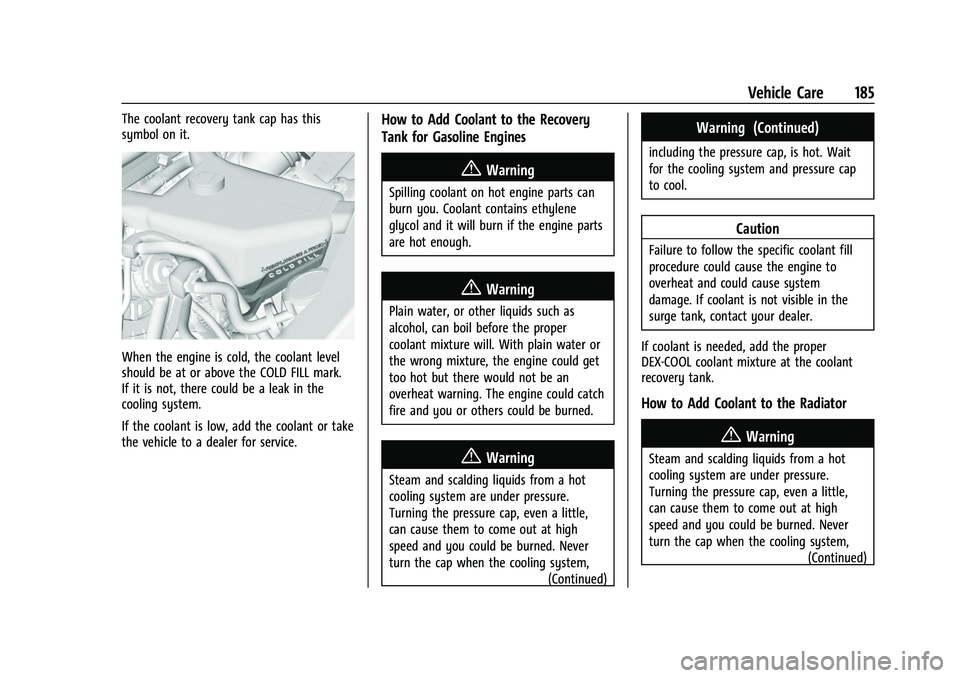
The coolant recovery tank cap has this
symbol on it.
When the engine is cold, the coolant level
should be at or above the COLD FILL mark.
If it is not, there could be a leak in the
cooling system.
If the coolant is low, add the coolant or take
the vehicle to a dealer for service.
How to Add Coolant to the Recovery
Tank for Gasoline Engines
{Warning
Spilling coolant on hot engine parts can
burn you. Coolant contains ethylene
glycol and it will burn if the engine parts
are hot enough.
{Warning
Plain water, or other liquids such as
alcohol, can boil before the proper
coolant mixture will. With plain water or
the wrong mixture, the engine could get
too hot but there would not be an
overheat warning. The engine could catch
fire and you or others could be burned.
{Warning
Steam and scalding liquids from a hot
cooling system are under pressure.
Turning the pressure cap, even a little,
can cause them to come out at high
speed and you could be burned. Never
turn the cap when the cooling system,(Continued)
Warning (Continued)
including the pressure cap, is hot. Wait
for the cooling system and pressure cap
to cool.
Caution
Failure to follow the specific coolant fill
procedure could cause the engine to
overheat and could cause system
damage. If coolant is not visible in the
surge tank, contact your dealer.
If coolant is needed, add the proper
DEX-COOL coolant mixture at the coolant
recovery tank.
How to Add Coolant to the Radiator
{Warning
Steam and scalding liquids from a hot
cooling system are under pressure.
Turning the pressure cap, even a little,
can cause them to come out at high
speed and you could be burned. Never
turn the cap when the cooling system, (Continued)
Page 187 of 283
Chevrolet Express Owner Manual (GMNA-Localizing-U.S./Canada/Mexico-
16547501) - 2023 - CRC - 6/10/22
186 Vehicle Care
Warning (Continued)
including the pressure cap, is hot. Wait
for the cooling system and pressure cap
to cool.
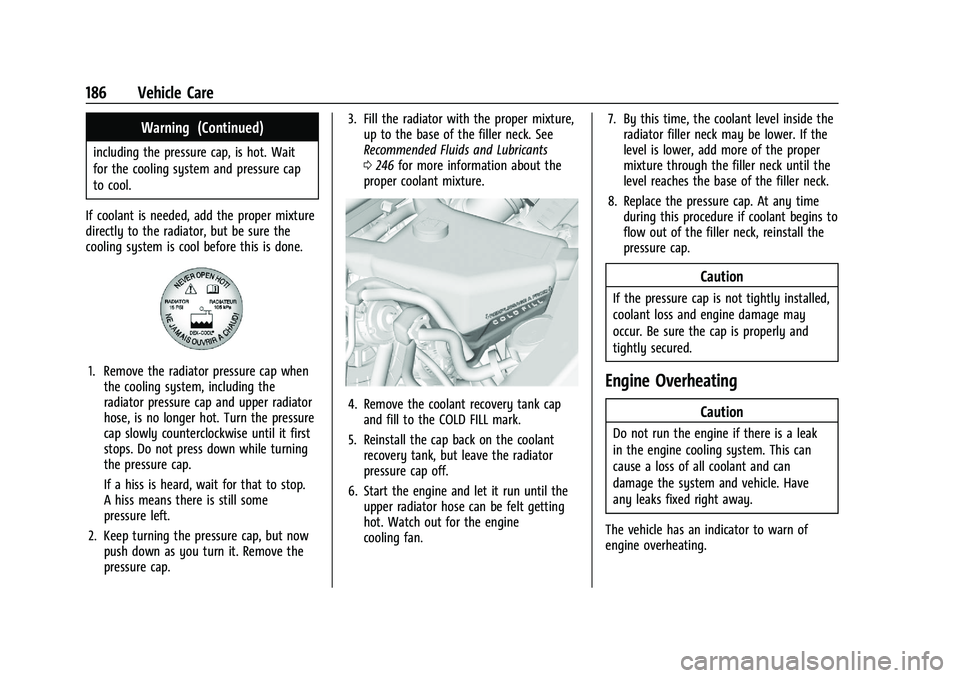
If coolant is needed, add the proper mixture
directly to the radiator, but be sure the
cooling system is cool before this is done.
1. Remove the radiator pressure cap when the cooling system, including the
radiator pressure cap and upper radiator
hose, is no longer hot. Turn the pressure
cap slowly counterclockwise until it first
stops. Do not press down while turning
the pressure cap.
If a hiss is heard, wait for that to stop.
A hiss means there is still some
pressure left.
2. Keep turning the pressure cap, but now push down as you turn it. Remove the
pressure cap. 3. Fill the radiator with the proper mixture,
up to the base of the filler neck. See
Recommended Fluids and Lubricants
0246 for more information about the
proper coolant mixture.
4. Remove the coolant recovery tank cap
and fill to the COLD FILL mark.
5. Reinstall the cap back on the coolant recovery tank, but leave the radiator
pressure cap off.
6. Start the engine and let it run until the upper radiator hose can be felt getting
hot. Watch out for the engine
cooling fan. 7. By this time, the coolant level inside the
radiator filler neck may be lower. If the
level is lower, add more of the proper
mixture through the filler neck until the
level reaches the base of the filler neck.
8. Replace the pressure cap. At any time during this procedure if coolant begins to
flow out of the filler neck, reinstall the
pressure cap.
Caution
If the pressure cap is not tightly installed,
coolant loss and engine damage may
occur. Be sure the cap is properly and
tightly secured.
Engine Overheating
Caution
Do not run the engine if there is a leak
in the engine cooling system. This can
cause a loss of all coolant and can
damage the system and vehicle. Have
any leaks fixed right away.
The vehicle has an indicator to warn of
engine overheating.
Page 188 of 283

Chevrolet Express Owner Manual (GMNA-Localizing-U.S./Canada/Mexico-
16547501) - 2023 - CRC - 6/10/22
Vehicle Care 187
There is an engine coolant temperature
gauge on the vehicle's instrument cluster.
SeeEngine Coolant Temperature Gauge
0 74.
If the decision is made not to lift the hood
when this warning appears, but instead get
service help right away, see Roadside
Assistance Program 0256.
If the decision is made to lift the hood,
make sure the vehicle is parked on a level
surface.
Then check to see if the engine cooling fans
are running. If the engine is overheating, the
fan should be running. If it is not, do not
continue to run the engine and have the
vehicle serviced.
See if the engine cooling fan speed increases
when idle speed is doubled by pushing the
accelerator pedal down. If it does not, the
vehicle needs service. Turn off the engine.If Steam is Coming from the Engine
Compartment
{Warning
Steam and scalding liquids from a hot
cooling system are under pressure.
Turning the pressure cap, even a little,
can cause them to come out at high
speed and you could be burned. Never
turn the cap when the cooling system,
including the pressure cap, is hot. Wait
for the cooling system and pressure cap
to cool.
If No Steam is Coming from the Engine
Compartment
If an engine overheat warning is displayed
but no steam can be seen or heard, the
problem may not be too serious. Sometimes
the engine can get a little too hot when the
vehicle:
.Climbs a long hill on a hot day.
.Stops after high-speed driving.
.Idles for long periods in traffic.
.Tows a trailer. See “Driving on Grades”
under Trailer Towing 0159. If the overheat warning is displayed with no
sign of steam:
1. Turn the air conditioning off.
2. Turn the heater on to the highest temperature and to the highest fan
speed. Open the windows as necessary.
3. When it is safe to do so, pull off the road, shift to P (Park) or N (Neutral) and
let the engine idle.
If the engine coolant temperature gauge is
no longer in the overheat zone or an
overheat warning no longer displays, the
vehicle can be driven. Continue to drive the
vehicle slowly for about 10 minutes. Keep a
safe vehicle distance from the vehicle in
front. If the warning does not come back on,
continue to drive normally and have the
cooling system checked for proper fill and
function.
If the warning continues, pull over, stop, and
park the vehicle right away.
If there is still no sign of steam, push down
the accelerator until the engine speed is
about twice as fast as normal idle speed for
at least three minutes while parked. If the
warning is still on, turn off the engine until
it cools down.
Page 190 of 283
Chevrolet Express Owner Manual (GMNA-Localizing-U.S./Canada/Mexico-
16547501) - 2023 - CRC - 6/10/22
Vehicle Care 189
To determine what kind of fluid to use, see
Recommended Fluids and Lubricants0246.
Always use the proper fluid. Failure to use
the proper fluid can cause leaks and damage
hoses and seals.
Washer Fluid
What to Use
When the vehicle needs windshield washer
fluid, be sure to read the manufacturer's
instructions before use. If operating the
vehicle in an area where the temperature
may fall below freezing, use a fluid that has
sufficient protection against freezing.
Adding Washer Fluid
Open the cap with the washer symbol on it.
Add washer fluid until the tank is full. See
Engine Compartment Overview 0176 for
reservoir location.
Caution
.Do not use washer fluid that contains
any type of water repellent coating.
This can cause the wiper blades to
chatter or skip.
.Do not use engine coolant (antifreeze)
in the windshield washer. It can
damage the windshield washer system
and paint.
.Do not mix water with ready-to-use
washer fluid. Water can cause the
solution to freeze and damage the
washer fluid tank and other parts of
the washer system.
.When using concentrated washer fluid,
follow the manufacturer instructions
for adding water.
.Fill the washer fluid tank only
three-quarters full when it is very cold.
This allows for fluid expansion if
freezing occurs, which could damage
the tank if it is completely full.
Brakes
Disc brake linings have built-in wear
indicators that make a high-pitched warning
sound when the brake linings are worn and new linings are needed. The sound can come
and go or can be heard all the time when
the vehicle is moving, except when applying
the brake pedal firmly.
{Warning
The brake wear warning sound means
that soon the brakes will not work well.
That could lead to a crash. When the
brake wear warning sound is heard, have
the vehicle serviced.
Caution
Continuing to drive with worn-out brake
linings could result in costly brake
repairs.
Some driving conditions or climates can
cause a brake squeal when the brakes are
first applied, clearing up following several
applications. This does not mean something
is wrong with the brakes.
Properly torqued wheel nuts are necessary
to help prevent brake pulsation. When tires
are rotated, inspect brake linings for wear
and evenly tighten wheel nuts in the proper
sequence to torque specifications. See
Capacities and Specifications 0250.
Page 247 of 283

Chevrolet Express Owner Manual (GMNA-Localizing-U.S./Canada/Mexico-
16547501) - 2023 - CRC - 6/10/22
246 Service and Maintenance
Recommended Fluids, Lubricants, and Parts
Recommended Fluids and Lubricants
Fluids and lubricants identified below by name or specification, including fluids or lubricants not listed here, can be obtained from your dealer.Usage Fluid/Lubricant
Automatic Transmission (6-Speed Transmission) DEXRON-VI Automatic Transmission Fluid.
Automatic Transmission (8-Speed Transmission) DEXRON-HP Automatic Transmission Fluid.
Chassis Lubrication, Parking Brake Cable Guides Chassis lubricant meeting requirements of NLGI #2, Category LB or GC-LB.
Engine Coolant 50/50 mixture of clean, drinkable water and use only DEX-COOL Coolant. See Cooling System
0 183.
Engine Oil Engine oil meeting the dexos1 specification of the proper SAE viscosity grade. ACDelco dexos1 full synthetic is recommended. See Engine Oil0179.
Hydraulic Brake System DOT 4 Hydraulic Brake Fluid.
Key Lock Cylinders, Hood Hinges Multi-Purpose Lubricant, Superlube. See your dealer. Power Steering System GM Power Steering Fluid. See your dealer. Rear Axle See your dealer.
Windshield Washer Automotive windshield washer fluid that meets regional freeze protection requirements.
Page 275 of 283

Chevrolet Express Owner Manual (GMNA-Localizing-U.S./Canada/Mexico-
16547501) - 2023 - CRC - 6/10/22
274 Index
Cluster, Instrument . . . . . . . . . . . . . . . . . . . . . . . .72
Collision Damage Repair . . . . . . . . . . . . . . . . . 258
CompartmentsStorage . . . . . . . . . . . . . . . . . . . . . . . . . . . . . . . . . 64
Compass . . . . . . . . . . . . . . . . . . . . . . . . . . . . . . . . . . 68
Connected Services Connections . . . . . . . . . . . . . . . . . . . . . . . . . . . 269
Diagnostics . . . . . . . . . . . . . . . . . . . . . . . . . . . . . 271
Navigation . . . . . . . . . . . . . . . . . . . . . . . . . . . . . 269
Connections Connected Services . . . . . . . . . . . . . . . . . . . . 269
Control Traction and Electronic Stability . . . . . . . 142
Control of a Vehicle . . . . . . . . . . . . . . . . . . . . . . 122
Convex Mirrors . . . . . . . . . . . . . . . . . . . . . . . . . . . . 17
Coolant Engine Temperature Gauge . . . . . . . . . . . . . 74
Cooling . . . . . . . . . . . . . . . . . . . . . . . . . . . . . . 114, 116
Cooling System . . . . . . . . . . . . . . . . . . . . . . . . . . .183
Courtesy Transportation Program . . . . . . . . 257
Cruise Control . . . . . . . . . . . . . . . . . . . . . . . . . . . .143 Light . . . . . . . . . . . . . . . . . . . . . . . . . . . . . . . . . . . . 82
Customer Assistance Offices . . . . . . . . . . . . . . . . . . . . . . . . . . . . . . . . . 254
Text Telephone (TTY) Users . . . . . . . . . . . . 255
Customer Information Publications Ordering Information . . . . . 260
Customer Satisfaction Procedure . . . . . . . . . 253 Cybersecurity . . . . . . . . . . . . . . . . . . . . . . . . . . . . 262
D
Damage Repair, Collision . . . . . . . . . . . . . . . . . 258
Danger, Warning, and Caution . . . . . . . . . . . . . .2
Dashboard . . . . . . . . . . . . . . . . . . . . . . . . . . . . . . . . . 4
Data Collection
OnStar . . . . . . . . . . . . . . . . . . . . . . . . . . . . . . . . . 263
Data Recorders, Event . . . . . . . . . . . . . . . . . . . 262
Daytime Running Lamps (DRL) . . . . . . . . . . . . 92
Defensive Driving . . . . . . . . . . . . . . . . . . . . . . . . . 121
Delayed Locking . . . . . . . . . . . . . . . . . . . . . . . . . . . 12
Devices Auxiliary . . . . . . . . . . . . . . . . . . . . . . . . . . . . . . . 103
Diagnostics Connected Services . . . . . . . . . . . . . . . . . . . . . 271
Disabled Vehicle
Transporting . . . . . . . . . . . . . . . . . . . . . . . . . . . 231
Distracted Driving . . . . . . . . . . . . . . . . . . . . . . . . . 121
Dome Lamps . . . . . . . . . . . . . . . . . . . . . . . . . . . . . . 94
Door Cargo Door Relocking . . . . . . . . . . . . . . . . . . . . 12
Delayed Locking . . . . . . . . . . . . . . . . . . . . . . . . . 12
Locks . . . . . . . . . . . . . . . . . . . . . . . . . . . . . . . . . . . . 11
Power Locks . . . . . . . . . . . . . . . . . . . . . . . . . . . . . 12
Rear Doors . . . . . . . . . . . . . . . . . . . . . . . . . . . . . . . 15
Side . . . . . . . . . . . . . . . . . . . . . . . . . . . . . . . . . . . . . 13
Sliding . . . . . . . . . . . . . . . . . . . . . . . . . . . . . . . . . . 14 Drive Belt Routing, Engine . . . . . . . . . . . . . . . 252
Driver
Assistance Systems . . . . . . . . . . . . . . . . . . . . 145
Information Center (DIC) . . . . . . . . . . . . . . . . 82
Driving Better Fuel Economy . . . . . . . . . . . . . . . . . . . . 121
Characteristics and Towing Tips . . . . . . . . 155
Defensive . . . . . . . . . . . . . . . . . . . . . . . . . . . . . . . 121
Distracted . . . . . . . . . . . . . . . . . . . . . . . . . . . . . . 121
Hill and Mountain Roads . . . . . . . . . . . . . . 124
If the Vehicle is Stuck . . . . . . . . . . . . . . . . . 126
Impaired . . . . . . . . . . . . . . . . . . . . . . . . . . . . . . . 122
Loss of Control . . . . . . . . . . . . . . . . . . . . . . . . 123
Off-Road Recovery . . . . . . . . . . . . . . . . . . . . . 123
Vehicle Load Limits . . . . . . . . . . . . . . . . . . . . 126
Wet Roads . . . . . . . . . . . . . . . . . . . . . . . . . . . . . 124
Winter . . . . . . . . . . . . . . . . . . . . . . . . . . . . . . . . . 125
E
ElectricalEquipment, Add-On . . . . . . . . . . . . . . . . . . . . . 171
System Overload . . . . . . . . . . . . . . . . . . . . . . 197
Electrical System Engine Compartment Fuse Block . . . . . . . 198
Floor Console Fuse Block . . . . . . . . . . . . . . . 202
Fuses and Circuit Breakers . . . . . . . . . . . . . 198
Emergency OnStar . . . . . . . . . . . . . . . . . . . . . . . . . . . . . . . . . 265
Page 276 of 283

Chevrolet Express Owner Manual (GMNA-Localizing-U.S./Canada/Mexico-
16547501) - 2023 - CRC - 6/10/22
Index 275
EngineAir Cleaner/Filter . . . . . . . . . . . . . . . . . . . . . . 182
Check Light (Malfunction Indicator) . . . . . 77
Compartment Overview . . . . . . . . . . . . . . . . 176
Coolant Heater . . . . . . . . . . . . . . . . . . . . . . . . 133
Coolant Temperature Gauge . . . . . . . . . . . . 74
Cooling System . . . . . . . . . . . . . . . . . . . . . . . . 183
Drive Belt Routing . . . . . . . . . . . . . . . . . . . . . 252
Exhaust . . . . . . . . . . . . . . . . . . . . . . . . . . . . . . . . 136
Fan . . . . . . . . . . . . . . . . . . . . . . . . . . . . . . . . . . . . 188
Oil Life System . . . . . . . . . . . . . . . . . . . . . . . . . 181
Oil Pressure Gauge . . . . . . . . . . . . . . . . . . . . . 73
Oil Pressure Light . . . . . . . . . . . . . . . . . . . . . . . 81
Overheating . . . . . . . . . . . . . . . . . . . . . . . . . . . 186
Power Messages . . . . . . . . . . . . . . . . . . . . . . . . 86
Running While Parked . . . . . . . . . . . . . . . . . 136
Starting . . . . . . . . . . . . . . . . . . . . . . . . . . . . . . . . 132
Enhanced Technology Glass . . . . . . . . . . . . . . . 20
Entry Lighting . . . . . . . . . . . . . . . . . . . . . . . . . . . . 95
Equipment, Towing . . . . . . . . . . . . . . . . . . . . . . 167
Event Data Recorders . . . . . . . . . . . . . . . . . . . . 262
Exit Lighting . . . . . . . . . . . . . . . . . . . . . . . . . . . . . . 95
Extended Mirrors . . . . . . . . . . . . . . . . . . . . . . . . . .18
Extender, Seat Belt . . . . . . . . . . . . . . . . . . . . . . . 34
Exterior Lamp Controls . . . . . . . . . . . . . . . . . . . . . . . . . . 91
Lamps Off Reminder . . . . . . . . . . . . . . . . . . . . 91
Lighting Battery Saver . . . . . . . . . . . . . . . . . . 96F
FanEngine . . . . . . . . . . . . . . . . . . . . . . . . . . . . . . . . . 188
Fast Idle System . . . . . . . . . . . . . . . . . . . . . . . . . . 133
Filter Engine Air Cleaner . . . . . . . . . . . . . . . . . . . . . 182
Fixed Mast Antenna . . . . . . . . . . . . . . . . . . . . . 103
Flash-to-Pass . . . . . . . . . . . . . . . . . . . . . . . . . . . . . . 92
Flashers, Hazard Warning . . . . . . . . . . . . . . . . . 93
Flat Tire . . . . . . . . . . . . . . . . . . . . . . . . . . . . . . . . . 219 Changing . . . . . . . . . . . . . . . . . . . . . . . . . . . . . . 220
Floor Mats . . . . . . . . . . . . . . . . . . . . . . . . . . . . . . . 240
Fluid Automatic Transmission . . . . . . . . . . . . . . . . 181
Brakes . . . . . . . . . . . . . . . . . . . . . . . . . . . . . . . . . 190
Power Steering . . . . . . . . . . . . . . . . . . . . . . . . 188
Washer . . . . . . . . . . . . . . . . . . . . . . . . . . . . . . . . 189
Folding Mirrors . . . . . . . . . . . . . . . . . . . . . . . . . . . .18
Forward Collision Alert (FCA) System . . . . . . . . . . . 148
Frequency Statement Radio . . . . . . . . . . . . . . . . . . . . . . . . . . . . . . . . . . 260
Front Storage . . . . . . . . . . . . . . . . . . . . . . . . . . . . . . . . . 64
Front Seats Adjustment . . . . . . . . . . . . . . . . . . . . . . . . . . . . . 22
Fuel Additives . . . . . . . . . . . . . . . . . . . . . . . . . . . . . . 153 Fuel (cont'd)
Economy, Driving for Better . . . . . . . . . . . . 121
Filling a Portable Fuel Container . . . . . . . 154
Filling the Tank . . . . . . . . . . . . . . . . . . . . . . . . 153
Foreign Countries . . . . . . . . . . . . . . . . . . . . . . 153
Gauge . . . . . . . . . . . . . . . . . . . . . . . . . . . . . . . . . . 72
Low Fuel Warning Light . . . . . . . . . . . . . . . . 81
Prohibited Fuels . . . . . . . . . . . . . . . . . . . . . . . 153
Recommended . . . . . . . . . . . . . . . . . . . . . . . . . 152
Top Tier . . . . . . . . . . . . . . . . . . . . . . . . . . . . . . . 152
Full-Size Spare Tire . . . . . . . . . . . . . . . . . . . . . . . 227
Fuses Engine Compartment Fuse Block . . . . . . . 198
Floor Console Fuse Block . . . . . . . . . . . . . . . 202
Fuses and Circuit Breakers . . . . . . . . . . . . . 198
G
GaugesEngine Coolant Temperature . . . . . . . . . . . . 74
Engine Oil Pressure . . . . . . . . . . . . . . . . . . . . . 73
Fuel . . . . . . . . . . . . . . . . . . . . . . . . . . . . . . . . . . . . . 72
Odometer . . . . . . . . . . . . . . . . . . . . . . . . . . . . . . 72
Speedometer . . . . . . . . . . . . . . . . . . . . . . . . . . . 72
Trip Odometer . . . . . . . . . . . . . . . . . . . . . . . . . . 72
Voltmeter . . . . . . . . . . . . . . . . . . . . . . . . . . . . . . . 74
Warning Lights and Indicators . . . . . . . . . . . 71
General Information Service and Maintenance . . . . . . . . . . . . . . 241