transmission CHEVROLET EXPRESS 2023 Owner's Manual
[x] Cancel search | Manufacturer: CHEVROLET, Model Year: 2023, Model line: EXPRESS, Model: CHEVROLET EXPRESS 2023Pages: 283, PDF Size: 16.23 MB
Page 173 of 283
Chevrolet Express Owner Manual (GMNA-Localizing-U.S./Canada/Mexico-
16547501) - 2023 - CRC - 6/10/22
172 Vehicle Care
Vehicle Care
General Information
General Information . . . . . . . . . . . . . . . . . . . 173
California Perchlorate MaterialsRequirements . . . . . . . . . . . . . . . . . . . . . . . . 173
Accessories and Modifications . . . . . . . . . . 173
Vehicle Checks
Doing Your Own Service Work . . . . . . . . . 173
Hood . . . . . . . . . . . . . . . . . . . . . . . . . . . . . . . . . . 174
Engine Compartment Overview . . . . . . . . 176
Engine Oil . . . . . . . . . . . . . . . . . . . . . . . . . . . . . 179
Engine Oil Life System . . . . . . . . . . . . . . . . . 181
Automatic Transmission Fluid . . . . . . . . . . 181
Engine Air Cleaner/Filter . . . . . . . . . . . . . . . 182
Cooling System . . . . . . . . . . . . . . . . . . . . . . . . 183
Engine Overheating . . . . . . . . . . . . . . . . . . . 186
Engine Fan . . . . . . . . . . . . . . . . . . . . . . . . . . . . 188
Power Steering Fluid . . . . . . . . . . . . . . . . . . 188
Washer Fluid . . . . . . . . . . . . . . . . . . . . . . . . . . 189
Brakes . . . . . . . . . . . . . . . . . . . . . . . . . . . . . . . . . 189
Brake Fluid . . . . . . . . . . . . . . . . . . . . . . . . . . . . 190
Battery - North America . . . . . . . . . . . . . . . 191
Rear Axle . . . . . . . . . . . . . . . . . . . . . . . . . . . . . . 191
Noise Control System . . . . . . . . . . . . . . . . . . 191
Starter Switch Check . . . . . . . . . . . . . . . . . . . 192
Automatic Transmission Shift Lock Control Function Check . . . . . . . . . . . . . . 193
Ignition Transmission Lock Check . . . . . . 193 Park Brake and P (Park) Mechanism
Check . . . . . . . . . . . . . . . . . . . . . . . . . . . . . . . . 193
Wiper Blade Replacement . . . . . . . . . . . . . 193
Windshield Replacement . . . . . . . . . . . . . . 194
Headlamp Aiming
Front Headlamp Aiming . . . . . . . . . . . . . . . 194
Bulb Replacement
Bulb Replacement . . . . . . . . . . . . . . . . . . . . . 194
Halogen Bulbs . . . . . . . . . . . . . . . . . . . . . . . . . 194
Front Turn Signal, Sidemarker, and Parking Lamps . . . . . . . . . . . . . . . . . . . . . . . 194
Taillamps . . . . . . . . . . . . . . . . . . . . . . . . . . . . . . 195
Center High-Mounted Stoplamp (CHMSL) . . . . . . . . . . . . . . . . . . . . . . . . . . . . . 196
License Plate Lamp . . . . . . . . . . . . . . . . . . . . 196
Electrical System
Electrical System Overload . . . . . . . . . . . . . 197
Fuses and Circuit Breakers . . . . . . . . . . . . . 198
Engine Compartment Fuse Block . . . . . . 198
Floor Console Fuse Block . . . . . . . . . . . . . . 202
Wheels and Tires
Tires . . . . . . . . . . . . . . . . . . . . . . . . . . . . . . . . . . 203
All-Season Tires . . . . . . . . . . . . . . . . . . . . . . . 204
Winter Tires . . . . . . . . . . . . . . . . . . . . . . . . . . . 204
Tire Sidewall Labeling . . . . . . . . . . . . . . . . . 205
Tire Designations . . . . . . . . . . . . . . . . . . . . . 206
Tire Terminology and Definitions . . . . . 206
Tire Pressure . . . . . . . . . . . . . . . . . . . . . . . . . . 208 Tire Pressure Monitor System . . . . . . . . . 209
Tire Pressure Monitor Operation . . . . . . . 210
Tire Inspection . . . . . . . . . . . . . . . . . . . . . . . . . 212
Tire Rotation . . . . . . . . . . . . . . . . . . . . . . . . . . . 212
When It Is Time for New Tires . . . . . . . . . 214
Buying New Tires . . . . . . . . . . . . . . . . . . . . . . 215
Different Size Tires and Wheels . . . . . . . . 216
Uniform Tire Quality Grading . . . . . . . . . . 216
Wheel Alignment and Tire Balance . . . . 217
Wheel Replacement . . . . . . . . . . . . . . . . . . . 218
Tire Chains . . . . . . . . . . . . . . . . . . . . . . . . . . . . 218
If a Tire Goes Flat . . . . . . . . . . . . . . . . . . . . . 219
Tire Changing . . . . . . . . . . . . . . . . . . . . . . . . . 220
Full-Size Spare Tire . . . . . . . . . . . . . . . . . . . . . 227
Jump Starting
Jump Starting - North America . . . . . . . . 228
Towing the Vehicle
Transporting a Disabled Vehicle . . . . . . . . 231
Recreational Vehicle Towing . . . . . . . . . . . 232
Appearance Care
Exterior Care . . . . . . . . . . . . . . . . . . . . . . . . . . 233
Interior Care . . . . . . . . . . . . . . . . . . . . . . . . . . . 237
Floor Mats . . . . . . . . . . . . . . . . . . . . . . . . . . . . 240
Page 182 of 283
Chevrolet Express Owner Manual (GMNA-Localizing-U.S./Canada/Mexico-
16547501) - 2023 - CRC - 6/10/22
Vehicle Care 181
Never dispose of oil by putting it in the
trash or pouring it on the ground, into
sewers, or into streams or bodies of water.
Recycle it by taking it to a place that
collects used oil.
Engine Oil Life System
When to Change Engine Oil
This vehicle has a computer system that
indicates when to change the engine oil and
filter. This is based on a combination of
factors which include engine revolutions,
engine temperature, and miles driven. Based
on driving conditions, the mileage at which
an engine oil change is indicated can vary
considerably. For the oil life system to work
properly, the system must be reset every
time the oil is changed.
When the system has calculated that oil life
has been diminished, it indicates that an oil
change is necessary. A CHANGE ENGINE OIL
SOON message comes on. Change the oil as
soon as possible within the next 1 000 km
(600 mi). It is possible that, if driving under
the best conditions, the oil life system
might indicate that an oil change is not
necessary for up to a year. The engine oil
and filter must be changed at least once a
year and, at this time, the system must bereset. Your dealer has trained service people
who will perform this work and reset the
system. It is also important to check the oil
regularly over the course of an oil drain
interval and keep it at the proper level.
If the system is ever reset accidentally, the
oil must be changed at 5 000 km (3,000 mi)
since the last oil change. Remember to reset
the oil life system whenever the oil is
changed.
How to Reset the Engine Oil Life System
Reset the system whenever the engine oil is
changed so that the system can calculate
the next engine oil change.
To reset the Engine Oil Life System on most
models:
1. Display the OIL LIFE REMAINING on the DIC. See Driver Information Center (DIC)
0 82.
2. Press and hold
Von the DIC while the
Oil Life display is active. The oil life will
change to 100%.
The oil life system can also be reset as
follows: 1. Display the OIL LIFE REMAINING on the DIC. See Driver Information Center (DIC)
0 82. 2. Fully press and release the accelerator
pedal three times within five seconds.
If the display shows 100%, the system is
reset.
If the CHANGE ENGINE OIL SOON message
comes back on when the vehicle is started,
the engine oil life system has not reset.
Repeat the procedure.
Automatic Transmission Fluid
How to Check Automatic Transmission
Fluid
It is not necessary to check the transmission
fluid level. A transmission fluid leak is the
only reason for fluid loss. If a leak occurs,
take the vehicle to your dealer and have it
repaired as soon as possible.
There is a special procedure for checking and
changing the transmission fluid. Because this
procedure is difficult, this should be done at
your dealer. Contact your dealer for
additional information.
Caution
Use of the incorrect automatic
transmission fluid may damage the
vehicle, and the damage may not be
(Continued)
Page 183 of 283
Chevrolet Express Owner Manual (GMNA-Localizing-U.S./Canada/Mexico-
16547501) - 2023 - CRC - 6/10/22
182 Vehicle Care
Caution (Continued)
covered by the vehicle warranty. Always
use the correct automatic transmission
fluid. SeeRecommended Fluids and
Lubricants 0246.
Change the fluid and filter at the intervals
listed in Maintenance Schedule 0242, and
be sure to use the fluid listed in
Recommended Fluids and Lubricants 0246.
Engine Air Cleaner/Filter
The air cleaner/filter assembly is on the
front of the engine compartment on the
driver side of the vehicle. See Engine
Compartment Overview 0176.
When to Inspect the Engine Air Cleaner/Filter
For intervals on changing and inspecting the
engine air filter, see Maintenance Schedule
0 242.
How to Inspect/Replace the Engine Air
Cleaner/Filter
Do not start the engine or have the engine
running with the engine air filter housing
open. Before removing the engine air filter,
make sure that the engine air filter housing and nearby components are free of dirt and
debris. Do not clean the engine air filter or
components with water or compressed air.
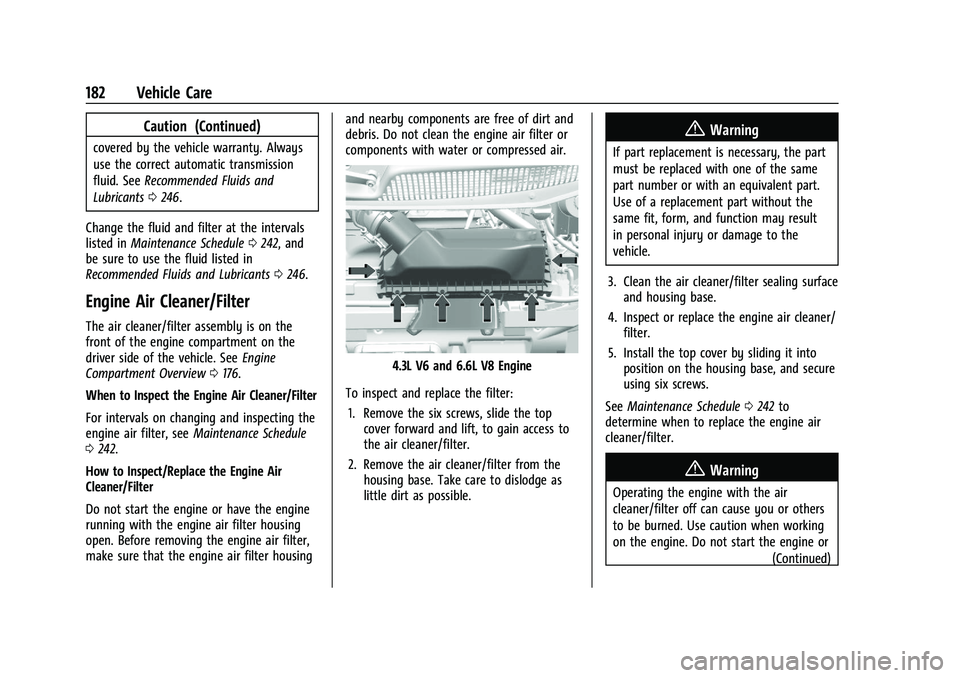
4.3L V6 and 6.6L V8 Engine
To inspect and replace the filter: 1. Remove the six screws, slide the top cover forward and lift, to gain access to
the air cleaner/filter.
2. Remove the air cleaner/filter from the housing base. Take care to dislodge as
little dirt as possible.
{Warning
If part replacement is necessary, the part
must be replaced with one of the same
part number or with an equivalent part.
Use of a replacement part without the
same fit, form, and function may result
in personal injury or damage to the
vehicle.
3. Clean the air cleaner/filter sealing surface and housing base.
4. Inspect or replace the engine air cleaner/ filter.
5. Install the top cover by sliding it into position on the housing base, and secure
using six screws.
See Maintenance Schedule 0242 to
determine when to replace the engine air
cleaner/filter.
{Warning
Operating the engine with the air
cleaner/filter off can cause you or others
to be burned. Use caution when working
on the engine. Do not start the engine or
(Continued)
Page 189 of 283

Chevrolet Express Owner Manual (GMNA-Localizing-U.S./Canada/Mexico-
16547501) - 2023 - CRC - 6/10/22
188 Vehicle Care
If the decision is made not to lift the hood,
get service help right away.
Engine Fan
The vehicle has a clutched engine cooling
fan. When the clutch is engaged, the fan
spins faster to provide more air to cool the
engine. In most everyday driving conditions,
the fan is spinning slower and the clutch is
not fully engaged. This improves fuel
economy and reduces fan noise. Under
heavy vehicle loading, trailer towing, and/or
high outside temperatures, the fan speed
increases as the clutch more fully engages,
so an increase in fan noise may be heard.
This is normal and should not be mistaken
as the transmission slipping or making extra
shifts. It is merely the cooling system
functioning properly. The fan will slow down
when additional cooling is not required and
the clutch partially disengages.
This fan noise may be heard when starting
the engine. It will go away as the fan clutch
partially disengages.
Power Steering Fluid
The power steering fluid reservoir is in the
engine compartment on the driver side of
the vehicle. SeeEngine Compartment
Overview 0176 for reservoir location.
When to Check Power Steering Fluid
It is not necessary to regularly check power
steering fluid unless there is a leak
suspected in the system or an unusual noise
is heard. A fluid loss in this system could
indicate a problem. Have the system
inspected and repaired.
Wait for the power steering system to cool,
with the engine off, before checking the
fluid.
How to Check Power Steering Fluid
To check the power steering fluid:
1. Set the ignition off and let the engine compartment cool down. 2. Wipe the cap and the top of the
reservoir clean.
3. Unscrew the cap and wipe the dipstick with a clean rag.
4. Replace the cap and completely tighten it.
5. Remove the cap again and look at the fluid level on the dipstick.
The level should be between the ADD and
FULL marks. If necessary, add only enough
fluid to bring the level up to the hashed
area between the ADD and FULL marks, do
not overfill.
To prevent contamination of brake fluid,
never check or fill the power steering
reservoir with the brake master cylinder
cover off.
What to Use
Caution
Use of the incorrect fluid may damage
the vehicle and the damages may not be
covered by the vehicle warranty. Always
use the correct fluid listed in
Recommended Fluids and Lubricants
0246.
Page 194 of 283

Chevrolet Express Owner Manual (GMNA-Localizing-U.S./Canada/Mexico-
16547501) - 2023 - CRC - 6/10/22
Vehicle Care 193
Automatic Transmission Shift Lock
Control Function Check
{Warning
When you are doing this inspection, the
vehicle could move suddenly. If the
vehicle moves, you or others could be
injured.
1. Before starting this check, be sure there is enough room around the vehicle.
It should be parked on a level surface.
2. Apply the parking brake. Be ready to apply the regular brake immediately if
the vehicle begins to move.
3. With the engine off, turn the ignition on, but do not start the engine. Without
applying the regular brake, try to move
the shift lever out of P (Park) with
normal effort. If the shift lever moves
out of P (Park), contact your dealer for
service.
Ignition Transmission Lock Check
While parked, and with the parking brake
set, try to turn the ignition off in each shift
lever position.
.The ignition should turn to off only when
the shift lever is in P (Park).
.The ignition key should come out only
when the ignition is off.
Contact your dealer if service is required.
Park Brake and P (Park)
Mechanism Check
{Warning
When you are doing this check, the
vehicle could begin to move. You or
others could be injured and property
could be damaged. Make sure there is
room in front of the vehicle in case it
begins to roll. Be ready to apply the
regular brake at once should the vehicle
begin to move.
Park on a fairly steep hill, with the vehicle
facing downhill. Keeping your foot on the
regular brake, set the parking brake.
.To check the parking brake's holding
ability: With the engine running and the
transmission in N (Neutral), slowly remove
foot pressure from the regular brake
pedal. Do this until the vehicle is held by
the parking brake only.
.To check the P (Park) mechanism's holding
ability: With the engine running, shift to
P (Park). Then release the parking brake
followed by the regular brake.
Contact your dealer if service is required.
Wiper Blade Replacement
Windshield wiper blades should be inspected
for wear and cracking. See Maintenance
Schedule 0242.
Replacement blades come in different types
and are removed in different ways. For
proper type and length, see Maintenance
Replacement Parts 0247.
Caution
Allowing the wiper arm to touch the
windshield when no wiper blade is
installed could damage the windshield.
Any damage that occurs would not be
covered by the vehicle warranty. Do not
allow the wiper arm to touch the
windshield.
1. Lift the wiper arm away from the windshield.
Page 200 of 283
Chevrolet Express Owner Manual (GMNA-Localizing-U.S./Canada/Mexico-
16547501) - 2023 - CRC - 6/10/22
Vehicle Care 199
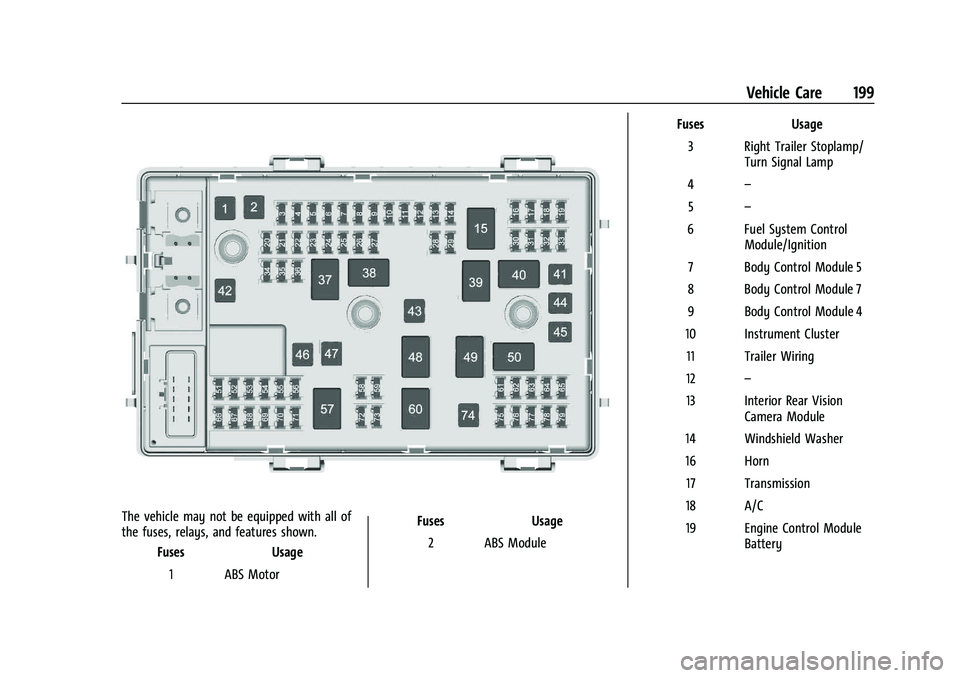
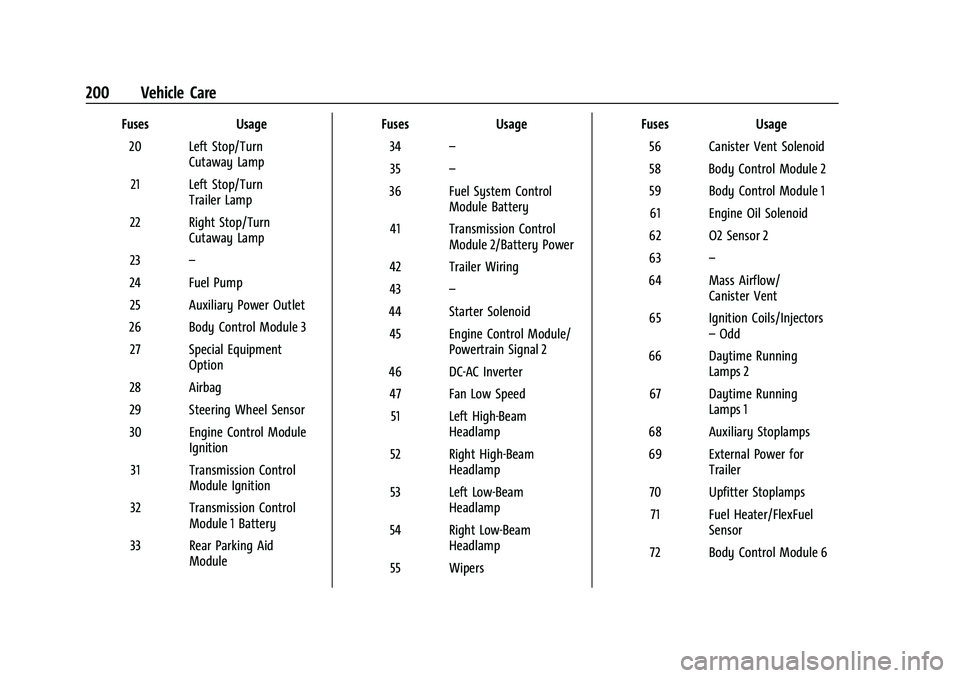
The vehicle may not be equipped with all of
the fuses, relays, and features shown.Fuses Usage
1 ABS Motor Fuses Usage
2 ABS Module Fuses Usage
3 Right Trailer Stoplamp/ Turn Signal Lamp
4 –
5 –
6 Fuel System Control Module/Ignition
7 Body Control Module 5
8 Body Control Module 7
9 Body Control Module 4
10 Instrument Cluster 11 Trailer Wiring
12 –
13 Interior Rear Vision Camera Module
14 Windshield Washer
16 Horn 17 Transmission
18 A/C
19 Engine Control Module Battery
Page 201 of 283
Chevrolet Express Owner Manual (GMNA-Localizing-U.S./Canada/Mexico-
16547501) - 2023 - CRC - 6/10/22
200 Vehicle Care
FusesUsage
20 Left Stop/Turn Cutaway Lamp
21 Left Stop/Turn Trailer Lamp
22 Right Stop/Turn Cutaway Lamp
23 –
24 Fuel Pump 25 Auxiliary Power Outlet
26 Body Control Module 3 27 Special Equipment Option
28 Airbag
29 Steering Wheel Sensor
30 Engine Control Module Ignition
31 Transmission Control Module Ignition
32 Transmission Control Module 1 Battery
33 Rear Parking Aid Module Fuses
Usage
34 –
35 –
36 Fuel System Control Module Battery
41 Transmission Control Module 2/Battery Power
42 Trailer Wiring
43 –
44 Starter Solenoid 45 Engine Control Module/ Powertrain Signal 2
46 DC-AC Inverter 47 Fan Low Speed 51 Left High-Beam Headlamp
52 Right High-Beam Headlamp
53 Left Low-Beam Headlamp
54 Right Low-Beam Headlamp
55 Wipers Fuses
Usage
56 Canister Vent Solenoid
58 Body Control Module 2
59 Body Control Module 1 61 Engine Oil Solenoid
62 O2 Sensor 2
63 –
64 Mass Airflow/ Canister Vent
65 Ignition Coils/Injectors –Odd
66 Daytime Running Lamps 2
67 Daytime Running Lamps 1
68 Auxiliary Stoplamps
69 External Power for Trailer
70 Upfitter Stoplamps 71 Fuel Heater/FlexFuel Sensor
72 Body Control Module 6
Page 230 of 283

Chevrolet Express Owner Manual (GMNA-Localizing-U.S./Canada/Mexico-
16547501) - 2023 - CRC - 6/10/22
Vehicle Care 229
Connection Points and Sequence
1. Discharged Battery Positive (+)Terminal
2. Good Battery Positive (+) Terminal
3. Good Battery Negative (−) Terminal
4. Discharged Battery Negative (−) Terminal
1. Check the other vehicle. It must have a12-volt battery with a negative ground
system.
Caution
If the other vehicle does not have a
12-volt system with a negative ground,
both vehicles can be damaged. Only use
a vehicle that has a 12-volt system with a
negative ground for jump starting.
2. Get the vehicles close enough so the jumper cables can reach, but make sure
the vehicles are not touching each other.
If they are, it could cause a ground
connection you do not want. You would
not be able to start the vehicle, and the
bad grounding could damage the
electrical systems.
To avoid the possibility of the vehicles
rolling, set the parking brake firmly on
both vehicles involved in the jump start
procedure. Put the vehicles into P (Park).
If the other vehicle has a manual
transmission, put the vehicle into
N (Neutral) before setting the parking
brakes.
Caution
If any accessories are left on or plugged
in during the jump starting procedure,
they could be damaged. The repairs
would not be covered by the vehicle
warranty. Whenever possible, turn off or
unplug all accessories on either vehicle
when jump starting.
3. Turn off both vehicles. Unplug unnecessary accessories plugged into the
cigarette lighter or the accessory power
outlet. Turn off the radio and all lamps
that are not needed. This will avoid
sparks and help save both batteries.
4. Open the hoods and locate the positive (+) and negative (−) terminal
locations of the other vehicle.
On your van, use the unpainted radio
antenna bracket as a remote negative (−)
terminal.
Page 232 of 283
Chevrolet Express Owner Manual (GMNA-Localizing-U.S./Canada/Mexico-
16547501) - 2023 - CRC - 6/10/22
Vehicle Care 231
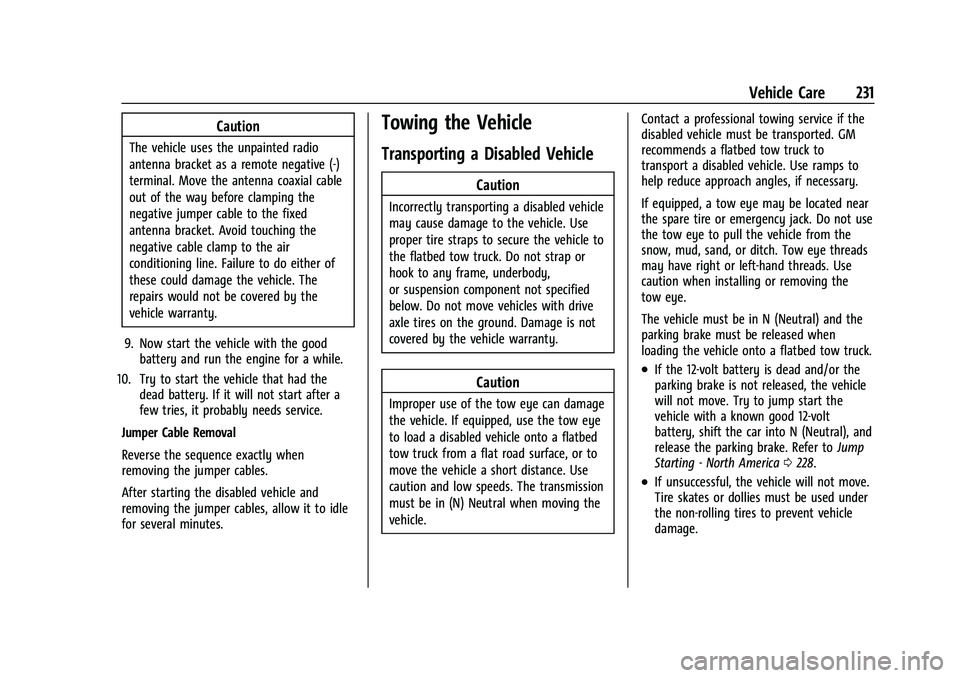
Caution
The vehicle uses the unpainted radio
antenna bracket as a remote negative (-)
terminal. Move the antenna coaxial cable
out of the way before clamping the
negative jumper cable to the fixed
antenna bracket. Avoid touching the
negative cable clamp to the air
conditioning line. Failure to do either of
these could damage the vehicle. The
repairs would not be covered by the
vehicle warranty.
9. Now start the vehicle with the good battery and run the engine for a while.
10. Try to start the vehicle that had the dead battery. If it will not start after a
few tries, it probably needs service.
Jumper Cable Removal
Reverse the sequence exactly when
removing the jumper cables.
After starting the disabled vehicle and
removing the jumper cables, allow it to idle
for several minutes.
Towing the Vehicle
Transporting a Disabled Vehicle
Caution
Incorrectly transporting a disabled vehicle
may cause damage to the vehicle. Use
proper tire straps to secure the vehicle to
the flatbed tow truck. Do not strap or
hook to any frame, underbody,
or suspension component not specified
below. Do not move vehicles with drive
axle tires on the ground. Damage is not
covered by the vehicle warranty.
Caution
Improper use of the tow eye can damage
the vehicle. If equipped, use the tow eye
to load a disabled vehicle onto a flatbed
tow truck from a flat road surface, or to
move the vehicle a short distance. Use
caution and low speeds. The transmission
must be in (N) Neutral when moving the
vehicle. Contact a professional towing service if the
disabled vehicle must be transported. GM
recommends a flatbed tow truck to
transport a disabled vehicle. Use ramps to
help reduce approach angles, if necessary.
If equipped, a tow eye may be located near
the spare tire or emergency jack. Do not use
the tow eye to pull the vehicle from the
snow, mud, sand, or ditch. Tow eye threads
may have right or left-hand threads. Use
caution when installing or removing the
tow eye.
The vehicle must be in N (Neutral) and the
parking brake must be released when
loading the vehicle onto a flatbed tow truck.
.If the 12-volt battery is dead and/or the
parking brake is not released, the vehicle
will not move. Try to jump start the
vehicle with a known good 12-volt
battery, shift the car into N (Neutral), and
release the parking brake. Refer to
Jump
Starting - North America 0228.
.If unsuccessful, the vehicle will not move.
Tire skates or dollies must be used under
the non-rolling tires to prevent vehicle
damage.
Page 233 of 283
Chevrolet Express Owner Manual (GMNA-Localizing-U.S./Canada/Mexico-
16547501) - 2023 - CRC - 6/10/22
232 Vehicle Care
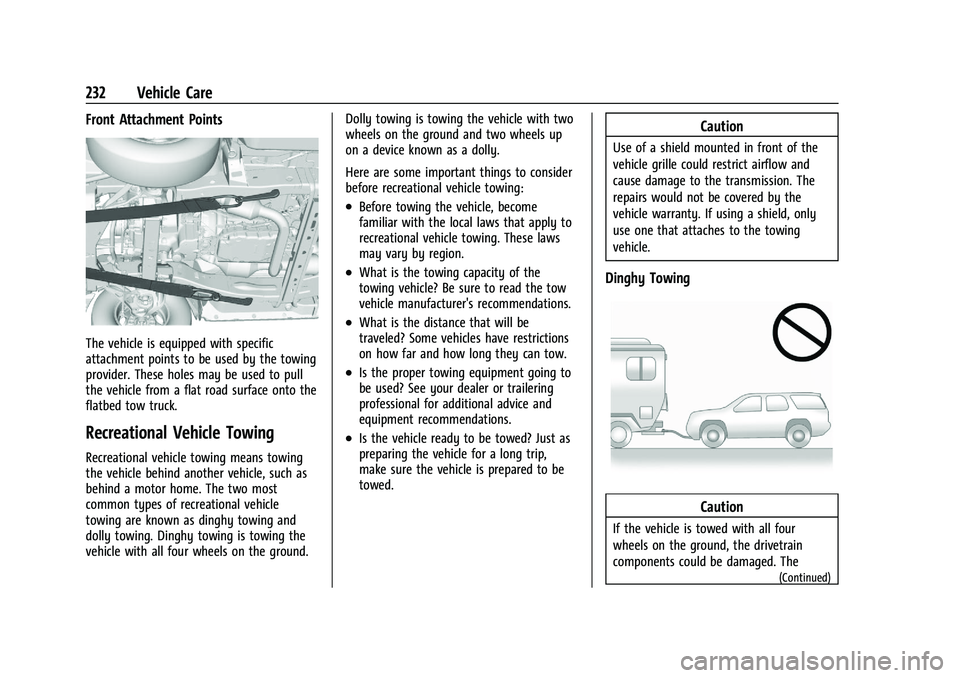
Front Attachment Points
The vehicle is equipped with specific
attachment points to be used by the towing
provider. These holes may be used to pull
the vehicle from a flat road surface onto the
flatbed tow truck.
Recreational Vehicle Towing
Recreational vehicle towing means towing
the vehicle behind another vehicle, such as
behind a motor home. The two most
common types of recreational vehicle
towing are known as dinghy towing and
dolly towing. Dinghy towing is towing the
vehicle with all four wheels on the ground.Dolly towing is towing the vehicle with two
wheels on the ground and two wheels up
on a device known as a dolly.
Here are some important things to consider
before recreational vehicle towing:
.Before towing the vehicle, become
familiar with the local laws that apply to
recreational vehicle towing. These laws
may vary by region.
.What is the towing capacity of the
towing vehicle? Be sure to read the tow
vehicle manufacturer's recommendations.
.What is the distance that will be
traveled? Some vehicles have restrictions
on how far and how long they can tow.
.Is the proper towing equipment going to
be used? See your dealer or trailering
professional for additional advice and
equipment recommendations.
.Is the vehicle ready to be towed? Just as
preparing the vehicle for a long trip,
make sure the vehicle is prepared to be
towed.
Caution
Use of a shield mounted in front of the
vehicle grille could restrict airflow and
cause damage to the transmission. The
repairs would not be covered by the
vehicle warranty. If using a shield, only
use one that attaches to the towing
vehicle.
Dinghy Towing
Caution
If the vehicle is towed with all four
wheels on the ground, the drivetrain
components could be damaged. The
(Continued)