weight CHEVROLET EXPRESS CARGO 2021 User Guide
[x] Cancel search | Manufacturer: CHEVROLET, Model Year: 2021, Model line: EXPRESS CARGO, Model: CHEVROLET EXPRESS CARGO 2021Pages: 296, PDF Size: 6.68 MB
Page 167 of 296
Chevrolet Express Owner Manual (GMNA-Localizing-U.S./Canada/Mexico-
14583525) - 2021 - CRC - 12/9/20
166 Driving and Operating
The resulting weight cannot exceed the
GCWR value shown on the Tow Rating
Chart.
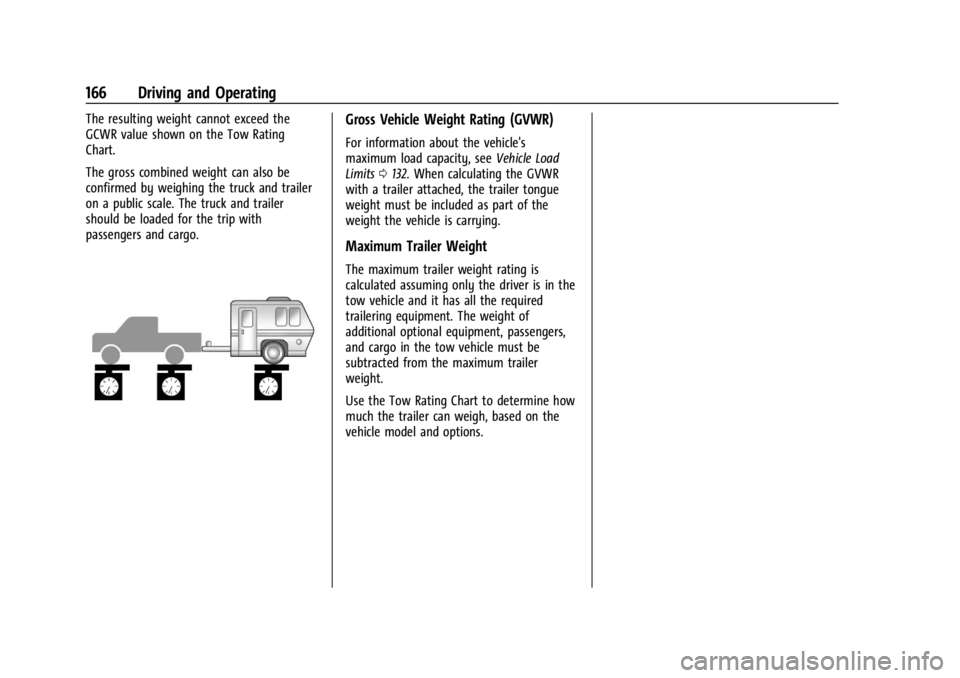
The gross combined weight can also be
confirmed by weighing the truck and trailer
on a public scale. The truck and trailer
should be loaded for the trip with
passengers and cargo.Gross Vehicle Weight Rating (GVWR)
For information about the vehicle's
maximum load capacity, seeVehicle Load
Limits 0132. When calculating the GVWR
with a trailer attached, the trailer tongue
weight must be included as part of the
weight the vehicle is carrying.
Maximum Trailer Weight
The maximum trailer weight rating is
calculated assuming only the driver is in the
tow vehicle and it has all the required
trailering equipment. The weight of
additional optional equipment, passengers,
and cargo in the tow vehicle must be
subtracted from the maximum trailer
weight.
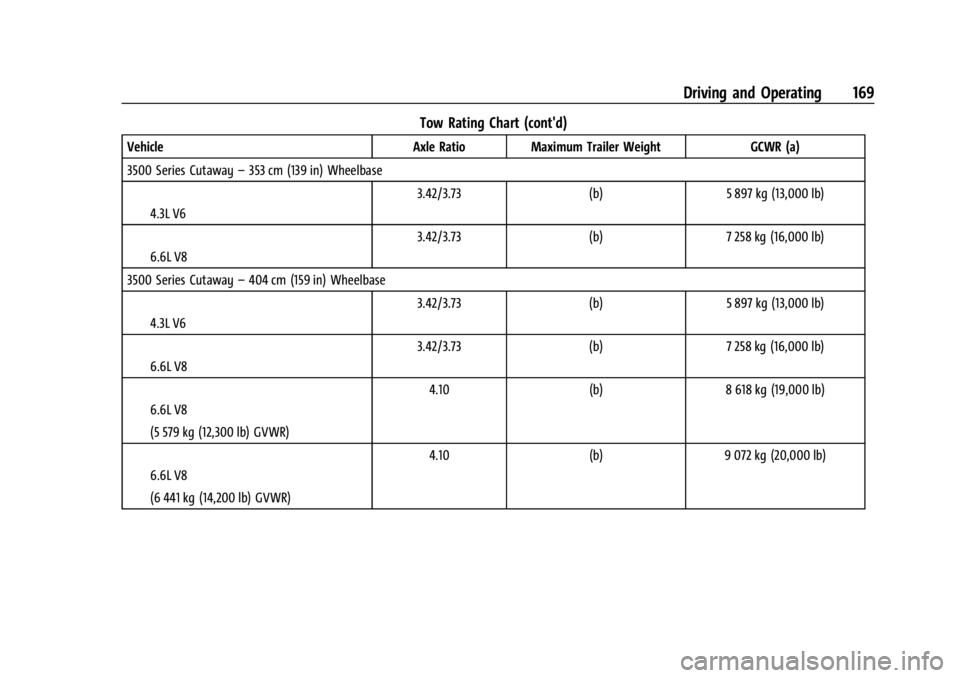
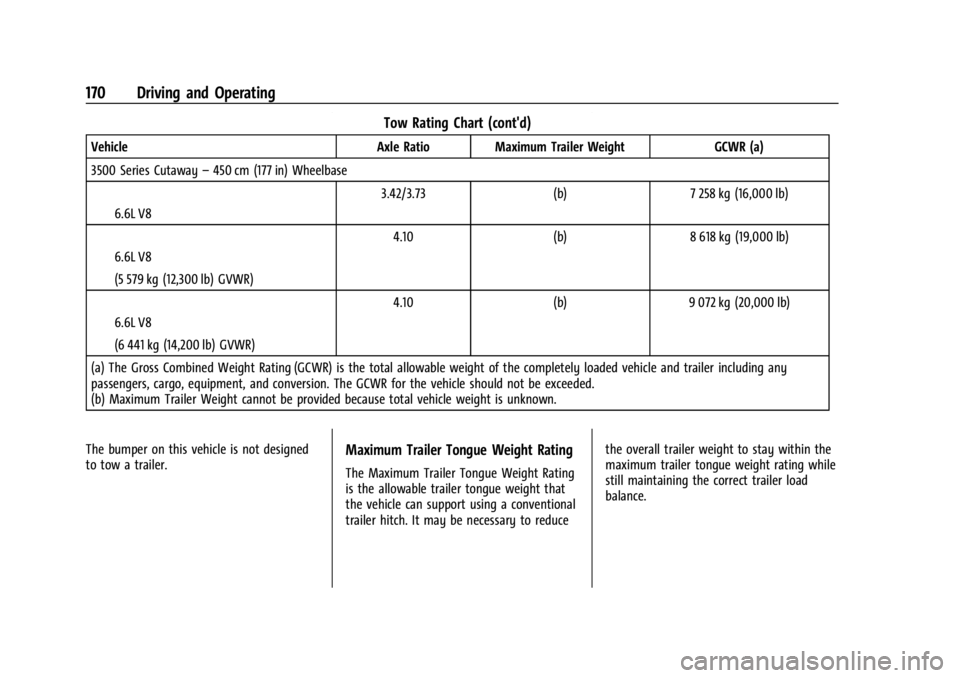
Use the Tow Rating Chart to determine how
much the trailer can weigh, based on the
vehicle model and options.
Page 168 of 296

Chevrolet Express Owner Manual (GMNA-Localizing-U.S./Canada/Mexico-
14583525) - 2021 - CRC - 12/9/20
Driving and Operating 167
Tow Rating Chart
VehicleAxle Ratio Maximum Trailer Weight GCWR (a)
G2500 Cargo Van 2WD Short Wheelbase
I4.3L V6 3.42
3 357 kg (7,400 lb) 5 897 kg (13,000 lb)
I6.6L V8 3.42
4 536 kg (10,000 lb) 7 258 kg (16,000 lb)
G2500 Cargo Van 2WD Long Wheelbase I4.3L V6 3.42
3 220 kg (7,100 lb) 5 897 kg (13,000 lb)
I6.6L V8 3.42
4 536 kg (10,000 lb) 7 258 kg (16,000 lb)
G2500 Passenger Van 2WD Short Wheelbase
I4.3L V6 3.42
3 039 kg (6,700 lb) 5 897 kg (13,000 lb)
I6.6L V8 3.42
4 355 kg (9,600 lb) 7 258 kg (16,000 lb)
G3500 Cargo Van 2WD Short Wheelbase I4.3L V6 3.42
3 357 kg (7,400 lb) 5 897 kg (13,000 lb)
Page 169 of 296

Chevrolet Express Owner Manual (GMNA-Localizing-U.S./Canada/Mexico-
14583525) - 2021 - CRC - 12/9/20
168 Driving and Operating
Tow Rating Chart (cont'd)
VehicleAxle Ratio Maximum Trailer Weight GCWR (a)
I6.6L V8 3.42
4 536 kg (10,000 lb) 7 258 kg (16,000 lb)
G3500 Cargo Van 2WD Long Wheelbase I4.3L V6 3.42
3 265 kg (7,200 lb) 5 897 kg (13,000 lb)
I6.6L V8 3.42
4 536 kg (10,000 lb) 7 258 kg (16,000 lb)
G3500 Passenger Van 2WD Short Wheelbase I4.3L V6 3.42
3 039 kg (6,700 lb) 5 897 kg (13,000 lb)
I6.6L V8 3.42
4 355 kg (9,600 lb) 7 258 kg (16,000 lb)
G3500 Passenger Van 2WD Long Wheelbase I4.3L V6 3.42
2 858 kg (6,300 lb) 5 897 kg (13,000 lb)
I6.6L V8 3.42
4 173 kg (9,200 lb) 7 258 kg (16,000 lb)
Page 170 of 296
Chevrolet Express Owner Manual (GMNA-Localizing-U.S./Canada/Mexico-
14583525) - 2021 - CRC - 12/9/20
Driving and Operating 169
Tow Rating Chart (cont'd)
VehicleAxle Ratio Maximum Trailer Weight GCWR (a)
3500 Series Cutaway –353 cm (139 in) Wheelbase
I4.3L V6 3.42/3.73
(b)5 897 kg (13,000 lb)
I6.6L V8 3.42/3.73
(b)7 258 kg (16,000 lb)
3500 Series Cutaway –404 cm (159 in) Wheelbase
I4.3L V6 3.42/3.73
(b)5 897 kg (13,000 lb)
I6.6L V8 3.42/3.73
(b)7 258 kg (16,000 lb)
I6.6L V8
I(5 579 kg (12,300 lb) GVWR) 4.10
(b)8 618 kg (19,000 lb)
I6.6L V8
I(6 441 kg (14,200 lb) GVWR) 4.10
(b)9 072 kg (20,000 lb)
Page 171 of 296
Chevrolet Express Owner Manual (GMNA-Localizing-U.S./Canada/Mexico-
14583525) - 2021 - CRC - 12/9/20
170 Driving and Operating
Tow Rating Chart (cont'd)
VehicleAxle Ratio Maximum Trailer Weight GCWR (a)
3500 Series Cutaway –450 cm (177 in) Wheelbase
I6.6L V8 3.42/3.73
(b)7 258 kg (16,000 lb)
I6.6L V8
I(5 579 kg (12,300 lb) GVWR) 4.10
(b)8 618 kg (19,000 lb)
I6.6L V8
I(6 441 kg (14,200 lb) GVWR) 4.10
(b)9 072 kg (20,000 lb)
(a) The Gross Combined Weight Rating (GCWR) is the total allowable weight of the completely loaded vehicle and trailer including any
passengers, cargo, equipment, and conversion. The GCWR for the vehicle should not be exceeded.
(b) Maximum Trailer Weight cannot be provided because total vehicle weight is unknown.
The bumper on this vehicle is not designed
to tow a trailer.
Maximum Trailer Tongue Weight Rating
The Maximum Trailer Tongue Weight Rating
is the allowable trailer tongue weight that
the vehicle can support using a conventional
trailer hitch. It may be necessary to reduce the overall trailer weight to stay within the
maximum trailer tongue weight rating while
still maintaining the correct trailer load
balance.
Page 172 of 296
Chevrolet Express Owner Manual (GMNA-Localizing-U.S./Canada/Mexico-
14583525) - 2021 - CRC - 12/9/20
Driving and Operating 171
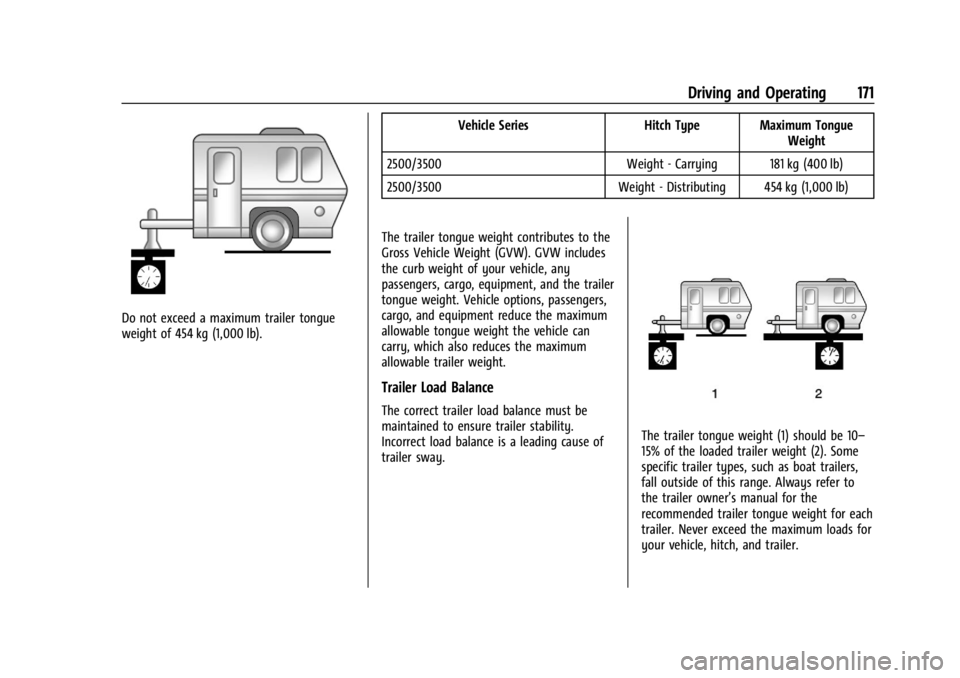
Do not exceed a maximum trailer tongue
weight of 454 kg (1,000 lb).Vehicle Series Hitch Type Maximum Tongue
Weight
2500/3500 Weight - Carrying 181 kg (400 lb)
2500/3500 Weight - Distributing 454 kg (1,000 lb)
The trailer tongue weight contributes to the
Gross Vehicle Weight (GVW). GVW includes
the curb weight of your vehicle, any
passengers, cargo, equipment, and the trailer
tongue weight. Vehicle options, passengers,
cargo, and equipment reduce the maximum
allowable tongue weight the vehicle can
carry, which also reduces the maximum
allowable trailer weight.
Trailer Load Balance
The correct trailer load balance must be
maintained to ensure trailer stability.
Incorrect load balance is a leading cause of
trailer sway.
The trailer tongue weight (1) should be 10–
15% of the loaded trailer weight (2). Some
specific trailer types, such as boat trailers,
fall outside of this range. Always refer to
the trailer owner’s manual for the
recommended trailer tongue weight for each
trailer. Never exceed the maximum loads for
your vehicle, hitch, and trailer.
Page 173 of 296
Chevrolet Express Owner Manual (GMNA-Localizing-U.S./Canada/Mexico-
14583525) - 2021 - CRC - 12/9/20
172 Driving and Operating
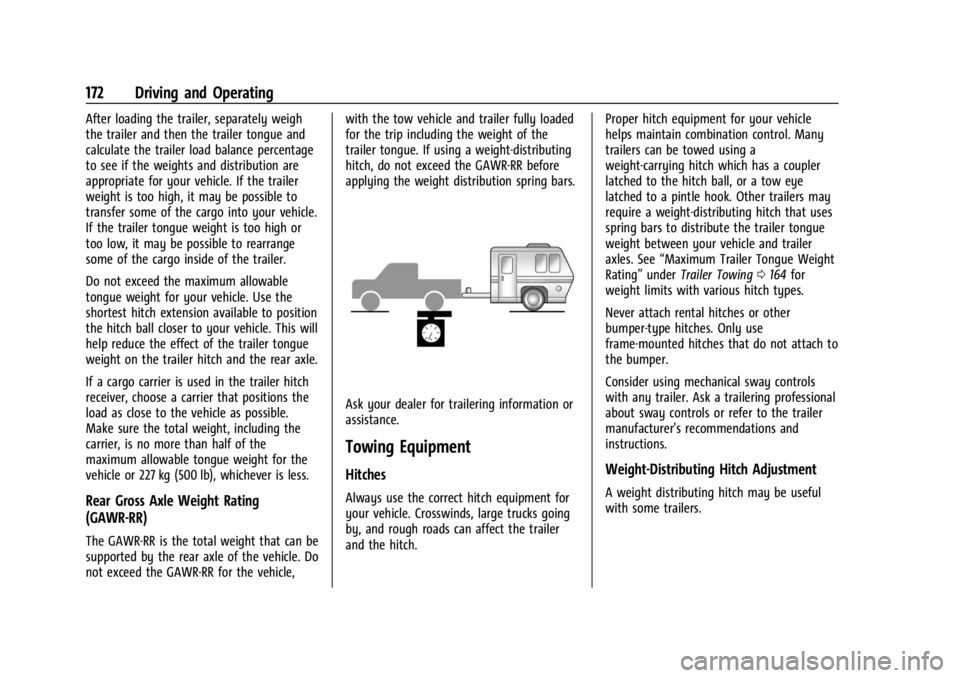
After loading the trailer, separately weigh
the trailer and then the trailer tongue and
calculate the trailer load balance percentage
to see if the weights and distribution are
appropriate for your vehicle. If the trailer
weight is too high, it may be possible to
transfer some of the cargo into your vehicle.
If the trailer tongue weight is too high or
too low, it may be possible to rearrange
some of the cargo inside of the trailer.
Do not exceed the maximum allowable
tongue weight for your vehicle. Use the
shortest hitch extension available to position
the hitch ball closer to your vehicle. This will
help reduce the effect of the trailer tongue
weight on the trailer hitch and the rear axle.
If a cargo carrier is used in the trailer hitch
receiver, choose a carrier that positions the
load as close to the vehicle as possible.
Make sure the total weight, including the
carrier, is no more than half of the
maximum allowable tongue weight for the
vehicle or 227 kg (500 lb), whichever is less.
Rear Gross Axle Weight Rating
(GAWR-RR)
The GAWR-RR is the total weight that can be
supported by the rear axle of the vehicle. Do
not exceed the GAWR-RR for the vehicle,with the tow vehicle and trailer fully loaded
for the trip including the weight of the
trailer tongue. If using a weight-distributing
hitch, do not exceed the GAWR-RR before
applying the weight distribution spring bars.
Ask your dealer for trailering information or
assistance.
Towing Equipment
Hitches
Always use the correct hitch equipment for
your vehicle. Crosswinds, large trucks going
by, and rough roads can affect the trailer
and the hitch.
Proper hitch equipment for your vehicle
helps maintain combination control. Many
trailers can be towed using a
weight-carrying hitch which has a coupler
latched to the hitch ball, or a tow eye
latched to a pintle hook. Other trailers may
require a weight-distributing hitch that uses
spring bars to distribute the trailer tongue
weight between your vehicle and trailer
axles. See
“Maximum Trailer Tongue Weight
Rating” underTrailer Towing 0164 for
weight limits with various hitch types.
Never attach rental hitches or other
bumper-type hitches. Only use
frame-mounted hitches that do not attach to
the bumper.
Consider using mechanical sway controls
with any trailer. Ask a trailering professional
about sway controls or refer to the trailer
manufacturer's recommendations and
instructions.
Weight-Distributing Hitch Adjustment
A weight distributing hitch may be useful
with some trailers.
Page 174 of 296
Chevrolet Express Owner Manual (GMNA-Localizing-U.S./Canada/Mexico-
14583525) - 2021 - CRC - 12/9/20
Driving and Operating 173
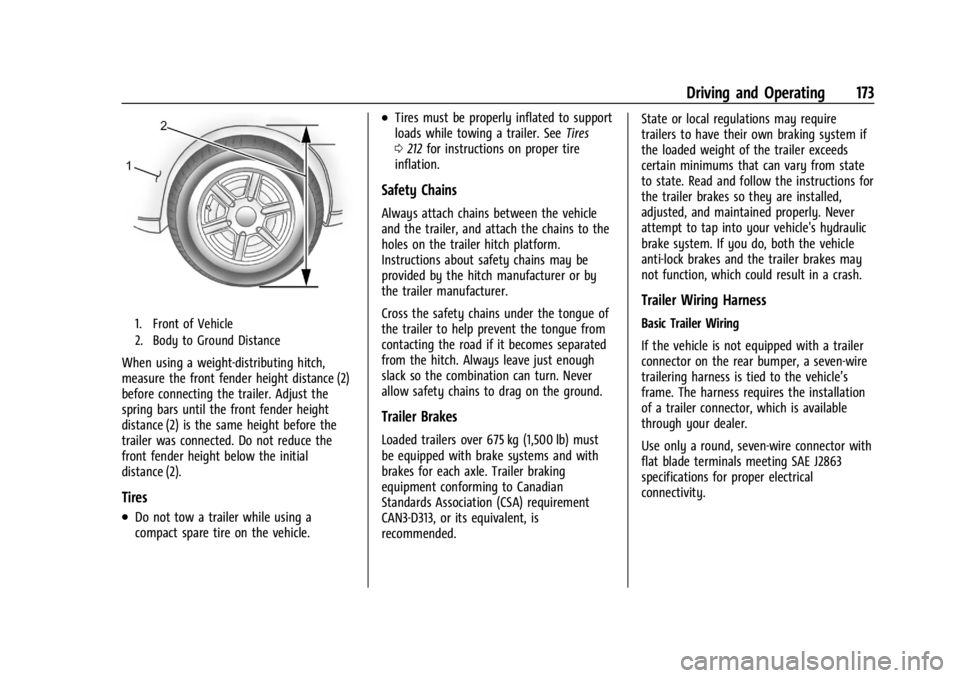
1. Front of Vehicle
2. Body to Ground Distance
When using a weight-distributing hitch,
measure the front fender height distance (2)
before connecting the trailer. Adjust the
spring bars until the front fender height
distance (2) is the same height before the
trailer was connected. Do not reduce the
front fender height below the initial
distance (2).
Tires
.Do not tow a trailer while using a
compact spare tire on the vehicle.
.Tires must be properly inflated to support
loads while towing a trailer. SeeTires
0 212 for instructions on proper tire
inflation.
Safety Chains
Always attach chains between the vehicle
and the trailer, and attach the chains to the
holes on the trailer hitch platform.
Instructions about safety chains may be
provided by the hitch manufacturer or by
the trailer manufacturer.
Cross the safety chains under the tongue of
the trailer to help prevent the tongue from
contacting the road if it becomes separated
from the hitch. Always leave just enough
slack so the combination can turn. Never
allow safety chains to drag on the ground.
Trailer Brakes
Loaded trailers over 675 kg (1,500 lb) must
be equipped with brake systems and with
brakes for each axle. Trailer braking
equipment conforming to Canadian
Standards Association (CSA) requirement
CAN3-D313, or its equivalent, is
recommended. State or local regulations may require
trailers to have their own braking system if
the loaded weight of the trailer exceeds
certain minimums that can vary from state
to state. Read and follow the instructions for
the trailer brakes so they are installed,
adjusted, and maintained properly. Never
attempt to tap into your vehicle's hydraulic
brake system. If you do, both the vehicle
anti-lock brakes and the trailer brakes may
not function, which could result in a crash.
Trailer Wiring Harness
Basic Trailer Wiring
If the vehicle is not equipped with a trailer
connector on the rear bumper, a seven-wire
trailering harness is tied to the vehicle’s
frame. The harness requires the installation
of a trailer connector, which is available
through your dealer.
Use only a round, seven-wire connector with
flat blade terminals meeting SAE J2863
specifications for proper electrical
connectivity.
Page 176 of 296
Chevrolet Express Owner Manual (GMNA-Localizing-U.S./Canada/Mexico-
14583525) - 2021 - CRC - 12/9/20
Driving and Operating 175
Refer to the aftermarket electric trailer brake
controller owner's manual to determine wire
color coding of the electric trailer brake
controller. The wire colors on the brake
controller may be different from the vehicle.
Trailer Lamps
Always check all trailer lamps are working at
the beginning of each trip, and periodically
on longer trips.
Turn Signals When Towing a Trailer
When properly connected, the trailer turn
signals will illuminate to indicate the vehicle
is turning, changing lanes, or stopping.
When towing a trailer, the arrows on the
instrument cluster will illuminate even if the
trailer is not properly connected or the bulbs
are burned out.
Tow/Haul Mode
Tow/Haul assists when pulling a heavy
trailer or a large or heavy load. For
instructions on how to enter Tow/Haul
mode, seeTow/Haul Mode 0145.
Tow/Haul Mode is designed to be most
effective when the vehicle and trailer
combined weight is at least 75% of the vehicle's Gross Combined Weight Rating
(GCWR). See
“Trailer Weight” underTrailer
Towing 0164.
Tow/Haul Mode is most useful when towing
a heavy trailer or carrying a large or
heavy load:
.through rolling terrain
.in stop-and-go traffic
.in busy parking lots
Operating the vehicle in Tow/Haul Mode
when lightly loaded or not towing will not
cause damage; however, it is not
recommended and may result in unpleasant
engine and transmission driving
characteristics and reduced fuel economy.
Trailer Sway Control (TSC)
Vehicles with StabiliTrak/Electronic Stability
Control (ESC) have a Trailer Sway Control
(TSC) feature. Trailer sway is unintended
side-to-side motion of a trailer while towing.
If the vehicle is towing a trailer and the TSC
detects that sway is increasing, the vehicle
brakes are selectively applied at each wheel,
to help reduce excessive trailer sway.
If TSC is enabled, the Traction Control
System (TCS)/StabiliTrak/ESC warning light
will flash on the instrument cluster. Reduce
vehicle speed by gradually removing your
foot from the accelerator. If trailer sway
continues, StabiliTrak/ESC can reduce engine
torque to help slow the vehicle. TSC will not
function if StabiliTrak/ESC is turned off. See
Traction Control/Electronic Stability Control
0 147.
{Warning
Trailer sway can result in a crash and in
serious injury or death, even if the
vehicle is equipped with TSC.
If the trailer begins to sway, reduce
vehicle speed by gradually removing your
foot from the accelerator. Then pull over
to check the trailer and vehicle to help
correct possible causes, including an
improperly or overloaded trailer,
(Continued)
Page 177 of 296
Chevrolet Express Owner Manual (GMNA-Localizing-U.S./Canada/Mexico-
14583525) - 2021 - CRC - 12/9/20
176 Driving and Operating
Warning (Continued)
unrestrained cargo, improper trailer hitch
configuration, or improperly inflated or
incorrect vehicle or trailer tires. See
Towing Equipment0172 for trailer
ratings and hitch setup recommendations.
Trailer Tires
Special Trailer (ST) tires differ from vehicle
tires. Trailer tires are designed with stiff
sidewalls to help prevent sway and to
support heavy loads. These features can
make it difficult to determine if the trailer
tire pressures are low only based on a visual
inspection.
Always check all trailer tire pressures before
each trip when the tires are cool. Low trailer
tire pressure is a leading cause of trailer tire
blow-outs.
Trailer tires deteriorate over time. The trailer
tire sidewall will show the week and year
the tire was manufactured. Many trailer tire
manufacturers recommend replacing tires
more than six years old. Overloading is another leading cause of
trailer tire blow-outs. Never load your trailer
with more weight than the tires are
designed to support. The load rating is
located on the trailer tire sidewall.
Always know the maximum speed rating for
the trailer tires before driving. This may be
significantly lower than the vehicle tire
speed rating. The speed rating may be on
the trailer tire sidewall. If the speed rating is
not shown, the default trailer tire speed
rating is 105 km/h (65 mph).
Conversions and Add-Ons
Add-On Electrical Equipment
{Warning
The Data Link Connector (DLC) is used for
vehicle service and Emission Inspection/
Maintenance testing. See
Malfunction
Indicator Lamp (Check Engine Light) 076.
A device connected to the DLC —such as
an aftermarket fleet or driver-behavior
tracking device —may interfere with
vehicle systems. This could affect vehicle (Continued)
Warning (Continued)
operation and cause a crash. Such devices
may also access information stored in the
vehicle’s systems.
Caution
Some electrical equipment can damage
the vehicle or cause components to not
work and would not be covered by the
vehicle warranty. Always check with your
dealer before adding electrical equipment.
Add-on equipment can drain the vehicle's
12-volt battery, even if the vehicle is not
operating.
The vehicle has an airbag system. Before
attempting to add anything electrical to the
vehicle, see Servicing the Airbag-Equipped
Vehicle 044 and
Adding Equipment to the Airbag-Equipped
Vehicle 045.