brake fluid CHEVROLET EXPRESS CARGO VAN 2004 1.G Owners Manual
[x] Cancel search | Manufacturer: CHEVROLET, Model Year: 2004, Model line: EXPRESS CARGO VAN, Model: CHEVROLET EXPRESS CARGO VAN 2004 1.GPages: 406, PDF Size: 2.66 MB
Page 253 of 406
Service............................................................5-3
Doing Your Own Service Work.........................5-4
Adding Equipment to the Outside of
Your Vehicle..............................................5-4
Fuel................................................................5-5
Gasoline Octane............................................5-5
Gasoline Specications....................................5-5
California Fuel...............................................5-6
Additives.......................................................5-6
Fuels in Foreign Countries...............................5-7
Filling Your Tank............................................5-8
Filling a Portable Fuel Container.......................5-9
Checking Things Under
the Hood....................................................5-10
Hood Release..............................................5-10
Engine Compartment Overview.......................5-12
Engine Oil...................................................5-13
Engine Air Cleaner/Filter................................5-18
Automatic Transmission Fluid.........................5-19
Engine Coolant.............................................5-22
Radiator Pressure Cap..................................5-25
Engine Overheating.......................................5-26
Cooling System............................................5-28Engine Fan Noise.........................................5-36
Power Steering Fluid.....................................5-36
Windshield Washer Fluid................................5-38
Brakes........................................................5-39
Battery........................................................5-42
Jump Starting...............................................5-43
All-Wheel Drive..............................................5-48
Rear Axle.......................................................5-49
Front Axle......................................................5-50
Noise Control System.....................................5-51
Tampering with Noise Control System
Prohibited.................................................5-51
Bulb Replacement..........................................5-52
Halogen Bulbs..............................................5-52
Headlamps..................................................5-52
Front Turn Signal, Sidemarker and
Parking Lamps..........................................5-54
Taillamps.....................................................5-54
Replacement Bulbs.......................................5-56
Windshield Wiper Blade Replacement..............5-56
Section 5 Service and Appearance Care
5-1
Page 265 of 406
A. Battery. SeeBattery on page 5-42.
B. Radiator Pressure Cap. SeeRadiator Pressure Cap
on page 5-25.
C. Coolant Recovery Tank. SeeCooling System on
page 5-28.
D. Transmission Fluid Dipstick. SeeAutomatic
Transmission Fluid on page 5-19.
E. Engine Oil Fill. SeeEngine Oil on page 5-13.
F. Engine Oil Dipstick. SeeEngine Oil on page 5-13.
G. Air Filter Restriction Indicator. SeeEngine Air
Cleaner/Filter on page 5-18.
H. Engine Air Cleaner/Filter. SeeEngine Air
Cleaner/Filter on page 5-18.
I. Power Steering Reservoir. SeePower Steering Fluid
on page 5-36.
J. Brake Master Cylinder. SeeBrakes on page 5-39.
K. Windshield Washer Fluid. SeeWindshield Washer
Fluid on page 5-38.Engine Oil
Checking Engine Oil
It is a good idea to check your engine oil every time you
get fuel. In order to get an accurate reading, the oil
must be warm and the vehicle must be on level ground.
The engine oil dipstick handle is a yellow loop. See
Engine Compartment Overview on page 5-12for
the location of the engine oil dipstick.
Turn off the engine and give the oil several minutes to
drain back into the oil pan. If you don’t, the oil
dipstick might not show the actual level.
Pull out the dipstick and clean it with a paper towel or
cloth, then push it back in all the way. Remove it again,
keeping the tip down, and check the level.
5-13
Page 273 of 406
Checking the Fluid Level
Prepare your vehicle as follows:
Park your vehicle on a level place. Keep the engine
running.
With the parking brake applied, place the shift lever
in PARK (P).
With your foot on the brake pedal, move the shift
lever through each gear range, pausing for about
three seconds in each range. Then, position the shift
lever in PARK (P).
Let the engine run at idle for three minutes or more.
Then, without shutting off the engine, follow these steps:
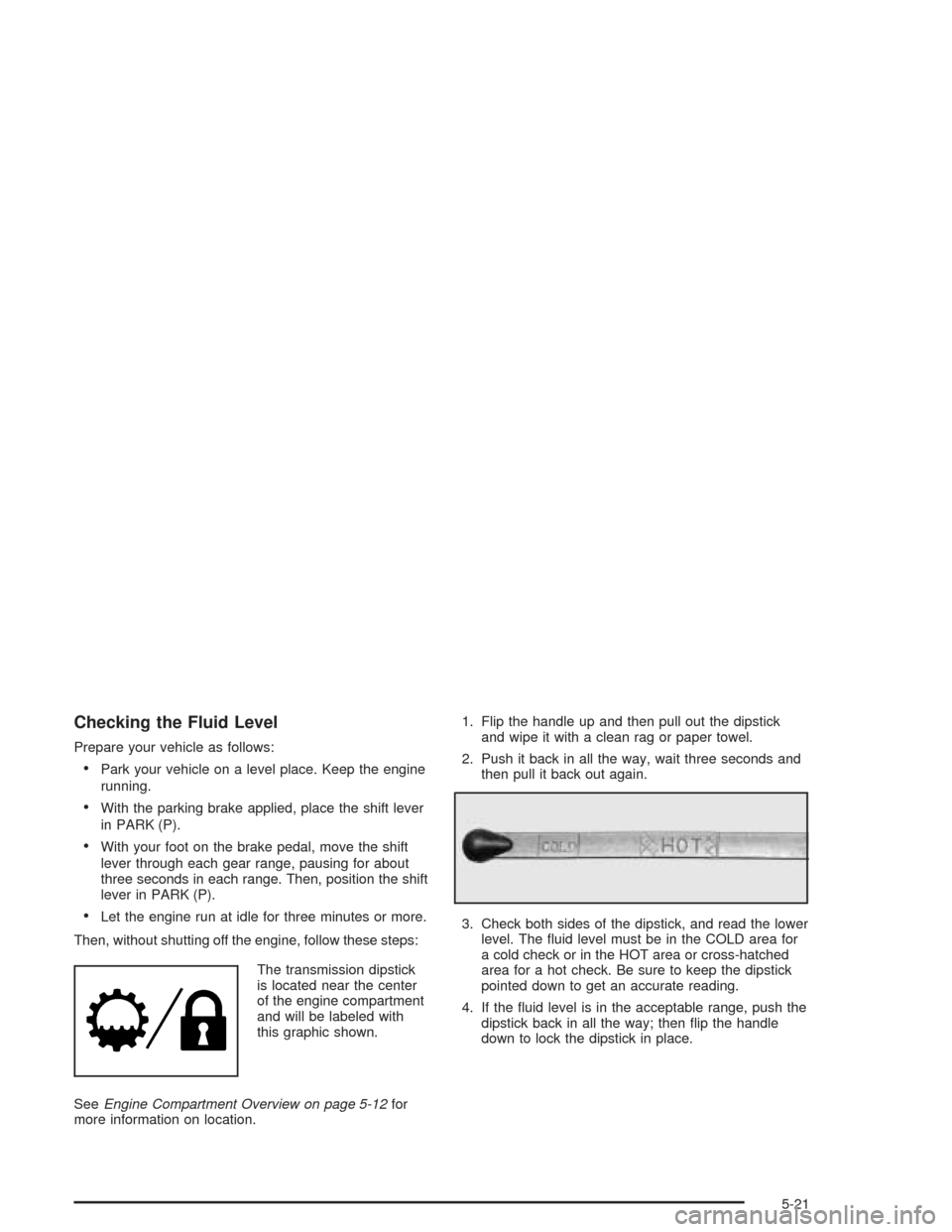
The transmission dipstick
is located near the center
of the engine compartment
and will be labeled with
this graphic shown.
SeeEngine Compartment Overview on page 5-12for
more information on location.1. Flip the handle up and then pull out the dipstick
and wipe it with a clean rag or paper towel.
2. Push it back in all the way, wait three seconds and
then pull it back out again.
3. Check both sides of the dipstick, and read the lower
level. The uid level must be in the COLD area for
a cold check or in the HOT area or cross-hatched
area for a hot check. Be sure to keep the dipstick
pointed down to get an accurate reading.
4. If the uid level is in the acceptable range, push the
dipstick back in all the way; then ip the handle
down to lock the dipstick in place.
5-21
Page 289 of 406
When to Check Power Steering Fluid
It is not necessary to regularly check power steering uid
unless you suspect there is a leak in the system or
you hear an unusual noise. A uid loss in this system
could indicate a problem. Have the system inspected
and repaired.
How to Check Power Steering Fluid
Turn the key off, let the engine compartment cool down,
wipe the cap and the top of the reservoir clean, then
unscrew the cap and wipe the dipstick with a clean rag.
Replace the cap and completely tighten it. Then
remove the cap again and look at the uid level on the
dipstick.The level should be at the COLD FILL mark. If necessary,
add only enough uid to bring the level up to the mark.
To prevent contamination of brake uid, never check or
ll the power steering reservoir with the brake master
cylinder cover off.
What to Use
To determine what kind of uid to use, see
Recommended Fluids and Lubricants on page 6-12.
Always use the proper uid. Failure to use the proper
uid can cause leaks and damage hoses and seals.
5-37
Page 291 of 406
Brakes
Brake Fluid
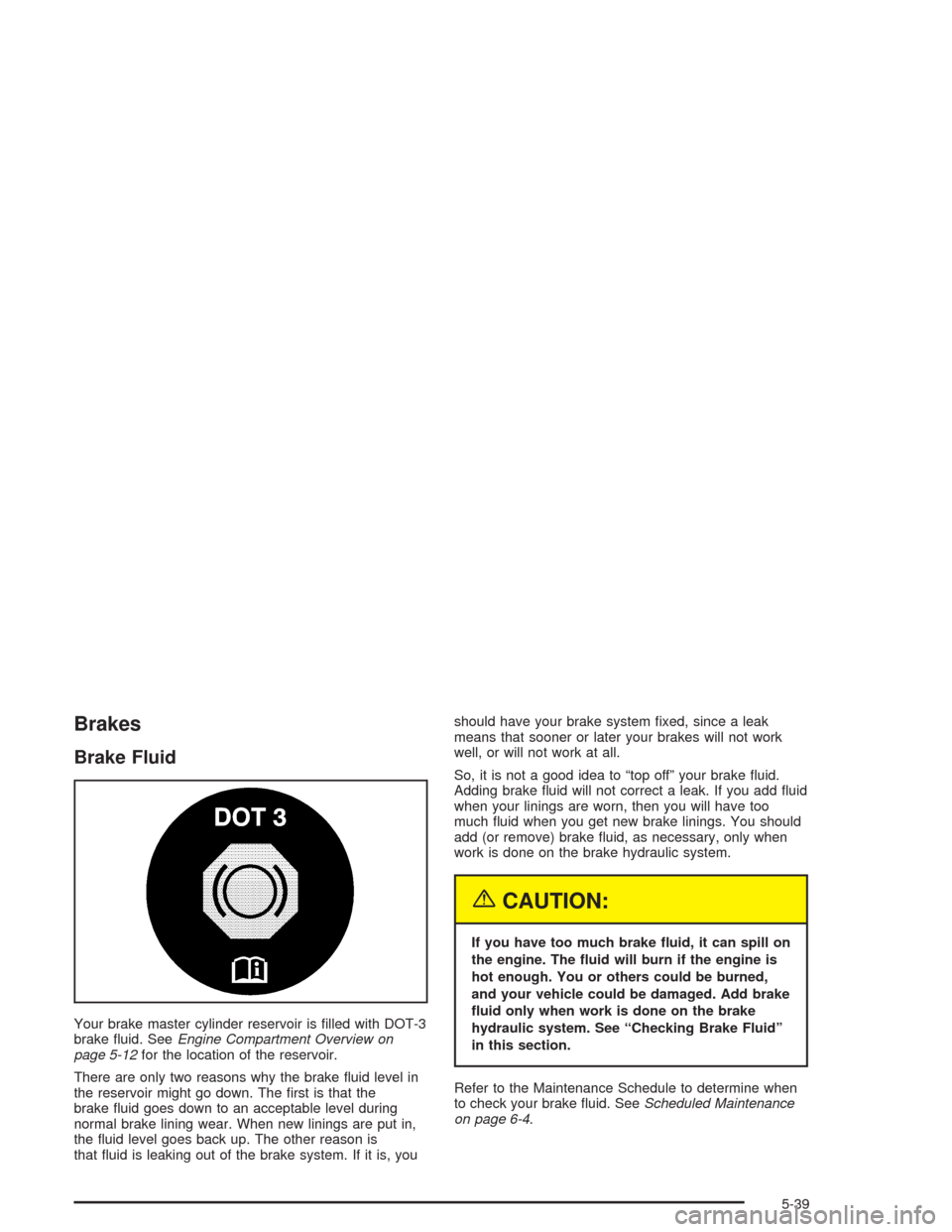
Your brake master cylinder reservoir is lled with DOT-3
brake uid. SeeEngine Compartment Overview on
page 5-12for the location of the reservoir.
There are only two reasons why the brake uid level in
the reservoir might go down. The rst is that the
brake uid goes down to an acceptable level during
normal brake lining wear. When new linings are put in,
the uid level goes back up. The other reason is
that uid is leaking out of the brake system. If it is, youshould have your brake system xed, since a leak
means that sooner or later your brakes will not work
well, or will not work at all.
So, it is not a good idea to “top off” your brake uid.
Adding brake uid will not correct a leak. If you add uid
when your linings are worn, then you will have too
much uid when you get new brake linings. You should
add (or remove) brake uid, as necessary, only when
work is done on the brake hydraulic system.
{CAUTION:
If you have too much brake uid, it can spill on
the engine. The uid will burn if the engine is
hot enough. You or others could be burned,
and your vehicle could be damaged. Add brake
uid only when work is done on the brake
hydraulic system. See “Checking Brake Fluid”
in this section.
Refer to the Maintenance Schedule to determine when
to check your brake uid. SeeScheduled Maintenance
on page 6-4.
5-39
Page 292 of 406
Checking Brake Fluid
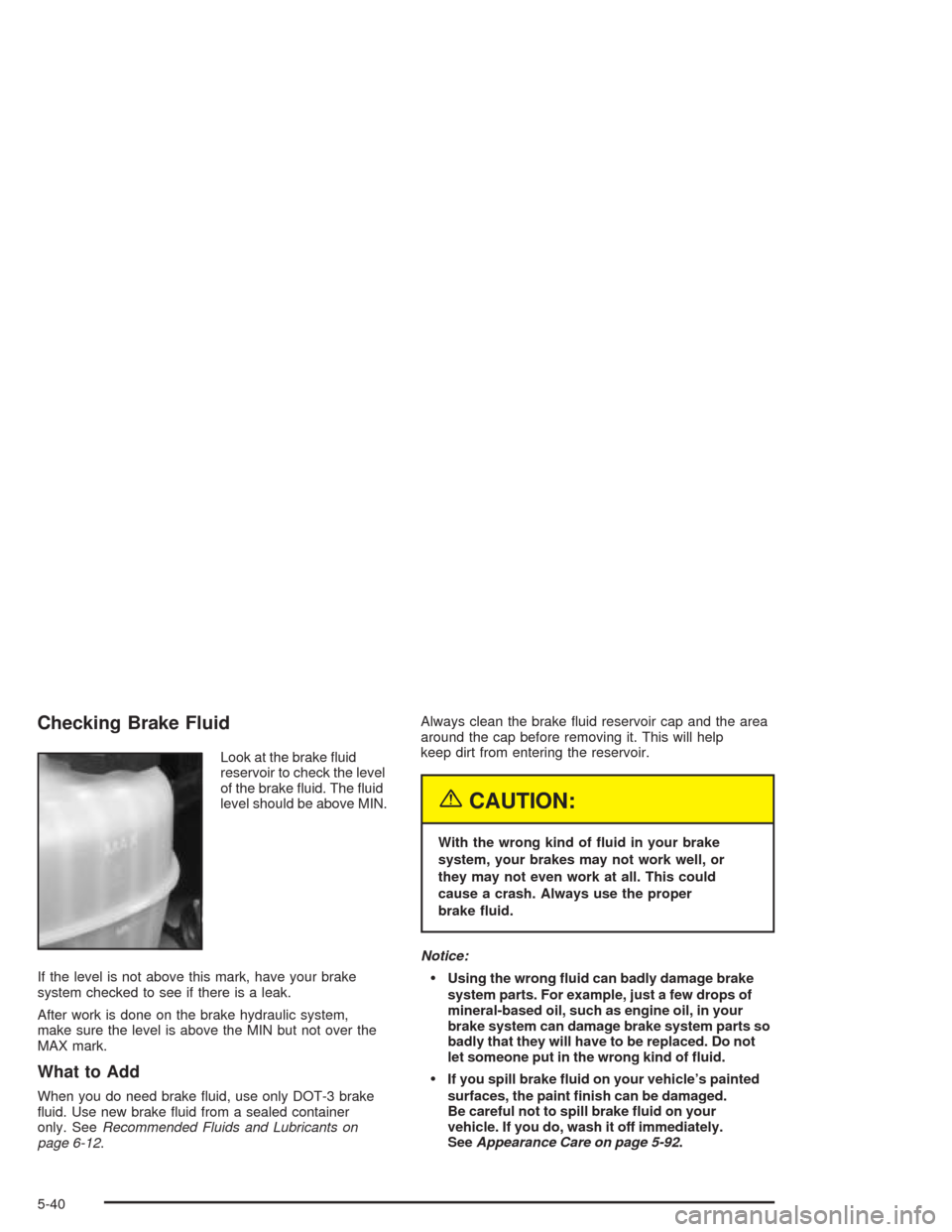
Look at the brake uid
reservoir to check the level
of the brake uid. The uid
level should be above MIN.
If the level is not above this mark, have your brake
system checked to see if there is a leak.
After work is done on the brake hydraulic system,
make sure the level is above the MIN but not over the
MAX mark.
What to Add
When you do need brake uid, use only DOT-3 brake
uid. Use new brake uid from a sealed container
only. SeeRecommended Fluids and Lubricants on
page 6-12.Always clean the brake uid reservoir cap and the area
around the cap before removing it. This will help
keep dirt from entering the reservoir.
{CAUTION:
With the wrong kind of uid in your brake
system, your brakes may not work well, or
they may not even work at all. This could
cause a crash. Always use the proper
brake uid.
Notice:
Using the wrong uid can badly damage brake
system parts. For example, just a few drops of
mineral-based oil, such as engine oil, in your
brake system can damage brake system parts so
badly that they will have to be replaced. Do not
let someone put in the wrong kind of uid.
If you spill brake uid on your vehicle’s painted
surfaces, the paint nish can be damaged.
Be careful not to spill brake uid on your
vehicle. If you do, wash it off immediately.
SeeAppearance Care on page 5-92.
5-40
Page 370 of 406
Engine Coolant Level Check
Check the engine coolant level and add
DEX-COOL®coolant mixture if necessary. SeeEngine
Coolant on page 5-22for further details.
Windshield Washer Fluid Level Check
Check the windshield washer uid level in the windshield
washer tank and add the proper uid if necessary.
At Least Once a Month
Tire Ination Check
Visually inspect your tires and make sure tires are
inated to the correct pressures. Do not forget to check
your spare tire. SeeTires on page 5-58for further
details. Check to make sure the spare tire is stored
securely. Push, pull and then try to rotate or turn
the spare tire. If it moves, tighten it. SeeChanging a
Flat Tire on page 5-76.
At Least Once a Year
Starter Switch Check
{CAUTION:
When you are doing this inspection, the
vehicle could move suddenly. If the vehicle
moves, you or others could be injured.
1. Before you start, be sure you have enough room
around the vehicle.
2. Firmly apply both the parking brake and the regular
brake. SeeParking Brake on page 2-26if
necessary.
Do not use the accelerator pedal, and be ready to
turn off the engine immediately if it starts.
3. Try to start the engine in each gear. The starter
should work only in PARK (P) or NEUTRAL (N).
If the starter works in any other position, contact
your GM Goodwrench dealer for service.
6-10
Page 372 of 406
Park on a fairly steep hill, with the vehicle facing
downhill. Keeping your foot on the regular brake, set the
parking brake.
To check the parking brake’s holding ability: With
the engine running and transmission in
NEUTRAL (N), slowly remove foot pressure from
the regular brake pedal. Do this until the vehicle is
held by the parking brake only.
To check the PARK (P) mechanism’s holding ability:
With the engine running, shift to PARK (P). Then
release the parking brake followed by the regular
brake.
Contact your GM Goodwrench dealer if service is
required.
Underbody Flushing Service
At least every spring, use plain water to ush any
corrosive materials from the underbody. Take care to
clean thoroughly any areas where mud and other debris
can collect.
Recommended Fluids and
Lubricants
Fluids and lubricants identied below by name, part
number or specication may be obtained from your
dealer.
Usage Fluid/Lubricant
Engine OilEngine oil which meets GM
Standard GM6094M and displays
the American Petroleum Institute
Certied for Gasoline Engines
starburst symbol. GM Goodwrench
oil meets all the requirements for
your vehicle. To determine the
proper viscosity for your vehicle’s
engine, seeEngine Oil on
page 5-13.
Engine Coolant50/50 mixture of clean, drinkable
water and use only
DEX-COOL
®Coolant. SeeEngine
Coolant on page 5-22.
Hydraulic Brake
SystemDelco Supreme 11 Brake Fluid or
equivalent DOT-3 brake uid.
Windshield
Washer SolventGM Optikleen
®Washer Solvent.
6-12
Page 373 of 406
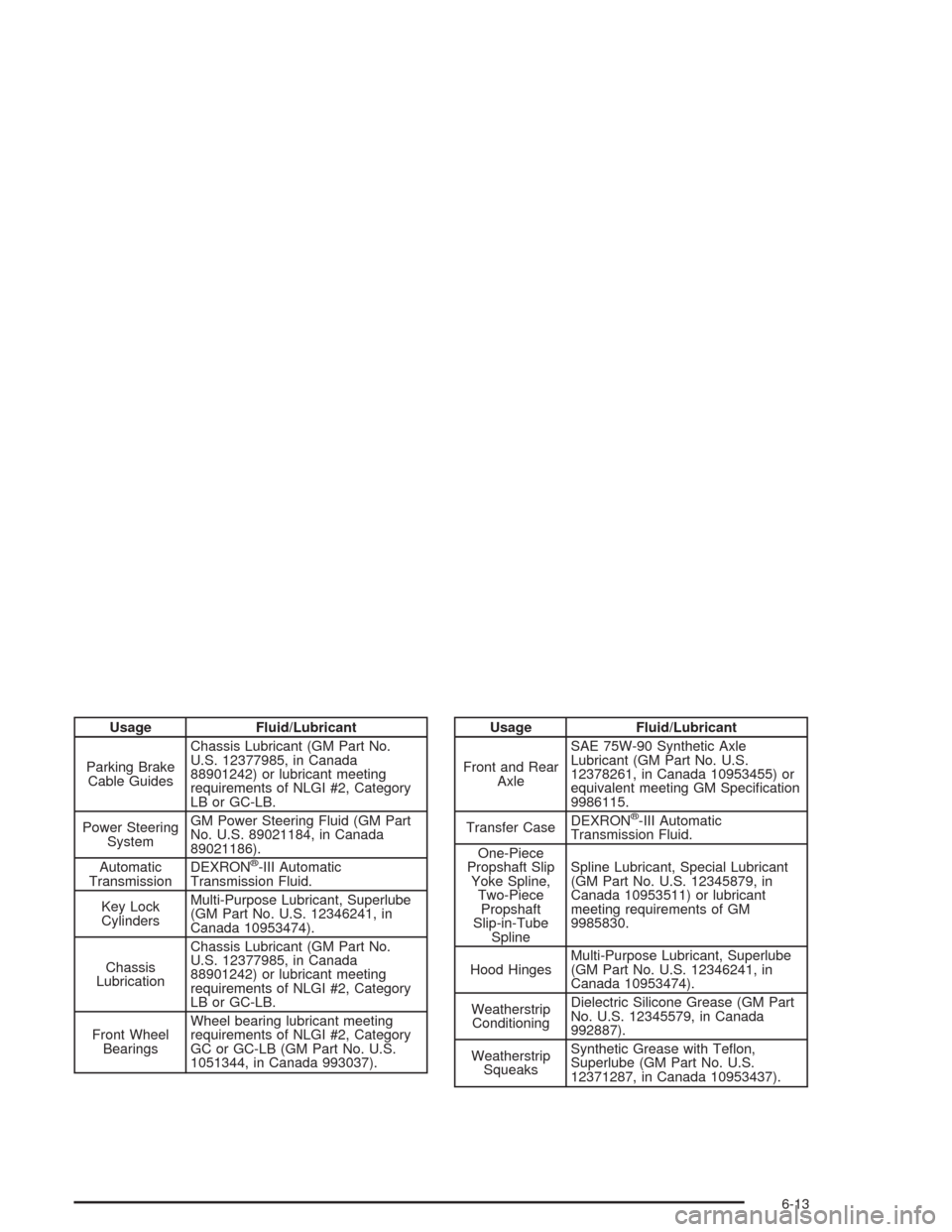
Usage Fluid/Lubricant
Parking Brake
Cable GuidesChassis Lubricant (GM Part No.
U.S. 12377985, in Canada
88901242) or lubricant meeting
requirements of NLGI #2, Category
LB or GC-LB.
Power Steering
SystemGM Power Steering Fluid (GM Part
No. U.S. 89021184, in Canada
89021186).
Automatic
TransmissionDEXRON
®-III Automatic
Transmission Fluid.
Key Lock
CylindersMulti-Purpose Lubricant, Superlube
(GM Part No. U.S. 12346241, in
Canada 10953474).
Chassis
LubricationChassis Lubricant (GM Part No.
U.S. 12377985, in Canada
88901242) or lubricant meeting
requirements of NLGI #2, Category
LB or GC-LB.
Front Wheel
BearingsWheel bearing lubricant meeting
requirements of NLGI #2, Category
GC or GC-LB (GM Part No. U.S.
1051344, in Canada 993037).
Usage Fluid/Lubricant
Front and Rear
AxleSAE 75W-90 Synthetic Axle
Lubricant (GM Part No. U.S.
12378261, in Canada 10953455) or
equivalent meeting GM Specication
9986115.
Transfer CaseDEXRON
®-III Automatic
Transmission Fluid.
One-Piece
Propshaft Slip
Yoke Spline,
Two-Piece
Propshaft
Slip-in-Tube
SplineSpline Lubricant, Special Lubricant
(GM Part No. U.S. 12345879, in
Canada 10953511) or lubricant
meeting requirements of GM
9985830.
Hood HingesMulti-Purpose Lubricant, Superlube
(GM Part No. U.S. 12346241, in
Canada 10953474).
Weatherstrip
ConditioningDielectric Silicone Grease (GM Part
No. U.S. 12345579, in Canada
992887).
Weatherstrip
SqueaksSynthetic Grease with Teon,
Superlube (GM Part No. U.S.
12371287, in Canada 10953437).
6-13
Page 393 of 406
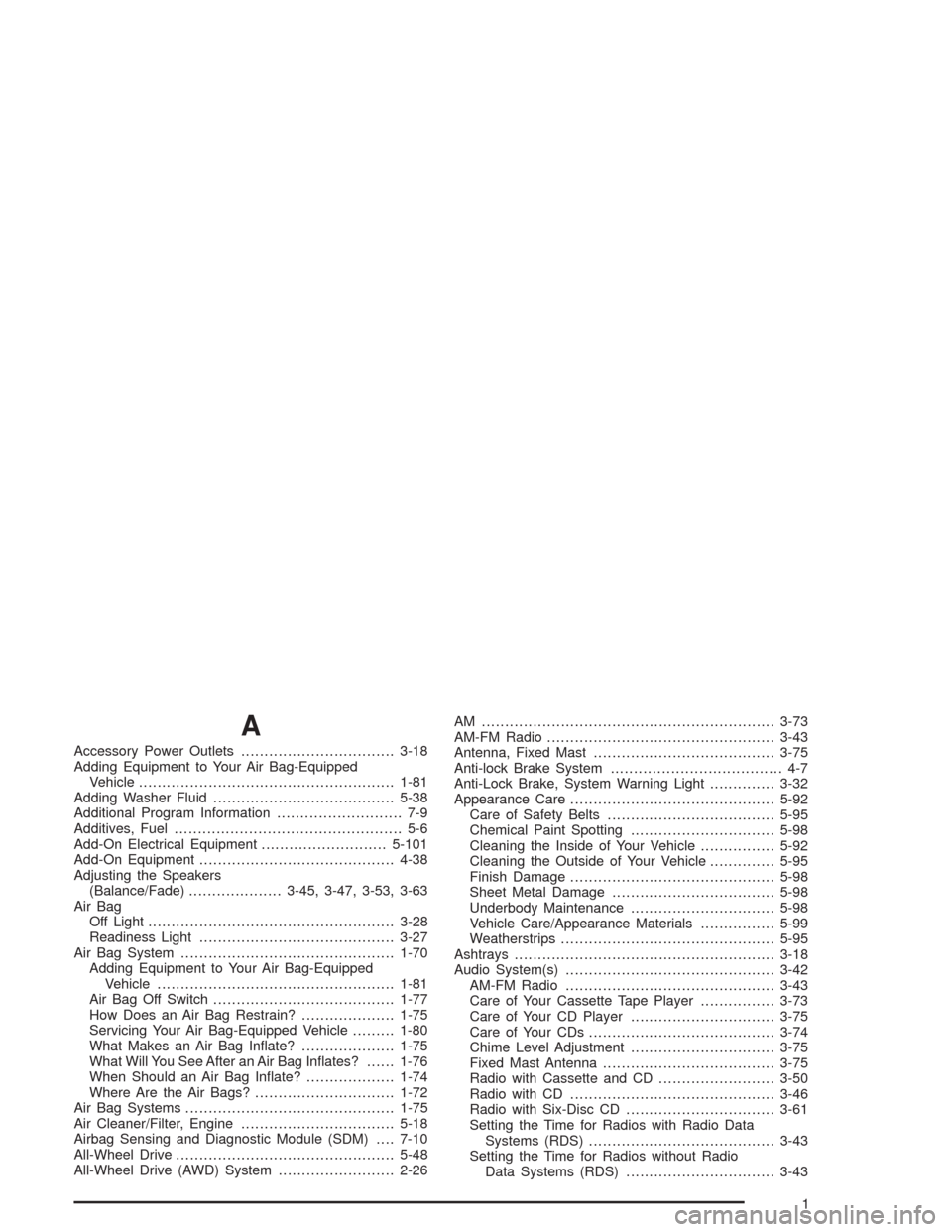
A
Accessory Power Outlets.................................3-18
Adding Equipment to Your Air Bag-Equipped
Vehicle.......................................................1-81
Adding Washer Fluid.......................................5-38
Additional Program Information........................... 7-9
Additives, Fuel................................................. 5-6
Add-On Electrical Equipment...........................5-101
Add-On Equipment..........................................4-38
Adjusting the Speakers
(Balance/Fade)....................3-45, 3-47, 3-53, 3-63
Air Bag
Off Light.....................................................3-28
Readiness Light..........................................3-27
Air Bag System..............................................1-70
Adding Equipment to Your Air Bag-Equipped
Vehicle...................................................1-81
Air Bag Off Switch.......................................1-77
How Does an Air Bag Restrain?....................1-75
Servicing Your Air Bag-Equipped Vehicle.........1-80
What Makes an Air Bag Inate?....................1-75
What Will You See After an Air Bag Inates?......1-76
When Should an Air Bag Inate?...................1-74
Where Are the Air Bags?..............................1-72
Air Bag Systems.............................................1-75
Air Cleaner/Filter, Engine.................................5-18
Airbag Sensing and Diagnostic Module (SDM)....7-10
All-Wheel Drive...............................................5-48
All-Wheel Drive (AWD) System.........................2-26AM ...............................................................3-73
AM-FM Radio.................................................3-43
Antenna, Fixed Mast.......................................3-75
Anti-lock Brake System..................................... 4-7
Anti-Lock Brake, System Warning Light..............3-32
Appearance Care............................................5-92
Care of Safety Belts....................................5-95
Chemical Paint Spotting...............................5-98
Cleaning the Inside of Your Vehicle................5-92
Cleaning the Outside of Your Vehicle..............5-95
Finish Damage............................................5-98
Sheet Metal Damage...................................5-98
Underbody Maintenance...............................5-98
Vehicle Care/Appearance Materials................5-99
Weatherstrips..............................................5-95
Ashtrays........................................................3-18
Audio System(s).............................................3-42
AM-FM Radio.............................................3-43
Care of Your Cassette Tape Player................3-73
Care of Your CD Player...............................3-75
Care of Your CDs........................................3-74
Chime Level Adjustment...............................3-75
Fixed Mast Antenna.....................................3-75
Radio with Cassette and CD.........................3-50
Radio with CD............................................3-46
Radio with Six-Disc CD................................3-61
Setting the Time for Radios with Radio Data
Systems (RDS)........................................3-43
Setting the Time for Radios without Radio
Data Systems (RDS)................................3-43
1