climate control CHEVROLET EXPRESS CARGO VAN 2006 1.G User Guide
[x] Cancel search | Manufacturer: CHEVROLET, Model Year: 2006, Model line: EXPRESS CARGO VAN, Model: CHEVROLET EXPRESS CARGO VAN 2006 1.GPages: 406, PDF Size: 2.51 MB
Page 252 of 406
Safety Chains
You should always attach chains between your
vehicle and your trailer. Cross the safety chains under
the tongue of the trailer to help prevent the tongue from
contacting the road if it becomes separated from the
hitch. Instructions about safety chains may be provided
by the hitch manufacturer or by the trailer manufacturer.
Follow the manufacturer’s recommendation for
attaching safety chains and do not attach them to the
bumper. Always leave just enough slack so you can
turn with your rig. Never allow safety chains to drag
on the ground.
Trailer Brakes
If your trailer weighs more than 1,000 lbs (450 kg)
loaded, then it needs its own brakes — and they must
be adequate. Be sure to read and follow the instructions
for the trailer brakes so you’ll be able to install, adjust
and maintain them properly.
Since your vehicle is equipped with StabiliTrak
®, your
trailer brake system cannot tap into the vehicle’s
hydraulic brake system.
Driving with a Trailer
{CAUTION:
If you have a rear-most window open and you
pull a trailer with your vehicle, carbon
monoxide (CO) could come into your vehicle.
You can not see or smell CO. It can cause
unconsciousness or death. SeeEngine
Exhaust on page 2-27. To maximize your safety
when towing a trailer:
Have your exhaust system inspected for
leaks, and make necessary repairs before
starting on your trip.
Keep the rear-most windows closed.
If exhaust does come into your vehicle
through a window in the rear or another
opening, drive with your front, main
heating or cooling system on and with the
fan on any speed. This will bring fresh,
outside air into your vehicle. Do not use
the climate control setting for maximum air
because it only recirculates the air inside
your vehicle. See Climate Control System
in the Index.
4-48
Page 322 of 406
Uniform Tire Quality Grading
Quality grades can be found where applicable on the
tire sidewall between tread shoulder and maximum
section width. For example:
Treadwear 200 Traction AA Temperature A
The following information relates to the system developed
by the United States National Highway Traffic Safety
Administration (NHTSA), which grades tires by
treadwear, traction, and temperature performance.
This applies only to vehicles sold in the United States.
The grades are molded on the sidewalls of most
passenger car tires. The Uniform Tire Quality Grading
(UTQG) system does not apply to deep tread, winter-type
snow tires, space-saver, or temporary use spare tires,
tires with nominal rim diameters of 10 to 12 inches
(25 to 30 cm), or to some limited-production tires.
While the tires available on General Motors passenger
cars and light trucks may vary with respect to these
grades, they must also conform to federal safety
requirements and additional General Motors Tire
Performance Criteria (TPC) standards.
Treadwear
The treadwear grade is a comparative rating based on
the wear rate of the tire when tested under controlled
conditions on a specified government test course.
For example, a tire graded 150 would wear one and
a half (1.5) times as well on the government course as
a tire graded 100. The relative performance of tires
depends upon the actual conditions of their use,
however, and may depart significantly from the norm
due to variations in driving habits, service practices, and
differences in road characteristics and climate.
Traction – AA, A, B, C
The traction grades, from highest to lowest, are AA, A,
B, and C. Those grades represent the tire’s ability
to stop on wet pavement as measured under controlled
conditions on specified government test surfaces of
asphalt and concrete. A tire marked C may have poor
traction performance.
Warning:The traction grade assigned to this tire is
based on straight-ahead braking traction tests, and does
not include acceleration, cornering, hydroplaning, or
peak traction characteristics.
5-66
Page 351 of 406
Floor Console Fuse Block
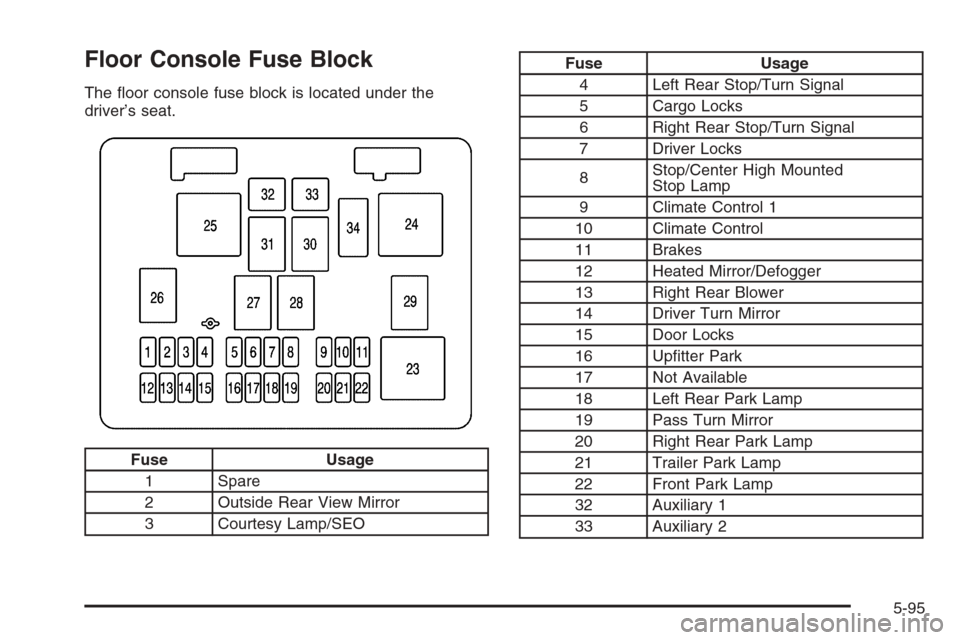
The floor console fuse block is located under the
driver’s seat.
Fuse Usage
1 Spare
2 Outside Rear View Mirror
3 Courtesy Lamp/SEO
Fuse Usage
4 Left Rear Stop/Turn Signal
5 Cargo Locks
6 Right Rear Stop/Turn Signal
7 Driver Locks
8Stop/Center High Mounted
Stop Lamp
9 Climate Control 1
10 Climate Control
11 Brakes
12 Heated Mirror/Defogger
13 Right Rear Blower
14 Driver Turn Mirror
15 Door Locks
16 Upfitter Park
17 Not Available
18 Left Rear Park Lamp
19 Pass Turn Mirror
20 Right Rear Park Lamp
21 Trailer Park Lamp
22 Front Park Lamp
32 Auxiliary 1
33 Auxiliary 2
5-95
Page 354 of 406
Fuse Usage
45 Right Headlamp - High Beam
46Truck Body Controller- Accessory
(Gas), Truck Body Controller,
Transmission Control Module
Accessory (Diesel)
47 Front Windshield Wiper
48Anti-lock Brakes, Vehicle Stability
Enhancement System
49 Ignition A
50 Trailer
51 Climate Control Blower
52 Ignition B
63Spare (Gas), Engine Control Module
Actuator (Diesel)
64 SpareRelays Usage
53 Windshield Wiper
54 Air Conditioning
55Spare (Gas), Rear Fog
Lamps (Diesel)
56 Headlamp - High Beam
57 Fuel Pump
58 Headlamp - Low Beam
59 Horn
SPARE (G),
ECM (D)Spare (Gas), Engine Control
Module (Diesel)
STRTR Starter
Circuit Breaker Usage
PWR SEAT Power Seat
5-98
Page 355 of 406
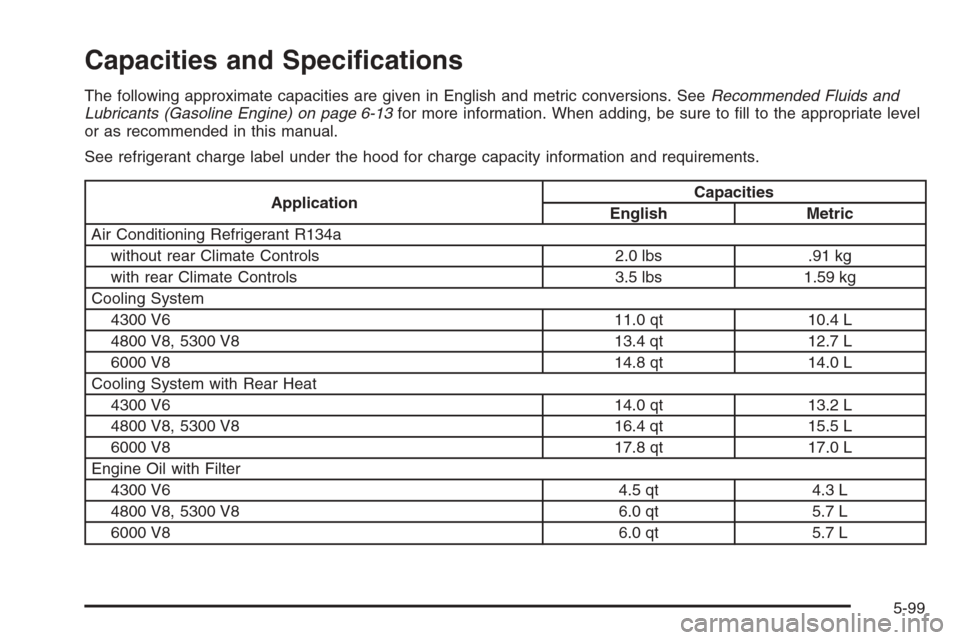
Capacities and Specications
The following approximate capacities are given in English and metric conversions. SeeRecommended Fluids and
Lubricants (Gasoline Engine) on page 6-13for more information. When adding, be sure to fill to the appropriate level
or as recommended in this manual.
See refrigerant charge label under the hood for charge capacity information and requirements.
ApplicationCapacities
English Metric
Air Conditioning Refrigerant R134a
without rear Climate Controls 2.0 lbs .91 kg
with rear Climate Controls 3.5 lbs 1.59 kg
Cooling System
4300 V6 11.0 qt 10.4 L
4800 V8, 5300 V8 13.4 qt 12.7 L
6000 V8 14.8 qt 14.0 L
Cooling System with Rear Heat
4300 V6 14.0 qt 13.2 L
4800 V8, 5300 V8 16.4 qt 15.5 L
6000 V8 17.8 qt 17.0 L
Engine Oil with Filter
4300 V6 4.5 qt 4.3 L
4800 V8, 5300 V8 6.0 qt 5.7 L
6000 V8 6.0 qt 5.7 L
5-99
Page 395 of 406
Center High-Mounted Stoplamp (CHMSL)............5-50
Center Passenger Position, Safety Belts.......1-25, 1-26
Chains, Tire...................................................5-69
Charging System Light....................................3-32
Check
Engine Light...............................................3-36
Gages Warning Light...................................3-42
Checking Things Under the Hood......................5-10
Chemical Paint Spotting...................................5-91
Child Restraints
Child Restraint Systems...............................1-37
Infants and Young Children...........................1-34
Lower Anchors and Tethers for Children..........1-43
Older Children.............................................1-31
Securing a Child Restraint in a
Center Seat Position.................................1-54
Securing a Child Restraint in a
Rear Outside Seat Position or the
Second Row Center Seat Position..............1-52
Securing a Child Restraint in the
Right Front Seat Position..................1-56, 1-60
Where to Put the Restraint...........................1-41
Chime Level Adjustment..................................3-79
Cigarette Lighter.............................................3-17
Cleaning
Aluminum Wheels........................................5-90
Exterior Lamps/Lenses.................................5-88
Fabric/Carpet..............................................5-86Cleaning (cont.)
Finish Care.................................................5-88
Inside of Your Vehicle..................................5-84
Instrument Panel, Vinyl, and Other
Plastic Surfaces.......................................5-87
Tires..........................................................5-90
Underbody Maintenance...............................5-91
Washing Your Vehicle...................................5-88
Weatherstrips..............................................5-87
Windshield and Wiper Blades........................5-89
Climate Control System...................................3-18
Outlet Adjustment........................................3-20
Rear Air Conditioning and Heating System......3-21
Rear Heating System...................................3-21
Collision Damage Repair..................................7-11
Comfort Guides, Rear Safety Belt.....................1-28
Compass.......................................................2-29
Control of a Vehicle.......................................... 4-6
Coolant
Engine Temperature Gage............................3-36
Heater, Engine............................................2-20
Cooling System..............................................5-26
Cruise Control................................................3-10
Cruise Control Light........................................3-41
Customer Assistance Information
Courtesy Transportation.................................. 7-8
Customer Assistance for Text
Telephone (TTY) Users............................... 7-4
3