wheel CHEVROLET EXPRESS CARGO VAN 2006 1.G Owner's Guide
[x] Cancel search | Manufacturer: CHEVROLET, Model Year: 2006, Model line: EXPRESS CARGO VAN, Model: CHEVROLET EXPRESS CARGO VAN 2006 1.GPages: 406, PDF Size: 2.51 MB
Page 233 of 406
Run your engine only as long as you must. This saves
fuel. When you run the engine, make it go a little
faster than just idle. That is, push the accelerator
slightly. This uses less fuel for the heat that you get and
it keeps the battery (or batteries) charged. You will
need a well-charged battery (or batteries) to restart the
vehicle, and possibly for signaling later on with your
headlamps. Let the heater run for a while.
Then, shut the engine off and close the window almost
all the way to preserve the heat. Start the engine again
and repeat this only when you feel really uncomfortable
from the cold. But do it as little as possible. Preserve
the fuel as long as you can. To help keep warm, you can
get out of the vehicle and do some fairly vigorous
exercises every half hour or so until help comes.
If Your Vehicle is Stuck in Sand,
Mud, Ice, or Snow
In order to free your vehicle when it is stuck, you will
need to spin the wheels, but you do not want to spin
your wheels too fast. The method known as rocking can
help you get out when you are stuck, but you must
use caution.
{CAUTION:
If you let your tires spin at high speed, they
can explode, and you or others could be
injured. And, the transmission or other parts of
the vehicle can overheat. That could cause an
engine compartment re or other damage.
When you are stuck, spin the wheels as little
as possible. Do not spin the wheels above
35 mph (55 km/h) as shown on the
speedometer.
Notice:Spinning your wheels can destroy parts of
your vehicle as well as the tires. If you spin the
wheels too fast while shifting your transmission
back and forth, you can destroy your transmission.
For more information about using tire chains on your
vehicle, seeTire Chains on page 5-69.
4-29
Page 234 of 406
Rocking Your Vehicle to Get It Out
First, turn your steering wheel left and right. That
will clear the area around your front wheels. Then shift
back and forth between REVERSE (R) and a forward
gear, spinning the wheels as little as possible. Release
the accelerator pedal while you shift, and press
lightly on the accelerator pedal when the transmission is
in gear. By slowly spinning your wheels in the forward
and reverse directions, you will cause a rocking
motion that may free your vehicle. If that does not get
you out after a few tries, you may need to be towed out.
If you do need to be towed out, seeTowing Your
Vehicle on page 4-35.
Loading Your Vehicle
It is very important to know how much weight your
vehicle can carry. This weight is called the vehicle
capacity weight and includes the weight of all occupants,
cargo, and all nonfactory-installed options. Two labels
on your vehicle show how much weight it was designed
to carry, the Tire and Loading Information label and
the Certification/Tire label.
{CAUTION:
Do not load your vehicle any heavier than the
Gross Vehicle Weight Rating (GVWR), or either
the maximum front or rear Gross Axle Weight
Rating (GAWR). If you do, parts on your
vehicle can break, and it can change the way
your vehicle handles. These could cause you
to lose control and crash. Also, overloading
can shorten the life of your vehicle.
4-30
Page 239 of 406
{CAUTION:
Things you put inside your vehicle can strike
and injure people in a sudden stop or turn,
or in a crash.
Put things in the cargo area of your
vehicle. Try to spread the weight evenly.
Never stack heavier things, like suitcases,
inside the vehicle so that some of them
are above the tops of the seats.
Do not leave an unsecured child restraint
in your vehicle.
When you carry something inside the
vehicle, secure it whenever you can.
Do not leave a seat folded down unless
you need to.
Add-On Equipment
When you carry removable items, you may need to put
a limit on how many people you carry inside your
vehicle. Be sure to weigh your vehicle before you buy
and install the new equipment.
Towing
Towing Your Vehicle
Consult your dealer or a professional towing service if
you need to have your disabled vehicle towed. See
Roadside Assistance Program on page 7-6.
If you want to tow your vehicle behind another vehicle
for recreational purposes (such as behind a motorhome),
see “Recreational Vehicle Towing” following.
Recreational Vehicle Towing
Recreational vehicle towing means towing your vehicle
behind another vehicle — such as behind a motorhome.
The two most common types of recreational vehicle
towing are known as “dinghy” (towing your vehicle with
all four wheels on the ground) and “dolly” (towing your
vehicle with two wheels on the ground and two wheels
up on a device known as a “dolly”).
With the proper preparation and equipment, many
vehicles can be towed in these ways. See “Dinghy
Towing” and “Dolly Towing” following.
4-35
Page 240 of 406
Here are some important things to consider before you
do recreational vehicle towing:
•What’s the towing capacity of the towing vehicle?
Be sure you read the tow vehicle manufacturer’s
recommendations.
•How far will you tow? Some vehicles have
restrictions on how far and how long they can tow.
•Do you have the proper towing equipment?
See your dealer or trailering professional for
additional advice and equipment recommendations.
•Is your vehicle ready to be towed? Just as you would
prepare your vehicle for a long trip, you’ll want to
make sure your vehicle is prepared to be towed.
Dinghy Towing
Two-Wheel-Drive Vehicles
Notice:If you tow your vehicle with all four wheels
on the ground, the drivetrain components could
be damaged. The repairs would not be covered by
your warranty. Do not tow your vehicle with all
four wheels on the ground.
Two-wheel-drive vehicles should not be towed with
all four wheels on the ground. Two-wheel-drive
transmissions have no provisions for internal lubrication
while being towed.
All-Wheel-Drive Vehicles
Your vehicle was not designed to be towed with all
four wheels on the ground. To properly tow these
vehicles, they should be placed on a platform trailer
with all four wheels off the ground.
Notice:Towing an all-wheel-drive vehicle with all
four wheels on the ground, or even with only two of
its wheels on the ground, will damage drivetrain
components. Do not tow an all-wheel-drive vehicle if
any of its wheels will be on the ground.
Dolly Towing
Rear Towing (Rear Wheels Off the Ground)
Two-Wheel-Drive Vehicles
Use the following procedure to tow your vehicle from
the rear:
1. Drive the vehicle onto the dolly.
2. Firmly set the parking brake. SeeParking Brake
on page 2-24for more information.
3. Put the automatic transmission in PARK (P).
4-36
Page 241 of 406
4. Follow the dolly manufacturer’s instructions to
attach and secure the vehicle being towed to
the dolly and then the loaded dolly to the tow
vehicle. Make sure the wheels are straight
before towing.
Use an adequate clamping device to ensure that
the front wheels are locked into the straight position.
5. Release the parking brake only after the vehicle
being towed is firmly attached to the tow vehicle.
6. Turn the ignition to LOCK.
If the tow vehicle will not be started or driven for
six weeks or more, remove the battery cable
from the negative terminal (post) of the battery to
prevent your battery from draining while towing.
All-Wheel-Drive Vehicles
Your vehicle was not designed to be towed with
two wheels on the ground. To properly tow these
vehicles, they should be placed on a platform trailer
with all four wheels off the ground.
Notice:Towing an all-wheel-drive vehicle with all
four wheels on the ground, or even with only two of
its wheels on the ground, will damage drivetrain
components. Do not tow an all-wheel-drive vehicle if
any of its wheels will be on the ground.
Towing a Trailer
{CAUTION:
If you do not use the correct equipment and
drive properly, you can lose control when you
pull a trailer. For example, if the trailer is too
heavy, the brakes may not work well — or even
at all. You and your passengers could be
seriously injured. Pull a trailer only if you have
followed all the steps in this section. Ask your
dealer for advice and information about towing
a trailer with your vehicle.
Notice:Pulling a trailer improperly can damage
your vehicle and result in costly repairs that would
not be covered by your warranty. Always follow
the instructions in this section and check with your
dealer for more information about towing a trailer
with your vehicle.
To identify the trailering capacity of your vehicle, you
should read the information in “Weight of the Trailer” that
appears later in this section.
4-37
Page 243 of 406
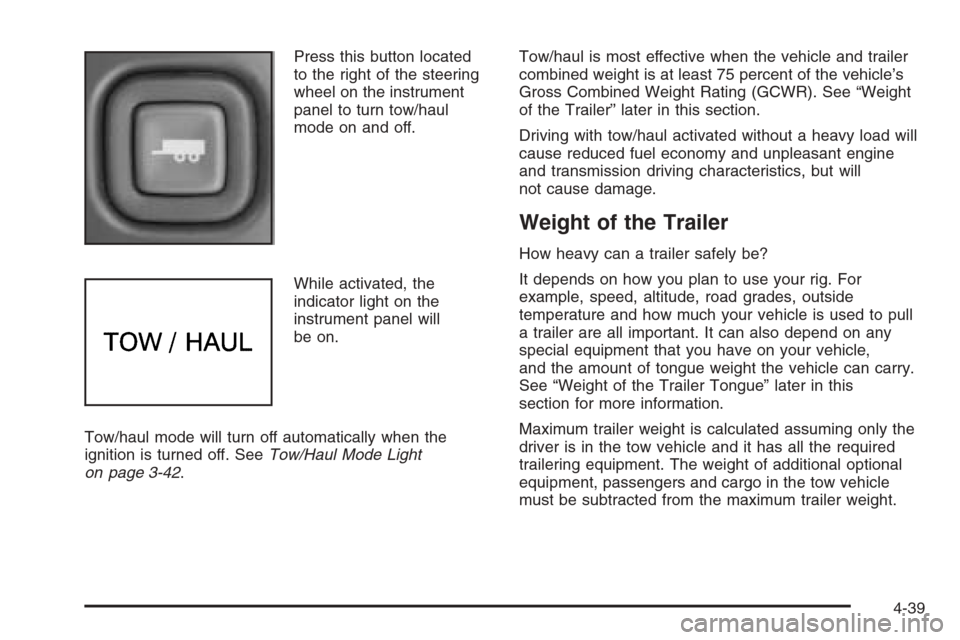
Press this button located
to the right of the steering
wheel on the instrument
panel to turn tow/haul
mode on and off.
While activated, the
indicator light on the
instrument panel will
be on.
Tow/haul mode will turn off automatically when the
ignition is turned off. SeeTow/Haul Mode Light
on page 3-42.Tow/haul is most effective when the vehicle and trailer
combined weight is at least 75 percent of the vehicle’s
Gross Combined Weight Rating (GCWR). See “Weight
of the Trailer” later in this section.
Driving with tow/haul activated without a heavy load will
cause reduced fuel economy and unpleasant engine
and transmission driving characteristics, but will
not cause damage.
Weight of the Trailer
How heavy can a trailer safely be?
It depends on how you plan to use your rig. For
example, speed, altitude, road grades, outside
temperature and how much your vehicle is used to pull
a trailer are all important. It can also depend on any
special equipment that you have on your vehicle,
and the amount of tongue weight the vehicle can carry.
See “Weight of the Trailer Tongue” later in this
section for more information.
Maximum trailer weight is calculated assuming only the
driver is in the tow vehicle and it has all the required
trailering equipment. The weight of additional optional
equipment, passengers and cargo in the tow vehicle
must be subtracted from the maximum trailer weight.
4-39
Page 245 of 406

Vehicle Axle Ratio Maximum Trailer Weight GCWR
G2500 Cargo Van 2WD
4300 V6 3.73 4,600 lbs (2 086 kg) 10,000 lbs (4 536 kg)
4800 V83.73
4.106,300 lbs (2 858 kg)
7,300 lbs (3 311 kg)12,000 lbs (5 443 kg)
13,000 lbs (5 897 kg)
5300 V8 3.73 6,600 lbs (2 994 kg) 12,000 lbs (5 443 kg)
6000 V83.73
4.108,300 lbs (3 765 kg)
10,000 lbs (4 536 kg)14,000 lbs (6 350 kg)
16,000 lbs (7 257 kg)
6600 V8 Diesel 3.73 10,000 lbs (4 536 kg) 17,000 lbs (7 711 kg)
Vehicle Axle Ratio Maximum Trailer Weight GCWR
H2500 Cargo Van AWD
5300 V8 3.73 6,400 lbs (2 903 kg) 12,000 lbs (5 443 kg)
Vehicle Axle Ratio Maximum Trailer Weight GCWR
G2500 Cargo Van 2WD Long Wheelbase
4300 V6 3.73 4,400 lbs (1 996 kg) 10,000 lbs (4 536 kg)
4800 V83.73
4.106,100 lbs (2 767 kg)
7,100 lbs (3 220 kg)12,000 lbs (5 443 kg)
13,000 lbs (5 897 kg)
5300 V8 3.73 6,400 lbs (2 903 kg) 12,000 lbs (5 443 kg)
6000 V83.73
4.108,100 lbs (3 674 kg)
10,000 lbs (4 536 kg)14,000 lbs (6 350 kg)
16,000 lbs (7 257 kg)
6600 V8 Diesel 3.73 10,000 lbs (4 536 kg) 17,000 lbs (7 711 kg)
4-41
Page 246 of 406
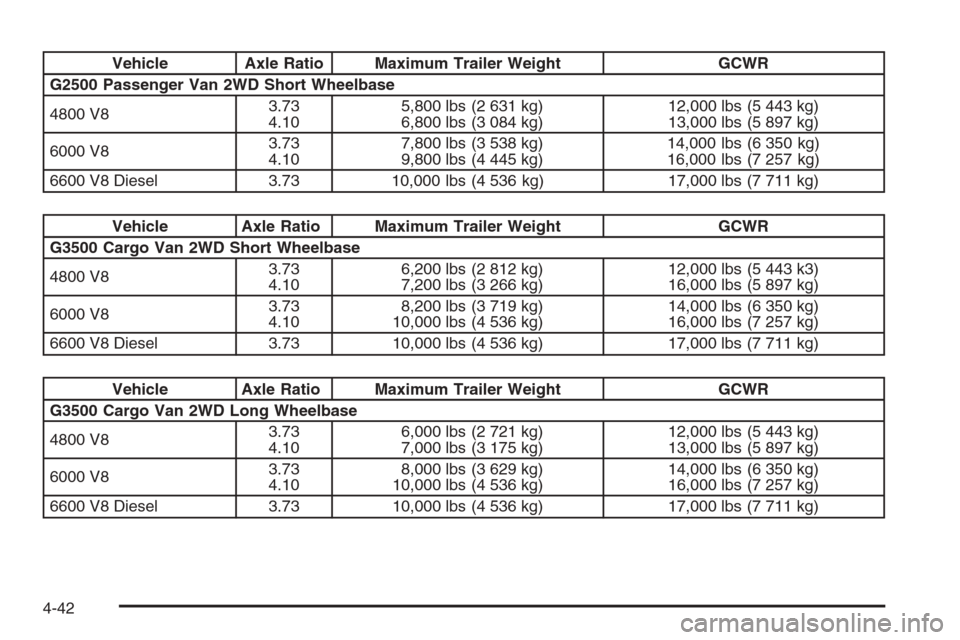
Vehicle Axle Ratio Maximum Trailer Weight GCWR
G2500 Passenger Van 2WD Short Wheelbase
4800 V83.73
4.105,800 lbs (2 631 kg)
6,800 lbs (3 084 kg)12,000 lbs (5 443 kg)
13,000 lbs (5 897 kg)
6000 V83.73
4.107,800 lbs (3 538 kg)
9,800 lbs (4 445 kg)14,000 lbs (6 350 kg)
16,000 lbs (7 257 kg)
6600 V8 Diesel 3.73 10,000 lbs (4 536 kg) 17,000 lbs (7 711 kg)
Vehicle Axle Ratio Maximum Trailer Weight GCWR
G3500 Cargo Van 2WD Short Wheelbase
4800 V83.73
4.106,200 lbs (2 812 kg)
7,200 lbs (3 266 kg)12,000 lbs (5 443 k3)
16,000 lbs (5 897 kg)
6000 V83.73
4.108,200 lbs (3 719 kg)
10,000 lbs (4 536 kg)14,000 lbs (6 350 kg)
16,000 lbs (7 257 kg)
6600 V8 Diesel 3.73 10,000 lbs (4 536 kg) 17,000 lbs (7 711 kg)
Vehicle Axle Ratio Maximum Trailer Weight GCWR
G3500 Cargo Van 2WD Long Wheelbase
4800 V83.73
4.106,000 lbs (2 721 kg)
7,000 lbs (3 175 kg)12,000 lbs (5 443 kg)
13,000 lbs (5 897 kg)
6000 V83.73
4.108,000 lbs (3 629 kg)
10,000 lbs (4 536 kg)14,000 lbs (6 350 kg)
16,000 lbs (7 257 kg)
6600 V8 Diesel 3.73 10,000 lbs (4 536 kg) 17,000 lbs (7 711 kg)
4-42
Page 247 of 406
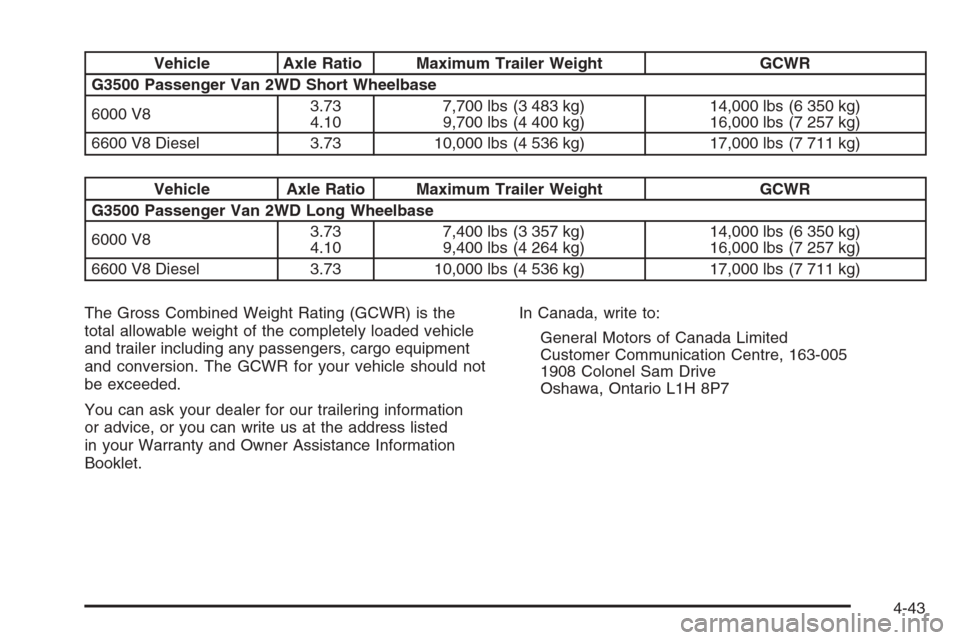
Vehicle Axle Ratio Maximum Trailer Weight GCWR
G3500 Passenger Van 2WD Short Wheelbase
6000 V83.73
4.107,700 lbs (3 483 kg)
9,700 lbs (4 400 kg)14,000 lbs (6 350 kg)
16,000 lbs (7 257 kg)
6600 V8 Diesel 3.73 10,000 lbs (4 536 kg) 17,000 lbs (7 711 kg)
Vehicle Axle Ratio Maximum Trailer Weight GCWR
G3500 Passenger Van 2WD Long Wheelbase
6000 V83.73
4.107,400 lbs (3 357 kg)
9,400 lbs (4 264 kg)14,000 lbs (6 350 kg)
16,000 lbs (7 257 kg)
6600 V8 Diesel 3.73 10,000 lbs (4 536 kg) 17,000 lbs (7 711 kg)
The Gross Combined Weight Rating (GCWR) is the
total allowable weight of the completely loaded vehicle
and trailer including any passengers, cargo equipment
and conversion. The GCWR for your vehicle should not
be exceeded.
You can ask your dealer for our trailering information
or advice, or you can write us at the address listed
in your Warranty and Owner Assistance Information
Booklet.In Canada, write to:
General Motors of Canada Limited
Customer Communication Centre, 163-005
1908 Colonel Sam Drive
Oshawa, Ontario L1H 8P7
4-43
Page 253 of 406
Towing a trailer requires a certain amount of experience.
Before setting out for the open road, you’ll want to get
to know your rig. Acquaint yourself with the feel of
handling and braking with the added weight of the trailer.
And always keep in mind that the vehicle you are
driving is now a good deal longer and not nearly as
responsive as your vehicle is by itself.
Before you start, check all trailer hitch parts and
attachments, safety chains, electrical connector, lamps,
tires and mirror adjustment. If the trailer has electric
brakes, start your vehicle and trailer moving and then
apply the trailer brake controller by hand to be sure
the brakes are working. This lets you check your
electrical connection at the same time.
During your trip, check occasionally to be sure that
the load is secure, and that the lamps and any trailer
brakes are still working.Following Distance
Stay at least twice as far behind the vehicle ahead as
you would when driving your vehicle without a trailer.
This can help you avoid situations that require
heavy braking and sudden turns.
Passing
You’ll need more passing distance up ahead when
you’re towing a trailer. And, because you’re a good deal
longer, you’ll need to go much farther beyond the
passed vehicle before you can return to your lane.
Backing Up
Hold the bottom of the steering wheel with one hand.
Then, to move the trailer to the left, just move that hand
to the left. To move the trailer to the right, move your
hand to the right. Always back up slowly and, if possible,
have someone guide you.
4-49