automatic transmission CHEVROLET EXPRESS CARGO VAN 2007 1.G User Guide
[x] Cancel search | Manufacturer: CHEVROLET, Model Year: 2007, Model line: EXPRESS CARGO VAN, Model: CHEVROLET EXPRESS CARGO VAN 2007 1.GPages: 458, PDF Size: 2.62 MB
Page 309 of 458
3. Clean the engine air cleaner/filter housing.
4. Inspect or replace the engine air cleaner/filter.
Make sure that the filter fits properly into the
housing.
5. Reinstall the cover and fasten the
retaining clips.
{CAUTION:
Operating the engine with the air cleaner/
lter off can cause you or others to be
burned. The air cleaner not only cleans the
air; it helps to stop ames if the engine
backres. If it is not there and the engine
backres, you could be burned. Do not
drive with it off, and be careful working on
the engine with the air cleaner/lter off.
Notice:If the air cleaner/lter is off, a backre
can cause a damaging engine re. And, dirt
can easily get into your engine, which will
damage it. Always have the air cleaner/lter
in place when you are driving.
Automatic Transmission Fluid
If your vehicle has the DURAMAX®Diesel engine,
see the DURAMAX®Diesel manual for more
information.
When to Check and Change
Automatic Transmission Fluid
A good time to check your automatic transmission
fluid level is when the engine oil is changed.
Change the fluid and filter at the intervals listed in
Additional Required Services (Gasoline Engine)
on page 408, and be sure to use the transmission
fluid listed inRecommended Fluids and
Lubricants on page 415.
309
Page 310 of 458
How to Check Automatic
Transmission Fluid
Because this operation can be a little difficult, you
may choose to have this done at the dealer/retailer
service department.
If you do it yourself, be sure to follow all the
instructions here, or you could get a false reading
on the dipstick.
Notice:Too much or too little uid can
damage your transmission. Too much can
mean that some of the uid could come out
and fall on hot engine parts or exhaust system
parts, starting a re. Too little uid could
cause the transmission to overheat. Be sure
to get an accurate reading if you check
your transmission uid.
Wait at least 30 minutes before checking the
transmission fluid level if you have been driving:
•When outside temperatures are
above 90°F (32°C).
•At high speed for quite a while.
•In heavy traffic — especially in hot weather.
•While pulling a trailer.To get the right reading, the fluid should be
at normal operating temperature, which is
180°F to 200°F (82°C to 93°C).
Get the vehicle warmed up by driving about
15 miles (24 km) when outside temperatures are
above 50°F (10°C). If it is colder than 50°F (10°C),
drive the vehicle in DRIVE (D) until the engine
temperature gage moves and then remains
steady for 10 minutes.
A cold fluid check can be made after the vehicle
has been sitting for eight hours or more with
the engine off, but this is used only as a reference.
Let the engine run at idle for five minutes if
outside temperatures are 50°F (10°C) or more.
If it is colder than 50°F (10°C), you may have
to idle the engine longer. Should the fluid level be
low during this cold check, you must check the
fluid hot before adding fluid. Checking the fluid
hot will give you a more accurate reading of
the fluid level.
310
Page 312 of 458
How to Add Automatic
Transmission Fluid
Refer to the Maintenance Schedule to determine
what kind of transmission fluid to use. See
Recommended Fluids and Lubricants on page 415.
Using a funnel, add fluid down the transmission
dipstick tube only after checking the transmission
fluid while it is hot. A cold check is used only
as a reference. If the fluid level is low, add only
enough of the proper fluid to bring the level up to
the HOT area for a hot check. It does not take
much fluid, generally less than one pint (0.5 L).
Do not overfill.
Notice:Use of the incorrect automatic
transmission uid may damage your vehicle,
and the damages may not be covered by
your warranty. Always use the automatic
transmission uid listed inRecommended
Fluids and Lubricants on page 415.
•After adding fluid, recheck the fluid level as
described under “How to Check Automatic
Transmission Fluid,” earlier in this section.
•When the correct fluid level is obtained, push
the dipstick back in all the way; then flip the
handle down to lock the dipstick in place.
Engine Coolant
If your vehicle has the DURAMAX®Diesel engine,
see the DURAMAX®Diesel manual for more
information.
The cooling system in your vehicle is filled with
DEX-COOL
®engine coolant. This coolant is
designed to remain in your vehicle for five years
or 150,000 miles (240 000 km), whichever
occurs first, if you add only DEX-COOL
®
extended life coolant.
The following explains your cooling system and
how to add coolant when it is low. If you have
a problem with engine overheating, seeEngine
Overheating on page 315.
A 50/50 mixture of clean, drinkable water and
DEX-COOL
®coolant will:
•Give freezing protection down to−34°F (−37°C).
•Give boiling protection up to 265°F (129°C).
•Protect against rust and corrosion.
•Help keep the proper engine temperature.
•Let the warning lights and gages work as
they should.
312
Page 331 of 458
Notice:Ignoring these steps could result in
costly damage to your vehicle that would
not be covered by your warranty.
Trying to start your vehicle by pushing or
pulling it will not work, and it could damage
your vehicle.
1. Check the other vehicle. It must have a
12-volt battery with a negative ground system.
Notice:If the other vehicle’s system is not
a 12-volt system with a negative ground, both
vehicles can be damaged. Only use vehicles
with 12-volt systems with negative grounds to
jump start your vehicle.
2. Get the vehicles close enough so the jumper
cables can reach, but be sure the vehicles are
not touching each other. If they are, it could
cause a ground connection you do not
want. You would not be able to start your
vehicle, and the bad grounding could damage
the electrical systems.To avoid the possibility of the vehicles rolling,
set the parking brake firmly on both vehicles
involved in the jump start procedure. Put
an automatic transmission in PARK (P) or a
manual transmission in NEUTRAL before
setting the parking brake.
Notice:If you leave your radio or other
accessories on during the jump starting
procedure, they could be damaged. The
repairs would not be covered by your
warranty. Always turn off your radio and
other accessories when jump starting
your vehicle.
3. Turn off the ignition on both vehicles.
Unplug unnecessary accessories plugged
into the cigarette lighter or the accessory
power outlet. Turn off the radio and all
lamps that are not needed. This will avoid
sparks and help save both batteries.
And it could save the radio!
331
Page 351 of 458
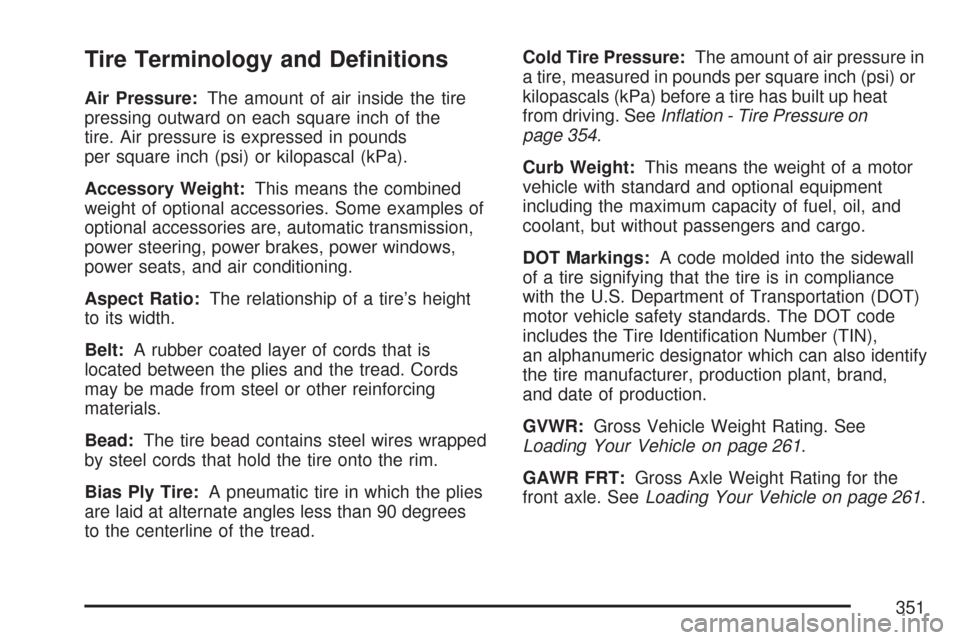
Tire Terminology and Denitions
Air Pressure:The amount of air inside the tire
pressing outward on each square inch of the
tire. Air pressure is expressed in pounds
per square inch (psi) or kilopascal (kPa).
Accessory Weight:This means the combined
weight of optional accessories. Some examples of
optional accessories are, automatic transmission,
power steering, power brakes, power windows,
power seats, and air conditioning.
Aspect Ratio:The relationship of a tire’s height
to its width.
Belt:A rubber coated layer of cords that is
located between the plies and the tread. Cords
may be made from steel or other reinforcing
materials.
Bead:The tire bead contains steel wires wrapped
by steel cords that hold the tire onto the rim.
Bias Ply Tire:A pneumatic tire in which the plies
are laid at alternate angles less than 90 degrees
to the centerline of the tread.Cold Tire Pressure:The amount of air pressure in
a tire, measured in pounds per square inch (psi) or
kilopascals (kPa) before a tire has built up heat
from driving. SeeInation - Tire Pressure on
page 354.
Curb Weight:This means the weight of a motor
vehicle with standard and optional equipment
including the maximum capacity of fuel, oil, and
coolant, but without passengers and cargo.
DOT Markings:A code molded into the sidewall
of a tire signifying that the tire is in compliance
with the U.S. Department of Transportation (DOT)
motor vehicle safety standards. The DOT code
includes the Tire Identification Number (TIN),
an alphanumeric designator which can also identify
the tire manufacturer, production plant, brand,
and date of production.
GVWR:Gross Vehicle Weight Rating. See
Loading Your Vehicle on page 261.
GAWR FRT:Gross Axle Weight Rating for the
front axle. SeeLoading Your Vehicle on page 261.
351
Page 400 of 458
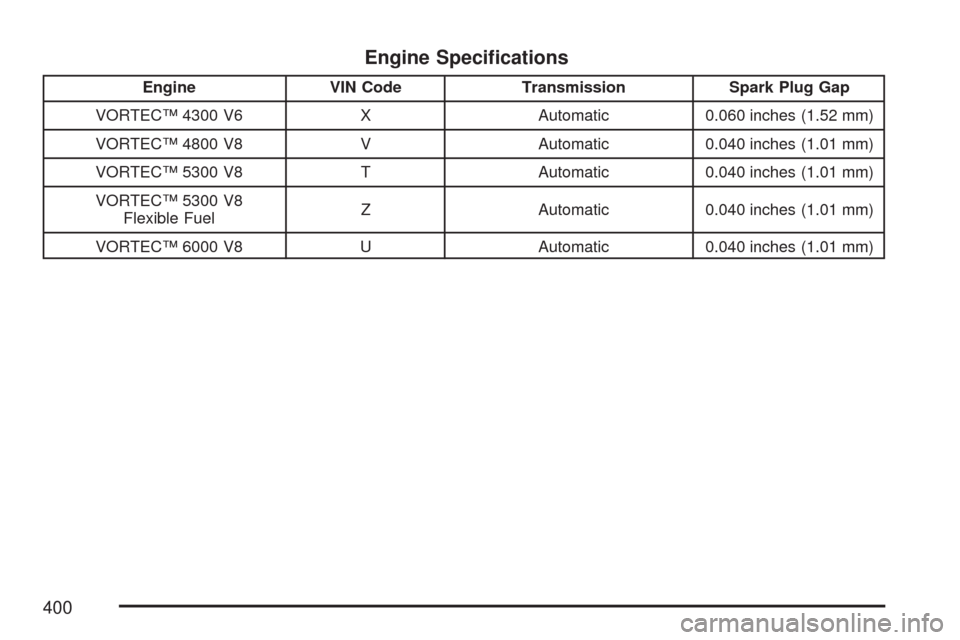
Engine Specications
Engine VIN Code Transmission Spark Plug Gap
VORTEC™ 4300 V6 X Automatic 0.060 inches (1.52 mm)
VORTEC™ 4800 V8 V Automatic 0.040 inches (1.01 mm)
VORTEC™ 5300 V8 T Automatic 0.040 inches (1.01 mm)
VORTEC™ 5300 V8
Flexible FuelZ Automatic 0.040 inches (1.01 mm)
VORTEC™ 6000 V8 U Automatic 0.040 inches (1.01 mm)
400
Page 408 of 458
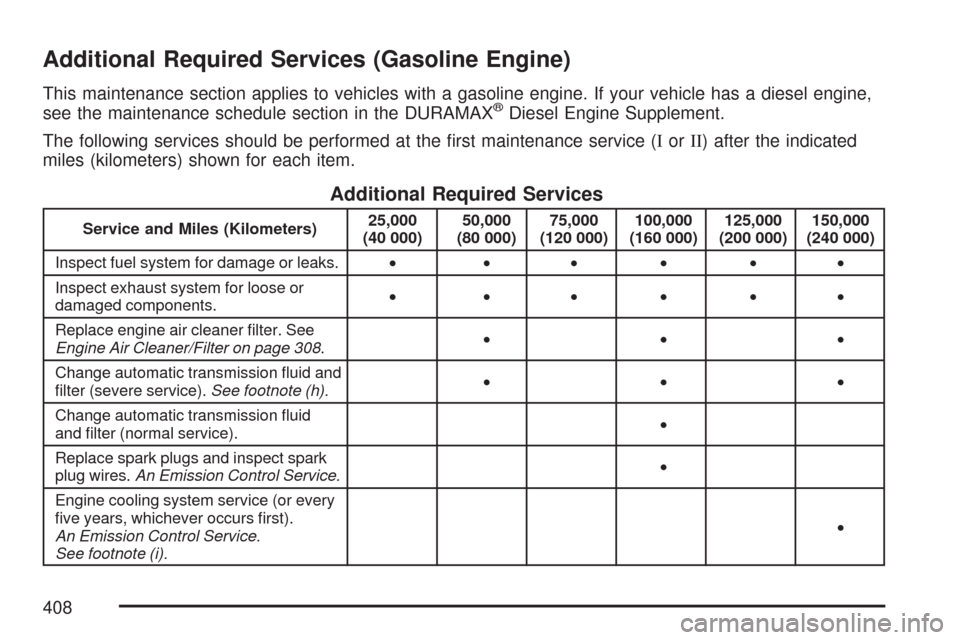
Additional Required Services (Gasoline Engine)
This maintenance section applies to vehicles with a gasoline engine. If your vehicle has a diesel engine,
see the maintenance schedule section in the DURAMAX®Diesel Engine Supplement.
The following services should be performed at the first maintenance service (IorII) after the indicated
miles (kilometers) shown for each item.
Additional Required Services
Service and Miles (Kilometers)25,000
(40 000)50,000
(80 000)75,000
(120 000)100,000
(160 000)125,000
(200 000)150,000
(240 000)
Inspect fuel system for damage or leaks.• •••••
Inspect exhaust system for loose or
damaged components.• •••••
Replace engine air cleaner filter. See
Engine Air Cleaner/Filter on page 308.•••
Change automatic transmission fluid and
filter (severe service).See footnote (h).•••
Change automatic transmission fluid
and filter (normal service).•
Replace spark plugs and inspect spark
plug wires.An Emission Control Service.•
Engine cooling system service (or every
five years, whichever occurs first).
An Emission Control Service.
See footnote (i).•
408
Page 410 of 458
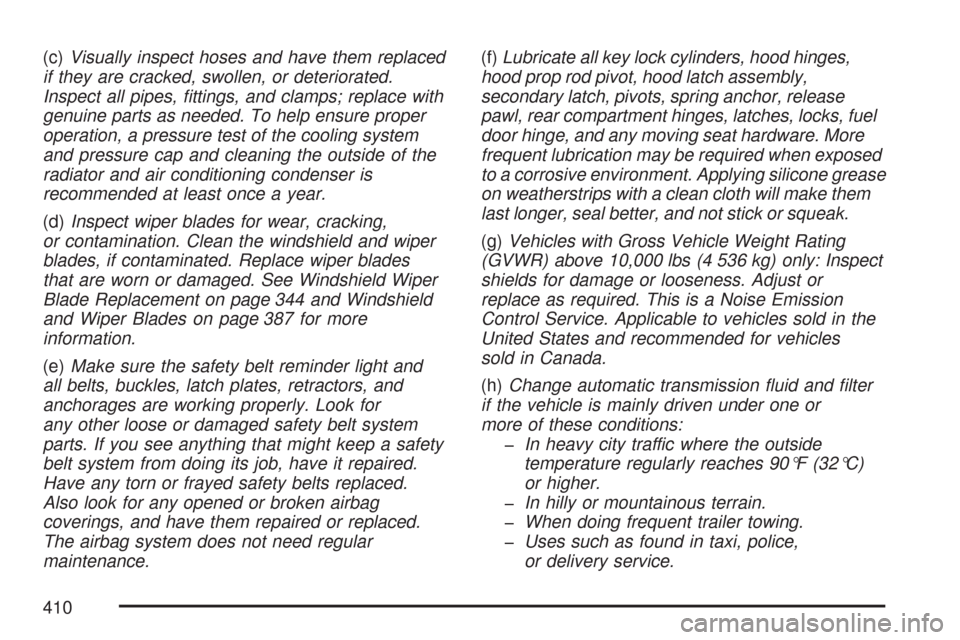
(c)Visually inspect hoses and have them replaced
if they are cracked, swollen, or deteriorated.
Inspect all pipes, ttings, and clamps; replace with
genuine parts as needed. To help ensure proper
operation, a pressure test of the cooling system
and pressure cap and cleaning the outside of the
radiator and air conditioning condenser is
recommended at least once a year.
(d)Inspect wiper blades for wear, cracking,
or contamination. Clean the windshield and wiper
blades, if contaminated. Replace wiper blades
that are worn or damaged. See Windshield Wiper
Blade Replacement on page 344 and Windshield
and Wiper Blades on page 387 for more
information.
(e)Make sure the safety belt reminder light and
all belts, buckles, latch plates, retractors, and
anchorages are working properly. Look for
any other loose or damaged safety belt system
parts. If you see anything that might keep a safety
belt system from doing its job, have it repaired.
Have any torn or frayed safety belts replaced.
Also look for any opened or broken airbag
coverings, and have them repaired or replaced.
The airbag system does not need regular
maintenance.(f)Lubricate all key lock cylinders, hood hinges,
hood prop rod pivot, hood latch assembly,
secondary latch, pivots, spring anchor, release
pawl, rear compartment hinges, latches, locks, fuel
door hinge, and any moving seat hardware. More
frequent lubrication may be required when exposed
to a corrosive environment. Applying silicone grease
on weatherstrips with a clean cloth will make them
last longer, seal better, and not stick or squeak.
(g)Vehicles with Gross Vehicle Weight Rating
(GVWR) above 10,000 lbs (4 536 kg) only: Inspect
shields for damage or looseness. Adjust or
replace as required. This is a Noise Emission
Control Service. Applicable to vehicles sold in the
United States and recommended for vehicles
sold in Canada.
(h)Change automatic transmission uid and lter
if the vehicle is mainly driven under one or
more of these conditions:
-In heavy city traffic where the outside
temperature regularly reaches 90°F (32°C)
or higher.
-In hilly or mountainous terrain.
-When doing frequent trailer towing.
-Uses such as found in taxi, police,
or delivery service.
410
Page 413 of 458
At Least Once a Year
Starter Switch Check
{CAUTION:
When you are doing this inspection, the
vehicle could move suddenly. If the vehicle
moves, you or others could be injured.
1. Before you start, be sure you have enough
room around the vehicle.
2. Firmly apply both the parking brake and the
regular brake. SeeParking Brake on page 128.
Do not use the accelerator pedal, and be ready
to turn off the engine immediately if it starts.
3. Try to start the engine in each gear. The
vehicle should start only in PARK (P) or
NEUTRAL (N). If the vehicle starts in any
other position, contact your GM Goodwrench
®
dealer for service.
Automatic Transmission Shift Lock
Control System Check
{CAUTION:
When you are doing this inspection, the
vehicle could move suddenly. If the vehicle
moves, you or others could be injured.
1. Before you start, be sure you have enough
room around the vehicle. It should be parked
on a level surface.
2. Firmly apply the parking brake. SeeParking
Brake on page 128.
Be ready to apply the regular brake
immediately if the vehicle begins to move.
3. With the engine off, turn the ignition to RUN,
but do not start the engine. Without applying
the regular brake, try to move the shift
lever out of PARK (P) with normal effort. If the
shift lever moves out of PARK (P), contact
your GM Goodwrench
®dealer for service.
413
Page 414 of 458
Ignition Transmission Lock Check
While parked, and with the parking brake set,
try to turn the ignition to LOCK in each shift
lever position.
•The ignition should turn to LOCK only when
the shift lever is in PARK (P).
•The ignition key should come out only in LOCK.
Contact your GM Goodwrench®dealer if service
is required.
Parking Brake and Automatic
Transmission Park (P) Mechanism Check
{CAUTION:
When you are doing this check, your
vehicle could begin to move. You or others
could be injured and property could be
damaged. Make sure there is room in front
of your vehicle in case it begins to roll.
Be ready to apply the regular brake at
once should the vehicle begin to move.Park on a fairly steep hill, with the vehicle facing
downhill. Keeping your foot on the regular
brake, set the parking brake.
•To check the parking brake’s holding ability:
With the engine running and transmission in
NEUTRAL (N), slowly remove foot pressure
from the regular brake pedal. Do this until the
vehicle is held by the parking brake only.
•To check the PARK (P) mechanism’s holding
ability: With the engine running, shift to
PARK (P). Then release the parking brake
followed by the regular brake.
Contact your GM Goodwrench
®dealer if service
is required.
Underbody Flushing Service
At least every spring, use plain water to flush
any corrosive materials from the underbody.
Take care to clean thoroughly any areas where
mud and other debris can collect.
414