engine overheat CHEVROLET EXPRESS CARGO VAN 2007 1.G User Guide
[x] Cancel search | Manufacturer: CHEVROLET, Model Year: 2007, Model line: EXPRESS CARGO VAN, Model: CHEVROLET EXPRESS CARGO VAN 2007 1.GPages: 458, PDF Size: 2.62 MB
Page 315 of 458
{CAUTION:
You can be burned if you spill coolant
on hot engine parts. Coolant contains
ethylene glycol, and it will burn if the
engine parts are hot enough. Do not spill
coolant on a hot engine.
Occasionally check the coolant level in the
radiator. For information on how to add coolant to
the radiator, seeCooling System on page 317.
Radiator Pressure Cap
The radiator pressure cap is located near the
center of the engine compartment. SeeEngine
Compartment Overview on page 302for more
information on location.
Notice:If the pressure cap is not tightly
installed, coolant loss and possible engine
damage may occur. Be sure the cap is
properly and tightly secured.
Engine Overheating
If your vehicle has the DURAMAX®Diesel engine,
see the DURAMAX®Diesel manual for more
information.
You will find an engine coolant temperature gage
on your vehicle’s instrument panel. SeeEngine
Coolant Temperature Gage on page 178for more
information.
315
Page 316 of 458
If Steam Is Coming From Your Engine
{CAUTION:
Steam from an overheated engine can
burn you badly, even if you just open the
hood. Stay away from the engine if you
see or hear steam coming from it. Just
turn it off and get everyone away from
the vehicle until it cools down. Wait until
there is no sign of steam or coolant
before you open the hood.
If you keep driving when your engine is
overheated, the liquids in it can catch re.
You or others could be badly burned.
Stop your engine if it overheats, and get
out of the vehicle until the engine is cool.
Notice:If your engine catches re because
you keep driving with no coolant, your vehicle
can be badly damaged. The costly repairs
would not be covered by your warranty.
If No Steam Is Coming From
Your Engine
If you get an engine overheat warning but see
or hear no steam, the problem may not be
too serious. Sometimes the engine can get a
little too hot when you:
•Climb a long hill on a hot day.
•Stop after high-speed driving.
•Idle for long periods in traffic.
•Tow a trailer. See “Driving on Grades”
underTowing a Trailer on page 269.
If you get the overheat warning with no sign of
steam, try this for a minute or so:
1. In heavy traffic, let the engine idle in
NEUTRAL (N) while stopped. If it is safe to
do so, pull off the road, shift to PARK (P)
or NEUTRAL (N) and let the engine idle.
2. Turn on your heater to full hot at the highest
fan speed and open the windows as
necessary.
316
Page 317 of 458
If you no longer have the overheat warning,
you can drive. Just to be safe, drive slower for
about 10 minutes. If the warning does not
come back on, you can drive normally.
If the warning continues, and you have not
stopped, pull over, stop, and park your vehicle
right away.
If there is still no sign of steam, push down the
accelerator until the engine speed is about
twice as fast as normal idle speed for at least
three minutes while you are parked. If you
still have the warning, turn off the engine and get
everyone out of the vehicle until it cools down.
You may decide not to lift the hood but to
get service help right away.
Cooling System
If your vehicle has a diesel engine, see
“Van Models” under “Cooling System” in
the DURAMAX
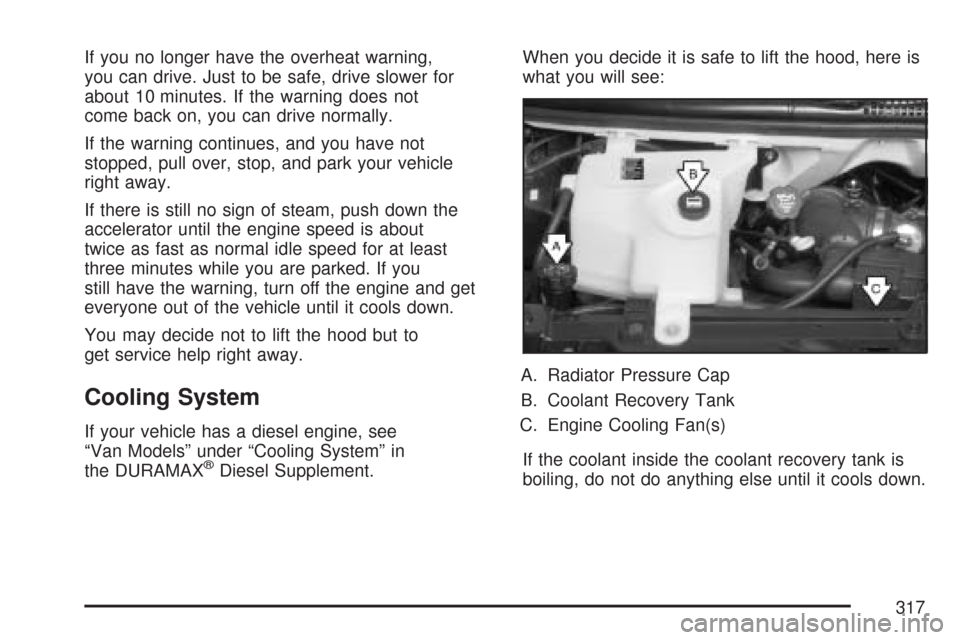
®Diesel Supplement.When you decide it is safe to lift the hood, here is
what you will see:
A. Radiator Pressure Cap
B. Coolant Recovery Tank
C. Engine Cooling Fan(s)
If the coolant inside the coolant recovery tank is
boiling, do not do anything else until it cools down.
317
Page 319 of 458
If you have not found a problem yet, but the
coolant level is not at the COLD FILL mark,
add a 50/50 mixture of clean, drinkable water
and DEX-COOL
®engine coolant at the coolant
recovery tank. SeeEngine Coolant on page 312
for more information.
{CAUTION:
Adding only plain water to your cooling
system can be dangerous. Plain water, or
some other liquid such as alcohol, can
boil before the proper coolant mixture will.
Your vehicle’s coolant warning system is
set for the proper coolant mixture. With
plain water or the wrong mixture, your
engine could get too hot but you would
not get the overheat warning. Your engine
could catch re and you or others could
be burned. Use a 50/50 mixture of clean,
drinkable water and DEX-COOL
®coolant.Notice:
When using concentrated washer uid,
follow the manufacturer’s instructions
for adding water.
Do not mix water with ready-to-use washer
uid. Water can cause the solution to
freeze and damage your washer uid tank
and other parts of the washer system.
Also, water does not clean as well
as washer uid.
Fill the washer uid tank only
three-quarters full when it is very cold.
This allows for uid expansion if freezing
occurs, which could damage the tank if
it is completely full.
Do not use engine coolant (antifreeze) in
your windshield washer. It can damage
the vehicle’s windshield washer system
and paint.
Notice:In cold weather, water can freeze and
crack the engine, radiator, heater core and
other parts. Use the recommended coolant
and the proper coolant mixture.
319
Page 320 of 458
{CAUTION:
You can be burned if you spill coolant
on hot components in the engine
compartment. Coolant contains ethylene
glycol, and it will burn if the engine parts
are hot enough. Do not spill coolant on a
hot engine or components in the engine
compartment.
When the coolant in the coolant recovery tank
is at the COLD FILL mark, start your vehicle.
If the overheat warning continues, there is
one more thing you can try. You can add the
proper coolant mixture directly to the radiator,
but be sure the cooling system is cool before
you do it.
{CAUTION:
Steam and scalding liquids from a hot
cooling system can blow out and burn
you badly. They are under pressure,
and if you turn the radiator pressure
cap — even a little — they can come out
at high speed. Never turn the cap when
the cooling system, including the radiator
pressure cap, is hot. Wait for the cooling
system and radiator pressure cap to cool
if you ever have to turn the pressure cap.
How to Add Coolant to the Radiator
for Gasoline Engines
If your vehicle has a diesel engine, see
“How to Add Coolant to the Radiator” under
“Van Models” in the Cooling System section
of the DURAMAX
®Diesel Supplement for the
proper radiator fill procedure.
320
Page 355 of 458
Radial tires may look properly inflated even when
they’re underinflated. Check the tire’s inflation
pressure when the tires are cold. Cold means your
vehicle has been sitting for at least three hours
or driven no more than 1 mile (1.6 km).
Remove the valve cap from the tire valve stem.
Press the tire gage firmly onto the valve to
get a pressure measurement. If the cold tire
inflation pressure matches the recommended
pressure on the tire and loading information label,
no further adjustment is necessary. If the
pressure is low, add air until you reach the
recommended amount.
If you overfill the tire, release air by pushing on
the metal stem in the center of the tire valve.
Recheck the tire pressure with the tire gage.
Be sure to put the valve caps back on the valve
stems. They help prevent leaks by keeping out
dirt and moisture.
Dual Tire Operation
When the vehicle is new, or whenever a wheel,
wheel bolt or wheel nut is replaced, check
the wheel nut torque after 100, 1,000 and
6,000 miles (160, 1 600 and 10 000 km) of driving.For proper wheel nut tightening information, see
“Removing the Flat Tire and Installing the Spare
Tire” later in this section, underChanging a Flat
Tire on page 366. Also see “Wheel Nut Torque”
underCapacities and Specications on page 398.
The outer tire on a dual wheel setup generally
wears faster than the inner tire. Your tires will wear
more evenly and last longer if you rotate the
tires periodically. SeeTire Inspection and Rotation
on page 356. Also seeScheduled Maintenance
(Gasoline Engine) on page 405.
{CAUTION:
If you operate your vehicle with a tire
that is badly underinated, the tire can
overheat. An overheated tire can lose
air suddenly or catch re. You or
others could be injured. Be sure all tires
(including the spare) are properly inated.
SeeTires on page 346andInation - Tire
Pressure on page 354for more information on
proper tire inflation.
355
Page 393 of 458
Electrical System
Add-On Electrical Equipment
Notice:Do not add anything electrical to your
vehicle unless you check with your dealer
rst. Some electrical equipment can damage
your vehicle and the damage would not
be covered by your warranty. Some add-on
electrical equipment can keep other
components from working as they should.
Your vehicle has an air bag system. Before
attempting to add anything electrical to your
vehicle, seeServicing Your Airbag-Equipped
Vehicle on page 96.
Headlamp Wiring
The headlamp wiring is protected by fuses in the
engine compartment fuse block. An electrical
overload will cause the lamps to flicker on and off,
or in some cases to remain off. If this happens,
have your headlamp wiring checked right away.
Windshield Wiper Fuses
The windshield wiper motor is protected by a
circuit breaker and a fuse. If the motor overheats
due to heavy snow, etc., the wiper will stop
until the motor cools. Although the circuit is
protected from electrical overload, overload due
to heavy snow, etc., may cause wiper linkage
damage. Always clear ice and heavy snow from
the windshield before using the windshield wipers.
If the overload is caused by some electrical
problem and not snow, etc., be sure to get it fixed.
Fuses and Circuit Breakers
The wiring circuits in your vehicle are protected
from short circuits by a combination of fuses
and circuit breakers. This greatly reduces
the chance of fires caused by electrical problems.
Look at the silver-colored band inside the fuse.
If the band is broken or melted, replace the fuse.
Be sure you replace a bad fuse with a new
one of the identical size and rating.
393
Page 449 of 458
Driving
At Night................................................... 244
City.......................................................... 249
Defensive................................................. 228
Drunken................................................... 229
Freeway................................................... 250
Hill and Mountain Roads.......................... 254
In Rain and on Wet Roads...................... 246
Rocking Your Vehicle to Get it Out.......... 260
Winter...................................................... 256
Dual Tire Operation..................................... 355
E
EDR ............................................................ 441
Electrical System
Add-On Equipment................................... 393
Engine Compartment Fuse Block............. 395
Floor Console Fuse Block........................ 394
Fuses and Circuit Breakers...................... 393
Headlamp Wiring..................................... 393
Windshield Wiper Fuses........................... 393
Engine
Air Cleaner/Filter...................................... 308
Change Engine Oil Light.......................... 183
Check and Service Engine Soon Light..... 178
Coolant.................................................... 312Engine (cont.)
Coolant Heater......................................... 123
Coolant Temperature Gage...................... 178
Drive Belt Routing.................................... 418
Engine Compartment Overview................ 302
Exhaust................................................... 132
Fan Noise................................................ 323
Fuel Regulator......................................... 123
Oil ........................................................... 303
Oil Life System........................................ 306
Overheating............................................. 315
Reduced Power Light............................... 184
Running While Parked............................. 133
Starting.................................................... 122
Entry Lighting.............................................. 158
Event Data Recorders................................. 442
Exit Lighting................................................ 158
Extender, Safety Belt..................................... 40
Exterior Lamps............................................ 155
F
Filter
Engine Air Cleaner................................... 308
Finish Damage............................................ 389
Fixed Mast Antenna.................................... 226
Flashers, Hazard Warning........................... 146
449