fuel CHEVROLET EXPRESS CARGO VAN 2007 1.G User Guide
[x] Cancel search | Manufacturer: CHEVROLET, Model Year: 2007, Model line: EXPRESS CARGO VAN, Model: CHEVROLET EXPRESS CARGO VAN 2007 1.GPages: 458, PDF Size: 2.62 MB
Page 180 of 458
If the Light Is Flashing
The following may prevent more serious damage
to your vehicle:
•Reducing vehicle speed
•Avoiding hard accelerations
•Avoiding steep uphill grades
•If you are towing a trailer, reduce the amount of
cargo being hauled as soon as it is possible
If the light stops flashing and remains on steady,
see “If the Light Is On Steady” following.
If the light continues to flash, when it is safe to do
so, stop the vehicle. Find a safe place to park
your vehicle. Turn the key off, wait at least
10 seconds and restart the engine. If the light
remains on steady, see “If the Light Is On Steady”
following. If the light is still flashing, follow the
previous steps, and see your dealer for service as
soon as possible.
If the Light Is On Steady
You may be able to correct the emission system
malfunction by considering the following:
Did you recently put fuel into your vehicle?
If so, reinstall the fuel cap, making sure to fully
install the cap. SeeFilling the Tank on page 297.
The diagnostic system can determine if the
fuel cap has been left off or improperly installed.
A loose or missing fuel cap will allow fuel to
evaporate into the atmosphere. A few driving trips
with the cap properly installed should turn the
light off.
Did you just drive through a deep puddle
of water?
If so, your electrical system may be wet. The
condition will usually be corrected when the
electrical system dries out. A few driving trips
should turn the light off.
180
Page 181 of 458
Have you recently changed brands of fuel?
If so, be sure to fuel your vehicle with quality fuel.
SeeGasoline Octane on page 293. Poor fuel
quality will cause your engine not to run as
efficiently as designed. You may notice this as
stalling after start-up, stalling when you put
the vehicle into gear, misfiring, hesitation on
acceleration, or stumbling on acceleration.
(These conditions may go away once the engine
is warmed up.) This will be detected by the
system and cause the light to turn on.
If you experience one or more of these conditions,
change the fuel brand you use. It will require at
least one full tank of the proper fuel to turn the
light off.
If none of the above steps have made the light
turn off, your dealer can check the vehicle.
Your dealer has the proper test equipment and
diagnostic tools to fix any mechanical or electrical
problems that may have developed.Emissions Inspection and
Maintenance Programs
Some state/provincial and local governments have
or may begin programs to inspect the emission
control equipment on your vehicle. Failure to pass
this inspection could prevent you from getting a
vehicle registration.
Here are some things you need to know to help
your vehicle pass an inspection:
Your vehicle will not pass this inspection if the
Check Engine light is on or not working properly.
Your vehicle will not pass this inspection if the
OBD (on-board diagnostic) system determines that
critical emission control systems have not been
completely diagnosed by the system. The vehicle
would be considered not ready for inspection. This
can happen if you have recently replaced your
battery or if your battery has run down. The
diagnostic system is designed to evaluate critical
emission control systems during normal driving.
This may take several days of routine driving. If you
have done this and your vehicle still does not pass
the inspection for lack of OBD system readiness,
your dealer can prepare the vehicle for inspection.
181
Page 186 of 458
If the light comes on and stays on while you
are driving, check your coolant temperature and
engine oil pressure gages to see if they are in the
warning zones.
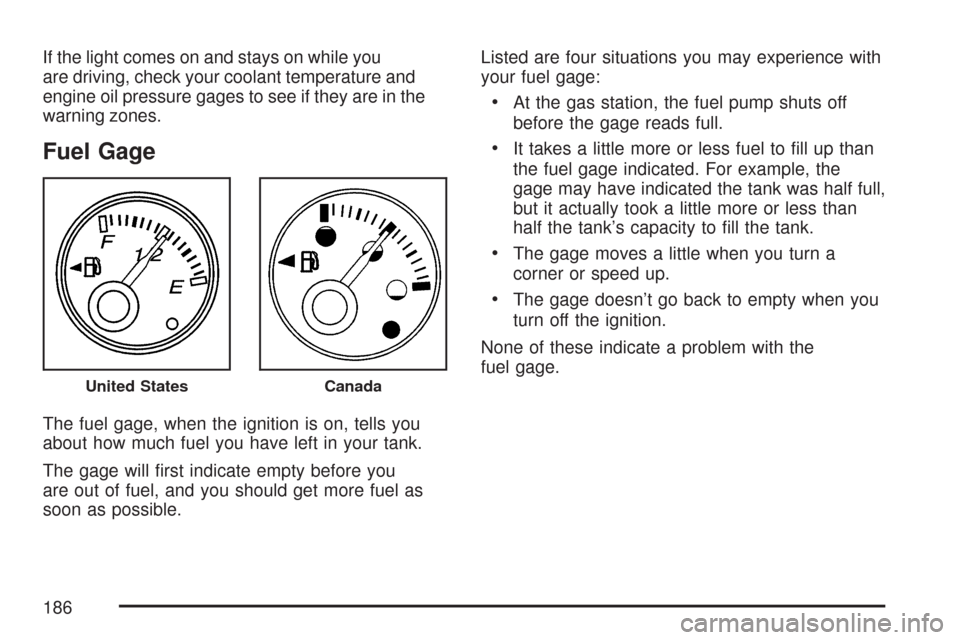
Fuel Gage
The fuel gage, when the ignition is on, tells you
about how much fuel you have left in your tank.
The gage will first indicate empty before you
are out of fuel, and you should get more fuel as
soon as possible.Listed are four situations you may experience with
your fuel gage:
•At the gas station, the fuel pump shuts off
before the gage reads full.
•It takes a little more or less fuel to fill up than
the fuel gage indicated. For example, the
gage may have indicated the tank was half full,
but it actually took a little more or less than
half the tank’s capacity to fill the tank.
•The gage moves a little when you turn a
corner or speed up.
•The gage doesn’t go back to empty when you
turn off the ignition.
None of these indicate a problem with the
fuel gage.
United StatesCanada
186
Page 252 of 458
Before Leaving on a Long Trip
Make sure you are ready. Try to be well rested.
If you must start when you are not fresh — such
as after a day’s work — do not plan to make
too many miles that first part of the journey.
Wear comfortable clothing and shoes you can
easily drive in.
Is your vehicle ready for a long trip? If you keep
it serviced and maintained, it is ready to go.
If it needs service, have it done before starting
out. Of course, you will find experienced and
able service experts in GM dealerships all across
North America. They will be ready and willing
to help if you need it.Here are some things you can check before a trip:•Windshield Washer Fluid:Is the reservoir
full? Are all windows clean inside and outside?
•Wiper Blades:Are they in good shape?
•Fuel, Engine Oil, Other Fluids:Have you
checked all levels?
•Lamps:Are they all working? Are the
lenses clean?
•Tires:They are vitally important to a safe,
trouble-free trip. Is the tread good enough
for long-distance driving? Are the tires
all inflated to the recommended pressure?
•Weather Forecasts:What is the weather
outlook along your route? Should you
delay your trip a short time to avoid a major
storm system?
•Maps:Do you have up-to-date maps?
252
Page 259 of 458
{CAUTION:
Snow can trap exhaust gases under your
vehicle. This can cause deadly CO
(carbon monoxide) gas to get inside. CO
could overcome you and kill you. You
cannot see it or smell it, so you might not
know it is in your vehicle. Clear away
snow from around the base of your
vehicle, especially any that is blocking the
exhaust pipe and/or the fuel operated
heater exhaust system, if equipped. And
check around again from time to time to
be sure snow does not collect there. If
your vehicle has a diesel engine and a
fuel operated heater, see “Fuel Operated
Heater (FOH)” in the diesel engine
supplement.
Open a window just a little on the side of
the vehicle that is away from the wind.
This will help keep CO out.Run your engine only as long as you must. This
saves fuel. When you run the engine, make it go a
little faster than just idle. That is, push the
accelerator slightly. This uses less fuel for the heat
that you get and it keeps the battery (or batteries)
charged. You will need a well-charged battery (or
batteries) to restart the vehicle, and possibly for
signaling later on with your headlamps. Let the
heater run for a while.
Then, shut the engine off and close the window
almost all the way to preserve the heat. Start
the engine again and repeat this only when you
feel really uncomfortable from the cold. But do it as
little as possible. Preserve the fuel as long as
you can. To help keep warm, you can get out of
the vehicle and do some fairly vigorous exercises
every half hour or so until help comes.
259
Page 264 of 458
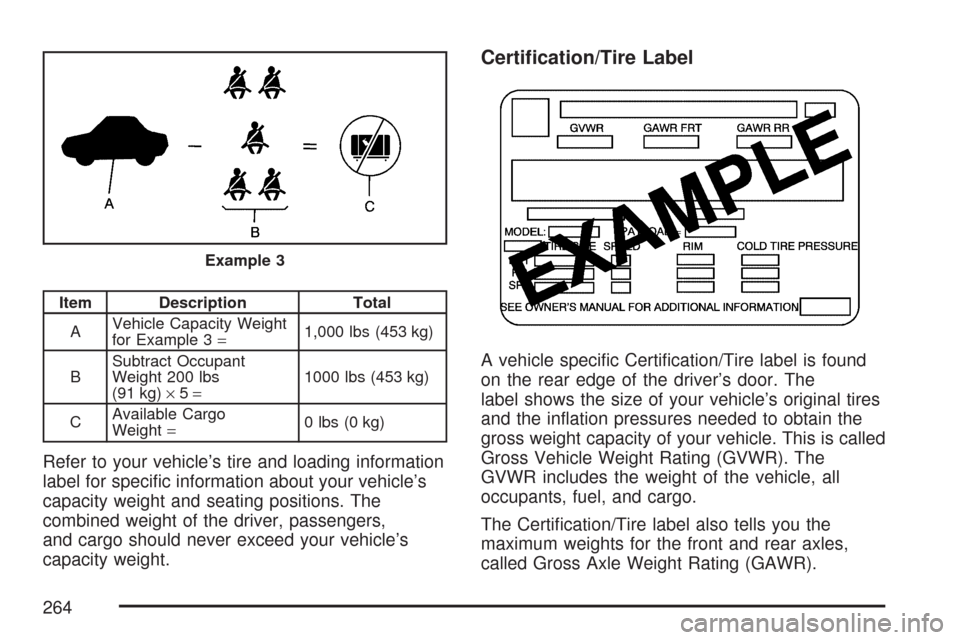
Item Description Total
AVehicle Capacity Weight
for Example 3=1,000 lbs (453 kg)
BSubtract Occupant
Weight 200 lbs
(91 kg)×5=1000 lbs (453 kg)
CAvailable Cargo
Weight=0 lbs (0 kg)
Refer to your vehicle’s tire and loading information
label for specific information about your vehicle’s
capacity weight and seating positions. The
combined weight of the driver, passengers,
and cargo should never exceed your vehicle’s
capacity weight.
Certication/Tire Label
A vehicle specific Certification/Tire label is found
on the rear edge of the driver’s door. The
label shows the size of your vehicle’s original tires
and the inflation pressures needed to obtain the
gross weight capacity of your vehicle. This is called
Gross Vehicle Weight Rating (GVWR). The
GVWR includes the weight of the vehicle, all
occupants, fuel, and cargo.
The Certification/Tire label also tells you the
maximum weights for the front and rear axles,
called Gross Axle Weight Rating (GAWR).
Example 3
264
Page 269 of 458
Towing a Trailer
If your vehicle has a diesel engine, see the
DURAMAX®Diesel manual for more information.
{CAUTION:
If you do not use the correct equipment
and drive properly, you can lose control
when you pull a trailer. For example, if the
trailer is too heavy, the brakes may not
work well — or even at all. You and your
passengers could be seriously injured.
You may also damage your vehicle; the
resulting repairs would not be covered by
your warranty. Pull a trailer only if you
have followed all the steps in this section.
Ask your dealer/retailer for advice and
information about towing a trailer with
your vehicle.Notice:Pulling a trailer improperly can
damage your vehicle and result in costly repairs
that would not be covered by your warranty.
Always follow the instructions in this section
and check with your dealer/retailer for more
information about towing a trailer with your
vehicle.
To identify the trailering capacity of your vehicle,
you should read the information in “Weight of
the Trailer” that appears later in this section.
Trailering is different than just driving your vehicle
by itself. Trailering means changes in acceleration,
braking, handling, durability and fuel economy.
Successful, safe trailering takes correct equipment,
and it has to be used properly.
That’s the reason for this part. In it are many
time-tested, important trailering tips and safety
rules. Many of these are important for your safety
and that of your passengers. So please read
this section carefully before you pull a trailer.
269
Page 271 of 458
Press this button
located to the right of
the steering wheel
on the instrument panel
to turn tow/haul
mode on and off.
While activated, the
indicator light on the
instrument panel will
be on.
Tow/haul mode will turn off automatically when the
ignition is turned off. SeeTow/Haul Mode Light
on page 185.
Tow/haul is most effective when the vehicle and
trailer combined weight is at least 75 percent of the
vehicle’s Gross Combined Weight Rating (GCWR).
See “Weight of the Trailer” later in this section.
Driving with tow/haul activated without a heavy
load will cause reduced fuel economy and
unpleasant engine and transmission driving
characteristics, but will not cause damage.Weight of the Trailer
How heavy can a trailer safely be?
It depends on how you plan to use your rig. For
example, speed, altitude, road grades, outside
temperature and how much your vehicle is used to
pull a trailer are all important. It can also depend
on any special equipment that you have on
your vehicle, and the amount of tongue weight the
vehicle can carry. See “Weight of the Trailer
Tongue” later in this section for more information.
Maximum trailer weight is calculated assuming
only the driver is in the tow vehicle and it has all
the required trailering equipment. The weight
of additional optional equipment, passengers and
cargo in the tow vehicle must be subtracted
from the maximum trailer weight.
271
Page 287 of 458
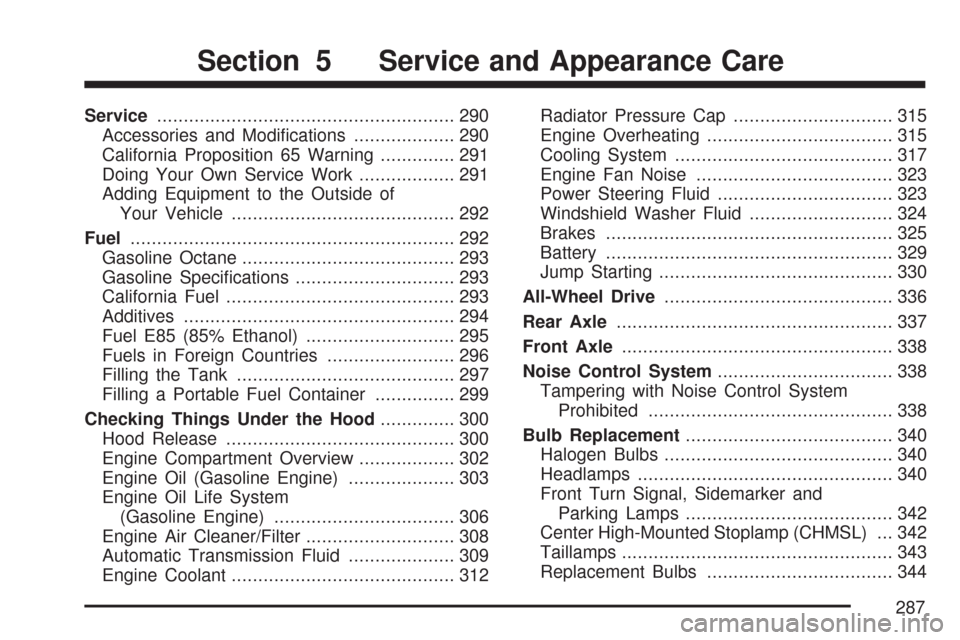
Service........................................................ 290
Accessories and Modifications................... 290
California Proposition 65 Warning.............. 291
Doing Your Own Service Work.................. 291
Adding Equipment to the Outside of
Your Vehicle.......................................... 292
Fuel............................................................. 292
Gasoline Octane........................................ 293
Gasoline Specifications.............................. 293
California Fuel........................................... 293
Additives................................................... 294
Fuel E85 (85% Ethanol)............................ 295
Fuels in Foreign Countries........................ 296
Filling the Tank......................................... 297
Filling a Portable Fuel Container............... 299
Checking Things Under the Hood.............. 300
Hood Release........................................... 300
Engine Compartment Overview.................. 302
Engine Oil (Gasoline Engine).................... 303
Engine Oil Life System
(Gasoline Engine).................................. 306
Engine Air Cleaner/Filter............................ 308
Automatic Transmission Fluid.................... 309
Engine Coolant.......................................... 312Radiator Pressure Cap.............................. 315
Engine Overheating................................... 315
Cooling System......................................... 317
Engine Fan Noise..................................... 323
Power Steering Fluid................................. 323
Windshield Washer Fluid........................... 324
Brakes...................................................... 325
Battery...................................................... 329
Jump Starting............................................ 330
All-Wheel Drive........................................... 336
Rear Axle.................................................... 337
Front Axle................................................... 338
Noise Control System................................. 338
Tampering with Noise Control System
Prohibited.............................................. 338
Bulb Replacement....................................... 340
Halogen Bulbs........................................... 340
Headlamps................................................ 340
Front Turn Signal, Sidemarker and
Parking Lamps....................................... 342
Center High-Mounted Stoplamp (CHMSL) ... 342
Taillamps................................................... 343
Replacement Bulbs................................... 344
Section 5 Service and Appearance Care
287
Page 292 of 458
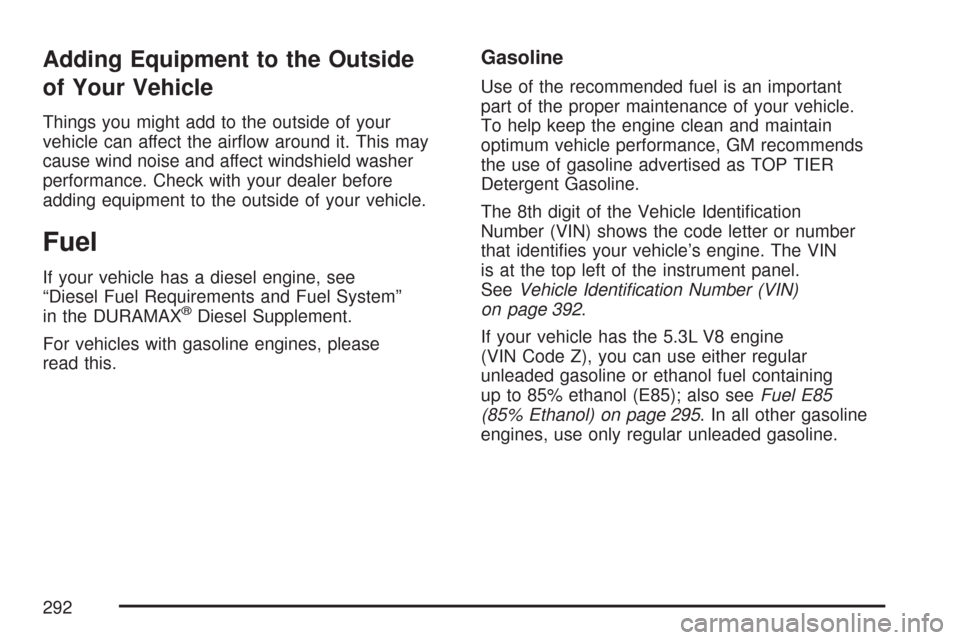
Adding Equipment to the Outside
of Your Vehicle
Things you might add to the outside of your
vehicle can affect the airflow around it. This may
cause wind noise and affect windshield washer
performance. Check with your dealer before
adding equipment to the outside of your vehicle.
Fuel
If your vehicle has a diesel engine, see
“Diesel Fuel Requirements and Fuel System”
in the DURAMAX
®Diesel Supplement.
For vehicles with gasoline engines, please
read this.
Gasoline
Use of the recommended fuel is an important
part of the proper maintenance of your vehicle.
To help keep the engine clean and maintain
optimum vehicle performance, GM recommends
the use of gasoline advertised as TOP TIER
Detergent Gasoline.
The 8th digit of the Vehicle Identification
Number (VIN) shows the code letter or number
that identifies your vehicle’s engine. The VIN
is at the top left of the instrument panel.
SeeVehicle Identication Number (VIN)
on page 392.
If your vehicle has the 5.3L V8 engine
(VIN Code Z), you can use either regular
unleaded gasoline or ethanol fuel containing
up to 85% ethanol (E85); also seeFuel E85
(85% Ethanol) on page 295. In all other gasoline
engines, use only regular unleaded gasoline.
292