lock CHEVROLET EXPRESS CARGO VAN 2007 1.G User Guide
[x] Cancel search | Manufacturer: CHEVROLET, Model Year: 2007, Model line: EXPRESS CARGO VAN, Model: CHEVROLET EXPRESS CARGO VAN 2007 1.GPages: 458, PDF Size: 2.62 MB
Page 34 of 458
Center Passenger Position
(2nd Row)
If your vehicle has a second row bench seat,
someone can sit in the center position. When
you sit in the center position in the second
row bench seat, you have a lap-shoulder belt
which works the same way as the rear seat
outside passengers’ belts.
To learn how to wear a lap-shoulder belt
see, “Lap-Shoulder Belt” underRear Outside
Passenger Positions on page 34.
Rear Outside Passenger Positions
It is very important for rear seat passengers
to buckle up! Accident statistics show that unbelted
people in the rear seat are hurt more often in
crashes than those who are wearing safety belts.
Rear passengers who are not safety belted
can be thrown out of the vehicle in a crash.
And they can strike others in the vehicle who
are wearing safety belts.
Lap-Shoulder Belt
The positions next to the windows have
lap-shoulder belts. Here is how to wear a
lap-shoulder belt properly.
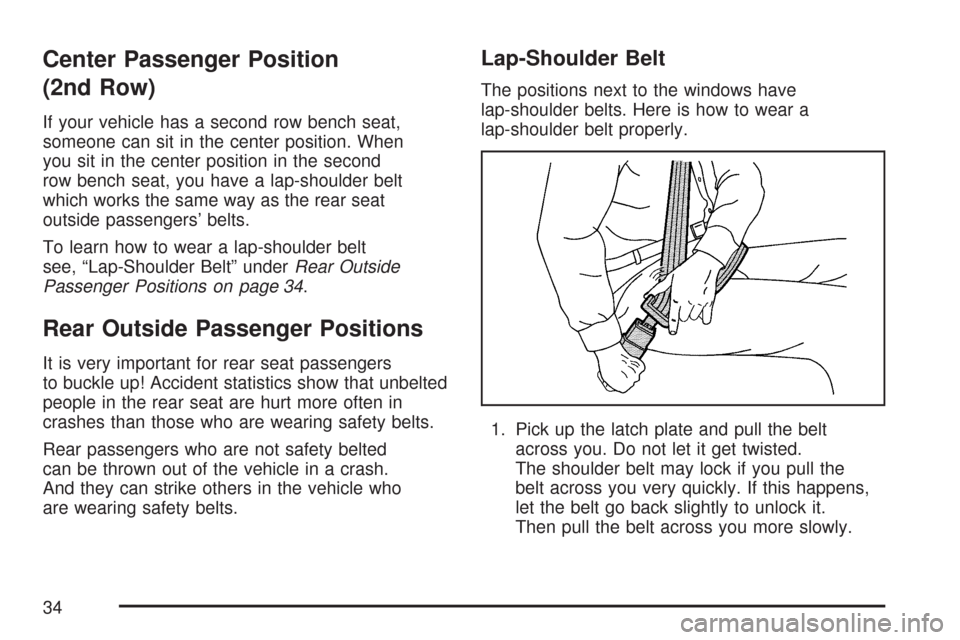
1. Pick up the latch plate and pull the belt
across you. Do not let it get twisted.
The shoulder belt may lock if you pull the
belt across you very quickly. If this happens,
let the belt go back slightly to unlock it.
Then pull the belt across you more slowly.
34
Page 35 of 458
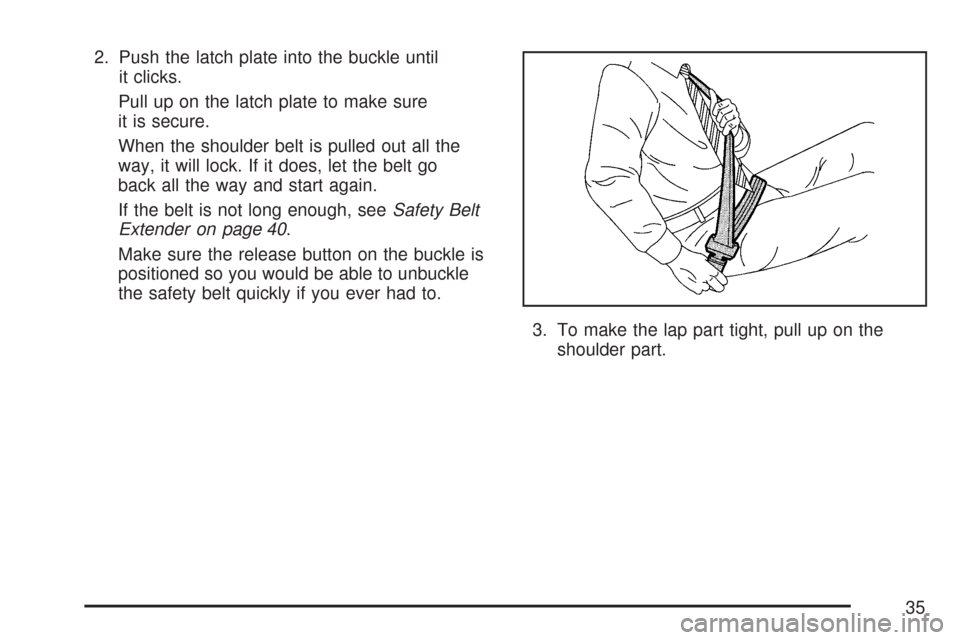
2. Push the latch plate into the buckle until
it clicks.
Pull up on the latch plate to make sure
it is secure.
When the shoulder belt is pulled out all the
way, it will lock. If it does, let the belt go
back all the way and start again.
If the belt is not long enough, seeSafety Belt
Extender on page 40.
Make sure the release button on the buckle is
positioned so you would be able to unbuckle
the safety belt quickly if you ever had to.
3. To make the lap part tight, pull up on the
shoulder part.
35
Page 36 of 458
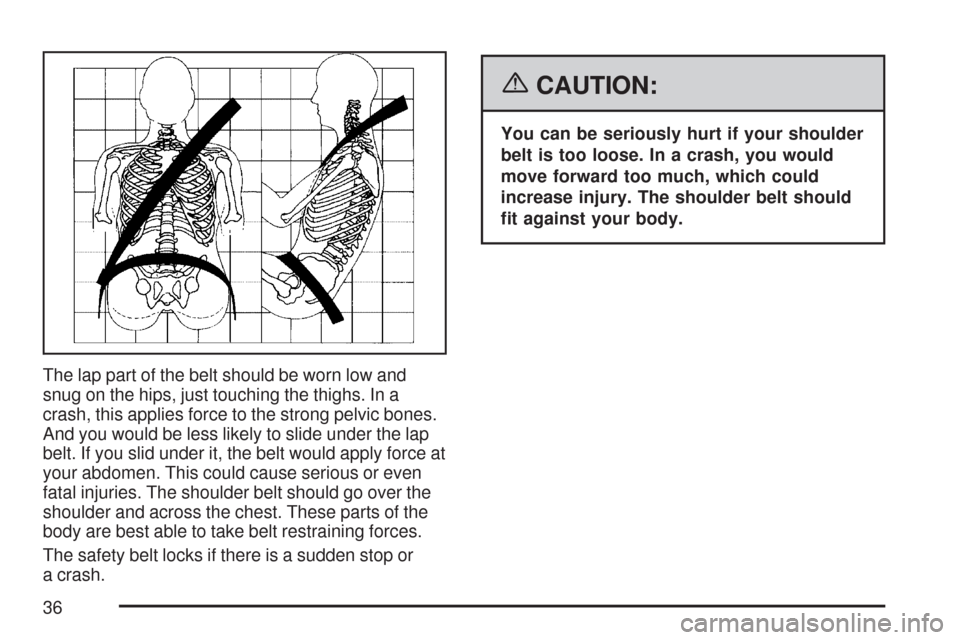
The lap part of the belt should be worn low and
snug on the hips, just touching the thighs. In a
crash, this applies force to the strong pelvic bones.
And you would be less likely to slide under the lap
belt. If you slid under it, the belt would apply force at
your abdomen. This could cause serious or even
fatal injuries. The shoulder belt should go over the
shoulder and across the chest. These parts of the
body are best able to take belt restraining forces.
The safety belt locks if there is a sudden stop or
a crash.
{CAUTION:
You can be seriously hurt if your shoulder
belt is too loose. In a crash, you would
move forward too much, which could
increase injury. The shoulder belt should
t against your body.
36
Page 61 of 458
{CAUTION:
Children can be seriously injured or
strangled if a shoulder belt is wrapped
around their neck and the safety belt
continues to tighten. Secure any unused
safety belts behind the child restraint so
children cannot reach them. Pull the
shoulder belt all the way out of the
retractor to set the lock, if your vehicle
has one, after the child restraint has been
installed. Be sure to follow the instructions
of the child restraint manufacturer.
Notice:Contact between the child restraint or
the LATCH attachment parts and the vehicle’s
safety belt assembly may cause damage to
these parts. Make sure when securing unused
safety belts behind the child restraint that
there is no contact between the child restraint
or the LATCH attachment parts and the
vehicle’s safety belt assembly.Folding an empty rear seat with the safety
belts secured may cause damage to the safety
belt or the seat. When removing the child
restraint, always remember to return the safety
belts to their normal, stowed position before
folding the rear seat.
1. Attach and tighten the lower attachments to
the lower anchors. If the child restraint does
not have lower attachments or the desired
seating position does not have lower anchors,
secure the child restraint with the top tether
and the safety belts. Refer to your child
restraint manufacturer instructions and the
instructions in this manual.
1.1. Find the lower anchors for the desired
seating position.
1.2. Put the child restraint on the seat.
1.3. Attach and tighten the lower
attachments on the child restraint to
the lower anchors.
61
Page 64 of 458
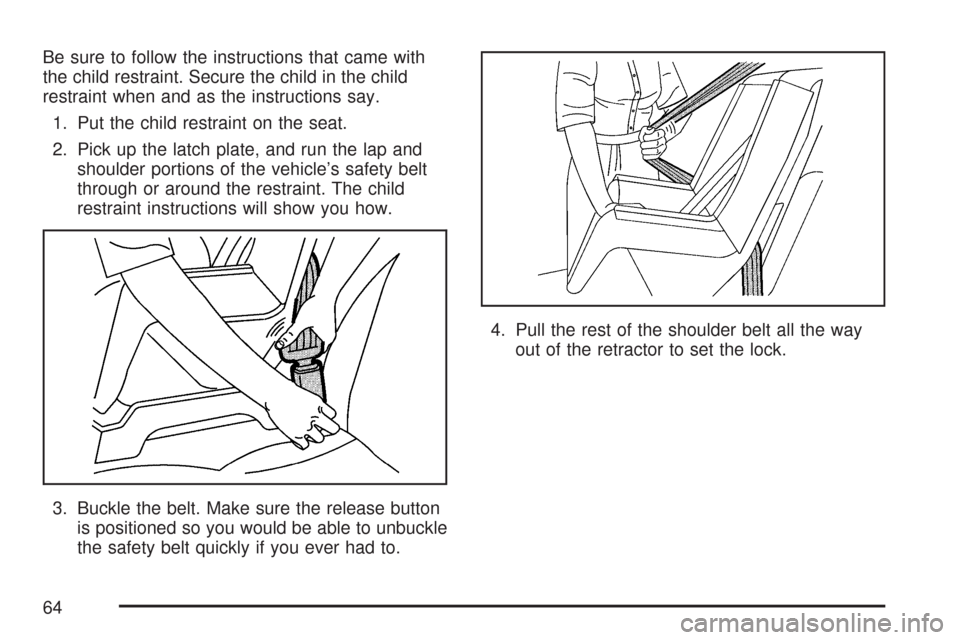
Be sure to follow the instructions that came with
the child restraint. Secure the child in the child
restraint when and as the instructions say.
1. Put the child restraint on the seat.
2. Pick up the latch plate, and run the lap and
shoulder portions of the vehicle’s safety belt
through or around the restraint. The child
restraint instructions will show you how.
3. Buckle the belt. Make sure the release button
is positioned so you would be able to unbuckle
the safety belt quickly if you ever had to.4. Pull the rest of the shoulder belt all the way
out of the retractor to set the lock.
64
Page 71 of 458
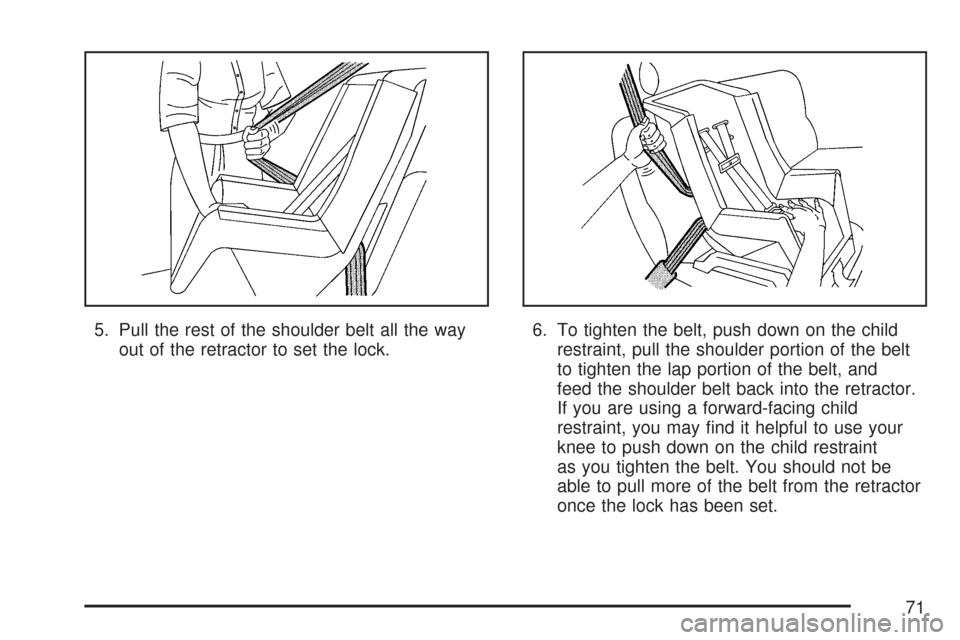
5. Pull the rest of the shoulder belt all the way
out of the retractor to set the lock.6. To tighten the belt, push down on the child
restraint, pull the shoulder portion of the belt
to tighten the lap portion of the belt, and
feed the shoulder belt back into the retractor.
If you are using a forward-facing child
restraint, you may find it helpful to use your
knee to push down on the child restraint
as you tighten the belt. You should not be
able to pull more of the belt from the retractor
once the lock has been set.
71
Page 76 of 458
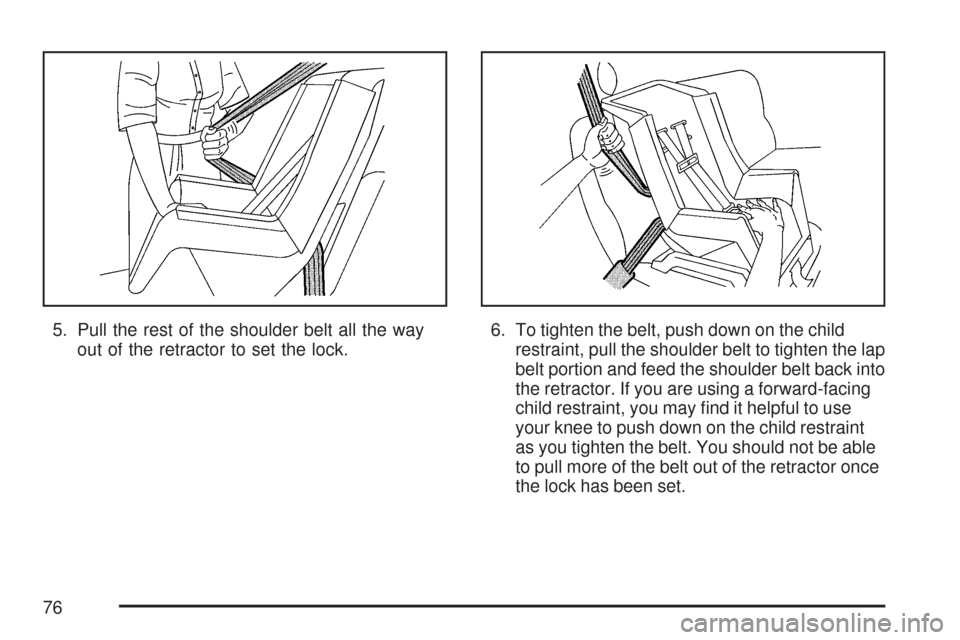
5. Pull the rest of the shoulder belt all the way
out of the retractor to set the lock.6. To tighten the belt, push down on the child
restraint, pull the shoulder belt to tighten the lap
belt portion and feed the shoulder belt back into
the retractor. If you are using a forward-facing
child restraint, you may find it helpful to use
your knee to push down on the child restraint
as you tighten the belt. You should not be able
to pull more of the belt out of the retractor once
the lock has been set.
76
Page 85 of 458
{CAUTION:
When an airbag inates, there may be
dust in the air. This dust could cause
breathing problems for people with a
history of asthma or other breathing
trouble. To avoid this, everyone in the
vehicle should get out as soon as it is
safe to do so. If you have breathing
problems but cannot get out of the
vehicle after an airbag inates, then get
fresh air by opening a window or a door.
If you experience breathing problems
following an airbag deployment, you
should seek medical attention.
Your vehicle has a feature that may automatically
unlock the doors, turn the interior lamps on, and
turn the hazard warning flashers on when the
airbags inflate. You can lock the doors again, turn
the interior lamps off, and turn the hazard warning
flashers off by using the controls for those features.In many crashes severe enough to inflate an airbag,
windshields are broken by vehicle deformation.
Additional windshield breakage may also occur
from the right front passenger airbag.•Airbags are designed to inflate only once.
After they inflate, you will need some new parts
for the airbag system. If you do not get them,
the airbag system will not be there to help
protect you in another crash. A new system
will include airbag modules and possibly other
parts. The service manual for your vehicle
covers the need to replace other parts.
•Your vehicle has a crash sensing and
diagnostic module which records information
after a crash. SeeVehicle Data Recording
and Privacy on page 441andEvent Data
Recorders on page 442.
•Let only qualified technicians work on the
airbag system. Improper service can mean
that an airbag system will not work properly.
See your dealer/retailer for service.
85
Page 101 of 458
Keys............................................................ 102
Remote Keyless Entry (RKE) System........ 104
Remote Keyless Entry (RKE) System
Operation............................................... 105
Doors and Locks........................................ 108
Door Locks................................................ 108
Power Door Locks..................................... 109
Cargo Door Relocking............................... 109
Rear Door Security Locks......................... 110
Lockout Protection..................................... 110
Sliding Side Door...................................... 111
60/40 Swing-Out Side Door....................... 112
Rear Doors............................................... 114
Windows...................................................... 115
Manual Windows....................................... 115
Power Windows........................................ 116
Swing-Out Windows.................................. 117
Sun Visors................................................ 117
Theft-Deterrent Systems............................. 118
Passlock
®.................................................. 118
Starting and Operating Your Vehicle......... 119
New Vehicle Break-In................................ 119
Ignition Positions....................................... 120Retained Accessory Power (RAP)............. 121
Starting the Engine.................................... 122
Fuel Regulator........................................... 123
Engine Coolant Heater.............................. 123
Automatic Transmission Operation............. 125
Parking Brake........................................... 128
Shifting Into Park (P)................................. 129
Shifting Out of Park (P)............................. 130
Parking Over Things That Burn................. 131
Engine Exhaust......................................... 132
Running the Engine While Parked............. 133
Mirrors......................................................... 134
Manual Rearview Mirror............................. 134
Automatic Dimming Rearview Mirror with
Compass and Temperature Display........ 134
Outside Manual Mirror............................... 136
Outside Camper-Type Mirrors.................... 136
Outside Power Mirrors............................... 138
Outside Convex Mirror............................... 138
Outside Heated Mirrors............................. 139
Storage Areas............................................. 139
Section 2 Features and Controls
101
Page 103 of 458
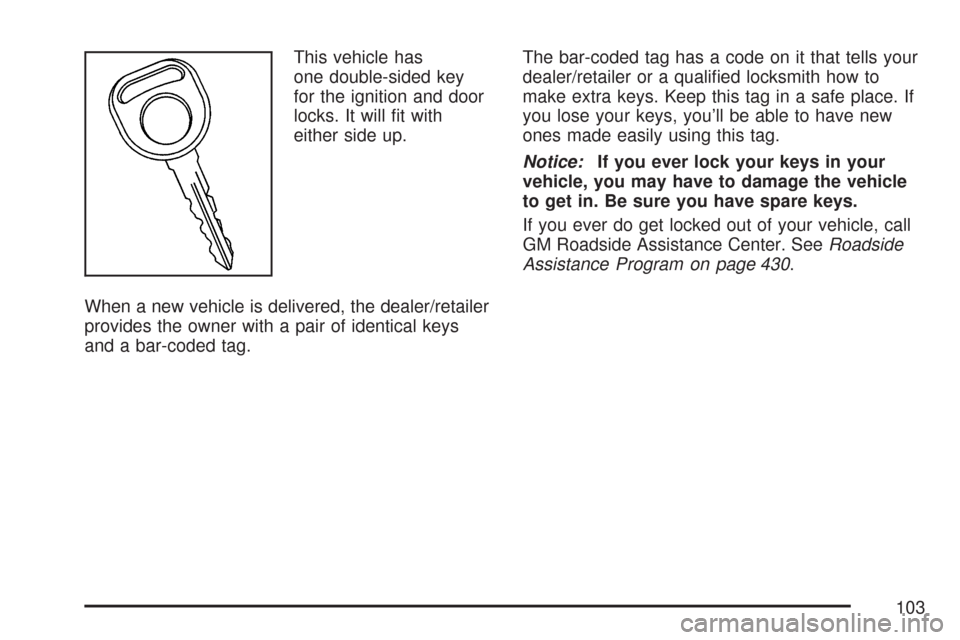
This vehicle has
one double-sided key
for the ignition and door
locks. It will fit with
either side up.
When a new vehicle is delivered, the dealer/retailer
provides the owner with a pair of identical keys
and a bar-coded tag.The bar-coded tag has a code on it that tells your
dealer/retailer or a qualified locksmith how to
make extra keys. Keep this tag in a safe place. If
you lose your keys, you’ll be able to have new
ones made easily using this tag.
Notice:If you ever lock your keys in your
vehicle, you may have to damage the vehicle
to get in. Be sure you have spare keys.
If you ever do get locked out of your vehicle, call
GM Roadside Assistance Center. SeeRoadside
Assistance Program on page 430.
103